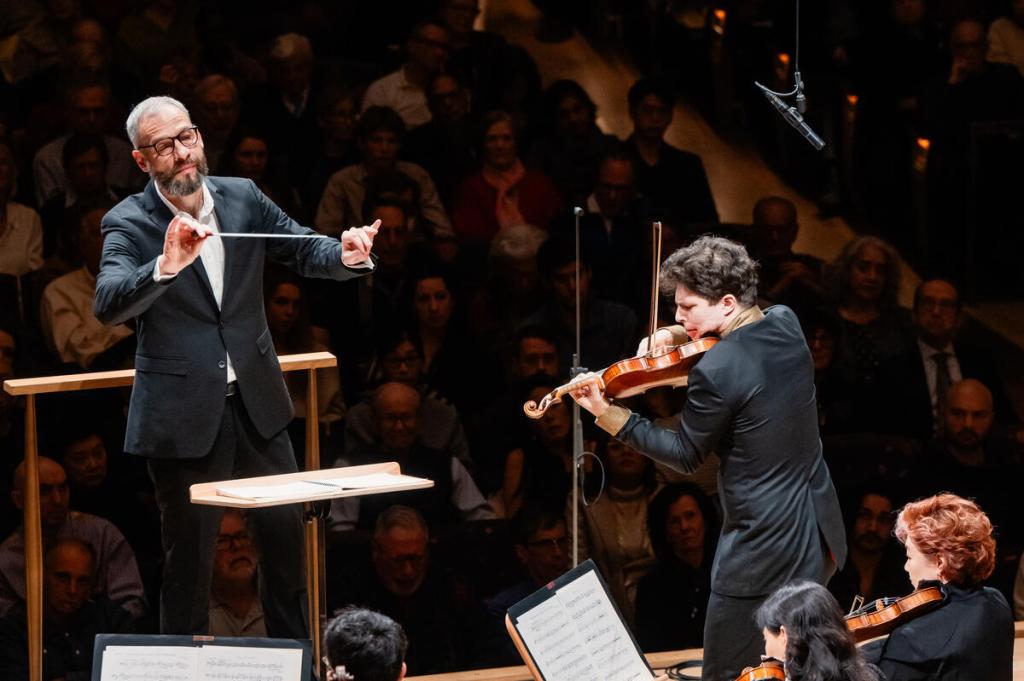
Above: Maestro Dima Slobodeniouk and violinist Augustin Hadelich onstage at David Geffen Hall; photo by Brandon Patoc
~ Author: Lane Raffaldini Rubin
Saturday November 22nd, 2025 – On Saturday night, the New York Philharmonic wrapped up a run of performances featuring American-German violinist Augustin Hadelich and Russian-born Finnish conductor Dima Slobodeniouk. Hadelich, who will return to David Geffen Hall in January to present an Artist Spotlight recital, tonight played Samuel Barber’s affable violin concerto. The rest of the program focused on Finnish music, with the New York premiere of the decade-old Stonework by Sebastian Fagerlund, and Jean Sibelius’s Symphony No. 2.
Samuel Barber wrote one of the least hubristic concertos in the violin literature, foregrounding melody and interplay between the soloist and the orchestra rather than virtuosic display. Hadelich’s playing and stage presence suit the piece very well, despite a number of moments when he was overpowered by the Slobodeniouk and the Philharmonic. Geffen Hall is not acoustically generous to violin soloists, a fact which a conductor more experienced in this hall may have more deftly addressed.
Hadelich gave the opening solo of the first movement a darker tone than is typically heard and allowed his sound to bloom into a full, even primaveral sweetness. He maintained the intensity of his tone and vibrato across the full range of the instrument, which had the effect of bringing a lovely satin tone to the usually more metallic upper reaches of the violin.
Hadelich received an extended, warm ovation from the audience and played his own arrangement of Orange Blossom Special, a popular fiddle tune by Ervin T. Rouse that Johnny Cash later immortalized in concerts and recordings. Hadelich’s version featured many of the bravura techniques that Barber’s concerto lacks and showed off his brilliant skill. The crowd was audibly entertained and impressed.
Stonework was written as a standalone tone poem in 2014-15 and later became the first in a trilogy, followed by Drifts (2017) and Water Atlas (2017-19). Fagerlund’s music tends toward the vast, the evocative, and the cinematic. Slobodeniouk’s hurried starting tempo proved too active for the atmospheric music that opens the piece, a smattering of sharp attacks over a continuous chord across the orchestra. Presumably these figures are meant to conjure sparking flints, an effect hindered by what became a uniform blanket of sound from the orchestra.
In one passage that unleashes the full forces of the brass and percussion, producing an impressively towering sonority from the orchestra, Slobodeniouk could have managed a better balance across the orchestra so that the intricate material in the strings would have been intelligible. For the first time in my listening life, here we had too much cowbell. A soft, sustained section lent the second half of the piece a sense of mystery and cinematic texture that built in tension and direction to the end.
Fagerlund’s vision of an abstract Finnish landscape was set against Sibelius’s own from a century earlier, which Slobodeniouk approached with technicolor vibrance starting with the very first contoured hillocks in the strings that open the first movement. Slobodeniouk ran the risk of over-determining the shapes of each phrase, but the reward was a superbly crafted first movement. The strings sounded consistently opulent and each capacious brass passage was accompanied by a satisfying sense of arrival.
Slobodeniouk kept this up in the second and third movements as well. In the second movement he drew out earthy, Stravinskian sounds from the double-reeds and brass and he made the downright weird scribbles of fast notes in the strings at the very end of the movement make sense with a fast, thundering energy.
But Slobodeniouk’s pacing couldn’t sustain this arc all the way through the piece. The fourth movement seemed gushy and maudlin in contrast to the craftsmanship of the prior movements and the orchestra pulled stubbornly against some of his desired tempos. It was a disappointing way to end, after Slobodeniouk had demonstrated his ability to draw out superb detail and longer dramatic arcs from the Philharmonic.
~ Lane Raffaldini Rubin
 Oberon's Glade