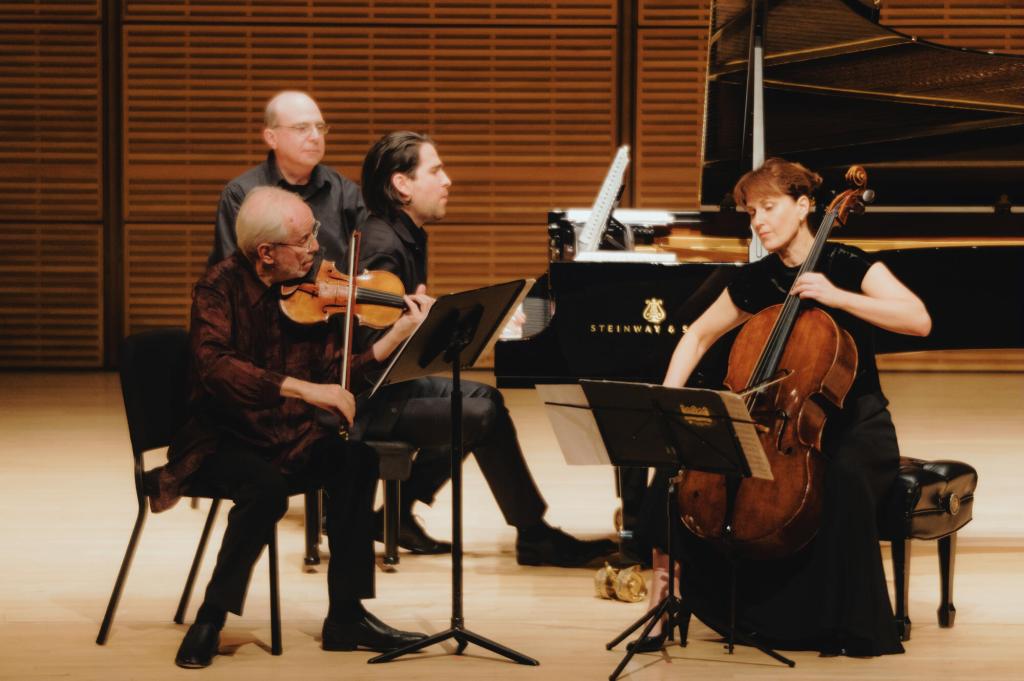
Above, the evening’s artists: Gidon Kremer, Georgijs Osokins, and Giedrė Dirvanauskaitė. Photo by Lawrence Sumulong, courtesy of Carnegie Hall.
~ Author: Lane Raffaldini Rubin
Friday December 5th, 2025 – Carnegie Hall’s season-long celebration of the 90-year-old Estonian composer Arvo Pärt continued on Thursday in Zankel Hall.
The performance featured the violinist Gidon Kremer alongside pianist Georgijs Osokins and cellist Giedrė Dirvanauskaitė. Pärt wrote the definitive violin version of his iconic 1977 piece Fratres for Kremer, now 78 years old himself. Therefore a performance of Fratres by Kremer was indispensable to Carnegie’s thorough accounting of Pärt’s musical legacy.
The program, which included three works by Pärt as well as music by Giya Kancheli and Sergei Rachmaninov, was all about homage and admiration between a constellation of musical figures.
Kremer’s style was the inspiration for an entire paradigm of violin playing that prioritized substance, vitality, and driving directionality of phrasing over refinement and sweetness. He opened the door for chamber music groups like the Emerson String Quartet to develop a similarly gritty sound in their ensemble playing and, for many violinists, offered an alternative to Jascha Heifitz’s teutonically rigid poise, Yehudi Menuhin’s maudlin lyricism, or Nathan Milstein’s hyper-disciplined technique. As with Fratres, Kremer is the definitive interpreter of much of Piazzolla’s music and his recordings of Beethoven’s sonatas and Mozart’s concertos breathed new life into a deeply rutted corner of the violin repertoire.
So it was disappointing to hear Kremer’s playing in its current, diminished state. Fratres is not a bravura showpiece but it does rely on several virtuosic violin techniques like false harmonics and rapid string crossings, which Kremer executed with varying levels of security. Osokins was a solid partner at the keyboard and the two musicians pulled off a dignified performance despite Kremer’s technical shortcomings and flimsy sound.
Pärt’s Mozart-Adagio was a fascinating, rarely heard gem played by the full trio. Pärt’s piece is simply an augmentation of the second movement of Mozart’s Piano Sonata No. 2 in F Major (K. 280), with new material written for the violin and violoncello parts. It’s as if an artist added brushstrokes to the canvas of a revered earlier artist. The result is a modest but gorgeous retelling of Moart’s minor-key siciliana (a slow triple-meter figure with a dotted rhythm). Dirvanauskaitė played with richness, especially in the lower register of the violoncello, Osokins possessed an exceptional clarity of tone at the keyboard, and Kremer’s intuitive dexterity as a chamber musician was on full display.
Osokins’s reading of Für Alina, which opened the program, was the highlight of the evening. Für Alina, written in 1976, was the first instantiation of Pärt’s tintinnabuli compositional method, which features a melodic voice and a harmonizing accompanying voice. “Melodic” might seem like the wrong word for Pärt’s proportionally rigorous, rules-based, often stepwise lines. But the music they produce is sublime in its ruthless simplicity and aching consonance. Osokins brought out the “little bell” sonority of this ur-tintinnabular piece, the notes making up a cascade of discrete raindrops in the midst of silence.
After the three Pärt works, the full trio rounded out the first half of the program with Giya Kancheli’s Middelheim of 2016, a piece written in thanks to the doctors and nurses of the Antwerp hospital of the same name where Kancheli, in his eighties, convalesced after heart operations. The piece opens with a strident statement in the piano that makes use of sympathetic vibrations to establish an eerie mood. A menacing figure that quotes Shostakovich acts as a leitmotif, recurring across the piece’s free-flowing series of transformations. Kancheli’s trio, which sounded profane and urbane compared to Pärt’s “sacred minimalism”, was well crafted and exploited the strings with soaring melodic lines and a range of ornamental effects.
A small printed insert in the program announced the addition of a “short solo piece, Serenade, by Ukrainian composer Valentin Silvestrov, who was [Kremer’s] friend as well as a friend of Arvo Pärt.” Kremer dedicated the performance of this music “to Ukraine and its people, who—in defending their independence—are enduring terrible suffering.” Silvestrov’s piece resembled the introductory movements of J.S. Bach’s sonatas for unaccompanied violin but had a distinct if subtle Slavic character. It was a humble offering on Kremer’s part, and it may have been meant as penance for the next piece on the program, Rachmaninov’s Trio élégiaque No. 2 – about as Russian as music gets.
Rachmaninov dedicated the piece to his hero and mentor Peter Ilyich Tchaikovsky and wrote it immediately following the latter composer’s death in 1893. The piece not only pays direct homage to Tchaikovsky but is also heavily based on Tchaikovsky’s own 1891 Trio in A-minor. Rachmaninov’s piece relies more heavily on the role of the piano to establish melodic themes and effectuate transitions, but both pieces feature steep climbs toward dramatic high points and have descending “lamentation” figures underpinning them. Osokins’s playing was scintillating throughout the piece. Kremer, lacking his old edge, remained animated and burnished. Dirvanauskaitė brought hushed flutters and prayer-like cantabile playing in passages that brought to mind Beethoven’s Heiliger Dankgesang.
As an encore, the trio played a charming arrangement of Franz Schubert’s lied “Du bist die Ruh (You are peace)”, as if to take one more stand against Russia’s aggressions in Ukraine. It was an affecting end to an evening bound together by music of respect, admiration, and dignity.
~ Lane Raffaldini Rubin
 Oberon's Glade