Tuesday December 9th, 2025 – This was a concert I attended because of the participating singers. Joelle Harvey is a great favorite of mine, and – after his recent, magnificent Don Ottavio at The Met – I wanted very much to hear Paul Appleby again…immediately. John Moore (then known at John Michael Moore) was in the Met Young Artists Program at the same time as my friend Lisette Oropesa, and I’ve always tried to keep tabs on that group of youngsters, which includes Sasha Cooke, Kate Lindsey, and Shenyang.
I admit to running hot or cold when it comes to Bach. I was a late-comer to getting into classical music – beyond my obsession with opera – and Bach never really grabbed me, at least not until I encountered the Brandenburgs. Aside from those luminous concerti, which I have heard annually at CMS in the Yuletide season for several years now, I am not really familiar with most of Bach’s music, and in fact tonight was my first time hearing these cantatas.
The instrumental ensemble backing up the singers this evening was a prestigious one: Kenneth Weiss was at the harpsichord, with violinists Ani Kavafian and Cho-Liang Lin, violist Lawrence Dutton, cellist Timothy Eddy, and bassist Blake Hinson. They were joined by flautists Yoobin Son and Demarre McGill, and bassoonist Peter Kolkay…the last-named I had not heard for a while, and so I was glad to encounter him again this evening.
“Non sa che sia dolore”, BWV 209, (c. 1747) opened the program, commencing with some delectable flute playing from Yoobin Son, her pearly tone so inviting in an extended solo. Mssrs. Eddy and Hinson were an amiable rhythm section, and Ms. Kavafian’s violin sounded sweetly. Joelle Harvey, lovely in a black frock and with her long tresses falling around her shoulder, now steps forward to sing, looking as beautiful as she sounds. Her voice is wonderfully present, alive with dynamic variety and enchanting colours. In her first aria, the sound of her voice was entwined with that of Yoobin Son’s magic flute. After a brief recitative, her lively second aria brought a flow of coloratura that fell most pleasingly on the ear.
John Moore and Ms. Harvey traded arias and also duetted in Durchlauchtster Leopold, BWV 173.1 (c. 1722). Mr. McGill and Yoobin Son created a flute-fest here, and Peter Kolkay’s bassoon extended the colour-palette. The piece heaps compliments on Prince Leopold of Anhalt-Cothen, Bach’s employer. I suppose a modern-day equivalent would be a cabinet meeting at the Trump White House, wherein flattery is carried to extremes.
The flutes wrap their warbling attractively about the Harvey voice, and Mr. Moore displays a voice far more powerful than I recall from his ‘young artist’ days, as well as a dramatic edge to his recitatives. A vocal duet is matched by duetting flutes, and embellished by a sprightly violin line from Cho-Liang Lee. The baritone brings some heady notes into play in a joint recit with Ms. Harvey; the soprano has an animated aria, brightly sung. In his final aria, introduced by the Kolkay bassoon, Mr. Moore’s voice was vividly powerful, and he must have intoned the name “Leopold!” a dozen times. The cantata closes with the singers and flautists in a double duet.
During the interval, I was telling my companion about Paul Appleby’s gorgeous singing of Don Ottavio at The Met and how pleased I was to be hearing his voice again tonight; my friend – who has sung the tenor part in the Coffee Cantata – warned me that the role is brief.
The program’s second half opened with the dramatic Amore traditore, BWV 203 (written between 1718-1719), a solo work for which Mr. Moore is joined by only the cello and harpisichord. The sparseness of the accompaniment somehow made this piece all the more riveting. Mr. Eddy’s cello has a very active role at first; the singer is called on for some florid passages to which the cello replies in a solo interlude. Mr. Moore’s darkish timbre asserts itself in a dramatic rectitative, followed by a twinkling harpsichord introduction to the concluding aria, which offers further opportunities to Mr. Weiss’s superb playing with another solo to display his perfect technique. This work was the most interesting on the program, at least for me.
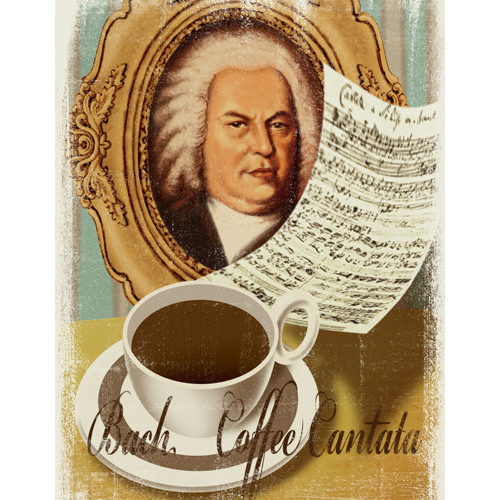
The ensemble – minus Yoobin Son and Peter Kolkay – now joined for the finale: the Coffee Cantata, composed around 1734. My friend was correct – the tenor has little to do here; luckily I’ve booked to hear Mr. Appleby again soon, as Tamino in the Taymor FLUTE at The Met…where Ms. Harvey will be his Pamina.
The Coffee Cantata is pretty silly, actually, and the singers had fun with it. Mr. Appleby has a few lines at the start, and later participates in the concluding trio. Mr. Moore plays a father who is alarmed by his daughter’s addiction to coffee. A program note suggests that Bach drank 30 cups of coffee a day, which may have inspired him to write this inane cantata. Mr. Moore has the lively opening aria, followed by an angry recit/lecture to his daughter: she must give up coffee or abandon the hope of ever marrying. The sparring continues with arias for both Mr. Moore and Ms. Harvey, which are finely sung. DeMarre McGill’s flute adds delicious flourishes to the music, which ends with a trio for the three voices. The flute and Mr. Hinson’s double-bass are active in this finale, which ends with the observation that grandmothers and mothers have always loved their coffee…so why should the daughter be any different?
~ Oberon
 Oberon's Glade