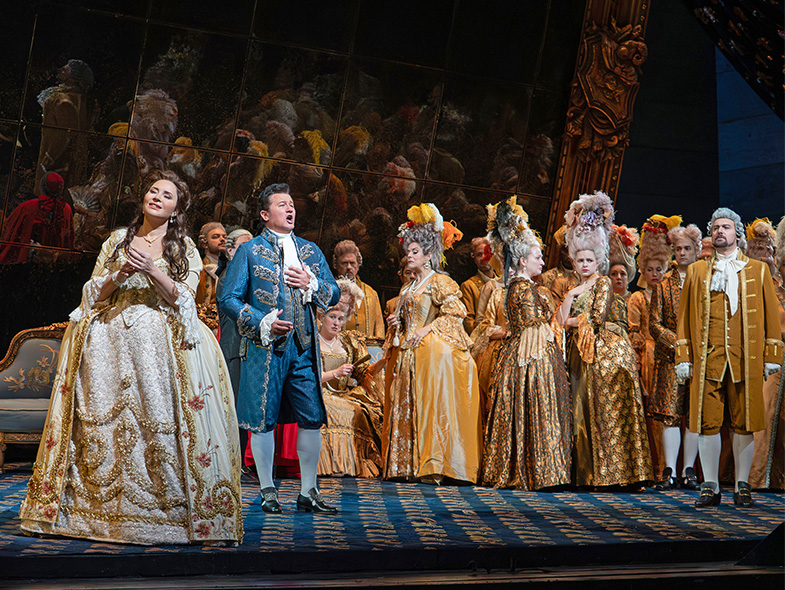
Above: Sonya Yoncheva, Piotr Beczala, Nancy Fabiola Herrera, and Igor Golovatenko in Act I of ANDREA CHENIER; a MetOpera photo.
~ Author: Oberon
Saturday December 13th, 2025 matinee – Giordano’s ANDREA CHENIER is high on my list of favorite operas; it stands as a beacon in the verismo repertoire, and is all the more meaningful as it draws upon the life of a real person: the poet André Marie Chénier; read about him here. Like the Carmelite nuns in Poulenc’s DIALOGUES DES CAMELITES, Chénier was executed in the final days of the Reign of Terror.
In my earliest years of opera-obsession, the title-role of this opera at The Met was shared by three great tenors: Franco Corelli, Richard Tucker, and Carlo Bergonzi (Mario del Monaco had left The Met in 1959) whilst Maddalena de Coigny was a favoured role of Zinka Milanov and Renata Tebaldi, though my first Maddalena was Raina Kabaivanska (unforgettable in her only Met appearance in the role, opposite Tucker). A host of wonderful baritones took on the role of Carlo Gerard, among them Warren, Merrill, Bastianini, and Colzani; my first Gerard was Mario Sereni, who sings the role on my favorite commercial recording of the opera, opposite Franco Corelli and Antonietta Stella.
The principals in this afternoon’s CHENIER were Sonya Yoncheva, Piotr Beczała, and Igor Golovatenko, with Daniele Rustioni on the podium.
The first voice to be heard today belonged to Ben Strong, currently in the Met’s Young Artist Program, as the Major-Domo; even in this brief role, he was able to make his mark. Igor Golovatenko’s house-filling voice immediately seized the imagination; portraying a life-long 2nd generation servant at maison Coigny, Carlo Gerard watches his father, now in his old age, struggle with his duties. Gerard curses the aristocracy: his “T’odio, casa dorata!” is a powerfully sung threat, but it is met with a surge of volume from the pit that nearly covers the climax; such onslaughts will continue throughout the afternoon.
CHENIER offers excellent opportunities in its character roles, and as Act I continues we hear Nancy Fabiola Herrera – who has sung Maddalena, Carmen, and Herodias at the Met – as the Comtesse de Coigny, singing beautifully. Two graduates of the Young Artist Program – tenor Tony Stevenson and mezzo-soprano Siphokazi Molteno – made excellent impressions today as the Abbé and Bersi. Alexander Birch Elliott sounds impressive as he introduces the evening’s entertainment, a ballet with sweet choral harmonies and the lovely sounds of harp and horn.
Ms. Yoncheva, who drew some negative comments after the season prima of CHENIER, sounds fine thus far today. As Maddalena, she playfully baits the poet Andrea Chenier, who responds with the famous Improviso. Mr. Beczala’s singing has a trace of pitchiness early on, but he is soon delivering powerful, passionate singing, sometimes infringed upon by the orchestra. The tenor won hearty applause for his generous vocalism.
Gerard now brings in a chorus of rag-tag peasants, singing ominously; the servant lashes out at the nobility, then tenderly urges his father to come away with him. Ms. Herrera has the act’s final lines as order is restored, and the aristocrats join in a stately gavotte…dancing on their graves.
Five years pass before the story resumes in 1794, when the Reign of Terror is in full bloom. New characters – Mathieu (the wonderful basso buffo Maurizio Muraro), the spy L’Incredibile (vividly voiced by Brenton Ryan), and Chenier’s friend Roucher (recent Met newcomer Guriy Gurev, excellent of voice). Ms. Molteno’s Bersi plays at being a “daughter of the revolution” whilst secretly trying to get a message to Chenier from the now-destitute Maddalena. Throughout this act, the orchestra will offer unnecessary bursts of sound, pressuring the voices.
At last, evening falls. Mr. Muraro has a delightful “la-la-la” tune as the street lamps are lit. Now Ms. Yoncheva emerges from the shadows for her meeting with Chenier. To me, the soprano sounds quite wonderful today, skillfully pulling back ever-so-slightly on some of the higher notes to keep the vibrato under control. Her lyricism in “Eravate possente” is just lovely, as is her moving “Son solo al mondo…” Beczala/Chenier reassures Maddalena with his persuasive “Ora soave…” in which the orchestra is too prominent. The soprano spins out some poetic phrases here, and their duet ends on joint high-note, big and brave despite the onslaught from the pit.
Gerard, having eaves-dropped, emerges and attacks Chenier, who fights back. Collapsing from a stab-wound, Gerard tells Chenier: “Protect Maddalena!“. When the crowd surges around, outraged by the attack on Gerard, he refuses to identify his attacker. The orchestra ends the act noisily.
After a second endless intermission, the Revolutionary Tribunal assembles. Gerard, recovered, is greeted enthusiastically; his noble response is spoilt by the orchestra. Olesya Petrova as Old Madelon offers her juvenile grandson to join the revolutionary cause. Ms. Petrova’s singing, tonally fabulous and dynamically masterful, brings forth a gorgeous piano G on “…dolce…”
Mr. Ryan’s narrative arietta is nimbly expressed, and he leaves Gerard alone to offer one of the greatest arias ever written for the baritone voice: “Nemico della patria“. From its powerful start, the singer thrills us with his passionate vocalism; despite having to fend off sonic blasts from the pit, Mr. Golovatenko was simply magnificent, and the audience’s response was thunderous…and so well-deserved.
Maddalena now appears, to beg her former servant to help free Chenier. Mr. Golovatenko tells her passionately of his infatuation with her thoughout his time as Maison Coigny. He is on the verge of raping her; with her chest-voiced response “Ebbene, prendimi…” she shames him. In the great aria “La mamma morta“, Ms. Yoncheva is truly compelling as she describes the horror of watching her mother being murdered, and of Bersi selling her body to buy food and medicine for her former mistress. The soprano’s narrative is extraordinarily poignant; out of despair, Maddalena has found love and forgotten her sorrows…”Io son l’obblio!” was heroically sustained, and then the soprano took the high ending of the aria, drawing fervent applause.
Jeongcheol Cha and Christoper Job sound so sinister as Dumas and Fouquier-Tinville, presiding over Chenier’s trial. Mr. Beczala gives his all in his “Si, fu soldato!” wherein he sings of his love of country…to no avail. “Morte!!” is the dreaded verdict.
Awaiting execution, Chenier reads to Roucher his final line of poetry. There’s a trace of tiredness in Beczala’s voice now, after an afternoon of coping with the noise from the pit, but he summons up deep reserves to triumph at the aria’s climax. Mr. Muraro’s humming of the Marseillaise is a momentary diversion. Maddalena arrives and bribes the jailer (the ever-wonderful Richard Bernstein) to let her take the place of a condemned woman, Idia Legray. Yoncheva’s “Benedica il destino...” tore at my heartstrings. Gerard rushes off to seek a reprieve from Robespierre.
Together at last, Maddalena and Chenier sing one of opera’s most thrilling love duets: “Vicino a te...” Both singers sang their hearts out, the soprano’s voice aglow with passion, the tenor still pouring out tone with great generosity.
The curtain calls, taken before the Met’s signature gold curtain, recalled the many years wherein that’s the way bows were always done. Although this deprives the singers in supporting roles a chance to walk out and be applauded, it was grand to see a bouquet of red roses fly across the footlights and land at Ms. Yoncheva’s feet.
At the stage door, I met (and got a kiss from!) Ms. Petrova, and chatted up Mssrs. Bernstein and Muraro. Mssrs. Beczala and Golovatenko were engulfed by fans wanting selfies, but Ms. Yoncheva still had not appeared by the time I left for home.
~ Oberon
 Oberon's Glade