
Above: Paul Neubauer, Sterling Elliott, Daniel Phillips, Mika Sasaki, and Nina Bernat; photo by Cherylynn Tsushima
Author: Lane Raffaldini Rubin
Friday December 12th, 2025 – When Wu Han, the co-artistic director of the Chamber Music Society of Lincoln Center, came out on stage to make introductory remarks before this annual performance of J.S. Bach’s Brandenburg Concertos, she perfectly captured the spirit of these six pieces and the CMS’s tradition of presenting them all in one evening each holiday season. In front of a full house at Alice Tully Hall, she explained the underlying challenge of programming this music: hiring the right personnel! If at first blush this is merely a collection of six concertos, one quickly finds that each has a unique ensemble of players, instruments, and characters.
At each year’s CMS performances of the Brandenburgs, the order of the concertos is jumbled to keep things interesting. Tonight, the first half of the evening happened to feature the first three concertos and the second half featured the final three.
The CMS players began with the 3rd Brandenburg, setting the tone with a rounded, wholesome sound. Daniel Phillips led the ensemble of three violin soloists, three viola soloists, and three cello soloists. This concerto has an Italianate interplay between the many solo parts and was handled by the CMS players with taut buoyancy, particularly in the third movement with hunt-like passages of running notes. The three cellists produced an impressively large sonority together.
The 1st Brandenburg Concerto followed, bringing an entirely different character and sound to the stage. The first movement opened with its stately, gallant theme with an ensemble that includes horns and double reeds in addition to strings and continuo. Phillips led this concerto as well, this time from the piccolo violin, which produced a bright sound in his solo passages. In the second movement, oboist James Austin Smith offered shapely solos and Phillips played with a blooming vibrato. The joyful third movement featured brilliant solo passages for Phillips, which was unfortunately marred by the muddle of the two horn players.
The fourth movement felt like a bonus after the flourishes of the third movement. It features a sequence of trios separating the recurring minuet, passing music around to different sections of the ensemble in each trio. The conclusion of one of the reed trios, which featured clockwork precision among the oboes and a characterful sound from the bassoon, was met with an audibly satisfied sigh from audience. Violinist Bella Hristova had her moment to shine in another trio, to which she lent a burnished, Romantic sound that suited this music surprisingly well. She played her solos with vivid phrasing and snappy rhythms.
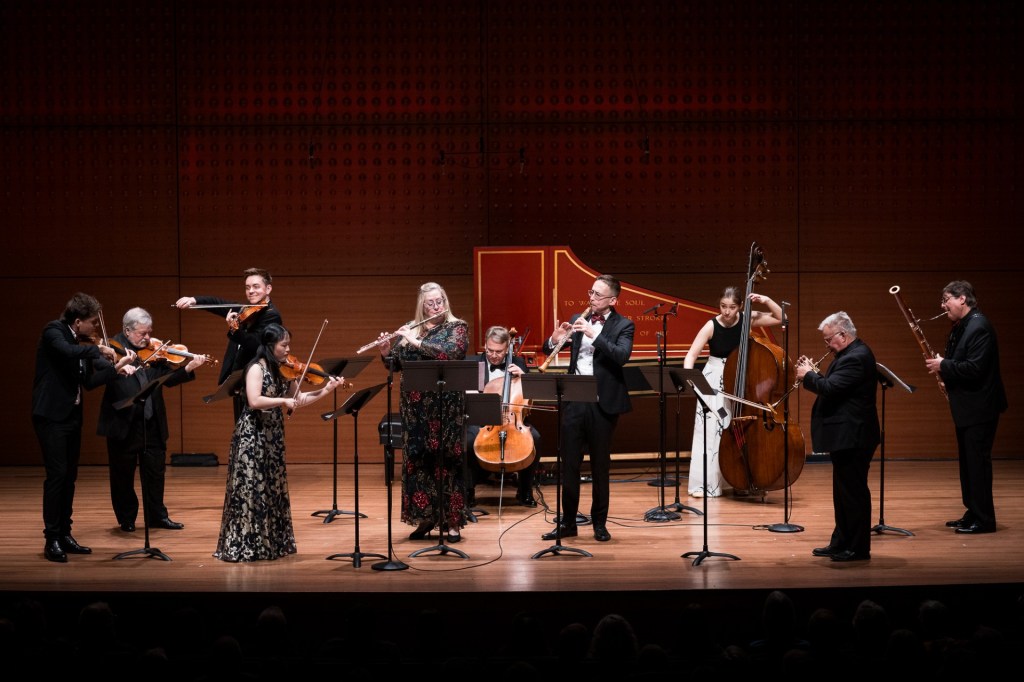
Above: trumpeter David Washburn (right) was playing his farewell CMS Brandenburgs this season; photo by Cherylynn Tsushima
Violinist Tien-Hsin Cindy Wu led a superb reading of the 2nd Brandenburg, which gave pride of place to trumpetist David Washburn in what would be his final run of Brandenburg performances after sixteen seasons. This concerto features complex interplay among the concertante parts and was given a contoured, at times suspenseful shape by the players. Wu’s violin solos were electric throughout, and Washburn dazzled with flawless execution of the monumentally difficult part for piccolo trumpet. In the last movement, Washburn and Smith (playing the oboe solo part) were visibly gleeful in their shared passages. Washburn, the clear star of the evening, received an enthusiastic ovation from the audience.
The second half of the concert began with the 5th Brandenburg, which is undoubtedly the least interesting of the set. Mika Sasaki’s extended cadenza on the harpsichord was the highlight as well as Sooyun Kim’s elegantly played flute part.
Things picked back up with the 6th Brandenburg, led by violists Matthew Lipman and Tien-Hsin Cindy Wu (Wu played violin and viola in these performances). This concerto features strings and continuo but, notably, omits violins, leaving the two viola parts as the highest voices. The result is an earthen sound which nonetheless was given buoyancy by the players. In the second movement, cellist Sterling Elliott and double-bassist Nina Bernat brought a grinding continuo sound to the ensemble. The magisterial third movement features a gigue-like ritornello and the players fully burst forth at the coda.
The 4th Brandenburg provided the evening’s finale. Here Hristova led from the violin alongside flutists Sooyun Kim and Tara Helen O’Connor. They gave the first movement a pastoral piping, swift but full-bodied in sound. Hristova, the most technically impressive of the night’s violinists, had many virtuosic passages which she tossed off effortlessly. Her Romantic sound did not serve this concerto as well as the 1st Brandenburg, perhaps because the flutes lend this music a more rustic, country-dance flavor.
If Wu Han set up high expectations for the evening, the CMS players delivered. Pervasive in their performance was a sense of abundance in this music and a festive spirit of enjoying this music together.
~ Lane Raffaldini Rubin
Performance photos by Cherylynn Tsushima, courtesy of Chamber Music Society of Lincoln Center
 Oberon's Glade