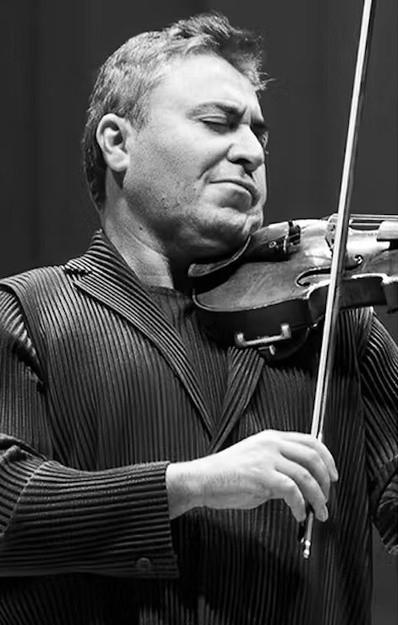
Above: Maxim Vengerov, photo by Fadi Kheir
~ Author: Mark Anthony Martinez II
Tuesday December 16th, 2025 – What a breathtaking night of music. Chamber music is not inherently showy in the way that a concerto, or even a more symphonic piece, might be. Instead, it offers a more intimate side of music, one that is not necessarily as loud, figuratively and literally, but through its softness could speak even stronger.
Tonight was one of those nights where the sheer elegance, beauty, and refinement of the pieces resounded loudly. The Clarinet Quintet in particular was perhaps one of the best renditions of the piece, whether live or on recording, I had ever heard.
The concert tonight was entitled Maxim Vengerov and Friends. The performance consisted of two Brahms quintets, the first being his Piano Quintet in F-minor and the second being the Clarinet Quintet in B-minor.
Maxim Vengerov has had an interesting career. Starting off as a child prodigy, Vengerov toured the world as a soloist. After years of tireless performing and suffering an injury, Vengerov took several years off. In that time, he became an accomplished conductor, but has since returned to the stage.
After having returned to the spotlight, Vengerov has preferred to create music more collaboratively, as in this night’s chamber music concert.
The core quartet of the concert consisted of Maxim Vengerov (violin), Vilde Frang (violin), James Ehnes (viola), and Daniel Muller-Schott (cello). For the first half of the concert, Yefim Bronfman played the piano, and for the second half, Anthony McGill played the clarinet.
The musicians strode out onto the stage as an ensemble. What was interesting is that although the concert had Vengerov’s name on the marquee, he made no indication of being the selling point of the night.
The five moved to their designated spots and started to play the piano quintet.
The quintet starts with a plaintive theme that immediately gets developed into the energizing force that powers the first movement of the piece. The balance of the players was wonderful, with every performer listening to each other. While the balance of the quintet was exemplary, it did seem at times that this quintet might have been the less rehearsed of the two. The performers were not perfectly clean in their entrances together, but this never detracted from the performance overall.
After the end of the first movement of the piano quintet, after the performers finished playing, it felt as if a held breath was released by everyone in the audience.
The most notable moments for me were the third and fourth movements of the quintet. The third movement, a scherzo, had a pulsing theme underpinning the music that at times felt like a march, but more menacing. It reminded me a bit of some of the darker Shostakovich chamber pieces, though this Brahms work had no programmatic nature to that effect.
The movement ended quite abruptly and without a long cadence, which I loved. Brahms, while being a Romantic composer, held firm to the classical roots of the prior movement, but he still pushed boundaries.
You could really hear the boundary pushing in the beginning of the fourth movement. The movement verged on atonality in the most delightful and intriguing ways. In a style that harkened to later decades, the opening was shocking to be embedded in such a traditional piece.
This quintet was written while Brahms was still a fairly young composer. This piece had all the makings of what defines the Brahmsian color and felt quintessentially Brahms. The second quintet was written only several years before Brahms’s death, and it is apparent that this was a piece of music written by a master with nothing left to prove.
The lushness of the piano quintet was stripped down compared to the clarinet, but somehow still very Brahmsian in nature, contemplative and restless, with shadows of beauty. The piece truly started, though, when McGill sounded out the first notes of the clarinet.
McGill’s playing was heavenly and sang through the air. I previously mentioned that it seemed as if the Piano Quintet was not as rehearsed as it needed to be, but the Clarinet Quintet was locked in and passionate.
You could tell from each individual solo section, or when people paired off to play together, that every performer was giving it their all.
You could tell that everyone was enraptured by the artistry on display, and it was hard not to just stare off into the distance as the music wafted through the air.
Every movement was a standout, though I believe the second was my favorite of the night. It was a mix of serene, wistful, and virtuosic. I simply did not want the music to end, but we slowly made our way through the movements.
The last movement was a very playful theme and variations that had many moments of energy, but ended on an almost haunting deathbed of pianos, with one final cadence. The performers ended on an up-bow, which was certainly intentional and showed that every bar of this piece was played together and with care.
After the quintet ended, many people, myself included, rose to give the performers several rounds of ovations. My friend accompanying me to this concert wondered if Maxim Vengerov would perform a solo encore. I figured that given the nature of the show, any encore would be a surprise. After several minutes, the ensemble talked amongst themselves, and McGill announced that they would be performing the second movement of the quintet again. It was a lovely night of music, and I was glad to hear more of it before the night closed.
~ Mark Anthony Martinez II
 Oberon's Glade