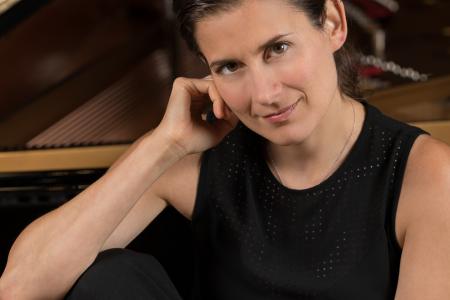
Above: pianist Anna Polonsky
~ Author: Oberon
Wednesday December 24th, 2025 ~ Carnegie Hall is my favorite place to spend Christmas Eve. This year it was especially nice because my spouse accompanied me. The all-Mozart program, offered by the New York String Orchestra, was conducted by Jaime Laredo. A sell-out house gave the evening a joyous air, canceling out – at least for a brief time – the ways and woes of our current world with a re-affirmation of faith, hope, and love.
The young musicians of the NY String Orchestra took the stage, and Maestro Laredo was warmly greeted. Opening the evening was the overture to LE NOZZE DI FIGARO. Hearing this familiar music (which I first became familiar with when my high-school band director brought it into our rep, along with Meyerbeer’s Coronation March from LE PROPHETE and Elsa’s Procession to the Cathedral from LOHENGRIN) tonight conjured up memories of playing it, as well as thoughts of the first time I saw the Mozart masterwork in 1968, when Rome Opera brought their gorgeous Luchino Visconti production to The Met, conducted by Carlo Maria Giulini, with a stellar group of Italian Mozartians – Ilva Ligabue, Graziella Sciutti, Biancamaria Casoni, Rolando Panerai and…Tito Gobbi (my only time seeing him onstage!)
The NOZZE overture swept by, the Maestro keeping the music swift and sure. This was followed immediately by the Symphony No. 40 in G-minor, K. 550, one of only two Mozart symphonies in a minor key. The opening Molto allegro opens with a famous, agitated theme; a later central passage seems to anticipate Mendelssohn. The Andante is elegant and stately, laced with subtle touches of wit (such as a tiny “Tamino” reference); the music turns darker and more insistent. The Minuetto is rather more dynamic than expected, with basses and celli in powerful unison. It contains an interlude for the wind voices, in which the horns were impressive. In the concluding Allegro assai, there’s a sense of urgency; the music is richly played, with a lovely clarinet solo and other interjections from the winds. The audience applauded each movement; I guess that silent attentiveness throughout a piece with multiple movements is no longer considered de rigueur.
Pianist Anna Polonsky – a musician new to me – now seated herself at the Steinway for the Piano Concerto No. 27 in B-flat Major, K. 595. She looked striking in a black trouser-suit with silvery accents; with her mastery of dynamics and colour, she held the Hall under a spell.
The #27 was completed in 1791, the year of Mozart’s death. The opening Allegro commences with a pulsing start from the strings, which the piano joins with rippling passages that flow lovingly over the rhythmic structure. A hushed minor-key piano passage veers to major and then back to minor; the oboe and bassoon chime in. A gorgeous theme for piano draws a response from the flute, and the two sounds entwine. In the cadenza, Ms. Polonsky’s dynamic palette is impressively displayed.
The concerto’s Larghetto brings forth poignant music, with melancholy hues. Full lyricism awakens, and the music takes on a reverential feeling. A gracious melody from the piano – so deliciously played – draws us deeper into the music as a hushed, poetic atmosphere settles over the hall. A series of ascending trills leads into a long keyboard passage with commentary from the winds. As the music faded into silence, applause ruined the moment.
The concerto ends with a Rondo/Allegro; here Ms. Polonsky was simply marvelous. Mozart brings forth a theme from his song “Sehnsucht nach dem Frühling” (Longing for Spring). And then, with a dazzling cadenza, the pianist finished the evening by basking in an affectionate standing ovation from the packed house.
Periodically throughout the concerto, there was a sense that someone in the audience was humming along with the music. This is the second time this season that this has happened at Carnegie Hall.
~ Oberon
 Oberon's Glade