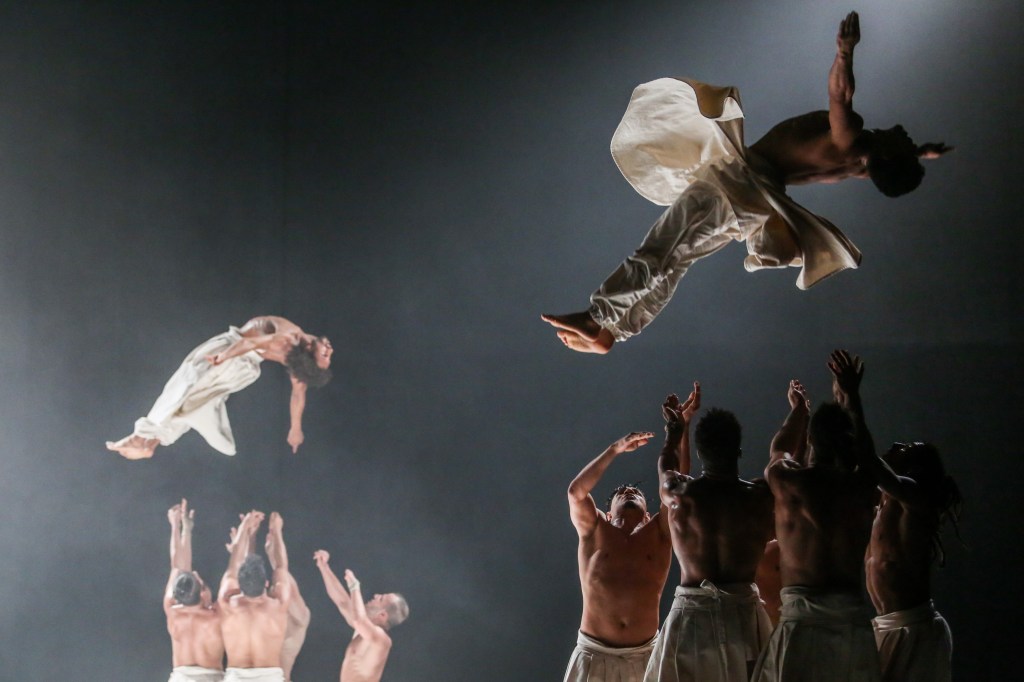
Above photo by Liliana Mora
~ Author: Oberon
Tuesday January 6th, 2025 – Opening night of the return of Compagnie Hervé KOUBI to The Joyce with the choreographer’s masterpiece, What The Day Owes to the Night; the presentation is supported by Dance Reflections by Van Cleef & Arpels.
When I first saw this piece back in 2018, I was simply bowled over by it. Unfortunately, my write-up of it was lost in the transfer from the Grove to the Glade. Every element of the production is simply stunning: music, movement, lighting, and – above all else – the dancing.
From the program notes: “What The Day Owes To The Night features a highly physical, stunningly fluid, gravity-defying piece that combines capoeira, martial arts, urban, and contemporary dance with powerful imagery evocative of orientalist paintings and the stone filigree of Islamic architecture. Through its mystical, enchanting, and hypnotic choreography, French-Algerian choreographer Hervé Koubi retraces his own history by relating it to the story of a young boy from a novel by Yasmina Khadra.”
The 13 men from Koubi’s company who take the stage for this piece hail from Algeria and Morocco; they are powerful athletes, a blood-brotherhood of fearless dancers who are also poets of movement. The fact that they are incredibly charismatic adds another dimension to their dancing. The musical score is a collage of sufi sounds – drawing on Islamic mysticism and recorded by the Kronos Quartet – with music by J S Bach, and by the Egyptian composer Hamza El Din. Lighting designs by Lionel Buzonie create an atmosphere of vast deserts and forgotten ruins. The all-white costuming by Guillaume Gabriel evokes images of angels…or ghosts.
The music commences with a feeling of mystery; the slumbering men, huddled together on the ground, awaken slowly and commence dancing as if compelled by unseen forces. Fantastical hand-turns and bounding leaps precede an explosion of music; rhythmic variety supports the movement, which ranges from eye-boggling somersaults and flying back-flips to dreamy, hypnotic expressiveness.
Silence falls; the men reach skyward. In a solo to a plucked rhythm, a man dances with his shadow. Pools of light illuminate the space as the men dance onward to the sexy sway of the music. The dancers seem randomly to spin on their palms or whirl endlessly on their heads; how they mastered these moves is beyond comprehension.
Airy flute sounds signal a new phase: a quintet of dancers are slowly joined by the others. Chimes sound, along with distant chanting : an anthem of voices. Things get noisy, then subside, only to rebound. More dare-devil stunts fill the stage; young men are flung into the air and caught by their brothers. Silence falls, sounds of Bach fade, the flute warbles. Night comes.
As with so many artistic masterworks, M. Koubi’s signature work eludes description; it has to be seen…and felt. For me, What The Day Owes To The Night is a dance for eternity.
The audience reaction at the end was thrilling to be part of. The dancers basked in waves of applause and shouts from the packed house; they took a double curtain call, some of them tossing in an impromptu air-somersault, as if they simply could not stop dancing. The choreographer appeared, much to everyone’s delight.
It wasn’t until this morning that I noticed a poem, in very small print, in the playbill. I assume M. Koubi wrote it after his first visit to Algeria (he had been born and raised in France). I keep reading it…and crying.
“I went there to the other side of the sea which saw me grow up on an unknown land which was nevertheless mine./ I went there to see the streets, the houses and the tombs./ I went there without knowing what I was looking for./ I went there to face the emptiness./ I went there to meet my lost brothers./ I went there and my tears flowed at the oblivion and the cruel time that had passed./ I went there and brought back to my heart my finally found brothers./ I went there full of brotherly love nowhere else known./ I went there out of love for them and for mine./ I went there because I believe in the power of love and spirit./ I went there./ I went there.”
~ Oberon
 Oberon's Glade