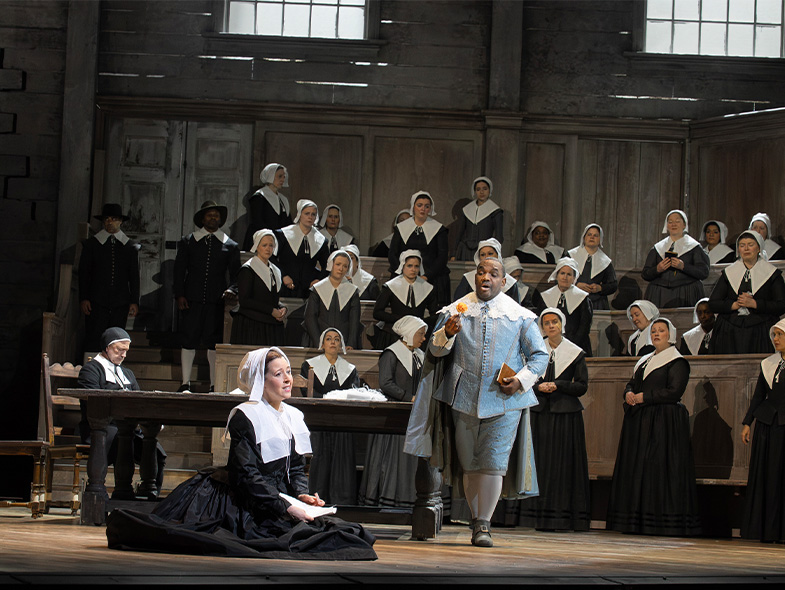
Above: Lisette Oropesa as Elvira and Larry Brownlee as Arturo; a MetOpera photo
~ Author: Oberon
Saturday January 10th, 2026 matinee – It’s been a while since I last attended a performance of I PURITANI; it’s not an opera I listen to very often…and when I do, I am reminded that there are stretches of ‘filler’ that are not very interesting. This afternoon’s Met performance featured a cast change, and much spectacular singing. Unfortunately, lacklustre conducting was a serious – thought not unexpected – detriment.
I ‘learned’ PURITANI from the first Sutherland recording; whenever I’d play thru it, I’d find myself skipping over certain parts. Among these were the prelude, opening chorus, and the prayer-quartet; hearing these ‘tracks’ today reminded me of why I used to pass them by and start my listening with the baritone’s aria and cabaletta. Stepping in for Artur Ruciński as Riccardo this afternoon was Ricardo José Rivera, a handsome fellow with a handsome voice, who had debuted at the Met earlier this season in ARABELLA.
Mr. Rivera’s singing was immediately engaging, his cavatina covering an impressive dynamic range, the cadenza expertly handled. The orchestra was too loud during the exchange between the baritone and tenor Tony Stevenson as Bruno; Mr. Rivera then clinched his success with his finely-sung cabaletta, winning sustained applause.
Lisette Oropesa (Elvira) and Christian van Horn (Giorgio) made a vocal feast out of the duet in which she persuades her “secondo padre” to let her marry the man she loves. Both singers sounded fabulous, Lisette’s coloratura and delicious trills illuminating the music; her stunning crescendo at “O padre mio!” was thrilling to the ear. Thru all this, the orchestra continued to menace the voices rather than support them; passages of col canto accompaniment were too brassy. But the singers prevailed, completing the duet with a dazzling top note from the soprano; a pointless orchestral postlude delayed the applause.
Greeted by an overly-long choral segment, Larry Brownlee as Arturo commenced his afternoon of incredible vocalism with the surpassing beauty of his “A te, o cara...” in which his tonal allure and poetic phrasing cast a spell. Mr. van Horn and basso David Pittsinger (who I hadn’t heard for quite a long time) made striking interjections, and Lisette’s response to Brownlee’s courting lyricism was a series of heavenly, floated notes. The singers’ bel canto perfection drew fervent applause.
Eve Gigliotti as Queen Henrietta made a vivid vocal impression; if only Bellini had given her more to sing. In her desperation to be saved from execution, the hapless queen wins Arturo’s support, but before they can escape, Elvira bursts in to sing her polonaise, “Son vergin vezzosa“, whererin Lisette treats us to a captivating display of bel canto charm. Her polished trills and festoons of fioratura – including some simply mad embellishments – are intoxicating. Ms. Gigliotti joins in the fun. A clunky postlude delays the applause.
Mr. Rivera’s Riccardo now attempts to prevent the queen’s escape with some big, menacing vocalism. Mr. Brownlee replies in kind, tossing in a super high note along the way, ignoring the orchestra’s noise fest. Riccardo lets the queen and Arturo leave, thinking their departure will enhance his chances with Elvira. The orchestra continues at high volume, over which Lisette strives valiantly to be heard. Aren’t these roles difficult enough as written? Do these orchestral assaults do anything other than add surface excitement?
Lisette’s “O vieni al tempio” – the first phase of her descent into madness – is so touching; she turns the scene into a highlight of the performance, overcoming the conductor’s indifference with her sensational vocalism. The over-extended choral finale counts for naught.
The prelude and opening chorus of Act II give us pleasant music for a “fatal day”; there’s no tinge of ‘dolor‘ here. What was Bellini thinking? Mr. van Horn’s “Cinta di fiori” is simply superb, his singing so full of colour and feeling; but even his powerful voice is not immune to the orchestra’s volume. A tedious – though finely sung – chorus of concern for Arturo’s fate goes on a bit, but now Lisette takes the stage for the Mad Scene. At “Qui la voce…” her warm lower register and beautiful dynamic palette are marvelously displayed, and she does so much with the words: “Ah, toglietemi la vita…”.” is heart-rending. A touching cadenza with a sustained B-flat leads into the coloratura display of “Vien, diletto” in which the fluency of her trills and her dizzying decorations of the vocal line are magical. Another idiotic postlude, which some conductors omit, dampens the applause somewhat.
A gorgeously-played horn solo sets up the great duet for Riccardo and Giorgio in which Mssrs. Rivera and Van Horn pulled out all the stops. The basso’s final plea to the baritone to forgive Arturo for Elvira’s sake is followed by a harmonized section and Van Horn’s impassioned “Ricccardo! Riccardo!!” which finally wins Rivera over. Their singing in the glorious “Suoni la tromba” (with its brilliant trumpet solo) was excellent, despite the orchestra pouring it on.
Now the house lights came up to half, halting the impetus of the drama. Then there’s some storm music (who cares?) before Elvira and her beloved are reunited. This scene is a bit superfluous, but it does give the tenor a lovely passage: “Corre a valle…” with Mr. Brownlee again enchanting to hear. At last they get things straightened out and launch the great duet “Vieni fra queste braccia…”. Here the Oropesa/Brownlee duo – a match made in heaven – revel in the passion of the music and its amazing high notes. Despite continued over-playing from the pit, the singers stopped the show.
Lisette pulls a cadenza out of the air, but the tenor still has one more mountain to climb: the demanding “Crediasi, misera” in which Mr. Brownlee summoned unbelievable reserves of tone. He was further tested by having to sing the repeat, but he carried it off brilliantly, right up to F above high C. Bravissimo!!
While I, and several other opera lovers, longed to hear the ‘lost’ soprano aria, “Ah! sento, o mio bel angelo…”, a more conventional ending was provided. The curtain calls were great fun, and at the stage door a big crowd waited patiently for the stars to appear.
~ Oberon
 Oberon's Glade