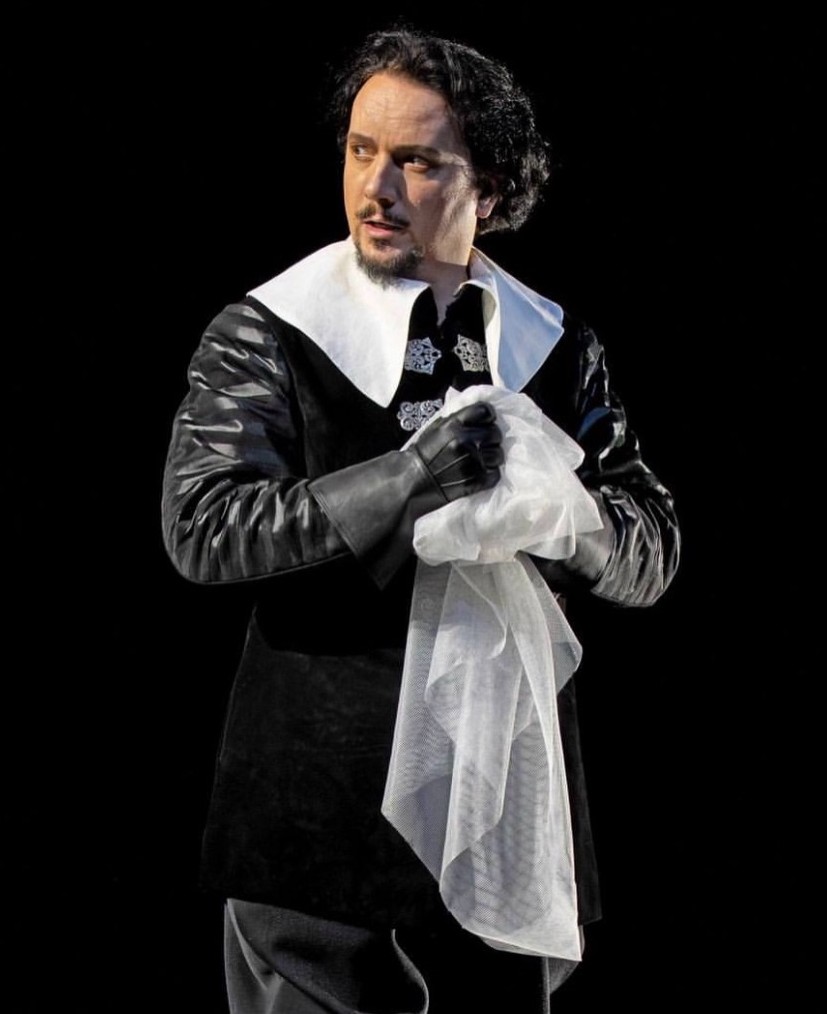
Above: Artur Ruciński as Riccardo/a MetOpera photo
~ Author: Oberon
Sunday January 18th, 2026 matinee – This afternoon marked the Metropolitan Opera’s final performance of Bellini’s I PURITANI this season. The production has been much disparaged, but the vocalism has been – for the most part – fantastic. There were illnesses (announced or not) among the cast, and the singers had to deal with over-loud playing from the pit…a trend nowadays at the world’s biggest opera house.
The house was literally sold out, and enthusiasm ran high all afternoon. The conducting was not inspiring, and the volume from the pit often caused voices to be covered. There’s a lot of filler in the score; unlike NORMA – where every bar of music counts – there are passages in PURITANI that, while aurally appealing, keep the story – such as it is – from flowing.
Eve Gigliotti (Queen Henrietta), Tony Stevenson (Bruno), and David Pittsinger (Gualtiero) repeated their strong performances.
The great Polish baritone Artur Ruciński, having missed the HD performance due to illness, was simply magnificent as Riccardo today. His opening aria was so appealingly phrased, his timbre warm and rich, and his technique so assured. In the exciting cabaletta that follows, the singer brought down the house by sustaining an incredible high-G throughout the orchestral postlude. Mr. Ruciński’s scene of aiding and abetting the escape of Queen Henrietta – thus improving his chances with Elvira, the object of his desire – was most impressively sung, and he and Christian Van Horn gave the performance some of its greatest thrills with their big duet, finishing with super-charged vocalism in “Suoni la tromba…”
Mr. Van Horn had a grand afternoon, his tone pouring forth, his marvelous singing of the gentle aria “Cinta di fiori…” – and its more intense passages – was a highlight of the afternoon. Despite its house-filling power, even this voice was at times blunted by the orchestra.
The bel canto duo of Lisette Oropesa and Larry Brownlee captivated the audience with their lyrical compatibility and their derring-do in rising to their interpolated – or in some cases, written – extreme high notes. Both singers are masters of beautiful dynamic shadings, long vocal lines, and compelling turns of phrase. Their singing of this opera put them in an echelon with the Sutherland/Pavarotti pairing – or, perhaps more aptly, with Sills/Gedda.
A prolonged ovation marked the end of the opera, the audience screaming and carrying on excitedly as each singer stepped forward to bow.
Then, after this kozmically demanding afternoon of singing, the principals had to sit onstage for another twenty minutes to chat with Peter Gelb. Do these sessions really do anyone any good? And I have a feeling the singers don’t get paid overtime.
~ Oberon
 Oberon's Glade