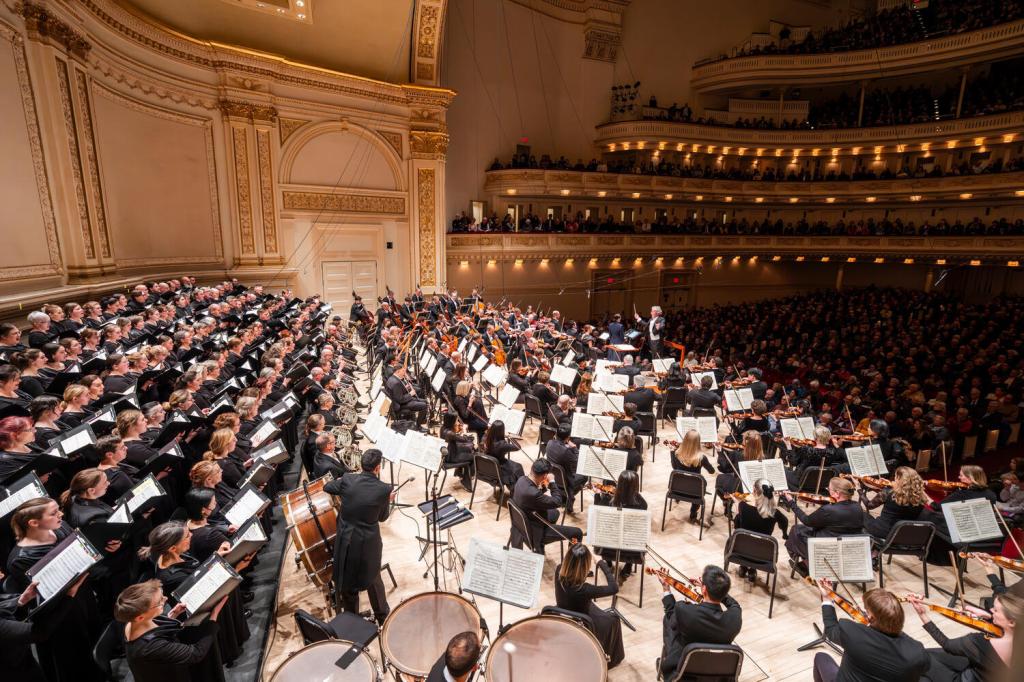
Concert photo by Chris Lee, courtesy of Carnegie Hall
~ Author: Oberon
Tuesday January 20th, 2026 – This evening’s performance of the Verdi REQUIEM at Carnegie Hall was one of the first events to go on my calendar when Gotham’s classical music venues began announcing their 2025-2026 plans nearly a year ago.
Over the years, I have experienced this masterpiece at such expansive settings as Tanglewood and in more intimate spaces like the Chapel at Trinity College in Hartford. Though spiritual in nature, the REQUIEM is very operatic; I sometimes think of it as my favorite Verdi opera. It’s been performed at The Met nearly 60 times since 1901; in 1981, the Company even took the piece on tour. In 1982, I attended a Met matinee performance with Leontyne Price heading the cast and conducted by James Levine; in 2017, another matinee marked Maestro Levine’s last appearance on the Met podium. In 2023, Yannick Nézet-Séguin conducted a performance at the Met from which I snuck out after the Lacrymosa.
Tonight at Carnegie Hall, Franz Welser-Möst, the Cleveland Orchestra’s Music Director, was wielding the baton. The Cleveland Orchestra Chorus, under the direction of Lisa Wong, were in full flourish, and the soloists were:
Asmik Grigorian, Soprano
Deniz Uzun, Mezzo-Soprano
Joshua Guerrero, Tenor
Tareq Nazmi, Bass
Of these artists, only Asmik Grigorian was familiar to me.
On this bitterly cold evening, the Hall was packed; anticipation was running high. We kept our coats on as we waited nearly 15 minutes past start-time. At last the soloists and the Maestro took the stage and we were drawn in by the chorus’s nearly- whispered words “Requiem…requiem aeternam“. The magic of this masterpiece was already casting its spell.
What I loved most, as the evening unfolded, was Maestro Welser-Möst’s forward impetus; things never seemed rushed, but the flow of the music was steady; no contrived piety from long pauses and drawn out phrases. After the Requiem’s first half, the conductor did not take a prolonged break but kept the soloists standing so that there was no interruption in the emotional arc of the evening.
The chorus, in their A cappella passage, established the necessary reverent mood, and then the soloists rose to introduce their voices to us. Tenor Joseph Guerrero has a full, lyrical sound with traces of an Italianate sob that I always find intriguing. The tall basso Tareq Nazmi has a huge, resonant voice that immediately established his authority; as the evening progressed, he proved to also be a very subtle singer. Asmik Grigorian sounded angelic as her voice wafted on high, and mezzo-soprano Deniz Uzun displayed a wide ranging voice which would keep the alto line nicely prominent all evening.
The chorus’s “Dies irae” was powerfully launched, but the voices and the orchestra brought an interesting dynamic range to this music. The trumpet sounded from the upper reaches of the Hall, and then a massive sustained chord was cut off suddenly, the choral voices echoed thrillingly – a moment I always love.
Mr. Nazmi’s “Mors stupebit” was chillingly rendered, and Ms. Uzun’s “Liber scriptus” allowed us to savor both the power and subtlety of her singing, with sure-voiced tops and ample chest tones mixed in with her hauntingly hesitant “Nil…nil…”
The bassoon’s playing during the “Quid sum miser” was so appealing. Mr. Guerrero’s sound continued to allure, Ms. Grigorian floating her high phrases sweetly. The “Rex tremendae” was galvanizing, the soprano’s “Salva me” was delicious…and was echoed by the basso’s beautiful intoning of the same plea.
The contrasted timbres of Mlles. Grigorian and Uzun made for interesting colorings in the “Recordare“, which was laced with enticing traces of rubato. Their duetting was truly lovely, with a polished finish. Mr. Guerrero’s “Ingemisco” brought a fine mix of poetry and strength. He sang from the heart, with some attractive mezza voce effects mixed in, and with power to spare. The sweet sounds of the oboe led to the tenor’s wonderfully hushed “Interoves locum praesta” before rounding off with a blazing finish.
Mr. Nazmi then gave us a stupendous “Confutatis maledictus“, covering its vast range with finely contrasted elements of lyricism and strength. The basso’s haunting singing of “Ora suplex at acclinis” and his heartfelt “Gere curam…” led us to his superb finish of this moving segment of the Mass.
The Lacrymosa was given a beautiful start from Ms. Uzun; the basso joins, and Ms. Grigorian keeps hovering magically in the heights. The four voices harmonize in a extended unaccompanied passage. Their final “Amen” brings a key change, a captivating moment to end the Requiem’s first half.
Ms. Uzan and Mr. Guerreo remain standing – preventing unwanted applause – and they are ready to go with “Domine Jesu Christe“, aided by the cello. What music! This soon becomes a quartet, over which Ms. Grigorian’s soft, sustained tones float angelically. Mr. Guerrero’s “Hostias” has a marvelous hush to it, and he offers the trills which elude some tenors. The basso chimes in, and Ms. Grigorian’s crystalline “Fac eas de morte transire ad vitam” leads to the simply gorgeous postlude.
The chorus sings the joyous “Sanctus” to perfection. The duet “Agnus Dei” was taken just a shade too fast but was lovingly sung by Mlle. Grigorian and Uzun. The mezzo-tenor-basso trio “Lux aeterna” was finely done, the a cappella section with nicely integrated timbres.
Ms. Grigorian’s “Tremens, factus sum ego et timeo” was wonderfully detailed, and her “Requiem aeternam” was mesmerizing. She soared over the chorus before reaching the austere beauty of her final “Libera me.”
For me, this was a performance that fulfilled all expectations, reminding me yet again how well I know – and how much I love – this music. A special bravo! to Maestro Welser-Möst for his thoughtful, clear vision of this monumental work.
~ Oberon
(If you are on Facebook, find more performance photos here.)
 Oberon's Glade