~ Author: Mark Anthony Martinez II
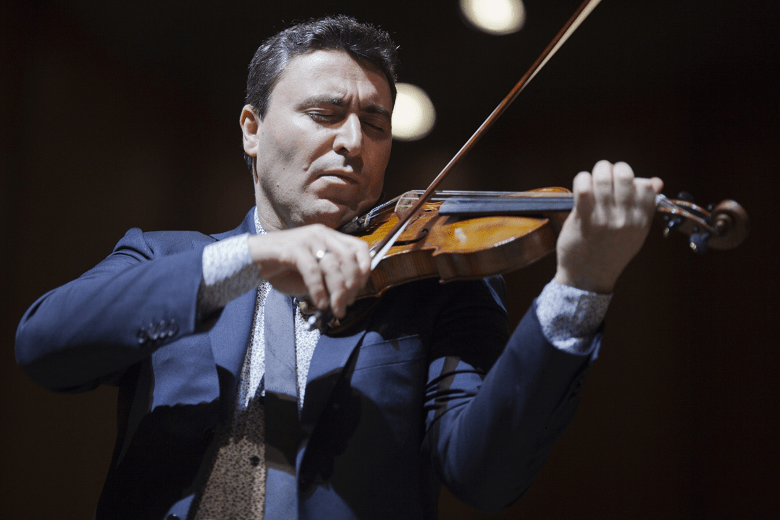
Above: Maxim Vengerov
Friday February 6th, 2026 – The Budapest Festival Orchestra and Maxim Vengerov wowed with one of the best interpretations of Tchaikovsky’s Violin Concerto I’ve ever heard, along with another big surprise that opened the concert.
The Budapest Festival Orchestra (BFO) is the creation of conductor, composer, and general multi-hyphenate Iván Fischer in the 1980s. The orchestra was created with the intent of having another world-class orchestra and is the main touring orchestra of Hungary.
The program featured favorites that I knew were going to be delightful. It was, in a way, a night of surprises as well.
As the lights started to dim, the stage was still empty except for the chairs already laid out. Soon, people started to file onto the stage, but without instruments. Mr. Fischer was among the group of people, and he addressed the audience as the mass of performers stood behind him.
I first thought, “Is this the chorus for the orchestra?” The first piece was by Arvo Part, a renowned choral composer. Fischer quickly answered my questions when he revealed that the chorus of singers behind him were actually the orchestra musicians. The only time I’ve heard an orchestra have to do any sort of vocalization is in the West Side Story suite, and even then, shouting the word “Mambo” is far different from singing an entire piece on the Carnegie stage.
But the orchestra sang the Part piece Summa (which was the choral debut of the piece on this stage) with aplomb. The piece was haunting and beautiful and reminiscent of ancient chants. I was impressed that the musicians were able to sing this choral work. The piece didn’t demand vocal fireworks, but to be able to perform in a medium one never normally performs in on one of the world’s most important stages was impressive.
Once the piece was over, the orchestra filed out and came back with their instruments. I initially saw that the BFO would perform Tchaikovsky’s elegant but infamously difficult Violin Concerto, but I hadn’t realized until the day before that it would be Maxim Vengerov as the soloist.
Vengerov is known worldwide as a violin virtuoso and conductor and, for quite a while, stepped away from the soloist track. I last saw him at Carnegie when he performed Brahms chamber pieces, which were stunning but very different from this high-flying concerto.
Vengerov was dressed in all black and didn’t make the usual soloist sartorial choice to stand out from the other musicians. The orchestra started to play the regal opening theme, and when Vengerov started to play, things felt different.
The long initial lines of his intro had such finesse and control. In a lot of ways, Vengerov’s playing felt more like a singer than a violinist, with the long, elegant phrases being sustained by breath support. It was just so beautiful and sustained, like the line would be never-ending.
Beyond the beauty, what was interesting was that Vengerov didn’t act like the usual soloist I was used to seeing. Soloists inevitably have a sense of diva-ness that is usually part of the aesthetic. The allure of a concerto is partially the high-wire drama of “can they actually do this?!” when going through extremely difficult passages.
I’ve seen performers of concertos who breezed through fiendishly difficult parts, and it doesn’t seem as exciting. Somehow, though, Vengerov was able to maintain a stoicism that didn’t belie the technical feats he was accomplishing, and it was mesmerizing.
Vengerov’s control over the violin was astounding. The pianissimo sections in the second movement were perfect, with musicality and phrasing that were unmatched.
Towards the climax of the third movement, I caught Vengerov sharing a smile with the concertmaster, as both knew what a special moment it was. And with that, the concerto was over. Vengerov received a standing ovation, one that was truly deserved.
Once the ovation died down and Vengerov left and returned to the stage, he played the first movement of Bach’s Violin Sonata in G minor as an encore. Once again, the hall was enraptured in silence, and we were left with a beautiful final treat.
After the intermission, the BFO performed a moving rendition of Brahms’s Symphony No. 2 in D major.
The symphony is such a breath of fresh air, especially given how cold NYC is at the moment. The BFO made it feel as if spring had wafted into the hall. The orchestra displayed such control and elegance, but also individuality.
I loved how one of the cellists played so passionately and moved with the music, while the orchestra as a unit played beautifully together. Technically, the BFO was immaculate. The pianissimos in the fourth movement, in particular, were deftly performed.
The BFO and Vengerov truly outdid themselves tonight.
~ Mark Anthony Martinez II
 Oberon's Glade