~ Author: Oberon
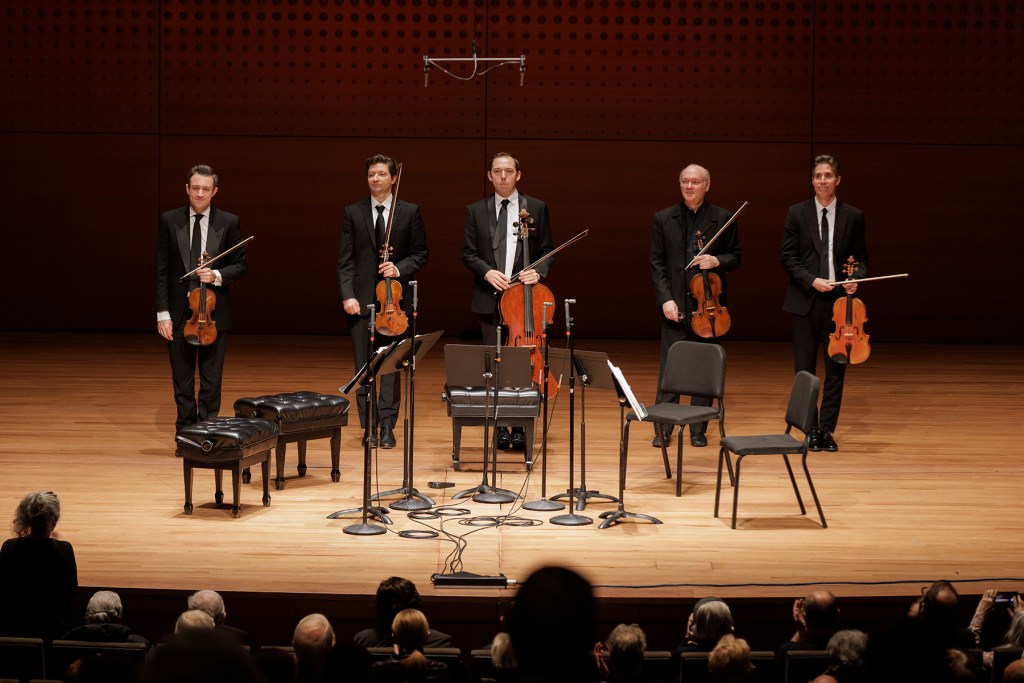
Above, the evening’s artists: Adam Barnett-Hart, Robin Scott, Brook Speltz, Paul Neubauer, and Pierre Lapointe. Photo by Tristan Cook, courtesy of Chamber Music Society of Lincoln Center.
Sunday January 10th, 2026 – The wonderful musicians of the Escher String Quartet were on top form this evening for a nicely-contrasted program of works by Mozart and Dvorak, along with the New York premiere of a piece by Chris Rogerson. Violist de luxe Paul Neubauer joined the Eschers for the Rogerson.
After checking their website a few days before this concert, I was aware that the quartet had taken on a new violinist; however, when they took the stage, it wasn’t the person I was expecting to see. No announcement was made as to the change. In any case, Robin Scott proved a very fine addition to the ensemble.
Mozart’s “Prussian” quartet (K. 575) was the opening work; in the melodic flow of the initial Allegretto, it was evident that the trademark Escher blend was intact. The music is gracious, with rhythmic variety and virtuosic elements. Brook Speltz’s cello pulse was a constant element, and the music offers Mr. Scott opportunities to shine. Adam Barnett-Hart and Mr. Speltz revel in the main theme, which Mozart marked as “dolce” (sweetly).
The Andante has a gentle feeling, with lovely harmonies. The main theme is passed from player to player, the better to savour their distinctive timbres. The Menuetto veers between elegance and animation, with a dotty segment and unison motifs. Mr. Speltz’s cello is again prominent. The cellist and violist Pierre Lapointe harmonize to open the concluding movement. There’s lively playing from all, with passages of virtuosity yielding briefly to a lyrical theme.
Composer Chris Rogerson received a warm greeting from the packed house when he stepped onstage to introduce his 2024 Quintet for Two violins, Two Violas, and Cello, having its New York premiere tonight. He spoke of the various types of clouds which had inspired this six-movement piece. Master violist Paul Neubauer joined the Eschers for the 25-minute work, filled with shifting moods and colours.
Eerie chords evoke the foggy atmosphere of Sratus; the plucked cello evokes the drippy dampness, and a high violin theme has a dreamy feeling. The music fades away, and Zephyr commences. This music is infused with a stealthy feeling, with glissandos lending a slippery sound. Nimbus brings a dark, steady rain: the music veers from somber to quirky. The Barnett-Hart violin sings of longing, then is joined by Mr. Scott in a dirge-like theme.
The longest movement – Cumulus – opens with the violists and cello, soon joined by the violins. Sorrowful feelings are mingled with anxiousness; Mr. Speltz’s cello adds depth to the atmosphere. The mood picks up a bit, and then a poignant theme hints at hopefulness. Mr. Neubauer has a solo passage, gorgeously played. Wistful moments give way to passion before subsiding into lyricism. For all its appealing qualities, this movement did seem a bit too long.
Storm opens urgently, with plucking strings like driven raindrops. The wind rises, and the music reaches a sudden, dramatic end. The final movement, Cirrus, is bleak and dreary. A pensive violin theme is finely rendered by Mr. Barnett-Hart, ascending to a high range. Throughout this work, I thought of Britten…and of Debussy. The audience seemed to immerse itself in Mr. Rogerson’s music, giving him a warm ovation at the end.
Following the interval, Dvorak’s Quartet in G-major, Op. 106, splendidly played, gave me my usual love/hate dilemma with this composer’s music. The Allegro moderato has an exciting start, with swirling dances and a folkish feel. After a while, I find my mind wandering. The long tones and dense harmonies of the Adagio are truly appealing; a slow-rise gypsy dance – the violin over pulsing figurations – turns intense. But then it all becomes a bit aimless. The Molto vivace is a charming, elvish dance, with more treats from the Barnett-Hart violin. In the finale, the composer seems to have an over-abundance of ideas to bring forth, the onward impetus of the music impeded by detours and cul de sacs. The sumptuous playing of the Eschers made me long for Beethoven…or Mendelssohn. But that is a minority report, for the audience gave the players a rousing ovation at the end, in which I was happy to join.
~ Oberon
 Oberon's Glade