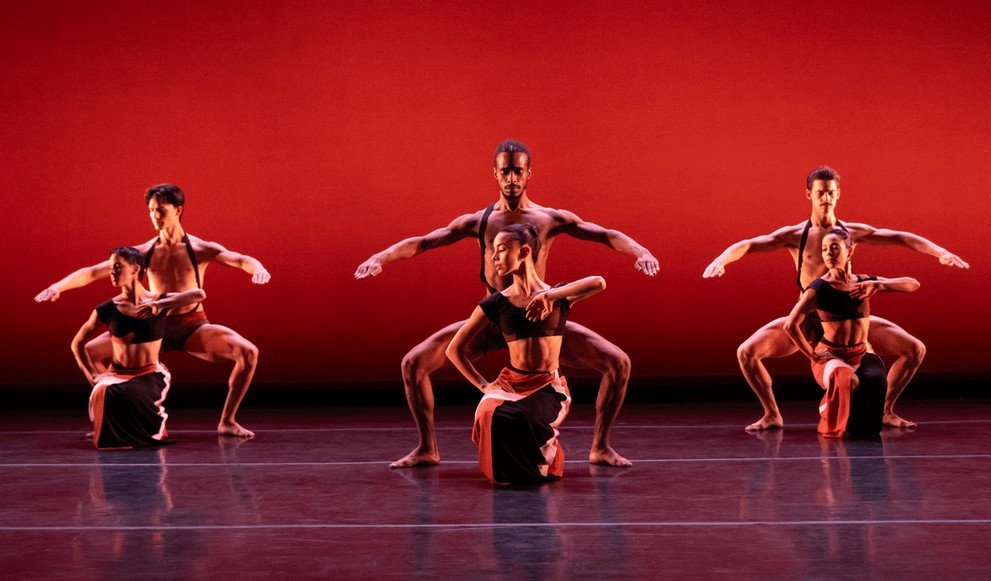
Above: The Malpaso Dance Company performing Martha Graham’s Dark Meadow Suite; photo by Steven Pisano
Author: Oberon
Sunday February 15th, 2026 matinee – The Malpaso Dance Company closing their eleventh engagement at The Joyce today with a triple bill program that featured the company’s premiere performances of works by Martha Graham, Keerati Jinakunwiphat, and Daileidys Carrazana. Live music was a key element in the production’s success this afternoon.
The Graham Company’s artistic director, Janet Eilber, has crafted a suite from the choreographer’s 1946 longer work, Dark Meadow, to a score by Carlos Chavez. Bringing this Dark Meadow Suite into their repertoire gave the Malpaso the distinction of being the first Cuban dance company to stage a work by Martha Graham. This ritualistic work, with its underlying exploration of a woman’s sexual awakening, was set on the Malpaso dancers by Graham régisseur Elizabeth Auclair.
The Chavez score was performed live – and gorgeously – by the Alma String Quartet, giving the piece a palpable immediacy. This ensemble, founded in 2016 by its marvelous cellist, Amaya Justiz, played from their hearts: a really engrossing blend of musical textures.
The piece opens with the female dancers in a passage of classic Graham steps and gestures; the men then back into the space, and a solo by danseur Esven González is superbly rendered. All afternoon, Mr. González will continue to captivate the eye. The suite dances on, with processions and partnered rituals. In a unique scene, the men, seated on the floor. support the standing women by grasping their ankles as they lean forward as if searching for something other-worldly. The female principal, I believe it was Greta Yero today, has a poignant solo; we then leave this realm as the light fades away.
Though it takes years of dedicated study and physical discipline to master the Graham technique and style, the Malpaso dancers rose nobly to the challenge. The playing of the Alma quartet made an indelible impression; and kudos also (all afternoon) to the lighting designs by Manuel da Silva.
Following a pause, a quartet of remarkable musicians gathered in the Joyce’s improvised pit to astonish us with their simply fabulous playing: trumpeter Adam O’Farrill and his colleagues from Stranger Days – saxman Xavier Del Castillo, bass-player Walter Stinson, and percussionist Zack O’Farrill – blew the roof off the place with their dynamic rhythms and vibrant sound. I could have listened to them for hours, but there was also dancing to be enjoyed in Year Of The Lion, choreographed by Kyle Abraham alumna Keerati Jinakunwiphat.
The six dancers, clad in satiny unisex dresses designed by Karen Young, were Dailiedys Carranza, Greta Yero, Jennifer Suarez, Laura Rodriguez, Esven Gonzalez, and Esteban Aguilar. Fleeting solo and duet passages are woven into full ensembles in choreography that is eye-catching and vividly responsive to the musical score. The dancers were divine, the music kozmic.
Following the interval, the program continued with La Estación (The Season), a new work by Malpaso co-founder Daileidys Carrazana. The score, drawing on themes of the changing seasons, was a collage of works by Astor Piazolla, Tchaikovsky, and Vivaldi – the last-named in arrangements by Max Richter. The Alma Quartet served up this delicious musical feast with their perfect playing; they were joined at the keyboard by Gabriel Chakarji. Much of the music has a Spanish flair.
All eleven of the Company’s dancers were onstage for this grand-scale piece, which opens in silence with a man and woman standing – facing each other – in a pool of light. The music commences; it will veer thru many mood swings as the dance unfolds. The beautiful hues that the musicians conjure up are not well-matched by the drab unisex costumes of steely grey, which give anonymity to the individual dancers.
Passages of interesting choreography are offset by moments of emptiness. A lineup of the dancers executing gestural motifs gets lively; the excellent lighting holds our attention. The music turns dirge-like for a male duet. At last, the original couple are alone onstage again. They seem to have reconciled, and they head upstage, as if moving on to their future together. But instead, a long pas de deux ensues.
The program might have been better crafted had the Graham piece been given last. To open with a masterpiece by one of the greatest choreographers of all time sets a very high bar.
~ Oberon
 Oberon's Glade