~ Author: Oberon
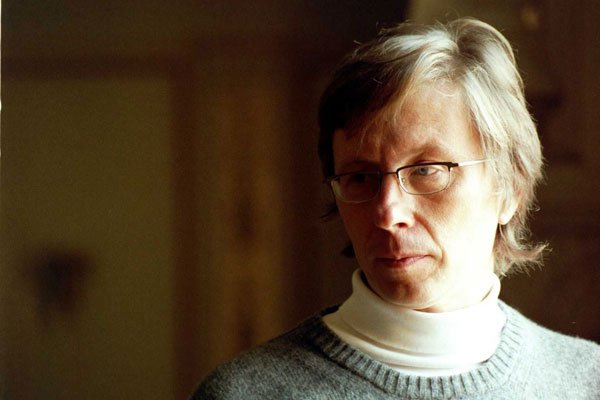
Above, the composer Georg Friedrich Haas
Sunday February 22nd, 2026 – This afternoon’s concert by Parlando had intrigued me since it was first announced. The orchestra’s founder and conductor, Ian Niederhoffer, had provided this “preview”:
“What does it mean to make music in complete darkness? Join Parlando for an immersive performance of Georg Friedrich Haas’s in vain, a gripping, hour-long work that bends time, light and memory. Written in response to the far-right’s resurgence in Austria and described by The Guardian as “the first masterpiece of the 21st century,” in vain confronts the fragility of democracy through waves of harmony, shimmering stillness, and sudden rupture. As politics around the world grow darker, Haas offers both a warning and a vision: a plea to keep listening, even when the lights go out. In this performance, lighting is written into the score, alternating between brightness and darkness.”
As the afternoon of the performance drew nigh, uncertainties about the weather caused my guest and I to wonder if the MTA would be reliable; and whether we should simply stay home. But the storm had not yet hit, and so a mere misty rain with a smattering of snowflakes decided us to venture out to Merkin Hall, where a full house of intrepid New Yorkers gathered for a mind-blowing performance of a terrifying and gorgeous 21st century masterwork that kept us enthralled from start to finish.
Maestro Niederhoffer gave a brilliant, truly informative introductory speech, telling us of what had impelled Georg Friedrich Haas to write his hour-long symphonic poem; the gist of his talk can be read in the program quote at the top of this article. He also told us what to expect in terms of the complex lighting scheme of the presentation, and of the darkness that would envelop us at times. The program charmingly included a reference to the level of “listening difficulty”; my companion and I had no difficulties whatsoever.
The work commences with tingling, cosmic sounds. A pulsing beat from the orchestra’s bassist, Dara Bloom, heralds a loud passage which develops into drooping motifs. Marimba, harp, and xylophone keep lightness in the mix, but sustained wind tones flow into the ominous darkness, with the vibrating gong a harbinger of fate. Echoing sounds and fading light leave harpist Kristi Shade illuminated: an outstanding visual effect.
Shivering violins and lingering wind notes evolve into long chords with dense harmonies. Bursts of brightness are offset with growling, sighing, whining sounds. The music develops a soul-searching depth, with descending brass arpeggios. Cymbals crash; massive sonic attacks and chilling strings fill the air. Hell-fire is evoked; we hear oozing chords, stutterings from the marimba, and fractured brass sounds. The lighting causes the polished surface of Ms. Bloom’s double-bass to turn blood red. The doom-ladened gong is struck.
Swirling, plunging motifs suddenly run out of gas. The music crawls along, with sighs from the cellos. A brief passage of tonality – a mystical quietude – gives way to rising fanfares. Throbbing rhythms, a rattling bell, and brass chords are played as darkness descends for the second time. The insistent bell underscores the music’s tension; deep resonances are explored. Then harp glissandos signal a sonic sunburst of hope. A repeated piano note as the music sails into the stratosphere, with gong attacks seeming to carry a warning. Tumult ensues. Weighted chords descend, only to rise again; the rhythm speeds up. The ebb and flow of the music, which perhaps goes on a bit too long here, ends in silence. After a profound pause, the applause commenced, soon turning into a standing ovation.
A mixture of despair and elation as we emerged into the developing storm. Awakening the morning after, I could feel the intense silence of an island now buried in snow. For a few minutes, all was peaceful. But then the morning’s headlines drew me back into reality all too soon.
Boundless admiration for the composer’s thrilling, daring work…and for Maestro Niederhoffer and his marvelous band of music-makers for bringing it to us with such stunning clarity.
~ Oberon
 Oberon's Glade