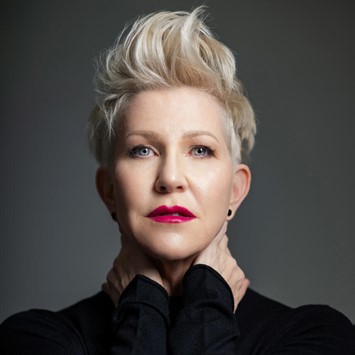
Above: Joyce DiDonato, photo by Chris Gonz
~ Author: Mark Anthony Martinez II
Thursday February 19th, 2026 – Emily Dickinson wrote such beautiful and moving poetry that in many ways she has become one of the great poetic geniuses of the United States, and it’s no surprise that there are many musical works set to her writing.
In the program notes for the concert at Carnegie Hall with Joyce DiDonato, singing from Dickinson’s perspective, and Time for Three, acting as a further inner dialogue at times, it was noted that over 3,000 pieces have been written using Dickinson’s words.
The Carnegie debut of this cycle set itself apart with the grandeur of the set and the sheer scope of the music itself.
Carnegie is most often a concert hall, with the music alone being the focal point of the venue. Today’s concert was an exception. On the stage there was a large set which would be befitting enough for a one-act opera. The set had an elevated platform with a singular writing desk placed approximately in the middle of the platform. Above the platform was a forest of white fabric draping down in strips with pendulous lights mixed in.
There were words being projected onto the stage and around the hall as well, although I couldn’t catch what they were actually saying.
Before the concert started, I noticed that Joyce DiDonato was walking around the back of the stage, grazing the walls, clearly in the character she was playing. People didn’t seem to notice her as she made her home on stage, since I hadn’t heard anyone say anything about it around me.
The lights dimmed, and then the trio Time for Three rushed up onto the platform, performing the first song of the first piece.
Emily – No Prisoner Be is a new song cycle written by the composer Kevin Puts. A product of works originating during COVID, Puts knew from the start he was writing for Time for Three and then Joyce DiDonato.
It’s not too common to understand where the exact origin of a song cycle stemmed from, but the program notes mention this specific Dickinson poem kicked off the entire project.
“They shut me up in Prose –”
As when a little Girl
They put me in the Closet –
Because they liked me “still” –
Still! Could themself have peeped –
And seen my Brain – go round –
They might as wise have lodged a Bird
For Treason – in the Pound –
Himself has but to will
And easy as a Star
Look down upon Captivity –
And laugh – No more have I –”
And just like the original inspiration, the entire night was a journey of exploration, personal freedom, and triumph.
As Time for Three came on stage, the violinist playing as he walked, the stage was immediately set. Unlike a traditional song cycle where the singer stands giving a monologue or a soliloquy of sorts, DiDonato and Time for Three were intent on making the night a true show.
Each song within the larger work was a poem from Dickinson. The first piece was “They shut me up in Prose –,” which set the stage for the night’s music.
DiDonato truly was at home in this music. The style of singing was a mix of classical and contemporary, with good use of amplification so that she didn’t need to rely on operatic technique to be heard throughout the hall. DiDonato really did sound fantastic in this medium, and clearly Puts, the composer, endeavored to make the piece utilize the best parts of her voice.
Time for Three not only were the instrumentalists but also joined in quite frequently to provide backup vocals in the piece. I loved their playing but was actually quite a fan of their singing as well. The folksy nature of the piece and their dynamic style really made the night feel more like a contemporary folk concert than just a traditional classical performance.
Many of the pieces were beautiful, though at times the tonal quality of them felt so alike that it was hard to distinguish when one began and one ended. My highlight of the night was the music set to perhaps Dickinson’s most famous poem, “Because I could not stop for Death –.” This piece revealed a total tonal shift, and instead of the flowing, watery nature of the pieces beforehand, it was punctuated, loud, and full of drama.
The audience loved the short instrumental-only intermissions which were also inspired by Dickinson poems but did not use her words. The titles of each piece, as well as lyrics of the songs, were projected onto the bottom of the platform on stage. The first instrumental-only section was labeled “Bee Scherzo,” but subsequent ones cheekily wrote things like “Another Bee Scherzo,” which drew larger and larger laughs from the audience each time the title came up.
The night concluded with the namesake of the whole work, the song “No Prisoner Be.” After the musicians performed the work, Kevin Puts came up on stage to a warm ovation, and DiDonato started to lead the crowd in a chorale of the melody from the last song. The musicians all embraced, and the crowd left the theater humming the final melody.
~ Mark Anthony Martinez II
 Oberon's Glade