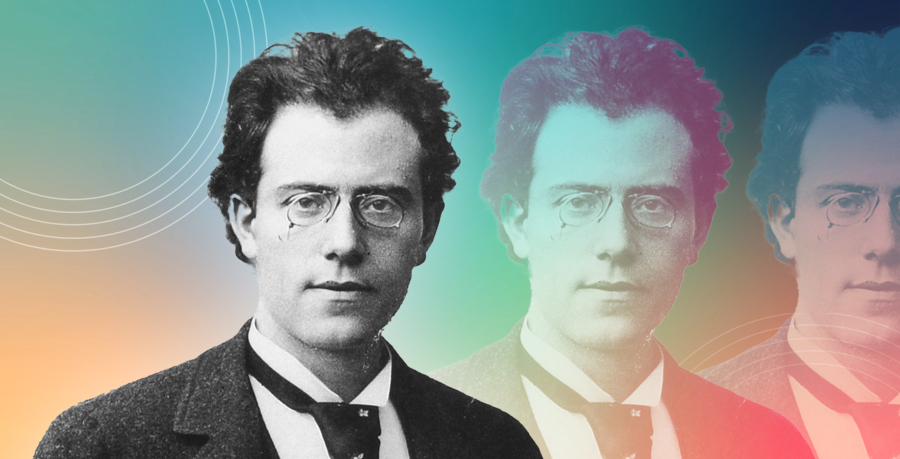
Above: Gustav Mahler
~ Author: Ben Weaver
Tuesday March 10th, 2026 – Gustav Mahler’s Symphony No. 2 in C minor, Resurrection,” has been a concert hall staple for more than 130 years. Its emotional power was noted from the night of its premiere in Berlin in 1895, conducted by the composer. The work was so transformative for many of its listeners, including fellow composers like Arnold Schoenberg and Alban Berg, that Berg said he felt compelled to confess his infidelity to his fiancée. One always hopes for something resembling such a catharsis when hearing a work of this stature, as I did on Tuesday, March 10, when Yannick Nézet-Séguin brought his Philadelphia forces to Carnegie Hall.
I often – perhaps unwisely – predict how things will progress within just a few minutes of this particular symphony. It’s violent opening, with stabbing cellos and double-basses, can set the tone for what’s to follow. On this evening, alas, maestro Nézet-Séguin did not bring out the desperation of the music in the opening bars, and what followed was a largely restrained Mahler. Some conductors pride their reserved approaches to the music of Mahler and, say, Tchaikovsky, but this has always truck me as bizarre. Would you re-stage the movies of Federico Fellini or Douglas Sirk through Stanley Kubrick’s lens?
Mahler’s works are almost always works of extreme contrasts: deepest sorrow quickly transforms into a mocking jingle followed by a violent march and a mournful sigh after that. The difficult part is always connecting these contrasts into one tapestry. Seems that Nézet-Séguin’s approach, instead, was to bring the contrasts closer together, lowering the temperature on the highs so they did not feel so out of place. The result was an underwhelming whole, with no surprises; everything was just fine and beautifully played by the magnificent Philadelphia Orchestra. The opening Allegro maestoso, as I noted, was low on voltage. It’s just as well that Mahler’s requested 5 minute pause after the first movement was not observed. (It rarely is.)
The following Andante moderato – which is Ländler dance – didn’t have much charm. It rather surprised me because Nézet-Séguin conducted the Vienna Philharmonic’s New Year’s Eve concert just a couple of month’s ago. I hoped he would have transferred that experience here. The darker second section of the movement had a bit more fire that was missing in the first movement, but the lackluster returning dance again disappointed.
The restless Scherzo was nicely done and the woodwinds of the Philadelphia Orchestra were on magnificent form here and throughout the evening. Mahler based the movement on the melody of his popular song “Des Antonius von Padua Fischpredigt” from Des Knaben Wunderhorn, which hecomposed concurrently.
The magnificent song “Urlicht,” one of Mahler’s most glorious compositions, also from Des Knaben Wunderhorn, serves as an introduction to the grand final movement. Mezzo-soprano Joyce DiDonato sang it beautifully, with a rich tone and carefully articulated words. The warm tones from the singer and chorales from the trumpets were chilling. Here and in the closing movement Nézet-Séguin finally found his footing. Mahler’s demands were beautifully handled, the hushed entry of the fine Philadelphia Symphonic Choir was magical. Mahler would have composed a magnificent Mass or Requiem if he ever chose to do it. (Shame he did not!)
Soprano Ying Fang joined Joyce DiDonato in the solo sections of the movement. Fang projected into the hall very nicely, her voice larger than some sopranos in this role. Sadly this revealed that while Ms. DiDonato sang wonderfully, perhaps an alto is a better choice for this work. Or a lighter soprano for a mezzo. The two voices on this night were just a tad too close together to create a full contrast.
This also brings me to Nézet-Séguin’s insistence that this soloists stand in the middle of the orchestra, not in front. He has done this now in performances of several works, including Brahms’ Ein Deutsches Requiem and Mahler’s 4th Symphony. I can’t imagine why he thinks his singers should be hidden, their voices minimized, their contributions lessened. This is certainly not what Mahler (or Brahms, or basically any composer of vocal concert works) wanted. Does he not want to share the spotlight? I can not tell, but it’s a rather obnoxious habit he has developed and nobody benefits from it.
~ Ben Weaver
 Oberon's Glade