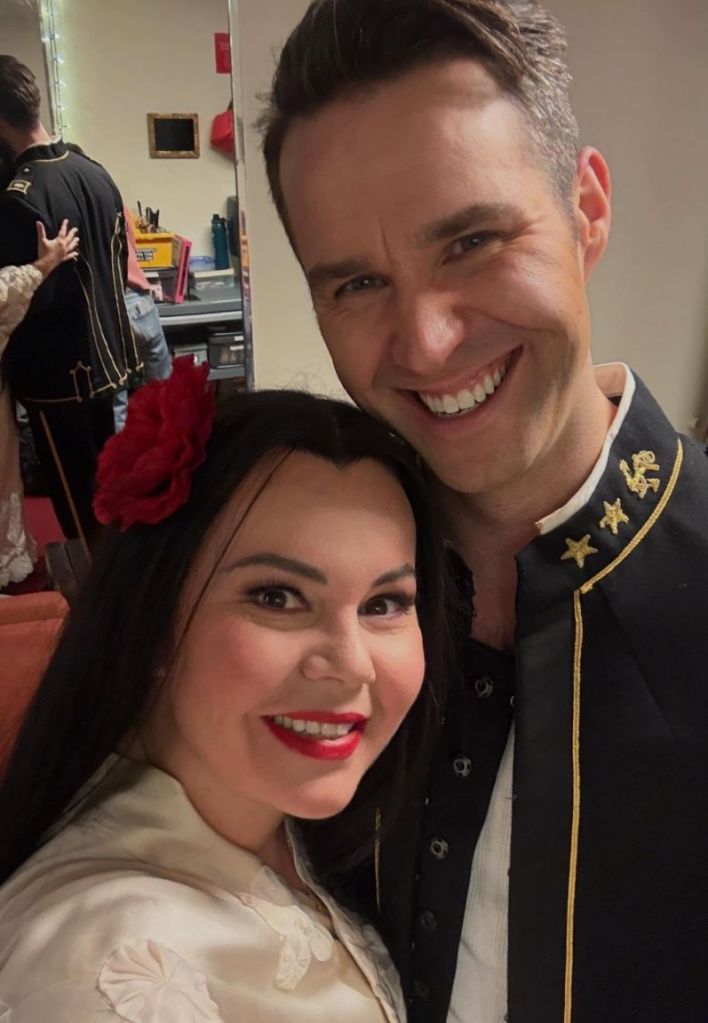
Above: This afternoon’s Butterfly and Pinkerton, Aleksandra Kurzak and Adam Smith; photo borrowed from Ms. Kurzak’s Facebook page.
~ Author: Oberon
Saturday March 14th, 2026 matinee – Being in a highly emotional state (which is not unusual, really), everything about today’s matinee of MADAMA BUTTERFLY at The Met felt extraordinarily immediate and deeply moving. Tears welled up in me time after time; the first act in particular really got to me…and this is the (mostly) “happy” act. When the tragedy began to build in the remaining acts, I was thoroughly immersed in the individual characters and the music they were singing.
My original choice for Butterfly this season was Elena Stikhina; when she withdrew due to pregnancy, Sonia Yoncheva was my second choice. Then she withdrew, and Aleksandra Kurzak came to the rescue, flying in from Miami, where she had just sung her first Turandot. I’d seen and enjoyed Ms. Kurzak’s Puccini heroines – Mimi, Butterfly, and Tosca – previously; today, she surpassed those memories with her marvelous vocalism, and deep involvement in the drama.
Carlo Rizzi was on the podium; he often comes across as being of the loud-and-fast school of opera conducting. Today he was more cordial to the singers, though at times in the third act the voices were covered.
The opera’s lively prelude was expertly played. Tony Stevenson was today’s perfect Goro; Mr. Stevenson is a character tenor who sings, making every word and note important. English tenor Adam Smith as Pinkerton has a lyrically masculine voice, and Jennifer Johnson Cano as Suzuki commenced her afternoon with her clear, warm mezzo introducing herself with the character’s chattering phrases as she meets her new boss. Quinn Kelsey, even from offstage, gave notice of his major baritone voice as Sharpless, one of opera’s most sympathetic characters.
Mr. Smith’s “Dovunque il mondo” was clearly and sturdily sung, with Mr. Kelsey’s interjections superbly voiced. From the pit, Rizzi was mostly supportive. Tenor and baritone joined enthusiastically in their toast to “America Forever!”, then Mr. Smith’s nimble, finely articulated “Amore o grillo” gave Sharpless the first warning signs of what would come to pass. “I must possess her!” boasts Pinkerton, with a capital B-flat. The voices stay on top as the music gets brassier. Mr. Smith rounds off the scene with a sustained “…sposa Amerciana!”.
The offstage chorus of Butterfly’s bridal attendants is heard approaching; Ms. Kurzak’s singing is lovely as she floats her lines so engagingly, finishing off with a clear high D-flat. The chattering of Butterfly’s family members resolves with Mr. Kelsey’s beautiful “O amico fortunata…”. The ‘one night of love’ theme is heard as soprano and tenor converse, with Mr. Smith’s tenderness towards his bride sweetly evident. Both singers are excellent colorists. Ms. Kurzak’s “Ieri son salita...” is fantastic, her dynamics luring the ear as she builds her declaration: “Amore mio!” The sturdy voice of Paul Corona as the Commissioner pronounces the wedding vows; Sharpless departs, with a fateful warning to Pinkerton: “Giudizio!”.
The powerful voice of Peixin Chen as the Bonze shatters the celebration; he denounces Butterfly for abandoning her faith. Her family and friends turn from her and flee. Pinkerton soothes his bride with the consoling “Bimba, non piangere” and the two embark on a love duet filled with dynamic shifts and touching shadings of the words. The music becomes unbearably gorgeous as the two sing of their passion. The orchestra is pushing, but the voces soar overall. Kurzak’s “Dolce notte” and “...quanti occhi fisi atenti…” are rapturous. The act ends with the soprano’s radiant high-C, with the tenor harmonizing.
Act II commences in a very different mood; a sense of desolation has settled over the once-happy house on the hill. Ms. Johnson Cano sings Suzuki’s prayer with deep feeling. Ms. Kurzak’s “Un bel di” is awash with pensive colourings, her singing expressive and truly moving. From the pit, Rizzi pushes her at the aria’s climax. Sharpless arrives, bringing bad news; but before he can share it, Jeongcheol Cha as Prince Yamadori arrives to make a final attempt to persuade Butterfly to marry him. Ms. Kurzak is hilarious as she describes the American laws on marriage. The Prince departs, still hopeful despite Butterfly’s rejection.
Now Mr. Kelsey begins to read Pinkerton’s letter. He and Ms. Kurzak are so compelling here. Butterfly does not comprehend the letter’s final line. When Sharpless suggests that she accept the Prince’s proposal, the tension gets unbearable. Kurzak’s gasp of “Ah! M’ha scordato…” is bleakly shattering. She brings forth her child. She sings the heartbreaking “Che tua madre“, her voice doom-ladened and desperate, the soprano tearing her heart out. The helpless consul departs.
Butterfly berates the faithless Goro, screaming at him. Alone with Suzuki, Butterfly seems at her wits’ end when the cannon from the harbor announces an arriving ship. Ms. Johnson Cano’s “Il canone del porto!” is followed by a profound silence: everything is about to change. The theme of “Un bel di” plays hauntingly as hope rises, climaxing with Ms. Kurzak’s thrilling “Ei torna, e m’ama”. In Italy, this would have stopped the show.
The Flower Duet is lovingly detailed, the voices of soprano and mezzo-soprano sublimely blended, reaching a sweet finish. The quietude of Butterfly’s reflective phrases finds Ms. Kurzak at her most hauntingly expressive. Night falls; the poignant music of “the wait” creeps in. The Humming Chorus commences, only to be interrupted by a jangling cellphone.
There is a long pause now, the house-lights on a quarter; this shatters the mood, with the audience chatting away. At last, Puccini’s atmospheric prelude commences, superbly played by the Met musicians.
Mistress and maid awaken; Ms. Kurzak’s dreamy “Dormi, amor mio” ends on a shimmering top-B. Pinkerton and Sharpless arrive. Ms. Johnson Cano is marvelous here – so anxious, and then terrified as she learns the truth; knowing what will happen, her low notes sound from her soul. The ensuing trio, one of my favorite parts of the opera, found Mr. Rizzi and his orchestra too aggressive. Sharpless turns on Pinkerton, reminding him of his prediction in Act I. Mr. Smith’s anguish is poured out in his aria, which includes a stunning diminuendo. He flees.
Hannah Jones as Kate Pinketon makes a fine impression as she and Ms. Johnson Cano – her despair palpable – discuss what is to come for Butterfly’s child. Butterfly rushes in; she slowly grasps the situation. Ms. Kurzak’s “Triste madre…” is shattering; her “Sotto il gran ponte del cielo…” to Kate is steeped in inconsolable grief. Kate and Sharpless leave.
Ms. Kurzak’s monumental dismissal of Suzuki is so powerful. The soprano’s tragic farewell to her son is thrilling: the powerful thrust of her voice laced with moments of great delicacy.
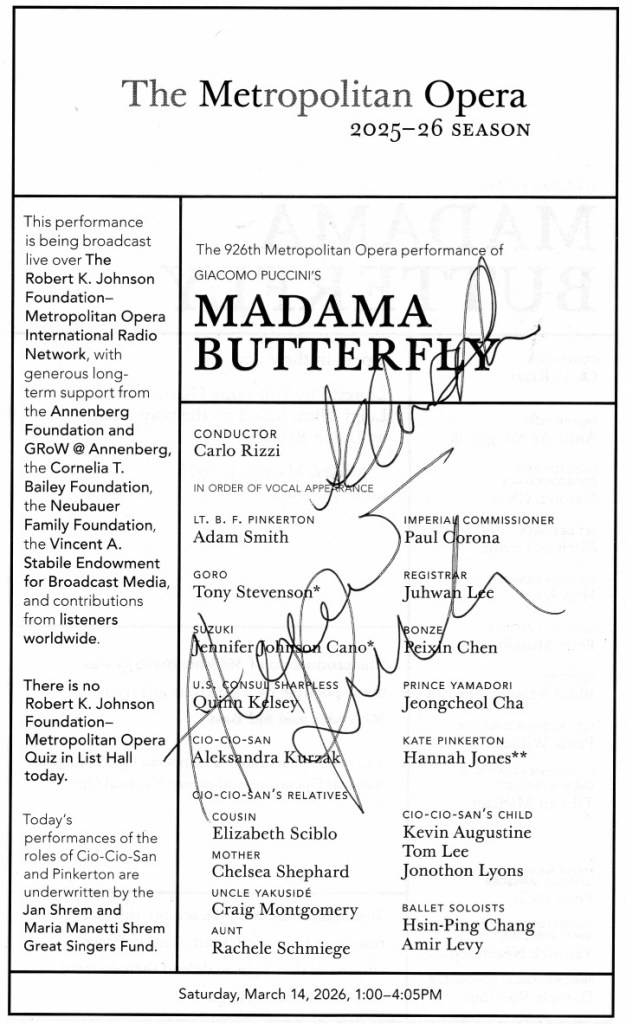
Following a warm ovation for all the singers, I went to the stage door where I met Ms. Kurzak and Mr. Smith. The soprano – so charmingly ‘real’ – regaled us with stories of what it is like to be a diva in this day and age: it’s not all champagne and roses. Her warmth and sense of humor made us feel like we were her long-time friends.
~ Oberon
 Oberon's Glade