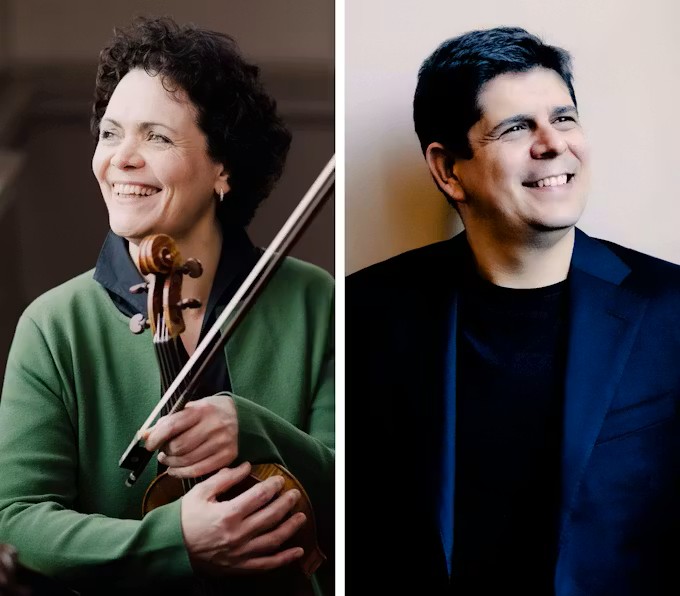
Above: Tabea Zimmermann and Javier Perianes; photos by Marco Borggreve
~ Author: Oberon
Sunday March 15th, 2026 – This was my first-ever viola recital. An appealing program drew me to Zankel Hall for an afternoon of inspired music-making by the German violist Tabea Zimmermann and her excellent colleague, pianist Javier Perianes.
Robert Schumann’s Fantasiestücke, Op. 73, were written in Dresden 1849; originally imagined for clarinet, the composer noted that they might also be played by violin or cello. The three-movement piece later became popular with violists for the possibilities for lyrical expressiveness they afford.
From a restless but dreamy start, Ms. Zimmermann displayed velvety tone; Mr. Perianes gave us gorgeous piano playing. A rise in passion gives way to melancholy. Continuing to the second song, we heard rippling piano motifs and a stream of melody from the viola; things get playful for a bit with Ms. Zimmermann offering some slithering scalework. The music gets rather wild, and there is a long build-up to a brisk finish.
Johannes Brahms’ Viola Sonata in E-flat Major, Op. 120, No. 2, like the opening Schumann, was originally written for clarinet. A glowing warmth pervades the first movement, described as amabile. The central movement is a scherzo; its mood swings to a hymn-like feeling before the initial theme returns. The finale andante/allegro begins warmly; it develops the air of a promenade, before reaching an exuberant finish. Superbly played, the Brahms felt very long to me this evening…but this composer’s music often seems over-extended to me as I move into old age.
Benjamin Britten’s Lachrymae is the composer’s only work for viola, accompanied by piano. Britten had played the viola in his youth, and he had dabbled in writing music for it though none of those sketches survived. In the 1970s, when I had fallen in love with ballet – having been introduced to it by my first lover, TJ – I heard the Britten piece and thought it cried out to be choreographed. I imaged it as a work for seven male dancers, and I even cast it – in my mind – from among the corps de ballet men of the New York City Ballet. Like many other creative ideas I had during those years, this one fell by the wayside.
Britten’s Lachrymae is a series of variations with the theme delivered at the end, rather than being heard first. As such, the variations hint at the work’s source of inspiration – an air by John Dowland – before it emerges in full. The first variation is somber and haunting; the viola goes high before taking up some chilling vibrations…the music calls for great control, in which Ms. Zimmermann revels. Variation two hesitant, with some whimsical plucking as Mr. Perianes offers a series of eerie chords. The third variation is languid and hushed, the fourth quite grand, with the viola digging in; a tune played over rambling keyboard motifs ends with a superbly sustained final note from the viola. In the fifth variation, the piano sounds sneaky whilst some drifting viola lines suddenly turn squeaky. Ghostly piano sounds and fragmented passages for the viola make up the sixth variation, and then we hear dirge-like music from the keyboard while the viola line feels frantic. Things settle in for a hopeful finale. The Zimmermann/Perianes duo were exceptional throughout this demanding and cherishable work.
Ms. Zimmermann and Mr. Perianes ended their program with the Shostakovich Viola Sonata. This was the composer’s final completed composition, completed literally as death awaited him. It’s awesome music, filled with so many distinctive ideas. Today’s performance of it was engrossing…and thrilling.
The opening moderato commences with plucked viola notes, and the piano evoking raindrops. A pensive descending viola theme gives the feeling of a wandering spirit. There is a sudden outburst, a revolt against death, with Ms. Zimmermann slashing her strings insistently. A chill settles over us; the music seems to be coming from another universe; it tapers down to a whisper before a gently plucked ending.
In contrast to the serious mood of the opening movement, the second feels very much like a scherzo. It opens with an insistent dance, tripping along before turning a bit glum. The viola is plucked over deep piano tones before the two play in unison. There is a viola cadenza leading to a fresh, irresistible dance. Following another unison passage, the viola gets restless. A fade-out leaves us with the viola alone.
With the adagio, we arrive at one of the most poignant movements in all the realm of music. From the eerie quoting of the iconic Moonlight Sonata motif, a gorgeous, blooming passage wells up. With periodic interjections of the moonlight beat, the music turns grand: viola and piano join in a theme best described as epic. The music is dense and disturbing, with the moonlight signature etched in. Then the very fabric of life seems to unravel; the music fades to nothingness.
The sold-out house erupted in cheers for Ms. Zimmermann and Mr. Perianes, and a massive standing ovation ensued. The duo returned for a simply sublime Clara Schumann encore.
~ Oberon
 Oberon's Glade