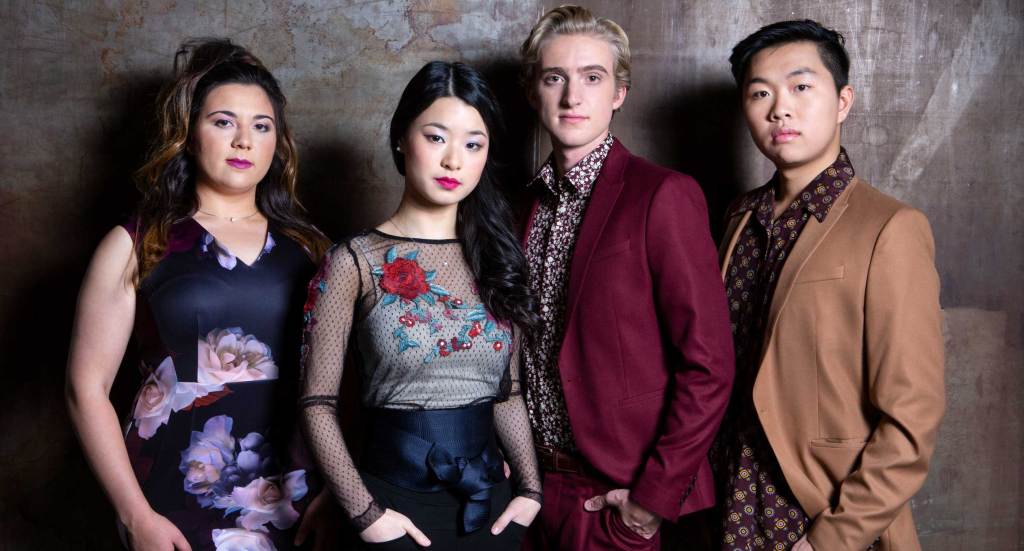
Above, the artists of the Viano Quartet: Aiden Kane, Lucy Wang, Tate Zawadiuk, and Hao Zhou
~ Author: Oberon
Sunday March 22nd, 2026 -The fantastic musicians of the Viano Quartet were back at Alice Tully Hall this evening as Chamber Music Society of Lincoln Center presented them in a finely-designed and wonderfully satisfying program.
Both of the women – Lucy Wang (violin) and Aiden Kane (viola) – chose gowns in different shades of green; the gentlemen (violinist Hao Zhou and cellist Tate Zawadiuk) looked very dapper in their tuxedos. Ms. Wang took the first chair for the opening work: Joseph Haydn’s Quartet in D-major for Strings, Hob. III:79, Op. 76, No. 5, composed in 1797. The opening Allegretto has a gracious, lyrical start. Things suddenly light up, but soon the main theme is revisited. The movement ends on a lively note. Mr. Zhou then rose and left the stage: a string had broken. His colleagues followed him.
After a few minutes, the players returned to the stage and took up where they’d left off: with the Largo, a poetic movement in the cantabile style. Ms. Wang opens with a tender theme, to which the others bring sweet harmonies, their timbres meshing in a polished blend. Ms. Kane’s velvety viola takes up the theme, then passes it on to Mr. Zawadiuk’s richly expressive cello. The exceptional tonal allure of each voice falls so lovingly on the ear.
With the Minuet, in which the cello is prominent, themes are passed from player to player. The movement has a sudden end, and then the lively, bustling music of the final Presto takes over. A steady beat from the viola keeps things pulsing along to an exuberant ending.
Music of Felix Mendelssohn came next: the Quartet in D-major, Op. 44, No. 1, dating from 1838. The agitato opening of the Molto allegro vivace (so exciting!) immediately confirms the reason Mendelssohn is so high on my list of favorite composers. Mr. Zhou is now the first chair, taking the lead with his impeccable playing. Great bowing from the Zawadiuk cello is as much fun to watch as to hear. The music veers into minor mode; a shivering motif from Ms. Kane’s viola is another delight. The pace slows, bringing on some rich harmonies. The cello is amiably plucked before descending to the depths. Things quieten, though tension remains. The music then sweeps on, with more shivers, to a big finish. I actually said “Wow!” aloud.
The voices entwine perfectly in the Menuetto; a flowing, nuanced solo from Mr. Zhou gets incredibly subtle; he plays on, delighting the ear. Plucked passages open the Andante, with cello tones anchoring a sublime blend. A violin cadenza eases into a plucked finish. The concluding Presto con brio has a scurrying start; endless pleasure is derived from hearing all the details brought out by each of the players. The viola glows; the speedy violins, the swift and sure passages of the cello…these elements unite so pleasingly. The “Viano blend” is in full bloom as the music dashes on to a sensational finish. The crowd was loving every moment of this Mendelssohn masterwork, bursting into fervent applause at the end.
After the interval, we heard Anton Webern’s gorgeous Langsamer Satz (1905). The piece is said to have been inspired by a hiking holiday in the mountains outside of Vienna, where Webern had taken his future wife. He is thought to have intended to write an entire quartet, but put it aside after completing this one movement. My companion was fascinated to hear this piece, which is so unlike the other Webern works she’s heard. The music’s Brahmsian beauty suits the Vianos to perfection..
Crowning the evening, Dmitri Shostakovich’s Quartet No. 9 in E-flat major, Op. 117, composed in 1964, is in five movements which progress without pause in one fantastical arc. It opens with viola and cello on a sustained note whilst the violins wander above. A plucking dance evolves as the viola sings. Fragments of melody are passed about, and a sense of longing develops. Another dance – this one galloping along as the cello saws away before trilling – turns more subtle. The music gets dreamy, and densely poetic. A searing violin passage brings a broadening quality of dense harmonies. The music develops a buzzing agitation, wild and insistent, before blazing onward with a strutting quality that oddly evokes the William Tell overture. The piece reaches its ending with the violin high in a serene heaven.
The program concluded with the triumphant Viano players basking in an epic standing ovation. As an encore, they offered the slow movement of Tchaikovsky’s first quartet. The reassuring beauty of their playing offered desperately needed solace in an ever-darkening world.
~ Oberon
 Oberon's Glade