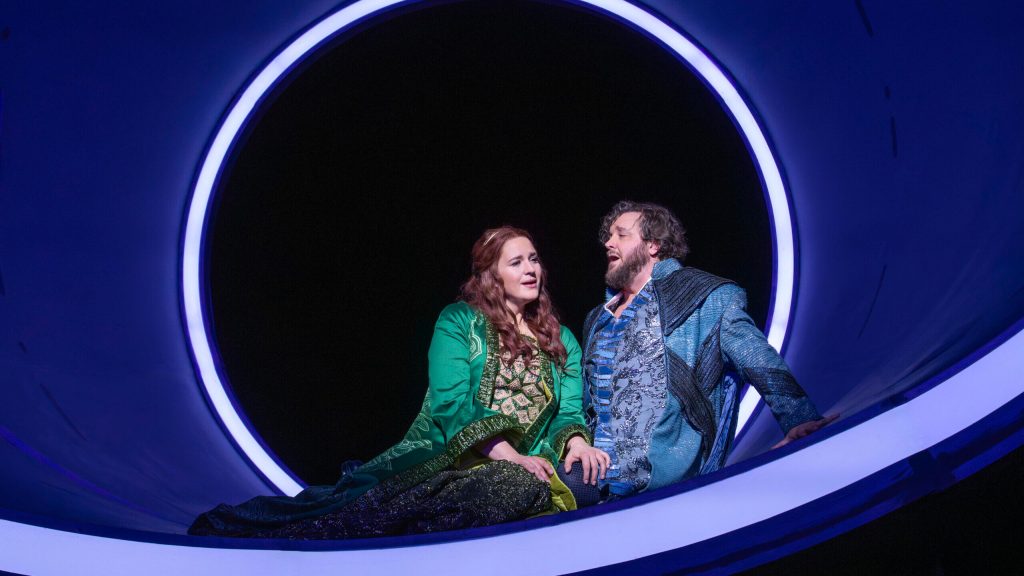
Above: Lise Davidsen and Michael Spyres as Isolde and Tristan; a MetOpera photo
~ Author: Oberon
Sunday March 29th, 2026 matinee – After several low-energy days, I thought seriously of skipping today’s matinee of TRISTAN UND ISOLDE at The Met. When the current season was announced, this Wagner masterpiece was at the top of my list of performances to attend. But as the date approached, the thought of a very long afternoon in the Met’s always-chilly score desk area found me in a “to-go-or-not-to-go” mood. So I made a deal with myself: to go for two acts.
It was an engrossing and wonderfully satisfying afternoon. The prelude alone was worth the trip: gorgeous playing (all afternoon) from the Met Orchestra made for a compelling sonic experience. Everyone knows how I feel about Yannick N-S, but this – along with his Met PARSIFAL in 2018 – was the best thing he has done in the House to date. Of course, true to form, there were patches where he let the orchestra swamp the voices; but I had expected there to be more of those passages. It was a relief to find him on his best behavior, though he could have done even more to support the voices is these long, arduous roles .
As the prelude faded away, a fantastic voice beamed out from the Family Circle: Ben Reisinger, a Met Young Artist, filled the darkened hall with his poetic rendering on the Sailor’s song. His voice holds great promise for the Wagnerian rep – and so much more – in the years to come: bravo…bravissimo!
The first act unfolded beautifully; though the orchestra did sometimes hinder the singers, Lise Davidsen and Ekaterina Gubanova managed to illuminate their phrases with lyrical flair. Mr. Reisinger repeats his song with some cunning modulations of dynamics. We hear Tristan (Michael Spyres) and Kurwenal (Tomasz Konieczny) for the first time; as the afternoon progresses, these voice will thrill us again and again.
Ms. Davidsen’s Narrative and Curse was inspired. Both in the dazzling focus of her high notes and in the urgency and poetry of her telling of her first meeting with Tristan, she lived the character so convincingly. Her “Er sag mir in die Augen…” gave me a frisson of romantic bliss. Her top-B was brilliant, though quickly released.
As the act progressed, the orchestra continued to periodically encroach on the voices; though her timbre is lovely, Ms. Gubanova does not quite have the carrying power to make Brangaene a force in drama. The potion is prepared, the orchestra so expressive. Mssrs. Spyres and Konieczny sound terrific; Ms. Davidsen’s lower register lacks colour in places. I noted that some people around me had nodded off. The final fanfares from the pit, which end Act I, awaken everyone.
Two longtime friends I had not seen in months came to chat with me during the extended interval. The house darkened; Yannick was heartily cheered as his return to the podium. The urgency and anticipation of the prelude were spoilt by a woman near me opening a crinkly bag of snacks: could you not have eaten during the Gelb-length intermission?
Ms. Davidsen’s top notes continue to ring true; Mr. Spyres brings a wonderful mix of lyricism and muscularity to his singing. The orchestra taxes the voices in the more strenuous passages. At last, the quiet ardor of “O sink hernieder, Nacht der Liebe” casts its spell over us. The voices of soprano and tenor achieve a beautiful blend, Ms. Davidsen finding a radiant softness of tone, whilst Mr. Spyres brings a tenderness of expression that no other Tristan in my experience has equaled.
Ms. Gubanova, in Brangaene’s two warnings, is lovely for the most part. Ms. Davidsen’s alluring piano phrases continue to entice; Mr. Spyres is thrilling as he commences “the liebestod theme”, igniting a flow of ecstatic singing that was simply sensational. Then, cruelly, the world crashes down about the lovers.
Ryan Speedo Green’s is not the type of voice one expects to hear in King Marke’s music, but as his long, heart-rending narrative progressed, he became increasingly persuasive…to the point where one wanted him to go on and on. Moments of heartbreak and despair over Tristan’s betrayal were achingly voiced, and the orchestra supported the singer poignantly. But as things became more intense, Yannick let the voice be covered, somewhat blunting the singer’s effectiveness.
Now Tristan turns to Isolde and asks if she will follow him into the realm of darkness: such melodious singing from Mr. Spyres…bravo!! Ms. Davidsen’s reply is hauntingly rendered. Wagnerian magic abounds, until Melot’s sword pierces Tristan.
Michael Spyres talks to HD host Lisette Oropesa about singing Tristan; watch and listen here.
~ Oberon
 Oberon's Glade