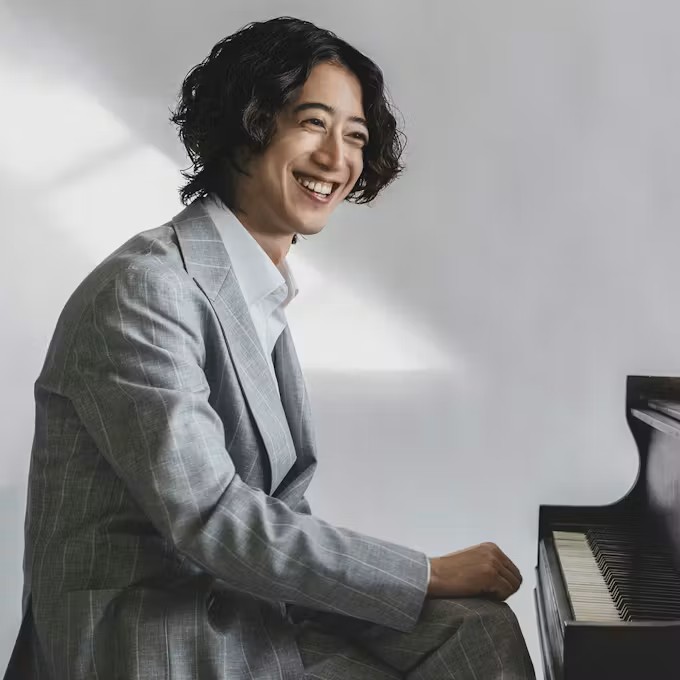
Above: pianist Hayato Sumino
~ Author: Kevin DallaSanta
Tuesday March 31st, 2026 – Fresh from his Carnegie Hall debut, pianist Hayato Sumino returned tonight to the Perelman Stage, performing Gershwin’s Piano Concerto with the Philadelphia Orchestra, led by Marin Alsop.
Both composer and pianist straddled the classical-jazz divide. For Gershwin, who was riding on the recent success of his Rhapsody in Blue, the commissioned concerto was an earnest attempt at academic writing. Gershwin’s use of traditional form and motivic unity appealed to the critical sensibilities of discerning ears, without compromising on the “blue” harmonies and rhythmic vitality that had made his Rhapsody a public success.
For Sumino, the concerto offered a chance to show off his classical bona fides alongside his love of jazz and improvisation. As in his strong showings at the XVIII Chopin Competition and his Carnegie debut, last fall, in solo recital, Sumino demonstrated great attention to detail and a formidable technique, with ferocious octaves and crystalline passagework. Together with Alsop, Sumino provided a compelling reading and avoided the triteness that often afflicts performers in the melancholy sections of Gershwin’s music.
However, in a crowded landscape of soloists, it is Sumino’s improvisational abilities that have differentiated him as a pianist and attracted a vast following on social media. After an improvised cadenza in the final movement, the vigorous response of the audience brought an encore improvisation on I’ve Got Rhythm. The song is closely associated with Earl Wild, who transcribed it for piano, and like Sumino crossed between jazz and classical idioms with fluency. Sumino’s take on the tune was delightful and full of clever references, such as Chopin’s A-flat Polonaise.
Classical purists may balk at the presence of Gershwin on a program, the substitution of improvisation for written cadenzas, or the role of social media as performing artists adapt to a changing public. Nonetheless, the enthusiastic response to Sumino’s musical offerings speaks to Carnegie’s efforts at diversifying their programming. If pianists can avoid typecasting, in the modern era, Sumino’s well-rounded abilities promise many interesting performances to come.
Preceding the concerto was the New York premiere of The Rock You Stand On, by John Adams, in its New York premiere. Like Gershwin, Adams frequently draws from American jazz alongside the classical tradition. Consistent with his other short orchestral works, such as Short Ride in a Fast Machine, this commission featured syncopated rhythms and minimalistic development. Dense harmonic clusters primarily drive the texture and rhythm, with only a secondary impact on modal shifts.
The program noted Adams’ mutual affinity with Alsop. Her forward-pressing momentum and vigorous baton were an excellent match for the work’s propulsive energy and staccato chords. Adams often groups sections into competing motifs, such as bursts of brass vying with string ostinati for musical dominance. At times, the volumes between sections were not equally balanced, stemming either from orchestration or from realization.
Commissioned composers often face a difficult choice between refining their existing style and innovating. Taken as a whole, Adams’ creative legacy includes many instances of risk-taking, such as Nixon in China (which Alsop has recorded) and On the Transmigration of Souls. Fans of Adams’ signature style will not be disappointed with this addition to his oeuvre. With time, The Rock You Stand On will take its place in his output.
After intermission, the orchestra turned to Prokofiev’s Romeo and Juliet. Delectable, succulent, and rich, Prokofiev’s take on the tale is among the best standalone scores in the ballet repertoire. The composer’s harmonic language shines as tonal chords resolve in unexpected ways, paralleling the bitter twists that characterize Shakespeare’s tragedy.
Romeo and Juliet spotlighted Philadelphia’s particular strengths: a sweet, warm tone, and smooth handoffs between instrumental sections. Alsop paid close attention to the narrative of the work, highlighting the many motifs that define the characters and their struggles. However, dynamic imbalances persisted, compounded by the live acoustics of the hall. It may be that Severance, where Alsop is principal guest conductor, provides more favorable acoustics. Or perhaps the Prokofiev is simply too much fun to play with restraint. After all, the young protagonists themselves loved with abandon.
In creating a separate orchestral version, Prokofiev invites questions about the subtractive nature of art. Is his ballet still Shakespeare without actors to tell the tale? Are the orchestral suites less-than for the lack of dancers, or do they stand on their own as a purely musical work? The enduring popularity of the work suggests that audiences, at least, find that the original narrative enhances the music.
In a fortunate coincidence, this performance of Romeo and Juliet precedes a summer staging with the Public Theater at the Delacorte in Central Park, and follows a recent staging at Stag & Lion Theatre Company. Shakespeare’s classic tale appears to benefit from continual reinterpretation, inspiring ballets, Broadway, and film. In the subsequent season at Carnegie, Philadelphia will explore another ballet, Ravel’s Daphnis et Chloé.
~ Kevin DallaSanta
 Oberon's Glade