~ Author: Kevin DallaSanta
Thursday April 9th, 2026 – Led by music director Andris Nelsons, the Boston Symphony returned to Carnegie Hall on this evening: a long-planned engagement jolted by news last month of Nelsons’ dismissal.
The night was originally slated to be a straightforward offering of works by John Adams and Dvorak, part of Carnegie’s “United In Sound” festival celebrating two hundred and fifty years of American music. For Nelsons, it became a victory tour of sorts, as he received raucous applause from the audience at the Hall, and enthusiastic foot stomping from his orchestra members, who have already voiced their support publicly.
Coincidentally, the first work of the program—three scenes from Nixon in China—is also a tale of clashing leaders and media spectacle. In the opera, the Nixons proceed through their historic visit with a mix of diplomatic braggadocio, bumbling misunderstanding, and occasional self-reflection. The libretto, by Alice Goodman, is more impressionistic than narrative, and conveys a sense of uncertainty under the facade of foreign affairs.
From the three-hour opera, Boston excerpted three scenes featuring Nixon and his wife, sung by Thomas Hampson and Renée Fleming, respectively. Both are reliable soloists, and executed the difficult vocal parts with clarity and diction; in fact, Hampson performed the role at the Paris Opera last month. Inexplicably, the unfilled soloist roles were sung by the entirety of the chorus, rather than individual members.
Adams depicts the diplomatic pressure and nerves using ceaseless rhythmic pulsations. This approach requires a great deal of work from the instrumentalists, who must play repeated figures at length, all the while counting bars to their next change of syncopation. Perhaps they are the toiling laborers lauded by the communists in the libretto; or perhaps they are just unlucky.
Despite the passage of five decades since the events took place, Nixon’s boasting, obsession with TV, frequent references to the space program, and rambling inner monologue ring eerily prescient. “I know America is good at heart,” Nixon says; but the year is 1972, and the audience knows what he was really thinking.
Dvorak’s Ninth Symphony occupied the second half of the program. A perennial crowd-pleaser, the work carries itself, with its famous English horn solo and bombastic brass finale. Dvorak enthusiastically credited Native American and Black music as inspiration. Dvorak’s Ninth is also strongly associated with the City, having been commissioned by the New York Philharmonic, during the composer’s time here, and premiered at Carnegie Hall. One can find a statue of the composer in Stuyvesant Square, and a plaque on his residence nearby.
The familiar symphony can nearly play itself, but Nelsons engaged actively with the orchestra, gesturing and shaping motifs as they passed between sections. The performance was anchored by excellent timpani work from principal Tim Genis. With extensive applause, Nelsons had plenty of time to acknowledge him and other individual musicians; indeed, Nelsons seemed ready to have every member stand up in turn. His own reluctant bow, as the concertmaster remained seated, was greeted with a roar from the audience. In a rare gesture of high praise, Nelsons was repeatedly brought back onstage by rhythmic clapping, unusual for a New York audience accustomed to rushing for the train.
“In politics, perception is reality,” both for Nixon in China and Nelsons in Boston. The unusual step by Boston’s management to release a statement appears to have backfired, in the court of public opinion, and Nelsons will likely receive a flurry of invitations. In New York, at least, spirits were high and the mood was optimistic.Thursday April 9th, 2026 – Led by music director Andris Nelsons, the Boston Symphony returned to Carnegie Hall on April 9, a long-planned engagement jolted by news last month of Nelsons’ dismissal.
The night was originally slated to be a straightforward offering of works by John Adams and Dvorak, part of Carnegie’s “United In Sound” festival celebrating two hundred and fifty years of American music. For Nelsons, it became a victory tour of sorts, as he received raucous applause from the audience at the Hall, and enthusiastic foot stomping from his orchestra members, who have already voiced their support publicly.
Coincidentally, the first work of the program—three scenes from Nixon in China—is also a tale of clashing leaders and media spectacle. In the opera, the Nixons proceed through their historic visit with a mix of diplomatic braggadocio, bumbling misunderstanding, and occasional self-reflection. The libretto, by Alice Goodman, is more impressionistic than narrative, and conveys a sense of uncertainty under the facade of foreign affairs.
From the three-hour opera, Boston excerpted three scenes featuring Nixon and his wife, sung by Thomas Hampson and Renée Fleming, respectively. Both are reliable soloists, and executed the difficult vocal parts with clarity and diction; in fact, Hampson performed the role at the Paris Opera last month. Inexplicably, the unfilled soloist roles were sung by the entirety of the chorus, rather than individual members.
Adams depicts the diplomatic pressure and nerves using ceaseless rhythmic pulsations. This approach requires a great deal of work from the instrumentalists, who must play repeated figures at length, all the while counting bars to their next change of syncopation. Perhaps they are the toiling laborers lauded by the communists in the libretto; or perhaps they are just unlucky.
Despite the passage of five decades since the events took place, Nixon’s boasting, obsession with TV, frequent references to the space program, and rambling inner monologue ring eerily prescient. “I know America is good at heart,” Nixon says; but the year is 1972, and the audience knows what he was really thinking.
Dvorak’s Ninth Symphony occupied the second half of the program. A perennial crowd-pleaser, the work carries itself, with its famous English horn solo and bombastic brass finale. Dvorak enthusiastically credited Native American and Black music as inspiration. Dvorak’s Ninth is also strongly associated with the City, having been commissioned by the New York Philharmonic, during the composer’s time here, and premiered at Carnegie Hall. One can find a statue of the composer in Stuyvesant Square, and a plaque on his residence nearby.
The familiar symphony can nearly play itself, but Nelsons engaged actively with the orchestra, gesturing and shaping motifs as they passed between sections. The performance was anchored by excellent timpani work from principal Tim Genis. With extensive applause, Nelsons had plenty of time to acknowledge him and other individual musicians; indeed, Nelsons seemed ready to have every member stand up in turn. His own reluctant bow, as the concertmaster remained seated, was greeted with a roar from the audience. In a rare gesture of high praise, Nelsons was repeatedly brought back onstage by rhythmic clapping, unusual for a New York audience accustomed to rushing for the train.
“In politics, perception is reality,” both for Nixon in China and Nelsons in Boston. The unusual step by Boston’s management to release a statement appears to have backfired, in the court of public opinion, and Nelsons will likely receive a flurry of invitations. In New York, at least, spirits were high and the mood was optimistic.
~ Kevin DallaSanta
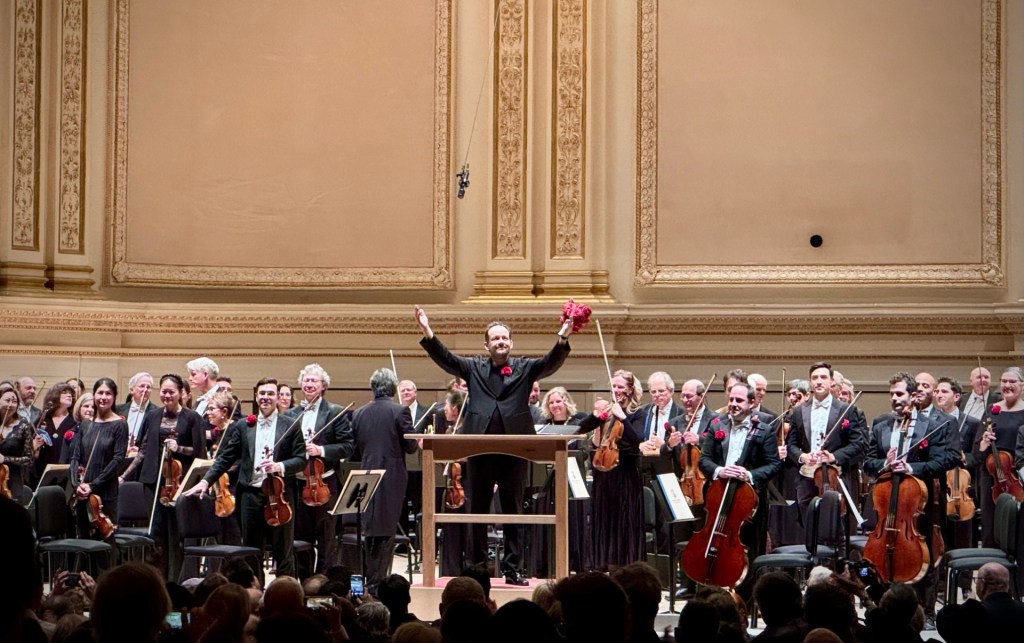
Performance photo by Kevin DallaSanta
 Oberon's Glade