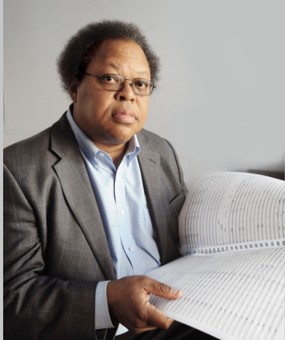
Above: composer George Floyd
Author: Kevin DallaSanta
Wednesday April 8th, 2026 – Soprano Golda Schultz joined the New York Philharmonic for a fascinating program led by conductor Kwamé Ryan. Featuring emotionally dense and intellectual works, the program explored existential themes through the lens of American composers.
Schultz was to sing three powerful works: Barber’s Knoxville: Summer of 1915; Stravinsky’s “No Word from Tom”, from The Rake’s Progress; and Floyd’s “The Trees on the Mountain,” from Susannah.
The first, Barber’s Knoxville, is a pinnacle of American writing for voice. The text, written by James Agee, narrates a summer evening from the perspective a young child. As is the way with children, the telling is a collage of sensory impressions and feelings. But between the lines, Agee conveys a subtext of nostalgia and the child’s dim understanding of loss and growing older. Barber masterfully develops this subtext in the orchestral accompaniment, who comment from a grown-up’s perspective. They, like the audience, understand the bittersweetness of the soloist’s naive words.
The second, Stravinsky’s “No Word from Tom,” finds the protagonist ghosted by her lover. She reflects on her plight but resolves to set out and find him. The opera, written in English and based on a set of paintings, is both praised and criticized for its neoclassicism; one could nearly mistake the aria for translated Mozart. Although Stravinsky was the only non-American composer on the program, the English language kept a sense of immediacy and tension for the evening’s existential theme.
The third, Floyd’s “The Trees on the Mountain”, is sung by a protagonist who experiences rejection from her religious community. Schultz did not sing the work in concert, due to vocal issues, but the work deserves listening on recording. Floyd’s gift for melody and sparing orchestration underscore the character’s isolation and add further heartbreak to the opera’s tragic plot.
Schultz’s voice is warm and pleasing, and her minimal vibrato emphasized the innocent nature of the characters. She performed with expressive acting, making Knoxville feel like an aria from some larger opera—a fresh and thought-provoking take. Ryan, who has won a Grammy for his conducting of new opera, provided excellent accompaniment, attuned to her nuance and deferential of the strong solo parts.
In addition to the three vocal works, the program included three instrumental works, of no less existential weightiness. The evening opened with Ives’ The Unanswered Question and closed with Barber’s Second Essay for Orchestra.
The Ives set a serious tone for the rest of the program, depicting the vain endeavor to answer the question of existence. Both Ives and Barber write rich tonal harmonies, providing a sense of familiar comfort, but use polytonality to disrupt that comfort with intrusive thoughts. The effect is like a bubble bath interrupted by a splash of cold water. The Barber is not explicitly programmatic, but its triumphant major resolution served in some respects as the “Answered Question”, concluding the program’s existential peregrination.
In both pieces, Ryan provided close attention to detail and a sense of rhythmic vitality. These aspects were particularly key for the new work of the program: George’s Lewis’ “…ohne festen Wohnsitz” (“…without a fixed abode”), in its world premiere.
The new work, co-commissioned by the Philharmonic, reflects Lewis’ research into the life of eighteenth-century African–German philosopher Anton Wilhelm Arno. Lewis writes: “I aim to remind listeners of our endemic condition of instability,” with concerns about colonialism, race, and institutions front of mind. The style of the piece was atonal and seemingly aleatoric—a genre sometimes called “experimental music,” which misleadingly implies that this sort of art has not been carefully cultivated across decades of composers’ efforts.
It can be helpful to interpret such atonal works in terms of sonic texture: loud crashes of sound alternate with shimmering, reflective pianissimos; and instruments produce both harsh scratches and dulcet tones. The impression is initially random chaos, but Lewis’ design gradually becomes clear, with an intentional progression of emotions.
Although the work largely defies classical conventions, Lewis does invoke a concerto model by featuring the New York quartet Yarn/Wire at the front of stage. With two keyboardists and two percussionists, the quartet dialogued with the orchestra and played three improvised cadenzas. Critics of new music will have well-worn responses to the premiere; but to stop there is to miss Lewis’ extremely active role in cultural and musical circles. By exploring the notion of “without a fixed abode,” and challenging the audience in their role as listeners, Lewis’ commission aligned with the program’s overarching existential theme.
The intellectual weight of the evening was further deepened by the presence of a Black conductor, Black soloist, and Black commissioned composer. Black music and musicians have certainly faced an existential journey, and the classical world is still struggling to reparate, even as it struggles to adapt to modernity. The works of Barber lose none of their potency over time, but the inclusion of new voices, both compositional and on stage, drew loud cheers from the audience. At intermission, Lewis could be seen in the aisle smiling and discussing animatedly with audience members. For a time, his hand is the one we can shake.
~ Kevin DallaSanta
 Oberon's Glade