Author: Philip Gardner

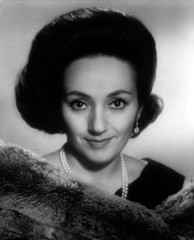
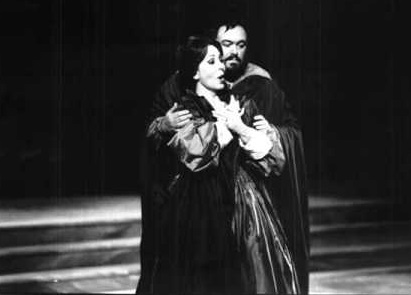
  • Consuelo Rubio

    A-1241315-1532445277-3560.jpeg

    Spanish soprano Consuelo Rubio (above) studied voice in Madrid and came to public attention in 1953 when she won the International Voice Competition at Xinebra.

    Her career took her to the Spanish music centers as well as to Aix-en-Provence, Chicago, Vienna, Rio de Janeiro, Munich, Amsterdam, Rome, Brussels, Turin, Buenos Aires, and the Hollywood Bowl; her wide-ranging repertoire included Susanna in NOZZE,  Carmen, Mimi, Donna Elvira, Eva in MEISTERSINGER, Elisabetta in DON CARLO, and Strauss’s Ariadne.

    Consuelo Rubio did not leave many recordings – and some of the ones she did make were only issued on vinyl. But here is a sampling of her spirited, soprano Carmen:

    Consuelo Rubio – Seguidilla – CARMEN – Leopold Simoneau

    She also Marguerite on the classic Igor Markevitch 1961 recording of Berlioz’s DAMNATION DE FAUST:

    Consuelo Rubio – D’amour l’ardente flamme ~ DAMNATION DE FAUST

    Ms. Rubio passed away in 1981 at the age of 54. 

    ~ Oberon

  • Anne-Sophie Mutter ~ Beethoven Evening

    CH1766263_Medium_res_comp

    Above: Anne-Sophie Mutter, photographed during the performance by © Jennifer Taylor.

    ~ Author: Oberon

    Thursday January 30th, 2020 – As the Beethoven Celebration year kicks off, only a handful of the announced “all-Beethoven” programs that are scheduled here in Gotham are of interest to me. But I would not have missed Anne-Sophie Mutter’s performance at Carnegie Hall tonight for anything. The esteemed violinist offered a pair of sonatas book-ending the “Ghost” trio. Ms. Mutter’s longtime collaborator, Lambert Orkis, was at the Steinway, and cellist Daniel Müller-Schott joined them for the trio.

    The comely violinist, now in the 40th year of her professional career, was warmly welcomed by a packed house as she walked onto the Carnegie Hall stage in a black gown bedecked with silver appliqué. She and Mr. Orkis immediately commenced the violin sonata No. 5 in F-Major, Op. 24, fondly known as “Spring”: the blithe opening passages were played softly, at once settling the audience and drawing them in.

    This opening Allegro continues thru a series of lyrical themes in which the two players alternate roles: melodist and accompanist. Minor key intrusions sometimes imply that clouds are passing overhead, but the sunshine always returns. A unison section shows the advantages of a longtime musical partnership: simply perfect.

    In the ensuing Adagio molto espressivo, Ms. Mutter and Mr. Orkis sustained a heavenly, pensive atmosphere with playing of exquisite delicacy and spun-out legato: they seemed to cast a spell over the venerable Hall. With a charming light touch, the Scherzo is over before it starts, and we are plunged into the Rondo – Allegro ma non troppo, in which almost Mozartean pleasantries are sometimes interrupted by jolts of fast and furious playing. But all’s well as ends well, and the Springtime sun illuminates the sonata’s optimistic ending.

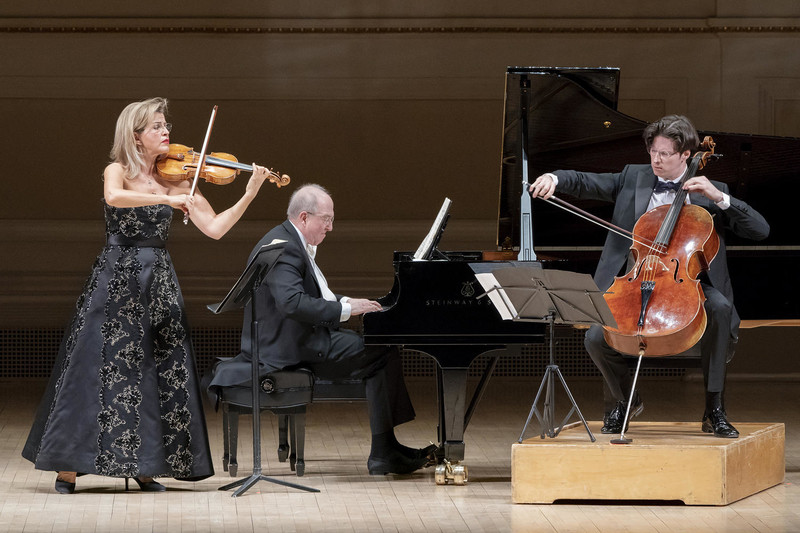
    CH1766260_Medium_res_comp

    Above: Ms. Mutter and Mssrs. Orkis and Müller-Schott, photo © Jennifer Taylor.

    The Piano Trio in D Major, Op. 70, No. 1, “Ghost” brought cellist Daniel Müller-Schott to the stage, joining Ms. Mutter and Mr. Orkis. 

    The energetic start of this popular trio, in which the cello quickly establishes a prominent place, leads on to a flowing lyricism with deftly rolling piano motifs which Mr. Orkis delivered with gracious sweep.

    The eerie start of the Largo heralds the movement which gives this trio its sobriquet: “Ghost.” A mournful theme from Mr. Müller-Schott’s cello is soon mingling with Ms. Muller’s bittersweet violin colorations. Again Mr. Orkis’s mastery of the piano’s softest dynamics is mesmerizing. Passion waxes and wanes as the movement approaches its finish, and Mr. Orkis plays a long and spell-binding downward scale in which every note has a quiet luminescence.

    Melancholy is swiftly dispelled by the opening of the concluding Presto. Mr. Orkis interjects flourishes of filigree as the music wends its way forward with alternating currents of vitality and delicacy. There were fleeting moments in the Trio this evening that made me feel that intonation was slightly off, but only by a hair’s breadth.

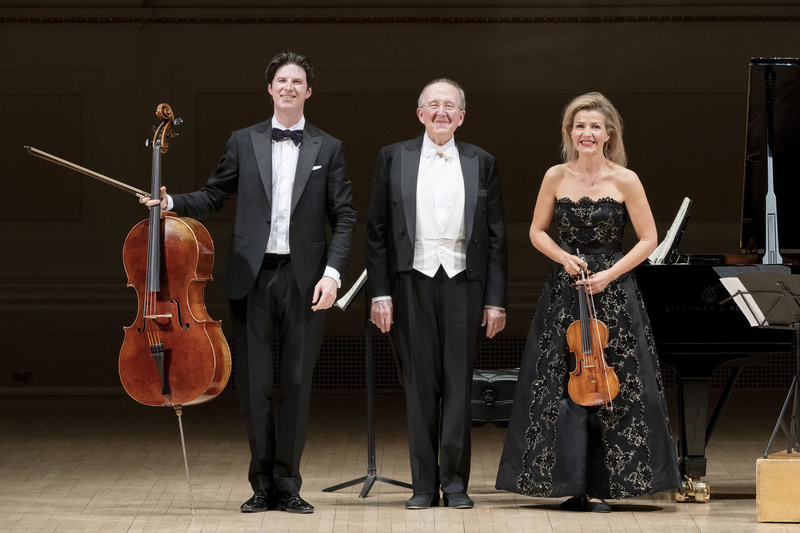
    CH1766262_Medium_res_comp

    Above: taking a bow after the “Ghost” trio, photo © Jennifer Taylor.

    During the interval, DK and I were anticipating our second “live” encounter with the Kreutzer sonata, Beethoven’s Op. 47, in the span of a month’s time. This epic work, which places so many demands on the two musicians, found the Mutter/Orkis partnership at its inimitable best.

    An intrusion at the very start almost destroyed the performance: just as the first notes were sounding, a very loud cellphone with a chiming ring tone-blared from one of the boxes. The culprit hastily fled, and for a moment I thought the musicians might pause and start over. But they moved on, leaving me to re-connect with the music as best I could. The playing was simply magnificent, with both players reveling in the bravura demands of the first movement’s Presto section. Together they brought a great sense of structure and musical coherence to the entire work.

    The “theme” of the ensuing Andante is a descending phrase which Arrigo Boito may have subconsciously lifted for the aria “Dai campi, dai prati” in his opera MEFISTOFELE. A ‘theme and variations’ setting develops, in which Ms. Mutter’s high-flying coloratura and enchanting trills ravished the ear. 

    The sonata’s Finale is exhilarating, with the irresistible impetus of a tarantella. A feeling of joy seemed to fill the house as the music sped on its way, Ms. Mutter and Mr. Orkis musically to urginge us to cast off our woes and – at least for the moment – savour the genius of Beethoven as played by two incredible artists.

    A massively enthusiastic full-house standing ovation commenced the moment the music ended. Ms. Mutter announced an encore: Beethoven’s Allegro in G-major, for mechanical clock, as arranged by Willy Hess. This little gem was delivered with tongue-in-cheek charm.

    Re-called by further waves of applause and cheers, Ms. Mutter charmingly introduced her second encore: an arrangement of ‘Nice To Be Around’ from the film Cinderella Liberty, part of her recent collaboration with composer John Williams. This beautiful tune was beautifully shaped by violinist and pianist.

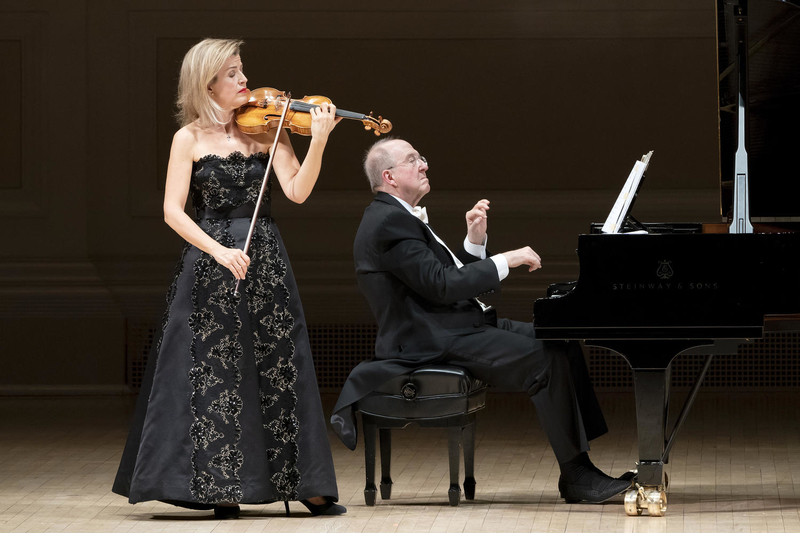
    CH1766261_Medium_res_comp

    Above: Ms. Mutter and Mr. Orkis, photo © Jennifer Taylor.

    All performance photos are © Jennifer Taylor, courtesy of Carnegie Hall.

    ~ Oberon

  • Omer Quartet | Hanzhi Wang @ YCA

    Hanzhi+Wang

    Above: Hanzhi Wang

    ~ Author: Oberon

    Wednesday January 29th, 2020 – For this concert in their noon-time series at The Morgan Library, Young Concert Artists brought together the Omer Quartet and accordionist Hanzhi Wang in a wide-ranging program.

    Ms. Wang opened the performance with three Scarlatti keyboard sonatas, K. 9, 146, and 159. These amply displayed Ms. Wang’s agile technique and rhythmic control. Her swift filigree passages were deftly dispatched, and the rich sound of the instrument’s lowest range added an earthy dimension; in fact, the music took on an appealing – almost folkish – quality at times. Woven into the accordionist’s exhilarating playing were some wonderful subtle touches. Very quickly, Ms. Wang had audience in the palm of her hand.

    Alfred Schnittke’s Revis Fairy Tale, dating from 1978, is a suite of dances which – truly – made me feel like dancing. In the first of four movements, Chichikov’s Childhood, the music is quite melodious and feels traditional; here Ms. Wang’s broad dynamic range came into play. The second movement, Officials, brought SWAN LAKE to mind…specifically, the ‘four cygnets’ motif. The music takes on a more ‘modern’ feel, with discordant passages of jazzy angularity cropping up. Waltz has a somber start, and the melody is low-lying. Later, one feels the waltzers might be drunk…or dotty. After a rise of passion, the music turns dour and ends with a downward slide. The concluding Polka was a lot of fun, with Ms. Wang breezing thru the composer’s demands and winning a burst of enthusiastic applause. 

    Moritz Moszkowski’s Etincelles figured in Ms. Wang’s 2018 concert at Zankel Hall, and I enjoyed encountering it again today. Full of almost giddy scales, and covering the accordion’s very wide range, the piece is a charming showpiece for Ms. Wang, with a witty ending.

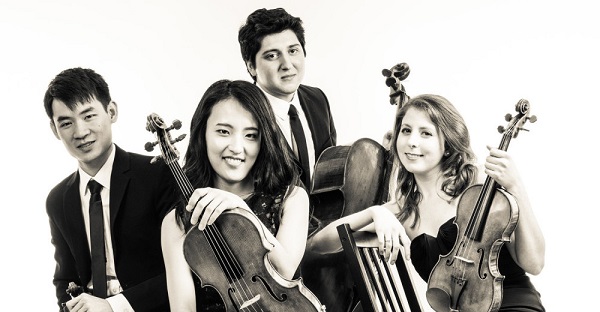
    Omer Quartet

    Above, the Omer Quartet: Mason Yu (violin), Jinsun Hong (viola), Alex Cox (cello), and Erica Tursi (violin).

    The Omer Quartet then took the stage for a very impressive performance of Haydn’s String Quartet in G-minor, opus 20, #3. The opening movement, Allegro con spirito, is full of mood swings. Immediately, the congenial blend of voices these players have achieved together assures us we are in for a treat. First violinist Mason Yu is a master of dynamic subtlety, and he and his colleagues illuminated the music in a perfectly-paced performance, with hints of hesitations here and there an added delight.

    In the Minuetto, Mr. Yu brings sweetness of tone to the poignant violin melody whilst the other players weave harmonies tinged with sadness. In the more optimistic interlude, things cheer up a bit although minor-key twinges continue to intrude. A return to the opening mood carries the music forward, but then it seems to stop in mid-phrase.

    Already at such a high level, the Omer Quartet went beyond in the Adagio, creating a palpably poetic atmosphere with playing of searing beauty. Emerging from the movement’s chorale-like opening, cellist Alex Cox commences a moving line that flows among lovely harmonies. Mr. Yu’s high pianissimo passages waft on the air, and violist Jinsun Hong and violinist Erica Tursi have opportunities to shine. Throughout, the cellist’s glowing tone and expressive phrasing are captivating.

    The final Allegro molto is animated – even agitated – veering between major and minor, with infinitesimal hesitancies along the way. The cumulative effect of the Omer’s Haydn this afternoon was both musically engrossing and emotionally gratifying. 

    Young Concert Artists composer Katherine Balch then introduced her work for string quartet, With each breathing, which she said was inspired by the notion of expressing aspects of the act of breathing in musical terms. The work’s title seemed somewhat ironic, but in fact the composer succeeded in her intent with music ranging from sighs and whispers to more labored and dramatic effects. The work’s exploration of textures was ideally set forth by the musicians of the Omer Quartet: a composer could not ask for better advocates.

    For the afternoon’s finale, excerpts from Five Tango Sensations by Astor Piazzolla brought together Ms. Wang and the Omer Quartet; this music had figured prominently in the accordionist’s 2018 Zankel Hall concert. With an intrinsic feel for both the allure and the danger that threads thru these tangos, the five musicians brought rich, haunting colours and irresistible rhythmic sway to the music.

    This highly enjoyable concert ended with the artists receiving a very warm ovation. The hall’s size and acoustic make it ideal for chamber music. And was that Anne-Marie McDermott seated a couple of rows in front of us?

    The performance was live-streamed, and may be seen here.

    ~ Oberon

  • Franz Mazura Has Passed Away

    Mazura

    The great Austrian singing-actor Franz Mazura has passed away at the age of 96. Mazura made his operatic debut at Kassel in 1949, and went on to appear at numerous German theaters in a wide variety of roles. His career eventually took him to the great stages of Paris, Vienna, Bayreuth, and New York City.

    Mazura was a stalwart at the Bayreuth Festival for fifteen summers, beginning in 1971. His most frequent Wagnerian roles were Alberich in the RING Cycle and Klingsor in PARSIFAL, but he also sang the Wanderer and Gurnemanz at the Wagner shrine.

    Franz Mazura as Gurnemanz – Bayreuth 1973

    Cap189

    At Bayreuth, he appeared in 1976 as Gunther in the controversial Pierre Chéreau centennial production of the RING Cycle: photo above, with Dame Gwyneth Jones as Brunnhilde.

    In 1979, Mazura sang Doctor Schön and Jack the Ripper in the premiere of the completed version of Alban Berg’s LULU at the Paris Opéra, conducted by Pierre Boulez.

    After making his Metropolitan Opera debut in 1980 in the Berg double-role, Franz Mazura went on to appear on The Met stage 175 times. In 1989, he was a magnificent Alberich in the RING Cycle, my first experience of seeing the Cycle in the span of a week. Earlier, in 1987, he had stepped in as Wotan in WALKURE, a performance my friend Paul Reid attended; Paul described Mazura as “…a cantankerous god.”

    Franz Mazura’s final Met appearance was as Schigolch in LULU in 2002.

    Here is a sampling of his extraordinary portrayal of Klingsor:

    PARSIFAL – scene from Act II – Leonie Rysanek & Franz Mazura – Met bcast 1985(1)

    Among the many roles Franz Mazura sang in his long career was the Spirit Messenger in DIE FRAU OHNE SCHATTEN:

    Helga Dernesch & Franz Mazura – FRAU OHNE SCHATTEN ~ opening scene – C Perick cond – Met 1989

    He displayed his versatility in such roles as La Roche in CAPRICCO, Pizarro in FIDELIO, Scarpia in TOSCA, the Doctor in WOZZECK, Creon in OEDIPUS REX, and the Speaker in ZAUBERFLOETE. His final operatic appearance was at Berlin as Schwarz in MEISTERSINGER on April 21st, 2019…the eve of his 95th birthday.

    Franz Mazura appears in the film of Pierre Chéreau‘s 2013 production of ELEKTRA from the Aix-en-Provence Festival; he makes a touching effect as the Tutor of Orest.

    ~ Oberon

  • Lydia Johnson Dance ~ Studio Event

    DSCF2451

    Above: Stephen Hanna and Katie Martin-Lohiya

    On Sunday, January 26th, 2020, Lydia Johnson Dance presented excerpts from their repertoire – including a new work-in-progress set to music of Ludwig van Beethoven (celebrating the composer’s 250th birthday!) – at a studio showing held at the Alvin Ailey Dance Center. The afternoon offered a preview of the Company’s 2020 season, wherein Craig Hall and Stephen Hanna, both former members of New York City Ballet, will appear as guest artists.

    Due to a conflict, I was unable to attend the studio event, but Dmitry Beryozkin provides these images:

    DSCF2893

    Brynt Beitman and Kate Martin-Lohiya

    DSCF3113

    Brynt Beitman and Min Kim

    DSCF3672

    Laura DiOrio and Craig Hall; this is Craig’s second season guesting with Lydia Johnson Dance

    DSCF3353

    Stephen Hanna and Katie Martin-Lohiya; Stephen previously appeared as a guest with Lydia Johnson Dance in 2018

    DSCF3822

    Katie Martin-Lohiya, Craig Hall, Min Kim, and Catherine Gurr in a passage from the new Beethoven piece, which draws inspiration from the writings of Edith Wharton

    DSCF3835

    Brynt Beitman and Craig Hall, with Katie and Min

    DSCF3815

    DSCF3872

    The ensemble

    Lydia Johnson Dance‘s annual New York season will be at the Ailey Citigroup Theatre on June 17, 18, and 19, 2020.

    ~ Oberon

  • All-French Program @ Chamber Music Society

    Paulhuang

    Above: violinist Paul Huang

    ~ Author: Oberon

    Sunday January 26th, 2020 – As darkness continues to settle over the world at an alarming rate, the reassurance of great music, poetry, and art becomes increasingly essential in keeping our spirits from being battered down beyond repair. Tonight’s program of music by three French masters, played with elegance and passion by a quartet of extraordinary artists, was an uplifting experience such as Chamber Music Society of Lincoln Center are wont to offer us.

    In her enlivening and reassuring speech of welcome, the Society’s co-Artistic Director (and tonight’s pianist) Wu Han spoke of the connection between the program’s three composers: Camille Saint-Saëns was the teacher of Gabriel Fauré, who in turn taught Maurice Ravel. Though the perfume of each work is distinctive, the feeling of a continuum was a key element as the evening progressed.

    Saint-Saëns’ Trio No. 1 in F-major for Piano, Violin, and Cello, Op. 18 (1864) opened the program, played to perfection by Wu Han (piano), Paul Huang (violin), and Clive Greensmith (cello). It is a work full of mood swings. The work’s opening Allegro vivace has a playful, exhilarating, dance-like feeling. Briefly rhapsodic, the music mostly maintains a lightness which the three players seemed to revel in. At the Steinway, the virtuosic keyboard passages were given a quicksilver feeling by Wu Han. The silent communication between the musicians was charming to behold as the work unfurled with a lively sense of optimism. 

    A sustained tone from Mr. Huang’s 1742 “ex-Wieniawski” Guarneri del Gesù is heard over Wu Han’s mysterious pacing motif as the Andante commences. The violin’s wistful song leads the music to a darker, more dramatic place. Clive Greensmith’s rich cello tone is heard in an exchange of phrases with the Huang violin, building to arching, gorgeous harmonies. Twinkling sounds from the piano underscore an à la Russe passage from the cellist which is taken up by the violin, Mr. Huang’s tone at its most alluring and silken. Fascinating subtle sounds shine from the keyboard; the violin has a sweetly rambling paragraph which morphs into a cello cadenza. In a da capo, the movement’s feeling of mystery returns, but is even more pronounced. The music, played with captivating nuance, moves to a fading end. As silence fell, my companion and I sighed from the sheer beauty of it all.

    The plucking, prancing Scherzo – alive with syncopated staccati – transforms into a swaying dance. The music romps along, witty and exuberant, with a da capo that leads to a false ending – the applause charmingly vetoed as the players hastily resumed in a dash to the actual finish line.

    The trio’s final Allegro opens with the violin and cello trading very brief phrases over a sparkling piano accompaniment. A unique series of slides up-and-down the scale becomes emblematic here: first played by violin and cello, and later by the piano, they create a slightly woozy effect. With a sense of hustle and flow, this Saint-Saëns masterpiece concluded, igniting the first of the evening’s enthusiastic ovations.  

    Mssrs. Huang and Greensmith returned for Maurice Ravel’s Sonata for Violin and Cello. In 1920, Ravel was asked by his publisher Durand to contribute to an issue of “La Revue Musicale“, dedicated to Claude Debussy. Included were the first movement of Ravel’s Sonata for Violin and Cello, as well as works contributed by Debussy’s friends Stravinsky, Satie, Dukas, Bartok and de Falla. This first movement of Ravel’s Sonata, of which the autograph is lost, was later expanded upon by the composer into a four-movement work which includes some tantalizing modernities in the writing.

    This Ravel work is rarely heard, and it seemed so fresh and contemporary in the hands of our two outstanding players this evening. Clocking in at twenty minutes, the sonata is in four brief movements. A touch of jazz can be felt in the opening Allegro, wherein the two impeccable musicians treated us to music with a feel of perpetual motion. Très vif describes the second movement, a pluck-fest that evolves into swift bowing. A bit of slashing is heard, followed by an almost boogie-woogie cello line and some delicious trills from the violin. After a slight lull, things pulse up again for a jazzy finish.

    Marked Lent, the third movement opening with a deep, searching cello passage. Following this is a pensive duet that has an oddly liturgical feel, and gets quite eerie. A rise in passion is temporary, for the movement ends with a air of quiet sadness; Mssrs. Huang and Greensmith displayed consummate control in sustaining the atmosphere here. The final movement, established by the rhythmic cello, is dancelike and fun; at its end, the two players were heartily cheered as they bowed to the house, and to one another. Excellent! 

    Following the interval, violist Matthew Lipman joined his colleagues in a gorgeous performance of Gabriel Fauré’s Quartet No. 1 in C-minor for Piano, Violin, Viola, and Cello, Op. 15 (1876-79).

    The rich opening of this piano quartet has a dramatic feeling, with the strings in unison. Mr. Lipman’s viola takes up a dipping motif, which is passed about as melodic strands develop. From the pianist, a solo is heard over sustained strings. Mr. Huang pursues the melody, so persuasively, as the movement flows along lyrically. Plucking sprightliness and brief disputes of rhythm mark the Scherzo, with its trio section offering a change of pace.

    Wu Han’s magical mastery of the softest dynamics becomes a key element in the Adagio. Cello, viola, and violin in turn are each heard in a rising passage before meshing in somber harmonies. An interlude, tinged with regret, is finely rendered. Again Wu Han’s exquisitely delicate lyricism can be savoured, drawing us into the poignant sadness that permeates this movement: the composer’s reaction to having been rejected in his romantic pursuit of Pauline Viardot’s daughter. 

    The energetic Allegro molto is not the music that concluded this work when it was premiered in 1880. Fauré replaced the movement in 1883, prior to the piano quartet’s publication in 1884. The replacement offers a rising motif which the string players constantly return to, and makes for an enjoyable finale. Still, we are left wondering what the original final movement was like.

    A packed Alice Tully Hall reverberated with applause and cheers as the musicians took their bows to a full-house standing ovation. The players responded to our acclaim by offering a lovely Schumann encore before sending us forth to face the realities of life with a renewed sense of hope.

    ~ Oberon

  • Amanda Selwyn Dance Theatre ~ Studio Event

    Thumbnail_20200115_AmandaSelwyn_AileyOpenRehearsal_ChristopherDuggan_107 copy

    Above: the dancers of Amanda Selwyn Dance Theatre, photo by Christopher Duggan

    Wednesday January 15th, 2020 – In preparation for their 20th season, Amanda Selwyn Dance Theatre tonight opened their studio doors to friends of the Company for a preview of Hindsight, which will have its premiere performances March 5th – 7th, 2020, at the Baruch Performing Arts Center.  Hindsight looks back fondly on two decades of Selwyn repertory, whilst also looking ahead – in new choreography – to the promise of the future.

    This evening’s open rehearsal took place at the Ailey Studios. As audience members settled in, we watched the dancers taking class. Amanda then welcomed us, and introduced her talented dancers in a series of excerpts from past productions which will be integrated into Hindsight as well as new passages created specially for the upcoming performances.

    The Selwyn dancers are exhilarating to watch, each one very much a part of the collective whilst also displaying distinctive personalities; they shine forth in these images from the evening’s presentation captured by the renowned dance photographer Christopher Duggan:

    Thumbnail_20200115_AmandaSelwyn_AileyOpenRehearsal_ChristopherDuggan_047 copy

    Manon Hallay

    Thumbnail_20200115_AmandaSelwyn_AileyOpenRehearsal_ChristopherDuggan_053 copy

    Minseon Kim, Sho Miya, Manon Hallay

    Thumbnail_20200115_AmandaSelwyn_AileyOpenRehearsal_ChristopherDuggan_065 copy

    Sho Miya

    Thumbnail_20200115_AmandaSelwyn_AileyOpenRehearsal_ChristopherDuggan_083 copy

    Ashley McQueen

    Thumbnail_20200115_AmandaSelwyn_AileyOpenRehearsal_ChristopherDuggan_075 copy

    Michael Bishop, Misaki Hayama

    Thumbnail_20200115_AmandaSelwyn_AileyOpenRehearsal_ChristopherDuggan_098 copy

    Nolan Elsbecker, Ashley McQueen, Sho Miya, Misaki Hayama

    The Company Dancers: Torrey McAnena (rehearsal director), Michael Bishop, Nolan Elsbecker, Alisa Gregory, Manon Hallay, Misaki Hayama, Isaac Kerr, Minseon Kim, Ashley McQueen, Sho Miya, Lauren Russo, and Evita Zacharioglou.
     
    ~ Oberon

  • Shanghai Ballet’s SWAN LAKE

    AatgRM6U

    ~ Author: Oberon

    Saturday January 18th, 2020 – Billed as the “Grand SWAN LAKE“, Shanghai Ballet’s production of the Tchaikovsky classic arrived at Lincoln Center for four performances, of which we saw he third. In this very traditional setting, the Derek Deane Petipa-based choreography offers no surprises, aside from the sheer number of swans to be seen: I guess that’s what makes it “grand”.

    The production is mostly pleasing visually, but the scene in the palace ballroom has a very ugly mish-mash of a set in which the vision of Odette seems like an afterthought, thus missing a key dramatic point. Garish costumes for the national dances added to the cheesy effect.

    NpBsJKht

    But the lakeside scenes were fine, and the 48 swans were wonderfully in-sync choreographically, making the stage seem full but not over-crowded. Mr. Deane deploys them skillfully as they form pleasing patterns and make smooth entrances and exits throughout the White Swan act. Zhu Haibo, a Rothbart with expansive wings dripping with seaweed, menaced Odette and her prince as Rothbarts have ever been wont to do.

    There’s no Jester in this production, nor does the prince have any friends to join him on his hunting expedition. There is a Tutor, who is thankfully not given much to do.

    DI8YdXbF

    At the heart of the matter, Qi Bingxue as Odette/Odile and Wu Husheng as Siegfried (above) danced expressively and with technical polish. Their love, doomed from the start, played out in the moving tenderness of their partnering, in their effortless brilliance in the feats of the Black Swan pas de deux, and in the jolt of betrayal. But the production ends rather weakly, as the lovers float over the stage on a large swan-boat while Rothbart lay dying. Once you’ve experienced the final moments of the Peter Martins SWAN LAKE, nothing else compares. 

    The New York City Ballet orchestra played the familiar score with some very nice solo parts shining thru, and Charles Barker conducted, keeping a firm rein on things whilst also admirably supporting the principal couple thru both the poignant and the showy passages.

    Late seating, and ushers wandering the aisles to admonish viewers about cellphones during the music, were serious distractions, as were the constant babbling of the two Russian women seated next to us, and of the two silly queens sitting behind us. But we stayed until the end, because Wei was enjoying it.

    Production photos by North American Photography Associates, courtesy of Michelle Tabnick PR

    ~ Oberon

  • Shanghai Ballet’s SWAN LAKE

    AatgRM6U

    ~ Author: Oberon

    Saturday January 18th, 2020 – Billed as the “Grand SWAN LAKE“, Shanghai Ballet’s production of the Tchaikovsky classic arrived at Lincoln Center for four performances, of which we saw he third. In this very traditional setting, the Derek Deane Petipa-based choreography offers no surprises, aside from the sheer number of swans to be seen: I guess that’s what makes it “grand”.

    The production is mostly pleasing visually, but the scene in the palace ballroom has a very ugly mish-mash of a set in which the vision of Odette seems like an afterthought, thus missing a key dramatic point. Garish costumes for the national dances added to the cheesy effect.

    NpBsJKht

    But the lakeside scenes were fine, and the 48 swans were wonderfully in-sync choreographically, making the stage seem full but not over-crowded. Mr. Deane deploys them skillfully as they form pleasing patterns and make smooth entrances and exits throughout the White Swan act. Zhu Haibo, a Rothbart with expansive wings dripping with seaweed, menaced Odette and her prince as Rothbarts have ever been wont to do.

    There’s no Jester in this production, nor does the prince have any friends to join him on his hunting expedition. There is a Tutor, who is thankfully not given much to do.

    DI8YdXbF

    At the heart of the matter, Qi Bingxue as Odette/Odile and Wu Husheng as Siegfried (above) danced expressively and with technical polish. Their love, doomed from the start, played out in the moving tenderness of their partnering, in their effortless brilliance in the feats of the Black Swan pas de deux, and in the jolt of betrayal. But the production ends rather weakly, as the lovers float over the stage on a large swan-boat while Rothbart lay dying. Once you’ve experienced the final moments of the Peter Martins SWAN LAKE, nothing else compares. 

    The New York City Ballet orchestra played the familiar score with some very nice solo parts shining thru, and Charles Barker conducted, keeping a firm rein on things whilst also admirably supporting the principal couple thru both the poignant and the showy passages.

    Late seating, and ushers wandering the aisles to admonish viewers about cellphones during the music, were serious distractions, as were the constant babbling of the two Russian women seated next to us, and of the two silly queens sitting behind us. But we stayed until the end, because Wei was enjoying it.

    Production photos by North American Photography Associates, courtesy of Michelle Tabnick PR

    ~ Oberon