Author: Philip Gardner

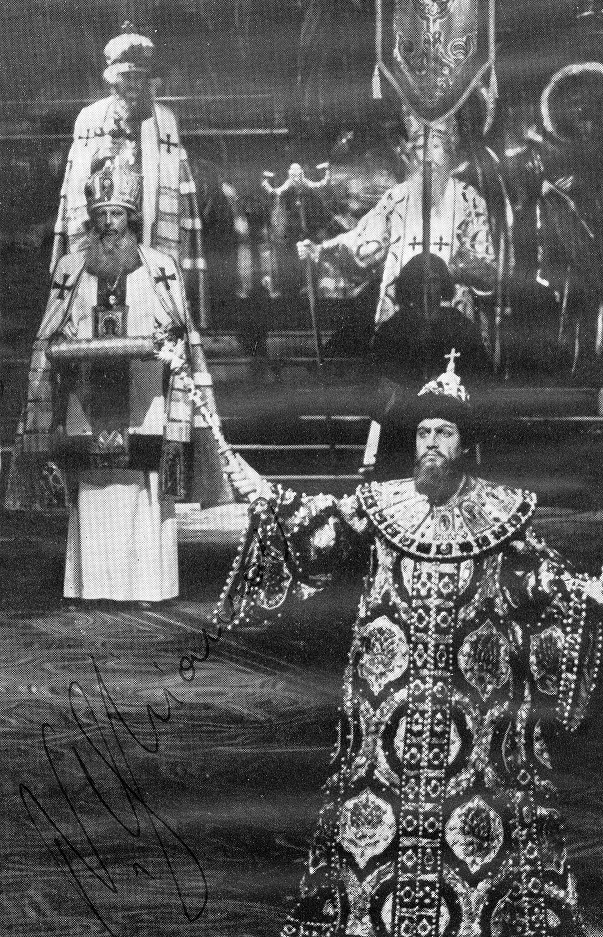
  • Irene Dalis as Fricka

    Walkure6465.05

    The great dramatic mezzo-soprano Irene Dalis in the scene of confrontation between Fricka and Wotan from Act II of Wagner’s DIE WALKURE:

    Irene Dalis as Fricka – WALKURE – w Birgit Nilsson & Otto Edelmann – Leinsdorf cond – Met bcast 1961

    From her 1957 debut there, Irene Dalis sang some 275 performances with the Metropolitan Opera Company – in New York City and on tour – during her twenty-year Met career. Her greatest roles were The Nurse in DIE FRAU OHNE SCHATTEN and Amneris in AIDA. In 1969, her electrifying performance of Verdi’s Egyptian princess at a concert performance at the Sheep Meadow, Central Park, drew an estimated  crowd of 50,000; Dalis’s super-charged singing in the Judgement Scene evoked a thunderous ovation.

    6a00d8341c4e3853ef00e54f20ad648833-800wi

    Following her retirement from singing, Irene Dalis founded Opera San Jose, which she ran with great success for over two decades.

    In August 2007, I wrote an appreciation of Irene Dalis, which she eventually found and read; she sent me a lovely message of thanks.

    ~ Oberon

  • Christmas Eve @ Carnegie Hall

    CH1464970_Medium_res_comp

    Above, violinists for Vivaldi: Pamela Frank, Kyoko Takezawa, Bella Hristova, and Jinjoo Cho; photo by Pete Cecchia

    ~ Author: Ben Weaver

    Monday December 24th, 2018 – Christmas Eve at Carnegie Hall was a nearly sold-out performance by the New York String Orchestra, a program organized by the Mannes School of Music each year: its 50th incarnation this year was marked by mayor Bill De Blasio declaring it the New York String Orchestra Day in NYC. Under the baton of Jaime Laredo, the 64-member orchestra, made up of young musicians from around the world (ages 16-23) presented an ambitious program of Mendelssohn, Vivaldi and Beethoven.

    Mendelssohn’s popular Hebrides Overture is one of his most famous compositions: the moody, dark opening from the low strings, evoking the churning waves of the ocean, is an instantly recognizable tune. There are several of those in the work, heard by all in numerous commercials and movies over the years. The young musicians, following Maestro Laredo’s relaxed tempo, created an evocative, almost creepy, aural landscape.

    Vivaldi’s thrilling Concerto for Four Violins from his famed collection of 12 concertos entitled L’estro armonico, was so admired by J.S. Bach that he transcribed it for four harpsichords. Requiring a quartet of star soloists to pull it off, the New York String Orchestra delivered four with unimpeachable credentials: Jinjoo Cho, Pamela Frank, Bella Hristova, and Kyoto Takezawa. The soloists both compete and complement one another throughout the work. Dazzling displays of virtuosity and unpredictable rhythms of the first movement give way to a yearning slow moments, where the four soloists play by turn in unison and in solo passages, then the fiery finale brings down the curtain. Certainly the four soloists leave nothing to be desired and the orchestra provided thrilling support.

    CH1464968_Medium_res_comp

    Without stopping for an intermission (a welcome move), the piano was immediately set up for Beethoven’s great Piano Concerto #4 with Yefim Bronfman (above, photo by Pete Cecchia) at the piano. Mr. Bronfman has long been one of our favorite artists on this blog: he a musician of singular musical sensitivity and imagination. His gentle solo introduction of the concerto before the orchestra picks up the melody was like meeting an old friend. Beethoven’s melodies come in waves. Bronfman handles the running scales effortlessly. Maestro Laredo’s expansive tempo was especially rewarding in the Andante con moto movement where Bronfman’s soulful playing could move anyone to tears. Here, too, the young musicians provided wonderful support.

    Performance photos by Pete Cecchia, courtesy of Carnegie Hall.

    ~ Ben Weaver

  • Forgotten Voices: Rudolf Ritter

    5ab02691af300

    I came upon the voice of Rudolf Ritter by chance while sampling recordings of different tenors in the music of Verdi’s Otello.

    Rudolf Ritter – Otello’s Death ~ OTELLO – in German

    Following service in the Austro-Hungarian army (1898-1908), Rudolf Ritter studied singing at the Vienna Music Academy. In 1910 he made his debut at the Volksoper in Vienna, where he sang until 1913; he then joined the Hofoper in Stuttgart, where he made a name for himself as a leading artist for twenty years, singing in world premieres by Braunfels and Zemlinsky as well as the standard repertory.

    Ritter joined a touring group, the German Opera Company, in 1923. In North America, he sang at Chicago and in Kienzl’s Der Evangelimann in New York City. He appeared at the Bayreuth Festival from 1924-1930 as Siegfried and Tannhäuser, and in 1926 he scored a major success with performances in South America.

    From 1929-1931 season, Ritter was again touring North America with the German Opera Company, along with soprano Johanna Gadski.  He made guest appearances at London’s Covent Garden, the Paris Opéra, Vienna Staatsoper, and Zurich. In 1927 at the Zoppot Festival, he sang Siegfried in Götterdämmerung.

    Rudolf Ritter retired from the stage in 1933, settling at Stuttgart where he taught and coached. He was married to the pianist Gret Hein. He passed away in 1966.

    Ritter’s rounded, steady tone sounds really good in Wagner:

    Rudolf Ritter – Allmächtǵer Vater ~ RIENZI

    Rudolf Ritter – Winterstürme wichen dem Wonnemond ~ WALKURE

    ~ Oberon

  • The Hopes And Fears Of All The Years

    Little town

    Emmylou Harris ~ O Little Town of Bethlehem

    O little town of Bethlehem
    How still we see thee lie…
    Above thy deep and dreamless sleep
    The silent stars go by.
    Yet in thy dark streets shineth
    The everlasting Light…
    The hopes and fears of all the years
    Are met in thee tonight.

     
    For Christ is born of Mary
    And gathered all above
    While mortals sleep, the angels keep
    Their watch of wondering love.,
    All morning stars together
    Proclaim the holy birth
    And praises sing to God the King
    And Peace to men on earth.
     
    How silently, how silently
    The wondrous gift is given!
    So God imparts to human hearts
    The blessings of His heaven.
    No ear may hear His coming,
    But in this world of sin
    Where meek souls will receive him still
    The dear Christ enters in.

  • Licia’s Last Butterfly

    Albanese

    On Friday, November 26, 1965, I went to a performance of MADAMA BUTTERFLY at the Metropolitan Opera House. On the following day, I had an operatic double-header: a matinee of ELISIR D’AMORE and an evening performance of FAUST. That Saturday marked the last time I ever set foot in the Old Met. The venerable theatre had been marked for demolition, while a New Met was rising at Lincoln Center.

    The eight performances I saw at the Old House are very special memories for me. The singers I saw there had become gods and goddesses to me thru their singing on the Texaco Metropolitan Opera radio broadcasts; I was now experiencing ‘live‘ the rituals Milton Cross described each week over the airwaves: the house lights going down, the applause greeting the conductor, the great gold curtain being drawn back for the curtain calls. It was like a dream come true.

    Licia Albanese’s was one of the first operatic voices I became familiar with. She was one of the singers on the first 2-LP set of opera arias and duets that I owned. She sang Liu on a memorable Met broadcast of TURANDOT in 1962, opposite Nilsson and Corelli. And my parents had taken me to see her as Violetta (her 100th performance of the role) at the Cincinnati Zoo Opera in 1963.

    In all honesty, Albanese’s voice was never really among my favorites; it was more her expressive intensity of communication and her endearing persona that I found appealing. But I understood her importance as a singer in the grand tradition, and if her singing of the Violetta and Butterfly that I saw could turn dry and almost ghostly, I can still vividly recall her stage presence and her instinctive if Olde School acting.

    What I did not realize as I watched Licia Albanese taking her bows after that 1965 Butterfly was that it was the final time she ever sang the role. After playing Cio-Cio-San some eighty times on that stage, this was to be the last. Like many performances I have experienced, the evening became iconic over time when measured as part of the singer’s career.

    I met La Licia after the performance – I was one of a sizeable group of admirers who had waited for her – and she was of course elegantly gowned and coiffed, chattering away to her fans in Italian. She signed my program with a flourish: 

    Scanned Section 7-1

    It was a happy crowd of fans and friends, and no mention was made of it being “her last Butterfly”. She did sing one more complete role at The Met: Manon Lescaut; and the following Summer she sang Mimi in LA BOHEME with Barry Morell in a concert presented by The Met at the Newport Festival. 

    A few days after the performance, I sent her a fan letter and received this photo in return, along with her calling card:

    Scanned Section 11-1

    Licia Albanese – Ancora un passo or via ~ MADAMA BUTTERFLY

    There were two further memorable moments related to the Old Met and to MADAMA BUTTERFLY in Albanese’s extraordinary life: at the gala farewell concert that marked the closing of the Old Met on April 16th, 1966, Licia sang the aria “Un bel di” and, during the applause, she knelt to place a kiss on the stage where she had appeared so frequently since her debut in 1940:

    Old met farewell

    Once the demolition of the ‘old yellow brewery’ began, Licia donned her kimono and sang “Un bel di” one last time amid the ruins.

    But my connection with the legendary diva was not over. One evening during the first season at the New Met, I saw her among the audience on the Grand Tier during intermission. She was talking with another elegantly-gown lady as I approached them hesitantly. The other woman gave me an encouraging smile, so I took Madame Albanese’s hand and awkwardly told her of having seen her Violetta and Butterfly. She thanked me quietly, but kept hold of my hand. Then she turned to her friend and said, in her charming accent: “It is so wonderful to be remembered! He’s so young, he will tell people about me many years from now.”

    Then, some thirty-five years on, I was holding down the fort in the opera room at Tower Records one dreary afternoon when Licia Albanese came in with a companion; the soprano was rather feeble by that point in time, but when I greeted her, she smiled silently. I said to her, “I saw your one hundredth Violetta at the Cincinnati Zoo Opera!” She was silent for a moment, and I thought my remark had not registered. Her friend gave me a look as if to say that Madame’s mind might not be perfectly clear.

    “The Zoo!” said the diva firmly. Then she began to roar like a lion and sing little birdcalls and make noises like chattering monkeys. Anyone who has ever attended a performance at the Cincinnati Zoo will know that these sounds were always a continuous obbligato to the opera being performed. We all laughed. And then I bade the two women goodbye, thinking to myself – as I have so often – “What a life I am living!”

    920x920

    Above: Licia Albanese at age 93; she passed away in 2014 at the age of 105. 

    ~ Oberon

  • Licia’s Last Butterfly

    Albanese

    On Friday, November 26, 1965, I went to a performance of MADAMA BUTTERFLY at the Metropolitan Opera House. On the following day, I had an operatic double-header: a matinee of ELISIR D’AMORE and an evening performance of FAUST. That Saturday marked the last time I ever set foot in the Old Met. The venerable theatre had been marked for demolition, while a New Met was rising at Lincoln Center.

    The eight performances I saw at the Old House are very special memories for me. The singers I saw there had become gods and goddesses to me thru their singing on the Texaco Metropolitan Opera radio broadcasts; I was now experiencing ‘live‘ the rituals Milton Cross described each week over the airwaves: the house lights going down, the applause greeting the conductor, the great gold curtain being drawn back for the curtain calls. It was like a dream come true.

    Licia Albanese’s was one of the first operatic voices I became familiar with. She was one of the singers on the first 2-LP set of opera arias and duets that I owned. She sang Liu on a memorable Met broadcast of TURANDOT in 1962, opposite Nilsson and Corelli. And my parents had taken me to see her as Violetta (her 100th performance of the role) at the Cincinnati Zoo Opera in 1963.

    In all honesty, Albanese’s voice was never really among my favorites; it was more her expressive intensity of communication and her endearing persona that I found appealing. But I understood her importance as a singer in the grand tradition, and if her singing of the Violetta and Butterfly that I saw could turn dry and almost ghostly, I can still vividly recall her stage presence and her instinctive if Olde School acting.

    What I did not realize as I watched Licia Albanese taking her bows after that 1965 Butterfly was that it was the final time she ever sang the role. After playing Cio-Cio-San some eighty times on that stage, this was to be the last. Like many performances I have experienced, the evening became iconic over time when measured as part of the singer’s career.

    I met La Licia after the performance – I was one of a sizeable group of admirers who had waited for her – and she was of course elegantly gowned and coiffed, chattering away to her fans in Italian. She signed my program with a flourish: 

    Scanned Section 7-1

    It was a happy crowd of fans and friends, and no mention was made of it being “her last Butterfly”. She did sing one more complete role at The Met: Manon Lescaut; and the following Summer she sang Mimi in LA BOHEME with Barry Morell in a concert presented by The Met at the Newport Festival. 

    A few days after the performance, I sent her a fan letter and received this photo in return, along with her calling card:

    Scanned Section 11-1

    Licia Albanese – Ancora un passo or via ~ MADAMA BUTTERFLY

    There were two further memorable moments related to the Old Met and to MADAMA BUTTERFLY in Albanese’s extraordinary life: at the gala farewell concert that marked the closing of the Old Met on April 16th, 1966, Licia sang the aria “Un bel di” and, during the applause, she knelt to place a kiss on the stage where she had appeared so frequently since her debut in 1940:

    Old met farewell

    Once the demolition of the ‘old yellow brewery’ began, Licia donned her kimono and sang “Un bel di” one last time amid the ruins.

    But my connection with the legendary diva was not over. One evening during the first season at the New Met, I saw her among the audience on the Grand Tier during intermission. She was talking with another elegantly-gown lady as I approached them hesitantly. The other woman gave me an encouraging smile, so I took Madame Albanese’s hand and awkwardly told her of having seen her Violetta and Butterfly. She thanked me quietly, but kept hold of my hand. Then she turned to her friend and said, in her charming accent: “It is so wonderful to be remembered! He’s so young, he will tell people about me many years from now.”

    Then, some thirty-five years on, I was holding down the fort in the opera room at Tower Records one dreary afternoon when Licia Albanese came in with a companion; the soprano was rather feeble by that point in time, but when I greeted her, she smiled silently. I said to her, “I saw your one hundredth Violetta at the Cincinnati Zoo Opera!” She was silent for a moment, and I thought my remark had not registered. Her friend gave me a look as if to say that Madame’s mind might not be perfectly clear.

    “The Zoo!” said the diva firmly. Then she began to roar like a lion and sing little birdcalls and make noises like chattering monkeys. Anyone who has ever attended a performance at the Cincinnati Zoo will know that these sounds were always a continuous obbligato to the opera being performed. We all laughed. And then I bade the two women goodbye, thinking to myself – as I have so often – “What a life I am living!”

    920x920

    Above: Licia Albanese at age 93; she passed away in 2014 at the age of 105. 

    ~ Oberon

  • First Voice

    Morell

    Above: tenor Barry Morell

    Opera lovers: who among you can remember the very first voice you heard in a live opera performance? I’m not talking about recordings, broadcasts, telecasts, or DVDs, but actually being there.

    For me it was tenor Barry Morell, singing the Duke of Mantua in a performance of RIGOLETTO at the Cincinnati  Zoo Opera in 1962.

    RIGOLETTO

    I don’t have an MP3 of Barry Morell as the Duke, but here he is in the passionate aria of Maurizio from ADRIANA LECOUVREUR; his voice is warm, with a nice Italianate ring to it:

    Barry Morell – La dolcissima effigie – ADRIANA LECOUVREUR

    By 1962, Barry Morell was well-established at The Met, having debuted there in 1958 as Pinkerton in MADAMA BUTTERFLY opposite the Cio-Cio-San of Victoria de los Angeles. In the ensuing years, he sang more than 250 performances with The Met, in New York City and on tour. His co-stars were some of the Met’s reigning divas: his first Tosca was Licia Albanese, his first MImi was Renata Tebaldi, and in his first Met Duke of Mantua, Elisabeth Söderström sang Gilda.

    After that initial RIGOLETTO at Cincinnati, we returned for two more Summers, seeing Barry Morell as Alfredo in TRAVIATA (Albanese was singing her 100th Violetta that night) and as des Grieux in Massenet’s MANON, with Adriana Maliponte singing the title-role.

    On November 26, 1965, Licia Albanese sang her last Madama Butterfly at The Met; Barry Morell was her Pinkerton. I was there.  

    In the Summer of 1966, we went up to Saratoga where the Philadelphia Orchestra was giving FLEDERMAUS in concert, conducted by Eugene Ormandy. Barry Morell was Alfredo, with Hilde Gueden (Rosalinda), Roberta Peters (Adele), and Kitty Carlisle (Prince Orlofsky).

    38b1e7568ea4345712de0e72683ce526-1

    Soon after that FLEDERMAUS, I made made first solo trip to New York City to join the first ticket line for the opening season at the New Met. Among the performances I saw in the first season or two at the Lincoln Center venue were TRAVIATA in which Barry Morell’s Violetta was Anna Moffo, and a BOHEME with Morell and Tebaldi.

    Barry Morell sang at The Met until 1979; he passed away in 2003.

    ~ Oberon

  • Met Opera All-Stars

    Thumbnail_image

    Helping Placido Domingo celebrate the 50th anniversary of his Met debut, four great stars who sang with him often came backstage to greet the “tenoritone” after his prima of GIANNI SCHICCHI. Above: Sherrill Milnes, Martina Arroyo, Placi, Teresa Stratas, and James Morris in a Met Opera photo.

    Having already seen him several times at New York City Opera, I was at Placido Domingo’s Met debut – the night he stepped in (on very short notice) for Franco Corelli – as Maurizio in Cilea’s ADRIANA LECOUVREUR:

    6a00d8341c4e3853ef00e554b71cce8833

    My fondest memory of that evening was of Renata Tebaldi, as Adriana, turning her back on the audience so that Placi could look over her shoulder to watch conductor Fausto Cleva during his Act I aria, “La dolcissima effigie“. During the ensuing ovation, Renata kept patting Domingo’s shoulder and saying “bravo! bravo!” They went on to be good colleagues and friends:

    Renata & Placi Met June 1970

    While that ADRIANA was Domingo’s first performance from the Met stage, he had sung a single concert performance of CAV & PAG with the Company at Lewisohn Stadium in August, 1966:

    Metropolitan Opera @ Lewisohn Stadium
    August 9th, 1966
    In Concert

    CAVALLERIA RUSTICANA
    Mascagni

    Santuzza................Irene Dalis
    Turiddu.................Plácido Domingo [First appearance]
    Lola....................Joann Grillo
    Alfio...................Russell Christopher
    Mamma Lucia.............Carlotta Ordassy

    Conductor...............Kurt Adler

    Sherrill Milnes had made his Met debut during the final season at the Old Met (in the same performance of FAUST that Montserrat Caballé made hers); Martina Arroyo and Teresa Stratas had already established themselves at the Old Met by the time the Company moved to Lincoln Center. James Morris made his Met debut in 1971, and I saw him there in one of his very first performances, as Raimondo in a student matinee of LUCIA DI LAMMERMOOR.

    Now let’s hear from each singer in the “reunion” photo at the top:

    Martina Arroyo – Ritorna vincitor! – AIDA – Buenos Aires 1968

    GHOSTS OF VERSAILLES ~ final scene – Teresa Stratas & Hector Vasquez – Met bcast 1995

    James Morris – RHEINGOLD ~ Abendlich Strahlt Die Sonne – w M Lipovsek

    Sherrill Milnes joins Domingo on the final note of their OTELLO duet…such an exciting moment:

    Domingo & Milnes – OTELLO duet – Met bcast – 2~2~85

    To finish this reminiscence, here’s Domingo in a opera The Met could/should have staged for him, Meyerbeer’s L’AFRICAINE:

    Placido Domingo – O Paradis! – L’AFRICAINE

    ~ Oberon

  • @ The Guggenheim: Hilma af Klint

    Af-Klint-Hilm_Svanen-971x980

    Above: Svanen by Hilma af Klint

    Presenting one of the most fascinating art exhibits I’ve ever had the chance to experience, The Guggenheim’s gone all out to bring us a panorama of works by the Swedish artist Hilma af Klint (1862-1944).

    Born in Stockholm in 1862, Hilma af Klint started out as an academy-educated painter of landscapes and portraits, including some striking botanical pieces. The Spiritualist movement and an interest in scientific progress led af Klint to visualize a world beyond daily realities. She began creating radically abstract paintings in 1906.

    L1980321

    Feeling that her art would be beyond comprehension during her lifetime, she shunned exhibits of her work and avoided publicity-seeking. af Klint passed away in 1944; she remained an unknown until the 1980s.

    The Guggenheim’s exhibition thrilled me, and I hope to return for another look at af Klint’s magnificent work. Although the slanting floor of the long, winding Guggenheim gallery threw off my equilibrium (and similarly affected my friend Deb Hastings, who was with me), this is art that one could study for hours and still not grasp it all. 

    Much of the magic of af Klint’s work is in the details; here are a few examples:

    L1980227

    L1980240

    L1980262

    L1980284

    Some of af Klint’s largest canvases are displayed on the museum’s main floor:

    L1980302

    Her colours dazzle:

    L1980305

    L1980309

    L1980259

    But photos don’t do the work full justice: you have to be there.

    The Guggenheim exhibit, titled Paintings for the Future, runs thru April 23rd, 2019.

    Quote hilma-af-klint

    ~ Oberon