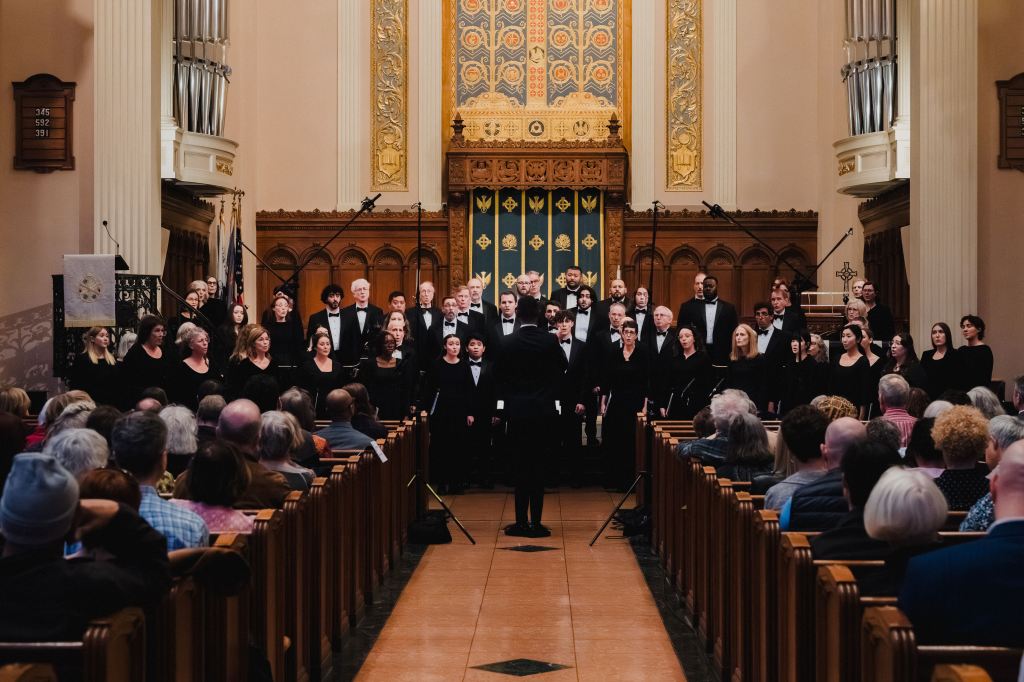
Saturday November 8th, 2025 – The Dessoff Choirs at Brick Presbyterian Church on Park Avenue in a program entitled Resilience & Revelation.
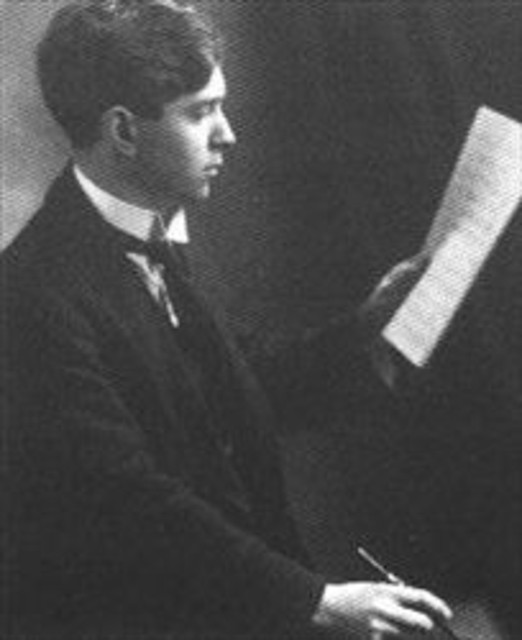
Herbert Howells (above) has an oboe sonata that my oboe teacher in undergrad really liked, so it caught my eye when the Dessoff choirs were performing his Requiem and Magnificat last Saturday. I don’t go to choir concerts much, and tend to forget how easily they sound religious, sometimes aggressively so. I suppose I should have expected that, at least with a Requiem.
Both Howells pieces were full of lush, deep harmony and texture I don’t hear often (on account of not going to choir concerts). The Requiem is a capella, and has a different structure and text than completely traditional Requiems, from what I gather. There was also a small antiphonal choir – I think referred to as a “semichoir”, though it was unclear if this is part of the piece or an artistic decision by the performers. It’s hard for me to have an informed opinion about vocalists, but the choir had impressive control, especially in quiet moments – which creates such a different texture than orchestra.
The three Philip Glass etudes in the middle of the concert were a little out of character, but also nice variation from the choral texture. It was hard to match the polished sound of the choir, but pianist Steven Ryan had some fresh interpretation, especially of number 3, where I was able to hear different harmonies than I’m used to. He did play them in a different order than they were listed in the program!
The composers on the latter half of the program, Tania Leon and Adolphus Hailstork, were both in attendance, which was a nice surprise – both well-known names. Tania Leon’s piece It’s a journey was nice, with some sweet choir interaction and more contemporary elements than the Howells.
The Hailstork The World Called with text by Rita Dove was a very nice piece that had some incongruous organ interludes that sounded like circus music. I believe the piece was originally written for choir with orchestra, so maybe something was lost in the orchestral reduction, but I had a lot of trouble making sense of what those interludes were conveying. The soprano soloist, Nicole Osmolovskaya, was a student at Brooklyn college and did a great job.
Though I really don’t understand much about the choral music ecosystem of New York, supposedly the Dessoff choirs are some of the best in the city, and after that concert I wouldn’t have any reason to disagree!
Sunday November 9th. 2025 matinee – What a treat it is to hear such a world class orchestra on a rainy Sunday! As part of Carnegie’s International Festival of Orchestras, the Orchestre National de France performed an all-French program filled with classics as well as one more obscure piece.
I’ve been told that European orchestras have a special way of playing, maybe it’s their philosophy of music, or perhaps because much of the repertoire originated in their homeland, but the difference is truly palpable.
I arrived at the hall a little earlier than usual and watched as it started to fill up with an audience. Part of what’s fun about seeing these international orchestras perform at Carnegie is seeing the audience that they bring in. When the Seoul Philharmonic performed the week before, I could hear a buzz of Korean around me. Today’s concert wasn’t quite as Frenchified in the same way, but there were definitely more Frenchmen than I would usually see.
I read the program and saw that the concert consisted of two piano concertos (Ravel,then Saint-Saëns), the Daphnis et Chloé Suite No. 2 also by Ravel, and Symphony No. 2 “Voina” by Elsa Barraine. The only composer missing from the household-name canon of French composers seemed to be Debussy.
Before the concert began, an announcement was made that the order of the concertos was going to be flipped, with the Saint-Saëns being performed after intermission.
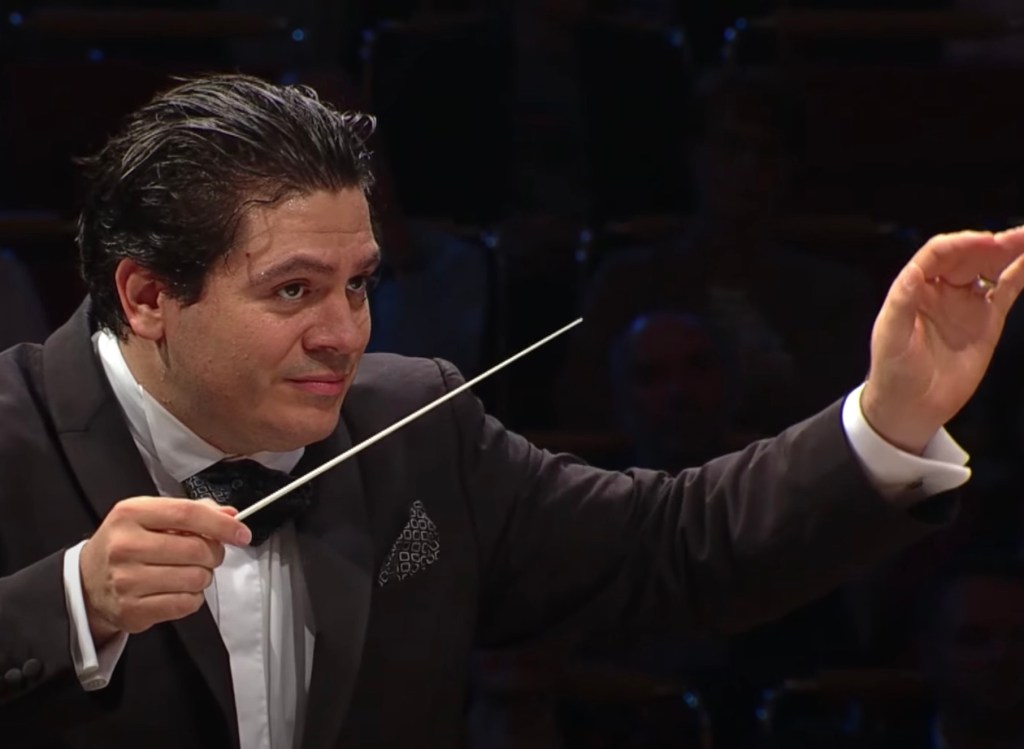
As the lights started to dim and Maestro Macelaru walked out onto the podium, the concert started.
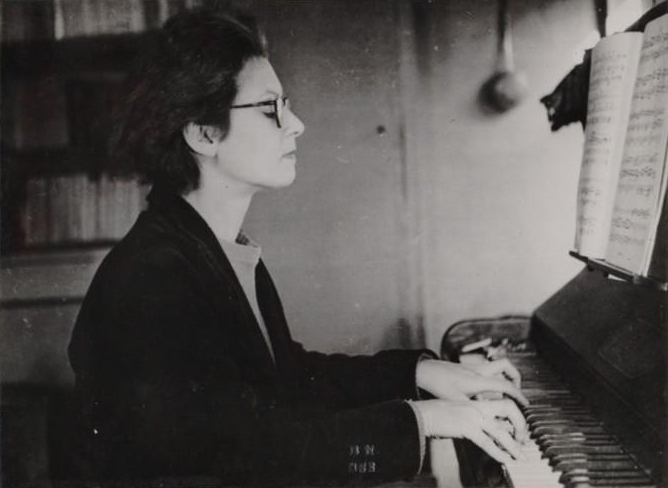
I had never heard of Elsa Barraine (photo above). She was a composer whose life spanned several periods of music (1910–1999), and she was a very decorated and, in her life, celebrated composer: a winner of the Prix de Rome and a student of Paul Dukas.
Her second symphony, subtitled War in Russian, was composed in 1938. In general, I loved it. It was tonally quite unique but had whispers of composers like Prokofiev and Debussy sprinkled in. The symphony started off with a haunting flute melody that broke into a more angular melody taken up by the strings.
Unlike a lot of French music of that time period, her symphony had a more traditional format instead of the more nebulous tone poem. The symphony was strident but beautiful. You could hear the war-like atmosphere in the echoes of marching and dominant flute solos reminiscent of battlefield instruments. At once playful and menacing, the music quickly became one of my new early 20th-century favorites.
The music, though, was not only fantastic because of the composition but also because of the performers. What was so characteristic of these orchestra musicians was that they all seemed to have their own individual playing style; however, the sound they produced was somehow more in sync than any other orchestra I had ever seen. The concertmaster bopped along so playfully throughout the entire symphony, while every other performer had their own expression of the music, but their musicianship all complemented each other. I’m so used to seeing performers playing with machine-like precision, but somehow that never produced the same sonic unity as these performers with their own unique stylings had.
When the violins played a very sheer pianissimo, it sounded so fantastic! The control that each section had made it seem not like a combination of voices, but one singular instrument played by a master. This ability to have such delicate control and tonal beauty wasn’t limited to the violins or just to this first piece.
There was a moment in the second movement where the concertmaster had a solo right after her entire section played, and her playing simply melted out of the entire section as if it materialized out of thin air – really so phenomenal.
The second movement started with a brass fanfare that flourished into a sort of dirge, and the symphony ended with an oddly optimistic, almost Christmassy-sounding ending. Barraine’s symphony really is a masterwork that deserves more attention, so I was so glad to have heard it performed in such capable hands.
Once the piece ended, the orchestra changed configuration to bring out the piano for Ravel’s Piano Concerto. The soloist for tonight was Daniil Trifonov (photo above), an accomplished soloist, collaborative pianist, and veteran Carnegie performer.
The concerto started with its characteristic bang and quirky piano motif. Trifonov seemed to hover over the keys as he played, while the orchestra seemed to hover over him, as if the sound were simply appearing around him.
I’ve heard this piece several times before in concert, but somehow the music just felt different. There was a real conversation with the orchestra and the piano, and nothing ever felt forced.
The second movement of the concerto opens with a simple-sounding piano solo, which is unusual for its lack of flash compared to other concertos. The piano part in some ways resembled Pavane pour une infante défunte, also by Ravel, in its haunting beauty.
Trifonov really had such a gentle touch with the instrument that was perfect for this piece. There was no harshness in tone or jerkiness. His playing seemed to be like a cloud of sound emanating from the piano.
You could really tell how phenomenal the orchestra was at the end of the second movement, where the strings end the movement on another pianissimo that was barely audible but so resonant in its ethereal quality.
During the intermission, I noticed that there was a technician attending to the piano. I guess I hadn’t really seen many concerts with two concertos back to back, but it was certainly an interesting detail.
Once the intermission was over, Maestro Macelaru and Trifonov came back out to perform Saint-Saëns’s famous Second Piano Concerto.
Trifonov played the opening hauntingly and beautifully. One thing I noticed was his delicate touch. This concerto in particular is more often than not played in a very romantic way, very much of the time period it was written. Trifonov, however, emphasized not the booming bass or the dramatic chords, but the elegance of the piece. Saint-Saëns is a bit of an odd composer in that his music straddles classical beauty more reminiscent of Mozart while also being a full-fledged romantic.
The concerto was played more in the Mozartian style, and where other performers would push the music into storm and drama, Trifonov played it as more smoke and mystery.
My friend accompanying me to the concert noted how random the entire concerto seemed. Each movement is beautiful in its own right, but each movement did seem a bit disconnected from the piece overall. That being said, it was still played masterfully by Trifonov and the orchestra alike.
After the piece concluded, Trifonov took several triumphant and well-deserved curtain calls to a fully standing audience and then proceeded to perform an encore. I mentioned earlier that the only household-name French composer missing was Debussy, and lo and behold, we were treated to a beautiful rendition of Reflets dans l’eau by Debussy. After the shimmering piano piece was done, Trifonov received a giant red rose bouquet and was treated to another well-deserved standing ovation.
Once the orchestra was resettled after the removal of the piano, the numbers augmented to a large degree to perform Ravel’s Daphnis et Chloé Suite No. 2.
The orchestra picked the best piece to end on. The sound from the very beginning filled the hall in such gentle but angelic waves of sound. They had such amazing dynamic control. It was one of the few moments when I could do nothing but enjoy the sheer majesty and perfection of the music and playing.
I’ve heard many performances over the years, but this particular Daphnis et Chloé was one to really remember. Once they had finished a fairly long program, I was sad that it was already over. However, as people in the audience started to get up, the orchestra picked up again to play the entirety of Ravel’s Boléro! There was an audible chuckle from the audience when everyone realized what was going to be performed. We all sat listening to this final treat from a phenomenal orchestra.
The great Bulgarian soprano Stefka Evstatieva has passed away at the age of 78.
Ms. Evstatieva studied at the State Academy of Music at Sofia, and made her operatic debut as Amelia in BALLO IN MASCHERA in 1971. She joined the Sofia National Opera in 1978, and for the next several years she made appearances at Vienna, Munich, Verona, Paris, Rome, Brussels, Buenos Aires, La Scala, and Berlin.
Ms. Evstatieva made her Metropolitan Opera debut in 1984 as Elisabetta in DON CARLO – a performance I attended. I was very impressed by her singing, and by her regal bearing. Her other Met roles were Maddalena de Coigny, Santuzza, and the BALLO Amelia.
Watch the soprano in a video of her “Pace, pace mio dio” from LA FORZA DEL DESTINO here, and her “La mamma morta” from ANDREA CHENIER here.
Saturday November 8th, 2025 matinee – LA BOHEME has been with me for a long time. The Act I arias of Rodolfo and Mimi, plus their love duet, were on the first operatic recording I ever owned: a two LP set of arias and duets from operas by Verdi and Puccini that my parents gave me in 1960. The singers were Victoria de los Angeles and Jussi Björling. I later brought the full opera with the same singers, conducted by Sir Thomas Beecham. When LPs became passé, I bought the same complete recording on CDs. It remains the only complete BOHEME in my CD collection, and the voices of de los Angeles and Björling still seem so perfectly suited to the music.
My first hearing of a complete BOHEME live was on a Met broadcast in 1962 with Lucine Amara and Barry Morell. I finally saw the opera onstage for the first time at New York City Opera in 1966 with Anne Elgar and Michele Molese. My first live Met Opera performance of BOHEME took place (in concert form) in Central Park in 1967 with Anna Moffo and Sándor Kónya. And at last, in 1968, I saw Teresa Stratas and Gianni Raimondi singing BOHEME at The Met.
This afternoon, up at my score desk and waiting for the Met matinee to start, these memories flashed thru my mind. Curiously, in the last 60 years, I’ve seen BOHEME less frequently than one might expect. My repertoire has expanded greatly, and my passion is more with Wagner and Strauss than with Puccini and Verdi. Even so, Puccini’s Bohemian rhapsody can still smack me right in the heart, as today’s performance proved.
This matinee of BOHEME was being transmitted live to movie theatres all over the world; for some reason, the show started 15 minutes late. By the time Mimi made her entrance, it was freezing up in the score desk area, and during both of the interminable intermissions, I thought of leaving. But the singers and the orchestra’s playing kept me there as if by force.
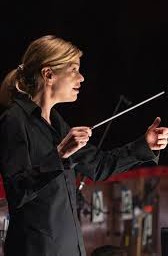
Above: Keri-Lynn Wilson
I frequently complain about Met conductors who rush thru operas and carelessly drown out the voices along the way. I feared as much today, since I was experiencing Keri-Lynn Wilson (aka Mrs. Gelb) for the first time; but she proved me wrong, giving us one of the best and most thoughtfully conceived BOHEMEs I’ve ever heard. Curiously, at the stage door after the show, one fan was whining about her covering of the voices…well, yes: for a few moments she did do that. But compared to the onslaughts of noise some of the Met’s favoured maestros deliver, she was refreshingly supportive of the voices.
Curtain up, and the huge sound of Lucas Meachem’s mavelous baritone immediately seizes our attention. The likewise voicey tenor of Freddie De Tommaso soon chimed in, and a few minutes later, basso Jongmin Park and baritone Sean Michael Plumb rounded out this impressive quartet of Bohemians. Mr. Meachem baited the Met’s go-to Benoit, Donald Maxwell, and after a dismissive, stentorian “Via di qua!” (“Get out of here!”) the roomates were headed out to Cafe Momus. Throughout all of this, Maestro Wilson kept everything lively but under control.
Above, landlord and tenants: Donald Maxwell as Benoit surrounded by the four Bohemians: Sean Michael Plumb, Freddie De Tommaso, Lucas Meachem, and Jongmin Park. Photo by Karen Almond.
Mimi – Juliana Grigoryan (above)- has a ‘big lyric’ voice that sounds so pleasing in the House; she and Mr. De Tommaso will carry us thru their much-beloved arias with engrossing phrasing and melodious detail. The conductor supports the voices perfectly. Mr. De Tommaso’s “Che gelida manina” is generously sung, and Ms. Grigoryan’s way with words makes a touching impression: her “Viva sola, solletta…” beautifully sustained, her “Ma quando vien lo sgelo” gorgeously savourable. The conductor is so attentive to the poetry of the music. As the introductory phrase of the love duet sounds, the voices of the offstage Bohemians chiding Rodolfo seemed more humorous than ever. Soprano and tenor pour forth a flood of sound before their charming banter about whether to leave for Momus or stay in the intimate garret is truly engaging. The soprano’s top-C was not quite perfect, but the tenor harmonized in a most pleasing finale to the act.
After the long pause of re-setting the stage, Maestro Wilson gives the Momus scene a dynamic start; I am loving everything the conductor is doing with this score. In the ensuing conversational phrases among the characters, Mr. Park’s voice stands out. Mr. De Tommaso sings thrillingly in his brief introduction of Mimi to his friends. The jolly “Parpignol” chorus seems fresh in Maestro Keri’s approach to it: the magic’s in the details, such as Mimi’s delight in her new bonnet, and the candid commentary from the Bohemian pals.
Heidi Stober’s Musetta sounds annoying at first, but that’s often the case with this high-strung character, The soprano commences the waltz with enticing intimacy of phrase, becoming more expansive before a big-bang of a high-B at the end. She nails the tops in the ensuing ensemble…Marcello/Meachem leads the waltz-reprise with boundless power…another Stober top-B polishes things off, whilst her besotted beau confides: “Sirena…!“
Maestro Keri (I’m loving her by now!) paints a sonic picture with the opening of Act III…there is delicacy here, as well as a boding of things to come. The harp enchants, and Keri brings out the sound of the clinking wine glasses from inside the tavern – I’d never previously understood what that passage was depicting. Ms. Stober’s nice reprise of the waltz motif brings an end to this little ‘prologue’ to the drama to come…a prologue to which the thoughtful conductor has brought a sense of importance.
Ms. Grigoryan and Mr. Meachem make their duet an essential part of the unfolding drama: she perfectly communicating the desperation of Mimi’s plight, and he a consoling angel. The following exchange of De Tommaso and Meachem is riveting, the tenor powerful at “Invan, invan nascondo…” before the mounting anxiety of “Una terrbile tosse…”
Ms. Grigoryan’s aria of farewell is heart-rendingly expressive; soprano and conductor capture every nuance here, moving me deeply with their sustained, poignant finish. In the ensuing quartet, each character’s emotions are expressed. But the audience’s laughter at the Met Titles’ translation of the Musetta/Marcello exchange blots out Mimi’s infinitely tender “Sempre tua per la vita…”.
Maestro Keri gives us a brisk and loud introduction to Act IV. Mr. DeTommaso opens his nostalgic duet with Mr. Meachem so beautifully; the baritone takes a long, powerful top note at “…una bocca procace“. The duet’s final phrases are superbly sung, and ideally supported by the orchestra.
Sean Michael Plumb stands out in the ensuing scene of the partying Bohemians, making his every note and word count. Musetta’s sudden appearance with the dying Mimi brings all joy to a standstill. The voices of Mimi and Rodolfo briefly unite in a vocal outpouring. Mimi greets her friends by name; sadness abounds. She reminds Macello how good a person Musetta is; the situation brings these two back to the reality of their mutual love.
Jongmin Park’s “Vecchia zimara” – a vocal highlight of the afternoon – was so deeply felt, his timbre and sustained line infinitely touching.
Mimi and Rodolfo are left alone; Ms. Grigoryan’s “Sono andati?” is achingly expressive. Mr. De Tommaso is so ardent in his despair…every moment of his singing comes from the heart. The delicacy of the soprano discovering the bonnet that was Rodolfo’s first love token wipes me out. After Mimi’s hushed final words – such magically spun pianissimi from Ms. Grigoryan – the audience gently applauded…something I’d never experienced before.
And then, suddenly, the opera became a palpable reminder of all my faults and shortcomings as a lover and a friend over the years. There’s no way of undoing what’s been done, and no opportunity to express remorse, or even to apologize: we simply carry these burdens to our graves.
Above: Maestro Pichon and the Orchestra of St. Luke’s; photo by Fadi Kheir
Author: Lane Raffaldini Rubin
Thursday November 6th, 2025 – As the OSL strings played the soft opening chords of the Geistlicher Marsch from Beethoven’s König Stephan, members of the Clarion Choir marched toward the stage in slow motion from the wings and the rear of the hall. The enveloping, uncanny feeling of this assembly was heightened when Alex Rosen, in his booming profound bass, recited passages from Walt Whitman’s “Song of Myself”:
Do I contradict myself?
Very well then I contradict myself,
(I am large, I contain multitudes.)
The audience, who came to hear Beethoven’s Symphony No. 9, were confronted head-on (in English) by Beethoven’s and Whitman’s inner questioning: How does the self relate to the collective? How might my ego find its place in the world? These questions remain as vital today as they were for Beethoven’s revolutionary-enlightenment deism and Whitman’s rugged American individualism.
In Whitman’s multitudes we hear a prefiguration of Beethoven’s (andSchiller’s) Millionen (“millions”). But if Millionen merely suggests sheer number, then multitudes shows us the integration of the self and the collective: the multitudes within each of us, the multitudes in which we are each just one voice.
The evening’s program, played without breaks or applause, wove together the march from Beethoven’s König Stephan incidental music, Friedrich Silcher’s Persischer Nachtgesang based on the Allegretto from Beethoven’s Symphony No. 7, selections of Beethoven’s incidental music from the play Leonore Prohaska, and his Symphony No. 9.
Overlaid on an orchestral excerpt from Leonore Prohaska were excerpts from Maya Angelou’s “The Caged Bird”:
The caged bird sings
with a fearful trill
of things unknown
but longed for still
and his tune is heard
on the distant hill
for the caged bird
sings of freedom.
Angelou’s lines do not map as neatly onto Beethoven’s music and philosophy as Whitman’s do, but they evoke a similar struggle of an individual toward a lofty goal, whether it be joy, freedom, or confraternity. And they invoke music—singing, in particular—as a vehicle for this struggle. Leonore Prohaska, a play about a real war orphan who enlisted to defend Prussian freedom against Napoleonic despotism, was a fitting substrate for the recitation of Angelou’s poem of freedom, read in an impressive Scottish brogue by mezzo-soprano Beth Taylor.
This is how Pichon chose to preface Beethoven’s Symphony No. 9: by preemptively reframing our notion of what Schiller’s and Beethoven’s Ode to Joy is really about. By constructing a ground above which Beethoven’s finale might nobly soar.
When Pichon moved seamlessly into the Symphony’s first movement, I came to a new understanding, steeped in all this prefatory music and language, of this sometimes vacuous movement. My understanding came from another near-contemporary of Beethoven, Søren Kierkegaard, who said that “anxiety is the dizziness of freedom.” As the singers resumed their slow-motion procession onto the stage, the Orchestra launched crisply into the first movement’s buzzing and abstract terrain. This music bursts at the seams but never seems to go anywhere. It is not until the Scherzo begins that we find an outlet for this pent-up energy. Pichon and the Orchestra brought out this intensity but could have lent more contrast to the first movement’s few peaks and valleys.
The alternating Scherzo and Trio sections of the second movement illustrate the dual nature of Beethoven’s cosmology. On the one hand, the Scherzo music is a Newtonian clockwork, an ideal machine of intricate contrapuntal parts. The Trio music, on the other hand, takes us outside on one of Beethoven’s sylvan walks. This movement presents both of Beethoven’s paradigms of nature in miniature: one concerning its logical internal structure, the other its sublime, unpredictable, earthly manifestations. The Orchestra occasionally sacrificed clarity for the sake of Beethoven’s fast tempos. The woodwinds and horns struggled to keep up, while the strings grew muddy in more difficult passages.
The third movement inhabits the sublime realm of B-flat major. The violins take up a prayer-like melody (reminiscent of the ascending theme from the slow movement of the Pathétique piano sonata) that gets reworked into ever-more florid variations—as a religious follower might search for more and more effusive ways to profess devotion. The first violins effortlessly tossed off the fast runs of these variations and the clarinet solo near the middle of the movement was an oasis of transparent simplicity. Amidst these high points, the prominent horn solo was disappointingly labored and out of tune.
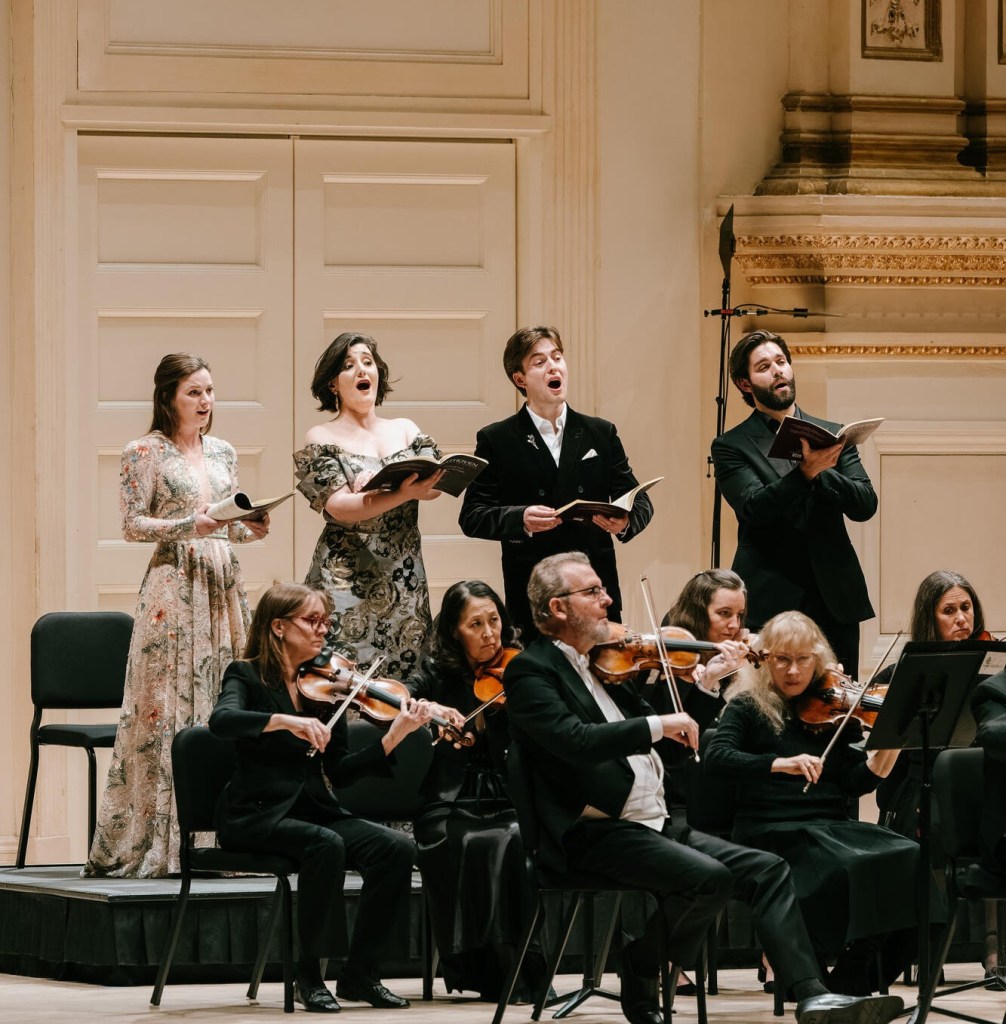
Above, the evening’s vocal soloists: Liv Redpath, Beth Taylor, Laurence Kilsby, and Alex Risen. Photo by Fadi Kheir.
The fourth movement, an entire symphony unto itself, begins by mixing music from each prior movement with cacophonous fanfare and a recitative-style prefiguring in the low strings of the statement later enunciated by the baritone. The low strings were unfortunately ponderous and clumsy, while the themes from the earlier movements all sounded even better in their recapitulations than they did in context. Pichon took an extended pause before the first full statement of the Ode to Joy theme, a shame because it detached this music from the lines that constructed it.
When Alex Rosen stood to deliver “O Freunde, nicht diese Töne! (Oh friends, not these sounds!)”—a moment that never fails to produce frisson—he seemed to embody Whitman, shaking the score in his hands and elbowing his sound into every corner of Beethoven’s line. The chorus and soloists worked through variations on the Ode to gloriously full-throated effect, arriving at a massive and harmonically remote chord. When the fog of that chord clears, Beethoven pieces together a Turkish military march and tops it off with a tenor solo (Froh, wie seine Sonnen fliegen), sung with brassy heroism by Laurence Kilsby.
By this point Beethoven has abandoned the traditional form of the symphony (to say nothing of his use of choral forces and cantata-like text) in favor of the narrative journey of Schiller’s poem. At one moment a chorale suits the narrative best, in others a chant-like recitative, in another an interlude of fugal variations in the strings.
All this music in the service of Beethoven’s existential goal—a brotherhood of man, “Seid umschlungen, Millionen! (Be embraced, ye millions!)”—tonight, however, understood to mean not only confraternity but also freedom and the enactment of oneself.
Orchestra of St. Luke’s, 11/6/2025
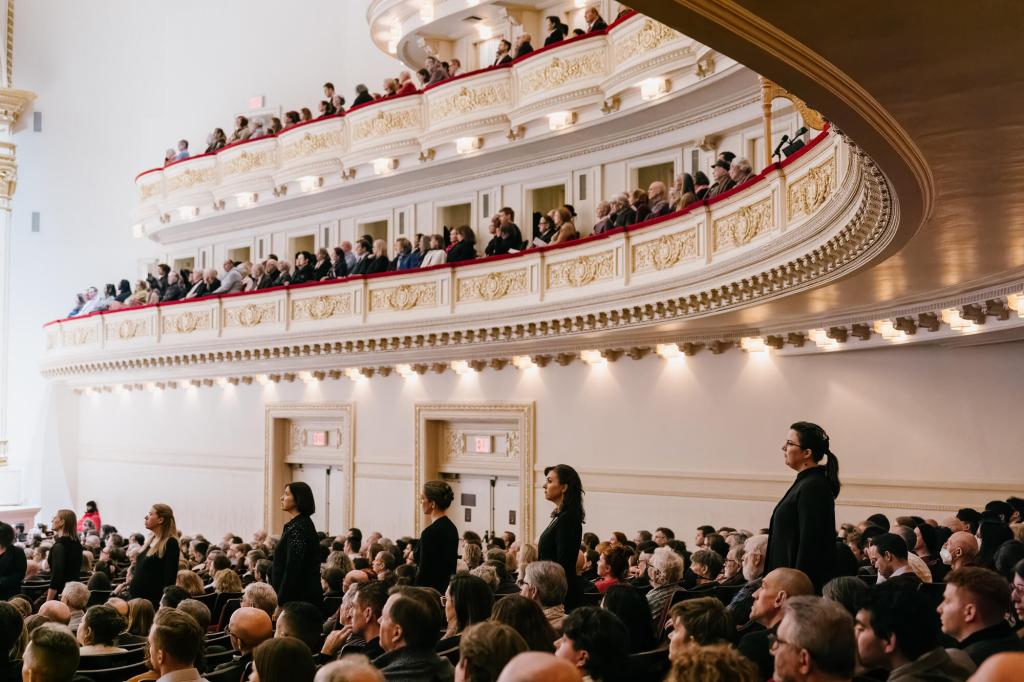
At the coda, some members of the audience stood (photo above by Fadi Kheir), scores in hand, and joined in singing the final verses. It was a gesture that borders on pandering and gimmickry, but it showed the ever-expanding potential for the idea of a universal brotherhood. The Orchestra’s playing did not always rise to meet this lofty aim, but Pichon’s program may have finally given the Symphony No. 9 a full-enough arc to warrant so norm-shattering and monumental a finale as the one that Beethoven gave us.
~ Lane Raffaldini Rubin
Performance photos by Fadi Kheir, courtesy of Carnegie Hall
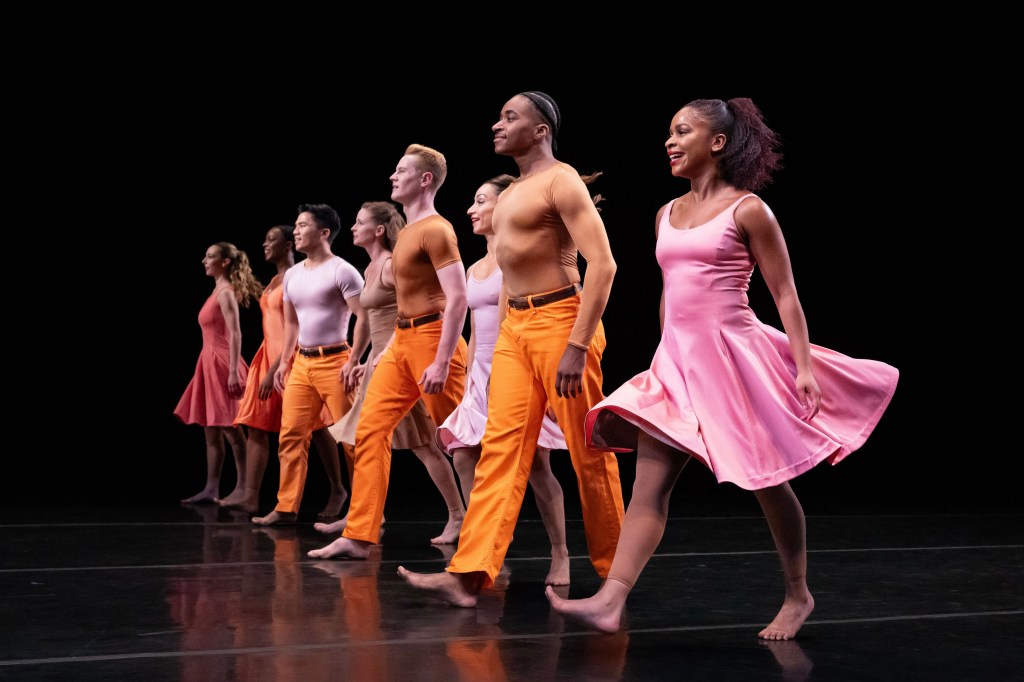
Above: from Paul Taylor’s ESPLANADE, photo by Steven Pisano
Wednesday November 5th, 2025 – The Paul Taylor Dance Company are back at Lincoln Center for a 3-week season; I’ll be going on three consecutive Wednesdays. This evening’s program looked short on paper but was stretched by an unnecessary second intermission.
On a day after we had our first glimmer of hope in many dreary months, the program opened with the rather desolate, unfathomable SCUDORAMA; this 1963 dancework is set to a score by Clarence Jackson. It is music of wide rhythmic variety, by turns eerie, clever, and vibrant. The Orchestra of St. Luke’s, under the baton of David LaMarche, gave a superb rendering of the score, which features some jarring whistle-blowing.
The setting, by Alex Katz, shows stylized dark clouds hovering in a toxic yellow sky. Seemingly homeless, people huddle under discarded blankets. A quintet of women – Jessica Ferretti, Emmy Wildermuth, Elizabeth Chapa, Lisa Borres Casey, and Gabrielle Barnes – have many comings and goings. Tall and alluring, Kenny Corrigan made an outstanding impression. The centerpiece of the work is a duet for Kristin Draucker and Devon Louis; Ms. Draucker’s solo, in a red gown, was stunningly danced, and she was vociferously applauded when she took her bow at the end of the ballet.
Paul Taylor’s TROILUS AND CRESSIDA (reduced vesion) uses music by Amilcare Ponchielli, whose LA GIOCONDA is one of my favorite operas. The Dance of the Hours became famous – and familiar to millions – via the Disney film FANTASIA. Paul Taylor has spoofed the classical nature of the ballet with a fanciful back-drop and trios of Cupids (Mlles. Draucker, Borres Casey, and Payton Primer) and invading Greek soldiers (Mr. Corrigan, Caleb Mansor, and Patrick Gamble) while Madelyn Ho and Alex Clayton are brilliant as the principals who cannot seem to do anything right. At one point, the danseur even loses his trousers.
Choreographer Robert Battle’s very brief TAKADEME dates from 1999; it is set to a score by Sheila Chandra which features rhythmic vocalizations of the Indian Kathak dance style. In a tour de force performance, Devon Louis captured all the facets of footwork and gesture that the solo calls for. Taking his bow to a cheering audience, the dancer summoned Mr. Battle to join him onstage.
Paul Taylor’s iconic masterpiece, ESPLANADE, closed the evening. St. Luke’s violinists Krista Bennion Feeney and Alex U Fortes beautifully played the Bach score, and the cast of nine – Mlles. Draucker, Borres Casey, Ferretti, Barnes, and Chapa joined by the ever-delightful Jada Pearman; and Mr. Clayton with his colleagues Lee Duveneck and John Harnage, revevelled in the Taylor choerography. The three duets were danced by Ms. Barnes with Mr. Duveneck, Ms. Borres Casey with Mr. Clayton, and Ms. Draucker with Mr. Harnage.
The lighting for ESPLANADE tonight seemed terribly “pinkish” and tended to wash out the dancers. And someone near us was loudly humming along – somewhat off-pitch – to the Largo.
As the Bach drew to its end, I was again thinking that I much prefer seeing Taylor at venues like Jacob’s Pillow (where I first discovered them back in the 1970s) and The Joyce. In the House of Mr. B, the dancers seem far away…and their personalities less distinctive. My companion – a dancer and choreographer – agreed with me, and suggested City Center as an alternative: a place which used to be the Taylor company’s Gotham home.
The great American contralto Jean Madeira sings Erda’s Warning from Wagner’s DAS RHEINGOLD from a performance at the 1956 Bayreuth Festival. Hans Hotter is Wotan, and Hans Knappertsbusch conducts.
The extraordinary German baritone Eike Wilm Schulte has passed away at the age of 86.
Mr. Schulte studied with the great German baritone Josef Metternich; he made his operatic debut in 1966 as Sid in ALBERT HERRING at the Deutsche Oper am Rhein. For many years a mainstay at Wiesbaden, and later at the Bavarian State Opera, Schulte developed a repertoire of over 100 roles. He sang at the Bayreuth Festival, and he appeared in the world premieres of several operas.
Among Mr. Schulte’s many roles were Papageno, Guglielmo in COSI FAN TUTTE, Hamlet, William Tell, and the four Villains in TALES OF HOFFMANN.
He made his debut at The Metropolitan Opera in 1991 as the Speaker in ZAUBERFLOETE; in the ensuing years, he sang Kurwenal, Beckmesser, Faninal, the Herald in LOHENGRIN, and the Spirit Messenger in FRAU OHNE SCHATTEN here in New York City,for a total of 65 Met performances. I saw him in all six of his Met roles: a compelling voice and a powerful presence.
Listen to Eike Wilm Schulte sing Dappertutto’s Diamond Aria here, and singing Alberich’s Curse from RHEINGOLD here.
Monday October 27, 2025 – The Seoul Philharmonic Orchestra came to perform at Carnegie Hall tonight under the baton of their conductor and music director, Jaap van Zweden. This was a sort of return home for van Zweden, as he was the music director of the New York Philharmonic from 2018 to 2024.
I love Carnegie’s series this year, “International Festival of Orchestras II,” because you really get to see how each orchestra operates and performs. Even when playing the same classics, it is fascinating to see how different cultures approach music and performance.
On this particular night, there was a strong contingent of Koreans in the audience, which would make sense because of the orchestra, but it was also the U.S. premiere of South Korean composer Jung Jae-il’s new piece.
Right when the concert started, the entire orchestra stood up to greet their maestro as he made his way to the stand. The large orchestra, all in concert black, cut an imposing figure as they all waited for van Zweden to arrive at the podium before sitting down. As someone who grew up in Korea, it reminded me of students standing for a teacher when they entered the classroom. This was one of those interesting cultural moments that was on display beyond just the music itself.
Above: composer Jung Jae-il
The orchestra went directly into their first piece, Inferno, by Jung. Jung is not a classical composer by training, but has had some amazing merits to his name already. Jung composed the music for not only the Korean movie Parasite, which steamrolled the Oscars several years ago, but also Squid Game, which took the world by storm in 2020 and this past year as the series concluded.
I was curious as to how the music would sound coming from a primarily film composer. I had some expectations because I always thought that if someone like Mozart were alive today, he would be writing for Hollywood and Broadway instead of just the symphony.
The piece started off cacophonous, in a similar soundscape to his television work. I might have been biased because I am a fan of the Squid Game series, but the violence of the sound felt very much in that world. The music itself felt more like tone painting than the more cerebral or academic sort of modern music that I’ve heard more frequently. I quite enjoyed the music, even though I have a penchant for more melodic or tonal pieces.
It was interesting that there wasn’t much of a melody in the work. It really felt like a film score in that sense, where the music was describing a mood. There were several distinct sections to the piece that didn’t have too much relation to each other, sort of like a movement. Unlike some other classic examples of tone paintings, which have their own movements, these sections were demarcated by distinct moments of silence between each other. This is almost assuredly a product of being a film or television composer instead of a classical one. Where, say, in La Mer, there are distinct sections within the movement that blend into one another, here it felt more like track 2 of a movie soundtrack, which then moved on to track 3 right afterward. This is not a detraction from the piece itself, though! It is just a note on how the world of music is adapting to how it’s used. I’m sure when Monteverdi first wrote Orfeo, people noticed how differently the music was used since it was a work for the stage instead of just the court.
There were moments where the percussion actually had the main role, which was very interesting because I feel like that doesn’t happen too often. And if it is used by composers like Rachmaninoff as the focal point (who would come later on in the program), those instruments are the more melodic kind, such as the glockenspiel.
After the piece ended, the composer came up from the audience and embraced van Zweden. He took several bows in every direction of the audience. I’m sure it was a wonderful moment for him.
After the composer and maestro left the stage, the orchestra set itself up for a diametrically different piece. Bomsori Kim (photo above) came out to the much-reduced orchestra in a beautiful yellow dress and took center stage.
The Mendelssohn Violin Concerto is such a beautiful gem, and it was a great bridge to move back into an earlier sonic world. The piece was well played by Kim as the soloist. As such an iconic piece, there is little room for error, but it was executed very well. The first movement felt a bit uninspired in the beginning, but by the end, Kim was fully involved in the piece and really giving a show.
After the concerto ended, Kim received a very spirited ovation and, after a couple of curtain calls, played a Kreisler solo violin piece marvelously.
After the intermission, the orchestra increased in size again and was ready to play the behemoth that is Rachmaninoff’s Second Symphony. The symphony was longer than the entire first half of the concert and quite technically demanding. To be able to navigate a modern piece, an early Romantic, and a late Romantic piece in one concert showed the ability of the orchestra as well as the conductor.
The Rachmaninoff was sublimely played. Most of the time, I was lost in the soundscape that was so reminiscent of other Rachmaninoff pieces in the most pleasant ways. You can hear shades of his piano concertos in his symphonic writing.
After the symphony drew to a close, I thought the concert must surely be over, but there was an encore! It was the Slavonic Dance No. 8 by Dvořák. I could only imagine how tired the orchestra was after such a long night of demanding music, but I left a happy concertgoer.






 Oberon's Glade