Author: Philip Gardner

  • At Home With Wagner VI

    Richard-wagner-1351529175-view-0

    Wagnerian afternoons in the Summer: from the Bayreuth Festival 1961 comes the prologue and first act of GOTTERDAMMERUNG featuring Birgit Nilsson at her most marvelous. Conducted by Rudolf Kempe, the performance generates tremendous excitement, most notably in the thrilling build-up to the Dawn Duet. Nilsson unleashes her patented lightning-bolt top notes, and hearing her on this form reminds me of my first encounters with her live at The Met where in 1966 she sang a series of Turandots that were simply electrifying.

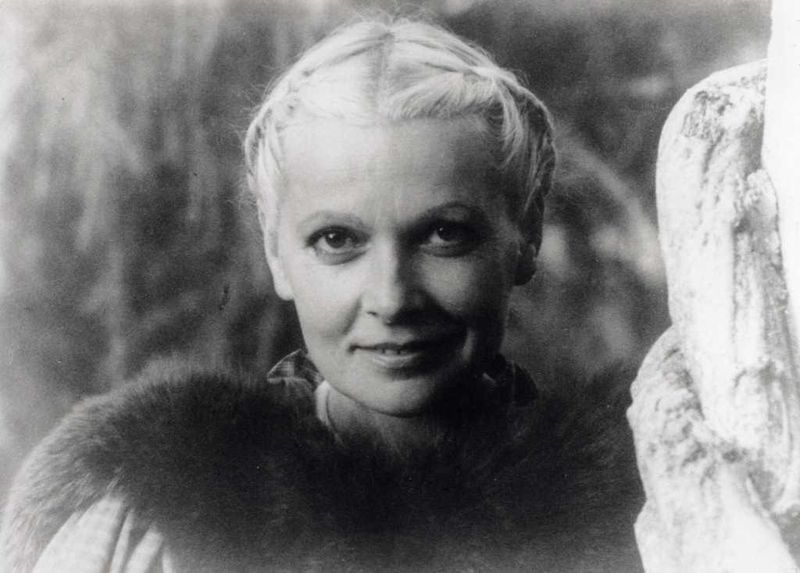
    Elisabeth Schärtel

    The performance is very fine all around, opening with a thoroughly absorbing Norn Scene which begins with the richly expressive singing of contralto Elisabeth Schärtel (above) followed soon after by the equally impressive Grace Hoffman. It’s rather surprising to find Regine Crespin singing the Third Norn. She had made a huge success at Bayreuth in 1958 as Kundry, and had repeated that role at the next two festivals. In 1961 she was invited back to the Green Hill for Sieglinde, and thus she was able to take on the Norn as part of her summer engagement. She sings beautifully, with her distinctive timbre, though there is a trace of tension in her highest notes.

    317372_340994792689362_1142580761_n

    Above: Birgit Nilsson; we used to refer to her as “The Great White Goddess” or simply “The Big B”. The thrilling accuracy and power of her singing here, as well as her ability to create a character thru vocal means, is breath-taking.

    Hans Hopf is a fine match for Nilsson in the Dawn Duet; he is less persuasive later on when his singing seems a bit casual. Wilma Schmidt (Gutrune) and the always-excellent Thomas Stewart (Gunther) make vocally strong Gibichungs, and the great Wagnerian basso Gottlob Frick is a dark-toned Hagen with vivid sense of duplicity and menace. Rudolf Kempe again shows why he must be rated very high among the all-time great Wagner conductors: his sense of grandeur and ideal pacing set him in the highest echelon.

    ~~~~~~~~~~~~~~~~~~~~~~~~~~~~~~~~~~~~~~~~~~~~~~~~~~~~~~~~~~~~~~~~~~~~~~~~~~~~~~~~~~~~~~~~~~~ 

    Gerhard Stolze

    Gerhard Stolze (above) is the Loge in a RHEINGOLD from the Bayreuth Festival 1964; I have a special love for Mr. Stolze in this role as he was my first Loge – at The Met on February 22, 1968, a broadcast performance conducted by Herbert von Karajan and my first experience of a RING opera live. Here at Bayreuth, as later at The Met, Stolze brings a wonderfully debauched, almost greasy vocal quality to the vain, spoiled demi-god. The voice is large and effortlessly penetrating, but he can also be tremendously subtle: after screaming “Durch raub!’ (‘By theft!”) when Wotan asks Loge how the Rhinegold might be acquired, Stoltze goes all lyrical as he says: “What a thief stole may be stolen from the thief…” this is but one of Stotze’s countless brilliant passages in the course of his portrayal. At Nibelheim and later, as Loge taunts the captured Alberich, Stolze is simply superb.

    Two other singers who appeared in my Met/Karajan RHEINGOLD are also heard in this Bayreuth performance: Theo Adam has a big, burly voice and sings imposingly if not always with a lot of tonal allure. His Wotan builds steadily throughout the opera to an imposing rendering of Wotan’s greeting to Valhalla and the entire final scene. Zoltán Kelemen is a splendid Alberich; his handsome baritone sound sometimes shines thru in what is essentially a dramatic character role. Power and calculation mark his traversal of the first scene; later, in Nibelheim, Kelemen is wonderfully subtle. Having been tricked by Loge and kidnapped, he’s truly fabulous as he summons his slaves to bring the treasure up as ransom for his freedom. Later, having lost everything, his crushing sense of vulnerability gives way to a violent hurling of the curse at Wotan.

    Z Keleman

    Above: Zoltán Kelemen as Alberich

    Grace Hoffman is a capital Fricka, bringing verbal urgency and vocal attractiveness to her every line, most expressive as she draws Wotan back to her after Erda’s intervention. Jutta Meyfarth, a very interesting Sieglinde on the 1963 Bayreuth WALKURE conducted by Rudolf Kempe, is too stentorian and overpowering as Freia, a role which – for all its desperation – needs lyricism to really convince. Hans Hopf, ever a stalwart heldentenor, probably should not have tried Froh at this point in his career: he sounds too mature. Marcel Cordes is a muscular-sounding Donner; there is an enormous thunderclap to punctuate Donner’s “Heda! Hedo!”

    The estimable contralto Marga Höffgen brings a real sense of mystery to Erda’s warning. Gottlob Frick is a vocally impressive Fasolt, his scene of despair at giving up Freia is genuinely awesome. Peter Roth-Ehrang (Fafner) and Erich Klaus (Mime) are names quite unknown to me; the basso is a bit blustery but has the right feeling of loutishness. Herr Klaus is a first-class Mime, with his doleful singing in the Nibelheim scene giving way to a fine mix of dreamy dementia and raw power as he tells Loga and Wotan of his dwarvish despair. Barbara Holt as Woglinde plucks some high notes out of the air; Elisabeth Schwarzenberg and the excellent Sieglinde Wagner as her sister Rhinemaidens.
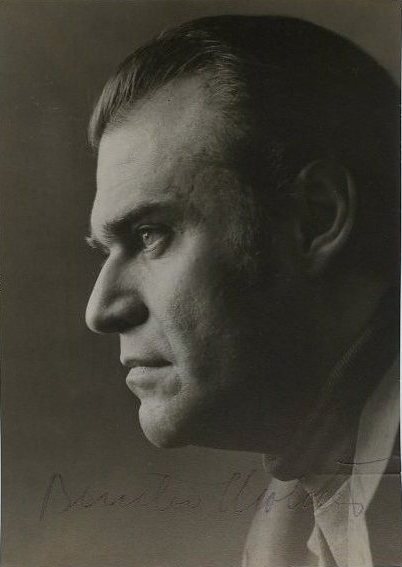
    Klobucar

    Berislav Klobucar (above), who conducted 21 Wagner performances at The Met in 1968 (including taking over WALKURE from Herbert von Karajan when the latter withdrew from his half-finished RING Cycle for The Met) opens this RHEINGOLD with a turbulent prelude. Klobucar has an excellent feel for the span of the opera, for the intimacy of the conversational scenes, and for the sheer splendour of the opera’s finale.

    ~~~~~~~~~~~~~~~~~~~~~~~~~~~~~~~~~~~~~~~~~~~~~~~~~~~~~~~~~~~~~~~~~~~~~~~~~~~~~~~~~~~~~~~~~~~
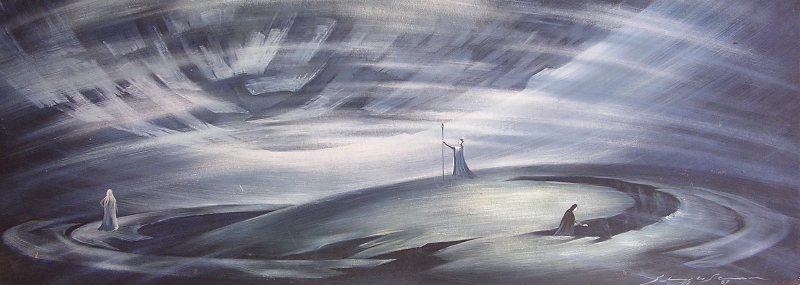
    1967-rheingold-salzburg-easter-festival-karajan-1967

    Above: a Günther Schneider-Siemssen design for the Herbert von Karajan Salzburg Festival production of the RING Cycle, 1967.

    Thinking of my Karajan/RHEINGOLD introduction to the RING at The Met in 1968 caused me to next take up the conductor-director’s complete WALKURE and GOTTERDAMMERUNG from the 1967 Salzburg Festival where his production of the Cycle originated. Of course, he only ended up conducting RHEINGOLD and WALKURE at The Met though the two remaining operas were staged there in his absence, with the productions credited to him. The settings remained in use at The Met thru 1981, and then the Otto Schenk production commenced in 1986.

    I must admit to never having listened to Karajan’s commercial RING Cycle (maybe a few random scenes but never any of the complete operas); it’s simply one of those inexplicable sins of omission which all opera lovers must eventually confess to. Maybe someday I will get around to it, though I’m so taken up with all these live RING recordings that Opera Depot keep tempting us with.

    At any rate, I must say I don’t much care for Karajan’s first act of WALKURE, at least not as it was performed at Salzburg in 1967. It feels to me terribly slow and overly polite. Gundula Janowitz and Jon Vickers seem much of the time to be vocally walking on eggshells: they whisper and croon gently to one another and the lifeblood seems to drain out of the music. Martti Talvela is his usual excellent self as Hunding; once he has gone to bed, Vickers commences a properly reflective sword monologue (the first orchestral interjection of the Sword motif ends on a cracked note). The tenor is stunning in his prolonged cries of “Wälse! Wälse!”, and then comes Janowitz’s ” Der Männer Sippe” which is verbally alert but there’s a slight tension in her upper notes and a feeling of being a bit over-parted. They sing very successfully thru the familiar “Winterstürme” and “Du bust der Lenz” all filled with attractive vocalism but Karajan maintains a rather stately pacing thru to end end of the act: there’s no impetus, no sense of being overwhelmed by sexual desire. Actually I found it all somewhat boring, and my mind tended to wander.

    A complete volte face for Act II, one of the finest renderings of this long and powerful act that I have ever encountered. Karajan launches the prelude, weaving together the various motifs, and Thomas Stewart unfurls Wotan’s opening lines commandingly. Regine Crespin’s sings a spirited “Ho-Jo-To-Ho!” and then Fricka arrives on the scene…
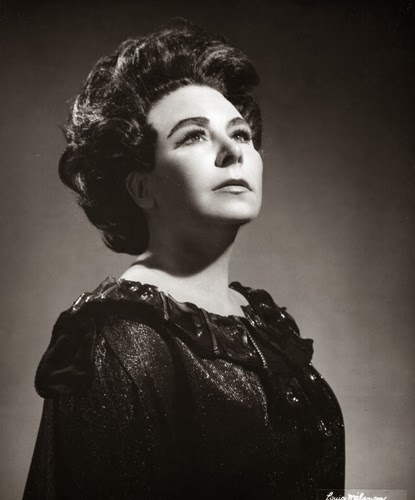
    16 Ludwig Fricka Walkure Melancon 1967

    …in the marvelous person of Christa Ludwig (Louis Melançon photo, above). When people ask me, “Who was the greatest singer you ever heard?” I invariably reply “Christa Ludwig” even though on a given day the memory of some other voice might seem to rival her. But in everything I have heard from her, both live and on recordings, Ludwig seems to have the ideal combination of a highly personal timbre, natural and effortless technical command, a remarkably even range, phenomenal abilities as a word-colorist, and overwhelming warmth and beauty of sound. Her Fricka here is magnificent in every way, and so supremely Christa

    6a00d8341c4e3853ef01901e20b373970b-800wi

    The scene between Fricka and Wotan is so impressive, yet incredibly Thomas Stewart (above, with Karajan) goes on to surpass himself with one of the most thrilling and spine-tingling renderings of Wotan’s monolog that I have ever experienced. Stewart vocally displays every nuance of the god’s emotional state as he confides in his daughter, first in his long ‘historical’ narrative which grumbles and whispers its way into our consciousness. Crespin is an ideal listener, her beauteously sung queries lead her father to divulge more and more. Soon Stewart is pouring out both his vanity and despair; the temperature is at the boiling point when he reaches “Das ende! Das ende!”, overcome by tears of anguish. Instructing Brunnhilde to honor Fricka’s cause and defend Hunding in the impending fight, Stewart crushes Crespin’s protests with a furiously yelled “Siegmund falle!” (“Siegmund must die! That is the Valkyrie’s task!”) and he storms away. I had to stop at this point; Stewart’s performance had both moved and shaken me and I wanted to pause and reflect.

    As beautifully as Crespin and Vickers sing the ‘Todesverkundigung’ (Annunciation of Death), the scene does not quite generate the mysterious atmosphere that I want to experience here. Thomas Stewart’s snarling “Geh!” as he send Hunding to his fate is a fabulous exclamation mark to end the act.

    Act III opens and there is some very erractic singing from the Valkyries in terms of pitch and verbal clarity. Crespin’s top betrays a sense of effort in her scene with Sieglinde, and Janowitz’s voice doesn’t really bloom in Sieglinde’s ecstatic cry ” O hehrstes Wunder!”  Thomas Stewart hurls bold vocal thunderbolts about as he lets his anger pour out on Brunnhilde and her sisters.

    And then at last the stage is cleared for the great father-daughter final scene. Crespin is at her very best here, singing mid-range for the most part and with some really exquisite, expressive piano passages. Only near the end, when the music takes her higher, does the tendency to flatness on the upper notes seem  to intrude. Stewart is impressive throughout. Karajan takes the scene a bit on the slow side, but it works quite well.

    It should be noted that the voice of the prompter sometimes is heard on this recording, especially in Act I.

    ~~~~~~~~~~~~~~~~~~~~~~~~~~~~~~~~~~~~~~~~~~~~~~~~~~~~~~~~~~~~~~~~~~~~~~~~~~~~~~~~~~~~~~~~~~~
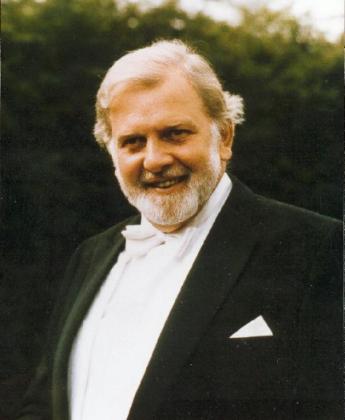
    Ridderbusch

    Above: Karl Ridderbusch, who sang Hagen in the 1967 Salzburg Festival RING Cycle.

    Herbert von Karajan’s GOTERDAMMERUNG, from the Salzburg Festival 1970, starts off with a very fine Norn Scene. Lili Chookasian – after a few warm-up measures – and Caterina Ligendza are authetically Wagnerian as the first and third sisters, with the resplendent Christa Ludwig luxuriously cast as the 2nd Norn. Her superb vocalism is marked by a great lieder-singer’s colourings of the text.

    Helga Dernesch and Jess Thomas give a sturdily-sung rendition of the Dawn duet. Though Dernesch’s highest notes seem somewhat tense, she does sustain a solid high-C at the duet’s conclusion. Karl Ridderbusch is a potent Hagen, able to bring out a softer grain to the tone when he wants to. His sound is somewhat baritonal, but he still hits the lowest notes with authority. Thomas Stewart is an outstanding Gunther, a role that often loses face as the opera progresses. Gundula Janowitz  is not my idea of a good Gutune: she sound mature and a bit tired.

    Christa Ludwig’s Waltraute is a performance of the highest calibre; her superb musicality wedded to her acute attentiveness to the words make this scene the highlight of the performance. Dernesch is good here also, but both she and Jess Thomas seem to flag a bit in vocal energy in the rape scene.

    Act II opens with another of my favorite RING scenes: Alberich (Zoltán Kelemen) appears to his son Hagen (Karl Ridderbusch). Kelemen, so musical in the 1964 Klobucar RHEINGOLD reviewed above, here resorts to sprechstimme and all manner of vocal ‘effects’: I wonder if this is what Karajan wanted, or is this simply what the baritone came up with. Ridderbush sings much of Hagen’s music here in an appropriately dreamy half-voice. A bit later he turns on the power with his “Hoi ho!”, summoning the vassals; the men’s chorus lung it lustily in response. Despite the continued feeling of effort behind Helga Dernesch’s high notes, she hits them and holds them fair and square. Jess Thomas sounds a bit tired as Siegfried; though he manages everything without any slip-ups, the voice just seems rather weary. Gundula Janowitz’s Gutrune is much better in Act II than earlier in Act I, and Thomas Stewart’s Gunther transforms what is sometimes viewed as a ‘secondary’ role into a major vocal force in this performance.

    I had high hopes for the opening scene of Act III: the Rhinemaidens – Liselotte Rebmann, Edda Moser, and Anna Reynolds are all fine singers. Yet they don’t quite achieve a pleasing blend. Jess Thomas sounds brassy and one keeps thinking he might have a vocal collapse, but he stays the course. It is left to Dernesch to be the performance’s saving grace and she nearly accomplishes it: the sense of vocal strain is successfully masked for the most part and she hits and sustains the high notes successfully though it’s clear she is happier singing lower down; she did in fact become a highly successful dramatic mezzo in time. Dernesch gives the Immolation Scene a tragic dimension, and then Karajan sweeps thru the long orchestral postlude with a sense of epic grandeur.

    Overall, Karajan’s GOTTERDAMMERUNG is impressive to hear. Were Helga Dernesch and Jess Thomas thoroughly at ease vocally the overall performance would have been quite spectacular. As it is, it’s Christa Ludwig, Thomas Stewart, and Karl Ridderbusch who make this a memorable Twilight of the Gods.

  • Music for a Summer Afternoon IV

    6a00d8341c4e3853ef01a511e902fb970c-800wi

    Philippe Jaroussky sings Handel’s Ombra mai fu from SERSE.

  • Death of The Fox

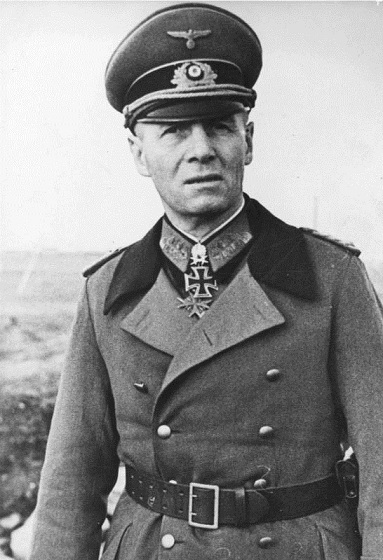
    Bundesarchiv_Bild_183-J16362,_Erwin_Rommel

    In October 1944 the death of the German Field Marshall Erwin Rommel was reported in the press. Popularly known as The Desert Fox for his brilliant military achievements in Africa (1941-1943), Rommel was said to have died from complications arising out of severe wounds he had sustained when his car was strafed while in France at the Western Front in June 1944. A grandiose funeral with full military honors was accorded to Rommel and while – curiously – none of the top Nazis attended the services, Hitler personally sent an enormous wreath.

    In fact, Hitler had turned against Rommel following the disastrous end of the African campaign. Rommel and the German troops had fought on valiantly despite lack of supplies and reinforcements which Hitler kept promising but never delivered. (Unbeknownst to the Germans, the Allies had broken their radio code and were thus able to track and  sink supply ships approaching the African coast, preventing ammunition, vehicles, fuel, food and other necessities from reaching port.)

    Despite his perceived failure in Africa, Rommel was considered one of the all-time great military strategists and was vastly loved by the German troops and idolized by the German public. Hitler, with the war already going badly for the Axis, could not afford to pubicly chastise Rommel and so gave him a top command post on the Western Front. Disillusioned, Rommel served honorably while already envisioning the fall of the Third Reich. Following the landing of the Allied troops at Normandy in June 1944, Rommel was a high-profile figure frequently seen at the front line. On July 17, 1944 his car was strafed by Allied aircraft. Badly wounded, he was returned to Germany for treatment and convalescence.

    On July 20, 1944 an attempt was made on Hitler’s life: a bomb hidden in a briefcase planted beneath a conference table at Hitler’s military headquarters in Rastenburg, Prussia exploded. Miraculously, Hitler survived. The conspirators, who had hoped to destroy Hitler and end the war before Germany was thoroughly devastated, were rounded up and executed. Although Rommel was not directly implicated in the assassination plot, his name was found near the top of a list of names of men who might succeed Hitler after the war ended. Hitler now viewed Rommel as a defeatist and a traitor.

    Some three months after the failed attempt on Hitler’s life, the public, struggling with the deprivations of wartime, were stunned by the news of Rommel’s death; they accepted the official story that the general’s demise was a result of complications from his war wounds.  

    It was US Army Captain Charles Marshall who uncovered the true story about Rommel’s death. As the Nazi regime collapsed and the Allies closed in on Berlin from both East and West, Captain Marshall was in charge of interviewing captured German officers on the Western front and reviewing seized documents to ascertain what charges should be brought against those who had been active on Hitler’s behalf.

    Although Rommel had been dead for several months, his widow still lived in their home in Herrlingen. Captain Marshall called on Frau Rommel to obtain her husband’s papers. Their first meeting was cordial; weeks later when the Captain – as promised – went back to Herrlingen to return those of the general’s papers which were not relevant to his investigation, the widow revealed to him the truth about Rommel’s death: he had been forced by Hitler to commit suicide.

    On October 14, 1944 two generals had arrived at the Rommel home in a chauffered car. They met with Rommel privately and offered him a choice: he could be taken prisoner, tried for conspiracy and treason, and publicly hung, or he could take the poison that they would provide and be given a hero’s funeral. If he chose suicide his wife and son would be spared imprisonment and degradation. Rommel agreed to end his own life; he met with his wife and son briefly and explained to them what was about to happen. Then he was driven in the chauffered car to a nearby country lane where he bit down on a cyanide capsule. Rommel was then rushed to a nearby hospital where – as had been pre-arranged – he was pronounced dead from ‘a heart attack resulting from his battle injury’.

  • CURRENT SESSIONS Volume IV, Issue II

    10540414_809848329055281_1375134267170772879_n

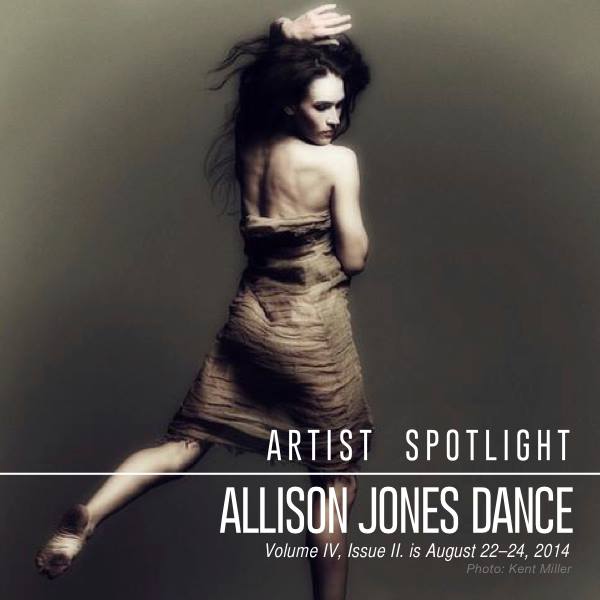
    Sunday August 24th, 2014 – This was the only performance of the ‘current sessions’ of the CURRENT SESSIONS that I could attend. I dearly wanted to see Colby Damon’s work but that will have to wait for another opportunity. Meanwhile, tonight’s line-up had the range and flair we’ve come to expect from these unique dance programmes. A big round of applause for the SESSIONS‘ co-Artistic Directors Allison Jones (photo at the top) and Alexis Convento for making it happen yet again.

    Housed in a comfortable, intimate venue The Wild Project down on the Lower East Side, the CURRENT SESSIONS bring together works by established and emerging choreographers in mix-and-match programming, getting dance and dancers seen in smoothly-produced and finely-lit (by Mike Inwood) repertory evenings. 

    This particular programme offered three fascinating works for solo female dancers, an entracing film based on the legend of Narcissus, an extended selfie of imaginative wit and energy, and ensemble pieces of visual variety, all served up by inspired and inspiring dancers.

    Jenna Pollack, a hypnotic mover, opened the evening in Nicole van Arx’s solo Wasserflut. Eerie and feral at first, Ms. Pollack expands thru the dance into a compelling presence; her backless black shirt reveals her expressive dorsal musculature. As the piece evolves, Jenna’s shadow becomes an element of the choreography. Fleetingly glimpsed through a sonic haze are fragments of the Schubert song from which the solo draws its title. 

    Enza DePalma // E|N|Z|A offered some bloom in darkness; this work for four dancers employs white chairs outlined in flourescent light. In this abstracted domestic drama revolving around our sense of security in our accustomed living space, the chairs are re-arranged as the dance moves forward. A distorted version of the Barcarolle from CONTES D’HOFFMANN is danced in-sync by the two girls; then the boys dance to a heavy beat. As the dancers re-claim their seats, we expect another vignette but instead a sudden blackout leaves us pondering what we’ve just seen.

    Jay Carlon’s Dance Film Selfie showed this engaging dancer/choreographer in a variety of public settings (starting on an escalator at Sochi) all caught on his own camera. Charmingly mixed, the scene of Jay dancing to “The Man I Love” while waiting for a bus was especially poignant; later he’s ticketed by the police: it’s a misdemeanor to dance in Brooklyn? As the film ends, Jay appears live onstage, sets his camera in the corner, and records another selfie solo to add to his repertoire. When the soundtrack, for solo violin, starts skipping like a broken record, it’s over. Jay’s timely and wonderfully whimsical work was a direct hit with the Wild Project crowd. Check him out here.

    Playback, a duet choreographed by Bryan Arias, was performed by Roya Carreras and Elise Ritzel to music played on an old cassette deck. Evoking both memory and expectation, the duet becomes intimate as the girls move to a collage of Mozart, a mostly incoherent spoken-word passage, and Max Reger. Bryan Arias’ choreography brought out a dark side in his two beautiful dancers.

    57c0d547191d0cc7a8f32dd041be8b95_large

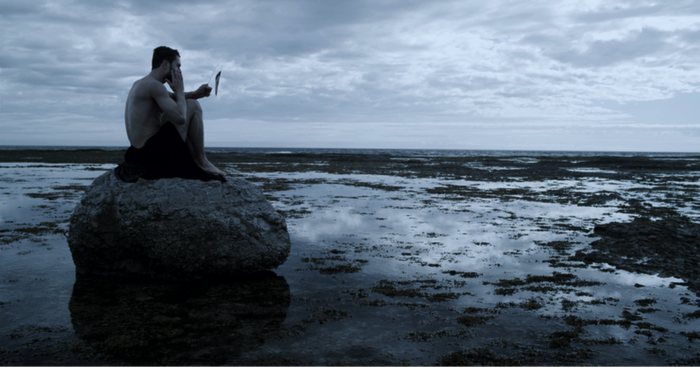
    Above: Nico Archambault in the film Stagnant Pool

    Stagnant Pool, a film by Kevin Calero co-choreographed by Wynn Holmes and Nico Archambault, transports us to a mythic land’s end where – inspired by the legend of Narcissus – Mr. Archambault moves like a demi-god across the seascape from which rise other-worldly rock formations. Shards of a broken mirror allure the dancer to his own image as fantastical music of the spheres becomes transportive: the cumulative effect is breath-taking. And then the vision evaporates into a nightmarish coda.

    Allison Jones presented the evening’s second solo work, SUBCYCLE, in which she performed to a Sam Silver composition. Deep sonics anchor the work in which Allison, bathed at first in golden light, moves with an intense sense of plastique gesture, pausing briefly to rest on the floor before brighness floods the space and she revives: an absorbing and definitive performance.

    Choreographer Kat Rhodes has tirned to Cormac McCarthy’s novel The Crossing as inspiration for LOBO (Wolf), an excerpt of whch was shown tonight. A young girl in a homespun dress is roused from her sleep by three other women in prairie denim garb appear in this ritualistic and evocative work: the three women may variously represent men, or wolves. Music by Nick Cave and Warren Ellis, as well as Mike Inwood’s lighting, enhanced the committed work of the four dancers.

    Andrea Murillo, a dancer I first saw work while she was working with the Martha Graham Dance Company, danced gorgeously in a Troy Ogilvie-choreographed solo Legacy Part One. The power and control of movement which Ms. Murillo developed while working at Graham were amply evident in her inspired peformance tonight. Spoken narrative and a kozmic big beat set the atmosphere as the radiant dancer held sway over the crowd, the lights coming up to a huge brightness as the solo progressed. Andrea’s perfomance was a knockout: I can’t wait to see Part Two

  • US Open Qualifying Tournament 2014 #4

    L1470420

    Above: Japan’s Yoshihito Nishioka

    Friday August 22nd, 2014 – Really nice day at the US Open Qualifying Tournament. Clouds kept the heat index at a comfortable level, and there was a breeze stirring. Around 3:00 PM, a ceiling of dark clouds settled over the Tennis Center, and just as Yoshihito Nishioka finished signing autographs after his win, the rains came down. I had really wanted to see the end of Hiroki Moriya’s match and to see Tatsuma Ito, a player I realy like and whose first two matches I missed this time around. But the rains were heavy enough to send the crowds scurrying, and it was obviously more than just a passing shower. I knew that even if play resumed within an hour, it would take an additional hour or more to dry the courts. So I left, though I didn’t really want to. 

    L1470317

    I started my day watching Japan’s Taro Daniel (above) in a hard-fought match against the experienced Canadian player Peter Polansky. Polansky took the first set convincingly, and Taro was showing visible frustration and fatigue in the second set when I had to walk away so as not to miss any of Steve Darcis’ match on Court 17. I was a bit surprised to find – after the truncated Darcis match – that Taro was still playing: he had apparently pulled himself together and taken the second set, and he was just a couple of games away from winning the third. He played really well, and the crowd was loving him. After the final point, he sank to his knees in disbelief. He had to sign a ton of autographs.

    L1470376

    Above: Taro Daniel after his win

    L1470327

    Over at Court 17 (above), I was totally psyched for the Darcis match. I found a nice seat very high up with no one in my immediate vicinity and a breeze to keep me cool. Tennis heaven! Steve played a stupendous first set. His opponent Emilio Gomez of Ecuador simply couldn’t get anything going against the Darcis Machine. Gomez managed to take one game in the first set but otherwise it was all-Darcis, all the time; Steve won the first set in 23 minutes, concluding with a superb passing shot. 

    Steve won the first game of the second set and then Emilio walked over to the chair umpire and asked for the trainer. After a long wait the trainer showed up, taped Emilio’s ankle, and play resumed. But as soon as Steve finished the second game, Emilio limped off the court and retired. So Steve’s victory, however assured, was a bit bittersweet. Nevertheless, it’s good he’s into the main draw and I hope he has a success.

    L1470335

    Above: Steve Darcis of Belgium

    After watching the end of the Taro Daniel/Peter Polansky I went over to Courts 4/5/6 where four Japanese players were to be playing their matches in succession. Yuichi Sugita was over-powered by Germany’s Matthias Bachinger today. Yuichi didn’t show the same energy as he had in his previous match. He had the trainer out during the second set for his ankle; though hobbled, he was still able to play out the match. Hiroki Moriya, following his thrilling match on Wednesday, seemed subdued today as he met the powerful Swiss Marco Chiudinelli. Marco thoroughly dominated the first set, but Hiroki came out swinging for the second set and fought hard to take it in a tie-breaker. However, he could not sustain the momentum and in the end Chiudinelli was the winner.

    L1470400

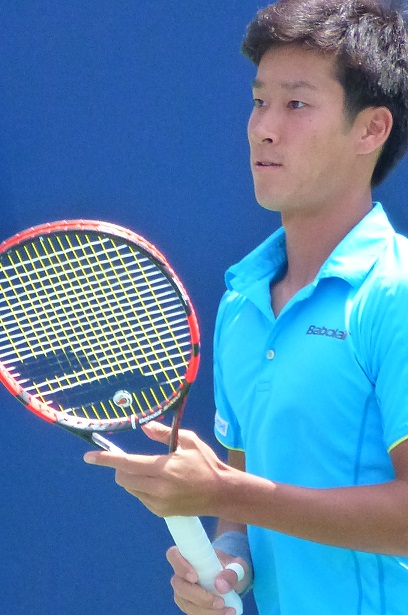
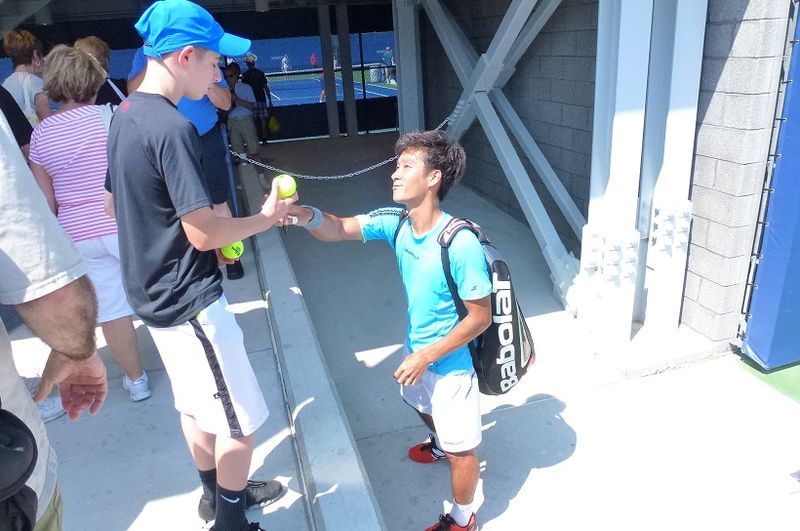
    Yoshihito Nishioka (above) held the Japanese banner high with a stunning win over Turkey’s hard-hitting Marsel Ilham. Like Sugita and Moriya, Nishioka is small of stature. But he was able to answer Marsel’s blistering strokes with well-placed, authoritative hitting. Nishioka only had one patch of trouble: a long service game where he kept being stalled at deuce. But once past that it was smooth sailing for the Japanese boy. The lopsided score (6-3, 6-1) does not really reflect the threat posed by Marsel Ilhan. But the crowd was over-joyed to celebrate Nishioka’s win, and he was engulfed by fans at the end.

    L1470487

    Above: Yoshihito Nishioka signing autographs after winning his match

    The rain prevented me from seeing Tatsuma Ito; I’m following his match now on the website. 

  • US Open Qualifying Tournament 2014 #2

    L1470053

    Above: Yuichi Sugita of Japan

    Wednesday August 20th, 2014 – Today was a really good day at the US Open Qualifying Tournament. What constitutes a “really good day” at a tennis tournament? A day when the players you like…win!

    L1470045

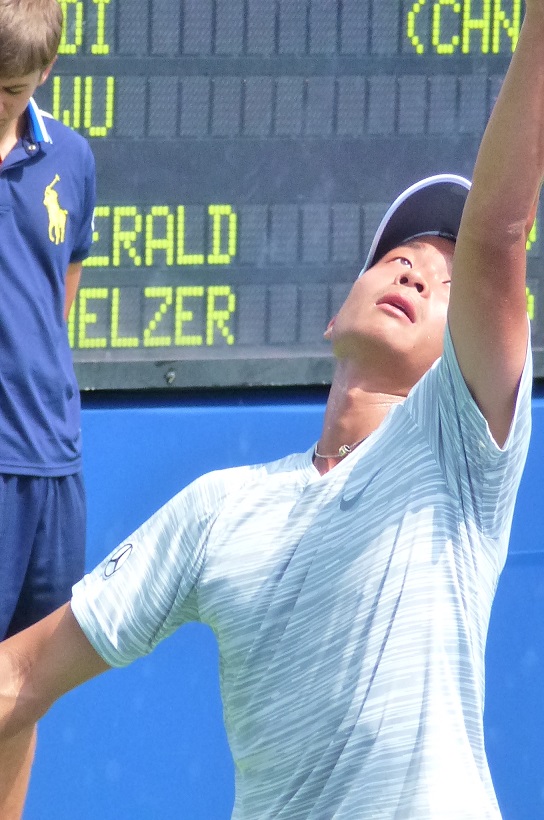
    Today started excellently with China’s Di Wu (above) scoring an impressive victory over Gerald Melzer of Austria. Di Wu dominated the match with his steady play, slowly wearing down his opponent. Patience and surety of technique kept the Chinese boy on the path to victory. The 6-2 6-2 score says it all.

    L1470049

    Above: Di Wu signing autographs after his match

    L1470101

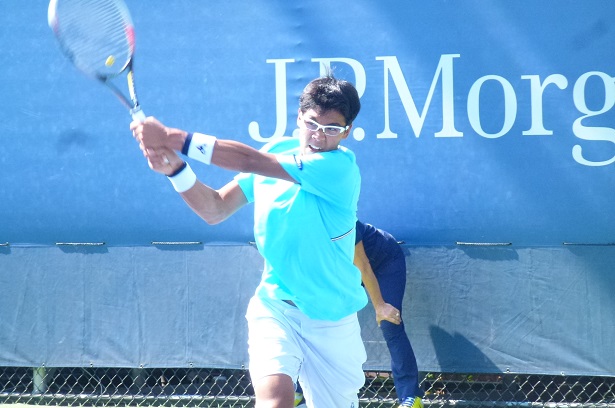
    A new face from Korea, Hyeon Chung (above), convincingly beat Argentina’s Augustin Velotti. Hyeon Chung, rather gangly and loose-limbed – and sporting some funky sunglasses – kept his opponent under control and was enthusiastically supported by a large contingent from New York’s Korean community.

    L1470062

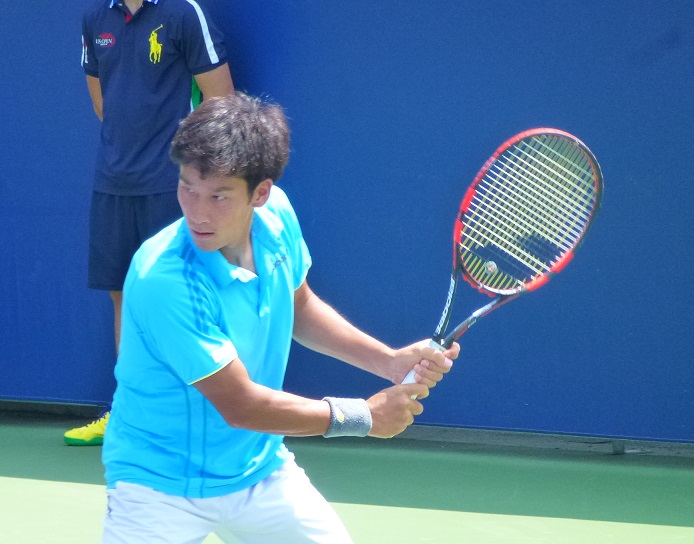
    Yuichi Sugita (above) played an exciting match against Germany’s Tim Puetz. Yuichi had opportunities to close out the first set sooner than he did, but his patience paid off. In the second set. Tim Puetz put up a strong battle, with some rowdy vocal support from the German fans, but Yuichi never lost his cool and he prevailed in the end, playing some beautiful tennis along the way. Rather reticent throughout the match, Yuichi let out a celebratory whoop when he scored match point.

    L1470086

    Above: Yuichi after the match

    L1470122

    Yuki Bhambri (above), the tall player from India, took an early break from the Lithuanian Laurynas Grigelis. But Grigelis broke back and the match progressed with some very exciting rallies and fantastical shots from both players. They seemed well-matched in the first set – it seemed it could go either way – but then Yuki took the edge. He sustained his high level of play throughout the second set, giving Grigelis few chances to make any headway. A strong victory for the Indian.

    L1470146

    Above: Yuki Bhambri

    L1470108

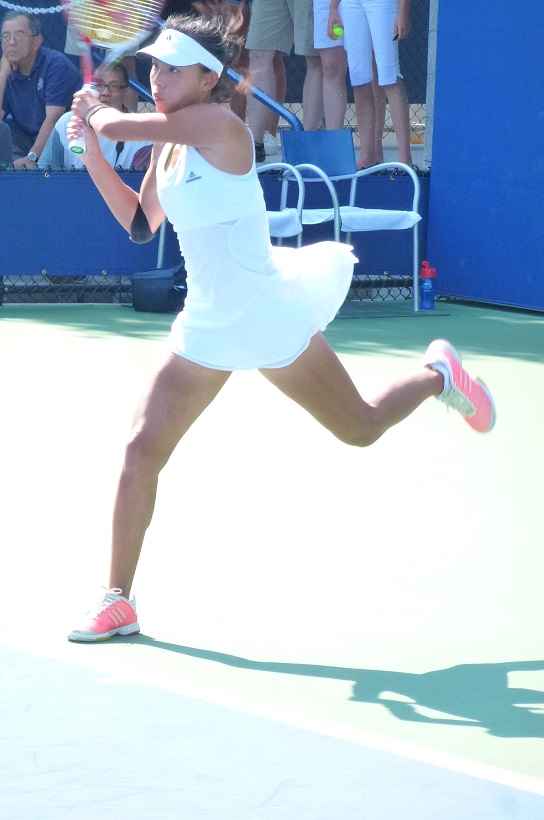
    I don’t get to watch many women’s matches at the Open; there are so many male players I try to follow, plus – to be honest – women’s tennis at the qualifying level is not always exciting. Today I did watch China’s Qiang Wang (above) fighting hard to sustain a win over Russia’s Evgenia Rodina in a three-set match buoyed by good audience particpation.

    I hadn’t been over to the corner courts (4, 5, and 6) on Tuesday and I was surprised today to see the renovations that have taken place since last Summer. The three courts are streamlined, with new scoreboards, seats that don’t over-heat as the sun beats down on them, and added “mezzanine” seating at each end of the court.

    One funny thing happened: the girl at the food stand misunderstood me, thinking I wanted a beer. She asked for ID! I said, “I need ID to buy a diet Coke?”

  • US Open Qualifying Tournament 2014 #3

    L1470263

    Above: Steve Darcis at the US Open Qualifiying Tournament 2014

    Thursday August 21st, 2014 – Another great match from Steve Darcis at the US Open Qualifying Tournament today as the Belgian player eliminated the popular American Michael Russell. Steve showed off his impressive style yet again, hopefully heading to the main draw after tomorrow’s final qualifying round.

    Michael Russell broke Steve’s serve early in the match but Steve broke right back. There were some great shots being exchanged, and Steve was coming to the net quite a bit, usually with good results. Despite some fine moments, Michael could not overcome Steve’s aggressive and technically sturdy momentum. 

    L1470294

    Over on Court 6, Japan’s Hiroki Moriya (above) – who played in the 2012 US Open – bounced back from losing the first set to Ruben Bemelmans of Belgium and played two very strong sets to clinch a place in the qualifying finals. Hiroki pulled off one incredible shot as he and Ruben tangled at the net. An enthusiastic crowd of Japanese fans gave Hiroki vital support throughout the match.

    On Wednesday, as my horoscope accurately predicted, I was on an energy high. Today it seemed to have evaporated. The sun was baking the courts and I had a long space of time to wait til my next anticipated match. Between the heat and the crowds, I grew restless, walking from court to court.

    L1470298

    I stopped to watch Gastao Elias (above) of Portugal play a set. Eventually the heat got to me and I decided reluctantly to leave. Checking in at the website later in the evening I found I missed several of my heroes chalking up wins: Tatsuma Ito, Di Wu, Yuichi Sugita, and Taro Daniel all advanced, with Rajeev Ram still playing.

    I’m planning to go to see the final qualifying matches on Friday, though rain is predicted. It’s a long trek from Inwood to Billie Jean’s place, so we’ll see what the morrow brings.

    It’s a bit odd that the heat defeated me today: I have been at the Open on far hotter days in past seasons. As someone who used to savour the heat and who spent many summers sunbathing devotedly, I’ve done a complete volte face since turning 64. Now I love the cold, the ice and the snow. Winter can’t get here fast enough.

  • Esser madre è un inferno

    Zilio_823

    Elena Zilio sings “Esser madre è un inferno” from Cilea’s L`ARLESIANA: LINK 

  • US Open Qualifying Tournamement 2014 #1

    L1470009

    Above: Belgium’s Steve Darcis

    Tuesday August 19th, 2014 – Steve Darcis played an immaculate first set at the US Open Qualifying Tournament today. The Belgian is one of my favorite tennis players; I first encountered him in 2007 when he played in the Qualifiers and secured a position in the main draw. He has been ranked as high as #44 (in 2008) but his successes have been counter-balanced by injuries that have kept it from attaining his rightful place in the tennis world. He has everything: serve, return-of-serve (really on today!), depth, variety of shots, great court coverage, and agility at the net.

    Throughout the first set today there was virtually nothing Spain’s Inigo Cervantes could do to keep the steam-rolling Darcis at bay. As the second set started, Cervantes seemed newly energized: his powerful serve began to work more impressively and there were some great rallies. And also some vocalism: both players loudly questioned line calls – Steve at one point rushing towards the chair umpire yelling “Jamais! Jamais! Jamais!” – and a bit later Cervantes smashed his racquet to the ground in frustration. Darcis had Cervantes at 5-4 and was serving for the match but he couldn’t close it out. They went on to a tie-breaker where Darcis finally prevailed.

    Earlier, Go Soeda – a great favorite of mine and ranked #2 among the qualifiers – played his usual gorgeous game. But Oscar Hernandez’s power and grit were too much for Go to handle. The opposite happened when Ireland’s Louk Sorenson, a powerful and almost brutal player, took the first set from Portugal’s Gastao Elias. Thereafter Elias seized the upper hand, grinding down Sorenson’s stubbornly sturdy game with craftiness and finesse and going on to victory.

    L1460993

    Above: Gastao Elias

    Sorenson is a player who grunts emphatically every time he hits the ball. God help us if he and Azarenka ever team up for mixed doubles.

    Growing weary of the crowds, I decided to head home a bit earlier than I had originally planned.

  • Cedar Lab @ Cedar Lake

    1969399_10152531894249210_2500814993722967151_n

    Above: Cedar Lake‘s Jon Bond

    Wednesday July 30th, 2014 – I have always loved Cedar Lake Contemporary Ballet‘s homespace on West 26th Street and I very much enjoyed this evening’s presentation of Cedar Lab, a new adventure for the Company wherein the dancers create choreography on their colleagues.  Tonight, works-in-progress by Jon Bond, Navarra Novy-Williams, Matthew Rich, Joaquim de Santana and Vânia Doutel Vaz were presented.

    Earlier this month I stopped in at a rehearsal of two of the works, those created by Navarra and Vânia, so I had a sampling of tonight’s programme. The Cedar Lake dancers are among Gotham’s most talented and alluring, and this opportunity for five of them to spread their choreographic wings did indeed make for a stimulating evening. A quote from dancer/choreographer Navarra Novy-Williams set the tone for this new initiative: “We explored a lot, and I’m certain we are still exploring.”

    The only drawback to my enjoyment of the evening was that I was seated in the back row which, despite being on risers, caused my view of anything happening on the floor to be cut off by the rows of spectators in the intervening space. Since most of the choreographers made use of floor time in their danceworks, this aspect of the presentation went for nought from my perspective. 

    The opening work set a very high standard for the evening in terms of choreography, music, production elements, and dancing. Joaquim de Santana presented his duet DISTANT SILENCE, set to Sigur Rós’ “Fjögur Píanó” and “I Just wanted to Know” by Phillip Jack. The work opened with a brief film by Billy Bell in which the dancers – Jon Bond and Vânia Doutel Vaz – made a ghostly appearance. A large white drape is then torn down and Jon and Vânia appear in the flesh. They cross the space in a flow of gorgeously plastique moves, illuminating the music and choreography in a way that puts the viewer under a spell. Dancing in true sync or in partnered passages, Jon and Vânia were a compelling pair. Jon’s solo, with Vânia doing a walk-about, underscored his status as one of the great movers in the modern danceworld. Vânia is a marvelous match for him: her solo – in the second ‘movement’, set to spoken word and mechanical music – was very finely wrought. Mr. de Santana knows his dancers well and employed their incredible gifts to the finest advantage. There were no bows after the individual works, but if there has been Jon, Vânia and Joaquim would have brought down the house.

    Vânia was the next featured choreographer: her ensemble work THEM THERE was danced to an original score by Tom Sansky. The dancers wear simple white shirts and black briefs. One by one they step into the spotlight to pose and emote as their colleagues dance quietly in the background. Combining solo opportunities and in-sync ensemble passages, the overall effect was excellent though I wish I could have seen what was going on on the floor. Ebony Williams, that paragon of contemporary dance, was the last to step into the solo spotlight; she was soon engulfed by her fellow dancers. 

    I was dazzled by RESIDUAL REACTION, a film in which Matthew Rich combined his ‘double-major’ of dance and fashion, working with Billy Bell who directed and edited the work. A fabulous dance track from Nalepa and Flume sent the movie into orbit with incredible footage of Cedar Lake‘s sexy and spellbinding dancers. And they have never looked more sensuous: Nickemil Concepcion, Joseph Kudra, Navarra Novy-Williams, Guillaume Quéau, Ida Saki, Rachelle Scott, Madeline Wong, with guests Patrick Coker and Daphne Fernberger. The camera invades their privacy, lingering on their skin and muscle with provocative investigation as they move with seductive glamour to the music. Baby powder is an unexpected element, and later – dancing on a rooftop – we are enslaved by the emblematic gorgeousness of the Cedar Lake dancers. I hope this film will soon be available on the Company website, or on YouTube. It makes a super-enticing trailer. The moment it ended I wantd to watch it again.

    Some audience members are summoned to the stage to observe MUSE, Navarra Novy-Williams’ series of three solos, danced in turn by Acacia Schachte, Madeline Wong, and Rachelle Scott. Acacia, with her very personal mystique, snaps her fingers to turn on the spotlight for her solo which includes some very witty moves and covers the space fluently. Madeline, in a fanciful puff-skirt, dances to a big lyrical theme by Ennio Morricone, and then Rachelle displays powerful balance and control as she dances to “Moon River“. Here, more than elsewere, my inability so see the floorwork of the dancers was especially disheartening. But enough of the flavour of Navarra’s work emerged, and the music was particularly well-used.

    Jon Bond produced a nightmarish work, THE DEVIL WAS ME, dealing with the aspects of sin – one of my favorite topics! Music by Murcof and Peter Broderick summoned excellent work from the dancers – those already mentioned above plus Billy Bell, Gwen Benjamin, Joaquim de Santana and Jin Young Won. The work begins with a deeply ominous theme, Rachelle Scott in the spotlight; later she will endure a satanic ritual performed on a table. The dark gathering of masked feral creatures is briefly relieved by a passage where the dancers appear in silhouette before a yellow-gold sunset. But the overall tone is sinister and sinful.  The one thing that might have made this purgatorial work even more fascinating would have been to have Jon Bond dancing in it.

    The house was packed, and when I emerged into the lovely summer evening light there was a long line of dance-lovers waiting to get in to the second show. This sort of initiative is a feather in Cedar Lake‘s cap, and I sincerely hope Cedar Lab becomes an annual event.