Author: Philip Gardner

  • Boston Ballet @ Lincoln Center

    10492224_10152189404857607_7335500118768821092_n

    Friday June 27th, 2014 – Boston Ballet have been celebrating their 50th season with performances at Lincoln Center this week. Tonight’s programme looked so tantalizing on paper, and it turned out to be a magnificent evening overall: Vaslav Nijinsky’s Afternoon of a Faun, George Balanchine’s Symphony in Three Movements, Jorma Elo’s Plan to B and Jiří Kylián’s Bella Figura were all superbly danced by the Boston troupe.

    When visiting companies bring Balanchine to New York, I sometimes wonder if it’s a good idea. Can’t you bring us something we don’t see all the time? But understandably, other companies are proud of their Balanchine and want to show off their abilities. Boston Ballet did a great job with The Master’s Symphony in Three Movements, even bringing their own orchestra to play the score. And Boston Ballet has strong Balanchine ties: he became Artistic Advisor to the Company in 1963, gifting them with more than seventeen of his ballets as a gesture of support.

    Curtain up, and I immediately found Shelby Elsbree in the diagonal. The ballet surges forward, with delightful performances by Misa Kuranaga and Jeffrey Curio – the high-bouncing couple – and Rie Ichikawa and Bradley Schlagheck. In the ballet’s central pas de deux, Lia Curio and Lasha Khozashvili excelled. The audience, fortified by a contigent of Bostonians, gave liberal and much-deserved applause to the dancers.

    Boston Ballet had brought their production of Vaslav Nijinsky’s Afternoon of a Faun to Fall for Dance in 2009 and I was mesmerized by it. Seeing the Leon Bakst backdrop and costumes again this evening provided a tangible link to the history of ballet and to that scandalous night over a century ago when Faun set Paris on its collective ear. Tonight, Altan Dugaraa embodied the exotic beauty of the Faun, his mystique and his longings, and Erica Cornejo was the Nymph, miming with stylized perfection. So grateful to have had another opportunity to see this production.

    In 2006, I experienced Jorma Elo’s work for the first time at the New York City Ballet’s premiere of Slice to Sharp. Slice received the longest ovation of any new work I’ve encountered at the ballet over the years: endless curtain calls and a state of euphoria among the crowd. Boston Ballet‘s performance of Mr. Elo’s Plan to B had something of the same a dynamic pungency about it. Illuminated by a large glowing screen stage right, six dancers reveled in fantastical choreographic patterns, flinging themselves into off-kilter leaps and flying across the stage, arms whirling like windmills in a tornado. Dusty Button, Whitney Jensen, Bo Busby, Jeffrey Cirio, John Law, and Sabi Varga danced thrillingly and were deservedly cheered for their jaw-dropping virtuosity.

    Alas, I am afraid Jiří Kylián’s Bella Figura was not really to my liking. Returning from the intermission, we find the dancers already onstage…warming up? Or is it a choreographed passage to start the ballet? Either way, it’s pretentious. Purgatorial and several minutes too long, the Bella Figura seemed to be more about the staging than anything else: black curtains endlessly re-arranged, a complex lighting scheme, flaming braziers bringing a taste of Hell to the stage, dancers coming and going almost randomly. The dancing was of course remarkable, and there are some very attractive passages, most especially when the topless dancers in long red skirts dance in unison. But it seemed to go on and on.
  • Cherylyn Lavagnino Dance @ St. Mark’s

    5941803_orig

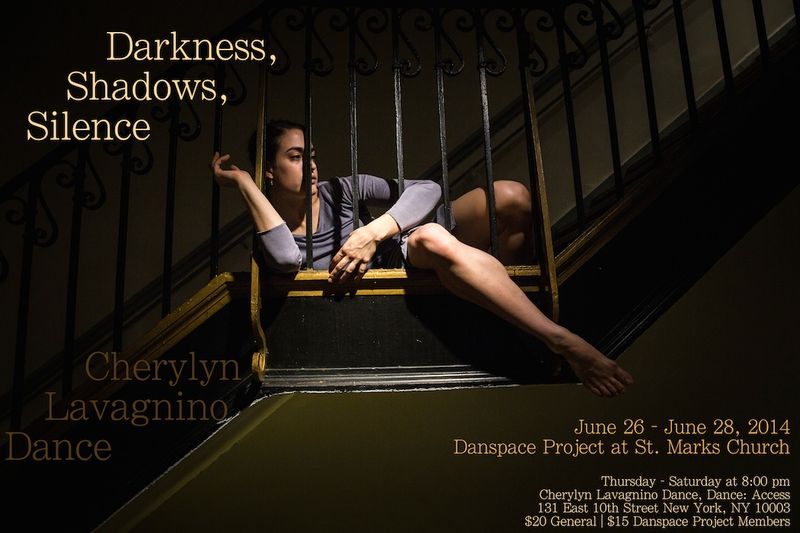
    Thursday June 26th, 2014 – Cherylyn Lavagnino Dance presenting a programme entitled Darkness, Shadows, Silence as part of the Danspace Project at St. Mark’s Church. It was rather stuffy inside the church on this summer evening, but the music and the dancing soon took my mind off any such concerns.

    Tonight’s first ballet is perhaps my favorite of Cherylyn’s works that I have experienced to date: TRYPTYCH is set to music by Francois Couperin and danced in bare feet. It opens with Claire Westby, invoking the dance from the mezzanine above. The four couples enter and commence a series of ensemble dances meshed with fleeting solo, duet or trio passages, the women wearing soft grey frocks and the men clad in simple dark costumes. Some of the phrases for the four women draw to mind the sisterly ensembles of Isadora Duncan. TRYPTYCH is spiritual though not heavy-handed: ritualistic yet human.

    I very much enjoyed the expressive interaction between Cherylyn’s beautiful dancers in this work: Giorgia Bovo, Selina Chau, Giovanna Gamna and Christine Luciano seemed deeply immersed in the music, and their partners – Michael D Gonzalez, Elliot Hammans, Travis Magee and Adrian Silver – came and went with a sense of quiet urgency. The ballet seems to draw to a lovely closing, but there is a pendant still to come.

    Scott Killian’s score for the final movement of TRYPTYCH alludes to Couperin yet is distinctly contemporary. An excellent duet for two men – Travis Magee and Elliot Hammans – gives way to another duet danced by Selina Chau (now on pointe) and Adrian Silver. The work ends with Ms. Westby in a benedictive phrase. This appended final movement at first seems somewhat unrelated to what’s gone on before, but Ms. Lavagnino and her dancers draw it convincingly full-circle in the end.

    Two movements of Cherylyn Lavagnino’s Schubert ballet TREIZE EN JEU were presented: this is a ballet for large ensemble wherein the dancers from TRYPTYCH are joined by Kristen Stevens, Eliza Sherlock-Lewis, Lila Simmons, and Justin Faircloth. Set to Schubert’s E-flat major trio, opus 929, the work displays the choreographer’s sense of structure, with a particularly memorable ‘pacing’ motif at the opening of the second movement as two phalanxes of dancers approach from opposite sides of the stage. Once again the individual personalities of the dancers played a vital element in the success of the piece. My only reservation was that the women’s costumes seemed too sporty and contemporary for the musical atmosphere: I would have addded long, gossamer black skirts. 

    Back in April, I visited Cherylyn’s studio where the works presented this evening were in rehearsal. And in the ensuing weeks I have read Kim Thúy’s novel, RU, from which Cherylyn’s newest work draws its inspiration. RU is a contemporary-style ballet set to a commissioned score by Scott Killian.

    The novel by Kim Thúy, which describes a young woman’s life as a post-Vietnam War political refugee, revolves around cultural dislocation and the struggle for identity. T’ai Chi’s passive resistance serves as gestural influence for the choreographer, and Christopher Metzger’s costumes for the women are reminiscent of the traditional Vietnamese áo dài dress: they are clad in white, with red accents indicating the bloodshed of war.

    Ms. Thúy’s novel is more like a book of poetry: each page contains only a few sentences (or, at most, a few paragraphs) describing in no specific order the details of escape from Asia to Canada, the cultural shock of this transplantation, and the writer’s emeging personality as a wife and mother. The choreography moves the female ensemble across a darkening landscape, suggesting their furtive escape from war and the formation of new bonds as their former lives are left behind. The men, bare-chested, can seem threatening or protective by turns. 

    In RU, Cherylyn Lavagnino and Scott Killian have summoned up the atmosphere of the novelist’s poetic vignettes yet the ballet also takes a wider view of displaced peoples, their exposure to abuse and treachery, and their assimilation into new cultures. I look forward to seeing this piece again in the future.

  • Beethoven Piano Concertos @ NY Phil III

    310696_2199382298108_399524588_n

    Wednesday June 25th, 2014 – The New York Philharmonic presenting the final programme of their 2013-2014 subscription season at Avery Fisher Hall; over the past two weeks, the orchestra have offered the first four Beethven piano concertos with Alan Gilbert on the podium and Yefim Bronfman at the Steinway. Tonight Mr. Bronfman played the 5th (‘Emperor’) concerto as the concert’s finale; earlier in the evening, he was joined for the Triple Concerto by the Philharmonic’s soon-to-retire concertmaster Glenn Dicterow, and the principal cellist Carter Brey join Mr. Bronfman. This same programme will be repeated on June 26th, 27th, and 28th, the final evening marking Glenn Dicterow’s farewell performance with the Philharmonic.

    The Triple Concerto (1804) opens with a traditional Allegro in which the solo voices are introduced one by one: the cello, then the violin, and finally the piano. In the Largo which follows (and is rather short), the concerto finds its heart with a melody, introduced by the cello, which displays the expressive richness that characterize the greatest passages of Beethoven’s works. Without pause, the final Rondo alla Polacca commences; again the insistently repeated phrases of the cello are prominent. This rondo features joyful themes seemingly inspired by Polish folk music, with lively shifts from major to minor.

    The performance, though thoroughly enjoyable, somehow never really developed a rapport between the three solo players, mainly due to the fact that Mr. Bronfman, of necessity, had his back to his string-playing collegues. Mssers. Dicterow and Brey were able to communicate directly with one another, whilst Mr. Bronfman was left in his own (beautiful) world.

    20130205193002_la-1337491-et-bronfman-1-lkh

    Following the intermission, Yefim Bronfman’s playing of the ‘Emperor’ concerto this evening was a superb finale to this NY Philharmonic Beethoven Concerto Festival. This majestic work was given a vibrant performance by the pianist and the artists of the Philharmonic, all wonderfully woven together by Maestro Gilbert’s baton.

    By this Saturday, Mr. Bronfman will have played on thirteen evenings over a three week period: an exhausting schedule, yet the pianist’s playing seemed awesomely fresh and vital tonight, with his uncanny mastery of dymanics always giving a shimmer to the sound. For all his technical brilliance, Bronfman’s playing also has a noble, heartfelt quality that makes his playing so deeply satisfying. The waves of applause that have engulfed him at each of these concerts have been very moving to experience. And it’s to our good fortune that he will be back at Avery Fisher Hall in late October 2014 playing the Bartok 3rd with Alan Gilbert on the podium. The dates are already on my calendar.

  • A Novel: ASTONISH ME by Maggie Shipstead

    Astonish-Me

    Maggie Shipstead’s ballet-based novel ASTONISH ME draws its title from something Serge Diaghilev reportedly used to say to his dancers: “”Etonnez-moi!” The novel will make a good Summer read for balletomanes who will likely enjoy getting to know book’s characters who are based (loosely or otherwise) on Gelsey Kirkland, Mikhail Baryshnikov, Natalia Makarova, George Balanchine and Suzanne Farrell, among others.

    In the novel, a young American ballerina named Joan is rather mysteriously tapped to assist the great Russian dancer Arslan Rusakov in defecting to the West in 1975. A romance between the two follows, but Arslan eventually ends up with Ludmilla, his Russian lover who has also defected. Joan gives up her dancing career and settles into a solid but conventional marriage. But as her son Harry grows up, he displays a remarkable natural affinity for ballet and he plunges headlong into that world, meeting and being mentored by his idol, Arslan Rusakov.

    The novel is at its most convincing when dealing with the world of ballet and with the devotion, disappointments, amours, addictions and quirks of the various dancers who people the story. Chapters dealing with Joan’s life away from ballet are a bit tedious, but as Harry’s career seems poised to take off, she is drawn back into the center of things. What might be considered the ‘big revelation’ of the story will in fact be rather obvious to alert readers way before it occurs to the characters involved.

    One interesting aspect of the story is that the ‘Balanchine’ character, here called “Mr. K”, succumbs to AIDS.

    The ending of the novel is somewhat under-mined by the convention of having the various interactions of the characters and the inter-twinings of their lives danced out in a ballet; I kept wishing that Shipstead could have found a more vivid way of drawing the threads of the story together, providing us with a less predictable denouement.

    Despite some reservations, the book is very well-written and definitely worth checking out.

  • Dress Rehearsal of SWAN LAKE @ ABT

    ABT_Swan_Lake_14_event

    Monday June 23, 2014 – I had a wonderful time at the dress rehearsal of ABT’s SWAN LAKE this afternoon, as the guest of my friend Monica Wellington. We had a very nice view of both the stage and the orchestra from a Grand Tier box.

    I’ve been to many opera dress rehearsals at The Met over the years, but this was my first time for a ballet. The dancers did not always dance full-out – just as the singers in an opera sometimes mark at a dress rehearsal. Partial costuming, lack of full stage make-up, headwear worn or not…all this made for a very ‘personal’ experience (one girl in the corps wore her eyeglasses throughout).

    James Whiteside was an excellent Prince Siegfried in Act I, and then we had a different pair of principals in each of the following acts: the exquisite Hee Seo dancing with Roberto Bolle in the first lakeside scene, then the lush and imperial Veronika Part with Cory Stearns in the Black Swan act, and finally Paloma Herrera (my lovely Giselle from last week) with Mr. Whiteside in the final act. Misty Copeland, Isabella Boylston, and Luis Ribagorda danced the pas de trois, and the soon-to-depart Jared Matthews danced Rothbart’s set-piece in the Black Swan act.

    At the end of the ballet, it was decided to rehearse part of the Maypole dance from Act I again, so we had the delightful experience of watching the girls, costumed as white swans, folk-dancing.

    The orchestra brought a special glow to the score, playing at performance-level all afternoon. I was especially impressed – and moved – by the woodwinds in the final act: the two oboists were ideally matched in phrasing, harmony and incredible breath-control, as were the bassoonists. Later the melody passes to clarinet, then flute, then piccolo. I very much enjoyed watching the musicians – all dressed in summer casuals – and I quietly applauded their artistry throughout the ballet.

    At the end, we stayed on as all the dancers – many of them now in street clothes – returned to the stage for notes. Cory Stearns practiced some very elegant multiple pirouettes stage left. 

  • Paul B Goode’s VISION #4

    Vision04_cover

    Above: ABT‘s Cynthia Harvey, Robert Hill, and Susan Jaffe in MacMillan’s REQUIEM, photographed in 1986 by Paul B Goode

    Photographer Paul B Goode has produced the fourth issue of his magazine, VISION. In this issue, Paul looks back on his formative years and at the people who influenced his development as a photographic artist in the realm of dance.

    Paul’s earliest work shooting dance was for Dianne McPherson’s dance company and for Ekstasis Modern Dance Company back in 1981. Following the path of his development, this reflective issue of VISION includes essays by choreographer Charlie Moulton, and by dancers Linda Kent (Paul Taylor Dance Company), John Carrafa (Twyla Tharp Dance Company) and Marie de la Palme, as well as Paul’s commentary on his work shooting at ABT. The current issue also features lavish spreads devoted to the dance drawings of Valerie Sonnenthal and to the photography of Gordon Munro. It was Munro’s work for the 1981-1982 Danskin catalog that initially inspired Paul B Goode – who was Munro’s assistant on the Danskin shoot – to venture into dance photography himself.

    Rounding out VISION #4 are some of Paul’s images from a recent studio rehearsal of the Steps Repertory Ensemble, which is now under the artistic direction of Bradley Shelver. My dancer/friend Lane Halperin contributes a beautiful essay to accompany Paul’s images.

    VISION #4, as well as the magazine’s previous ssues, may be ordered (either in hard-copy or digitally) via Paul B Goode’s website: LINK.

  • RIOULT: Martha, May and Me @ The Joyce

    Rioult_4181

    Above: Charis Haines of RIOULT; photo by Paul B Goode

    Saturday June 21st, 2014 matinee – Celebrating twenty years of dance, RIOULT– named for their founder/choreographer Pascal Rioult – offered two programmes at The Joyce. My over-stuffed, end-of-season calendar only showed space for a single performance, and it was a great afternoon of dance.

    May O’Donnell was only a name to me, and one that I honestly had heard only in passing. I knew nothing of her work beyond the fact that she had danced for Martha Graham. RIOULT have revived O’Donnell’s 1943 work, SUSPENSION, set to a score by Ray Green. This ‘blue ballet’ made an absolutely stunning effect as the opening work on today’s programme at The Joyce – a programme in which Pascal Rioult honored the creative influence of two women for whom he danced: Ms. O’Donnell and Martha Graham. In a brief film shown before the O’Donnell was performed, Pascal Rioult spoke of the deep impression made on him when he first saw SUSPENSION; the piece had the same powerful effect on me today. 

    SUSPENSION opens with a marvelous solo danced today by Sara E. Seger. In deep blue body tights, her hair in a ponytail, Ms. Seger is perched upon a pair of powder-blue boxes set stage left. This solo has the feel of an Olympic balance-beam ‘routine’ and was performed with a combination of athleticism and grace by the dancer. Her colleagues, in vari-hued blue body tights then assemble: Jane Sato, Anastasia Soroczynski, Catherine Cooch, Jere Hunt, Holt Walborn, and Sabatino A Verlezza. In stylized movement, they display deep arabesques and open wingspans, striking sustained poses with great control. Their communal rituals are at once stripped-down and ornate; SUSPENSION is as clear as a pristine Summer sky.

    Pascal Rioult’s BLACK DIAMOND (2003) shows O’Donnell’s influence in the gestural language. This duet for two women is set to Igor Stravinsky’s ‘Duo Concertant‘, a work familiar to ballet-goers thru George Balanchine’s ballet of the same name. The curtain rises on a black space pierced by David Finley’s shafts of light. In a smoky atmosphere, dancers Charis Haines and Jane Sato – each atop a large black box – begin to move in parallel solos, sometimes in-sync and sometimes echoing one another. Later they descend to stage level and the dancing becomes more spacious. They return to the heights for the final moments of the ballet, with a breath-taking lighting coup as the curtain falls.

    Earlier this month, photographer Matt Murphy and I watched Charis and Jane rehearsing BLACK DIAMOND – a memorable hour in Pascal’s studio. Read about that experience here, with Matt’s striking images.

    Martha Graham’s 1940 work EL PENITENTE employs a specially-written score by Graham’s ‘dear  indispensability’ Louis Horst. Inspired by the simple penitential morality plays presented by traveling players in the American Southwest, we see the self-inflicted torture of flagellation, the temptation of Adam by Eve, repentance, crucifixtion, and redemption all played out with naive simplicity. Michael S Phillips is the Christ figure and Charis Haines plays all the female roles, from virgin to temptress. With his god-like physique and powerful dancing, Jere Hunt’s Penitent was a perfect portrayal.

    For the afternoon’s closing work, VIEWS OF THE FLEETING WORLD, master-choreographer Pascal Rioult turns to the music of Bach – from ‘The Art of the Fugue‘ – for this seven-part dancework interpersed with empty-stage interludes which create a pensive atmosphere. The ensemble passages, with the dancers sometimes clad in long red skirts, give way to three duets in which the couples appear in evocative vignettes: Marianna Tsartolia and Michael S Phillips in Dusk, Charis Haines and Jere Hunt in Summer Wind, and Sara E Seger and Brian Flynn in Moonlight. Here – and throughout the afternoon – the technical prowess and personal allure of the RIOULT dancers set the choreography in high relief; their commitment and artistry are wonderfully satsfying to behold.

  • Herrera/Stearns/Part GISELLE @ ABT

    Paloma-herrera

    Friday June 20, 2014 – With Paloma Herrera’s announced retirement in mind, I wanted to re-visit her in the role of Giselle. ABT graciously provided me with a press seat (next to the lovely Mary Cargill) and despite this being my umpteenth viewing of this production of GISELLE, I truly enjoyed the entire evening.

    ABT could surely use a new production of GISELLE: the current one uses sets created for the film Dancers in 1987 and while it is perfectly serviceable, a fresh rendering would surely be a boon for frequent ballet-goers. The orchestra sounded especially plush tonight under David LaMarche’s baton, and it was refreshing to be at The Met for something that didn’t include a 35-to-40-minute intermission (the intermissions at Gelb’s opera performances are interminable and a real drain on the dramatic impetus of the operas).

    ABT‘s corps of Wilis danced with their usual expertise, though the two waves of applause as the hopping ballerinas cross paths are now more obligatory than a sign of genuine admiration: applause here rather dampens the atmosphere. Still, there’s no denying it’s an impressive moment. Tonight we had stellar casting in the roles of Myrna and Zulma – Misty Copeland and Yuriko Kajiya respectively – and a spectacularly danced, dramatically vivid Myrthe from the imperial Veronika Part.

    Earlier, in Act I, Luciana Paris and Luis Ribagorda danced a spirited Peasant pas de deux, with Luis especially fine in his second solo. Kelly Boyd, as Berthe, was very clear in her mime as she warned her daughter of the perils of dancing too much: a warning Giselles have ignored for decades.

    I was excited to see Sascha Radetsky listed as Hilarion – Sascha too is about to retire – but a pre-curtain announcement advised us Thomas Forster would be doing the role instead. Thomas was excellent – a Hilarion taller than the evening’s Albrecht made for an interesting conflict. Of course for me, I’m always on Hilarion’s side in all of this: Albrecht is a liar and a cheat who simply shrugs off his deceitful behavior when he’s cornered. Nothing really to admire here: he’s only redeemed by Giselle’s steadfast love.    

    I had only seen Ms. Herrera’s Giselle once before, in 2009, on a night when Roberto Bolle danced his first ABT Albrecht. That performance was a veritable Bolle Fan Fest and Paloma’s Giselle, though impressively danced, got somewhat swept away by the enthusiam her partner generated among the fans. So tonight the focus was rightly on the ballerina, and in my view she turned in a beautiful performance in every regard.

    Paloma’s sensitive musicality and her lush technique were very much to be savoured tonight; her Act I solo with super-confident hops on pointe and softly sweeping attitude turns drew cheers from the audience; later, her Mad Scene was marked by moments of stillness where Giselle’s mind seemed to be collapsing inwardly upon itself, her dreams destroyed in the debris of love’s betrayal.

    In the second act, Ms. Herrera and Cory Stearns formed a visually appealing partnership, his elegance of line and fleet-footed vistuosity counter-poised by the ballerina’s poetic lyricism and the inner strength she summons to keep her beloved alive. The poignant last farewell, the presentation of the single blossom that signifies forgiveness and redemption, was beautifully rendered by these two artists.

  • Gotham Chamber Opera: THE RAVEN

    64f8384177b1bc6ce6103c6e19507a29d202a740

    Friday May 30th, 2014 – Gotham Chamber Opera presenting the U.S. premiere performances of The Raven, a monodrama by Toshio Hosokawa, based on Edgar Allen Poe’s immortal narrative poem. Mezzo-soprano Fredrika Brillembourg and prima ballerina Alessandra Ferri take the leading roles with the chamber ensemble under Neal Goren’s baton; Luca Veggetti staged and choreographed the opera.  As a prelude, André Caplet’s rarely heard Conte fantastique: Le Masque de la Mort rouge, inspired by another Poe work – The Mask of the Red Death – was performed by a quintet featuring harpist Sivan Magen.

    The evening was engrossing both musically and visually; from the moment we entered the theater we were drawn to the stage by the shadow cast by Mr. Magen’s harp. The players made ravishing sounds in the eerily colourful Caplet score, the harpist’s pianissimo melismas delicately pricking the ear. The composer, in this conte fantastique, limns the tale of Prince Prospero who – with several guests – walls himself up in his castle to escape the plague. But Death finds him anyway. At one point Mr. Magen knocked on the wooden frame of his harp, a sinister effect.

    Luca Veggetti had the excellent notion of creating a musical bridge between the Caplet and the Hosokawa by having the clarinetist play a sustained tone soon after the opening work ended. Other players took up the sound, an improvised entr’acte that prevented the audience lapsing into idle chatter as the stage was set for the opera.

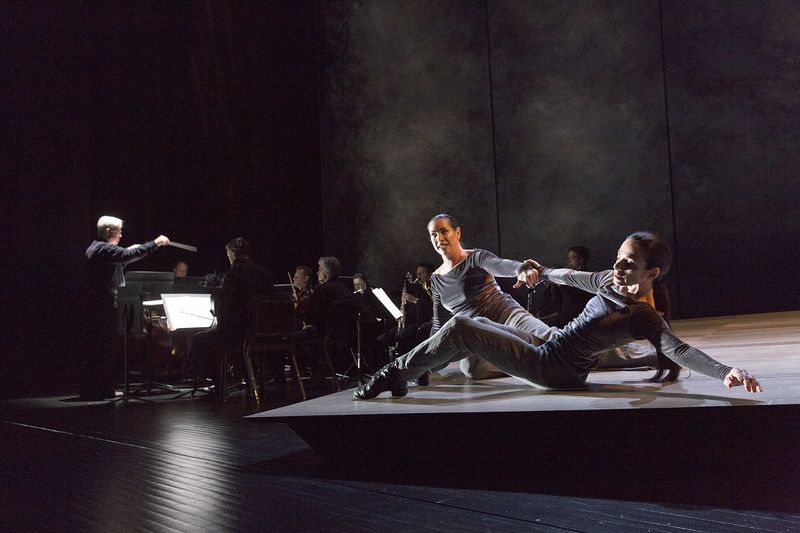
    The Raven takes place on a raked platform, imaginatively lit by Clifton Taylor. The mezzo-soprano sings/speaks the entire Poe narrative poem whilst the dancer moves about the space – is she is the Raven or the lost Lenore? – sometimes physically entwining herself with the singer. 

    Toshio Hosokawa’s score creates a sonic tapestry which sets the singer’s incantation in high relief. Winds and strings mingle voices with piano and percussion, evoking the eerie nocturnal visitation of the raven. The chill of an evening breeze sweeping thru a graveyard, the darkling shimmer of moonlight on a marble tomb, the icy shudder of tree roots shifting in the frost-covered ground: these illusions are musically expressed, deepening the mystery of the theatrical experience. 

    Fredrika Brillembourg offered a triple tour de force in her performance: she has mastered both lengthy and repetitive the texts of the poet and the sung-speech called for by the composer, and also the physicality of the director’s staging in which the singer becomes an active counterpoise to the dancer. In the beginning, Ms. Brillembourg’s speech had an exaggerated, measured slowness of expression; her narration later became more urgent. Her clarity of diction almost made the super-titles superfluous. In bursts of song, the mezzo revealed a vast range and a fine dynamic mastery: her vocal performance was engrossing at every moment. Ms. Brillembourg entered fully into the physical demands of the production, singing powerfully from improbable positions…

    RTRH4C1132 copy

    …and even at one point balancing Ms. Ferri on her up-turned feet, as in the childhood game of Flying Angels. [above photo by Richard Termine]

    At the end of this marvelous portrayal, Ms. Brillembourg was rightfully cheered by the large audience who had experienced her riveting performance in a state of pin-drop silence.

    Ms. Ferri was equally compelling, her slightest gesture or tilt of the head having a poetic quality that the greatest artists instinctively possess. I found my eyes constantly lured by her, even when she was merely standing still. Her silent presence spoke with the same authority as her singing colleague’s, and together they made the strongest possible statement on behalf of the composer and the poet.

    RTRH4C0374 copy

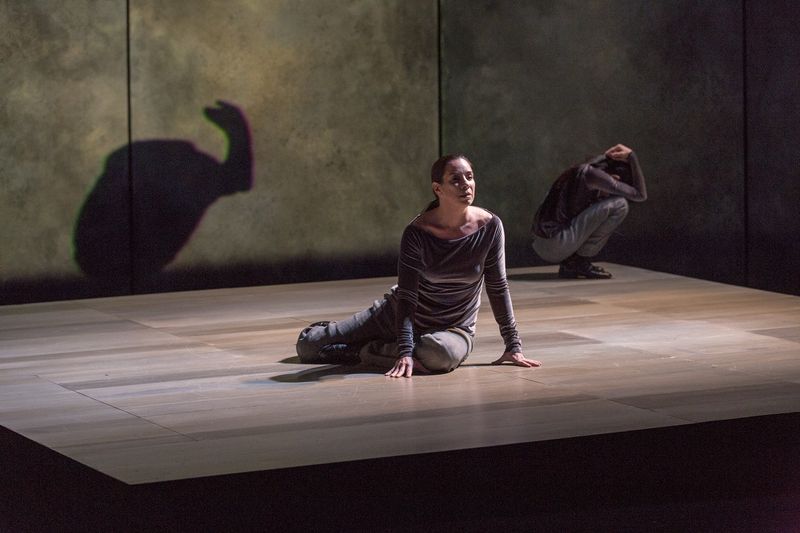
    In an uncanny moment, while Ms. Ferri is kneeling at the far corner of the platform (above) her shadow suddenly rises and moves across the backdrop as if drawn by the sound of the music being played stage right. This theatrical trompe l’oeil literally gave me the chills, especially as it was so subtly done.

    More images from The Raven, thanks to photographer Richard Termine:

    RTRH4C0287 copy

    RTRH4C0867 copy

    Nothing but praise then for everyone involved in this excellent production: another feather in Gotham Chamber Opera’s cap as they continue to play a vital role in the City’s cultural realm.

  • Viktoria Tereshkina in ABT’s BAYADERE

    Tereshkina

    Thursday May 29th, 2014 – This red-letter date had finally arrived: the guest appearance of ballerina Viktoria Tereshkina (above) in ABT‘s production of LA BAYADERE. I fell in love with Tereshkina when I saw her dancing Balanchine’s BALLET IMPERIAL with the Kirov at City Center in 2008. Vladimir Shklyarov was this evening’s Solor while ABT‘s beautiful Isabella Boylston portrayed Gamzatti.

    ABT‘s BAYADERE is old-fashioned looking, but that’s fine…it’s an old-fashioned ballet. The Lanchberry arrangement of Ludwig Minkus’s melodious score often takes on a cheapish, ‘music hall’ feeling, yet nothing can destroy the perfection of the Kingdom of the Shades, in which the ABT corps danced so well tonight; they very much deserved the sustained applause they received after their entrée.

    There was lots of excellent dancing to be seen all evening, starting with Aaron Scott’s energetic and commanding Head Fakir: very clever of him to slip the antidote to the High Brahmin just before Nikiya finds an asp at her bosom. One distracting element of attending ballet performances at The Met is the noise the toe-shoes make on the opera house’s stage. Somehow the lovely Stella Abrera overcame this problem in her Shade solo, lyrically and silently danced; her sister Shades were Skylar Brandt (very impressive as she crossed the stage in a series of arabesque hops on pointe) and Melanie Hamrick, always a pleasure to watch.

    Zhiyao-zhang

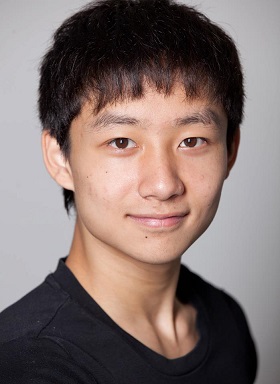
    Zhiyao Zhang (above) stepped out from the corps to dance the demanding solo of the Bronze Idol and did a very neat and precise job of it; he is a young dancer to keep an eye on.

    6a00d8341c4e3853ef017d3d08210a970c-800wi

    Casting about for a photo of Isabella Boylston, I recalled the day Jade Young and I watched Bella (above) rehearsing with Pontus Lidberg for MORPHOSES.  She was on particularly radiant form tonight as Gamzatti, a more complex character than she at first seems. Though vengeful, she is merely acting as her position dictates: a princess can’t be trumped by a mere temple dancer. Gamzatti accepts and embraces her arranged marriage; it’s Solor who has thrown a monkey wrench into things by failing to observe the accepted etiquette and giving his heart elsewhere. Thus for all her spitefulness in Act I, Gamzatti does engage our sympathies when her wedding ceremony crumbles before her very eyes in the ballet’s final scene: Isabella was particularly lovely in the solo here, expressing a bride’s hope and quiet joy, shadowed by the knowledge that her husband’s heart is elsewhere. Earlier, at the betrothal fete, she showed her technical command with some elegant and very grand dancing. The audience loved her.

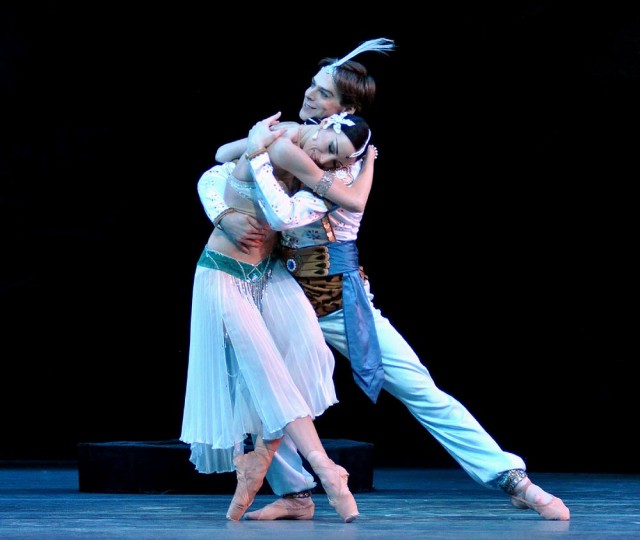
    Jr_bayadere_tereshkina_shklyarov_014_1000.sized

    Above: Tereshkina and Shklyarov in the Mariinsky production of BAYADERE; photo by John Ross.

    Vladimir Shklyarov completely won the Met audience’s collective heart tonight; enthusiastic applause greeted his solo passages and his partnering of Ms. Tereshkina was simply exquisite. Shklyarov’s dancing was marked by big virtuosity, his jumps sublimely floated and grandly elevated, his turns rapid and sure. His portrayal was marked by great tenderness for Nikiya and the despair of helplessly watching his beloved expire, forced by decorum to turn his back on her anguish. Remorse and guilt, and then the elation of finding Nikiya again among the Shades, were finely depicted by the danseur; by the time he stands before the Brahmin to be married, Solor is nearly mad, haunted by visions of his love.

    Ms. Tereshkina was everything one can hope for in a Nikiya; her dancing – all rooted in a stupendously strong technique – was refined, spiritual, and deeply musical. Forming a particularly resonant relationship with her partner, the ballerina reveled in the tenderness and ecstacy of their mutual love. In the solo danced before the betrothed Gamzatti and Solor, Tereshkina’s lithe and fluid body revealed the temple dancer’s sense of both duty and humiliation in a finely nuanced performance. In the Kingdom of the Shades, the ballerina attained a remarkable level of technique and artistry, re-affirming the great admiration I had felt when I first saw her dancing with the Kirov. She made a stunning spirit in the final scene as she drove the bridal couple asunder.

    When the final curtain fell on Nikiya and Solor ascending the stairway to heaven, the audience commenced an appreciative ovation that lasted longer than anything I’ve heard at the opera or the ballet in recent seasons. Tereshkina and Shklyarov bowed together several times, and even after the house lights were up and the gold curtain definitively closed, they were called out yet again. The audience clearly wanted solo bows, but the two stars remained resolutely a couple throughout the ovation.

    One especially lovely moment during the bows: Tereshkina came to the very edge of the stage and gave a deep curtsey to the musicians in the pit, thanking them with a sweeping gesture.

    I must remember in future not to spend the extra money for a balcony seat at ABT; there’s a massive invasion of the Balcony level from Family Circle: people who have paid less but want more clambering over me, marking seats with jackets and scarves, inquiring ‘Is that seat taken?’  The Met’s depleted ushering staff aren’t able to police the area, so this practice is virtually unimpeded. I myself retreated to the near-empty Family Circle once these eager, pushy people descended. I mean, if you are half-a-block from the stage, a few more yards either way hardly matters. But then, even during Shades, people continue playing musical chairs, much to the disadvantage of the performance. Had it been anyone other than Tereshkina, I probably would have left.