
“Memory, what can I make of it now
that might please you —
this life, already wasted
and still strewn with miracles?”
~ Mary Ruefle (b. 1952)
“Memory, what can I make of it now
that might please you —
this life, already wasted
and still strewn with miracles?”
~ Mary Ruefle (b. 1952)

Above: Kristen McGrew, choreographer and artistic director of Nomad Contemporary Ballet; photo by Melissa Bartucci
Last summer, last I attended Nomad’s premiere performance and I have kept in touch with the Company’s photographer, Melissa Bartucci. I ran into Kristen and Melissa last week and they told me about an exciting new project they are involved in: Joshua MacLeod, executive editor of Vesper magazine, is creating a film in collaboration with Nomad Contemporary Ballet. They invited me to a workshop which is part of the creative process for the film.
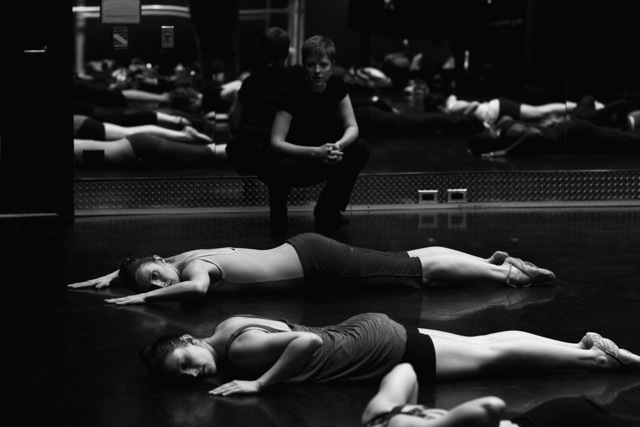
The workshop ran for three days at MMAC; I went on the final day. Joshua and the magazine’s art director Lalique Martinez were there filming and shooting, along with Melissa who provided me with the images for this article. The work being filmed is Kristen McGrew’s newest choreographic creation, Wind Spirits.
Here are Melissa Bartucci’s images of some the dancers who took part in the workshop or who are members of the Nomad company:
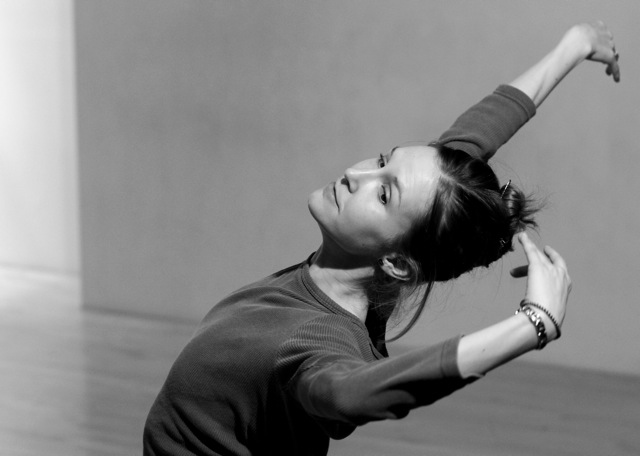
Erin Ginn
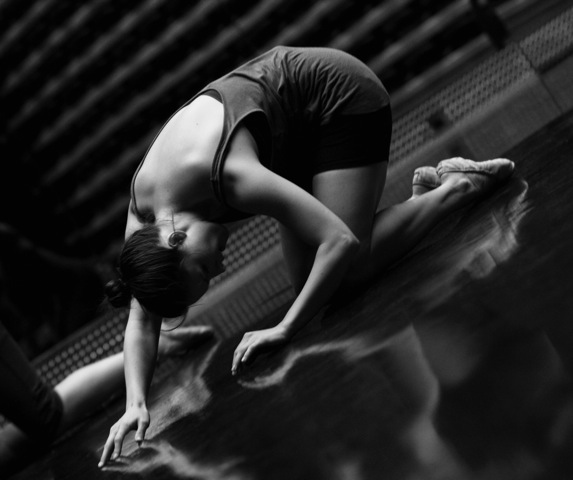
Elise Ritzel
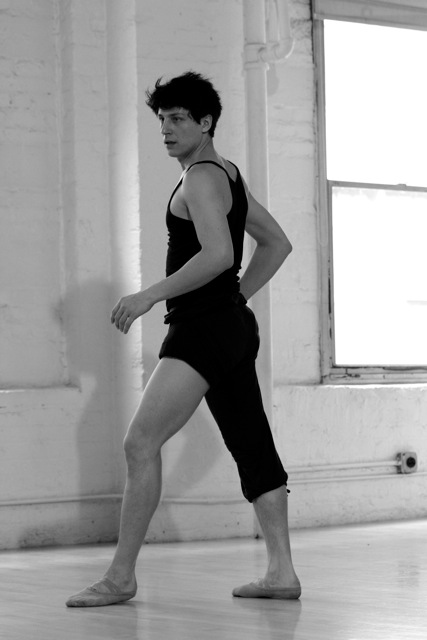
Joel Levy
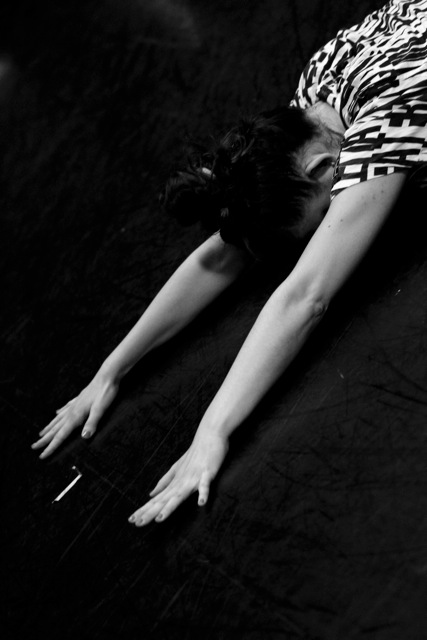
Alessandra Giambelli
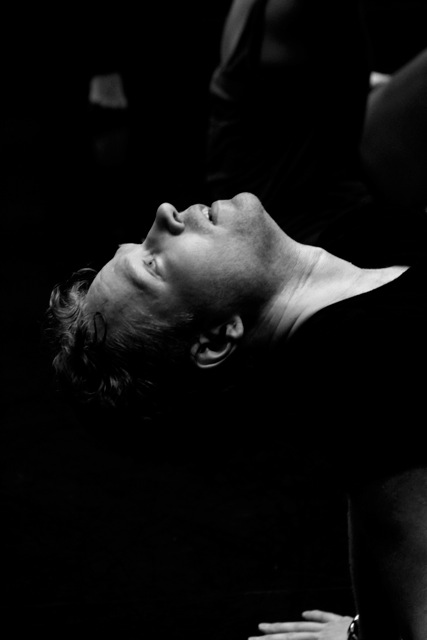
Eric Vlach

Ursula Verduzco

Kevin Tate

Shannon Maynor

Courtney Conigatti
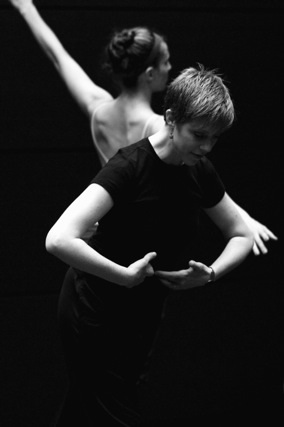
Choreographer Kristen McGrew
More information about this film with be forthcoming as the process evolves.
Photography by Melissa Bartucci.

Above: New York City Ballet principal ballerina Ashley Bouder in a Matt Murphy portrait
Friday May 24th, 2013 – A panoramic vision of George Balanchine’s choreographic artistry was on display this evening at New York City Ballet: an iconic classic, a quirky and mysterious series of danced vignettes, a spirited showpiece pas de deux, and a masterwork set in a luminous Chagall decor.
It must be a memorable landmark in a NYCB ballerina’s career to be cast in one of the principal roles in SERENADE. Sterling Hyltin, who recently took on the Russian Girl, was tonight making her debut as the Waltz Girl. Sterling has her own brand of youthful elegance and sophistication as well as the mature depth of artistry to bring something very personal to this role. As the inherent drama of the ballet evolved, Sterling’s sure sense of the music and her nuanced conveyance of its romantic beauty made a poetic impression, enhanced by the angelic fall of her hair.
Jared Angle was a perfect cavalier for Sterling in their Waltz, and his airy solo passage was beautifully crafted. Megan LeCrone’s unique persona and wonderfully fluid movement continually found inspiration in the Tchaikovsky score, and Adrian Danchig-Waring was again a marvel of physique and presence.
I’ve seen Megan Fairchild as the Russian Girl many times and I felt that tonight she surpassed her own high standards in the role; every phrase had a serene quality and in matters of expressiveness she found the exact hues in her dancing to enhance the lyrical glow of the music. It was a very pleasing interpretation in terms of both technique and artistry.

Above: newly-promoted to soloist, Ashley Laracey – one of the Company’s most distinctive dancers – in IVESIANA; photo by Paul Kolnik. The opening section of this ballet, entitled In Central Park, commences with a convergence of almost zombie-like women wandering the park at night. Ms. Laracey, in virginal white, moves among them – a blind girl feeling her way in the darkness. She encounters the broodingly handsome Zachary Catazaro and falls prey to his sexual desire, but it’s all very subtly manifested.

Above: Anthony Huxley and Janie Taylor in The Unanswered Question from IVESIANA; photo by Paul Kolnik. In this duet, the barefoot ballerina is borne aloft by unseen carriers while the desperate young man pursues her in vain. I’m reminded of a similar Balanchine duet, PORTE ET SOUPIR, in which the female character appears ever beyond reach. The two ballets end differently, but the mystery and allure evoked are provocative in both works. Anthony Huxley, beautifully vulnerable, gives a charismatic youthfulness to the questing boy and his thwarted desires, while the divine Janie Taylor, wrapped in an enigma, entrances with her pale skin and iconic hair.
In a sudden snap-out-of-it burst of reality, Teresa Reichlen and Amar Ramasar appear in a vaudeville-like duet. Playful and unromantic, they trade solo passages before shaking hands and going their separate ways. Confident and super-attractive, Tess and Amar give IVESIANA its only bright spot, for the ballet ends in deep twilight with the corps now walking about on their knees, downcast and anonymous.
The programme then did a volte face and gave us Balanchine at his most witty and entertaining with TARANTELLA, a virtuoso courting duet with a Neopolitan flair. Daniel Ulbricht gave a dynamic and high-flying performance, the crowd with him every step of the way as he leapt and swirled about the stage in uncanny combinations. Not to be outdone, the charming Erica Pereira brought a delicate but spicy air to her performance: her fancy footwork matched Daniel’s, and she showed off some very pretty attitude turns. As the pas de deux sails forward, the zils started to fly off from Daniel’s tambourine causing much mirth in the audience. The two dancers swept offstage after Daniel’s victorious kiss, then returned to an avalanche of applause. They were called out four times by the delighted crowd.
It’s not often we see a fourth curtain call after a ballet at NYCB, but it happened a second time tonight as Ashley Bouder delivered a brilliant Firebird to end the evening. Ashley’s boundless technique is matched by her insightful dramatic interpretation, filled with subtle detail and highly personal musicality. She created a vibrant and magical atmosphere, topped off by a striking manege of full-stretched jetes. But then she also summoned up the gentle rapture needed in the whispering bourees of the Berceuse. Fortunate ballet-goers to have experienced two superb Firebirds – Ashley’s and Maria Kowroski’s – in a single week. They are as different as two birds of a feather could be, yet each seems perfect.
Justin Peck was the wide-eyed and courtly Prince and Gwyneth Muller the willowy, enchanting Princess. Blessings on my lovely girls in the Dance of the Captive Maidens. Conductor Leif Bjaland and the NYCB players gave a jewel-like rendering of this fascinating Stravinsky score.

Wednesday May 22, 2013 – Ian Spencer Bell’s PASTE-UP was performed at City Center Studios this evening. On entering the studio, the dancing area has been created: a square has been taped off on the floor, studded along its perimeter with large light bulbs. The viewers are seated along all four sides of the square; as the house lights dim, the self-illuminated space comes to life.
There is no music for PASTE-UP though one of its sources of inspiration is Benjamin Britten’s Young Person’s Guide to the Orchestra. The only sounds we hear are the voices of the dancers calling out individual words.
The ballet commences with the ten dancers leaping across the space one by one; they repeatedly execute flying jetés from one side of the square to the other, or on the diagonals. As each dancer’s jump reaches its apex, he/she calls out the word “Lift!”. Yes, I know: it sounds terribly simplistic – even naive – but in fact it weaves a particular spell.

A trio evolves, danced by Ian Spencer Bell, Lindsey Jones and Joshua Tuason (above), and the word being said now is “Left!”. The movement vocabulary expands cautiously, with straight-armed salutes and more variety of steps and self-expression.
Switching to “Loft!”, the full company enter the space; they begin to touch one another, there are partnering elements and lifts along with seemingly improvisational self-contained solos. The work’s opening leaping patterns are repeated, now executed in trios.
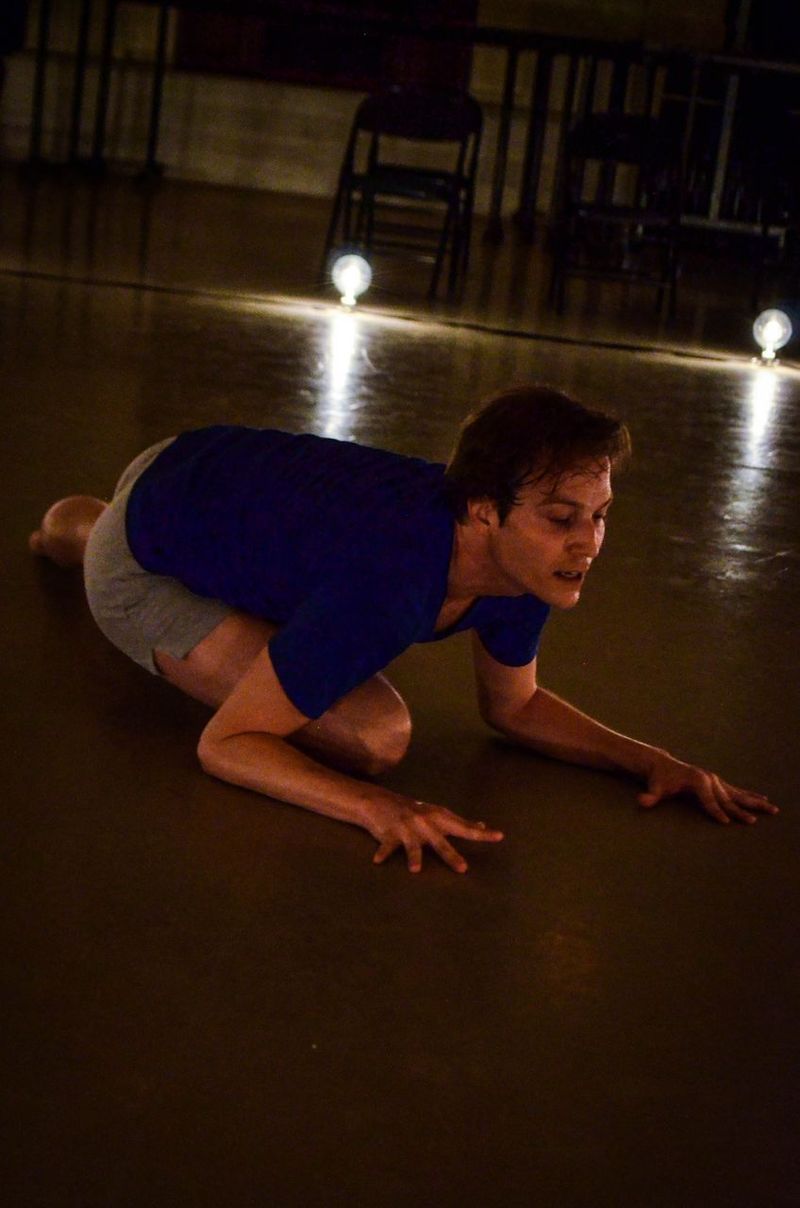
Introspection comes in Ian’s solo; we seem to be eaves-dropping on the dancer as he works alone in the space. He’s talking to himself: musing on Britten and on the music only he can hear, quietly infatuated with the sound of his own voice. Other dancers intrude, calling out things like “a beautiful melody!” where there is none.
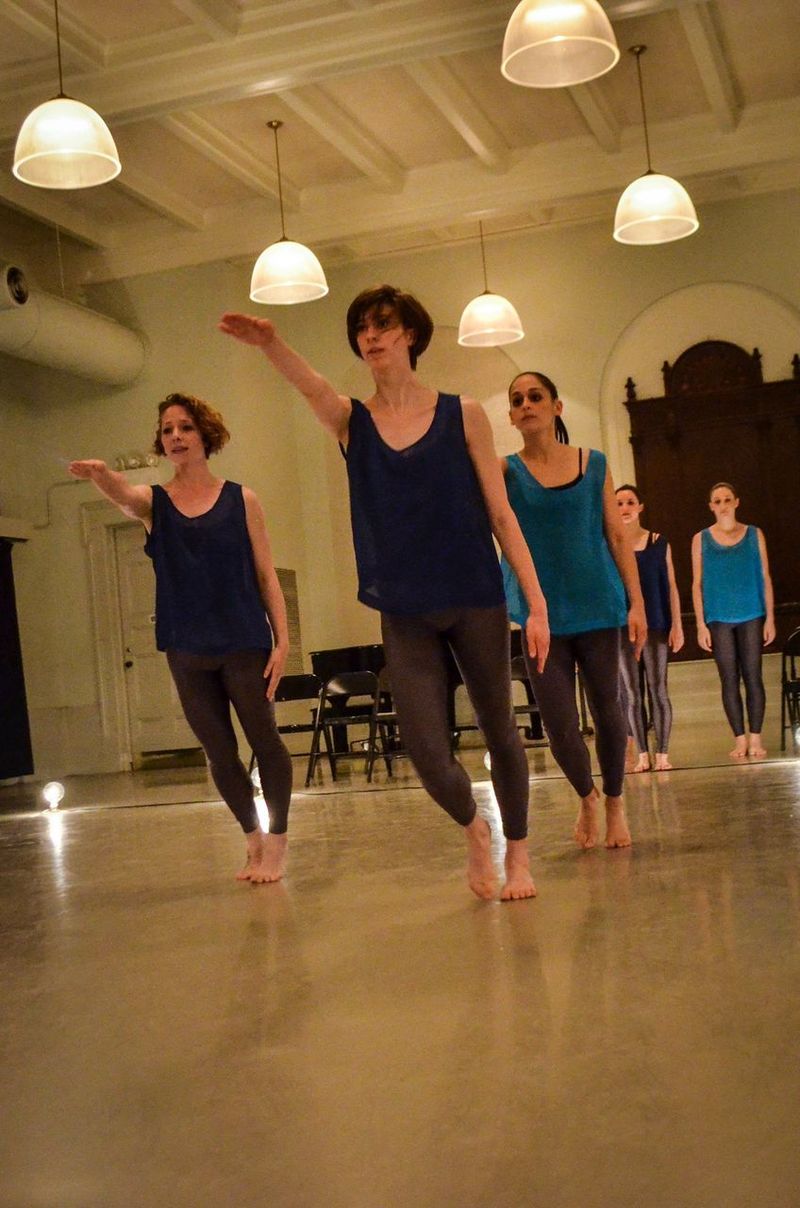
Above: Stevie Oaks, Lindsey Jones and Courtney Lopes
In an animated quartet – Lindsey, Joshua, Courtney Lopes and Stevie Oakes – the individual instruments of the orchestra are named along with descriptive words. The finale builds with the full ensemble, their voices becoming more urgent and their dancing more extroverted and complex. One by one the dancers exit, leaving Ian alone in the twilight, his voice fading to nothing.
I have described the facts of PASTE-UP but it’s rather more complicated to describe the atmosphere of the piece which has an odd intensity and a dreamlike quality. It evokes memories of innocence and of the simplicity of dancing alone, unobserved, discovering oneself with music that comes from within.
Ian’s works are distinctive and seem to evolve from simple and highly personal musings, finding a connection to the viewer thru the movement and the expressive gifts of his individual dancers. He certainly has a unique place in the current NYC dance scene and I look forward to seeing more of his work.
Appearing in PASTE-UP are: Ian Spencer Bell, Lindsey Jones, Courtney Lopes, Stevie Oaks, Mara Driscoll, Debra Bona, Oceane Hooks-Camilleri, Sally Kreimendahl, Vani Ramaraj, Joshua Tuason, and Justin Rivera. The lighting design is by Nicholas Houfek.
Photos by Taylor Crichton.
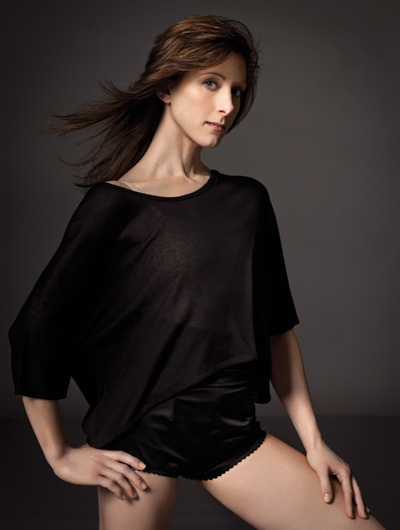
Above: NYCB‘s Jennie Somogyi in a Henry Leutwyler portrait
Tuesday May 21st, 2013 – Principal dancer Jennie Somogyi has returned to New York City Ballet after being sidelined with an injury for several months. Tonight was my first chance to see her since her return and she gave a super-charged performance in Ulysses Dove’s RED ANGELS. NYCB cognoscenti scatttered throughout the house gave her a hearty cheer when she stepped out for her bows. It’s wonderful to have her back.
The house was fairly full tonight – including about half of the Fourth Ring – though I know there were people outside who really wanted to come in but who could not afford the available tickets. I’m going far less often myself, because it’s just out of comfortable reach financially.
Guest conductor Leif Bjaland opened and closed the evening conducting two great scores: Tchaikovsky’s Serenade for Strings and Stravinsky’s Firebird. In the Tchaikovsky, he gave a somewhat more spacious feeling to the music than we’ve heard here in recent seasons: the fast passages were lively but not frantic, and he was adept at bringing out the inner voices that intertwine in the serenade’s melodic arcs.
Curtain-rise for SERENADE still puts a lump in my throat; despite a couple of tiny faux pas tonight the ballet was beautifully danced, and of course it’s a corps watcher’s paradise. The recent promotion of some of the Company’s loveliest ballerinas to soloist means that we’ll see these girls less frequently onstage; but tonight three of them – Ashley Laracey, Lauren King and Georgina Pazcoguin – retained their familiar places in this Balanchine masterpiece. The entire ballet was a feast for my opera glasses as one appealing vision after another moved across the stage in their swirling pale plue tulle.
Sara Mearns danced with silken beauty, handsomely partnered by Jonathan Stafford. Ashley Bouder’s marvelous sense of the music allows her to sail on the score’s melodic ebb and flow, pausing here and rushing forward impetuously there; her peerless technique and expressive face invest the role with many felicitous details. Rebecca Krohn gave a radiant performance, her lyricism at full-flight and so attractive to behold. It seems to me that both Ashley and Rebecca would be ideal in the ‘waltz girl’ role, and I’m hoping they’ll each have the opportunity soon. Adrian Danchig-Waring made a striking impression both in physique and face; his deep immersion in the ballet’s unspoken drama was spell-binding.
So exciting to see RED ANGELS again; it’s a favorite ballet of my friend Arlene Cooper, and I was glad to spot her from above this evening. Mary Rowell has played every performance of this ballet that I have ever experienced and she’s phenomenal, turning her electric violin into both a percussive and melodic vessel. In sleek physique-defining red body tights, the four dancers appear in introductory solos, then in duets, second solos, and a brief coda for all.
Amar Ramasar gave a magnificent, stellar performance of expansive and space-filling dance wedded to undeniable sex appeal. Jared Angle has followed in the footsteps of Peter Boal as the Company’s most poetic male dancer; in this case it’s poetry with an edge and Jared reads it with power and clarity. Teresa Reichlen’s long-limbed amplitude and cool allure are perfect here, dancing with sharp attack and soaring extension. Ms. Somogyi, her body in Olympian condition, was intense and keenly aware of the sensual energy that pulses thru the Einhorn score. Throughout, the four dancers communicate in a rich gestural dialect. Mark Stanley’s lighting is a major factor. The audience whooped it up for these exciting dancers and their vivid one-woman rock band.
Clothilde Otranto took up the baton for a definitive change of pace with the Tchaikovsky Pas de Deux. Andrew Veyette stepped in for Joaquin de Luz and won continuous rounds of applause for his swift and scintillating turns and leaps while the charm and delicacy of Megan Fairchild’s dancing exuded lyric grace, reaching an apex in a set of delicious fouette turns in the coda. The audience loved them, and rightly so.
Maria Kowroski’s imperial Firebird was the perfect finale for this parade of super-dancers. The elegant ballerina shaped the elusive avian creature into a poetic statement, creating a compelling reverie in the haunting Berceuse. Earlier, her fluttery evasions and eventual taming were finely wrought in gesture and expression and – needless to say – her long legs are an exceptional asset. I love Jon Stafford in this ballet (he replaced Ask LaCour tonight) for his sense of wonderment and almost naive heroism. He and Savannah Lowery as the captive princess gave a charming account of their courtship, surrounded by a bevy of maidens consisting of some of my favorite ballerinas. The girls – I know – take this scene with a tongue-in-cheek quality. For me it’s quite beautiful, as is the Stravinsky score – his finest in my view, and wonderfully played tonight under Mr. Bjaland’s baton.
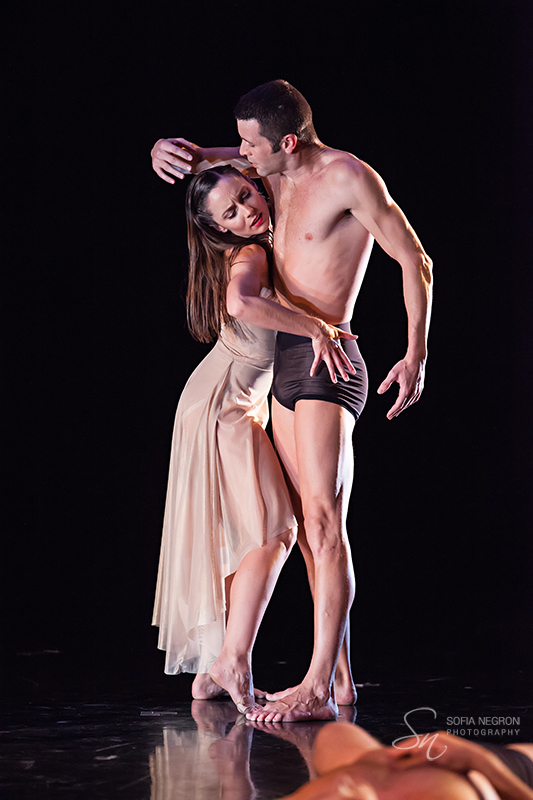
Above: Charis Haines and Brian Flynn in Pascal Rioult’s ON DISTANT SHORES; photo by Sofia Negron
Monday April 29, 2013 – For me, there are few choreographers currently creating who can rival Pascal Rioult for musicality, structure and dramatic nuance. This evening at the Paul Taylor Studios an invited audience watched an excerpt from one of Pascal’s most perfect works, ON DISTANT SHORES; and we were then treated to a preview of his current work-in-progress, set to a score by Michael Torke. Both ballets draw their inspiration from the stories of legendary women: Helen of Troy for DISTANT SHORES and Iphigenia for the new creation.
The except from ON DISTANT SHORES was danced this evening by Charis Haines, a charismatic and mysterious beauty; seeing her as the iconic Helen seems like a providential case of type-casting, for her presence is as mesmerizing as her face. She is surrounded by the spirits of four warriors, Greek or Trojan, with the torsos of demi-gods and each with his own indivdual allure: Jere Hunt, Brian Flynn, Holt Wilbourn and Josiah Guitian. The ballet is set to an ethereal and evocative score by Aaron Jay Kernis.
The dancers have been up at Katsbaan preparing IPHIGENIA; the Michael Torke score for this ballet will be performed live when it premieres at The Joyce in June. This new work is something of a fresh departure for Pascal Rioult in that it takes on the aspects of a dance-drama; there will be a spoken narrative, and the dancers’ acting skills will be to the fore. In this evening’s preview-showing the four principal roles were danced by Jane Sato, Marianna Tsartolia, Brian Flynn and Jere Hunt – all looking splendid, and vibrantly committed – while the other dancers of the Company take on the classic duties of the Greek chorus.
RIOULT will be at The Joyce June 9th thru 14th, 2013. Information here. Ah, and they are doing BOLERO…yet another of Pascal’s masterpieces.

Follow the link to watch a film about Wendy Whelan!
Photo by Matt Murphy.
Follow Wendy’s current project, RESTLESS CREATURE, here.

Above: the composer Hugo Wolf
Sunday April 28, 2013 – The Chamber Music Society of Lincoln Center presented a programme of works spanning three centuries; the Jupiter String Quartet and the celebrated baritone Thomas Hampson collaborated in a new work by Mark Adamo (NY Premiere), and the Quartet played Wolf, Schubert and Webern before rounding out the evening with Wolf songs sung by Mr. Hampson.
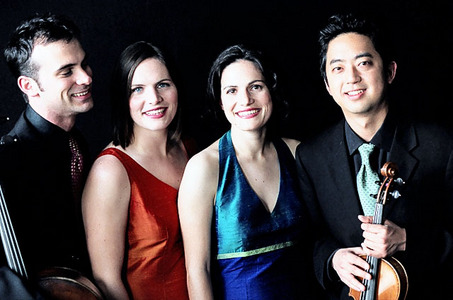
The Jupiter String Quartet opened the programme with Franz Schubert’s quartet in E-flat major, written when the composer was 16 years old. The players immediately displayed the warm, Autumn-gold sound that they would sustain throughout the concert. The melodies of this youthful work of the composer were wafted into the hall with generous lyricism; in the adagio especially, violinist Nelson Lee’s persuasive turns of phrase had a bel canto polish.
Anton Webern’s Langsamer Satz (‘Slow Movement’) was composed in 1905 but never publicly performed in the composer’s lifetime. Dating from the period before he embraced his twelve-tone destiny, this brief quartet was written when Webern was 22 and exploring a relationship with his cousin Wilhelmine, who he eventually married. The music is in full-blown Romantic style; its heart-on-sleeve emotional quality tinged with a trace of melancholy was lovingly captured by the Jupiter players.

Thomas Hampson, photo by Dario Acosta
I’ve been following Thomas Hampson’s career since I first heard him at the annual Winners Concert of the Metropolitan Opera National Auditions in 1981. He seems to be the only singer from among that year’s winners to have developed and sustained a major international career. Among his many roles at The Met since then, several have ranked high among my memorable operatic experiences, most especially his Count Almaviva, Billy Budd (a spectacular performance all round, in 1992), Onegin, Posa, Werther, Wolfram in TANNHAUSER, and Amfortas in PARSIFAL. In recent seasons, he has explored the heavier Verdi roles; I was very impressed with his Iago just a couple of months ago.
Today in Mark Adamo’s ARISTOTLE, Hampson’s voice seemed remarkably fresh and showed nary a trace of the passage of time. It was completely and marvelously satisfying vocalism from a singer who has passed the thirty-year mark of his career. Blessed from the start of his singing career with an immediately identifiable timbre, the baritone today sang with warmth, a broad dynamic palette, impressive sustaining of phrase and keen verbal clarity (no need for us to refer to the printed texts). This was singing of the first magnitude.
Mark Adamo’s ARISTOTLE can already be ranked as a 21st century vocal masterpiece. Set to a poem by Billy Collins, the work is about the passage of time and the stages of life. It resonates on a personal level, especially for those of us moving into the later decades of our span. Mark Adamo’s writing and the playing of the Jupiter Quartet provided Mr. Hampson with a marvelous vehicle in which the singer’s artistry is fully presented.
The poet’s text is imaginative, funny, poignant; opening candidly with “This is the beginning…almost anything can happen…” each of the works three ‘movements’ describes the experiences – from epic to mundane – that colour our lives as time passes. “This is your first night with her, your first night without her” is a touching wrinkle in the first section.
“This is the middle…nothing is simple anymore…” sets forth this memorable line: “Disappointment unshoulders his knapsack here and pitches his ragged tent.” And finally at the last: “And this is the end, the car running out of road, the river losing its name in an ocean…” Singer and players joined to create a memorable musical experience, the baritone’s incredible sustaining of the work’s final lines truly magical. The composer, seemingly overwhelmed by emotion, was called up to the stage and joined the musicians in receiving a sustained applause.
The second half of the evening was given over to works of Hugo Wolf, commencing with his brief and melodic Italian Serenade, played by the Quartet. Thomas Hampson then offered a set of the composer’s songs. With the exception of Anakreon’s Grab – which was the concluding work on today’s printed programme – I have never really been drawn to Wolf’s lieder, despite many attempts over time to make a connection. The first two songs today were rather jolly, and then the singer and musicians moved into deeper and darker territory, which proved very pleasing indeed. And yet it was still the calm beauty of Anacreon’s Grave that moved me the most. As an encore, Wolf’s
Schubert: Quartet in E-flat major for Strings, D. 87, Op. 125, No. 1 (1813)
Webern: Langsamer Satz for String Quartet
Adamo: Aristotle for Baritone and String Quartet (2012, CMS Co-Commission, New York Premiere)
Wolf: Italian Serenade for String Quartet (1887)
Wolf: Selected Lieder for Baritone and String Quartet
 Oberon's Glade