(Reaching back nearly 20 years to bring this article over to the Glade from the Grove.)
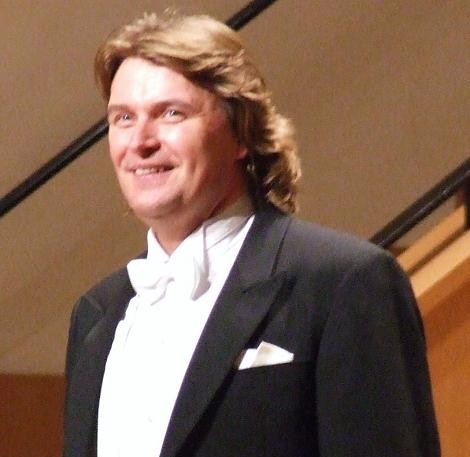
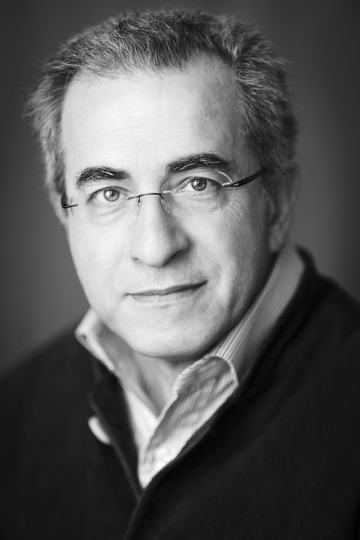
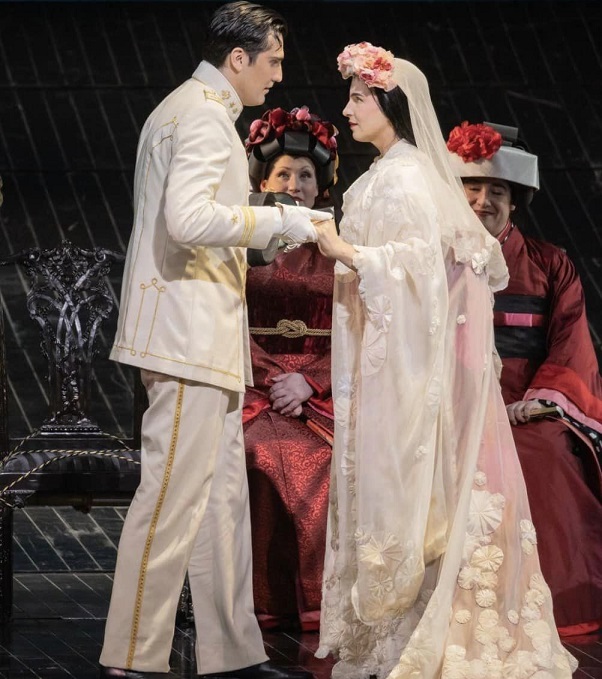
Above: Klaus Florian Vogt
May 3rd, 2006 – Opera was always my first love, and even though in recent years I have found myself going to NYCB far more frequently than to either of our opera companies, I can still get a thrill when all the elements come together at the opera – as they did last night in a performance of Wagner’s LOHENGRIN at the Met.
This is the controversial Robert Wilson production. The staging is very static; the chorus is largely stationary. The singers move in slow motion, using stylized hand gestures that sometimes recall old photos of the Nijinsky L’APRES MIDI D’UN FAUN. I would imagine it is quite strenuous on the performers and have heard stories of singers needing chiropractic treatment after a run of performances. The opera takes place against a (mostly) blue cyclorama with large panels of blinding white light drifting in and out at key moments. Aside from a throne for the King and an empty chair for the “tower” scene the only bit of stage decor is a large wing to represent the swan. You either love it or hate it.
Karita Mattila has a great role as Elsa and even though her voice seemed sometimes to be at the very limits of what she can do, the results were thrilling. Her silver-blue clarity fits the music, and the production, to a T. Margaret Jane Wray, once a lyric mezzo who went into soprano rep and was a fine Sieglinde a couple years ago was here trying out Ortrud; she sang most of the music with far more beauty of tone than we normally hear, but she did not have the easy top needed for her Invocation or her confrontation of Elsa at the wedding. Her final interjections were a bit more desperate than one wants to hear. Greer Grimsley, a sinister and almost alien-looking presence, hurled out his darkish tones with great passion and turned what is usually an ungrateful role into a key element of the evening. Rene Pape is simply magnificent, his beautiful basso voice just keeps flooding the hall. Young up-and-comer Charles Taylor took a few bars to warm up and then delivered the Herald’s pronouncements with striking depth of tone.
Ben Heppner’s been doing the Lohengrins this season and, much as I admired him in the role about 6 years ago, he has been going thru some ups & downs; on the recent broadcast he had some vocal cracks. So I decided to try the alternate, Klaus Florian Vogt, who was making his Met debut. You just never know these days what you are going to get in a 2nd cast or cover performance; the Met is apparently economizing by hiring less-than-stellar back-ups. And so I waited for Vogt’s first lines with some trepidation, fearing he might be some old strenuous-sounding heldentenor-has-been. And then he literally caressed the ear with his sweet sound. It became clear that we were in for a very different-sounding Lohengrin than we are accustomed to. This was more a Tamino voice than anything remotely “helden”. He used dynamics with skill, and his almost vulnerable quality gave the music an other-worldy aspect which truly suits the character. I’m sure there were people in the audience who wanted a more hefty sound, but for me it was a revelation. In his long Act III narration, Vogt seemed to enthrall the audience – you could hear the proverbial pin drop – as he unfolded the story of the Grail and the swan to the distraught Elsa.
Phillippe Auguin was replacing the recuperating James Levine on the podium and he drew a glorious account of the score from the orchestra and from the chorus, who can sound rather “elderly” at times – but not here. Concertmaster David Chan, one of the Met’s treasures, is fascinating to watch from my extreme high-side vantage point.
The performance won an enormous audience response and the ovation that greeted Mr. Vogt seemed to take him off-guard. He stood there as if dumbfounded. People above me were pounding on their score desks and everyone was screaming “bravo!” at the tops of their lungs. This was reminiscent of the great ovations that were an everyday experience back in the Last Golden Age at the Met (’60s – early ’80s). It’s been a while since a night at the opera seemed this thrilling.
(One of several articles written for Oberon’s Grove that failed to reach Oberon’s Glade in the original transfer. I couldn’t leave a review of my favorite opera behind!)
Above: Lise Davidsen as Ariadne
Author: Oberon
Saturday March 5th, 2022 matinee – My favorite opera is always a joy to experience, even in a flawed performance; today, I brought my fellow opera-lover, Craig Salstein, along with me to the Met’s matinee. Craig was seeing ARIADNE for the first time. The Met’s very fine Elijah Moshinsky production has held up well since its 1993 premiere; this season’s Met performances are the first since 2011.
Some people say it is unfair to hold current singers up for comparison to earlier singers we have heard in the operas thru the decades, but such comparisons have always been the case amongst dedicated opera-goers. I recall being frustrated, in my early days of attending performances, by older fans who found Beverly Sills’ Lucia “…not as good as Lily Pons…” or told me that Victoria de los Angeles’ Mimi could not be considered ‘the greatest’ if you’d never seen Bidu Sayão. But over time, I understood how they felt.
I admit to having been spoiled rotten by my previous performances of ARIADNE AUF NAXOS. In the title role, the voices of Leonie Rysanek, Carol Neblett, Johanna Meier, Jessye Norman, Stephanie Sundine, Deborah Voigt (in her initial outing in the role in Boston), and Christine Brewer still ring grandly in my ear.
My first Zerbinetta was Reri Grist: absolute perfection, and a tough act to follow. Patricia Wise, Gianna Rolandi, Kathleen Battle, Tracy Dahl, Erie Mills, Ruth Ann Swenson, and Natalie Dessay have all come close to attaining Grist’s level.
Bacchus is a killer role. James King sang the role in my first ARIADNE. And John Alexander had a great success with it at New York City Opera. Robert Dean Smith took a more lyrical approach to the music, with pleasing results, and Richard Margison made a striking vocal impression with his big, tireless sound.
The Composer, to my mind, should always be sung by a soprano. If you listen to Irmgard Seefried, Julia Varady, or Teresa Zylis-Gara on recordings, or think back to Evelyn Lear, Maralin Niska, or Olivia Stapp onstage, you can hear that a soprano voice has an advantage in this music. That said, such mezzos as Susanne Marsee, Tatiana Troyanos, Susanne Mentzer, Dame Sarah Connolly, Charlotte Hellekant, and Kristine Jepson have pleased me greatly in this great role.
A great conductor is essential to experiencing a great ARIADNE; Karl Böhm was my first maestro for this opera, and James Levine and Julius Rudel were both outstanding; but Kirill Petrenko at The Met in 2010 may have surpassed them all.
So as we sat in our balcony box waiting for today’s performance to start, thoughts of all my past ARIADNEs ran thru my head. When the conductor, Marek Janowski, entered the pit, I tried to put all these memories behind me and give the current cast my full attention.
Maestro Janowski’s interpretation of the score felt ideally-paced, and the orchestra played very well indeed. The overture was a highlight of the afternoon. But the performance, as it turned out, was somewhat erratic in terms of the singing. Lise Davidsen is everything you want in an Ariadne, and Johannes Martin Kränzle was perfect in the role of the Music Master. The other three principals succeeded to varying degrees, though none were in a league with Ms. Davidsen and Mr. Kränzle.
The smaller roles were all done to perfection. I was sorry to hear that Sir Thomas Allen, one of my all-time favorite operatic personalities, would not be appearing in the speaking role of the Major-Domo. The Met found a world-class substitute: Wolfgang Brendel, who last appeared here as Altair in 2007 in Strauss’s AEGYPTISCHE HELENA. Endearingly, Mr. Brendel added some sputters and chortles to his interpretation, and he seemed genuinely delighted at the prospect of the fireworks display that would follow the end of the opera being presented by his boss: “…the richest man in Vienna”.
Patrick Carfzzi was a voicey Lackey, and Thomas Capobianco (Officer) and Philip Cokorinos (Wigmaker) both made their mark. Brenton Ryan was a lively and well-sung Dancing Master. Sean Michael Plumb sang Harlekin’s serenade handsomely, and his fellow comedians – Alok Kumar, Miles Mykkanen, and Ryan Speedo Green – sang and acted with gusto; Mssrs. Mykkanen and Green both capitalized on the outstanding impression they made earlier this season in BORIS GODUNOV. I should note, too, that the acrobats attached to Zerbinetta’s little troupe were deft and charming.
With some of the best music in the score, the trio of nymphs today gave much pleasure: Deanna Breiwick (Najade), Tamara Mumford (Dryade), and Maureen McKay (Echo). Ms. Mumford’s beautiful timbre was particularly alluring: I wish she had been cast as the Composer today.
Isabel Leonard’s Composer looked the part to a T, and her acting was truly convincing, especially as she briefly fell under the spell of Zerbinetta. Ms. Leonard’s voice is too light for this music in the huge space of The Met, and she was tested by the role’s upper notes. She did, however, make a beautiful thing out of the character’s passage: “Sie verzehrt sich in Sehnsucht und wünscht den Tod herbei.“
Brenda Rae had the full range for Zerbinetta’s demanding music, and was impressive for the most part. The voice can be edgy, and lacking in the sweetness that can illuminate certain phrases. In the prologue duet with Ms. Leonard, they established a genuine rapport, both vocal and emotional. Ms. Rae’s big aria pleased the crowd, and she entered into the spirit of the rather bawdy scene with her colleagues, allowing both Pierrot and Harlekin to get a hand up her skirt.
Brandon Jovanovich cut a handsome stage figure as Bacchus; he sounded fine in the more lyrical moments, but as the music becomes more strenuous, the tenor seemed at the outer limit of his vocal resources. It’s a killer role, and rather ungrateful, and Mr. Jovanovich did what he could with it.
Above: Isabel Leonard as the Composer and Johannes Martin Kränzle as the Music Master
Following his successes as Beckmesser at The Met (two seasons) and as Bartok’s Bluebeard with the NY Philharmonic, Johannes Martin Kränzle made a vivid impression today as the Music Master. Very much a stage creature, Mr. Kränzle never seems to act: he simply becomes whatever character he is portraying. And his singing is both powerful and alive with nuance. How I would love to see him as Wozzeck and Mozart’s Don Alfonso.
Lise Davidsen filled the house with her rich, opulent voice – a voice that blooms as she goes on the ascent. The entire two-part monologue was thrilling, resounding gloriously at “Bald aber nahet ein Bote, Hermes heissen sie ihn” and also producing some radiant piano notes. As the soprano moved on to “Du wirst mich befreien…”, the hall seemed filled a sense of rapture. Maestro Janowski wisely took a full stop after “Bei dir wird Ariadne sein…” as the audience gave the prima donna a sustained ovation. During the course of the opera’s great final duet, Ms. Davidsen’s voice sometimes took on a metallic tinge. She received thunderous applause during the curtain calls.
One letdown came near the end of the opera, where the nymphs (singing from the pit) reprise their heavenly “Töne, töne, süsse Stimme!” while Ariadne spins an ecstatic counter-song. In past years, the nymphs have been poorly placed in the pit and their singing has been muffled, while Ariadne’s voice gleamed. Today, the nymphs were more cordially placed, but now Ariadne is too far upstage to be clearly heard. Maybe one day, they’ll get it right.
Bravi tutti!
Metropolitan Opera House March 5th, 2022 ~ matinee
ARIADNE AUF NAXOS Richard Strauss
Ariadne/Prima Donna.....Lise Davidsen Bacchus/Tenor...........Brandon Jovanovich Zerbinetta..............Brenda Rae The Composer............Isabel Leonard Music Master............Johannes Martin Kränzle Harlekin................Sean Michael Plumb Scaramuccio.............Alok Kumar Truffaldin..............Ryan Speedo Green Brighella...............Miles Mykkanen Najade..................Deanna Breiwick Dryade..................Tamara Mumford Echo....................Maureen McKay Major-domo..............Wolfgang Brendel Officer.................Thomas Capobianco Dancing Master..........Brenton Ryan Wigmaker................Philip Cokorinos Lackey..................Patrick Carfizzi
(Bringing this 2024 article forward from Oberon’s Grove; this was my first time hearing this incredible ensemble.)
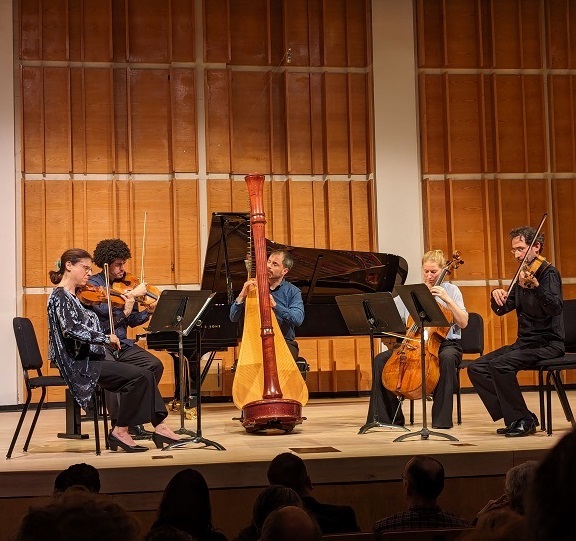
Above: the musicians of the Israeli Chamber Project at the end of their Merkin Hall concert; from left to right: Kobi Malkin, Carmit Zori, Guy Ben-Ziony, Assaff Weisman, Michal Korman, tenor Karim Sulayman, Sivan Magen, and Tibi Cziger. Photo by Judy Kuan.
~ Click on each image to enlarge.
~ Author: Oberon
Friday April 12th, 2024 – This evening’s concert by the Israeli Chamber Project at Merkin Hall was one of the most engaging and moving performances I’ve ever had the pleasure of attending. I’m not sure I can do justice to it in words; it was an emotional and spiritual experience that is practically indescribable.
The program featured classic works by Schumann, Debussy, and Barber, mixed with contemporary pieces by Naji Hakim and Zohar Sharon, and a thrilling world premiere from Gity Razaz. All of it was played (and sung) to perfection by the ensemble’s world-class musicians, and the distinctive voice of tenor Karim Sulayman. It was a desire to experience Mr. Sulayman’s singing live that initially drew me to attend the concert, after having heard him on some clips on YouTube (one of the finest here). His singing tonight was revelatory, as was everything about the program.
Above, playing the Schumann: Carmit Zori, Kobi Malkin, Guy Ben-Ziony, Michal Korman, and Tibi Cziger; photo by Judy Kuan
Music by Robert Schumann – Three Fantasy Pieces, Op. 73 (arranged by J. Keren for clarinet and string quartet) – opened the evening. Clarinetist Tibi Cziger’s plush tone mingled delightfully with the blend of the string players: Camit Zori and Kobi Malkin (violins), Guy Ben-Ziony (viola), and Michal Korman (cello). The immediacy of sound in this intimate hall made me feel like I was onstage, seated among the players.
The melodic flow of the Zart und mit Ausdruck, the light, waltzy Lebhaft, leicht (with its exhilarating rising scales), and the jubilant Rasch und mit Feuer provided one delight after another, with Mr. Cziger’s clarinet at the center of it all.
Above: composer Gity Razaz
A change in the order of the program now brought us the world premiere of Flowing Down the Widening Rings of Being by Gity Razaz. This is a staggeringly beautiful piece of music: the texts, drawn from Rilke and Rumi, were sung with compelling ardor and grace by Mr. Sulayman, and the blending of the players’ individual timbres creating an incandescent sound-world. I was often reminded of Britten, but this music has a deeper spirituality…and a dizzying feeling of rapture.
There are five songs, and for every line – even every word – of the texts, Ms. Razaz has found perfect colours for her instrumentation; aligned with this is the Sulayman voice, which is poetry itself. One of the key elements of the music is the harp, played by Sivan Magen; his melismas had an other-worldly feel. Mr. Cziger’s clarinet and deft expressiveness of Assaff Weisman at the Steinway were woven into the string textures to create gorgeously kaleidoscopic sonic resonances.
Mr. Sulayman cast his spell of enchantment in the opening song, Limits of Longing. The English translation of the Rilke poem has the striking passage, “Let everything happen to you: beauty and terror…”
Two Rumi settings – The Tree of Awe and Dance – are next. In the first, the incredible mixes of the instrumental sounds underlined Mr. Sulayman’s poignant words: “What hurts you blesses you”…”Darkness is your candle.” Dance has a great sense of urgency: it’s done as an agitato, with jagged sounds and a rambling piano part. There is a weirdly wonderful declamatory finish; the overall effect is one of palpable beauty.
In Rilke’s Endless Song, Mr. Sulayman suffuses each word and note with colours from his expansive palette. The orchestration is so…alive!…with the harp and clarinet constantly luring the ear. The singer/poet asks: “…am I a falcon, a storm, or an endless song?” with melting tenderness.
A Community of the Spirit (Rumi) brings the song cycle to a fabulous finish. Here we can savour the deep purple tones of Ms. Korman’s cello, whilst Mr. Sulayman tells us, at the end: “Live in silence. Flow down and down in always widening rings of being”; the tenor’s benediction lingers in a high, floated passage.
During the interval, I sought out composer Gity Razaz (above), and finally found her, with the help of one of her friends. I had so many things to say to her, but of course when the moment came I could only tell her how wonderfully she writes for the voice – a gift not shared by many contemporary composers. She was very kind, and signed my program:
Above: composer Zohar Sharon
Zohar Sharon’s The Ice Palace maintained the high level of both the writing and the playing which has made the evening fascinating so far. Mr. Cziger has brought his clarinet and bass clarinet, saxophone to the stage, and some of the players have singing bowls with them; Mr. Magen’s harp is still in place. We are ready for more magic.
Above, tenor Karim Sulayman singing Zohar Sharon’s Ice Palace with Mssrs. Malkin, Ben-Ziony, and Weisman, Ms. Korman, and Mssrs. Magen and Cziger; photo by Judy Kuan
Ice Palace is in five movements, opening with a Prelude of cool, shivering strings. Then comes Slow Freezing Drops, which is especially fine: the harp and strings in chilly harmonies, the clarinet and high-pitched violin duetting. Along the way, the song bowls hum or chime, lending a sense of reverence and mystery. Mr. Weisman brings a mood of Chopin to the Nocturne, with its rippling piano figurations sounding over shimmering textures. Swirling note patterns from the Magen harp align with clarinet and piano in Sparkling Flashes in the Mirror. At last we are Inside The Ice Palace, summoned by chimes and the rumblings of the bass clarinet. The harp and the sighing violins are heard; suddenly, there is a shocking chord. The music becomes eerie and – in the end – somber, with the bass clarinet lingering in the depths.
Back in my seat after the interval, I was annoyed by the texting of a girl seated in the front row across the aisle; my spirits sank. I’m sure the musicians noticed her, but luckily they ignored her…and so, eventually, did I.
Above, playing the Debussy: Carmit Zori, Kobi Malkin, Sivan Magen, Michal Korman, and Guy Ben-Ziony; photo by Judy Kuan
Claude Debussy’s Sacred and Profane Dances for harp and string quartet is a piece I’d never heard before; Sivan Magen’s deftly lyrical playing of the exotic harp motifs emerged from the unison opening passage. The music is dreamy, then ecstatic, and finally lush in a cinematic way. Swirls of harp notes tempt the ear; it’s simply intoxicating music. But…why do I keep hearing phrases from TURANDOT here? My first thought was that Debussy had borrowed from Puccini, but, after a date-check, I realized it must have been vice- versa.
Above: composer Naji Hakim, photo by Aleksey-Vylegzhanin
Mr. Sulayman now re-appeared for The Dove by Naji Hakim. Drawn from biblical texts, the song opens with a high violin passage; the music is quite cheerful at first. Then agitated strings underscore the voice, and the music becomes more emphatic…and finally, almost exuberant. Again, the Sulayman voice cast its spell; his ravishing final note hung on the air, like a blessing of peace.
Above: tenor Karim Sulayman
Samuel Barber’s Knoxville: Summer of 1915, played tonight in an arrangement by Y. Shapiro, has been sung by tenors before: Russell Thomas has sung it in recital to striking effect. The Sulayman voice is very different from that of Mr. Thomas, and this evening the James Agee text sounded youthful, almost boyish.
The musical arrangement, with strings, clarinet, and piano, works beautifully in this setting. The clarity of Mr. Sulayman’s diction, and the radiant purity of his voice, were ideally matched with Mr. Cziger’s warm-toned clarinet, whilst the piano and strings were so artfully employed that I didn’t miss the orchestra at all.
Above: tenor Karim Sulayman singing the Barber, with Kobi Malkin, Carmit Zori, Assaff Weisman, Guy Ben-Ziony, Michal Korman, and Tibi Cziger; photo by Judy Kuan
Two passages especially intrigued me this evening: the uncanny expressiveness of Mr. Sulayman’s voice at the passage which begins “Now is the night one blue dew…” and the blessèd assurance of Mr. Cziger in the clarinet solo preceding “On the rough wet grass…”
And then there were the sweet head-tones which Mr. Sulayman produced for the final lines of the poem…and Mr. Cziger’s poignant response.
I see, reading over what I have written, that I have not really conveyed how luminous – and how precious – this evening felt to me. To all the artists and composers involved, my humble thanks.
~ Oberon
{Special thanks to Avi @ the ICP for sending me the performance photos by Judy Kuan}
(Somehow this article about a Met performance of TOSCA – for which my longtime opera-loving friend Craig Salstein and I shared a balcony box – didn’t get included in the original transfer from the Grove to the Glade. Copy-and-paste served the purpose, keeping the memory of a perfect “Vissi d’arte” alive for two of Sondra’s ardent admirers: Craig and I were there from the start of her Met career.)
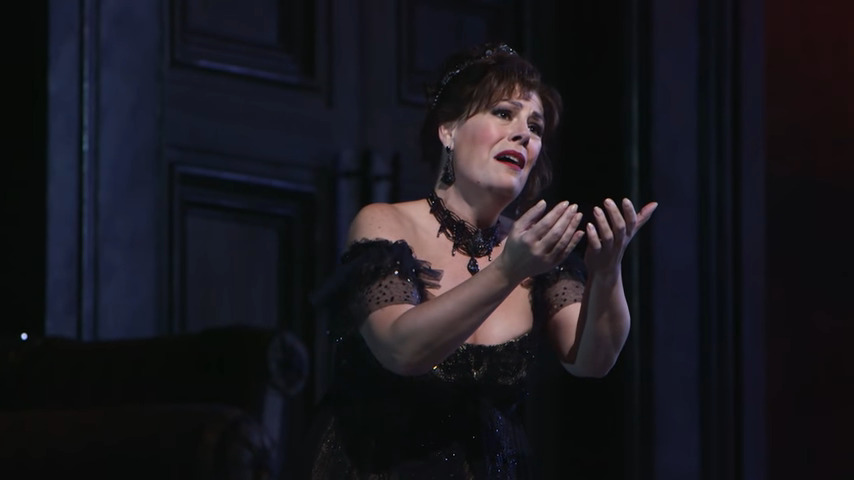
Above: Sondra Radvanovsky as Tosca; click on the image to enlarge
~ Author: Oberon
Saturday November 17th, 2018 – In an age when few voices can truly be called distinctive, Sondra Radvanovsky’s performances are always red-letter dates on my calendar. Like all the greatest divas down thru the centuries, Sondra’s voice is not to all tastes: she has her enthusiastic admirers and her detractors. Through it all, she moves from opera house to opera house, garnering big ovations, and making my continued devotion to the art form worthwhile.
This afternoon, my fellow “Rad-Fan”, Craig Salstein and I settled into a balcony box to watch our prima donna playing a prima donna – Floria Tosca – in an opera once described as a ‘shabby little shocker’. TOSCA hardly shocks us nowadays, inured as we are to genuine, disturbing shocks in the daily headlines. But it can still be an absorbing story to watch unfold in The Met’s traditional and mostly attractive production.
It’s a production designed for patrons sitting in the middle of the house. If you like a side box, you lose sight of 1/3 of the action. In Act I, for instance, you can either forego the sight of Cavaradossi’s painting of Mary Magdalene, or you can miss the religious procession that closes Act I (during which the Marchesa D’Attavanti makes an unexpected appearance). We chose house-right, the better to savour Sondra’s “Vissi d’arte“.
All afternoon, people around us chatted blithely throughout the show; two women in the box below us simply had to discuss something during the tenor’s “Vittoria!” And there was a round of laughter after each line of the lovers’ Act I banter about the eye colour of Mary Magdalene. It’s not all that funny, really.
Carlo Rizzi was on the podium. A routinier, Rizzi was absent from the Met from 2007 to 2016, and as far as I know, no one missed him. The orchestra played superbly today – it’s still basically “Levine’s orchestra” – but Rizzi’s taffy-pull tempi, and occasional covering of the singers didn’t do Puccini any favors.
Brenton Ryan was a clear-toned, incisive Spoletta; a bouquet was thrown to him over the footlights during the curtain calls – and he charmingly retrieved it. Oren Gradus was strong of voice as Angelotti, and Patrick Carfizzi really sings the Sacristan’s music, with a robust bass-baritone (though I could do without his muttering remarks during his entrance music….the director’s idea, I suppose…)
A very tall, slender Italian baritone named Claudio Sgura took over most of the Scarpias this season when Wolfgang Koch withdrew from the role. Mr. Sgura was severely over-parted in the Big House during most of Act I. In Act II, once he and Ms. Radvanovsky were left alone onstage, things improved and the atmosphere was ramped up as their cat-and-mouse game developed. But even so, Mr. Sgura’s voice doesn’t really seem to be of Met quality.
In past seasons, Joseph Calleja has done some outstanding singing in such essentially lyrical roles as the Duke in RIGOLETTO, Rodolfo in BOHEME, Nemorino in ELISIR, and Gabriele Adorno in SIMON BOCCANEGRA. He is moving into heavier repertory now (Don Jose, Rodolfo in LUISA MILLER, and Pollione), and today as Mario Cavaradossi he often sounded at full-stretch. There are still many attractive elements in his singing – the soft, sustained final note of “Recondita armonia” and some heavenly, heady piano singing in Act III – but we’re used to more bloom on the top (and more heft in general) – in this music.
In such surroundings, it would take an epic performance of the title-role to make the afternoon worthwhile. And that’s what Ms. Radvanovsky gave us.
With her blazing high notes, her marvelously modulated dynamics – down to a thread of tone – and her passionate commitment to the music, Ms. Radvanovsky’s vocalism was so generous and thrilling; from first note to last, she carried the opera to the heights.
While her choice to sing lines like “Tu non l’avrai stasera…giuro!” and “Assassino!” in a high-pitched sort of shriek makes them irritating rather than chilling, Sondra’s dark, chesty resonance at “E Morto ! Or gli perdono!” was much, much more to my liking. At the other end of the range, her uncannily sustained high-C as her lover is dragged off to his fate in Act II was thrillingly connected to her ensuing cries of “Mario! Mario!!“
What I will always remember about this performance is Sondra’s singing of the “Vissi d’arte” which was the greatest rendering of that thrice-familiar aria in my experience. Over the decades, I’ve heard this iconic piece sung – on recordings and in live performances – by everyone from Giannina Arangi-Lombardi to Anna Netrebko. Today I heard it phrased the way I’ve always wished to hear it, the singing emotion-drenched but utterly musical. A hall-filling, rapturous high B-flat and a gorgeously sustained finish left me deeply moved and gratified. Craig said his heart was racing.
Metropolitan Opera House November 17th, 2018 matinee
TOSCA Giacomo Puccini
Tosca...................Sondra Radvanovsky Cavaradossi.............Joseph Calleja Scarpia.................Claudio Sgura Sacristan...............Patrick Carfizzi Spoletta................Brenton Ryan Angelotti...............Oren Gradus Sciarrone...............Christopher Job Shepherd................Davida Dayle Jailer..................Paul Corona
(In a mass transfer of articles from Oberon’s Grove to Oberon’s Glade, several items inexplicably failed to make the jump. I’ve gone back to some of the missing stories that are especially dear to me and posted them individually; the lack of chronology is worth it to me in order to preserve these memories.)
~ Author: Oberon
Thursday December 12th, 2024 – Since hearing the Lithuanian soprano Asmik Grigorian (photo above by ) in her magical Met debut role as Puccini’s Madama Butterfly, I’ve been looking forward to hearing her again. She was at Carnegie’s Zankel Hall tonight for a recital of songs by Tchaikovsky and Rachmaninoff.
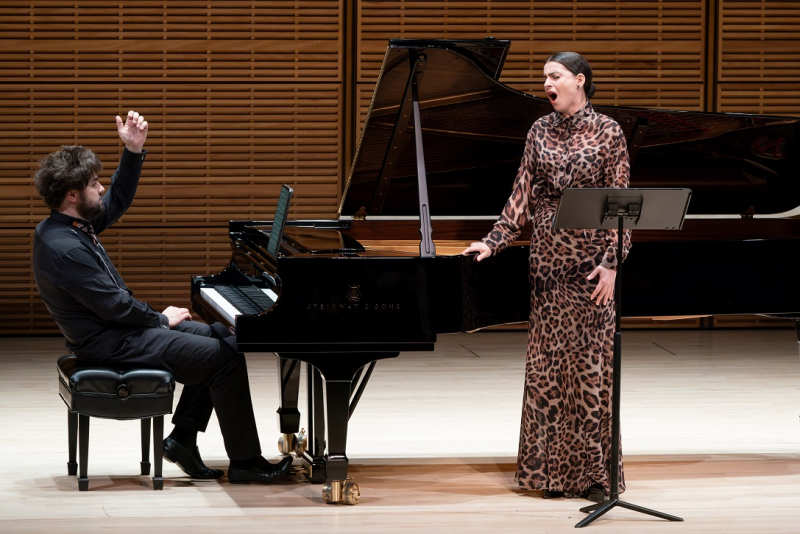
With her this evening at Zankel was the excellent pianist Lukas Geniušas (photo above by Jennifer Taylor), who regaled us with solo piano works by the two featured composers in the course of the evening.
By coincidence, Ms. Grigorian sang several of the same Tchaikovsky and Rachmaninoff songs that tenor Piotr Beczala had offered at his Carnegie Hall recital three days earlier. During the interval tonight, it was amusing to hear audience members comparing the two performances, and debating over who sang which songs “better”. Both singers were compelling, and such comparisons are frivolous.
Zankel Hall was full of Grigorian fans; it seems her Met Butterflies really put her on the map here in Gotham. She was welcomed tonight with genuine affection.
From its hushed start, Tchaikovsky’s “Amid the din of the ball” revealed a soprano voice so alive, and so persuasive with its modulations of dynamics and color. With Mr. Geniusas an ideal accomplice, they brought the song to a perfect finish. He then commenced the introduction to “Again, as Before, Alone” so expressively, the soprano joining with singing that was vibrantly passionate, mixed with moments of marvelous softness. The ultra-familiar “None but the Lonely Heart” was beautifully sung, with the ending so touching. The pensive piano introduction to “A tear trembles”, and Ms. Grigorian’s engaging rendering of the song, underlined the wistfulness of the words.
The pianist returned alone, to play the Romance in F-Minor, Op. 5, but unfortunately there was a late seating which he perhaps didn’t expect. To the sounds of clomping heels on wooden steps and the breathy efforts to clamber over already-seated patrons, the pianist strove to continue; the Romance has many mood swings, which he deftly introduces. The latecomers had settled in in time for the ensuing Scherzo humoristique, wherein Mr. Geniusas moved blithely between the grand and the sprightly.
Another late seating delayed Ms. Grigorian’s “I bless you, forests” in which she made much of the thoughtful song, with ravishing soft notes before things get passionate, leading to a lush outpouring of tone. The piano postlude was so persuasively played. The duo then took up “Do not Ask” which has a reflective start before turning intense; feverish emotions give way to a subdued finish.
Above: pianist and singer, photo by Jennifer Taylor
If the first half of the program had seemed on the short side, this was finely balanced by a longer second half. Some of Rachmaninoff’s most familiar songs were to be heard in the first set: “In the silence of the secret night”, “Oh, Do Not Sing to Me, Fair Maiden”; “Child, thou art as beautiful as a flower”; “The Dream”; “Spring Waters”; “Oh, do not grieve!”; and “I wait for thee”. I admit I took a break from note-taking, the better to savor the many sonic delights that soprano and pianist gave us. These included top notes from Ms. Grigorian that ranged from gossamer pianissimi to astounding Turandot-like attacks: one such amazing passage caused the audience to erupt in bravas, and singer and pianist took a bow before continuing.
Mr. Geniusas returned for two Rachmaninoff preludes: the shimmering “Prelude in G-sharp Minor” and the “Prelude in D-flat Major” with its sense of grandeur climaxing in cascades of notes and an epic finish.
Ms. Grigorian then offered “Twilight”, a simple song, hypnotically sung. This was followed by “How fair this spot” with its dreamy start giving rise to more potent emotions; here the singer shone with a delectable high pianissimo, which lingered on the air. “Let Us Rest” is a somber, reflective song, and here Ms. Grigorian’s low range glowed. “Dissonance” closed the program: its intense, agitated piano introduction turns rapturous, but there’s also a feeling of uncertainty and hesitation. Then the music pours forth, pausing for yet another pristine Grigorian high note before rushing on to a grand finish from Mr. Geniusas’s keyboard.
Photo by Jennifer Taylor
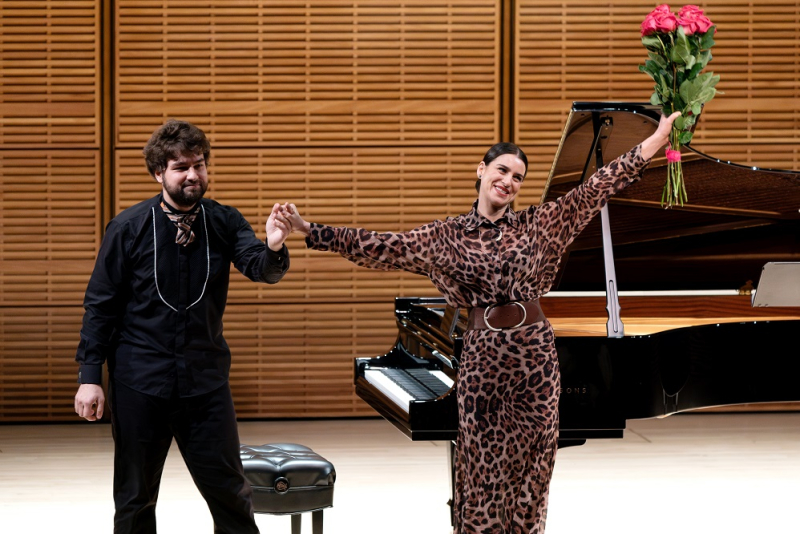
There was a single encore – Rachmaninoff’s “Believe me not, Friend,” Op. 14, No. 7 – and the diva was handed bouquets as she and her poetic pianist basked in the audience’s affectionate applause.
Performance photos by Jennifer Taylor, courtesy of Carnegie Hall.
(An article from Oberon’s Grove about an American Symphony Orchestra concert in 2022 that was so memorable needs to be included in Oberon’s Glade, so I’ve copied and pasted it here.)
Friday July 15th, 2022 – Leon Botstein’s American Symphony Orchestra presenting the US premiere of Sergei Taneyev’s cantata, At the Reading of a Psalm; this was the composer’s final work.
The performance had originally been scheduled for last season, but was postponed due to complications arising from the COVID pandemic. As time passed, I began to wonder if the performance might never come to fruition; but tonight – at long last – this Taneyev masterpiece proved worth the wait. It is thoroughly engrossing, making me curious as to why it is so rarely heard. To me, it stands in the same echelon of such great choral works as the Verdi Requiem, Britten’s War Requiem, and the Vaughan Williams Sea Symphony.
The Psalm referenced in the work’s title is No. 50 in the King James Bible: ‘The mighty God, even the Lord, hath spoken’. God appears through a storm to chastise those who believe that superficial sacrifices and ritual offerings are of more value to faith than prayer and thankfulness. The poet and theologian Alexey Khomyakov wrote his poem At the Reading of a Psalm in 1856. The poem tells us that the outward trappings of religion are as nothing compared to simple truths, and that brotherly love and goodness of heart -‘a heart purer than gold’ – are the attributes God values. Khomyakov’s poem inspired the composer Taneyev, who used it for the cantata he completed in 1915, in the last months of his life.
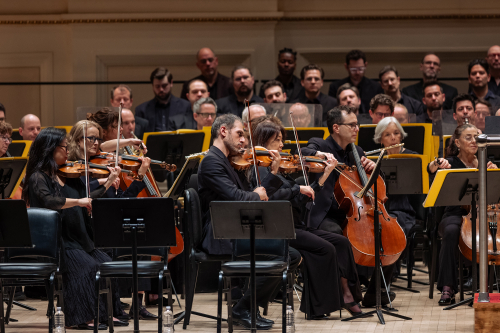
Above: the America Symphony Orchestra and Maestro Botstein; performance photo by Matt Dine
Taneyev’s epic work unfolds in three movements. The first movement, in three parts, is a choral feast, served up this evening by the excellent Bard Festival Chorale, under the direction of James Bagwell. A deep drum roll and a bass clarinet solo set the mood for “The Earth is Trembling”, which comes alive with driving energy and brass fanfares. The chorus sings fervently in great dramatic outbursts: this is big, thrilling music.
By contrast, part II of the first movement – “Israel, You Build Temples for Me” – commences with a gentle theme for female voices; later, the men join in the flowing melody. The harp chimes in, and there is a sense of the ecstatic. Then, a wonderful passage for cellos and string basses leads on to a gorgeous finish.
The first movement concludes with “What Good Are Magnificent Temple Vaults?”; with glorious brass phrases. The music is forward-moving and affirmative, in celebration of God’s creation. The string basses provide a deep undercurrent, leading to a march-like refrain. Drums sound as the music builds to a grand finale.
The cantata’s second movement has a rather ominous start. The poem begins “What Good Is Gold To Me?”, and the music is full of drama and strife; it actually gets quite wild before a sudden ending.
At this point, we finally hear from the vocal soloists, who til now have been sitting patiently onstage. Armenian soprano Mané Galoyan, who I heard in a ‘Russian evening‘ at Chamber Music Society of Lincoln Center in 2019, has a full lyrical sound, with a charming gift for colouring the vocal line, and a soaring high range. Eve Gigliotii, whose performance in Nico Muhly’s Dark Sisters, given by Gotham Chamber Opera in 2011, first drew me to her as a passionate and alluring singer, sounded superb tonight (more about her later…) while Jamaican-American tenor Terrence Chin-Loy put me in mind – both physically and vocally – of the young George Shirley with his poignant timbre and lovely dynamic shadings. The tall, handsome basso Christian Zaremba, who made a distinct impression as Angelotti in Toscaat The Met in 2018, sang clearly, with a pleasing expressiveness. This vocal quartet passed melodies from voice to voice to fine effect, and harmonized beautifully.
The soloists and the chorus join forces in “Wherefore The Lights?” which ends the cantata’s second movement. Here the principal vocalists had many opportunities to delight us, most notably as their voices entwined during the sustained final passages. A special bravo! to Mr. Chin-Loy for some wonderfully sustained phrasing here.
An orchestral interlude opens the final movement of the cantata. The music has a sense of urgency, and there’s an oboe solo which Keisuke Ikuma phrased to perfection.
As the interlude came to its end, Eve Gigliotti (above, photo by Matt Dine) rose to sing the cantata’s only extended vocal solo: “There Is a Precious Gift that God Needs”. As the aria begins, a sense of calm and reassurance fills the Hall. Ms. Gigliotti’s rich, expressive singing is so perfect for this music, and her voice meshed perfectly with the sound of concertmaster Cyrus Beroukhim’s spun-out phrases. The mezzo’s sense of the text – “I Need a Heart Purer Than Gold, and a Will That is Strong in Labor. I Need a Brother that Loves His Brother…” was underscored as she seemed to shape the phrases with her expressive hands. The voice came forth in a wondrous outpouring of warmth and beauty, the singer’s face aglow with the power of love.
For the cantata’s finale, the chorus take up the words “I Need a Heart Purer Than Gold” in a marvelous hymn, with a shimmering obbligato from Mr. Beroukhim s violin. As the work comes to its mighty finish, the four soloists joined the chorus: a powerful end to an extraordinary evening.
Above: during the bows, ASO concertmaster Cyrus Beroukhim, Mr. Zaremba, Mr. Chin-Loy, and Maestro Botstein; photo by Matt Dine
Special thanks to Maestro Botstein for bringing this rarity to us in all its glory; it reminds us, in these chaotic times, what religion is really all about.
American Symphony Orchestra/Leon Botstein, Conductor
Soloists:
Mané Galoyan, Soprano Eve Gigliotti, Mezzo-Soprano Terrence Chin-Loy, Tenor Christian Zaremba, Bass
Bard Festival Chorale/James Bagwell, Director
(Performance photos by Matt Dine, courtesy of Pascal Nadon. Click on each image to enlarge.)
(When I realized that this 2014 article from Oberon’s Grove hadn’t made it onto Oberon’s Glade, I did a hasty copy-and-paste. Such a memorable evening!)
Wednesday December 10th, 2014 – The American Symphony Orchestra presenting REQUIEM FOR THE 20th CENTURY, a memorial in music to those lost in some of the greatest tragedies of the 1900s, paid tribute by composers who lived through them.
The art of warfare changed radically over the course of the 20th century. The age-old tradition of opposing armies clashing on a field of battle, of cities under siege, and of naval vessels trying to sink each other on the high seas gave way to weapons of mass destruction which caused vast numbers of civilian deaths and the leveling of great cities into toxic rubble. Tonight’s concert stood as a reminder of these grim instances of man’s inhumanity to man, and of the downward spiral in which we now find ourselves where stories of racism, police brutality, injustice, religious zealotry, torture, ignoring of basic human rights for political expediency, the rape of our mother planet, and a decline of basic civility and of compassion erode mankind’s dignity on a daily basis.
Ralph Vaughan Williams’ Symphony No. 6 was composed in 1946–47, during and immediately after World War II. This symphony was first performed on April 21st, 1948. Within a year it had received some one hundred performances, including the US premiere on August 7th, 1948. Leopold Stokowski, who conducted the first New York performances the following January with The New York Philharmonic, said “…this is music that will take its place with the greatest creations of the masters.”
Vaughan-Williams often denied any programmatic intentions in writing his 6th symphony, which opens tempestuously. Throughout this Allegro, rhythmic variety holds our interest: march-like syncopations and jazzy elements give way to a stately theme before returning to a stormier feeling. In the Moderato second movement, a creeping sense of menace sets in; this builds inexorably to a broodingly powerful climax where a three-note figure is endlessly repeated by brass and percussion.
As this pounding wave subsides, the first of many solo phrases (expertly played tonight) come to us rather unexpectedly: plaintive English horn, ironic saxophone, warbling flutes, and a quietly expressive bass clarinet. The concluding Epilogue ambles a bit, though still intriguing with its misterioso trembling in the strings and muted brass voices. The symphony fades like a memory, sinking to near inaudibility.
In 1944, at age 21, the Hungarian composer György Ligeti was sent to a forced-labor camp; of his family, only the composer and his mother survived the war. He later said, “One dimension of my music bears the imprint of a long time spent in the shadow of death.” His Requiem, written in 1965, became widely known after film director Stanley Kubrick used parts of it – without the composer’s prior knowledge – in “2001: A Space Odyssey.”
The Requiem is a bizarre and unsettling work. In the opening Introitus, the chorus bassos vie with one another to produce the lowest notes imaginable. Later, as the rest of the chorus join in, the vast assortment of pitches sounding in unison produces the effect of an enormous buzzing hive of humanity.
The work calls for two vocal soloists, and tonight’s artists coped impressively with the demands Ligeti placed on them. Mezzo-soprano Sara Murphy produced ample, steadily-sustained tones at tricky, almost random-sounding intervals whilst soprano Jennifer Zetlan plucked amazing notes out of the highest range with deft marksmanship and thorough command.
Overall the Ligeti Requiem mirrors the despair of mankind; it is not an easy piece to listen to, but one listens on with a feeling both haunted and terrified.
After the interval, a powerful oratorio commemorating an unspeakable human tragedy: performed only once during the composer’s lifetime, Alfred Schnittke’s Nagasaki draws on the poetry of Russian and Japanese authors to commemorate the fateful dropping of an atomic bomb on the Japanese city. The work was written in 1958 while Schnittke was a 24-year-old student at the Moscow Conservatory. Nagasaki was so controversial at the time that, after a single radio broadcast performance in 1959, it was not heard again – as far as we know – until 2006, in Cape Town, South Africa.
In this work I was expecting something more stark and angular; instead the young composer seems to have peered into the past for musical inspiration: not simply to Shostakovich and Stravinsky, but back further to Mussorgsky and even Borodin. The music actually kept reminding me of Puccini’s TURANDOT with its exoticism and harmonic colours, and its continual employment of percussion instruments to punctuate and detail the forward-moving score. The effect is cinematic, and the use of chimes, celesta, and the uncanny ‘voice’ of a musical saw all keep the ear constantly engaged. The Bard Festival Chorale have much to do in the Schnittke and they did very well by it.
A high point in the concert came in a finely-crafted ‘aria’ which Schnittke assigns to a solo mezzo-soprano voice. Tonight Sara Murphy (above) expanded on the excellent impression she had made in the Ligeti: her voice has depth and warmth; it’s even and glowing throughout the range, and fills the hall effortlessly. Her singing has a rich emotional resonance which derives from the sound itself, free of theatrical embellishments. This was some of the most soul-pleasing vocalism I have heard in the past decade. She was enthusiastically cheered as she took her bows.
Kudos to Maestro Botstein for giving us yet another highly satisfactory programme: thought-provoking music which, though inspired by past tragedies, is very much of our time. We are left wondering if mankind has learned anything from the lessons of the 20th century.
(This performance was a highlight of the 2024-2025 season at Carnegie Hall. When I realized my article hadn’t been included in the primary transfer from Oberon’s Grove to the Glade, I doubled back and did a copy-and-paste.)
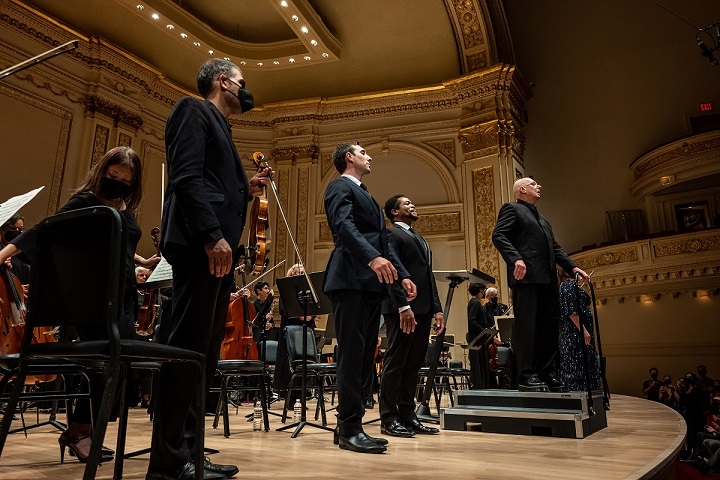
Onstage: Angela Meade, John Matthew Myers, Maestro Botstein, Nate Mattingly; photo by Matt Dine
~Author: Oberon
Friday June 6th, 2025 – The American Symphony Orchestra presenting a concert performance of Richard Strauss’s first opera, GUNTRAM, at Carnegie Hall. Leon Botstein was on the podium, and the ASO were joined by the Bard Festival Chorale, under the direction of James Bagwell.
CAST:
Angela Meade, Soprano (Freihild) John Matthew Myers, Tenor (Guntram) Kevin Short, Bass-Baritone (The Old Duke) Alexander Birch Elliott, Baritone (Duke Robert) Nate Mattingly, Bass-Baritone (Friedhold, a singer) Rodell Rosel, Tenor (The Duke’s Jester) Katharine Goeldner, Mezzo-Soprano (Old Woman) Bernard Holcomb, Tenor (Old Man)
At the time of the GUNTRAM premiere in 1894, Strauss had already achieved popular success with his tone poems Don Juan and Death and Transfiguration. But the composer’s first venture into opera was judged uninspiring by audience and critics alike. In his later years, the composer referred to his first opera as his “child of sorrow.”
GUNTRAM is the story of two men – the minstrel-knight Guntram and the tyrant Duke Robert – both of whom love the duke’s wife, Freihild. Having saved Freihild from drowning herself, Guntram is invited to the ducal court, where his song in praise of peace and denouncing tyranny seeks to incite rebellion. Duke Robert attacks the minstrel, who murders the duke. Guntram is denounced by the Elder Freihold for his sin. Freihild’s arrival brings Guntram to the realization that he has killed Duke Robert out of romantic jealousy rather than in the name of some lofty cause. Guntram renounces the brotherhood of minstrel-knights, and takes leave of Freihild to repent for his crime in solitude as a hermit.
Whatever listeners may feel about this opera, which musically looks back on Wagner’s LOHENGRIN and TANNHAUSER whilst at times suggesting FRAU OHNE SCHATTEN and other Strauss masterworks to come, it is loaded with gorgeous music and, in its 140-minute arc, there is never a dull moment.
The players of the ASO immediately lured me in with the opera’s long prelude, which starts very delicately; gentle wind themes emerge, and shimmering strings and mellow brass fall pleasingly on the ear. An ethereal violin solo from concert-master Cyrus Beroukhim (photo above by Matt Dine) signals his ongoing importance as the score unfolds. Broad, sweeping music transforms into a lyrical, pastoral segment before a burst of animation introduces the singers.
Tenor John Matthew Myers launched his thrilling evening of singing with passionate lyricism. Mr. Myers has taken on such arduous roles as Bacchus (at La Fenice) and the Emperor in FRAU OHNE SCHATTEN (at San Francisco Opera) whilst covering demanding parts like Peter Grimes, Walther von Stoltzing, and Herman in PIQUE-DAME at The Met. As the evening progressed, a voice in my head kept screaming: “This is our next Lohengrin!” Tonight, Mr. Myers scored a triumph at Carnegie Hall, winning a most enthusiastic ovation at the end.
As GUNTRAM‘s opening scene continues, we hear from one of my favorite mezzos, Katherine Goeldner (a delicious Carmen at NYC Opera) and tenor Bernard Holcomb as an Old Couple. Katherine is strikingly lovely to watch and hear, and when others were singing, she seemed engaged in the unfolding story. We also meet bass-baritone Nate Mattingly, stepping in for an ailing colleague in the role of Friedhold…we will hear more from Mr. Mattingly in the opera’s final act. As the opera moves onward, men from the chorus will come forward in small ensemble roles, always effective in voice and personality.
Mr. Myers now has a Lohengrin-like narrative wherein his dynamic range, the beauty and power of his voice, and his expressive gifts are all impressively on display: such an engaging singer.
Another group of singers now appear: Angela Meade as Freihild – in a blindingly bright golden gown – with Alexander Birch Elliott as her husband, Duke Robert, Rodell Rosel as the court jester, and the always marvelous basso Kevin Short as the Old Duke.
As the opera continues, it becomes evident that Maestro Botstein sometimes lets the orchestra play too loudly, causing the singers to have to over-sing. Ms. Meade’s voice always penetrates, and if her high notes were a bit screamy at first, she soon settled in to some of the best singing I have ever heard from her. Meanwhile, reminders of FRAU OHNE SCHATTEN and ROSENKAVALIER keep cropping up in the score.
Mr. Myers continues to amaze and delight us with his ardent, exciting vocalism, which also has a poetic air to it. There’s an all-hands-on-deck passage where everyone sings at once, but it’s brief. Then Kevin Short pours out his burnished tone, the jester has a silly moment, and a trio for Mssrs. Myers, Birch Elliott, and Short makes for some big singing. The chorus gives Act I a grand finish.
The principals leave the stage for a brief break, and then Act II (set at the Duke’s court) commences in a joyful, dance-like mood. Harp, chorus, and a male quartet of choristers have a scene, with interjections from Mr. Rosel. Ms. Meade and Mr. Short are joined by Mr. Myers, whose singing continues to amaze us. Maestro Botstein, seated and with his back to the audience, still occasionally allows orchestral volume swamp the singers, with who he has no eye contact.
Mr. Myers (above with the Maestro; photo by Matt Dine) now gives us some of the finest singing of the evening; his beautiful lied opens with harp accompaniment; this is a big sing, a flow of melody…truly outstandingly sung. Then the music turns stormy; Duke Robert meets his end (we could have wished for more vocal opportunities for the excellent Alexander Birch Elliott before his character’s demise). Kevin Short as the Old Duke now has a splendid passage before the stage is left to Ms. Meade.
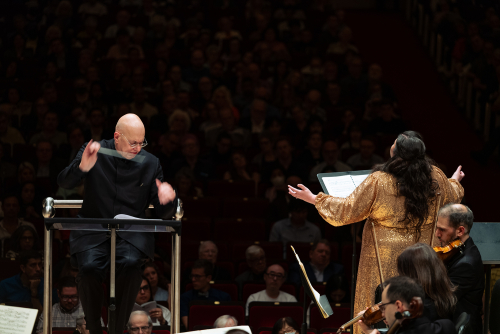
The soprano (above with the Maestro, photo by Matt Dine) delivers some of the best singing I’ve ever heard from her in her sad song, introduced by a somber clarinet theme. In the music, premonitions of Strauss’s FRAU and ELEKTRA yet to come can be detected. Ms. Meade proves herself a persuasive Straussian: she might make an excellent Dyer’s Wife.
Following a blessedly brief intermission, Act III opens with austere brass chords. A tone poem emerges, with the chorus chanting in Latin. Guntram and Freihild are alone onstage; the music becomes tempestuous, and the tenor sings of his anguish whilst the soprano continues in true Strauss mode. Mr. Myers’ voice is so perfect for this music. Ms. Meade sings with increasing urgency, the orchestra playing grandly, the string basses digging in as both singers give it their all.
Now Freihold, in the person of Nate Mattingly, arrives to chastise Guntram for the murder of Duke Robert. Mr. Mattingly sings handsomely. The conductor gets brass-happy but both Mssrs. Mattingly and Myers are unfazed, singing impressively.
Beautiful cello playing and shimmering violins now sound as Guntram faces his fate with resolve: he will withdraw from the world and live out his days as a penitent hermit. Mr. Myers really connects to his listeners here, his vocal generosity is ever-fascinating in its power and sheer beauty.
Amidst the hearty applause that greeted the bowing singers at the end, the tenor was lauded with special enthusiasm, deservedly so. I had hoped to congratulate him in person at the stage door, and to see Ms. Goeldner and Mr. Short again. But after a long wait, only the amiable basso had emerged.
(Performance photo by Matt Dine, courtesy of Pascal Nadon; click on each image to enlarge)
(Rescuing from Oberon’s Grove this article about a Metropolitan Opera MADAMA BUTTERFLY in 2024 that introduced me to two exciting singers: Asmik Grigorian and Jonathan Tetelman.)
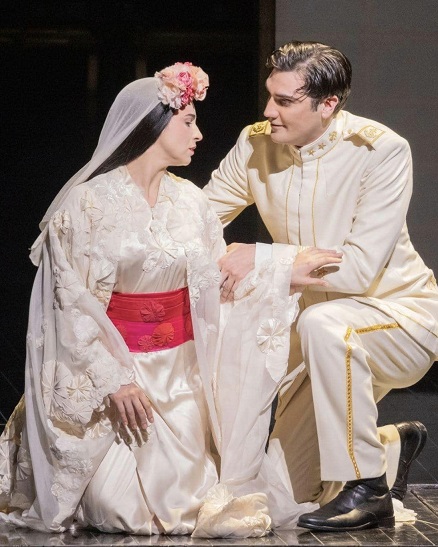
Above: Asmik Grigorian and Jonathan Tetelman; photo by Evan Zimmerman/MET Opera
Author: Oberon
Saturday May 11th, 2024 matinee – An almost completely different cast from my BUTTERFLY earlier in the current Met season brought me back to my score desk today. My Met history with this opera goes all the way back to the Old Met where, in 1965, I saw the last Butterfly of the renowned Puccini specialist, Licia Albanese.
One might think that, after 60 years of Butterflies, I would have developed an immunity to the title-character’s heartbreak. But it’s an opera that can still move me to tears; this afternoon’s performance was one that touched me deeply, and for so many different reasons. Up at my score desk, I could not see the stage, but I really didn’t need to…I could imagine everything that was happening, and feel the emotions of the characters as the story evolved.
The guiding light of this performance was Xian Zhang, the diminutive conductor who, two evenings ago, led – on very short notice – a deeply satisfying Brahms REQUIEM at Carnegie Hall. The MET orchestra sounded especially marvelous this afternoon, with numerous moments when individual players could shine in passages Puccini had assigned them: he’s such a phenomenal orchestrator.
The lively prelude is brief, and then the singing starts. Tony Stevenson’s Goro is a treat: he sings all of his music, rarely – if ever – going into character-tenor mode with over-emphasis or semi-parlando phrases. He made a vivid impression at every moment today.
New to me was the tenor Jonathan Tetelman, singing Pinkerton. His is an expressive, Italianate sound, with remarkable bloom in the highest range. His power-tops produced several spine-tingling effects as the opera progressed. As Suzuki, Elizabeth DeShong’s introductory lines are brief, but already we can sense a major voice at work; by the end of the opera, she had turned Suzuki into a star role. Lucas Meachum’s arrival as the American Consul Sharpless brought a voice of house-filling power and warmth into play.
The scene between Pinkerton and Sharpless was vocally rich; Puccini offers them so many phrases to savor, and savor them they did. From the opening quote from the Star Spangled Banner, the scene was so alive. The tenor has two arias – ‘Dovunque al mondo’ and ‘Amore o grillo..’ – both melodically rewarding, whilst Sharpless’s description of hearing Cio-Cio-San’s voice when she called at the consulate the previous day (“Ier l’altro, il Consolato…) turns into an expression of concern over Pinkerton’s rather casual attitude towards the marriage: it’s the first warning sign of the disaster to come. Mssrs. Tetelman and Meachum excelled here, both in terms of expressiveness and sheer vocal appeal; from the pit, Xian Zhang and the MET players offered perfect support.
Following Pinkerton’s revealing anticipation of a future “…sposa Americana!“, Tony Stevenson’s Goro breathlessly announces the arrival of the bridal party: is there any more poetic entrance aria in all of opera? ‘I am come at the call of love…’ Butterfly sings. With some delicious rubato from the orchestra, Asmik Grigorian’s voice soared sweetly over the female chorus, her lovely sense of dynamics already in play. A silvery top D-flat caps this ecstatic passage.
The opera now unfolds in a performance wherein every word and note seems to have a special quality. Ms. Grigorian’s every utterance is enchanting; Mr. Meachum expressing shock at learning Butterfly is only 15 years old; the chattery charm of the ensemble of the bride’s relatives; Mr. Meachum’s heartfelt “O amico fortunata“. I fell under Ms. Grigorian’s spell thru the way she invested each phrase with just the right nuance: her description of the dagger (“…cosa sacra e mia…”) and the narrative “Ieri son salita…” were alive with vocal detail.
Paul Corona and Christian Jeong made the most of their brief lines as the officiants at the wedding scene, and then Robert Pomakov as the Bonze arrives: the depth of his anger is palpable, making his denunciation of Cio-Cio-San truly disturbing. Mr. Tetelman’s powerhouse “…e niente Bonzeria!” puts an end to the interruption; everyone clears out, still cursing the bride as their voices fade into the distance.
Above: Jonathan Tetelman & Asmik Grigorian; photo by Evan Zimmerman/MET Opera
The ensuing love duet was simply magical, with both singers bringing sustained beauty to their lines, the words so poetically expressed. The poignant violin solo that introduces “Vogliatemi bene…” heralded some of Ms. Grigorian’s most enchanting singing of the day: her hushed pianissimi and softly spun-out upper notes were dreamy indeed. The impatient Pinkerton cries out “È notte serena!” and then the passionate build-up from “Dolce notte, quante stelle!” begins, carrying the singers to a joint high-C.
After an overly long intermission, Act II begins. This will essentially be a feast of wondrous singing and intense mood-swings. Butterfly does not know that her demise is already pre-ordained; her journey from the hopefulness of ‘Un bel di’ (sung with hushed beauty) thru the thorny interview with Sharpless (interrupted by a visit from the Yamadori of the excellent Jeongcheol Cha, who offers Cio-Cio-San a lifeline) to the desolation of “Che tua madre” brought spellbinding singing from Ms. Grigorian. Even the simple phrase “Quando fa la nidiata…” became a treasure in Ms. Grigorian’s haunting pianissimo.
Ms. Grigorian and Mr. Meachum were riveting throughout this pivitol scene, which ends with Sharpless taking his leave, knowing of the cataclysm about to hit. The baritone nearly choked on the words “Tuo padre lo saprà, teloprometto…” as he bade farewell to Butterfly’s child. This scene really wiped me out.
In a fury, Butterfly dismisses the gossipy Goro; her world seems about to collapse when the cannon thunders from the bay. In the pit, Xian Zhang conjures up an incredible sense of tension here, with Ms. Grigorian delivering a silvery lightning bolt as she reads thru her telescope the ship’s name: “Abramo Lincoln!!” Tense tremelos from the orchestra underscore her joy: her love and her faith have triumphed. “Eitorna, e m’ama!” finds Ms. Grigorian lingering ecstatically on the top B-flat before the orchestra unleashed all the pent-up emotion. Incredibly, the audience burst into applause with cries of brava! – something that used to happen quite often but that I have not heard for many years.
Soprano and mezzo now commence to strew the house with flowers and this evolves into a gorgeously sung Flower Duet from Mlles. Grigorian and DeShong, with lovely harmonies…it occurred to me that this is actually the love duet in this opera. Ms. Grigorian then made a thing of beauty out of Butterfly’s musing soliloquy wherein her anger with the disbelievers gives way to an elusive peace. This will be her last night on Earth.
Xian Zhang drew such beautiful sounds from the orchestra in the ensuing interlude, and the Humming Chorus was sung with extreme delicacy.
It was a mistake to bring the house lights up to a quarter before commencing the final scene; the audience grew chatty, and they were still gabbing as the prelude began: a definite blot on the atmosphere.
The orchestra played the prelude superbly, and Ms. Grigorian’s “Dormi, amor mio” was tinged with exquisite sadness. Now comes the most moving scene in the opera: darkness seems to fall, although it is morning…the end of Butterfly’s dream is at hand. Ms. DeShong and Mssrs. Tetelman and Meachum sang thrillingly in the emotional trio, the mezzo covering a wide range with her rich sound, Mr. Meachum so incredibly perfect, and the tenor giving the music his all…so passionate.
Mr. Meachum then tears into the Mr. Tetelman, upbraiding him for his callousness, but then the Consul calms himself and pours out his feelings before intoning the heart-crushing “Andante…il triste vero da sola apprenderà”. Mr. Tetelman’s “Addio, fiorito asil”, with a perfect diminuendo at one point, was drenched in sadness; it ended passionately, and then he ran away…again the audience broke in with applause.
Now we have come to the opera’s crushing final minutes. In an extremely tense exchange, Butterfly learns the truth from Suzuki: Pinkerton has indeed returned but not for the anticipated reason. Ms. DeShong has to struggle to even choke out the dreaded words to her mistress. Butterfly meets Kate Pinkerton, in the person of the comely mezzo-soprano Briana Hunter, and agrees to give up her child if Pinkerton will come alone in half an hour to fetch him.
Suzuki tries desperately to remain with Butterfly, but she is firmly dismissed, to the sound of horrific drumbeats. Ms. Grigorian reads the inscription on her father’s dagger: “To die with honor when one can no longer live with honor…”, sung in a low monotone.
Ms. Grigorian brought a desolate beauty to her singing of Butterfly’s farewell to her child; she sustained the vocal line heroically over the crushing orchestration. A moment later, Mr. Tetelman cries out “Butterfly!” three times, prolonging the notes to thrilling effect. The opera ends with a blazing, nightmarish chord.
The curtain calls gave me an opportunity to scream my lungs out for several minutes…it felt like the old days. And then, I went to the stage door to congratulate and thank the singers. A large crowd of fans had gathered, and Jonathan Tetelman was the first singer to appear: a very tall, slender, and handsome man who took a great deal of time with each person who approached him, and posed endlessly for selfies. Briana Hunter, our Kate Pinkerton, is a lovely young woman…she expressed remorse over her character’s part in Cio-Cio-San’s undoing.
Another very tall singer, Lucas Meachum, struck me as a man with a heart as big as his voice…which is saying something! So affable and patient as he pivoted among his admirers so they could snap photos. Conductor Xian Zhang has an animated personality; she spoke of the pressure (and ultimate pleasure) of having had to prepare the Brahms REQUIEM on 4-days notice. Elizabeth DeShong is a petite woman who has been blessed with such a rich and opulent sound: a very likeable and friendly lady. At last, Ms. Grigorian appeared, tall and slender. People asked her if she was returning to The Met next season, and she said “no”, but that she’d be at Carnegie Hall for Strauss’s Vier letzte lieder. Needless to say, I will be there.
(Scrambling to rescue favorite opera articles from Oberon’s Grove and post them here at The Glade before the Grove disappears.)
Sunday November 7th, 2021 matinee – Normally I would have wanted a seat with a view for the Met’s beloved production of DIE MEISTERSINGER, but between economizing a bit and wondering if I might need to leave early if my lower back acted up during such a long sit, I took a score desk.
I felt a curious excitement whilst en route to the Met today; I love the Met’s production of this very long Wagner opera (made even longer nowadays by two extended intermissions) and I have especially fond memories of the performances of it I saw during the Levine years – it was one of the Maestro’s greatest successes.
Arriving early, I found the curtain was open and the set for Act I being prepared while I listened to the tuba player warming up with phrases from today’s opera. Soon after, he was making lovely contributions to the opera’s Vorspiel.
Antonio Pappano was on the podium this afternoon. This run of MEISTERSINGER marks the maestro’s first Met appearances since his debut performances of EUGEN ONEGIN in 1997. Pappano’s take on the overture was somewhat brass-heavy, but very well-paced. As the opera progressed, he sometimes allowed the orchestra to cover the singers. The many solo opportunities that Wagner’s score affords to the Met’s principals were gorgeously played, and overall the orchestra sounded terrific – and they were hugely applauded. For all that, there was a feeling of…magic…that was not quite attained today.
Above: Michael Volle as Hans Sachs and Johannes Martin Kränzle as Beckmesser; photo by Richard Terimine
Before the performance, Michael Volle passed by me en route to the stage door; I saluted him and brandished my score; he gave me a big smile and a hearty wave. That brief encounter seemed like a good luck charm to me. He gave a simply magnificent performance.
The Volle voice sounded on top form this afternoon; his two monologues (Flieder- and Wahn) were surely highlights of the performance. But Mr. Volle never throws a line away: everything counted in his singing of the beloved cobbler of Nuremberg. His defense of Walther’s trial song in Act I was especially moving, and in Act II, his thunderous cries of “Jerum! Jerum!” were a real jolt; at the opposite end of the singer’s expansive dynamic range was a heavenly piano at “Johannisnacht…” in Act III.
Mr. Volle had ample voice left at the end of this very long role for Sachs’ controversial passage in defense of ‘holy German art…”: savour it before cancel culture demands it be banished. A great roar went up when Mr. Volle stepped out for a solo bow in this: one of the very few productions still in the Met repertory where the time-honoured tradition of taking bows before the great gold curtain is still upheld.
Johannes Martin Kränzle seemed like a perfect Beckmesser to me when he sang the role here in 2014. And he seemed perfect again today. His singing was full of subtleties of tone and expression, and he deftly managed the ‘koloratur” of his Act II serenade. And when power was needed, it was easily summoned: he nailed his “Fanget an!” in Act I. The Kränzle Beckmesser is a masterpiece that I was glad to experience again. In the interim between these two MEISTERSINGERs, Mr. Kränzle showed us another aspect of his artistry with a powerful and thrilling performance as Bartók’s Bluebeard with the New York Philharmonic.
All afternoon, Mssrs. Volle and Kränzle kept us under a spell with their marvelous singing. In some productions, Sachs and Beckmesser are reconciled at the end of the opera. I wish that had happened today, it would have been the frosting on this delicious Wagnerian cake.
Klaus Florian Vogt’s Walther was not to all tastes, but I enjoyed his rather adolescent tone quality in this music. He sang tirelessly and with great commitment in this arduous music. In Act III, the tenor sings the themes of the Prize Song endlessly: first in the building of the song with Sachs, then as a treat for Eva, and finally to the assembled Nurembergers on St. John’s Day. Mr. Vogt was still sounding well at the end, when he rejects the masters’ invitation to join their guild. This was my third time hearing this tenor in a demanding Wagner role at the Met: his Lohengrin and Parsifal were both unique experiences.
To me, Lise Davidsen seemed miscast as Eva. In my view, this role is best served by a Pamina-type voice: Irmgard Seefried, Arlene Saunders, Pilar Lorengar, Karita Mattila (in her younger days), and Hei-Kyung Hong all spring immediately to mind. Ms. Davidsen’s voice is larger that the music requires, and though she scaled it down successfully, much of the role of Eva is conversational and lies low. Finally, in Act III, the soprano gets to soar. With “O Sachs! Mein Freund! Du teurer Mann!” and in the ensuing quintet, Eva gets her chance to shine vocally. Ms. Davidsen’s powerful top-B seemed a bit harsh (a later high-A as far more lovely) and her ending phrases of the quintet had the kind of glow we want to hear in this music. I’m not sure why she wanted to take on Eva anyway, but I think her upcoming Met Ariadne and Chrysothemis will show her to far greater advantage. At any rate, today’s audience gave her Eva a vociferous ovation.
Some of the afternoon’s finest singing came from basso Georg Zeppenfeld (above) as Pogner. His is a proudly beautiful voice, of effortless power and very expressive. Would that he would come to the Met more often (his only previous Met appearances had been as Sarastro in 2009). He was so impressive today, his singing warm and affecting. Mr. Zeppenfeld studied with Hans Sotin, which says a lot.
The roles of Madgdalene and David were in the very capable hands (and voices) of Claudia Mahnke and Paul Appleby. Ms. Mahnke, physically dwarfed by Ms. Davidsen’s Eva, made a very fine ‘Lene, whilst Mr. Appleby not only handled David’s long discourse on the art of singing most attractively, but really made something of David’s scene at the start of Act III.
Martin Gantner was sang well as Kothner (his second Met engagement in this role), and Alexander Tsymbalyuk was magnificent in the brief role of the Night Watchman. Miles Mykkanen as Vogelgesang made his every line count vividly, and the company of of meisters further included such favorites of mine as Scott Scully and Richard Bernstein. Mark Delavan, who sang pretty regularly at The Met between 2001 an 2016, was back as Nachtigall.
A long and deeply pleasing afternoon at the Met, marred only by the absurdly long intermissions. How I missed my score desk haven during the long months of the pandemic; it felt so good to be there again, and to escape, at least for a time, the woes and worries of daily life.













 Oberon's Glade