(Sometimes in the Summer, when there’s not a lot going on in the classical music world here in Gotham, I write about personal stuff. One episode from my unhappy high school years in the little town has been running thru my mind recently: the day I won the 40-yard dash. This story originated on Oberon’s Grove in July 2025.)
I can’t remember now whether I was in my sophomore or junior year in school…those years were sort of a blur, full of sotto voce name-calling, gay slurs written on my locker and even on my music stand in the band room. A slam book was circulated, in which various students would anonymously write what they thought of their classmates…even my own girlfriend couldn’t think of something nice to say about me. The guys who were my immediate classmates could sometimes be very nice to me in a one-to-one conversation but when their buddies or sports teammates were around, they turned against me. I was never physically attacked; my older siblings were very popular…and my brother would have beat the crap out of anyone who laid a hand on me.
Anyway, as the school year was winding down, we had some days of phys ed skills tests: there was tumbling, parallel bars, trampoline skills, rope climbing, taking basketball shots, and more…these were done indoors. I didn’t make a fool of myself, but compared to the jocks in my class I felt ridiculous. I actually was doing really well in the rope climb until I got halfway to the ceiling and realized I did not know how to get back down…so I gave up and dropped to the floor, which seemed better than possibly falling from the ceiling to my death. Of course, everyone expected me to fail in all these tests, so I was just affirming my status as a loser.
On the last day of these trials, we went outdoors. The last ‘event’ was the 40-yard dash. I was standing amidst my classmates, some of who were on the track team; I watched them rush to the finish, knowing that anything under 5 seconds was considered excellent; even my nearest rival for class klutz ran it in just over 6 seconds. I didn’t expect to surpass him, but then I had this idea: what if I could imagine my bullies were chasing me, planning to tackle me and rub my face in the dirt?
I stepped up, and the pop gun sounded. I remember how exhilarating it felt to be moving so fast. It was over so quickly, I could not believe it. The guy with the stopwatch called out my time, but I never heard what he’d said; but apparently I was the fastest of the lot. All I knew was that my classmates surrounded me, patting me on the back. “You gotta join the track team!” said Mark Scriber, captain of the team and my secret idol; he’d never, ever said anything against me, despite the peer pressure (he had no peers, actually)…
Anyway, in the cafeteria the word went around and for a couple of hours, I was a hero. It didn’t last very long, and of course one of my meanest detractors came to the conclusion I had not been running, but flying…like a fairy.
For a while, people were nice to me…but it only lasted a day or two and then things were back to normal. I continued to be verbally abused and laughed-at for months to come. Even onstage at my graduation, as I was returning to my seat with my diploma, someone said “Queer!” under his breath as I passed by.
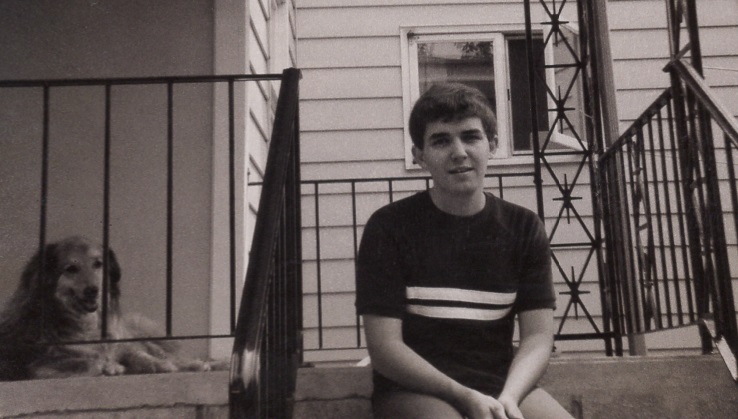
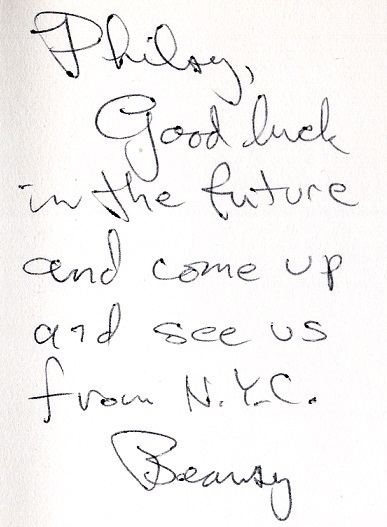
My unhappiness continued after I’d graduated. It took me another seven years to come to grips with my reality, which I’d known since I was nine. Interestingly, I found something prophetic in my Yearbook while thumbing thru it a few months ago: one classmate knew my destiny even then:
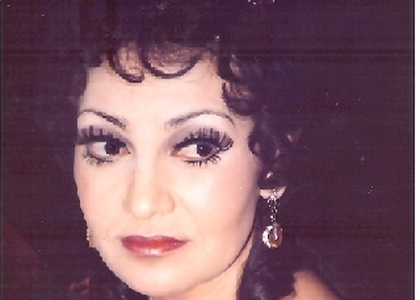
Maria Slătinaru (above) & Ludovic Spiess sing the Riddle Scene from Puccini’s TURANDOT at a 1970 concert given by the orchestra and chorus of Romanian Television. George Mircea sings the Emperor Altoum, and Teodora Lucaciu is Liu; Carol Litvin conducts.
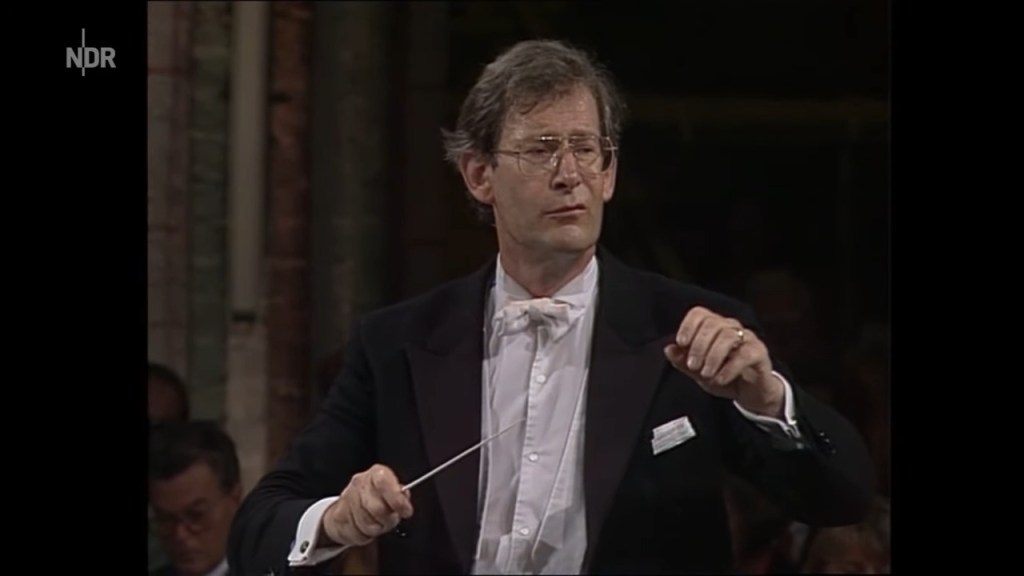
A performance of Benjamin Britten’s WAR REQUIEM given by the NDR Elbphilharmonie Orchestra, conducted by Sir John Eliot Gardiner (photo above), in 1992. The concert took place at St. Marienkirche in Lübeck.
The soloists are Luba Orgonasova, soprano; Anthony Rolfe Johnson, tenor; and Boje Skovhus.
Audio-only of Verdi’s RIGOLETTO as performed at Orange in 2001. The cast is led by Norah Amsellem (above), the late Béatrice Uria-Monzon, Marcelo Alvarez, Carlo Guelfi, and Paata Burchuladze; the conductor is Marco Guidari.
(This article first appeared on Oberon’s Grove back in 2007.)
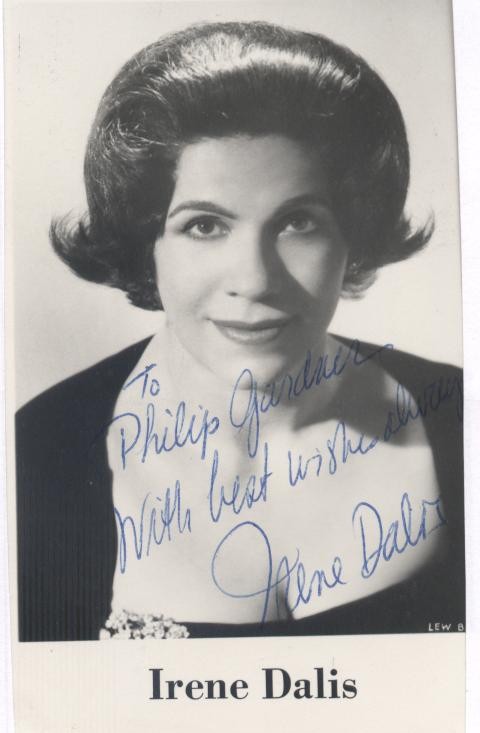
Irene Dalis was one of those opera singers who could drive audiences crazy with her intense vocal and dramatic portrayals. During the late 1960s and early 1970s I was a huge fan of hers and saw her in many roles. Her voice was certainly not conventionally beautiful; if you wanted sumptuous Italianate sound you went for Simionato and later for Cossotto. Christa Ludwig, Shirley Verrett and Grace Bumbry had more attractive voices and easier tops than Dalis. But there was something so passionate and incisive about the way Irene Dalis sang everything from Lady Macbeth to Fricka, from Santuzza to Herodias in SALOME, that caused me to plan trips from Syracuse specifically to see her onstage at the Met.
I heard her on many Met broadcasts before I actually encountered her in the theatre. In broadcasts of AIDA, MACBETH, the RING Cycle, DON CARLO, SAMSON ET DALILA and TRISTAN UND ISOLDE, Irene kept up an unsettling assault on the emotions of a young opera fan with her powerful vocal portrayals; I didn’t need to see her to imagine her stalking about the stage as the relentlessly needling Fricka or turning her scathing disdain on Samson in a fury at the end of Act II when her seductive endeavors have failed. She did not have a long, seamless vocal line nor was her top totally secure, but she had this way of delving into the colours of her instrument and of putting just the right stress on a word that would make an unforgettable impression.
I first saw Irene Dalis perform at the Cincinnati Zoo Opera as Azucena in TROVATORE. Her singing was powerful and her acting so passionate; my parents, who really knew nothing about opera, were excited by her performance. Backstage I timidly asked for her autograph and she was very kind as I recall, remarking that it was nice to see young people at the opera. I was 13. Her Leonora was the fledgling spinto Martina Arroyo; my father managed a conversation with the conductor Ottavio Ziino despite the latter’s total incomprehension of English.
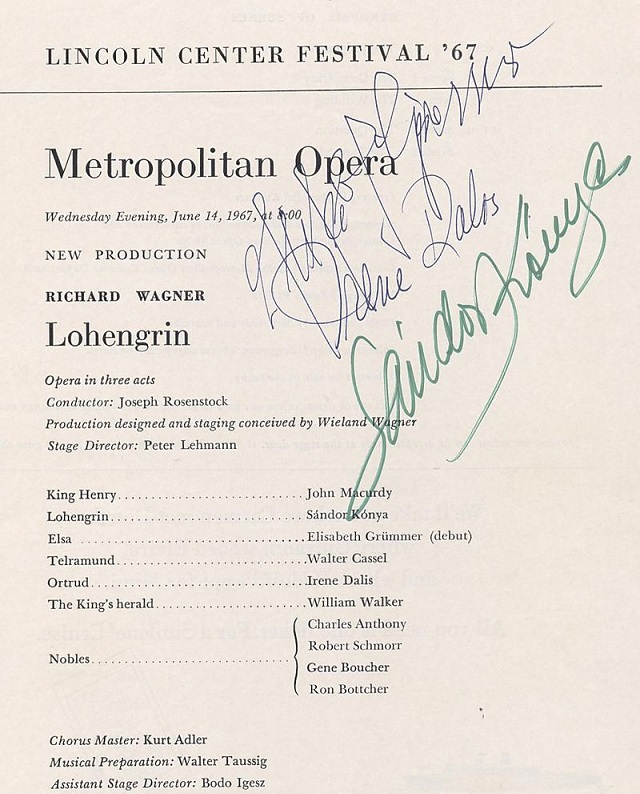
My first experience of seeing Irene Dalis on the Met stage was during the 1967 June Festival in a performance of the Wieland Wagner production of LOHENGRIN. When the new house opened, the demand for tickets was so high that the Met extended its season into June with added performances and some of its biggest stars. Irene’s cold-blooded and subtly inflected interpretation of one of opera’s great bad ladies held its own onstage with Sandor Konya, the top interpreter of Lohengrin of the day, and the legendary Elisabeth Grummer (who rarely signed autographs!)making a wildly successful and greatly belated Met debut at the age of 57. Irene wore a deep green gown, if memory serves, and seemed like some insidious reptile as she cravenly ingratiated herself to the hapless Elsa and then heartlessly turned against the naive maiden. The ovations that night were huge though nothing out of the ordinary during that golden era.
During the next few seasons Irene Dalis was a major reason for me to take the long train trip to Manhattan. I sent her fan letters to which she graciously replied. I saw her in unforgettable performances of AIDA, FRAU OHNE SCHATTEN, DON CARLO, CAVALLERIA RUSTICANA, TROVATORE, BALLO IN MASCHERA, SALOME and a particularly memorable ADRIANA LECOUVREUR at which the young rising-star tenor from NYC Opera, Placido Domingo, substituted for Franco Corelli at the last minute in an exciting Met debut opposite the beloved Renata Tebaldi in her favorite role. Irene’s venom-voiced Princesse and Anselmo Colzani’s poignantly human Michonnet turned the evening into a true classic. I can vividly recall both Tebaldi & Dalis graciously encouraging their young tenor colleague and turning their backs on the audience during duets with him so he could send his tones into the big hall and watch Maestro Cleva. Such generosity.
Irene’s first UIrica in BALLO at the Met was a five star affair. Her colleagues were Montserrat Caballe, Reri Grist, Placido Domingo and Robert Merrill. These singers gave us a rich evening of vocalism and Irene’s gripping delivery of the fortune-teller’s prophecies was enhanced by eerie contact lenses which gave the illusion of empty sockets. From the depths of her “Silenzio!” to the sailing harmonies in the trio with Caballe & Domingo, Dalis was on fascinating form.
At the June Festival in 1971, Irene had one of her great personal triumphs at the Met with a grand-scaled portrayal of Azucena in TROVATORE which evoked frantic ovations. The Dalis voice was totally ‘on’ throughout the range while she portrayed the demented gypsy with her accustomed fervor. Backstage afterwards, she was mobbed and they opened the greenroom to accommodate all the fans who wanted to meet her.
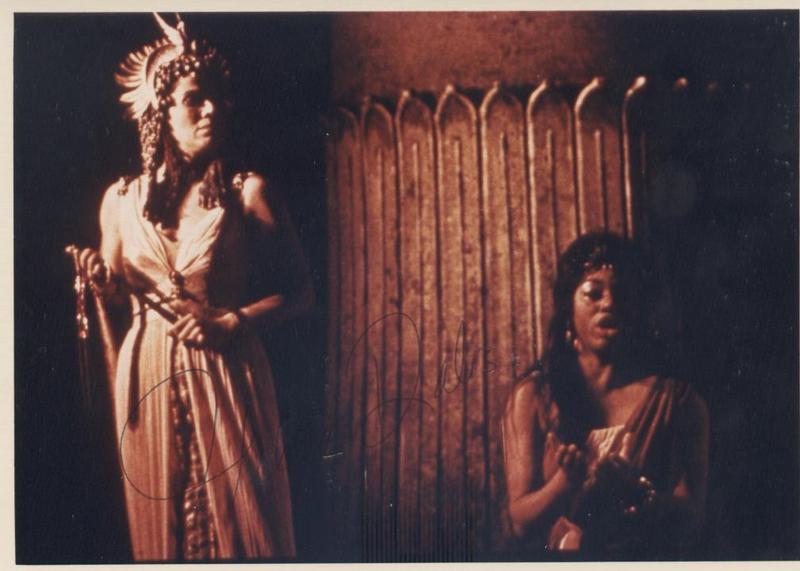
There were two roles in which Irene Dalis left particularly powerful memories. The first was Amneris in AIDA. In the photo above, Irene is lording it over Leontyne Price in their Act II confrontation. Irene signed the picture for me, though her signature has faded over time.
The Dalis voice, with its potent chest register, left such an indelible impression on so many phrases of this opera that to this day when I think about the music of Amneris, it is her voice I hear.
The Judgment Scene of Act IV of the Verdi opera, in which Amneris seeks to save her beloved Radames from a sentence of death for treason, was the high point of Irene’s interpretation. Here the character of Amneris who has been so proud and manipulative in the earlier acts is brought into acute human focus when her power as Princess of Egypt carries no weight with the condemning priests; she is reduced to begging only to have the implacable judges walk off chanting “Traditor!” In the final moments, Amneris turns on the priests and delivers a fiery curse on them before collapsing in despair.
On June 28, 1969 Irene Dalis sang Amneris with the Met in a concert performance in Central Park. She was in extraordinary voice and had the audience in the palm of her hand from her opening phrase. The massive crowd was so keyed-up by the time Irene came to the Judgment Scene that the excitement was palpable. I don’t think she ever topped this performance and aside from all her incisive dramatic phrases and startlingly vivid declamation of the words, she found the most shattering colours of remorse midway thru the scene when Radames has rejected her help. After the trial, in which Radames utters no word of self-defense, Amneris attempts to bargain with the priests but they will have none of it. Flinging out her scalding “Anatema su voi!” Irene brought the scene to a heart-pounding climax. The very instant she let go of her final top note the audience at Sheep Meadow erupted in a delirious ovation which went on for several minutes. Irene has to bow again and again.
Having lost everything, the once-proud Amneris appears at the very end of the opera to pray over the tomb where Radames has been buried alive. She does not know that her rival Aida has secretly entered the tomb and is dying in Radames’ arms. The quiet ending of the opera with Amneris intoning “Pace…pace” was the memorable end of one of Irene’s most exciting performances.
You wouldn’t think there could be anything to top her Amneris, but in 1966 at the Met premiere of DIE FRAU OHNE SCHATTEN Irene Dalis found the role of a lifetime. In one of the richest casts ever assembled – Leonie Rysanek, Christa Ludwig, James King and Walter Berry, conducted by the immortal Karl Bohm – Irene came close to stealing the show. As the Nurse, in whose care the Empress has been placed by her father {the enigmatic Keikobad}, Irene’s singing caught the myriad complexities of her character: maternal, scheming, ironic, tender and brutal by turns. The vocal writing races up and down thru the registers, cascading through demanding turns of phrase into the deepest chest tones and ending the second act on a searing top B. Irene took it all in stride, her acting as colorful as her singing and burning the words into the listener’s memory where I can still hear them today as if she were singing them directly to me. Leonie Rysanek was THE Empress of her time – of all time, I suggest – and she sang it here and in Europe with every interpreter of the Nurse who was willing to attempt the impossible role. She once said she rated the Irene Dalis interpretation as ideal.
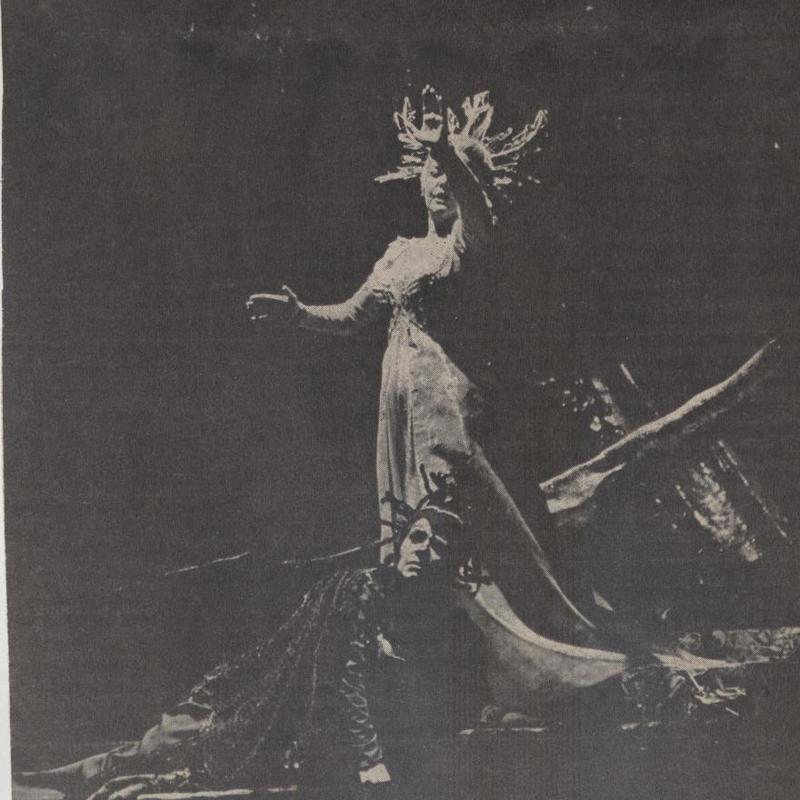
Above, an immortal moment: anyone who ever saw the Met’s FRAU with Rysanek and Dalis as Empress and Nurse will never forget this scene in the third act where the Empress rejects the Nurse and goes to her trial in Keikobad’s temple. The scene, starting with their arrival by boat at the tower gates, contains some of the most brilliant and taxing vocal writing Strauss ever conceived. The Rysanek Kaiserin was stupefying in its vocal power and intensity and Irene Dalis kept pace with her every step of the way. I once experienced FRAU from the front row of the orchestra, right behind Maestro Bohm’s left shoulder. An unforgettable evening.
It was always a great experience to visit Irene Dalis her backstage; she was so kind and she always remembered me. It was an unfortunate happenstance when she was scheduled to sing Klytamnestra in ELEKTRA at the Met – surely a perfect role for her – and on the day the scheduled Elektra took ill and they were unable to find a replacement. They were forced to change the opera to FIDELIO and New York never got to experience Irene’s interpretation of opera’s most maniaical mother.
There is only one commercial recording of Dalis to my knowledge: a 1962 PARSIFAL from Bayreuth conducted by Hans Knappertsbusch. But there are pirates of her many Met broadcasts; her 1961 RING roles (Fricka and Waltraute…she was superb!), the 1970 AIDA, and both her FRAUs from the airwaves are among my favorites.
After retiring from the operatic stage, Irene Dalis returned to San Jose to teach, and there she eventually founded Opera San Jose.
We simply have so few of these larger-than-life operatic performers today and I am thankful to have experienced so many of Irene’s performances…and to have known her.
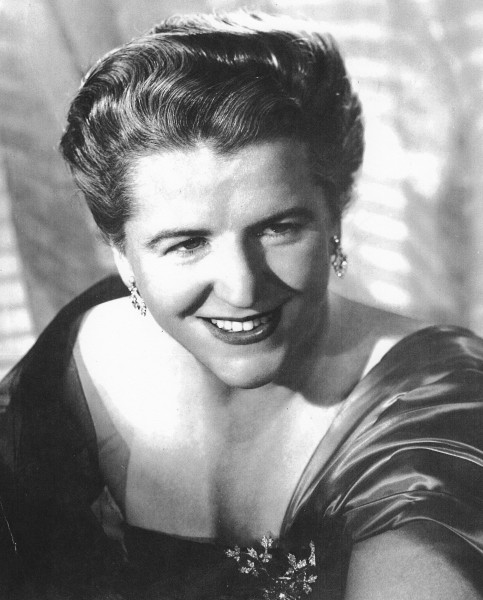
Dame Joan Hammond (above) and Heddle Nash sing the Garden Scene duet from Gounod’s FAUST; Owen Brannigan is Mephistopheles, and the The Philharmonia Orchestra is conducted by Walter Susskind. The recording dates from 1948.
(This story from Oberon’s Grove tells of my first encounter with Lydia Johnson Dance in March 2009.)
Above: dancers Jessica Sand and Tucker Ty Davis, photo by Julie Lemberger
Sunday March 29, 2009 – Back to the City Center Studios tonight with Evan to watch a rehearsal by the Lydia Johnson Dance Company of their latest work – as yet untitled – to the music of the Polish composer Henryk Gorecki. This was preceded by excerpts from Lydia’s 2004 work IN CONVERSATION set to the spectacular Violin Concerto of Philip Glass.
Waiting for the dancing to begin, Evan and I were speaking of the sheer number of invitations to dance events we receive on a daily basis. Sorting out what to see and what to miss increasingly becomes a dilemma as we try to decide from a press release whether it is something we will like or not; then it’s a matter of scheduling and also of hoping to space events out reasonably so there is time in between to reflect rather than dashing madly from one venue to another and never having anything really sink in. Fortunately I have struck it rich in many of my choices, such as TAKE Dance or Miro Magloire’s New Chamber Ballet.
Up until this evening Lydia Johnson was just a name I was vaguely familiar with; what made me say ‘yes’ to this invitation was the announcement that she would be working to music of Gorecki. Music is always the key element for me when it comes to enjoying dance; if I like the music, I’m halfway there before the dancing even commences.
So this is what happened: Lydia Johnson became overnight one of my favorite contemporary choreographers. Her dancers all appear to have strong classical ballet background and are wonderfully fluent in presenting what Lydia asks of them while each also shows keen individuality and personal magnetism. Lydia’s style seems to me very demanding physically, making us aware of the workings of the human body while always imaginatively aligning movement to the music .
Introducing the works, Lydia’s love of music shone thru in her words. Then her dancers took the floor and within seconds I knew I had found something I loved.
In excerpts from IN CONVERSATION, dancer Jessica Sand (who reminds me of Alexandra Ansanelli) immediately began ‘speaking’ to me with her superbly fluid movement; there is a gestural language here and Jessica’s dancing has a nice feeling of the poetic. She is partnered by an enigmatic dark-haired and dark-eyed young man named Robert Robinson. The bearded dancer immediately swept Jessica into a spacious lift, his strength as a partner surprising in view of his slender frame. Beyond that he showed elegant port de bras and a presence with an intriguing touch of mystery. Watching these two dancers move thru Lydia’s pas de deux with such extraordinary focus and grace as the gorgeous Glass score filled the room was quite an experience. I felt a deep connection to the music and to the expressive commitment of the dancers.
Meanwhile, Tucker Ty Davis stood on the sidelines. He seemed rather unassuming and his more hunky build made me wonder what kind of dancer he would be. The answer when he started to move was compelling: he is passionate, powerful, agile and fearless. His interjected solo lasted only moments but it was enough to put him right up high on my list of dancers to watch in future.
The Glass score with its hypnotic rhythms and haunting minor-key lyricism practically screams: “Dance to me!” It seemed to me that music, dancers and choreographer had met in a perfect union. And after such an exhilirating experience I had to keep reminding myself “It’s just a rehearsal”. Now I can’t wait to see it in full performance setting.
After a very short break, all nine of the Company’s dancers appeared in the untitled Gorecki. Still a work in progess, the piece uses part of the composer’s Harpsichord Concerto (‘…like the score of an old horror movie”…as Lydia aptly decribed it) and part of his String Quartet #1. Lydia stated that the two movements may eventually have a connecting interlude but I didn’t think it needed anything more; it looks so good and responds so well to the music just as it is.
At first the five women seem to be in their own world, moving with quiet intensity in patterns which seem to express that they are an isolated group but not discontented with their situation. As the four men join them, the movement becomes more expansive. Couples form, and the large group often splinters into trios who perform synchronized gestures as the dancing swirls around them; I especially liked this aspect of the piece. The work is both visually and musically extremely satisfying and again the individual dancers continually draw the eye from one to another. Jessica Sand, Tucker Ty Davis, Kerry Shea and the blonde Eric Vlach were outstanding in the leading roles here. The ensemble were anything but anonymous: rather each dancer makes a personal mark on the choreography. I look forward to putting names to faces so that I can properly enthuse over their individual efforts.
(This evening marked the start of my enduring friendship with Lydia Johnson and with many of the dancers who have appeared in her performances thru the ensuing years.)
(This paean to the Mexican soprano Gilda Cruz-Romo first appeared on Oberon’s Grove in 2008.)
In the Autumn of 1969 I decided to move to New York City; I withdrew all my savings from the bank and reserved a room at the Empire Hotel at a monthly rate. The plan, as I sold it to my parents, was that I would find a job and then an apartment. In actuality, all I really wanted to do was go to the opera every night. And that is exactly what I did, forgetting about job-hunting til my cash gave out and I returned home after a few weeks.
Unfortunately for me, that was the year of the Met orchestra’s strike. But I was not to be deterred: I went to every single performance of the New York City Opera’s Autumn season. Standing room cost next-to-nothing and I already had some favorite singers there – people like Beverly Sills, Maralin Niska, Patricia Brooks, Enrico di Giuseppe, Dominic Cossa and Norman Treigle. Treigle was in fact the focus of that Autumn season since NYCO was mounting a production of Boito’s MEFISTOFELE for him. Carol Neblett was singing the dual role of Margherita and Helen of Troy; but for the final performance of the run a debut was announced: a Mexican soprano named Gilda Cruz-Romo.
One never knows what to expect from a debut, and that was especially true back then when there was no Internet buzz, YouTube or Facebook that might have provided an inkling or an outright sample of a new singer’s work. In the weeks prior to her debut, I’d actually seen Gilda and her husband Bob Romo several times around Lincoln Center and at the Footlights Cafe; I’d even said hello to her and as a young, unknown singer she seemed genuinely thrilled to be recognized. But what – I kept wondering – does she sound like?
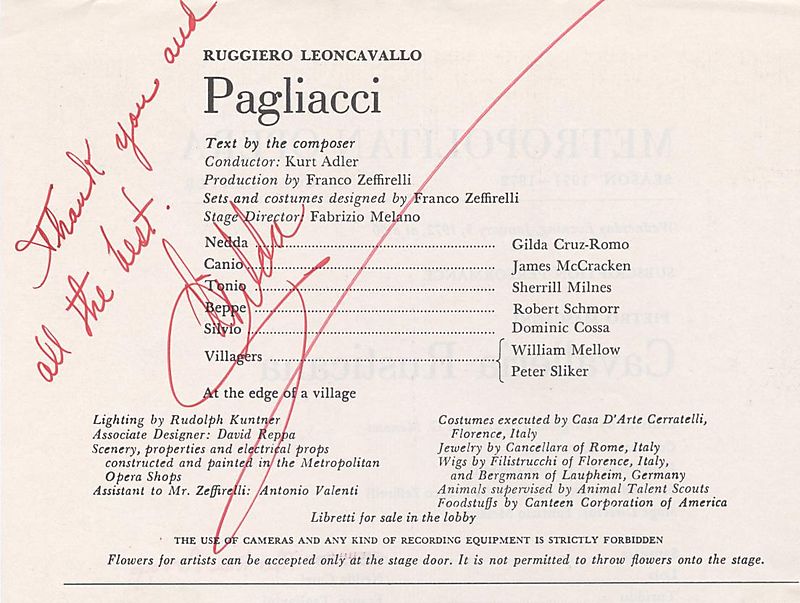
Her performance was something of a revelation: it was a big, warm lyric voice bordering on spinto. Her tone had an unusual freshness and clarity, with a pliant technique and shining upper register, and the kind of vocal candor that one finds in a new singer who just sings without relying on artifice. The audience took to her at once – the fans sensing that here was an Italianate voice that had real potential in the Verdi & Puccini repertoire. After the great aria “L’altra notte”, Cruz-Romo was warmly applauded but it was in the Helen of Troy scene that she capped her success: in the great concertato “Amore mistero!” the voice sailed out over the ensemble with a gleaming quality and as the line soared up to its climatic top-B the sound seemed to blossom – and Cruz-Romo swept onwards to triumph. I met her after the performance; she and her co-stars Norman Treigle and Nicholas di Virgilio all signed my program:
The next afternoon at Footlights a small gathering of fans met and we played over and over again our house tapes of the performance; we must have listened to that ensemble about twenty times. People at neighboring tables were drawn to the sound of her voice. In those days, New York City Opera was a real Company: if you made a successful debut you were invited back and became part of the family and were cast in as much repertoire in your fach as was available. Obviously Julius Rudel knew a special voice when he heard it, so Gilda – as we were by now all calling her – sang there for the next 2 or 3 years until the Met snatched her away.
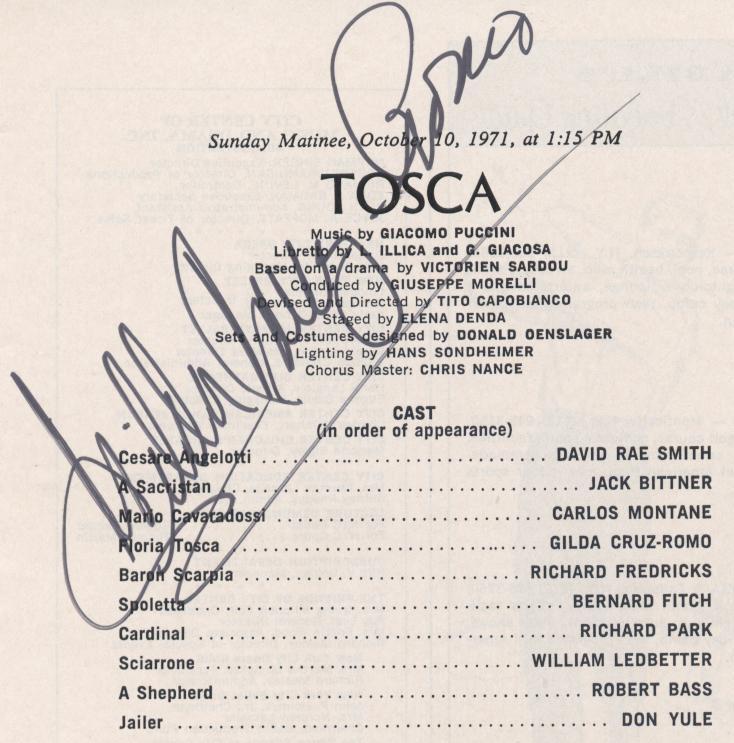
And so I saw her in more performances of MEFISTOFELE, as a glowing-voiced Butterfly and a golden-toned Mimi (especially moving) and – in one of her first ventures into the heaviest rep – Amelia in BALLO IN MASCHERA. Of her City Opera performances, my very favorite was her Tosca in 1971:
“…Gilda surpassed my highest expectations as Tosca. Rarely has this role had such a balanced combination of: a beautiful face, fine stage presence, sincere acting, fine diction and GORGEOUS spinto singing. In the first act, many phrases of great beauty. She looked lovely, young and excited. In Act II she sang superbly, her high Cs large and luminous. The dramatic utterances were all convincingly delivered. As she neared the end of her marvelously phrased “Vissi d’arte” tears welled up in her: one sob at the end, straight from the heart, was a perfect effect. She carried off the murder and the acting demands of the closing of Act II with excellent control. Maintaining her high level in Act III, Gilda ended the opera on a stentorian top-B and took a death-defying leap of ten feet! She was given a tumultuous ovation eminently deserved. Backstage she was literally mobbed – as big a crowd as I’ve seen at NYCO. After edging my way through the throng we hugged and she kissed me so many times. It took a few moments before either of us could speak…”
When things calmed down and we got to discuss the performance, she told me how petrified she was of taking that final jump. The production was designed so that Tosca’s suicidal leap was visible to the audience as she fell about a dozen feet before a parapet blocked her landing-mattresses from view. She had not had a stage rehearsal and she said she got to the edge of the platform and realized in a split second how exposed her descent would be; she crossed herself and took the plunge.
It was inevitable that a voice like Gilda’s would be both wanted and needed at the Met. In 1970 she entered the Met National Auditions and was a finalist, singing “La mamma morta” from ANDREA CHENIER. On May 8, 1970 she debuted with the Company on tour in Atlanta singing that same opera. In December of the same year she debuted at the Met proper as Butterfly, beginning a career there that stretched into the mid-1980s and encompassed over 160 performances.
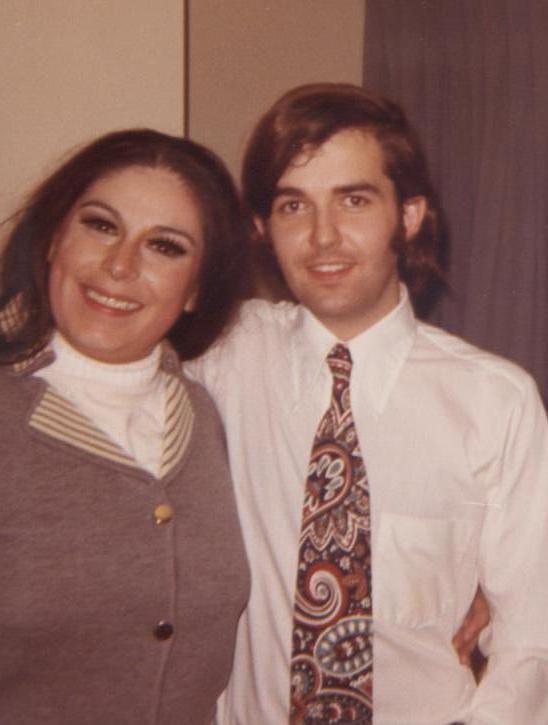
I saw her at the Met for the first time as Nedda in PAGLIACCCI opposite the frighteningly intense Canio of James McCracken. Gilda sang so beautifully, especially in the sensuous duet with Silvio (Dominic Cossa): “…great crescendos from tiny pianissimos...” It was after this performance that she and I were photographed together backstage. (OK, no comments about my tie…or my hair! Remember this was the 70s).
Then came a hiatus: I moved to Houston for a while and only kept tabs on her via the broadcasts. But after a while I was lured back to the Northwest and we had a beautiful reunion at a matinee of AIDA where she sang opposite Franco Corelli:
“…Gilda was in complete command of this arduous role every step of the way…there were phrases upon phrases of golden Verdi singing: her deeply-felt prayer at the end of ‘Ritorna vincitor’ and the miraculously spun high pianissimi in ‘O patria mia’ and even more incredibly on ‘Fuggiam, fuggiam…’ as she lured Corelli into her escape plan. She was able to healthily dominate the big ensembles and then turn around a float effortlessly in the tender ‘O terra addio…’ Really top-class Verdi singing!”
Gilda also sang in a revival of MANON LESCAUT and sounded lovely despite being cast opposite a very mediocre tenor. Her ‘In quelle trine morbide’ was poignantly phrased, mirroring Manon’s longing for the simple, true love of her Chevalier des Grieux. (Photo: Bill Hendrickson).
Then several things happened which kept me from seeing her onstage at the Met; I moved to Hartford with TJ and for a couple years we were basically broke. Trips to New York were infrequent and most of the time ballet trumped opera. Then too, Gilda’s international career was in full bloom; it seemed she sang everywhere and sang the most taxing repertoire – I think I once read that she ended up singing Aida five-hundred times! It seemed like whenever I was at the Met, she was somewhere else.
Thus it was a special pleasure when she came to Hartford and sang Desdemona in OTELLO (above), one of her most attractive roles. In 1979 she was Desdemona on a Met telecast opposite Placido Domingo and Sherrill Milnes.
In 1987 I saw Gilda onstage for the final time, as Cherubini’s Medea at Bridgeport, Connecticut. The declamatory style of many of the character’s utterances didn’t suit her so well – she was always a melodic singer – but the voice was still powerful and expressive.
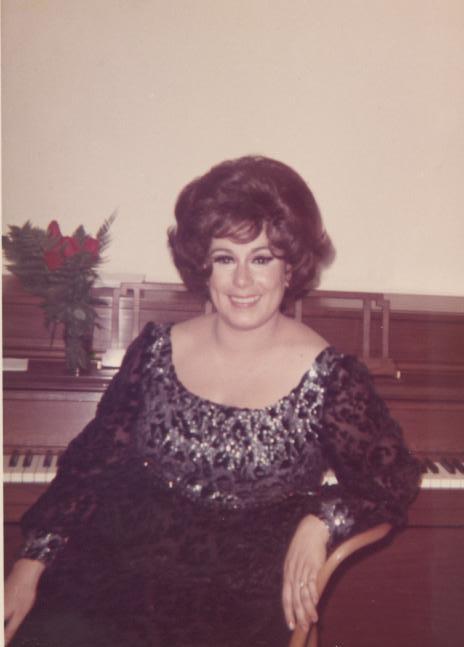
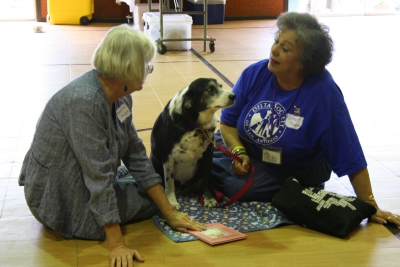
I met her again a few years ago when she was honored by the Puccini Foundation. I handed her the photo of the two of us and it took her only a half-second to realize who I was…I have changed MUCH MORE than she has! We keep in touch now; she lives in San Antonio and I was tickled to read recently that she keeps up her deep-sea fishing and is also active in a local Texas group which matches senior citizens with canine companions:
It’s been a long time since that day in Footlights soon after her NY debut that I pestered her with a million questions and she was unbelievably kind and patient. Once I wrote to her after she’d sung the title role in ANNA BOLENA in Dallas expressing my dismay that I couldn’t have been there; a few days later I was astounded to open the mailbox and find she had sent me a tape of the performance. That’s the generosity of spirit that Gilda always shows. So now, with love and gratitude, I’ve tried to put my admiration for her into words.






 Oberon's Glade
