Friday January 29, 2010 – The New York City Ballet’s very attractive production of SLEEPING BEAUTY is running for two weeks at Lincoln Center; tonight was my first opportunity to attend. The settings are straight out of a fairy tale with the passage of time and the changing of the seasons depicted in lovely projections. Clothilde Otranto conducted the somewhat truncated score fairly briskly and a huge contingent of dancers – from principals to young SAB students – filled the stage in a performance that was very enjoyable despite a few passing flaws. The production features the Balanchine choreography for the Garland Waltz, always a stage-filling spectacle with its pattern-richness.
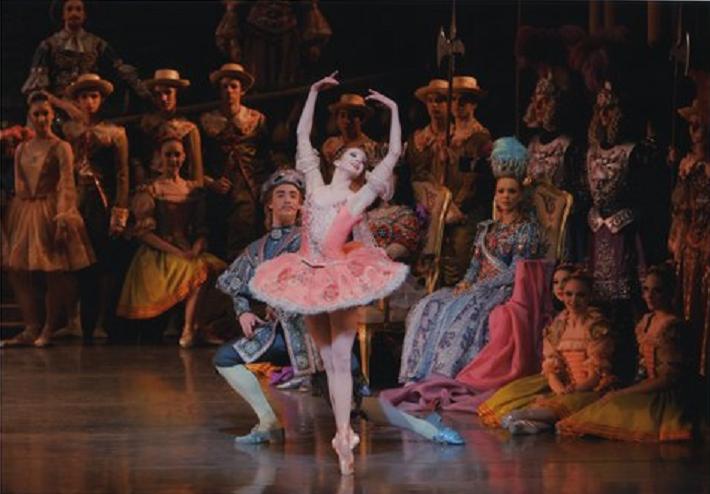
Sterling Hyltin as Aurora (above, in Paul Kolnik’s photo) was really superb; her elegant line and her technical certainty were combined with her lovely characterization of a girl on the brink of womanhood. In meeting her four suitors, her sense of eagerness and curiosity was kept in check by the instinctive good manners of a princess. The Rose Adagio went very well and the big solo variation even better but it was in the Vision Scene where Sterling was at her most was sublime, her dancing so refined and poetic. Her solo in the Wedding pas de deux was dazzlingly executed. For all her technical strength, Sterling has a complimentary air of delicacy which makes watching her such a sheer pleasure.
Jonathan Stafford matched Sterling very well and he spun off some polished air turns; Jon is a very good actor, unfussy and sincere. Only in the fish dives did they falter: a stunning first one was followed by a precarious second. I really wish something could be substituted for the dives which are so seldom accomplished with the necessary flash. Progressing to the Vision Scene, Jon, Sterling and Teresa Reichlen (the Lilac Fairy) wove in and out among the dream-like nymphs creating a living tapestry of movement. Tess is a pure delight as the Lilac Fairy, a role which seems tailor-made both for her long-limbed physical grace and her benevolent radiance of expression. Her calm dignity and her gentle reprimand of her nemesis Carabosse were beautifully expressed. With her many attitude poses, flourishing pirouettes and magical extension, Tess wove a silken thread of dance that holds the whole ballet together.
Jenifer Ringer, one of the finest Auroras I ever saw, took on a new role: one might think of her as an ideal Lilac Fairy but, having been cast against type, Jenifer revels in joyous nastiness as Carabosse, gleefully foretelling Aurora’s demise only to be thwarted by the omnipotent Tess. In this production Carabosse is a glamorous woman and Jeni fills the bill to perfection.
Among the beautifully-costumed fairies in the Prologue – featuring Gretchen Smith, Georgina Pazcoguin, Stephanie Zungre and Gwyneth Muller – Ashley Laracey made a particularly fine impression both in her variation (Generosity) and most especially in her solo passage in the coda. The Lilac Fairy has a very pretty octet of attendants ‘led’ by the always-lovely Likolani Brown. Ask LaCour’s was a perfect king and Arch Higgins was Catalabutte, the much put-upon Lord Chamberlain. In an all-too-brief appearance in the Hunting Scene, Amanda Hankes was a fetching Countess.
There may be a shortage of men in the Company now – some are out with injuries – which meant Vincent Paradiso had to dance in the Garland Waltz and then transform himself into the Bluebird. It was really nice to see Matthew Renko back onstage; having watched Matthew at close range lately working with Avi Scher and Adam Hendrickson he seems one of the finest young male dancers around. Let’s hope the reunion becomes permanent. The four princely suitors in the Rose Adagio included Justin Peck who looked striking in the Native American costume and later appeared as a high-leaping Wolf in the wedding divertissement.
Wei and I greatly enjoyed seeing Faye Arthurs in a new role: the White Cat where she cannily found ways to show off her extension; Adrian Danchig-Waring was the wily Puss-in-Boots. Rebecca Krohn was a regal Diamond in the Jewel pas de quatre where Alina Dronova’s fancy footwork and Erica Pereira’s fluent charm were seen to advantage as Emerald and Ruby respectively. Tyler Angle (Gold) looked great partnering Rebecca but he could not quite bring off the end of his variation. As Princess Florine and the Bluebird, Ana Sophia Scheller and Vincent Paradiso were physically well-matched in their dark-haired attractiveness. Vincent’s diagonal of fluttering beats at high velocity was impressive – the steps here look impossible to me – and Ana Sophia was superb, giving a lesson in classical presentation that the new-comers among the girls in the Company should heed. Daniel Ulbricht’s spectacular air combinations brought whoops of delight from the House, with Allen Peiffer and Ralph Ippolito as his jestering pals keeping pace in this spirited interlude.
For all this array of wonderful dancing I found myself constantly drawn to one person onstage who does not dance at all: Kaitlyn Gilliland as the Queen. Right from her first entrance Kaitlyn’s majestic height and gorgeous face grabbed my attention; whenever she was onstage my opera glasses would drift over to watch her beautifully expressive mime or the royal radiance with which she simply sat watching the festivities.
A couple of costume malfunctions were distracting but not nearly as much as the audience chatting during the interludes, the unwrapping of food and people getting up during the music and wandering to the exits possibly thinking they were at the cinema and could come and go at whim. Newcomers to the ballet are needed, of course, but they also have to be educated in how to behave during performances. In a time when common courtesy is no longer common, it’s up to the Company to assure an atmosphere where the people who really care about the ballet aren’t alienated.
 Oberon's Glade