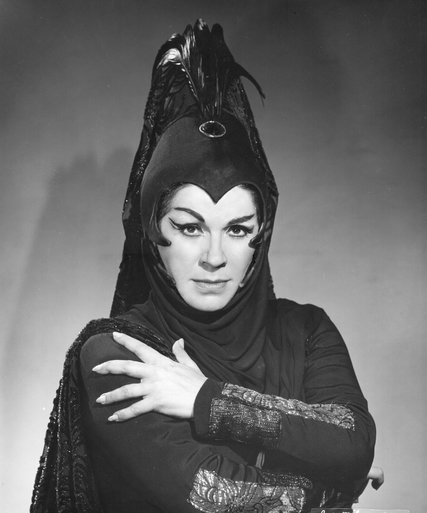
Christina Anghelakova sings the aria of La Vecchia Madelon from a film of Giordano’s opera, ANDREA CHENIER.
Watch and listen here.
Christina Anghelakova sings the aria of La Vecchia Madelon from a film of Giordano’s opera, ANDREA CHENIER.
Watch and listen here.

Teresa Berganza sings the Habanera from Bizet’s CARMEN here, in a live performance from L’Opera de Paris on May 14th, 1980. It’s just about the most perfect rendering of this super-familiar aria I ever heard.
Watch a video clip of Jerry Hadley and Judith Haddon singing the love duet from a 1982 New York City Opera performance of Puccini’s MADAMA BUTTERFLY here.

Katia Ricciarelli and Lucia Valentini-Terrani are the soloists in this performance of Pergolesi’s STABAT MATER conducted by Claudio Abbado.
Watch and listen here.
~ Author: Oberon
Tuesday March 25th, 2025 – Young Concert Artists presenting bass-baritone Joseph Parrish (photo above) in recital at Merkin Hall, with Francesco Barfoed at the piano.
I first heard Mr. Parrish in a performance of Pauline Viardot’s CENDRILLON given by City Lyric Opera in 2021; I was immediately impressed by his singing, acting, and charismatic personality. In 2023, he sang superbly at the Gerda Lissner Winners Concert, having won first prize in the song/lieder division. And in 2024, Mr. Parrish made a most convincing (and beautifully sung) Salieri in Rimsky-Korsakov’s opera MOZART AND SALIERI, performed by Parlando.
Tonight, Mr. Parrish showed that his is a voice that can bring people together. His stage presence is relaxed and cordial, with glimmers of humor along the way; it is a voice with an extensive range and a mastery of dynamics that allows him to veer impressively between hall-filling power and the most gentle of pianissimos. He can turn a phrase like a magician, whilst all the time his body language and expressive face draw listeners to him like a magnet. This is charisma personified.
For the first half of the program, Mr. Parrish shared the stage with a stellar pianist: Francesco Barfoed (photo above). Francesco is a musician of extraordinary talent, his playing so perfectly aligned with the singer’s vision of the music.
Mr. Parrish opened the evening with Harry Burleigh’s “Elysium”, and in this single song he set a very high standard for himself: a standard which he would often surpass as the concert progressed. “Elysium” displayed the voice’s sheer power, as well as its sense of control…the last note was simply awesome. More Burleigh next – “You ask me if I love you” – in which the singer details the sensations he experiences when with his beloved…as if to say: “Do you really need to ask? “
Classics from two masters of lieder followed: Mahler’s romantic Liebst du um Schönheit with its poetic words, so lovingly rendered, and Schubert’s immortal Ständchen, in which the pianist plays a major role; the music covers a big vocal range and part of the allure is in the detailing of subtle nuances. The song reached a majestic pinnacle but then ends quietly. Then back to Burleigh for “Her Eyes Twin Pools“; Mr. Barfoed’s playing here is essential to the song’s meaning, whilst the singer’s face, expressive hands, and slender form create a visual poem all their own.
Charles Brown’s ‘The Barrier‘ at first seems to sing of an admirer’s shyness in hesitating to approach the object of his desire, but there is another reason for his reluctance, revealed in the song’s final line. Whilst listening to the song, I was thinking: “How lovely…how poetic…” and then the last words sent a chill thru me.
“Along The Dusty Road” by Hal Johnson seems like a folksong at first; a touch of the blues takes us to a spiritual place; Mr. Parrish sang so many beautiful notes in this song until reaching a whispered final tone that hung on the air.
Charles Brown’s “Song Without Words” is just that. The singer begins with humming, then switches to what the French call “bouche fermée“ which has a slightly different feel from plain old humming. The singer opens his mouth but no words emerge, just sound. Who knew vocalizing could be so expressive?
The New York Premiere of Psalm by YCA Composer-in-Residence Alistair Coleman draws on the old German hymn “How a Rose E’er Blooming“. The words “No one…” are repeated endlessly, as Mr. Parrish displays his vast dynamic range. The words change to “We were…we are…” and the music grows more passionate. The piano then introduces the carol itself, creating an air of fragrant softness. Hypnotically, “…the thorn…” now becomes the song’s lyric.
After the interval, Mssrs. Parrish and Barfoed returned with a Margaret Bonds piece, “You Can Tell The World“, a song with a theatrical feel – so alive – and giving the pianist a chance to shine brightly; it reaches a fantastical finish. Three beloved classics came next. First, “Deep River” in which Joseph made such a poignant impression, displaying the strength, range, and awesome breath control at his command. In “A City Called Heaven“, I had that uncanny feeling that he was singing just to me. At last, the triumphant “Ride On, King Jesus” in which his singing moved me so deeply with his range, power, and vitality.
Now the young singers of the Washington Performing Arts Children of the Gospel Choir (above) took the stage, greeted by a vociferous ovation. Dressed in black gowns and tuxedos, they are just plain gorgeous to behold. And then they sang! Under the elegant and inspiring conducting of the group’s artistic director Michele Fowlin, and accompanied by the delightful pianist Anthony “Tony” Walker, they dazzled Merkin Hall with their young voices, weaving perfect harmonies, gesturing poetically, and swaying to Mr. Walker’s marvelous rhythms. Judging by the perfection their singing achieved, I would guess Ms. Fowlin can be a demanding taskmaster, but also that she has a heart of gold. She seemed to glow with pride for her young prodigies.
Their Praise Medley encompassed Greg Roberts’ Prelude to Worship, Rodnie Bryant’s We Offer Praise, and Richard Smallwood’s Anthem of Praise. The audience went crazy for these astounding kids, and Ms. Fowlin and Mr. Walker caused screams of joy to erupt as they took their bows. One boy in the choir reminded me so much of mi amor de loin, Brix, in far away Cebu; after one song, the boy fell to his knee and opened his arms as if to embrace the world.
Mr. Parrish offered three more songs – Bobby McFerrin’s Don’t Worry Be Happy, the profound Let Us Break Bread Together, and Richard Smallwood’s Total Praise (Joseph at the piano himself…!); the last two songs were arrangements by Ms. Fowlin. By then, I’d pocketed my pen and was letting the magic carry me. So much joy filled the hall as the evening came to an end.
~ Oberon

The late, lamented Giuseppe Sinopoli (above) conducted this concert performance of Strauss’s ELEKTRA with the Staatskapell Dresden at Tokyo’s Suntory Hall in 1995.
Watch and listen: https://www.youtube.com/watch?v=zBhGicuJMIM
Klytemnestra: Felicity Palmer; Elektra: Sabine Hass; Chrysothemis: Inga Nielsen; Aegisthus: Wilfried Gahmlich; Orestes: Alfred Muff.
(NOTE: this was originally published during the pandemic…)
During these endless days of being at home, I’ve been reading thru my opera diary, a hand-written document I started in 1962 and which now fills numerous file folders. So many wonderful memories of the great performances I saw over the years were stirred up by reading about them.
One such exciting night was the 1988 premiere of the Otto Schenk GÖTTERDÄMMERUNG, the closing opera of Wagner’s epic RING Cycle. Often referred to affectionately as “the Levine RING”, full cycles of the production in the ensuing seasons created a great international buzz; Wagnerites from all over the globe gathered in New York City to witness this classic staging.
Having already seen the RHEINGOLD, WALKURE and SIEGFRIED, I had a pretty good idea of what to expect; still, when the Gibichung Hall loomed into view, it took my breath away. Levine was mostly magnificent, though there were moments when he let things drag a bit; his orchestra gave it their all, and the chorus sounded sensational as they gathered in lusty expectation of the double wedding.
As to the singers, here’s what I wrote upon returning to my room at the Colonial House after the performance:
“Casting was strong, with pretty singing from the Rhinemaidens – Joyce Guyer (in her Met debut), Diane Kesling, and Meredith Parsons – and Franz Mazura made an astoundingly vivid Alberich, singing with oily malice. The opening scene of Act II, with Alberich pawing at the sleeping Hagen, was very atmospheric.
The Gibichung brother and sister were rather curiously cast: as Gunther, Anthony Raffell’s voice sounded veiled and throaty, and Kathryn Harries’ beautiful (and beautifully acted) Gutrune was undone by effortful singing and a prominent vibrato. [I mentioned that Cornell MacNeil and Lucine Amara could have made for far more interesting casting in these roles!].
The Norn Scene, which I have always loved, benefited from the super casting of Mignon Dunn as 1st Norn, sung with richly doom-ladened tone. Hanna Schwarz (2nd Norn) had a couple of husky moments, but overall sang vividly, with excellent diction. As the 3rd Norn, Marita Napier sometimes sounded a bit insecure, but she did not let down the side. These three really made something of their opening discussion.
Toni Kramer sang erratically but acceptably in the torturous role of Siegfried. He seemed to be husbanding his powers, doing his best singing in Act III.
Above: Christa Ludwig as Waltraute and Hildegard Behrens as Brunnhilde
The divine Christa Ludwig made a thrilling Waltraute, singing with great clarity and verbal point. The distinctive Ludwig tone – that cherished sound – drew the audience in to her every phrase. Add to this the anguished urgency of her delivery, and the result was a veritable triumph.
The Ludwig Waltraute produced one of my all-time favorite curtain calls: stepping before the gold curtain for her first solo bow, she was greeted by such a din of applause and shouting that she halted in her tracks; her eyes opened wide in amazement, and she broke into a huge smile. It seemed to me that she had not expected such an avalanche of affection. She bowed deeply, clearly savoring this outpouring of love from the crowd.
The towering magnificence of Matti Salminen as Hagen (above) produced tremendous excitement in the House. His huge voice was at peak form, effortlessly filling the hall with sinister sound. In the scene where Hagen’s father appears to him in a dream, Salminen and Franz Mazura matched one another in both power and eerily expressive subtlety: thoroughly engrossing. The basso’s portrayal as the drama of Act II unfolded was towering in its epic nastiness and in his manipulation of the situation to attain the character’s sole goal: to regain the ring. This was a performance thrilling to behold, and to hear.
The roar of applause for each of Salminen’s solo bows was thunderous, and I was so excited to be part of it, shouting myself hoarse.
~ Sample the Salminen Hagen, from a later broadcast…it gives me he chills:
Matti Salminen as Hagen – Met 1993
Hildegard Behrens (above) was a Brunnhilde of terrifying intensity and incredible feminine strength. This was an overwhelming interpretation, in which voice and physicality combined to transcend operatic convention, reaching me on the deepest possible level. Behrens lived the part, in no uncertain terms.
The Dawn Duet found Behrens portraying the tamed warrior maid to perfection, savoring her domestic bliss but eager that Siegfried should go out into the world and do great deeds. Her unconventional beauty and her inhabiting of the character were so absorbing to behold. Later, In the scene with Waltraute, Behrens as Brunnhilde listened anxiously to all her sister’s words and she began to grasp the first signs of the downward spiral that would culminate with Siegfried’s betrayal and her own sacrifice. Even so, she dismissed Waltraute with fierce disdain. Behrens’ vivid depiction of Brunnhilde’s terror and helpless dejection as the false Siegfried wrested the ring from her was palpable.
In one of the evening’s most gripping moments, Behrens – having become possessed by Brunnhilde’s plight in Act II – responded to Siegfried’s oath by snatching Hagen’s spear away him and singing her own oath with blistering abandon. Totally immersed in the character, her pain was painful to behold. In the powerful trio that ends Act II, Behrens, Raffell, and Salminen were splendid.
Above: Hildegard Behrens as Brunnhilde ~ Immolation Scene
In the Immolation Scene, the great strength of Brunnhilde’s love for Siegfried, and her determination to perish in the flames of his funeral pyre, marked the culmination of Hildegard Behrens’ sensational performance. Her singing was powerful, with unstinting use of chest voice and flaming top notes; there were moments when expressionistic effects crept in but it all seemed so right. The amazing thing about Behrens’ singing and acting here was that it all seemed spontaneous…she seemed to be living it all in the moment. One cannot ask more of an operatic portrayal.
The curtain calls went on and on, the audience eager to show their appreciation with volleys of bravos as the singers stepped forward time and again. Here we must also thank James Levine, whose grand design underlies the great success to date of the individual operas. Ahead, in the Spring, seeing the full cycle in a week’s time is already on my calendar. My dream will come true!”
~ Oberon
Camilla Nylund and Robert Dean Smith are Elsa and Lohengrin in a concert performance of the opening scene of Act III of LOHENGRIN given by the Royal Concertgebouw in 2010. Iván Fischer conducts.
Watch and listen here.

~ Author: Oberon
Saturday March 22nd, 2025 matinee – In 1883, a Swedish soprano named Christina Nilsson sang Marguerite in FAUST for the opening of the then-new Metropolitan Opera House. Last week, another Swedish soprano named Christina Nilsson (photo above) made her Met debut as Aida. This afternoon, I went to hear my second AIDA of the current season to see how she fared in the daunting role.

Another singer new to me, tenor Alejandro Roy (above), stepped in today as Radames; he had made a short-notice Met debut in TURANDOT in 2019 opposite Christine Goerke…

…and the Amonasro, Roman Burdenko (above), had just made his Met debut a few days ago.
Alexander Soddy was on the podium, and while he has good ideas about tempi and the alternating currents of grandeur and intimacy that run thru the score, he (like so many opera conductors today) tends to let the orchestra get the better of the singers all too frequently. Despite this, the score seemed extremely beautiful today, and I often felt moved.
The Messenger and the Priestess – Yongzhao Yu and Ann-Kathrin Niemczyk – made the most of their moments. The two bassos were both super: Alexander Vinogradov (Ramfis) and Krzysztof Bączyk (the King) have powerful voices and they sounded assured throughout their range. So many phrases from these two gentlemen impressed me today. In the ensemble in the opening scene – and again in the Triumphal Scene – where both bassos have great moments, they created a sonic energy that was so pleasing to experience.
Mr. Burdenko likewise made a vivid impression, his opening “Suo padre!” immediately established his dignity and fierce pride. Capable of both power and subtlety, Mr. Burdenko made every phrase come to life; a feeling of steadfastness emerged in his plea “Ma tu, Re…“. In the Nile Scene duet with Ms. Nilsson, the baritone veered from venomous (“…tu sei la schiava!“) to tenderness (“…pensa che un popolo…vinto…straziata…”) Bravo!!
Mr. Roy’s voice exudes masculine confidence; it’s tinged with baritonal shadings at times but he also had the top notes for the music when needed. Following with my score, he seemed to heed all the dynamic markings, though he took the end of the “Celeste Aida” full voice. Joining in the trio with Ms. Nilsson and Judit Kutasi (Amneris), the three were sometimes covered by the orchestra. Again, in the Temple Scene, the sturdy voices of Mssrs. Roy and Vinogradov had to combat the orchestra’s volume..
Having only one intermission, after the Triumphal Scene (wherein Mr. Roy blasted an epic B-flat at one point), the tenor must sing in succession the demanding Nile Scene and the dramatic confrontation with Amneris, and then bring forth lyricism for the tender final duet, “O terra addio…”). He handled this marathon quite impressively. I thought he might run out of steam near the end, but the final “…si schiude il ciel…” with Ms. Nilsson was handsomely clear and sustained.
Ms. Kutasi, whose Amneris was disappointing at my earlier performance this season, fared little better today, though her B-flats in the repeated phrase “…dal ciel si compira...” in the Judgement Scene were her best notes of the day. I really don’t know what is going on with her; there are exciting clips of her on YouTube, but the voice now is very erratic. The audience cheered her enthusiastically.
I grew up on such plushy spinto Aidas as Leontyne Price, Martina Arroyo, Leona Mitchell, Gilda Cruz-Romo, and Anna Tomowa-Sintow. Ms. Nilsson today curiously put me in mind of Lucine Amara, an under-appreciated ‘big lyric’ soprano who could float lovely piani on high; Ms. Nilsson’s style is not as Italianate as Lucine’s, but their vocal heft is similar.
A ravishing clarinet solo introduces Aida, and the Nilsson voice has immediate appeal; she sounds young – even girlish at times. In the cantabile passages of the trio and ensemble of the opening scene, her singing is very persuasive; but Mr. Soddy lets that ensemble get too brassy…and there was an added drum rhythm I’d never noticed before.
Ms. Nilsson got to show her stuff with “Ritorna vincitor“, her singing reflective, her phrasing having a lyrical glow; she gave the aria a lovely, poignant finish. In the boudoir scene, the soprano’s tone sometimes lacked richness, but she fared well in the Triumphal Scene, with a gleaming top-C to cap the ensemble’s first half.
On the banks of the Nile, Ms. Nilsson shaped “O patria mia…” perfectly, though more colours could have been introduced along the way. Her sweet high-C lingered long on the air, and her sustained phrases at the aria’s finish were gorgeous. Mr. Burdenko’s raging “…tu sei la Schiava!” elicited a blistering top-A from the soprano. She later got enticingly floaty and provocative with “…la, tra le foreste vergini...” in the duet with Radames, before spinning out a magical “…fuggiam…fuggiam.....” The stretta, with Mr. Roy, was excitingly sung.
The tenor commenced the final scene expressively, and Ms. Nilsson’s lyricism glows, lit by beaming high notes along the way; here she really reminded me of Amara. Mr. Roy sang valiantly as the opera moved towards its solemn ending, his voice well-matched to Ms. NIlsson’s. They took a joint bow, to a warm salute from the crowd. Mr. Roy had saved the day, and Ms. Nilsson had won new admirers.
Notably, it was the all-male ballet in the Triumphal Scene that roused the audience to the afternoon’s most enthusiastic cheers.
~ Oberon
~ Author: Shoshana Klein
Thursday March 20th, 2025 – This evening, I went to The Tank in Midtown (close to my office!) for a showing of solo operas in a small black box theater. Two operas were performed, both in impressive solo performances with varied skills and stories compellingly set forth forth. Other than that, they were very different experiences!
This is not about Natalie ~ Jason Cady
The first opera followed an unsuccessful musician feeling bad about her ex-music partner who became successful and moved on from their band. The story was told by way of daily vlogs that included conversations with a puppet – performer Sarah Daniels (photo above by Reuben Radding) did a great job, singing varied types of music, sometimes accompanying herself on electric guitar, and interacting with the ventriloquist puppet (whose voice had been pre-recorded, along with some accompaniment music, which was mostly kind of synth-pop). I thought it was interesting and pretty fun that the texture of the music – including songs performed as if they were kind of indie pop or rock – were being sung operatically, which somehow on the whole worked pretty well. The piece was clever, though transparent, and well executed.
INcomplete Cosmicomics ~ Anna Heflin
After intermission, we settled in for a piece twice the length of the first. This piece was different in most ways. Based off of/inspired by/in conversation with Calvino’s Cosmicomics (Which I came in knowing almost nothing about), the character Qwfwq spends the hour in verbal and musical conversation with the audience. There was no operatic style singing – just one performer with a cello, voice, and looper with some effects. The music often made use of the looper, with stories being told intermittently – stories that often felt like folk tales, but sometimes involved ruminations, and other times explanations. Qwfwq was in conversation with his author, and those who have written about him – Ursula K Le Guin, and some others I didn’t know – he responds in a very human way to the criticisms given to him.
Qwfwq spoke to us as the audience, directly, wearing an altered blue jumpsuit (photo above by with patches and doodles sewn on, and wool socks. The character often had a kind of self-deprecating self awareness that was very engaging, as well as feeling friendly and approachable, though presented as fragments, or a set of thoughts.
The music used a lot of looping – including with singing and speaking voice, as well as the cello, sometimes in complicated counterpoint. The piece went through many creative sound worlds that I liked – including making use of a tray of beads with contact microphone, and lots of breathing sounds that molded from the voice to the cello almost seamlessly.
I should have known this piece would have been great, since Anna wrote a somewhat similar solo piece for a friend of mine based on Alice and Wonderland – using voice and various effects to create something impressively textured and evocative. Prepared or not, I thoroughly enjoyed the performance, and Aaron Wolff (photo above by Reuben Radding) was an impressive interpreter – as an actor, cellist, and communicator.
~ Shoshana Klein
(Performance photos by Reuben Radding)