Author: Philip Gardner

  • LA GIOCONDA ~ Madrid 1970

    Gulin

    Above: soprano Ángeles Gulín

    Audio-only…Ponchielli’s LA GIOCONDA from Madrid 1970.

    So fun to find this unusual assembly of singers all in one place: recalling Gulin’s NY debut in HUGUEOTS at Carnegie Hall: biggest soprano sound I ever heard…I was at Glossop’s Met debut…Casoni was my first-ever Cherubino…a young Domingo…Ruggero Raimondi, always a favorite…and Pecile’s beautifully-sung ‘Voce di donna‘…some radio static, and singers and orchestra sometimes part company…but I’ve had a blast listening to it.
     
    I have to confess: GIOCONDA has always been my favorite Italian opera. It all boils down to this: love or death! Isn’t that the essence of opera?

    Listen here.

    CAST:

    La Gioconda – Angeles Gulín; Enzo – Plácido Domingo (debut in Madrid); Barnaba – Peter Glossop; Laura – Biancamaria Casoni; Alvise – Ruggero Raimondi; La Cieca – Mirna Pecile.

    Conductor – Anton Guadagno

  • Batiashvili/Mäkelä/Royal Concertgebouw

    Batiashvili

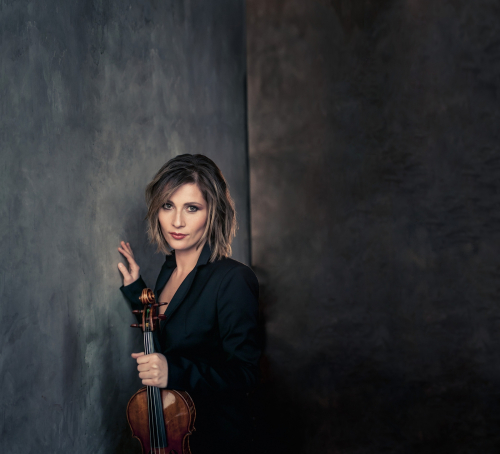
    Above: Lisa Batiashvili, photo by Sammy Hart/DG

    ~ Author: Oberon

    Friday November 22nd, 2024 – Tonight at Carnegie Hall, the Royal Concertgebouw Orchestra opened their program with the US premiere of Body Cosmic by the orchestra’s composer-in-residence, Ellen Reid. One of my all-time favorite musicians, Lisa Batiashvili, then offered Prokofiev’s Violin Concerto No. 2. Following the interval, the Concertgebouw’s Chief Conductor Designate Klaus Mäkelä led a seemingly endless performance of Rachmaninoff’s 2nd Symphony.

    Annoyances put us in a bad mood as we waited for the concert to begin: the Hall was freezing cold, and the start time ran late. Then came the silly tradition of the musicians making an entrance, obliging the audience to applaud as they leisurely took their places. Most people don’t get applause just for showing up at their job. After the music started, a squirmy (but silent) little girl next to us had a squeaky seat that made a metallic grinding noise every time she moved, whilst the young man behind us kept kicking the backs of our seats (he must have been man-spreading to cover so much territory). At last the house lights dimmed, and the conductor took the podium.

    The US premiere of Ms. Reid’s Body Cosmic was indeed what – back in the days of smoke and wine – we’d have called kozmic. The piece has a magical start, with rising passages lifting us out of the ordinary world into an airy, buzzy higher place. Is that a vibraphone I hear?

    A key player in the work is the Concertgebouw’s harpist, though I cannot tell you which of the orchestra’s two principals was playing since my view of her was blocked by her harp. Meshing with the flutes, the harp evokes a drifting feeling. The concertmaster – or ‘leader’ as he is listed in the Playbill – Vesko Eshkenazi, has much to do in this 15 minute piece, and his sound has a luminosity that delights the ear. Likewise, the trumpet soloist is really impressive, though again their are two possibilities listed in the roster.

    The music becomes increasingly rich in texture; it’s beautiful in an other-worldly sense. Muted trombones sigh, and then things get a bit jumbled. The violins, on a sustained high tone, clear the air. The harp again makes heavenly sounds, as distant chimes are heard. Flutes and high violins have a counter-poise in the deep basses (the Concertgebouw’s basses are particularly impressive). The music comes to a full stop.

    A violin phrase sets the second movement on its way; did someone whistle? The flutes trill and shimmer, with the concertmaster playing agitato; the basses and celli plumb the depths. The music turns fluttery, and then brass fanfares sound. A continuous beat signals a sonic build-up; with large-scale brass passages, things turn epic, only to fade as the harp sounds and the flutes resume their trilling. The world seems to sway, the trumpeter trills. A march-like beat springs up and then speeds up, evoking a sense of urgency. Following a sudden stop, a massive chord sounds: thunderous drums seem to announce a massive finish, but Body Cosmic ends with a solitary note from the violin. 

    I can’t begin to tell you how absorbing and ear-pleasing this music was: so much going on, and all of it perfectly crafted and fantastically played. The composer, who was awarded the 2019 Pulitzer Prize in Music for her opera, p r i s m, looked positively dishy in her unique blue and white frock – which featured a leggy mini-skirt and a charming train – when she was called onto the stage for a bow. She was greeted by both the audience and the players themselves with fervent applause. Ben Weaver, who is with me – and who is often resistant to “new music” – admitted that he’d enjoyed it. 

    Ms. Batiashvili then took the stage, having stepped out of the pages of Vogue in her stunning black gown: the very picture of elegance. Back in the days when Alan Gilbert was in charge of the NY Phil, Lisa appeared there often; she and the Maestro had a very special rapport, and I recalled how much I always loved to watch their interaction…almost like partners in a dance. Ms. Batiashvili sounds as gorgeous as she looks; her timbre has a particular fragrance, something no other violinist of my experience can quite capture.

    The Prokofiev concerto opens with the soloist playing alone: a hushed lament. The ensemble joins, taking up the theme. As the music becomes more animated, the violin sails thru fast figurations over the beating accompaniment of the basses. The music slows, and a fresh mood is then established, rather jaunty, with the soloist busily employed with reams of notes or with lyrical motifs, whilst unison basses and celli add a darker colour. Fanfares sound, and with Ms. Batiashvili playing at high-speed, everything breezes along…and then the music stalls. The low strings get things back on track, carrying the movement to a quirky finish.

    The Andante assai is a gracious slow dance; it has a dotty start as the familiar theme sounds over plucking strings. Ms. Batiashvili was mesmerizing here, her control and phrasing so enticing: both her presence and her playing tell of her innate grace and loveliness. This theme then repeats itself, now with the feel of a swaying rubato, and here Lisa is just plain magical. A sort of da capo finds the orchestra taking up the theme and the violin playing rhythm.

    In Prokofiev’s final Allegro ben marcato, Ms. Batiashvili dazzled us with with her virtuosity. Introducing fresh colours to the music, the composer adds castanets, the triangle, and the snare drum to his sonic delights. In a fascinating passage, Lisa’s slithering scales are underscored by the bass drum and double bass before we are swept along into the finale.

    Having put us under her spell for a half-hour, Ms. Batiashvili responded to our heartfelt applause with a Bach encore (I’ll have the details of the piece soon, hopefully…and some photos, too!) and then she was called back for a final bow, the musicians joining the audience in homage to this sublime artist.

    Update: Lisa’s encore was J. S. Bach’s Chorale Prelude on “Ich ruf’ zu dir, Herr Jesu Christ” (arranged for Violin and Strings by Anders Hillborg).

    Following a drawn-out interval, the Rachmaninoff 2nd made its deep start with the strings and horns sounding darkly gorgeous. I was taking notes, thoroughly engaged in the music. But after a while, things began to wear thin. The playing was simply grand – the solo voices among the orchestra all marvelous – and so is the music…so why am I losing my focus? By the time the big, ultra-familiar cinematic theme of the Adagio commenced, I was getting restless. It all seemed like too much of a good thing. The final movement was a succession of ‘finales’ which turn out to be culs de sac, forcing the players back to the main road, seeking an exit.

    After nearly an hour, the symphony ended to an enormous ovation and everyone in the Hall immediately leapt to their feet. My sidekick Ben Weaver and I hastened out into the rain. Ben was actually angry about the way the Rachmaninoff was done; he blamed the conductor. Then he told me that the composer had realized the work was too long and had later sanctioned cuts; tonight we’d heard the original, which is what made the music – which has a richness of themes and of orchestration that would normally thrill me (and it did, for the first quarter-hour) – feel like overkill to me. Often a composer’s second thoughts are more congenial to the ear than his original concept.

    ~ Oberon

  • József Simándy as Lohengrin

    Js

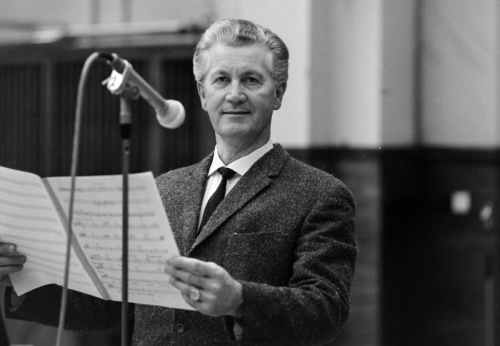
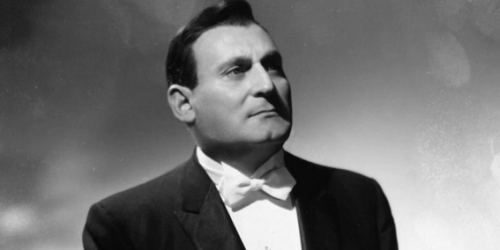
    The great Hungarian tenor József Simándy (above) sings Lohengrin’s Grail Narrative in Hungarian from a televised performance, date unknown.

    Watch and listen here.

    József Simándy was born on September 18, 1916 in a small rural Hungarian town called Kistarcsa. After graduating high school he worked as an auto mechanic until the fall of 1939, when the City Theater hired him as a chorister.

    Was was contracted as a soloist with the Szeged National Theater Opera Company in 1945. In the spring of 1947 he was hired by the Hungarian State Opera as a guest artist, and then became member of the company. Among his many roles were Turiddu, Don Jose, Lohengrin, Gabriele Adorno, Vladimir in Prince Igor), Radames, Walther von Stolzing, Manrico, Don Carlo, the Duke of Mantua, Lensky, Riccardo in Ballo in Maschera, Otello, Florestan, Canio, and Mario Cavaradossi. He also made guest appearances at the opera house in Munich,

    Simándy retired in November 1973 but continued to perform frequently until an official farewell performance in 1980. He died in Budapest in 1997.

  • Arvo Pärt: Virgencita ~ Ars Nova Copenhagen

    Virgincita

    Arvo Pärt’s Virgencita, performed by Ars Nova Copenhagen and recorded live at Ansgars Kirke, Odense, Denmark, on November 20th 2017. Paul Hillier is the conductor.

    Watch and listen here.

  • Jard van Nes ~ “Erbarme Dich, mein Gott”

    Jard-van-Nes6

    Jard van Nes sings “Erbarme Dich, mein Gott” from Bach’s St Matthew Passion at a performance given at the Alpirsbach Monastery Church by the Bach Collegium München, with the Neuburger Chorgemeinschaft, and Tolzer Sängerknaben, under the baton of Enoch zu Guttenberg.

    Watch and listen here.

  • Jard van Nes ~ “Erbarme Dich, mein Gott”

    Jard-van-Nes6

    Jard van Nes sings “Erbarme Dich, mein Gott” from Bach’s St Matthew Passion at a performance given at the Alpirsbach Monastery Church by the Bach Collegium München, with the Neuburger Chorgemeinschaft, and Tolzer Sängerknaben, under the baton of Enoch zu Guttenberg.

    Watch and listen here.

  • American Composers Orchestra @ Zankel Hall

    PXL_20241031_001633210

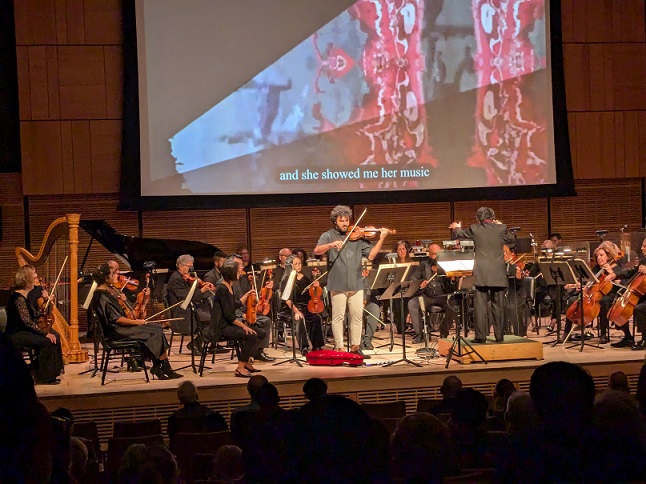
    Above: Curtis Stewart & Kebra-Seyoun Charles

    ~ Author: Shoshana Klein

    Wednesday October 30th, 2024 – I’ve had a thing about the concept of borders since the US border patrol incinerated my innocent house plants at the US Canada border in 2022. The name of this concert by the American Composer’s Orchestra was “The New Virtuoso: Borders” and at the beginning, Curtis Stewart framed the concert in a way that sounded really great. He talked about using virtuosity in new ways, rethinking the way the instruments work, and considering the use of borders. This included the concept of good borders (like healthy boundaries) versus harmful borders – like those used to start wars, and those that mark our identities without causing harm. I really wondered if the music would live up to this deep description. 

    The program:

    Michael Abels: Borders 

    Kebra-Seyoun Charles: New Work (ACO Commission, developed via EarShot CoLABoratory/World Premiere)

    Curtis Stewart, Embrace (ACO Commission)

    Paul Novak, Forest Migrations (ACO Commission/World Premiere)

    Victoria Polevá, The Bell

    The first piece was by Michael Abels, who has written the music to a bunch of blockbuster movies. The description of the piece and the inspirations for it that was printed in the program was beautiful – the idea was that in the first movement, the guitar is within the borders of the bar lines and in the second movement it’s not. The second movement also depicts a child running – sometimes in joy and sometimes in fear. It was a little hard to hear all of that in the music but in the second movement the guitar was definitely leading more and there were complicated rhythmic sections where the guitar and orchestra were definitely in different meters, which was a cool effect.


    The Paul Novak piece “Forest Migrations” was about trees and ecological borders – he used the orchestra of the metaphor for forest and forest migration caused by climate change. He described how the movement of the piece would be slow – each player playing one at a time, and also mentioned that musicians owe a debt to the trees that their instruments are made of, which I thought was really interesting. I really liked the concept but I was not convinced that the effect was going to be unique. In reality, it was really well done but not what I expected from the description – there was a lot more movement and melody than I was expecting. I like the way the concept of borders were explored and discussed in this new way, but once again, I was not sure I heard it in the music the way it was described. 


    Before the start of Kebra-Seyoun Charles‘ piece, Curtis Stewart asked if they wanted to say anything else about it and they said “have fun.” The piece was all about blending musical styles – so mostly genre borders were those being addressed. There was harpsichord in the orchestration, which was really cool juxtaposed against some of the other musical styles that were played, and in the first movement the piece kept falling into a sort of Bach sound. The idea of the first movement was walking down the street in New York and catching snippets of lots of different things and I think it achieved that relatively well. The whole piece was very virtuosic and seemed really technically difficult for the bass soloist (though it was the composer, so they did a great job and obviously knew what they were getting into!). The second movement started very schmaltzy and almost sounded like a quote from something. Charles seemed to be having fun and they actually got the orchestra to sound kind of raucous in a way that you don’t hear often in a concert hall, which was refreshing.


    The Victoria Poleva piece had dark and interesting sound worlds – it definitely explored the concept of a bell and the concept of war, though in reality a lot of the peace was actually really uplifting and bright. Another thing that was bright was the soloists dress which was right yellow and sparkly! This piece felt a lot more cinematic than Michael Abel’s piece, ironically. One movement was almost entirely an ascending major scale with various harmony changes. There were some really cool whistling wind whistling sounds going along with string string sounds that were like ghost noises. It was kind of interesting that this Ukrainian composer who mentioned Ukraine and mentioned the war didn’t really mention borders, though maybe it’s just implicit enough that it wasn’t necessary.


    PXL_20241031_014727965


    The last piece was by Curtis Stewart (above), who is also the artistic director of the ACO. This was probably the most involved piece of the program. There was a video and there was audio recording and there was audience participation! I’m always impressed when a composer tries to incorporate audience participation. In this context it worked pretty well, we basically sang chords in a progression. I wasn’t that much of a fan of the video but having the audio was nice. It was a compilation of his mother’s voice talking about music, interspersed with the composers from the concert and school kids from the ACO’s young composer program answering the same questions that she had. One of those questions that he mentioned before he started stuck with me was “how does music carry you through the changes in your life.” The piece was less full of electronics than I was expecting given his setup, but I did really like the music.


    Conductor Mei-Ann Chen, who I’ve heard great things about, seemed like a dynamic, clear, and energetic leader who would be fun to play under. Overall, I suppose the theme of the concert for me was something along the lines of “great thoughts and concepts that don’t always come through in the music” but in some ways that’s par for the course in new music, and honestly I still prefer it to a lack of contextualization or tying things together – I love a concert that ties ideas together and brings up relevant issues. Many things were tried and many of them were successful.

    ~ Shoshana Klein

  • Voices from South Africa @ Weill Hall

    Siphokazi-Molteno jpg

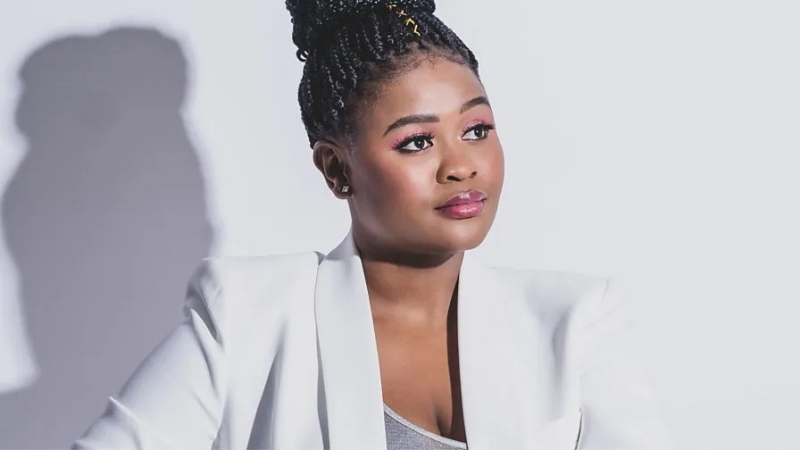
    Above: Siphokazi Molteno

    ~ Author: Oberon

    Monday October 28th, 2024 – The Met Orchestra Chamber Ensemble presenting a program of classic and contemporary works at Weill Hall. I was very keen to hear mezzo-soprano Siphokazi Molteno. who represented South Africa at the 2023 Cardiff Singer of The World competition, and who made her Metropolitan Opera debut in 2022 as Flora in LA TRAVIATA.

    Ms. Molteno opened the evening with the Brahms “Viola songs”, a pair of lullaby-like solos accompanied by viola (Shmuel D. Katz) and piano (Thomas Lausmann). The Molteno voice has a marvelous contralto richness as well as a lyrical warmth; to say she put me in mind of the great Florence Quivar is the highest compliment I can give. It’s a voice full of ‘humanity’ and a voice I will hope to hear again…and soon. Her colleagues from the MET Orchestra played sublimely, setting the evening gorgeously on its way.  

    There was then a longish pause while the stage was set for the next work, which involved five musicians: Seth Morris (flute), Tal First (viola), Hannah Cope (harp), Gregory Zuber (marimba), and Jeffrey Irving (percussion). Ndodana-breen

    Above: composer Bongani Ndodana-Breen

    The composer’s choice of instrumentation for his Rain Making really drew me in: if there’s a marimba to be heard, I want to hear it…and likewise the harp. Mr. Ndodana-Breen composed this piece in memory of Queen Modjadi, one in a line of Rain Queens of the Balobedu people in the Limpopo province of South Africa. A Rain Queen is believed to have the power to control the rain and the winds. This mythic association made the music even more intriguing for me.

    The players made a wonderful blend and the evocative sounds included a rhythmical flute, a plucked violin, and a bean bag played by the percussionist. The flute and violin trade melodic phrases, the violin shivers, the melismatic marimba enchants. Then, to a big, pounding beat propelled by the bass drum, the storm comes: the Rain Queen’s magic has succeeded. I loved this music, and watching the musicians as they entered into the spirit of the ritual; my only complaint was that the piece is too short.

    Maurice Ravel’s sultry Chansons madécasses found a most congenial interpreter in Ms. Molteno. I first heard these songs in 1975 when New York City Ballet premiered a Jerome Robbins ballet of the same title; the singer was Lorna Myers. Since then, I have frequently listened to the songs on Mira Zakai‘s marvelous recording. 

    The first of the three songs, Nahandove, has a beautifully sultry feeling: it tells of the seduction of a native woman. Jerry Grossman’s cello opens the piece, and Ms. Molteno’s voice is at its most sumptuous as she begins this tale of longing and ecstasy. Jazzy piano rhythms from Mr. Lausmann and the sound of the piping flute (played by Maron Khoury) develop a rocking feeling; the music turns pensive and then caressive. With the song’s final strophe, “Tu pars...” the tryst ends, though it seems the lovers will meet again at sunset.

    The second song, Aoua!, opens with the singer screeching a warning: do not trust the white men! The piano takes up a swaying rhythm as Ms. Molteno continues with singing of great intensity. This is violent, angry music, though eventually the cello and flute sound forlorn.

    By contrast, the final song – Il est doux – is a languid reflection on the joys of resting the shade of a tree on a late afternoon, while a lover whispers in your ear. The sensuous flute, the eerie cello on high echoing the buzzing insects with a trill, the voice and the cello entwining, solitary notes from the piano…so atmospheric.  Ms. Molteno’s singing was evocative and so pleasing to experience. The song ends with the swiftly spoken dismissal: “Go and prepare the evening meal…” 

    Mvd2022 jpg

    Following a longish interval, an ensemble of eight instrumentalists took the stage for music by Matthijs Van Dijk (above): we heard his extraordinarily powerful oratorio Moments in a Life. I had previously heard one of this Cape Town-based composer’s works [(rage) rage against the] played by the Signum Quartet in this very hall. 

    Thus, I expected a lot from the composer’s Moments in a Life, composed in 2016 for string quintet, clarinet, percussion, piano, overtone singer & narrator. Could lightning strike twice in the same place? The answer is a resounding YES!…Moments in a Life is one of the most powerful works I have ever experienced.

    The oratorio is based on the writings of Denis Goldberg, a native of Cape Town whose parents were politically active. In 1957, Denis joined the (banned) Communist Party and he was arrested and jailed in 1960 for supporting strikers. In the mid-1960s he was with other freedom fighters who were arrested for illegal acts and jailed. He remained a prisoner for 22 years, constantly being tortured and threatened with death.

    Gareth-lubbe

    At this evening’s performance, Gareth Lubbe (above) was the narrator. Mr. Lubbe is also an overtone singer; this is a technique in which the resonance in the mouth and throat are combined with tongue, lip, and jaw movements which create a perception of overtones as being individual notes. It’s a sound that is eerie…and fascinating.

    Moments in a Life, conducted by William Long, gives us so much to take in in its 40-minute duration. Trying to follow the narrative whilst also listening to the music was a bit of a challenge for me, a dedicated note-taker: I filled three pages with notes which barely scratched the surface of the work.

    “I was sure we would not die in prison,” marks the oratorio’s opening line. As the narration moves forward, the writer recalls his first teacher, who he fell in love with. He speaks of not seeing his wife and children for more than two decades while imprisoned. A fellow freedom fighter, Looksmart Ngudle, was tortured to death. Freedom costs.

    Nelson Mandela defends the accused patriots: “An ideal for which I am prepared to die”. Sentenced to life in jail, they are moved to a harsher prison affectionately known as “Beverly Hills”: three thousand prisoners singing hymns as individuals are led away to be hanged. Ironically, a gorgeous musical theme underscores this tragedy.

    Periodically thru the work, Mr. Lubbe’s overtone singing makes a striking impression: an indescribable mixture of humming and whistling.

    As to the music, the opening measures are pensively played by clarinetist Jessica Phillips: a slow, wide-ranging solo, soon joined by piano and strings. Cellist Mariko Wyrick underscores the story of the teacher, Ms. Cook. Andrew Gantzer’s double bass, so impressive throughout the piece, tells of Looksmart’s ordeal.

    Mr. Lubbe’s voice growls deeply; percussionist Jeffrey Irving plays a rollicking ‘cadenza’. Beauteous strings, the clarinet sings again; here are glowering chords and a lament played by violist Shmuel D Katz. Mr. Lubbe has an unaccompanied solo.

    Pianist Katelan Trần Terrell and Mr. Gantzer’s bass establish a beat; Mr. Katz strums his viola. A sudden militant outburst forebodes the assassination of activist Chris Hani; a poignant violin passage (Yurika Mok and Yang Xu) underscores the narrator’s reflections on Chris’s death.

    “A petty exercise of power that harms our people.”

    At last, in the forced-labor setting of The Quarry, where Nelson Mandela and his brother freedom fighters languished, a glorious theme of hope develops: “Let Freedom Reign”. Mr. Lubbe’s otherworldly overtones are heard over a long, sustained chord.

    The audience, who had witnessed the performance is a state of awed silence, now gave the performers a fervent round of applause.  

    Back home, I went to YouTube to see what I could find about this powerful work and immediately discovered this incredible document: Moments in a Life, recorded live in concert in the Endler Hall at the Stellenbosch International Chamber Music Festival on July 16th, 2016. This, I believe, was the work’s world premiere, with Denis Goldberg – then aged 83 – reading the texts (drawn from his autobiography) himself. The great freedom fighter passed away in 2020. 

    The work is so timely right now, when our democracy stands on a precipice. If we falter, our country – and indeed the world – will be forever changed.

    ~ Oberon

  • The Tucker Gala @ Carnegie Hall ~ 2024

    Richard-Tucker

    Above: Rlchard Tucker

    ~ Author: Oberon

    Sunday October 27th, 2024 – The 49th annual Richard Tucker Music Foundation gala took place this evening at Carnegie Hall. It was an excellent program – including one aria that is rarely performed – with much impressive vocalism. The evening descended into silliness during the encores, but the audience overwhelmingly approved of la commedia, leaving me feeling like an old stick in the mud.

    You always run into people you know at the Tucker Gala. I was especially happy tonight to run into my friend – and fellow Patricia Brooks fan – from back in the day: Matthew Epstein.
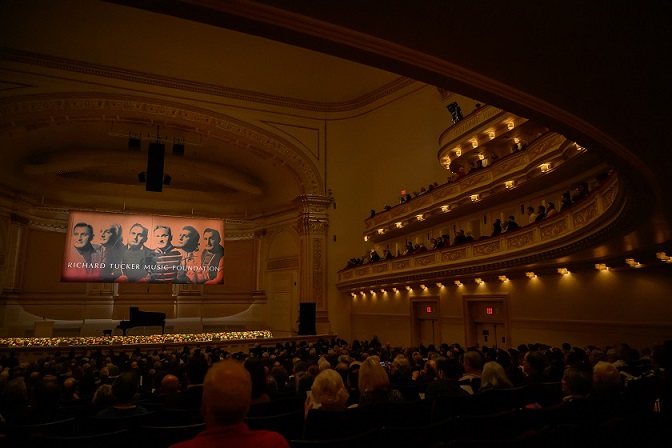
    003-RICHARD_TUCKER_GALA_2024-0025

    Photo by Dario Acosta

    Following tradition, the first voice we heard was that of Richard Tucker singing the “Addio alla madre” from CAVALLERIA RUSTICANA. The power and passion of his voice are immortal.
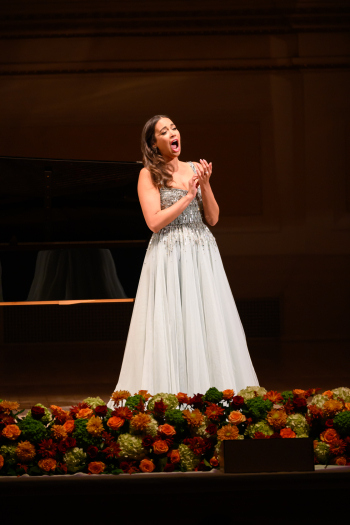
    014-RICHARD_TUCKER_GALA_2024-0214

    Above: Nadine Sierra, photo by Dario Acosta

    After Barry Tucker’s welcoming speech, the program commenced with Mimi’s narrative “Mi chiamano Mimi” from LA BOHEME; this brought Nadine Sierra and pianist Bryan Wagorn together in a rendition that was a bit slower than we might be accustomed to, but which gave us more time to savour Nadine’s luxuriant phrasing and lovely tone. She made the slow rise to B-natural before commencing “…ma quando vien o sgelo…” which makes such a magical effect. Listening to her this evening made me think that Nadine could now venture into roles like Mimi, Liu, and Amelia Grimaldi, and even Desdemona and the TROVATORE Leonora.
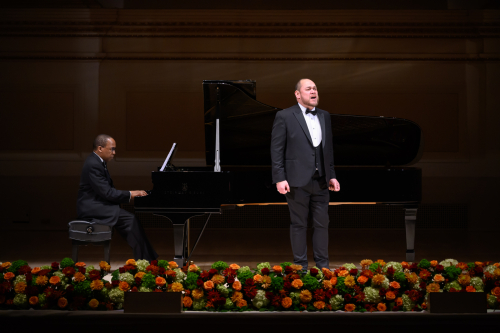
    028-RICHARD_TUCKER_GALA_2024-0340

    Quinn Kelsey (above, photo by Dario Acosta) then took the stage, accompanied by Howard Watkins, for a truly magnificent “Eri tu” from BALLO IN MASCHERA. This was opera at its grandest, the singer filling the Hall with a flood of golden tone, achingly heartfelt in the character’s distress and his sense of defeat and resignation. This is a baritone voice to rank with the greatest of my experience: Warren, Merrill, MacNeil, Milnes, and the unforgettable Dmitri Hvorostovsky.
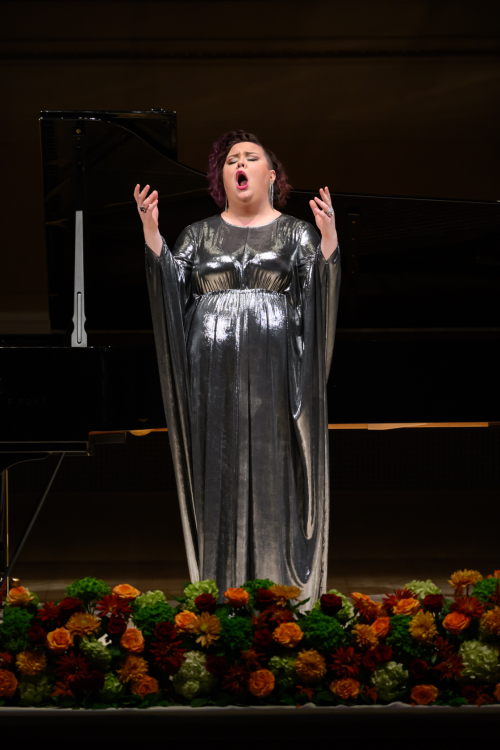
    047-RICHARD_TUCKER_GALA_2024-0506

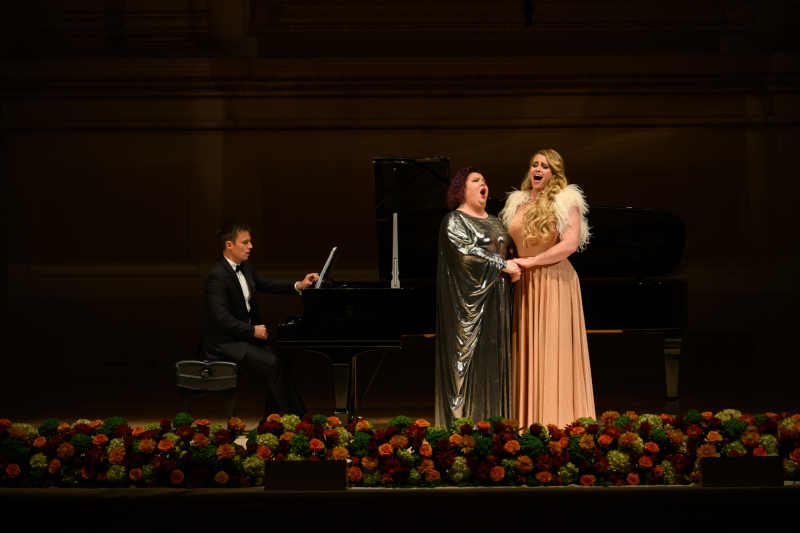
    Jamie Barton (above, photo by Dario Acosta), looking like an errant Valkyrie in her metallic-silver frock, was hilarious in the Witch’s aria from HANSEL & GRETEL. Mr. Watkins at the piano was a perfect accomplice to Jamie’s rowdy, riotous performance. Later, we would hear Jamie in bel canto mode, and finally as a top-flight songstress.
    071-RICHARD_TUCKER_GALA_2024-0704

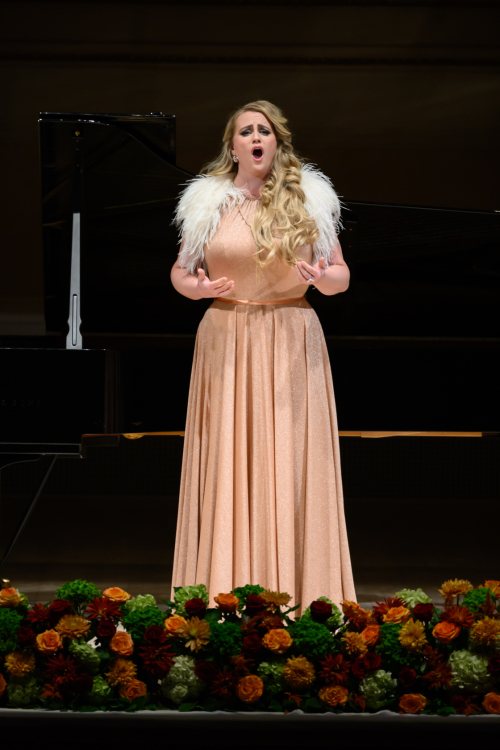
    Rachel Willis-Sorenson (above, photo by Dario Acosta), who the day before had joined Jamie Barton and Michael Fabiano in a rousing Met matinee of TROVATORE, today gave us the immortal “Casta viva” from Bellini’s NORMA. Although this bel canto jewel really needs an orchestra-and-chorus setting, Ms. Willis-Soremson and Mr. Wagorn were so persuasive that such concerns became irrelevant. With her impressive breath control, the soprano commanded the long phrases, introducing subtle nuances along the way. She concluded the aria with a gorgeous cadenza and then spun out an incredible inverted trill before sustaining the final note.
    082-RICHARD_TUCKER_GALA_2024-0805

    Above: Michael Fabiano, photo by Dario Acosta

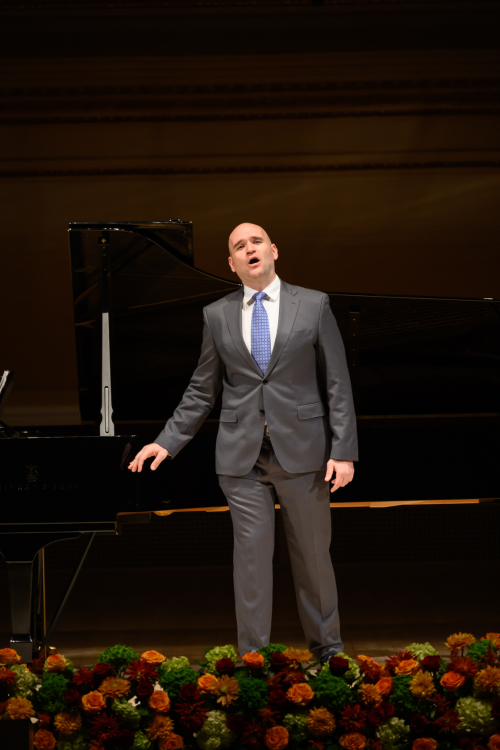
    At yesterday’s Met TROVATORE, a commotion in the wings after “Di quella pira” had raised questions; this evening they were answered: Michael Fabiano had fallen on exiting the stage and sustained an injury; he had managed to finish his Manrico – but, as anyone who has taken a fall knows – it’s the day after that the soreness manifests itself. The poor tenor – heroic, but obviously in deep pain – was slowly helped onto the stage by Mr. Watkins. Michael spoke briefly of the incident, then regaled us with a sublime rendering of Henri Duparc’s “Phidylé“, displaying his lyrical side after yesterday’s powerhouse Manrico.
    096-RICHARD_TUCKER_GALA_2024-0910

    Above: Elena Villalón, photo by Dario Acosta

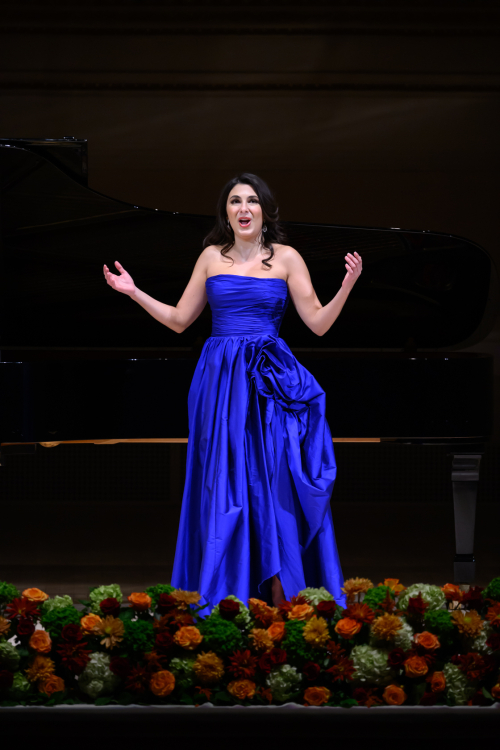
    Giving us some the most delightful singing of the evening was the soprano Elena Villalón, a Tucker Grant winner and currently at The Met in the Golijov AINADAMAR, having debuted there in the previous season as a charming Amor in ORFEO ED EURIDICE. Tonight, looking ravishing in her deep blue gown, the Cuban-American soprano sang Manon’s double aria from the Cours la Reine scene from the Massenet opera, with Mr. Watkins a gallant companion. The Villalón Manon is captivating, and she won my heart just as Patricia Brooks, Jeannette Pilou, and Lisette Oropesa have done in the role over the years.
    115-RICHARD_TUCKER_GALA_2024-1040

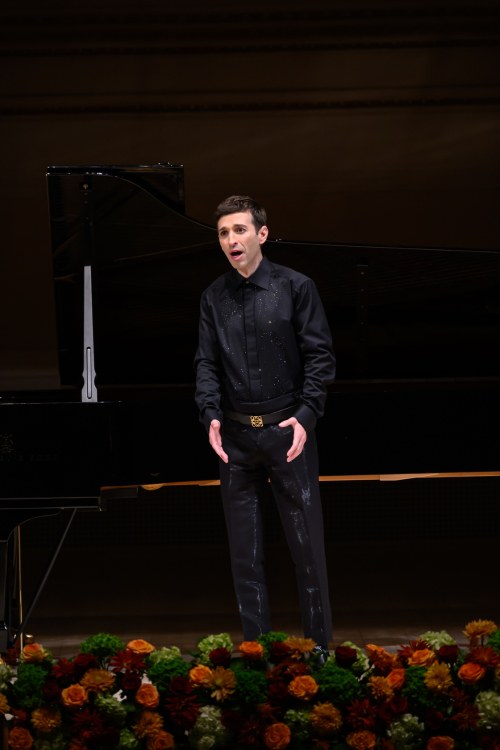
    Anthony Roth Costanzo (above, photo by Dario Acosta), in a sparkly shirt, was simply magnificent in Handel’s Stille amare from TOLOMEO. The voice is so delectable to hear in the Carnegie acoustic. Anthony’s emotional connection to the music – and his sublime pianissimi – were truly touching to experience.
    140-RICHARD_TUCKER_GALA_2024-1241

    Above: J’nai Bridges, photo by Dario Acosta

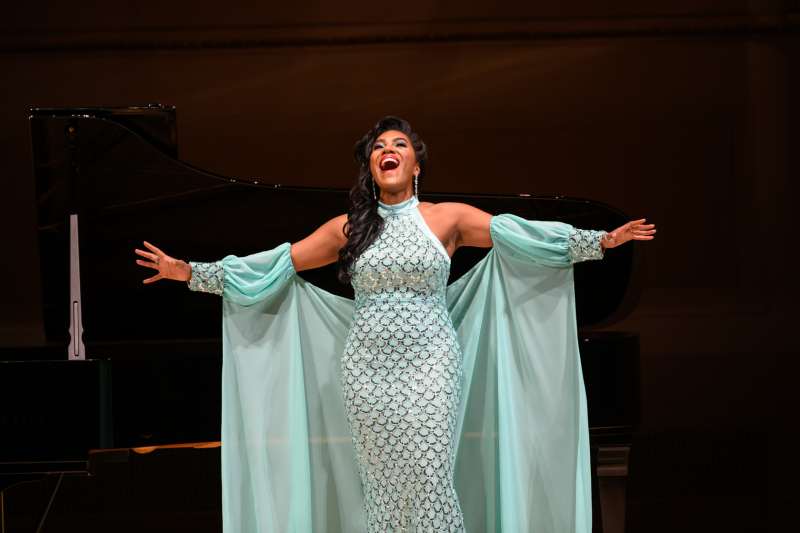
    Til tonight, I’d never heard Sapho’s grand final aria from the Gounod opera named after her sung live; but I’ve thrilled to its sense of grandeur and doom since by chance hearing a recording of Heather Begg singing it in English many, many moons ago. Thank you, J’nai Bridges, for bringing this splendid aria to currency. Mr. Wagorn was again simply perfect as the mezzo, resplendent in a mint green gown, delivered the poignant recit and majestic aria – which ends on a thrilling top note that Ms. Bridges sustained mightily – so convincingly that the vision of the heroine hurling herself into the ocean at the end was palpable.
    156-RICHARD_TUCKER_GALA_2024-1369

    Above: Anthony León, photo by Dario Acosta

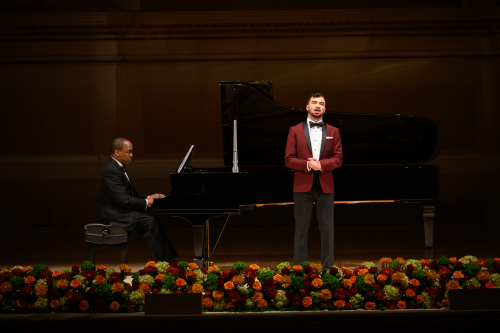
    Anthony León, 2022 1st prize and the Zarauela prize winner at the Operalia competition, sang a poetic “Una furtiva lagrima” from ELISIR D’AMORE with Mr. Watkins giving the youthful tenor wings on which to fly. The voice is sweet and clear, the singing so sincere, the words lovingly set forth, and the final phrase finely controlled. 
    166-RICHARD_TUCKER_GALA_2024-1406

    Above: Ryan Speedo Green, photo by Dario Acosta

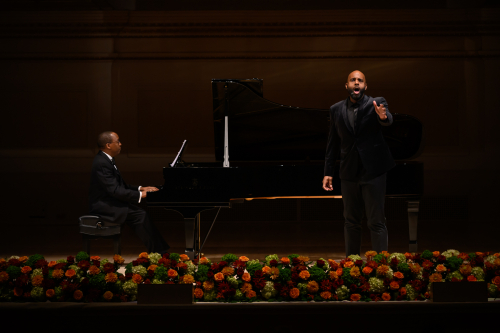
    After hearing his Serenade this evening, we must have Ryan Speedo Green’s Don Giovanni in the next Met revival of the Mozart masterpiece: such a suave singer, with charisma to burn. Ryan had sung a commanding Ferrando in yesterday’s TROVATORE, and I look forward his Spirit Messenger in the upcoming Met revival of FRAU OHNE SCHATTEN…to say nothing of his impending Zankel Hall recital on January 22nd, 2025…check out the program here!
    190-RICHARD_TUCKER_GALA_2024-1590

    Above: Nadine Sierra and Quinn Kelsey; photo by Dario Acosta

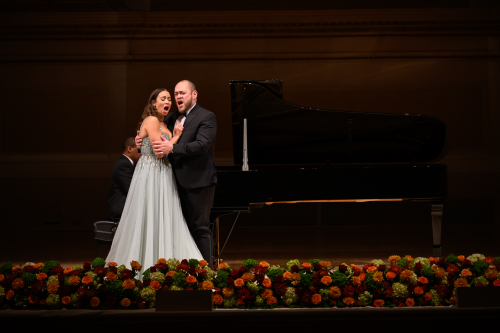
    In the great duet of Gilda and her father from RIGOLETTO, Nadine Serra and Quinn Kelsey seemed to give us the very essence of opera. With perfect musical support from Mr. Watkins, the two singers wandered about the stage, seemingly unable to face one another after the jester’s beloved Gilda’s had been defiled at the hands of the Duke. From “Piangi, piangi fanciulla…”on, Quinn held Nadine in his consoling arms. Their singing was so compelling, and Mr. Watkins’ playing so true to the music, that for a brief time we were transported to that poetic place that only opera can carry us up. By the end, Nadine was weeping. The audience response was delirious, and rightfully so.
    216-RICHARD_TUCKER_GALA_2024-1725

    Mlles. Willis-Sorenson and Barton (above, photo by Dario Acosta) brought bel canto to the fore with “Mira, O Norma” from the Bellini opera, Mr. Wagorn playing a key role in this beloved duet of rivals who become – if only briefly – fast friends. The voices made for a very congenial blend, the harmonies lingering so endearingly in he ear. Following the slow section, a dramatic exchange between the women was resolved with Ms. Willis-Sorenson’s “Trovo un’amica ancor”. and then they set off the vocal fireworks “Si, fino all’ore estreme”, even etching is some delicious harmonized turns before joining together on the penultimate note. 
    227-RICHARD_TUCKER_GALA_2024-1799

    Above: Angel Blue, photo by Dario Acosta

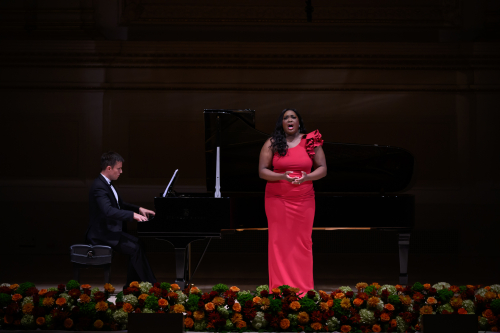
    The previously unannounced Angel Blue made a striking entrance in her red diva-gown. With Mr. Wagorn, she sounded like a goddess; she sang “America The Beautiful” with great ardor, then moved directly to Lee Hoiby’s touching “Lady of the Harbor”, a hymn to the Statue of Liberty. Angel sang with mythic power and pride, an iconic presence as she sang of the hope and the blessings of the American dream.

    Encores now commenced with Anthony Roth Costanzo duetting with himself in the cat-and-mouse scene of Susanna and Count Almaviva from NOZZE DI FIGARO

    As a child, I had a Swiss music box that played Stephen Foster’s “Beautiful Dreamer”; I was thinking of this when Nadine Serra and her college pal Bryan Wagorn gave the song a glowing lustre. They ended with a hug of genuine affection.

    Mr. Leon was affectionately welcomed back for an ardent, “Non puede ser” with Mr Watkins; and then – singing unaccompanied – Ryan Speedo Green sang “Deep River” straight from the heart. Ms. Bridges returned for a passionate “My man’s gone now” from PORGY AND BESS, and then Jamie Barton sang “It’s You I Like”: a Jake Heggie charmer that mixes Chopin and Fred Rogers.

    The evening ended with Nadine, Anthony, and Mr. Wagorn in a musical three-way spoof that was pretty silly, but the audience loved it. 
    313-RICHARD_TUCKER_GALA_2024-2145

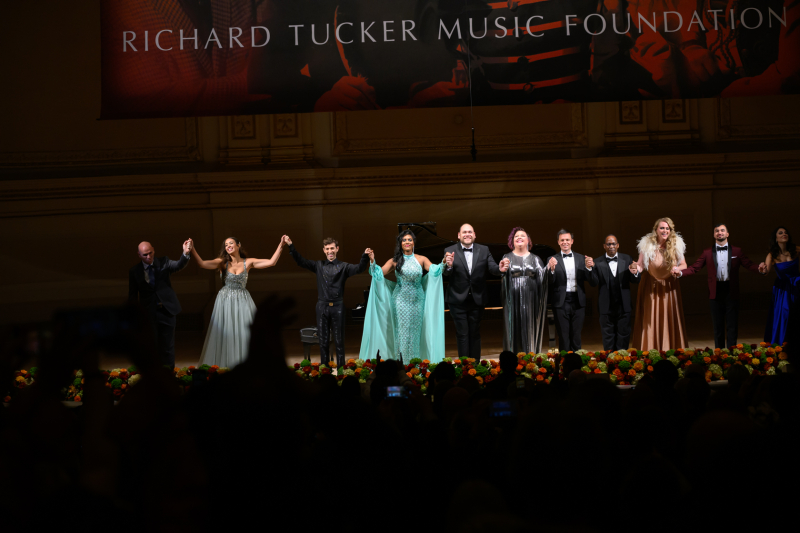
    Final bow. This, and all performance photos, by Dario Acosta.

    My thanks to Mallory McFarland of Morahan Arts and Media for arranging things for me.

    ~ Oberon

  • The Beethoven Quartets @ CMS

    Cms

    Above: the Calidore String Quartet at Alice Tully Hall; photo by Da Ping Luo

    ~ Author: Ben Weaver

    October 22nd & 27th, 2024 – Throughout the 2024-25 season, the Chamber Music Society of Lincoln Center is hosting a traversal of the complete Beethoven String Quartets at Alice Tully Hall, performed by a single ensemble: New York-based Calidore String Quartet. The ensemble is Jeffrey Meyers and Ryan Meehan on violins, Jeremy Berry on the viola, and Estelle Choi on the cello. The first two evenings of the cycle – October 22nd and 27th – included three quartets on each night.

    The 27-year-old Ludwig van Beethoven was commissioned to compose six String Quartets, alongside his former teacher Franz Joseph Haydn, who was considered the father of the string quartet. Haydn was ultimately only able to finish 2 of the 6 quartets he was supposed to compose, but Beethoven dove head-first into his first string quartets which became his Op. 18. By the time Beethoven reached the end of his life, he composed 16 string quartets, which have become the Mount Everest of the genre, arguably only equaled by Dmitri Shostakovich’s 15 String Quartets composed more than a century later.

    Commonly the Op. 18 String Quartets are called the Early String Quartets. Even though Beethoven was already exploring his more explosive and adventurous musical nature in other musical genres, most notably his piano sonatas, with these first forays into the string quartet, he harkened back to his predecessor masters of the genre, Haydn and Mozart. The Calidore Quartet are performing the works in the order they were composed, not numbered in the published score. The sequence is Nos. 3, 1, 2, 5, 4 and 6.

    By and large, these early six quartets are light in nature, with the first violin dominating the procedures. Happily, first violin Jeffrey Myers is an exceptional musician, the sweet sound of his instrument effortlessly filling the concert hall. Quartet No. 3 in D major opens with a charming melody, lovingly shaped by the Calidores, the lush and warm sound of their ensemble emphasizing the Classical and early Romantic nature of the works. (By contrast, for example, when the Danish String Quartet performed a full cycle of the Quartets at CMS in 2020, they leaned into their more modern sound, closer to Beethoven’s last quartets.) 

    Quartet No. 1 in F major also opens with a graceful, contagious melody – an obvious common thread running through all six of these works. Here, but especially in the second movement, cellist Estelle Choi, gets several key moments to stand out with a dark, glowing sound. There’s a depth to this movement that foreshadows Beethoven’s Romantic nature, one he would unleash in later compositions. He said this sorrowful movement was inspired by the ending of Shakespeare’s “Romeo and Juliet.” 

    The Calidores took most of the faster movements at a wonderfully quick pace: delirious, never chaotic. The beautiful coordination between the four partners kept them in perfect sync. This was most evident in the Quartet No. 2 in G major, the most humorous and closest in spirit to Haydn from the bunch.

    Quartet No. 5 in A major is thoughtful in its first two movements, with unexpected dramatic outbursts that bring surprising drama. Violist Jeremy Berry’s lovely solos shine in the second movement, as jagged stabs from the violins interrupt him. Second violin Ryan Meehan’s slightly sharper tone (not pitch) being a great contrast to Meyers’ sweeter sound. The third movement is a set of variations, the last of which is a tune that you can’t help but tap your toes to.

    Quartets No. 4 in C minor and No. 6 in B-flat major come closest to the Beethoven who would redefine Romanticism. Both of full drama and unexpected turns. No. 4 omits a traditional slow movement altogether, instead containing a Scherzo and Minuet in the middle. The Calidores darkened their sound for the dramatic outbursts, but kept their sense of humor for the quartet’s surprising and unexpected pizzicato close. 

    Quartet No. 6 in B-flat major, which closes this series of the Early Quartets, gives greater voice to the second violin and cello, with Meehan and Choi balancing Beethoven’s growing darkness, while the first violin soars above them. The final movement is an extraordinary piece by itself, with an extended grave “introduction” Beethoven titled “La Malinconia” (Melancholy.) It’s movement that lets us look into the future of Beethoven’s progress. The Calidores’ performance brought the full house to its feet.It should be noted that, especially on the 27th, the audience was remarkably quiet, hypnotized by these wonderful performances that made us all eagerly await the continuation of the cycle.

    The Calidore String Quartet will perform the Middle Quartets at Alice Tully Hall on January 28 and February 4, 2025. The Late Quartets, including the somewhat demented Große Fugue, will be performed on May 9 and 18, 2025. I recommend that anyone who missed these performances make sure to not miss rest of what is already an excellent cycle. 

    ~ Ben Weaver