Author: Philip Gardner
-
Chamber Music Society ~ Summer Finale 2024

~ Author: Oberon
Saturday July 27th, 2024 – The final offering of Chamber Music Society of Lincoln Center’s 2024 Summer Evenings series took place tonight at Alice Tully Hall. After a long lunch with friends, where some very serious topics were discussed, I was in a pensive mood when we arrived at the hall. The light, decorative music of Ludwig van Beethoven’s Serenade in D-major for Flute, Violin, and Viola, Op. 25, written in 1801, was not a good match for me today, feeling a need for something darker and more soulful.
Nevertheless, the playing was charming and, as the piece progressed, there was much to admire. It kicks off with a reveille, only it’s Tara Helen O’Connor’s flute that’s sending out a wake-up call rather than a bugle. Ms. O’Connor’s playing was at its most limpid throughout the suite. ln the songlike second movement, a minuet, her playing was elegant, whilst violinist Aaron Boyd and violist James Thompson provided echo effects. The Allegro molto shifts between major and minor modes.
Sweet harmonies fill the Andante, with its contrasting animated interlude, following by a scurrying Allegro scherzando. The final movement begins as an Adagio but soon transforms into an Allegro vivace, with lively playing from the three artists.
Franz Schubert’s Rondo in A-major for Violin and String Quartet, D. 438, dating from 1816, did not provide a contrast to the pleasantness of the Beethoven, though again it was beautifully played by soloist Sean Lee and a quartet made up of Cho-Liang Lin, Aaron Boyd, James Thompson, and Nicholas Canellakis.
Sean Lee’s playing was spot-on, with touches of rubato, and the ensemble cushioned his playing perfectly, grounded by Nick Canellakis’s ever-velvety tone.
Following the interval, Heinrich Wilhelm Ernst‘s demanding Grand Caprice on Schubert’s “Erlkönig” for Violin, Op. 26, was given a spirited rendering by Sean Lee, though perfect clarity was sometimes missing.
The concert ended with Wolfgang Amadeus Mozart’s Quintet in C- major for Two Violins, Two Violas, and Cello, K. 515, dating from 1787; it was here that I found my center with music more weighted and suitable to my mood. Cho-Liang Lin’s silvery, shining tone was exquisite, his phrasing thoughtful and so polished. Nick Canellakis savoured every phrase of the cello part, as the opening Allegro progressed with a rich blend of voices in the melodic flow, over a rhythmic pulse.
In the Minuetto, Mssrs. Thompson and Boyd engaged in a friendly duel with their violas, and the music at times had a curiously brooding feeling. The cello patterns bring a restless feeling into play, enhanced by the heartfelt Canellakis timbre.
The Andante is classic Mozart: achingly lovely, with James Thompson’s viola prominent and Mr. Lin spinning out a sweet theme, and – later – a mini-cadenza. This music is so engaging. The final Allegro, with Mr. Lin’s playing in high relief, brought the evening to a spirited ending, thanks to the enduring grace of Mozart.
So ended an unusual experience for me, wherein I strove to adjust my own state of mind to the program on offer; this had only happened to me a few times over the years – and mainly at the opera – where you have a ticket for ELISIR D’AMORE but are really in the mood for WOZZECK…or vice versa.
~ Oberon
-
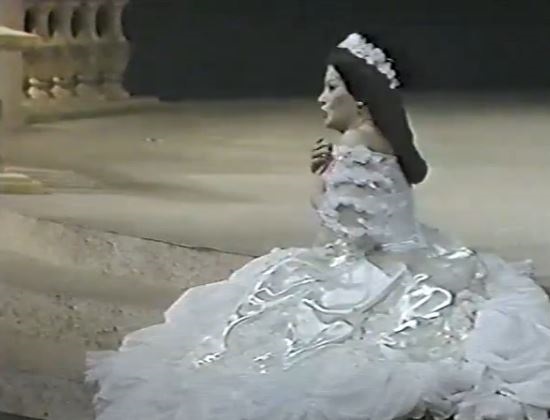
1956 RAI Film ~ CAVALLERIA RUSTICANA

Above: Carla Gavazzi as Santuzza
I love this old RAI film of Mascagni’s CAVALLERIA RUSTICANA sung and acted in Olde School verismo style by Carla Gavazzi (Santuzza),
-
Doro Antonioli ~ “Un dì all’azzurro spazio”

Doro Antonioli sings Andrea Chenier’s Improviso, “Un dì all’azzurro spazio”, from Act I of the Giordano opera.
Listen here.
-
Pilobolus @ The Joyce ~ Summer 2024
~ Author: Oberon
Tuesday July 23rd, 2024 – It’s been a while since I last saw Pilobolus, and it was truly revelatory reconnecting with this unique, legendary dance company tonight at The Joyce. The season celebrates re:CREATION, a brilliant collection of works – old and new – from Pilobolus’s 50-year history which were offered on two specially-devised programs.
Tonight’s program, entitled Dreams, featured five works; and while at times things seemed too same-y and certain passages went on too long, the cumulative force of the evening was incredibly powerful and meaningful on a personal level. Six dancers carried the entire evening, their awesome athleticism and boundless energy meshed with an innate sense of poetry and unstinting commitment to the work.
The program opened with Thresh|Hold, from Latinx choreographer and designer Javier De Frutos; several other names are listed in the program as collaborators. To shimmering music, the curtain rises on a closed door, which will become the epicenter of the piece. A rather haggard woman (the program tells us it’s either Marlon Feliz or Hannah Klinkman – not very helpful to someone attempting to write a review) opens the door and sits on the stoop; a male body is then thrown out onto the ground, and all hell breaks loose. The four men in the cast might be gestapo or just random trouble-makers. People chase each other about, torment the woman (or one another), whilst the door itself is the main character – spun about the stage, opened and closed at high speeds, allowing light to shine thru from varying angles. All this was handled with pinpoint timing by the dancers,
As the piece unfolds, we hear a fractured recording of the Casta Diva from Bellini’s NORMA, merged with other noises, sometimes harsh or otherworldly. After the pitch of the aria sags and becomes incoherent, the melody resumes – now voiced by the inimitable Maria Callas, whose version has been used in numerous danceworks over the years…if you’ve never heard it, here it is.
The dancework, nightmarish and somewhat incoherent, was engrossing to watch; the use of the door was truly clever and impressive. The woman (I believe it was Ms. Feliz) seems desperate to escape but is always thwarted, sometimes in mid-air. A men’s quartet near the end, with lifts, was oddly lyrical. The audience seemed captivated, and applauded heartily, but there were no bows.
The New York City premiere of the duet Bloodlines followed; an epic love duet that packs a heart-rending wallop. Choreographed by the co-directors of Pilobolus, Renée Jaworski and Matt Kent, in collaboration with Ms. Feliz and Ms. Klinkman, who danced it together. The luminous ‘music-of-the-spheres’ score is attributed to five composers: Andre Heller, Michael Gordon, Elisapie Isaac, Eva Reiter, and Meredith Monk.
Gorgeously lit by Diane Ferry Williams, Bloodlines was hypnotically danced as red rose petals fell from the sky. The two women, lovers, seem to retell the story of their love; they strike poses and move to jagged rhythms until a partnership is formed.
To the sentimental sound of an old 78 recording for violin and piano, they become increasingly intimate, one dancer cradling the other. But something is amiss; thru age or illness, one of the women expires, leaving her beloved bereft. The two dancers brought so much beauty and poetry to this duet, making the end unbearably poignant.
Still recovering from the emotional pull of Bloodlines, the deeply moving male quartet Gnomen sustained my intense involvement in what we were seeing and hearing. A tolling bell signals the opening of Gnomen, wherein we encounter a brotherhood of gnomes: ageless, deformed dwarves out of folklore who live in the earth.
The four – Connor Chaparro, Quincy Ellis, Sean Langford, and Derion Loman – wear black briefs; they move hesitantly, seemingly in pain, with their bodies disfigured. They seem to be downtrodden victims of fate. Helping one another, their entwined figures struggle to walk. They appear to pray, and now the chime sounds louder: they move spastically, like contorted acrobats.
The choreography is extremely athletic, strenuous, and demanding, and the dancers took it all in stride. Clockwork music and a dreamy harp are heard as the quartet attempt entwined tumbling. The sounds of the marimba transform to a melodious finish, with a sense of healing for the hapless creatures as the chimes sounds again. The seemingly healed gnomes kneel in prayer.
After a longish intermission, Symbiosis – choreographed by Michael Tracy in collaboration with Renée Jaworski and Otis Cook – opens with thunder and lightning. To the music – a collage of pieces by Thomas Oboe Lee, George Crumb, Arvo Pärt, and Jack Body, played by the Kronos Quartet – dancers Marlon Fritz and Quincy Ellis, nearly nude, perform a sensuous duet. The elasticity and grace of their bodies develop an intimacy underscored by Mr. Pärt’s languid, beguiling Spiegel im spiegel wherein the dancers tenderly see-saw in an embrace. The dancers’ athleticism takes on a poetic aspect as we surrender to the tender beauty of their entwined bodies.
Closing the program was Rushes, Pilobolus’s first collaboration with Israeli choreographers Inbal Pinto and Avshalom Pollak, and while it was overly-long and rather less engaging than the other works, there was an undercurrent which kept me focused.
Circus music heralds the rise of the curtain, and we find five dancers – Mlles. Feliz and Klinkman and Mssrs. Chaparro, Ellis, and Langford – seated in wooden chairs in a circle of light. They seem to be waiting for something – a flight, perhaps? To the sound of rushing water, playful renderings of “Mary had a little lamb” and “Oh, they don’t wear pants on the sunny side of France” are fleetingly heard.
Whimsical partnering, endless bouts of musical chairs, comic vignettes, and walkabouts come into play, but we don’t understand who these people are and what they are hanging about for. One character, played by Quincy Ellis, is an endearing elderly man with a suitcase full of dreams. In the end, the chairs are set in a row and the old man walks along them as the other dancers hastily move the seats so that his path remains endless. At the end. we again hear Arvo Pärt’s Spiegel im spiegel – all of it – which seemed to drag out the end of an otherwise engaging evening.
~ Oberon
-
Elena Mauti-Nunziata Has Passed Away
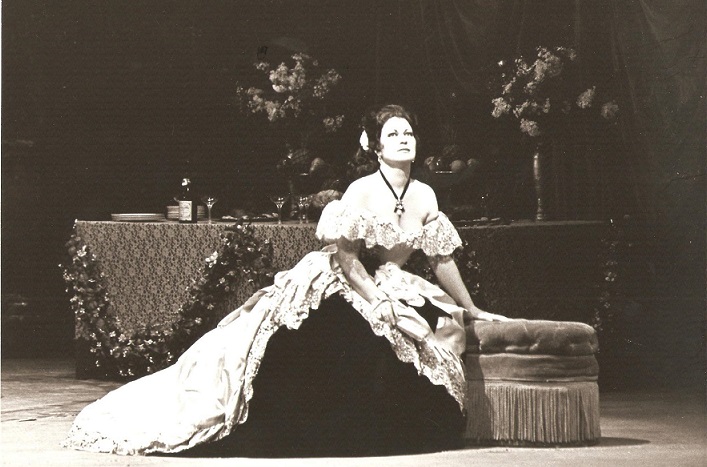
Above: Elena Mauti-Nunziata as Violetta
The death of the Italian soprano Elena Mauti-Nunziata has been reported. An interview with the soprano, conducted by Bruce Duffie, dates from 1983 and provides details of her career. Read it here.
Watch a film of a performance of TRAVIATA given in Madrid in 1977 with Elena Mauti-Nunziata, Alfredo Kraus, and Vicente Sardinero in the principal roles. Unfortunately, part of Act II (including “Di Provenza“) is missing, and the video quality is middling. But it’s a valuable document of Ms. Mauti-Nunziata in one of her finest roles. Watch and listen here.
Elena Mauti-Nunziata sang several performances of Mimi, Violetta, and Nedda at The Met from 1977-1979. I’m not sure how I managed to miss them. In 1982, I caught the last act of a broadcast of MADAMA BUTTERFLY from Dallas and was much taken with Ms. Mauti-Nunziata’s rendering of the opera’s final scene:
Elena Mauti-Nunziata – Morte di Butterfly – Dallas 1982
In 1985, I saw Ms. Mauti-Nunziata onstage for the only time: as Violetta at The Bushnell in Hartford, Connecticut. She gave a memorable portrayal.
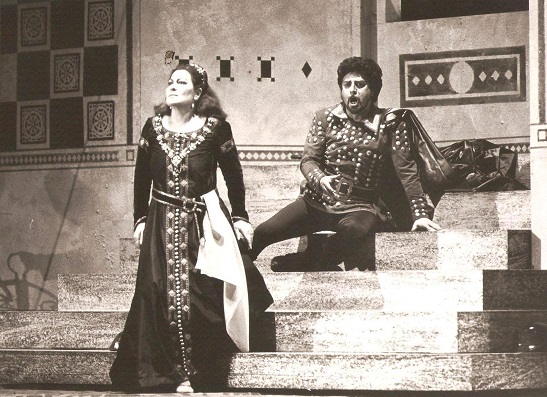
Above: as Francesca da Rimini, with Nicola Maritnucci

Above: Elena Mauti-Nunziata greets Maria Callas at the opening night of La Scala, 1970
Update: This scene from Act IV of TROVATORE from Verona 1985 has just surfaced on YouTube. Listen here.
The sound quality is mediocre, but I love the way Mauti-Nunziata spins out those ethereal high notes in the aria. After a Miserere where the recordist had some problems, we hear the cabaletta. (It’s best to listen with headphones.)
Giuliano Ciannella sings Manrico, and Reynald Giovaninetti conducts.
-
Dorrance Dance @ The Joyce ~ SHIFT

Above: Michelle Dorrance
~ Author: Oberon
Sunday July 21st, 2024 matinee – Michelle Dorrance’s SHIFT was another hit in the Joyce Theater’s mostly marvelous 2023-2024 season, which is now drawing to a close. The hour-long work was ideally lit by Kathy Kaufmann, with sound design by Christopher Marc, and casual costuming organized by Amy Page. Ms. Dorrance’s choreographic designs are a collaborative venture with her dancers, extending to improv.
To say that the dancing was sensational and thoroughly captivating is an understatement; adding to the vibrancy of the show were segments when some of the dancers took up musical instruments and regaled us with their impressive playing…to say nothing of a couple top-notch vocalists.
Before the house lights went down, the dancers appeared on the bare stage and began warming up – randomly at first, but then forming a circle and delivering individual tap motifs in turn as the others kept rhythm. This drew the audience deeply into the world of tap.
Once the house lights are out, it’s a hopeless task to take notes at The Joyce. But I’ve done my best to salvage what I could from my over-written pages.
The ‘formal’ program began with the first of six sections, entitled Dedicated To You, after the Sammy Cahn song, which was performed live by Ms. Dorrance (ukelele), Claudia Rahardjanoto (bass), with vocals by Ms. Rahardjanoto and Addi Loving, and danced by the Company’s male dancers – Sterling Harris, Luke Hickey, and Leonardo Sandoval – along with Elizabeth Burke and Ash Griffith is a smooth, swaying style. One of the singers soon joined the dancers whilst the other began whistling…such a fresh feeling, meshing music and dance in an imaginative union.
There followed the little glass ii and the little glass ii remix, which sort of flowed together into one continuous number. An especially intriguing segment was a male solo in which the dancer was followed about by a wheeled spotlight; after a bit, the dancer and the light-man switched places. The music takes on a psychedelic aspect; the lighting turns blood-red. Phrases are passed about, from dancer to dancer. Michelle Dorrance has a solo, which the other dancers observed from chairs ranged around the space. Michelle resumes playing her ukelele, but the music turns into a deep rumbling.
I Don’t Want To Set The World On Fire, with Ms. Dorrance singing lead to her ukelele accompaniment, backed by Ms. Loving, Asha Grffith, and Elisabeth Burke; their harmonizing was terrific. The male dancers have a trio which morphs into an octet, danced in a pool of light. Competition and camaraderie vie, to rhythmic clapping.
Elizabeth Burke seated herself at the grand piano for Moon, with Ms. Rahardjanoto on bass and Ms. Loving doubling piano/percussion. This followed by Ymir, to recorded music by Dawn of Midi. But I’d been forced to abandon note-taking in the dark, and so I just sat back and watched as the dancing continued – by turns subtle and sensational – from which I derived great pleasure. I began to feel a blessèd assurance in an uncertain world.
I’d expected a grand finale, a veritable tempest of tapping, but instead the performance ended on a purely musical note, with a song that hit me like a tsunami: That’s The Way It Is, by Alex Kramer and Joan Whitney; it just happened to perfectly reflect the emotional state I’ve been in of late. I have to include some of the lyrics here, so that I’ll always know where to find them:
“I tremble at your touchI know I shouldn’tBut that’s the way it isI want you oh-so muchI know I shouldn’tBut that’s the way it isI can see so clearlyThat we are worlds apartBut when you are near meI can’t see beyond my heartI worship at your shrineYou said I shouldn’tBut that’s the way it isI begged you to be mineI said I wouldn’tBut that’s the way it isI love you foreverThough it may never beBut that’s the way it isWith a guy like me”In the playbill, Ms. Dorrance offered the following note, in which she hit several nails on the head, reminding us of what’s at stake for our country in the weeks to come. I felt compelled to scan it and share it here:

There were no curtain calls, and as the lights came up I realized what a sense of community had enveloped us during the show. I could easily have watched it again…immediately.
~ Oberon
-
Extreme Taylor @ The Joyce ~ 2024
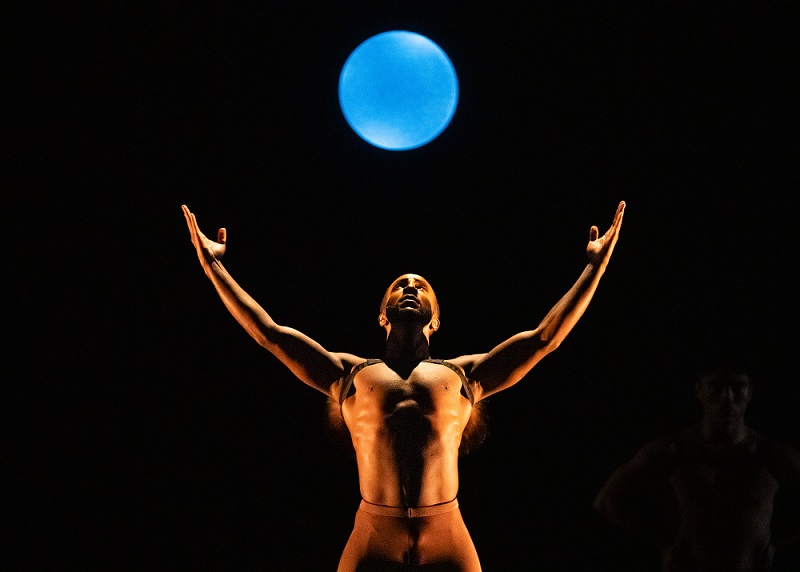
Above: Alex Clayton in Runes; photo by Steven Pisano
~ Author: Oberon
Saturday July 29th, 2024 matinee – In the days leading up to this afternoon’s Paul Taylor Dance Company performance, I was trying to recall my first-ever experience of seeing the Company live. I knew it was at Jacob’s Pillow, but was it 40 years ago…or earlier?
I went thru my archives (I save everything) and discovered that it was in the summer of 1983, though the exact date is not on the cast page. The program opened with Esplanade…is it any wonder I was hooked? In fact, my old pal Richard and I loved the Company so much (and especially David Parsons and Christopher Gillis) that we went to the box office during intermission and got tickets for the following weekend.

But…zooming back via time-warp to today’s matinee, it opened with Taylor’s Post Meridian, dating from 1965, set to a score by Evelyn Lohoefer de Boeck. This was my first encounter with this ballet, and I loved everything about it.

Above: from Post Meridian, photo by Steven Pisano
Somehow the Alex Katz costumes and Jennifer Tipton’s lighting created an impression of the dancers glowing from within. The music, described as “for magnetic tape”, is a delightful conglomeration of noises. The piece starts with thunder, or perhaps it’s the sound of a helicopter landing. Bizarre passages of spoken word, bang-on-a-can type percussive intrusions, a jazzy string bass rhythm, a trilling clarinet, music from a carnival funhouse: all this provides impetus to the dancers.
In an opening segment of walk-ons and gestural moves, we first meet Eran Bugge, Lisa Borres, and Jada Pearman. The men join – Lee Duveneck and Kenny Corrigan – along with Jessica Ferretti. Kristen Draucker has a featured solo, beautifully danced. A striking segment of two parallel pas de trois is truly original, with Mssrs. Duveneck and Corrigan handling the partnering elements with aplomb. Ms. Bugge dances a solo, and as the music turns whimsical, she spins blithely about the space. Devon Louis is fantastic in a jazz-based solo..simply superb.
Some images from Post Meridian:
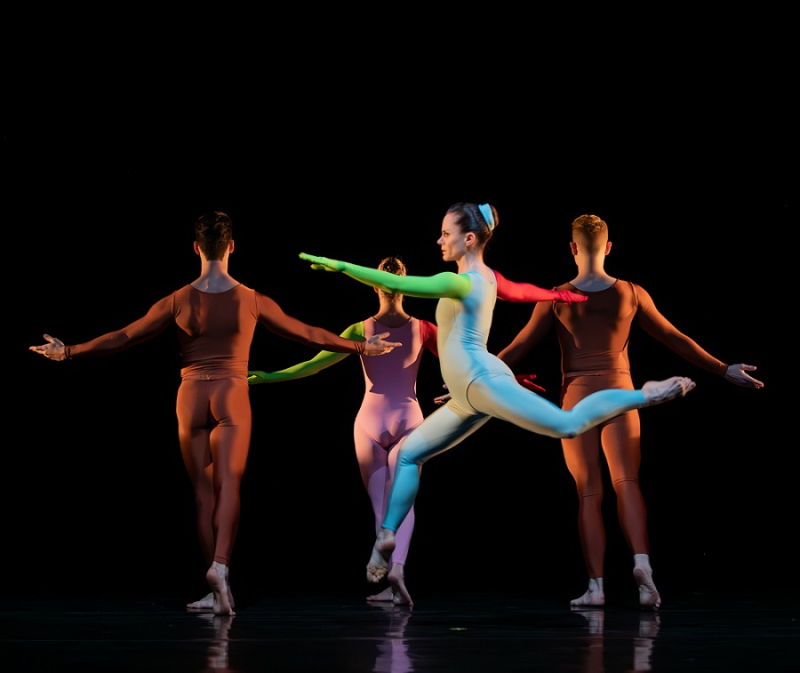
Kristin Draucker, photo by Ron Thiele

Devon Louis, photo by Ron Thiele
Paul Taylor’s Brandenburgs (1988) is normally a closing piece, but this afternoon it fit neatly between the quirkiness of Post Meridian and the mythic bleakness of Runes. Brandenburgs is quintessential Taylor. It has a cast of nine, but somehow feels ‘larger’, whilst the iconic Bach score lends a sense of grandeur.
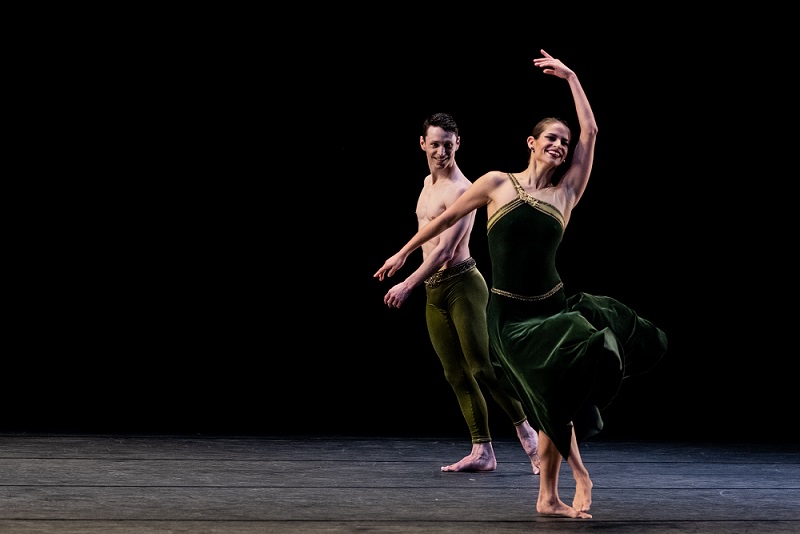
Above: Maria Ambrose and John Harnage in Brandenburgs; photo by Ron Thiele
From its opening pose of the six men and three women, Brandenburgs is a nonstop dance feast: each of the women – Maria Ambrose, Eran Bugge, and Lisa Borres – has a flirtatious segment with the five men of the ensemble: Lee Duveneck, Alex Clayton, Shawn Lesniak, Austin Kelly, and Jake Vincent. The men are given demanding Taylor moves as they come and go throughout, crossing the stage in leaping combinations.

The charismatic John Harnage (above, photo by Whitney Browne) holds the audience under a spell in the lyrical adagio, partnering Mlles. Bugge, Ambrose, and Borres in turn. In the succeeding faster movement, John admiringly observes solos by Maria, Eran, and Lisa, and then had a mesmerizing solo of his own. The animated finale brings us back to the ballet’s opening pose.
Closing the program was Runes, choreographed by Paul Taylor in 1975 to piano music by Gerald Busby. The ballet opens with a blue moon in the sky and a corpse onstage. Jennifer Tipton’s perfect lighting creates a timeless feeling as an ancient tribe gather to perform their sacred rituals. Their stylized movement has an air of Martha Graham about it.
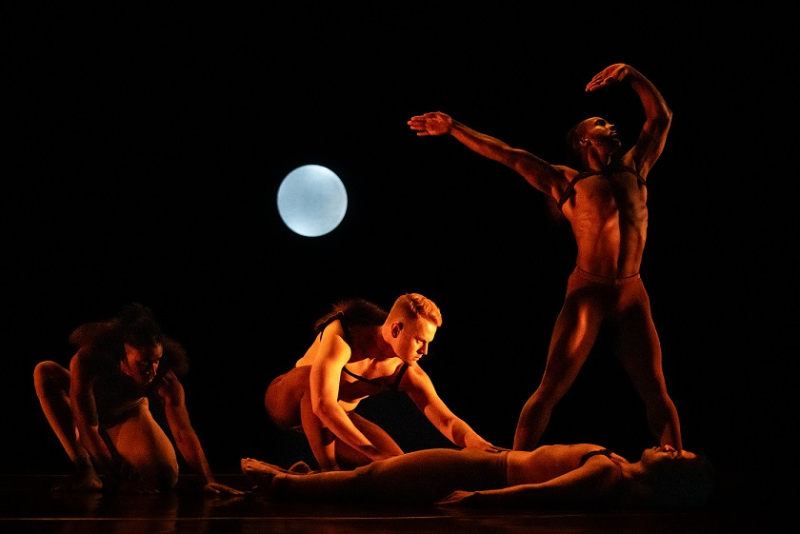
Above: Patches of fur on the men’s costumes evoke images of the Druids…dancers Lee Duveneck and Alex Clayton; photo by Steven Pisano
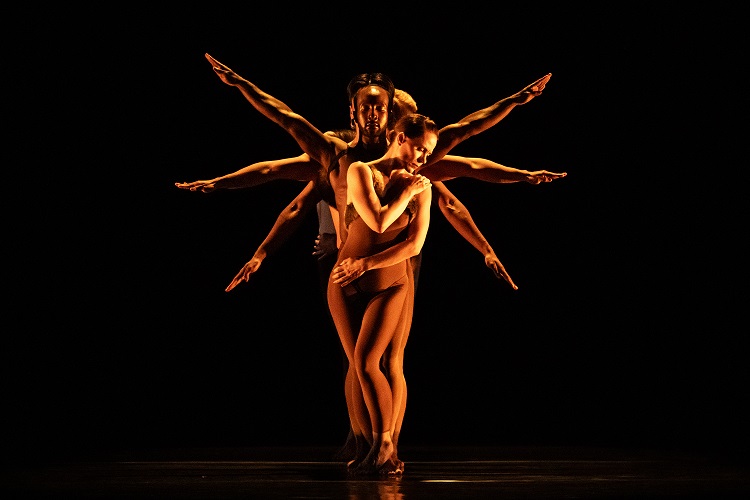
Eran Bugge (above, in a Steven Pisano photo) and Lee Duveneck have an intimate duet. They are joined by the captivating Ms. Draucker – as magnetic here as in Post Meridian; she and Devon Louis engage in a duet of their own, engrossing to watch.
Christina Lynch Markham’s solo stood out as the centerpiece of the ballet; she is perhaps the high priestess of the community, dancing powerfully whilst exuding a spiritual glow. Alex Clayton’s magnetism dominated the stage in a solo danced before a semi-circle of seated women; both here and in the ensuing duet with the radiant Madelyn Ho, Mr. Clayton once again affirmed his esteemed place in the Company. Runes ends with the corpse again in its place as the mysterious rites come to a close.

Above: Lisa Borres; portrait by Bill Wadman
Throughout the afternoon, I kept my eye on Lisa Borres, a dancer I have known for some time thru her performances with Lydia Johnson Dance and Damage Dance. Lisa’s dancing and presence have always stood out, and it’s so wonderful to find her so thoroughly at home in the Taylor repertoire.
The afternoon marked the last time I will see Eran Bugge and Christina Lynch Markham dancing with the Taylor Company. Thru the years, they have each provided me with many wonderful memories, and their distinctive – and very different – personalities have always put a personal stamp on whatever role they are dancing.

Above: Eran Bugge in Runes, photo by Seven Pisano

Above: Christina Lynch Markham; portrait by Bill Wadman
~ Oberon
-
Lando Bartolini Has Passed Away
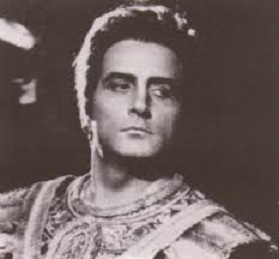
The Italian tenor Lando Bartolini has passed away. A native of Prato, Italy, Lando started studying voice in Philadelphia at the Academy of Vocal Arts with Nicola Moscona. Soon after, also in Philadelphia, he made his operatic debut as Luigi in IL TABARRO in 1968. He enjoyed an early success in Mascagni’s IRIS at the Teatro Liceu in Barcelona, and became a member of the Saint Gallen Opera.
Lando joined the New York City Opera in 1976, appearing there until 1979. His Italian debut came in 1982 as Ernani at La Scala. He sang at the Teatro Colón, at the Arena di Verona, at Hamburg, Berlin, Chicago, Vienna, Munich, Naples, Lisbon, Tokyo, Catania, Parma, Turin, Firenze, San Francisco, Rome, Washington DC, at Covent Garden, and in Sydney.
Bartolini made his debut with the Metropolitan Opera on tour in Boston in 1986, as Cavaradossi. He continued singing at The Met thru 1996, appearing as Manrico, Andrea Chenier, Calaf, and Radames. I saw him at The Met in AIDA opposite Leona Mitchell and Stefania Toczyska, and as Cavaradossi opposite Anna Tomowa-Sintow. He was a passionate singer, and his voice had real cutting power.

My favorite memory of Lando Bartolini was in LA BOHEME at the New York City Opera in 1976, opposite a very young Catherine Malfitano. He was a handsome, ardent poet whose “Che gelida manina” won strong applause; then he sat on the floor at Mimi’s feet as she told her story in “Mi chiamano Mimi.” Their love duet was youthful and rapturous.
Lando sings Andrea Chenier’s Improviso here, and Pinkerton’s “Addio, fiorito asil” here.
-
Camille Saint-Saëns ~ Piano Quartet
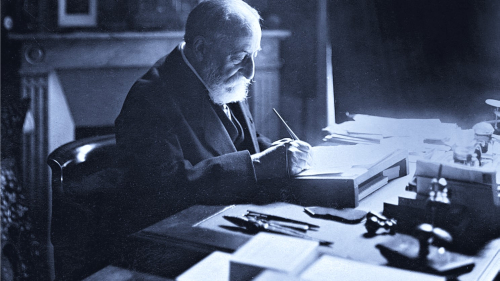
Above: Camille Saint-Saëns
A performance of Camille Saint-Saëns’ Piano Quartet, Opus 41, by members of the WDR Symphony Orchestra in 2022.
Watch and listen here.
The artists are Caroline Kunfalvi, violin; Katharina Arnold, viola; Martin Leo Schmidt, cello; and Nenad Lečić, piano.

 Oberon's Glade