Author: Philip Gardner

  • Lioba Braun ~ Alto Rhapsody

    Lioba Braun

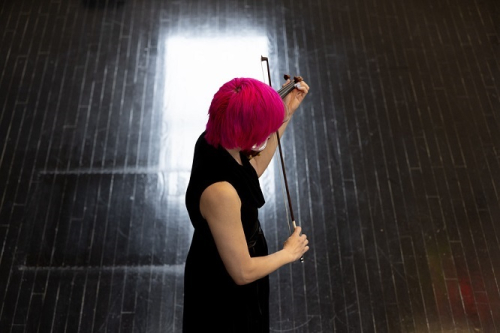
    Lioba Braun sings Johannes Brahms’ Alto Rhapsody, with Helmuth Rilling conducting the Radio-Sinfonieorchester Stuttgart des SWR.

    Listen here.

    German mezzo-soprano Lioba Braun was born in 1957. Based at the Nationaltheater Mannheim, she has appeared at the major opera houses and festivals of Europe. She became internationally known after singing Brangäne at the Bayreuth Festival in 1994, and she performed the soprano role of Isolde onstage for the first time in 2012.

  • Paola Prestini’s SILENT NIGHT @ National Sawdust

    Prestini

    Above: composer Paola Prestini; photo by Caroline Tompkins

    ~ Author: Lili Tobias

    Saturday October 28th, 2024 – I was lucky enough to have a front row seat to the world premiere of composer Paola Prestini’s new opera, Silent Light. I walked into National Sawdust on Saturday night to ambient insect noises mingling with the chatter of the audience finding their seats. As I looked out over the set of unfinished wood, I could smell the faint hint of bacon, eggs, and pancakes. And these things were just the beginning of how this production expanded not only my ears, but all of my senses!

    The innovative ways Prestini played with the sounds, visuals, and physical objects on stage really made Silent Light stand out, though the plot stuck close to standard operatic tropes—love, infidelity, etc. One of the first aspects of this that caught my attention was how she used mundane sounds either by themselves or incorporated into the musical sounds. The opera gets underway with the loud tick-tock of a grandfather clock (seen in the back left corner of the stage) oscillating in volume. The louder it gets, the more surreal the set feels. As that first scene progresses, the women and children of the family come onstage to set the table for breakfast (cooked onstage!) and all begin eating. The natural clatter of plates and utensils mingling with the warm low brass and string instruments created a very fun and realistic soundscape. It truly felt like the audience members were invisible observers within the room with the characters.


    Silent Light performance at NS_0115_


    Above: the ensemble, photo by Jill Steinberg


    I was especially impressed with the transitions between scenes, both in terms of the music and the staging. As breakfast wraps up, a wave of construction sounds rise up from the left side of the stage as the chorus becomes a team of workers. There’s a large waft of dust, which visually separates the two halves of the stage between the men at work outside and the women at work in the house. There were also two wonderful moments of transition between diagetic and non-diagetic music. One occurred during this scene as the chamber ensemble begins playing what seemed to me a lively popular song and the chorus sings along, simultaneously moving the chairs and table to prepare for the next scene. And later on, a French ballad begins playing on a television in the kitchen, then becoming the background for the characters Johan and Marianne to meet up in a hotel room. Both transitions were executed so seamlessly and really helped push the the flow of action forward.


    Silent Light performance at NS_0498_


    Above: Brittany Renee; photo by Jill Steinberg


    Another remarkable aspect of this opera were the juxtapositions between silence or quiet sounds and loud, nearly overbearing sounds. Overall, I felt like there was minimal actual singing in this opera, but not in a bad way at all! As a listener, I tend to get fatigued when operas have extra long passages of continuous singing, so I really appreciated the many moments of silence or instrumental music—or even just foley sounds—that provided contrast (and rest for the singers’ voices too). There were also many moments of abrupt shift from sound to silence. One especially striking moment takes place when Johan and his wife Esther are driving in a truck, Esther knowing that Johan has just slept with Marianne. The music, accompanied by the sound of heavy rain, creates a steady and unceasing anxiety as Esther finally comes to terms with her own feelings about her husband’s affair. Then it suddenly stops as she rushes out of the truck, leaving behind just the sound of the rain (and the literal water which has started pouring down onto the stage!).


    Tony & margaret silent light


    Above: Anthony Dean Griffey and Margaret Lattimore; photo courtesy of Mr. Griffey


    I also want to add that the novelties of this opera did not go unsupported by amazing musicianship. All the singers were incredibly strong both vocally and as actors, and the lyricism of Prestini’s music really helped them sound even more amazing! I also enjoyed Prestini’s writing for brass. Because of the small size of the instrumental ensemble, the proportion of brass instruments to other types felt very high relative to, for example, an orchestra. I liked how predominant a role the trumpet and trombone played in the music, and they really added a unique depth to the sound that was especially resonant in the small performance space.


    Silent Light performance at NS_0230_


    Above: Daniel Okulitch and Julia Mintzer, photo by Jill Steinberg


    This opera contained so many interesting things that it’s honestly been difficult to write about everything that caught my attention! I thought it was a huge success at National Sawdust, and I hope it gets many more performances. It will be super interesting to see how the staging evolves in different spaces and with different cast members. Silent Light was an incredibly immersive experience, and there was always something of interest to listen to, look at, and even smell!


    ~ Lili Tobias

  • Parlando: Night Music @ Merkin Hall

    Merkin

    ~ Author: Lili Tobias

    Thursday September 26th, 2024 – A wonderful night to spend listening to Parlando’s Night Music! Led by conductor Ian Niederhoffer, Parlando is a one-of-a-kind orchestra that strives to introduce listeners to underrepresented works through inventive programming and spoken introductions that provide context for each piece. As is standard for the ensemble, Thursday’s program featured a wide range of classical music all united under the theme of “night” (and this concert covered a span of just over 200 years!).

    The concert opened with the Nocturne from Fauré’s The Shylock Suite, Op. 57. I was unfamiliar with this piece, but it was a pleasure to hear for the first time. The orchestra played with an exceedingly delicate and precise tone. Though the piece was quiet all the way through, every note was clearly audible throughout the hall.


    Next was Takemitsu’s By The Sea, which I was really looking forward to (and it didn’t disappoint)! In the past, I’ve seen some of Takemitsu’s chamber music scores and have always been blown away by how beautiful the written music itself is. This was my first time hearing any piece of his live, and any conception of how I thought the written music might sound was eclipsed by the incredible real-life sounds of the orchestra and two soloists. When introducing By The Sea, Niederhoffer mentioned that the first version of this piece was a duo between flute and guitar, and I could still feel the chamber music-like qualities present in the orchestral re-arrangement. The soloists and the strings lead each other back and forth in a constant ebb and flow of dynamic swells—just like the waves of the ocean the piece was inspired by.


    Parlando


    Flautist Yoobin Son and harpist Parker Ramsay (photo above by Crios Photography) then joined the orchestra once more for the second movement from Mozart’s Concerto for Flute, Harp, and Orchestra in C Major, K. 299. I was especially impressed with Son’s incredible phrasing and expressive playing, which brought this intensely lyrical movement to another level. (She also wore a stunning lilac dress from designer Issey Miyake which seemed to float and dance along to the music.)


    The final piece on the program, Bartók’s Music for Strings, Percussion, and Celesta, Sz. 106, was a pleasant surprise. As someone who is not generally a fan of Bartók, I happened to love this piece. However, even after learning a bit about the social context surrounding its composition, I had a very different emotional response to the music. While the first movement wasn’t quite my cup of tea (especially after having had to sightread the fugue subject once for a musicianship class in college!), I greatly enjoyed the second, third, and fourth movements. The second and fourth I found especially fun—a stark contrast with the anguish Bartok may have intended it to convey. My ears latched onto the driving rhythms and confident percussive attacks and interpreted the music as lively and powerful, in a predominantly positive way.


    The orchestra was met with a well-deserved standing ovation at the end, and the concert was followed by a lively reception. While there was talk during the reception of finding a larger venue for future Parlando concerts, I actually think that smaller-scale performances could be a huge benefit towards Niederhoffer’s vision. A more intimate concert space could help open up dialogue between the musicians, audience, and even composers if they’re still living. As an audience member, I felt a bit boxed in by the spoken introductions to each piece—almost as if I was being told what to feel rather than encouraged to react to the music in my own way. While I completely understand the value in providing this musical context to the audience, I think there is a lot of further potential to create a more multi-faceted dialogue that draws from the diverse backgrounds and unique interpretations of both the musicians and the audience members. I’m excited to see what the future of Parlando holds!


    ~ Lili Tobias

  • ETHEL @ Merkin Hall

    Persist-photo

    Above: the members of ETHEL – Dorothy Lawson, Kip Jones, Ralph Farris, and Corin Lee – with flautist Allison Loggins-Hull; photo from the ensemble’s website

    ~ Author: Shoshana Klein

    Tuesday September 24th, 2024 – In the middle of a busy week, I got to hear the legendary string quartet ETHEL as well as flautist/composer Allison Loggins-Hull at Merkin Hall – the beginning of their official season as well as mine! Somehow I hadn’t crossed paths with ETHEL before, although I have known about them for a while – as one of the few dedicated new-music string quartets.

    PXL_20240924_235056666


    Above: interview with Dorothy Lawson, Allison Loggins-Hull, and John Schaefer


    This concert was also a New Sounds live broadcast, so in between each piece there were interviews by John Schafer with members of the ensemble. While I’m not a die-hard New Sounds listener, I’ve heard enough to be excited to hear it happening live.


    Another interesting note is that the ensemble was set up a little differently than you’d expect – with the viola on the left, the cello on the right and then the violins flanking the flute, which was in the middle. It makes for a bit more of a balanced sound than the usual string quartet, which has the violins on one side and the two lower voices on the other.


    The first piece, by Sam Wu, called Terraria, was in a very familiar new-music tonality that it feels like we use a lot nowadays, but there were enough different soundscapes for it to be interesting and engaging. It felt very much descriptive of a type of landscape and was a good opening piece.


    The second piece was by Migiwa “Miggy” Miyajima, who is Japanese – the piece was in four movements and she has a jazz background that was evident but not overwhelming. Each movement was distinct and interesting, and my favorite might have been one in which members of the string quartet vocalized a drone while Allison played an alto-flute melody over the top.


    The next piece was by Leilehua Lanzilloti – the composer on the program I was most familiar with – and was introduced with some information about Hawaii and US imperialism. They talked a lot about how the music had a lot of the “island music” feeling and that definitely came through – partially through some layered rhythmic plucking textures in the strings. Another really interesting effect was one in which the strings used multiple strings playing the same note and oscillated back and forth – sort of the string equivalent of what I’d call a timbral trill on the oboe, in which you slightly change the note so that it’s only vaguely perceptible. 


    The piece by Xavier Muzik was fun and energetic – it definitely had a different energy than the pieces before it even though it started somewhat similarly to some of the others. The last piece, by Ms. Loggins-Hull, had electronics and started with a fixed media drum beat that was kind of intense. It was a really nice piece that had a lot of variation and she certainly didn’t seem to give herself an easy part, which she of course performed flawlessly.


    I’m going to be honest: this concert was in the middle of a really busy time and I can’t say that I gave it the attention it deserved, but I was able to tell that all the music was really high quality and of course the performers are as well. It was well curated and nice to have one experience that was about an hour and a half interspersed with engaging interviews about the music. It always takes me a minute to get used to an amplified string quartet, but the sound was really well done and sounded exactly like listening to new sounds, which was both comforting and exciting to hear while seeing the music being made.


    ~ Shoshana Klein


  • BalletX @ The Joyce ~ 2024

    20240925_BalletX-Heroes_ChristopherDuggan_853

    Above: Savannah Green in Takehiro Ueyama’s HEROES; photo by Christopher Duggan for BalletX

    ~  Author: Oberon

    Wednesday September 25th, 2024 – Philadelphia’s BalletX at The Joyce tonight, offering three New York premieres: Takehiro Ueyama’s HEROES, Jodie Gates’ BEAUTIFUL ONCE, and Loughlan Prior’s MACARONI. Over the years, this Company has commissioned nearly 130 world premieres.

    The three works presented tonight were well-contrasted, and I must immediately praise the Lighting Designer, Michael Korsch, whose work was nothing less than sensational; this gave a special glow to the evening. Of the beautiful and highly accomplished BalletX dancers, two were known to me: Savannah Green (who danced in the closing work) and Jerard Palazo, who danced in the ballets by Loughlan Prior and Takehiro Ueyama, and who generated considerable star-power.

    20240925_BalletX-BeautifulOnce_ChristopherDuggan_191

    Above: Minori Sakita and Ashley Simpson in Jodie Gates’s BEAUTIFUL ONCE; photo by Christopher Duggan for BalletX

    The evening opened with Jodie Gates’s BEAUTIFUL ONCE, set to a score by Ryan Lott performed by Son Lux and yMusic. The slurring music of the opening moments soon transforms into rhapsodic themes as the dancers meet on the gorgeously lit stage, embracing one another with genuine affection. The choreography – danced on pointe – is full of sweeping lifts and swirling movement, all gracefully executed. A series of duets, laced with fleeting solos and passages danced as trios and quartets, keeps the eye thoroughly engaged. 

    The music becomes dense and passionate, and a sense of belonging pervades the stage. When the dancers are not dancing, they remain on the sidelines, as if supporting their colleagues. A lovely quintet for the women seems to offer a perfect ending to the piece, but then the men take over and the dancing flows on. As the ballet nears its end, individual couples step forward and embrace – not passionately, but tenderly.

    The program note refers to BEAUTIFUL ONCE as “a response to the chaotic moments in life”, and reminds us of the blessèd assurance of friendship and community.

    20240925_BalletX-Macaroni_ChristopherDuggan_422

    Above: Jonathan Montepara and company in Loughlan Prior’s MACARONI; photo by Christopher Duggan for BalletX

    I hardly ever enjoy comic ballets (Jerome Robbins’ THE CONCERT being an exception) and I can’t say that I derived much pleasure from Loughlan Prior’s MACARONI, a spoof on gay manners from the powdered wig era. The music, by Claire Cowan, served the choreographer well, laced with sounds of the harpsichord to evoke the baroque.

    The cast of eight included three women en travesti, dancing on pointe. Everyone danced superbly whilst showing expert comic timing and entering fully into the campy atmosphere. But as the work progressed, I felt rather sad: yes, we have made so much progress over the years…and yes, we must be able to laugh at ourselves. But there is still rampant homophobia and plenty of anti-gay/anti-trans violence in this country. Just a week ago, I heard three Spanish boys talking about me on the subway, using their favorite slur: pato. Will it never end?

    20240925_BalletX-Heroes_ChristopherDuggan_529

    Above: Francesca Forcella and Jerard Palazo infrom Take Ueyema’s HEROES; photo by Christopher Duggan for BalletX

    After the interval, Takehiro Ueyama’s HEROES summoned up a world of poignant beauty and mystery – a world we can always access in our imaginations but which the choreographer here transforms into reality. In his program note, Take dedicates the ballet to citizens who played a crucial role in the recovery of Japan from the devastation of World War II.

    Here, Mr. Korsch’s lighting designs (in collaboration with Christopher Ham) were extraordinarily atmospheric, and Eugenia P. Stallings’ costume designs – red garments that seemed at once ancient and ultra-contemporary – evoked the priestly rites that bind the community together.

    The piece opens with a prologue: deep rumblings are heard, and the summoning sound of chimes. From the pit, Tokoshieni – composed by percussionist Kato Hideki and performed by him and violinist Ana Milosavljevic – transports us to an illusory place and time. A red-clad couple emerge from the shadows and perform a slow, stylized duet to the sound of mysterious whispers. An eerie, brooding feeling creeps in; the man performs a slow solo and and the woman responds in kind. They don red jackets and vanish into the darkness.

    The music of John Adams – The Chairman Dances – rises as the full stage becomes illuminated. A diagonal of white chairs stage right becomes a walkway as the dancers enter. They move the chairs about, establishing a place for the evolving ritual. The chairs are lined across the stage and there is a wonderful seated passage of arm and hand gestures. A unison dance and individual walkabouts are highlighted by brief solos. 

    The music turns spacious and the dance slows, only to rebound as the dancers march about. Another unison passage leads to everyone dropping to the floor…only to rise and race about in a circle. Now the jackets come off and are collected; the dancers sit in a semi-circle, with the corpse of a woman covered with a jacket.

    A new beat develops; there is an intense duet which evolves into a trio and then a wild female solo. The lighting continues to play a powerful part in the effect of the choreography. In a visual coup, there is a striking line-up across the space, and the dancers advance towards us. They then fall into single-file and proceed to cross the bridge of chairs, sure of their destiny.

    More of Christopher Duggan’s images from HEROES:

    20240925_BalletX-Heroes_ChristopherDuggan_616

    Above: dancers Skyler Lubin and Mathis Joubert

    20240925_BalletX-Heroes_ChristopherDuggan_917

    Above: dancer Itzkan Barbosa

    ~ Oberon

  • Rival Princesses: Cruz-Romo/Bumbry

    Choregies-d-orange

    A brief and rather bizarre black & white film of excerpts from AIDA from a performance given at Orange on a windy evening in 1977. Gilda Cruz-Romo is Aida and Grace Bumbry is Amneris, with Luigi Roni as the King of Egypt and Peter Gougalov as Radames. Thomas Schippers conducts.

    Watch and listen here.

  • A Beautiful Aria, Beautifully Sung

    Credit Emilie Brouchon

    Étienne Dupuis (above, in an Emilie Brouchon portrait) sings Hérode’s great aria “Vision fugitive” from Massenet’s HÉRODIADE at a concert given at the Théâtre des Champs-Élysées, Paris, in November 2022. The Orchestra of the Opéra de Lyon is led by Daniele Rustioni.

    Watch and listen here.

  • Nicola Benedetti: Korngold’s “Marietta’s Lied”

    Nicola

    Violinist Nicola Benedetti gives a luxuriant rendering of Marietta’s Lied from Erich Korngold’s opera DIE TOTE STADT at the BBC Proms 2015, with the Bournemouth Symphony Orchestra under the baton of Kirill Karabits.

    Watch and listen here.

  • Nicola Benedetti: Korngold’s “Marietta’s Lied”

    Nicola

    Violinist Nicola Benedetti gives a luxuriant rendering of Marietta’s Lied from Erich Korngold’s opera DIE TOTE STADT at the BBC Proms 2015, with the Bournemouth Symphony Orchestra under the baton of Kirill Karabits.

    Watch and listen here.

  • Lucine Amara Has Passed Away

    Lucine

    Above: Lucine Amara as Aida; she signed the photo for me after a Met performance of PAGLIACCI

    The death of soprano Lucine Amara at the age of 99 has been announced. A native of Hartford, Connecticut, Ms. Amara was raised in San Francisco and sang with the San Francisco Opera chorus from 1944-1946; she made her professional concert debut in 1946.

    She made her Metropolitan Opera debut on November 6, 1950, as the Celestial Voice in Verdi’s DON CARLO, a performance that marked the start of Sir Rudolf Bing’s tenure as General Manager of The Met. From that date thru 1991, Ms. Amara sang 750 performances with The Met in New York City and on tour.

    The soprano’s vast repertoire included Wellgunde in the RING Cycle, Pamina, Liu, Nedda, Antonia in TALES OF HOFFMAN, both the Verdi Leonoras, Aida, Micaela, Contessa Almaviva, Eva in MEISTERSINGER, Alice Ford, Maddalena (and later, Madelon) in ANDREA CHENIER, Cio-Cio-San, Elsa in LOHENGRIN, Mimi, Donna Elvira, Amelia in BALLO IN MASCHERA, Tchaikovsky’s Tatyana, Ellen Orford, Tosca, Marguerite in FAUST, Fiordiligi, Luisa Miller, Mother Marie in DIALOGUES OF THE CARMELITES, Gertrude in HANSEL AND GRETEL, and Mascagni’s Santuzza.

    6a00d8341c4e3853ef022ad3e2833f200b-800wi

    My first experience of hearing Lucine Amara live was at the Old Met as Liu in TURANDOT in 1965. She sang gorgeously, with a lovely sense of lyricism and some finely-spun pianissimi. I met her after the performance (my only backstage visit at the Old House), and she was very happy to meet a young – but already very keen – opera enthusiast. (I was 16 at the time…)

    In the ensuing seasons at the New Met, I enjoyed Lucine’s Aida, Nedda, TROVATORE Leonora, and Cio-Cio-San. On April 22nd, 1972, she returned to her Met debut role as the Celestial Voice in DON CARLO to mark the final matinee broadcast of the Bing Era, which I attended. That evening, she sang the LOMBARDI trio at the Bing farewell gala. Her final Met appearance was as Madelon in 1991.

    The soprano left us some very fine recordings: the Verdi REQUIEM conducted by Eugene Ormandy, Musetta in the classic Beecham BOHEME, Nedda in PAGLIIACCI with Franco Corelli, and Elsa in LOHENGRIN under the baton of Erich Leinsdorf.  

    Here some samplings of Lucine Amara’s singing:

    As the TROVATORE Leonora:

    Lucine Amara – TROVATORE aria – Met 6~3~71

    Tatyana’s Letter Scene (in English) from EUGENE ONEGIN:

    Lucine Amara – Tatyana’s Letter Scene ~ ONEGIN – in English – Met 1957

    Duet from LA GIOCONDA from The Met’s 100th anniversary gala in 1983, with Bianca Berini:

    Lucine Amara & Bianca Berini – GIOCONDA ~ duet – Met Gala 1983

    And from her commercial recording of the Verdi REQUIEM:

    Lucine Amara – Requiem aeternam ~ Verdi REQUIEM

    Watch a video of the final scene of PAGLIACCI with Lucine and Richard Tucker from the Bell Telephone Hour, with Donald Voorhees conducting, here.

    One afternoon, while working in the opera room at Tower Records, I was playing the Leinsdorf LOHENGRIN on the overhead speakers. Four rather boisterous opera fans from Munich, who were in town for some Met performances, came in and were browsing the shelves while chatting away. As Lucine’s voice commenced Elsa’s ‘dream’ aria, the four fell silent. They stood listening as if under a spell. Then one of them came over to me and asked: “Who is this soprano?” They’d never heard of Lucine Amara. I told them of her Met career and her extensive repertoire. “This is a perfect Elsa voice! If we had had this singer in Europe, she would have been highly esteemed. It’s a heavenly sound.” 

    In the months that followed, I kept hoping Lucine might come in the store so I could tell her this story. But I never got the chance.