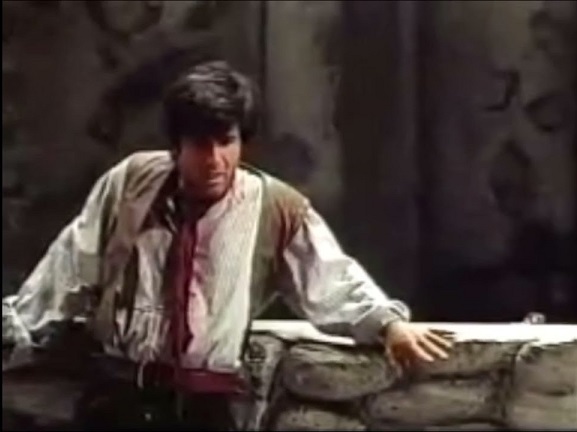
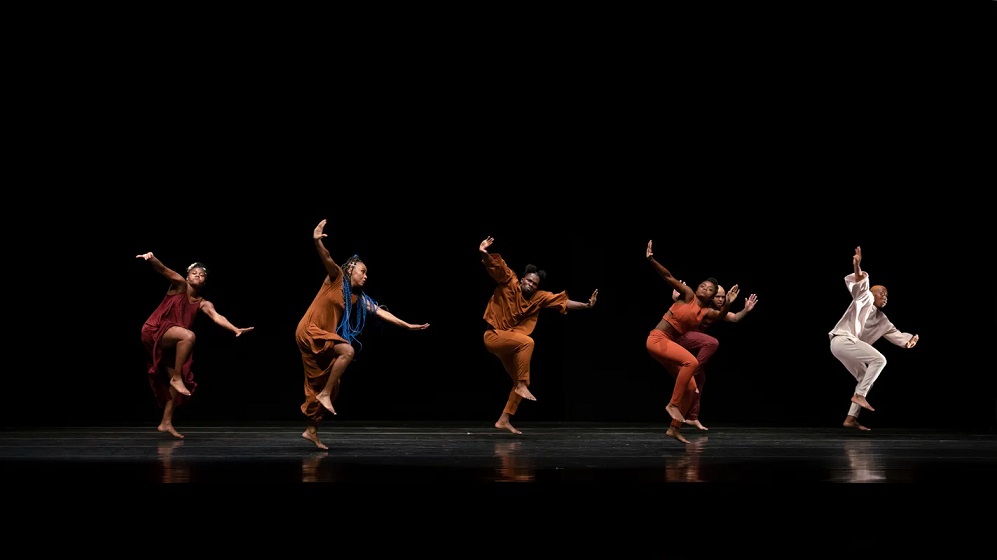
Angela Gheorghiu and Placido Domingo sing the great love duet, “Gia nella notte densa“, from Act I of Verdi’s OTELLO at a concert given at Innsbruck in 1995. Eugene Kohn conducts.
Watch and listen here.
Angela Gheorghiu and Placido Domingo sing the great love duet, “Gia nella notte densa“, from Act I of Verdi’s OTELLO at a concert given at Innsbruck in 1995. Eugene Kohn conducts.
Watch and listen here.

Angela Gheorghiu and Placido Domingo sing the great love duet, “Gia nella notte densa“, from Act I of Verdi’s OTELLO at a concert given at Innsbruck in 1995. Eugene Kohn conducts.
Watch and listen here.
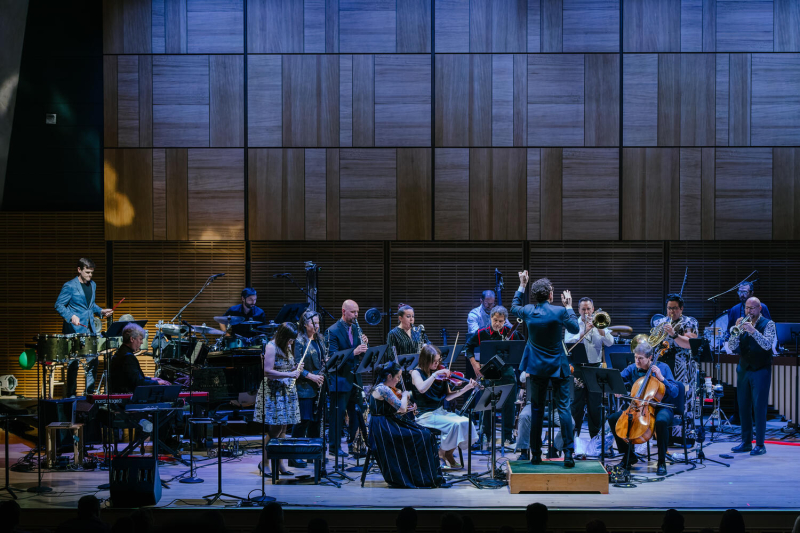
Above: concert photo by Fadi Kheir
~ Author: Shoshana Klein
Tuesday March 26th, 2024 – Though this concert started with slight technical difficulties, after about 3 minutes, the whole rest of the show went on without a hitch. The pieces were played with minimal breaks and the show could have gone on with no applause, except that everyone was so excited about the pieces that there was a lot of excitement in between.
There were audio introductions from each composer, and sometimes they even overlapped with the beginnings of the pieces. This created a really good flow that made the concert seem a little more connected and seamless than a normal program. This was actually my first official Alarm Will Sound concert despite being a fan of them for years. I’ve seen them in other contexts but not a fully programmed concert – it was a real treat!
The concert started with a piece by Tania León, who curated the concert in her capacity as the Richard and Barbara Debs Composer’s Chair of Carnegie Hall. Her piece was cool, groovy and fun, scored for small ensemble.
The second piece, by Chris P. Thompson, had some basis in drum corps, as explained by his introduction. It was really cool to hear about marching band in the context of “classical music”. I think it often gets ignored as an art form or a rigorous type of music when it’s actually pretty difficult in a way that was contextualized really well by the introduction to this piece, which was also really fun. The piece had a lot of rhythmic complexity and was really upbeat. One effect that was used was these tubes that are swung around by various musicians to create a pitch (and the pitch changes based on how quickly you swing the tube). I’ve been seeing this used in new music spaces more often recently and in this particular instance it did evoke the marching band – the coordination and visual aspects, or maybe more specifically the color guard spinning flags around on the field.
The next piece was by Christian Quiñones (who I worked with a couple of years ago but we’d never met in person!) His piece was really cool and also had lighting effects attached to the electronic sounds, which was an interesting though slightly jarring experience. The sounds were a little glitchy but rhythmic in a way that sounded really cool. The piece was based on the sound of hearing loss – sounds becoming obscured and distorted throughout.
The last piece on the first half, in my opinion, was definitely the show stealer. It was an excerpt of an opera by Damon Davis and he called it in his introduction a “black rap space opera”. I had moments of feeling like some of the music was familiar to the point where I wondered if I’d heard it before – but I think it was just that type of music, kind of magical in its familiarity as well as its novelty. It was well orchestrated, interesting in the way it used members of the ensemble as characters or kind of as set pieces. The songs were beautiful but also definitely post-genre, almost more similar to musical theater than anything. The music and the story were optimistic in a mythological way, almost like Disney or Miyazaki. Everybody seemed to want to hear the whole thing. This was a fragment of a larger work that will hopefully be performed soon!
The second half started with a piece by Elijah Daniel Smith which had a different tone – more subdued and introspective than the first half. It had a lot of really interesting sound worlds accompanying a narration that was interesting and impactful.
Next was a piece by Texu Kim that was rhythmic and upbeat and ended a frenzy of rhythm that was perhaps intentionally impossible to keep completely together, which was a nicely unconventional end to the piece.
Next was a five movement piece by Bora Yoon that was eclectic. There were moments of poetry, moments that felt conversational, and really interesting sound worlds including a prepared piano and an instrument she seemed to have made out of bicycle bells. The last movement particularly struck me – it was really really beautiful around an ocean theme. I wish I had more to say about this piece – it was delightful and brought us through many emotional spaces in a short time.

In the great confrontation scene from Mascagni’s CAVALLERIA RUSTICANA, Luis Lima as Turiddu (above) is cursed by Elena Obraztsova as Santuzza in a 1985 performance from the Vienna Staatsoper. Lima had broken his arm in a rehearsal; he sang the performances wearing a cast.
Watch and listen here.

Mara Zampieri and Jose Carreras (above) in a scene from Act I of TOSCA, from a 1981 concert; Anton Guadagno conducts.
Listen here.
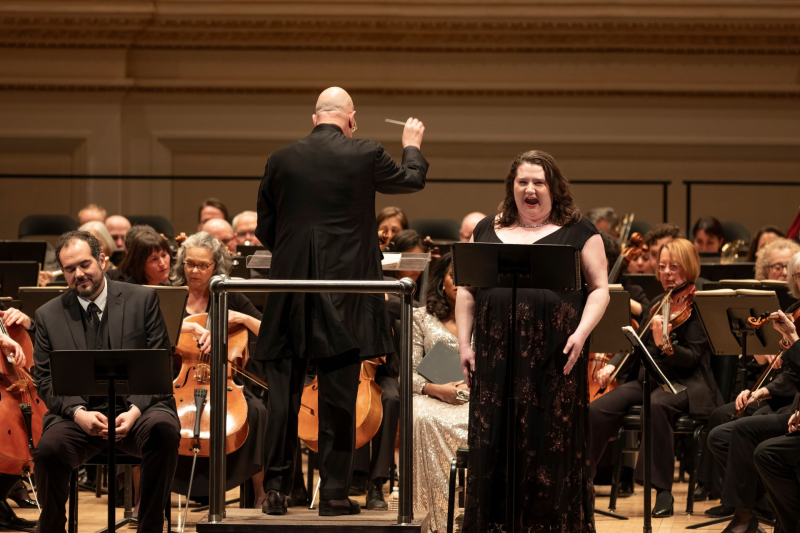
Above: tenor Dominic Armstrong (seated), conductor Leon Botstein, and soprano Felicia Moore onstage at Carnegie Hall; photo by Matt Dine
~ Author: Ben Weaver
Friday March 22nd, 2024 – Arnold Schoenberg’s gargantuan Gurre-Lieder, composed in 1900-03 (revised 1910-11), is unlike anything else in his catalog. With this lush and highly melodic work – for soloists, chorus and orchestra – he reached the ceiling of Romanticism and the only way out was to shatter it to smithereens. For Schoenberg, a mix of musical philosophy and observing the ravages of WWI signaled that music could not continue on the path laid out by his predecessors (Bach, Haydn, Mozart, Beethoven, Brahms, Wagner, etc. etc.) Schoenberg may have overreacted quite a bit, but, at a least with Gurre-Lieder, he left us with a grand finale of sorts to the excesses of 19th century music.
Gurre-Lieder’s libretto is adapted from Jens Peter Jacobsen’s dramatic poem Gurresange, written in 1868. It tells the story of King Waldemar and his love for the beautiful Tove, who is murdered by Waldemar’s jealous wife. Enraged, Waldemar curses God and is condemned to roam every night on wild hunts with his ghostly vassals. Waldemar is redeemed with arrival of Spring, and he and Tove are reunited as they become one with nature. Performances of this work are extremely rare, no doubt because Schoenberg calls for more than 150 musicians, an extravagance few organizations can afford, and none can afford frequently.
Part I opens with what Gabriel Adorno called “fairy land” music, a shimmering tapestry of harps, celesta, flutes, piccolo and some strings. Waldemar and Tove exchange declarations of love in extended monologues, set to ravishing Wagnerian and Straussian sounds.
Tenor Dominic Armstrong (above) took on the – let’s face it – impossible role of Waldemar. Schoenberg wrote the part for at least three different voices; not many singers have been able to possess them all. This is a Tristan/Parsifal/Tannhäuser part, with Tamino thrown in for good measure. I honestly don’t know who can really sing all this in a live performance. Dominic Armstrong is a lyrical tenor with a strong top, but sadly the voice disappears in the lower registers. And conductor Leon Botstein was not very kind, allowing the orchestra to cover Mr. Armstrong all evening. Armstrong’s strongest moments were in the lighter passages; his best singing came late in Part 3, in his final aria “Mit Toves Stimme flüstert der Wald”, when Schoenberg’s orchestration relaxed, allowing Waldemar to finally emerge.
Soprano Felicia Moore (above) possesses a large, blooming voice, that managed to break through the orchestral cacophony, in spite of an insensitive conductor. Her Tove was exotic and warm.

Mezzo-soprano Krysty Swann (above, in a Matt Dine photo), as the Wood-Dove who describes the terrifying details of Tove’s murder, was exciting in her long monologue. The voice is large and steely, the vibrato a bit loose at the top, but Ms. Swann possessed an excellent sense of drama, managing to build to thrilling and hair-raising final moments of the Wood-Dove’s narrative.
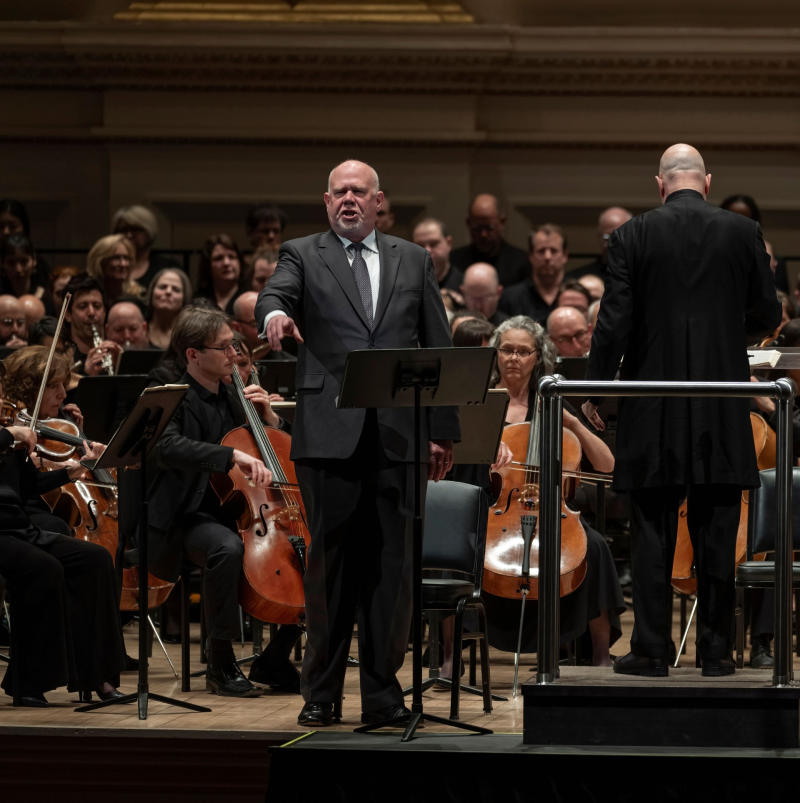
Bass-baritone Alan Held (above, photo by Matt Dine) has been a favorite of mine for many years. Though it seemed like James Levine always kept Mr. Held back at the Metropolitan Opera, where he should have been singing Wotan among many other roles, I still vividly recall a searing Wozzeck Mr. Held sang at the Met in 2011. It was wonderful to hear him once again, his large voice easily filling Carnegie Hall as the Peasant who is terrified by Waldemar and his men’s nightly processions.

Tenor Brenton Ryan (photo above by Matt Dine) was a very memorable Klaus the Jester, starting his long monologue from the house floor, then jumping on to the stage. Mr. Ryan possesses a strong, characterful tenor that made me think he might have been a better choice to sing Waldemar.
And German bass-baritone Carsten Wittmoser was a magnificent Narrator, his crystal clear diction perfect for the sprechstimme part, which is usually given to older singers nearing retirement or even non-singer actors (Karl Maria Brandauer and Barbara Sukowa, for example.) So it was nice to hear a singer still in his prime take on this role.
The American Symphony Orchestra was founded by Leopold Stokowski – who conducted the US Premiere of Gurre-Lieder in 1932, so it has a direct connection to this work, and they played quite beautifully, and certainly loudly. Here I must fault Leon Botstein for not being more considerate of his singers. Even the Bard Festival Chorale found itself drowned out by the orchestra, occasionally becoming just a mass of garbled sounds coming from somewhere at the back of the stage.
Still, any live performance – flaws aside – of this supremely difficult work is was a special treat to be able to experience. How long before another performance is organized in New York City?
~ Ben Weaver
Performance photos by Matt Dine, courtesy of Carnegie Hall

Above: Shota Myoshi of Hubbard Street Dance Chicago
~ Author: Oberon
Wednesday March 20, 2024 – So great to see Hubbard Street Dance Chicago again! When I lived in Hartford, we’d go up to see them each Summer when they came to Jacob’s Pillow. Tonight at The Joyce, they offered a finely-devised program which was musically and stylistically varied, and superbly danced.

Above: dancers Jacqueline Burnett and Aaron Choate in Coltrane’s Favorite Things; photo by Michelle Reid
Lar Lubovitch’s Coltrane’s Favorite Things was created in 2010 and was taken into the Hubbard Street rep in 2023. I confess that I’ve had a lifelong allergy to jazz, and while I admire John Coltrane’s inventive take on the Rogers and Hammerstein hit from The Sound of Music, I must admit that there were times when the music seemed endless. But: no worries! Mr. Lubovitch’s flowing, fleet-footed choreography filled the stage with movement, and the dancers seemed to be having a blast dancing it.
There may have been some cast changes from the listing in the Playbill, but one distinctive dancer stood out: Shota Myoshi (photo at the top) is a petite young man who dances large. His sheer joy at executing the technical feats of the choreography seemed to set the tone for his colleagues. Everyone danced their hearts out, winning a vociferous ovation at the end of the piece.
On leaving the hall at the end of the show, I ran into the irrepressible JJ (aka Jonathan E Alsberry), an iconic Lubovitch dancer who is now Senior Rehearsal Director at Hubbard Street. And with him was the great man himself: Lar Lubovitch. So wonderful to see them again!

Hubbard Street’s giving the New York premiere performances of Rena Butler’s Aguas Que Van, Quieren Volver during this run; production photo above. It is a captivating work in every regard. And the first acclaim goes to lighting designer Julie E Ballard; her settings seemed to create a narrative of their own in the work, which details the shifting emotions of a ménage à trois. From some performance photos I found, it looks like this piece is sometimes danced (as tonight) by a man and two women, and other times by a woman and two men.
This evening, the dancers were Jacqueline Burnett, Simone Stevens, and Eliot Hammons. They were technically perfect, and emotionally powerful. Each has solos to dance – Ms. Burnett’s being particularly well-choreographed, and beautifully danced – and the partnering ranges from sexy to quirky. Ms. Stevens brought a nervous energy to her dancing, and a personal intensity, whilst the tall Mr. Hammons moved and partnered with a distinctive personal grace; he seemed to be holding the triangle together by sheer force of will and desire. The music, which often has a sexy sway, was sublime, especially the ‘title song’.
At the end, order is restored – at least for the moment: beautiful final image of the threesome standing together. The work captivated me on a personal level, as I recalled the difficulties we faced in our own ménage à trois back in the early 1990s. Jealousy undid us.

The program ended with a masterpiece: return to patience by Aszure Barton, sent to a score by Caroline Shaw that may have been inspired by Satie. To me, this seemed to be a contemporary renewal of the tradition of ‘the white ballet’: everything is purely and wondrously white as the lights slowly come up on the entire company standing in place. Balanchine’s Serenade is cunningly given a graceful nod as the dancers in unison shift their feet into first position. Thereafter, thoughts of Swans, Wilis, Shades, and Sylphs constantiy dance thru the mind. Solos (again Ms. Burnett and Mr. Hammons stood out) are woven into passages for groups and fleeting partnering motifs. Mr. Myoshi was again entrancing.
The group dances in sync, with lyrical arabesques and slow ‘leaning’ passages.The tempo speeds up, but only a bit, for another solo from Mr. Hammons, joined by a sextet. The movement becomes more animated, with a male quartet and a female solo observed by all in a semi-circle. There is a reverential bow, but that is not quite the end.
Ms. Barton’s work held the audience under a spell, and then the dance seemed to recede as if we had experienced a dream that fades away. There was a moment of silence, before the audience responded with fervent applause.
~ Oberon
Photo by Marcela Gómez
~ Author: Oberon
Wednesday February 28th, 2024 – Still on a high from last night’s CARMINA BURANA at Carnegie Hall, I went down to The Joyce on a rainy evening to see the Colombia-based dance company Sankofa Danzafro performing Behind the South: Dances for Manuel, which took me even higher.
The work references the Colombian writer Manuel Zapata Olivella, whose “Changó, el Gran Putas” – a mythological construction of South America’s African diaspora which spans more than five hundred years of history – took the author two decades to complete.
The Company’s Artistic Director, Rafael Palacios’ work celebrates the traditional music and dances of the muntu (the African people) as a key element of the Afro-Colombian community. Sankofa means “to return to” or “to go back and fetch…”: a finding of one’s roots.
I read all the background information regarding what I was about to see and hear, but it all vanished from my head when the house lights went down: for one hour I was simply mesmerized by music and movement.
Seated in an upstage corner were the two drummers who cast a spell over the hall with their playing: Juan José Luna Coha and Gregg Anderson Hudson Mitchell. The rhythmic vitality of their drumming was a primal force – like the heartbeat of the universe – creating an irresistible and urgent need to dance.
In a brief prologue, individual dancers rush fearfully about the stage, dodging bullets and sometimes hurling stones at their oppressors. Then the first of the tales unfolds: Rebel Blood. A woman in a white gown stands trembling in a pool of light. The mood is somber, and mystical voices are heard. A red-clad quartet of dancers emerge; they dance in pairs. Now a heavily pregnant woman enters, tethered to her mate by a silken cord. The man begins to shake uncontrollably; a pale spirit appears and carries him away.
Then comes the Song of Yemayá, a nurturing sea-goddess all in white who performs a flowing solo invoking protective energy. The red quartet return, and a vocal solo is heard, which evolves into a hypnotic rhythm. A procession now arrives, to the ringing of a bell: the pregnant woman and her mate return. The scene slowly fades.
A lone female, masked and ghostly, appears. Eerie vibraphone-like music is heard as spirits gather. Dancing with small, rapid steps, they move hypnotically about the stage in evolving patterns, almost like automatons. From the assembled community, fleeting solos stand out. The endless beat accelerates and things get wild before the initial woman is left alone.
A freshly agitated rhythm leaps up, the dancing full of fast steps, and a sense of exuberance rises. There are swift comings and goings as the pace quickens, becoming a runabout, and a frantic man shakes violently. The dancing slows, and in the end the dancers strike poses in place as the light fades.
The audience had clearly been enthralled throughout the piece; they now rose as one to scream heartily for the dancers. The two drummers came forward to a torrent of cheers. The stage was cleared, but insistent applause brought everyone back for another bow. Waves of love seemed to fill the hall, flowing to – and from – the stage.
I don’t feel I’ve done justice to the evening and the emotions the piece evoked. I must say, it’s nearly impossible to take notes at The Joyce; in the darkness, you end up writing lines on top of lines, and when you get home it is all undecipherable. But what I was feeling during this hour can’t really be expressed in words…you had to be there.
~ Oberon


 Oberon's Glade