
A scene from Act I of Puccini’s TOSCA with Renata Tebaldi (above) and Carlo Bergonzi from Buenos Aires 1953. This was Bergonzi’s role debut as Cavaradossi.
Listen here.
A scene from Act I of Puccini’s TOSCA with Renata Tebaldi (above) and Carlo Bergonzi from Buenos Aires 1953. This was Bergonzi’s role debut as Cavaradossi.
Listen here.
So many wonderful things have popped up on YouTube during the pandemic. An audio-only recording of the Leonie Rysanek 25th Anniversary Gala at the Metropolitan Opera House in 1984 provides a document of a truly exciting performance…which I attended.
Listen here.
Before the performance began, I heard people seated near us asking: “Do you think she will scream?” The general consensus was that, being a concert performance, she would refrain from including her trademark screams as both Kundry and Sieglinde.
She screamed.

So many wonderful things have popped up on YouTube during the pandemic. An audio-only recording of the Leonie Rysanek 25th Anniversary Gala at the Metropolitan Opera House in 1984 provides a document of a truly exciting performance…which I attended.
Listen here.
Before the performance began, I heard people seated near us asking: “Do you think she will scream?” The general consensus was that, being a concert performance, she would refrain from including her trademark screams as both Kundry and Sieglinde.
She screamed.

Friday July 22nd, 2022 – Saxophonist Steven Banks (above) headlined this evening’s concert by the Mostly Mozart Festival Orchestra at Alice Tully Hall. The wonderfully sprightly – and hugely talented – Xian Zhang was on the podium.
The concert was presented as a choose-what-you-pay event, part of Lincoln Center’s Summer for the City festival. There were several small children in the audience, and for the most part they were well-behaved; I’m sure they found the very tall Mr. Banks – and the sound of his saxophone – intriguing, and most likely they were equally fascinated by Xian Zhang’s lively personality. The concert lasted about 90 minutes, without intermission.
Composer Nokuthula Ngwenyama greeted us, speaking briefly about her work, Primal Message, which was having its New York premiere as the opening piece this evening. She talked about prime numbers and about possible ways of communicating with extra-terrestrial life, but thoughts of science, and of theories, evaporated as her appealing music filled the space.
Melodious, and even romantic-sounding at times, the music commences with themes for cello and viola, leading to a haunting violin solo and sweet sounding phrases from the harp. Pinging tones from the xylophone, and isolated chime notes, signify a mystical language as the work wends towards its delicate finish. If beings on other worlds were to receive Ms. Ngwenyama’s Primal Message, their response would doubtless be cordial. The audience seemed taken with the music, applauding both musicians and composer enthusiastically.
I first heard saxophonist Steven Banks earlier this year in a noontime recital at the Morgan Library, presented by Young Concert Artists. Everything about his playing impressed me then, and he impressed me even more this evening. Mr. Banks towered over the diminutive Xian Zhang, but as artists they are of equal stature.
Tonight, Mr. Banks took the Tully Hall stage for a rarity: Alexander Glazunov’s Concerto in E flat major for alto saxophone and string orchestra, Op. 109, written in 1934. It is music deeply rooted in Romanticism, and it has become a standard in the saxophone repertoire; this was my first time hearing it, and it’s a complete delight.
Although invented in the early 1840s, the saxophone was still fairly new and unfamiliar in Glazunov’s day; it remained under-utilized for years as it was considered “low-brow”. Glazunov, however. was intrigued by this new timbre in the musical world; still, the composer almost certainly never heard his Saxophone Concerto publicly performed, since the Paris premiere of the work did not take place until after his death.
The concerto commences with a big, unison string theme: this is lushly lyrical music. Mr. Banks’s warm, gorgeous tone fills out the melodies so persuasively, and there are passages of coloratura that are deftly handled. The saxophone sings over a rather hesitant accompanying rhythm, from which a long cadenza for the soloist arises.
The music turns animated and wryly amusing. A swirling solo melody becomes a fugue. Mr. Banks sails onward, thru various trills and furbelows, to a lovely finish, winning the audience’s vociferous approval.
After a brief pause, Mr. Banks returned for another work: Jacques Ibert’s Concertino da Camera, written in 1935. From its flashy, almost chaotic start, Mr. Banks explores the saxophone’s jazzy side, later taking up a sad song over the orchestra’s swaying accompaniment. The strings, motivated by eloquent basses, commence a theme over which the saxophone delivers smooth fiorature. Things dance along, turning vibrant, and starting to swing.
In a mood-change, a soft and pensive saxophone solo sounds over the orchestra’s deep sighing: this is the sound of a broken heart, expressively sung by Mr. Banks and echoed by the horn. But you can’t keep a good man’s spirits down, and soon the sax player is reeling off rapid figurations: Mr. Banks revels in the subtleties of the score, polishing off a cadenza covering a vast range and brimming with dynamic shifts. Cries of “bravo” resounded in the Hall as this saxophone paragon took his bows.

Above: tonight’s conductor Xian Zhang
The evening concluded with the Beethoven’s Fourth Symphony, which was premiered at the Lobkowitz Palace in Vienna in March 1807; being a private concert, there are no first-hand reports of initial reaction to the work.
Here, we can savour Xian Zhang’s mastery of both grandeur and finesse; the orchestra played superbly for her, and the wind soloists – flute, clarinet, oboe, bassoon, and horn – had a heyday, reeling off their passages with élan, whilst the Mostly Mozart strings were suitably satiny. Ironically, both my companion and I found ourselves thinking of Mendelssohn’s Midsummer Night’s Dream during the Beethoven.
The concert ended with a joyous ovation, the conductor being hailed with special enthusiasm.
But our complete enjoyment of the concert was dampened by the news that we may be facing the end of Mostly Mozart as we have known and loved it. Weaving a handful of Mostly Mozart concerts into a summer festival of general entertainment events at Lincoln Center won’t suffice for hardcore classical music-lovers. Or are we really witnessing the long-dreaded ‘death of classical’?
This article sheds some light on the situation. Could another venue be found where Mostly Mozart could make their home – and flourish – in the future?
~ Oberon
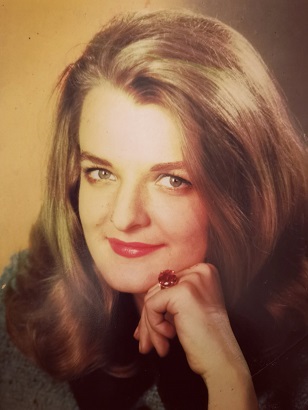
Helga Schmidt (above), Janet Coster, and Liane Synek were the Norns in a performance of GOTTERDAMMERUNG given at Cologne in 1972. Hans Wallat conducts.
Listen to their Norn scene in two parts:
Norns – Pt I – Helga Schmidt – Janet Coster – Liane Synek – Cologne 1972 – Wallat cond
Norns – Pt II – Helga Schmidt – Janet Coster – Liane Synek – Cologne 1972 – Wallat cond
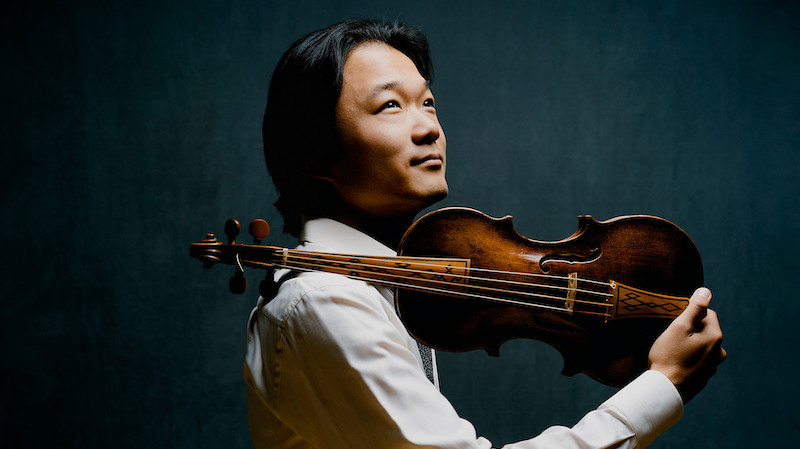
A 2015 performance of Bach’s Violin Concerto in E-major BWV 1042 with soloist Shunske Sato (above) and the Netherlands Bach Society.
Watch and listen here.
I went to the Garden of Love,
And saw what I never had seen:
A Chapel was built in the midst,
Where I used to play on the green.
And the gates of this Chapel were shut,
And “Thou shalt not” writ over the door;
So I turned to the Garden of Love,
That so many sweet flowers bore;
And I saw it was filled with graves,
And tombstones where flowers should be;
And Priests in black gowns were walking their rounds,
And binding with briers my joys and desires.
– William Blake (1757 – 1827)
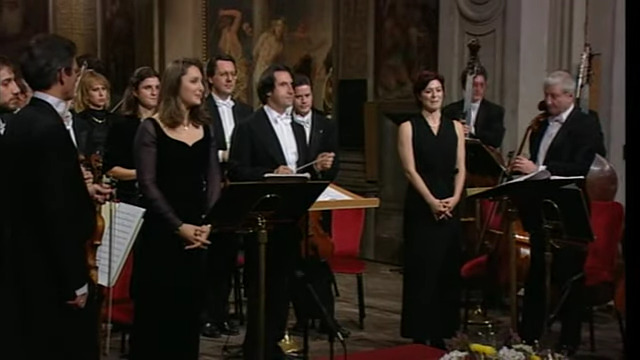
Riccardo Muti conducts a performance of Pergolesi’s STABAT MATER with soloists Barbara Frittoli and Anna Caterina Antonacci.
Watch and listen here.


 Oberon's Glade