Category: Ballet

  • Discovering Lydia Johnson Dance

    (This story from Oberon’s Grove tells of my first encounter with Lydia Johnson Dance in March 2009.)

    ljd first

    Above: dancers Jessica Sand and Tucker Ty Davis, photo by Julie Lemberger

    Sunday March 29, 2009 – Back to the City Center Studios tonight with Evan to watch a rehearsal by the Lydia Johnson Dance Company of their latest work – as yet untitled – to the music of the Polish composer Henryk Gorecki. This was preceded by excerpts from Lydia’s 2004 work IN CONVERSATION set to the spectacular Violin Concerto of Philip Glass.

    Waiting for the dancing to begin, Evan and I were speaking of the sheer number of invitations to dance events we receive on a daily basis. Sorting out what to see and what to miss increasingly becomes a dilemma as we try to decide from a press release whether it is something we will like or not; then it’s a matter of scheduling and also of hoping to space events out reasonably so there is time in between to reflect rather than dashing madly from one venue to another and never having anything really sink in. Fortunately I have struck it rich in many of my choices, such as TAKE Dance or Miro Magloire’s New Chamber Ballet.

    Up until this evening Lydia Johnson was just a name I was vaguely familiar with; what made me say ‘yes’ to this invitation was the announcement that she would be working to music of Gorecki. Music is always the key element for me when it comes to enjoying dance; if I like the music, I’m halfway there before the dancing even commences.

    So this is what happened: Lydia Johnson became overnight one of my favorite contemporary choreographers. Her dancers all appear to have strong classical ballet background and are wonderfully fluent in presenting what Lydia asks of them while each also shows keen individuality and personal magnetism. Lydia’s style seems to me very demanding physically, making us aware of the workings of the human body while always imaginatively aligning movement to the music . 

    Introducing the works, Lydia’s love of music shone thru in her words. Then her dancers took the floor and within seconds I knew I had found something I loved.

    In excerpts from IN CONVERSATION, dancer Jessica Sand (who reminds me of Alexandra Ansanelli) immediately began ‘speaking’ to me with her superbly fluid movement; there is a gestural language here and Jessica’s dancing has a nice feeling of the poetic. She is partnered by an enigmatic dark-haired and dark-eyed young man named Robert Robinson. The bearded dancer immediately swept Jessica into a spacious lift, his strength as a partner surprising in view of his slender frame. Beyond that he showed elegant port de bras and a presence with an intriguing touch of mystery. Watching these two dancers move thru Lydia’s pas de deux with such extraordinary focus and grace as the gorgeous Glass score filled the room was quite an experience. I felt a deep connection to the music and to the expressive commitment of the dancers.

    Meanwhile, Tucker Ty Davis stood on the sidelines. He seemed rather unassuming and his more hunky build made me wonder what kind of dancer he would be. The answer when he started to move was compelling: he is passionate, powerful, agile and fearless. His interjected solo lasted only moments but it was enough to put him right up high on my list of dancers to watch in future.

    The Glass score with its hypnotic rhythms and haunting minor-key lyricism practically screams: “Dance to me!” It seemed to me that music, dancers and choreographer had met in a perfect union. And after such an exhilirating experience I had to keep reminding myself “It’s just a rehearsal”. Now I can’t wait to see it in full performance setting.

    After a very short break, all nine of the Company’s dancers appeared in the untitled Gorecki. Still a work in progess, the piece uses part of the composer’s Harpsichord Concerto (‘…like the score of an old horror movie”…as Lydia aptly decribed it) and part of his String Quartet #1. Lydia stated that the two movements may eventually have a connecting interlude but I didn’t think it needed anything more; it looks so good and responds so well to the music just as it is.

    At first the five women seem to be in their own world, moving with quiet intensity in patterns which seem to express that they are an isolated group but not discontented with their situation. As the four men join them, the movement becomes more expansive. Couples form, and the large group often splinters into trios who perform synchronized gestures as the dancing swirls around them; I especially liked this aspect of the piece. The work is both visually and musically extremely satisfying and again the individual dancers continually draw the eye from one to another. Jessica Sand, Tucker Ty Davis, Kerry Shea and the blonde Eric Vlach were outstanding in the leading roles here. The ensemble were anything but anonymous: rather each dancer makes a personal mark on the choreography. I look forward to putting names to faces so that I can properly enthuse over their individual efforts. 

    (This evening marked the start of my enduring friendship with Lydia Johnson and with many of the dancers who have appeared in her performances thru the ensuing years.)

  • Singers: Gilda Cruz-Romo

    (This paean to the Mexican soprano Gilda Cruz-Romo first appeared on Oberon’s Grove in 2008.)

    gilda 1

    In the Autumn of 1969 I decided to move to New York City; I withdrew all my savings from the bank and reserved a room at the Empire Hotel at a monthly rate. The plan, as I sold it to my parents, was that I would find a job and then an apartment. In actuality, all I really wanted to do was go to the opera every night. And that is exactly what I did, forgetting about job-hunting til my cash gave out and I returned home after a few weeks.

    Unfortunately for me, that was the year of the Met orchestra’s strike. But I was not to be deterred: I went to every single performance of the New York City Opera’s Autumn season. Standing room cost next-to-nothing and I already had some favorite singers there – people like Beverly Sills, Maralin Niska, Patricia Brooks, Enrico di Giuseppe, Dominic Cossa and Norman Treigle. Treigle was in fact the focus of that Autumn season since NYCO was mounting a production of Boito’s MEFISTOFELE for him. Carol Neblett was singing the dual role of Margherita and Helen of Troy; but for the final performance of the run a debut was announced: a Mexican soprano named Gilda Cruz-Romo.

    One never knows what to expect from a debut, and that was especially true back then when there was no Internet buzz, YouTube or Facebook that might have provided an inkling or an outright sample of a new singer’s work. In the weeks prior to her debut, I’d actually seen Gilda and her husband Bob Romo several times around Lincoln Center and at the Footlights Cafe; I’d even said hello to her and as a young, unknown singer she seemed genuinely thrilled to be recognized. But what – I kept wondering – does she sound like?

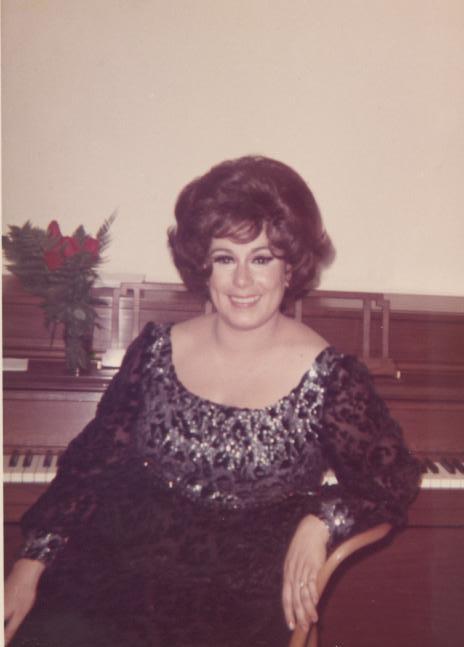
    Her performance was something of a revelation: it was a big, warm lyric voice bordering on spinto. Her tone had an unusual freshness and clarity, with a pliant technique and shining upper register, and the kind of vocal candor that one finds in a new singer who just sings without relying on artifice. The audience took to her at once – the fans sensing that here was an Italianate voice that had real potential in the Verdi & Puccini repertoire. After the great aria “L’altra notte”, Cruz-Romo was warmly applauded but it was in the Helen of Troy scene that she capped her success: in the great concertato “Amore mistero!” the voice sailed out over the ensemble with a gleaming quality and as the line soared up to its climatic top-B the sound seemed to blossom – and Cruz-Romo swept onwards to triumph. I met her after the performance; she and her co-stars Norman Treigle and Nicholas di Virgilio all signed my program:

    gilda 2

    The next afternoon at Footlights a small gathering of fans met and we played over and over again our house tapes of the performance; we must have listened to that ensemble about twenty times. People at neighboring tables were drawn to the sound of her voice. In those days, New York City Opera was a real Company: if you made a successful debut you were invited back and became part of the family and were cast in as much repertoire in your fach as was available. Obviously Julius Rudel knew a special voice when he heard it, so Gilda – as we were by now all calling her – sang there for the next 2 or 3 years until the Met snatched her away.

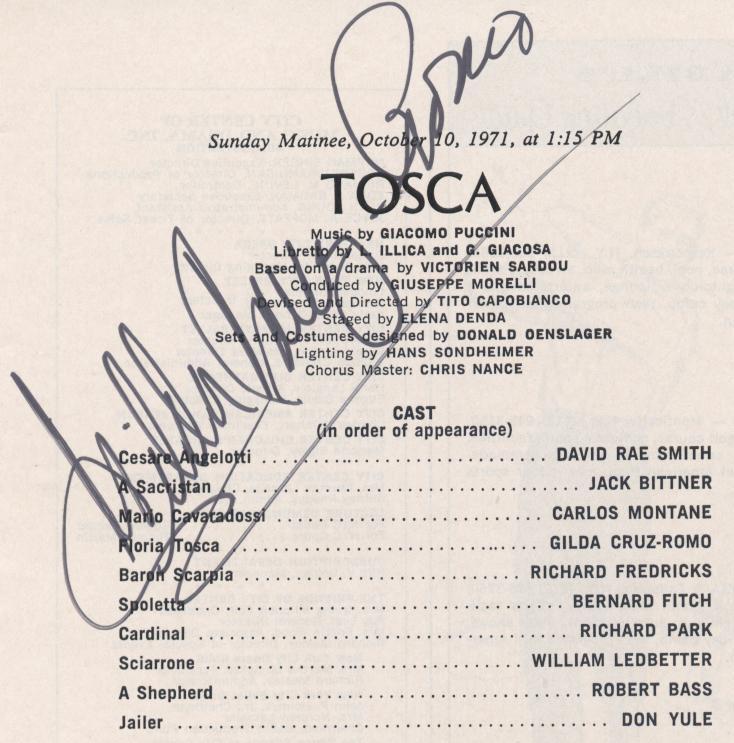
    And so I saw her in more performances of MEFISTOFELE, as a glowing-voiced Butterfly and a golden-toned Mimi (especially moving) and – in one of her first ventures into the heaviest rep – Amelia in BALLO IN MASCHERA. Of her City Opera performances, my very favorite was her Tosca in 1971:

    “…Gilda surpassed my highest expectations as Tosca. Rarely has this role had such a balanced combination of: a beautiful face, fine stage presence, sincere acting, fine diction and GORGEOUS spinto singing. In the first act, many phrases of great beauty. She looked lovely, young and excited. In Act II she sang superbly, her high Cs large and luminous. The dramatic utterances were all convincingly delivered. As she neared the end of her marvelously phrased “Vissi d’arte” tears welled up in her: one sob at the end, straight from the heart, was a perfect effect. She carried off the murder and the acting demands of the closing of Act II with excellent control. Maintaining her high level in Act III, Gilda ended the opera on a stentorian top-B and took a death-defying leap of ten feet! She was given a tumultuous ovation eminently deserved. Backstage she was literally mobbed – as big a crowd as I’ve seen at NYCO. After edging my way through the throng we hugged and she kissed me so many times. It took a few moments before either of us could speak…”

    gilda tosca

    When things calmed down and we got to discuss the performance, she told me how petrified she was of taking that final jump. The production was designed so that Tosca’s suicidal leap was visible to the audience as she fell about a dozen feet before a parapet blocked her landing-mattresses from view. She had not had a stage rehearsal and she said she got to the edge of the platform and realized in a split second how exposed her descent would be; she crossed herself and took the plunge.

    gilda 4

    It was inevitable that a voice like Gilda’s would be both wanted and needed at the Met. In 1970 she entered the Met National Auditions and was a finalist, singing “La mamma morta” from ANDREA CHENIER. On May 8, 1970 she debuted with the Company on tour in Atlanta singing that same opera. In December of the same year she debuted at the Met proper as Butterfly, beginning a career there that stretched into the mid-1980s and encompassed over 160 performances.

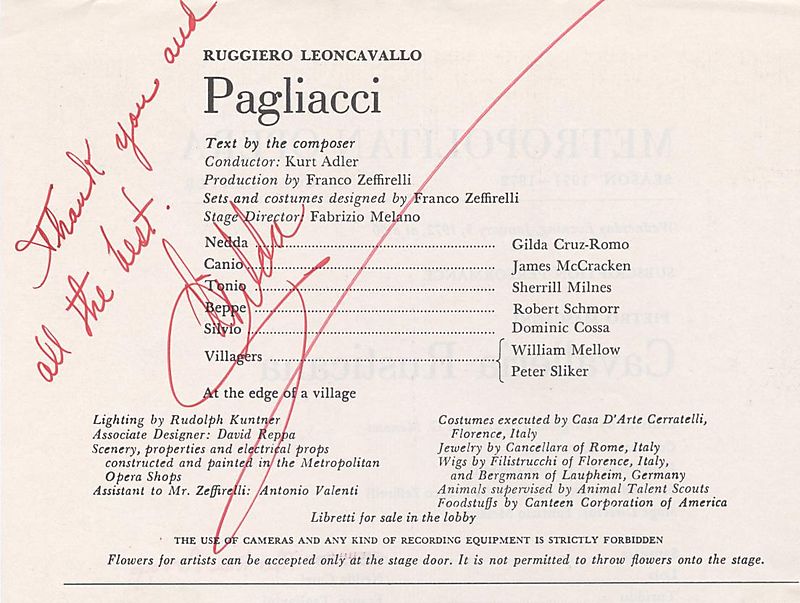
    gilda pag

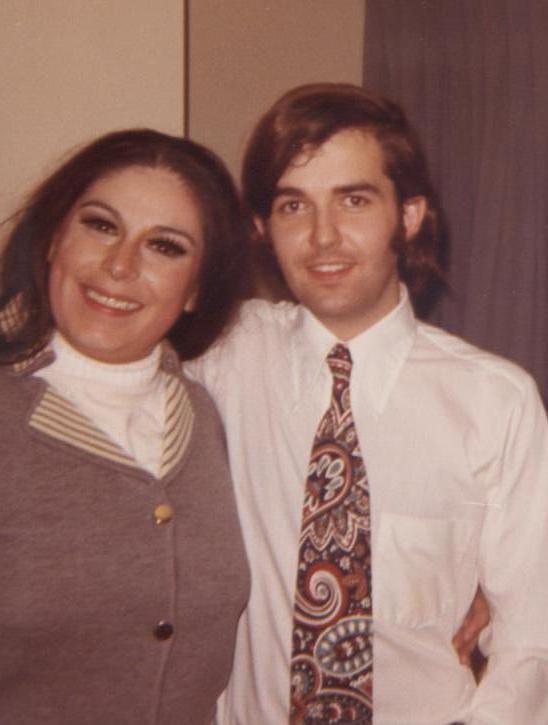
    I saw her at the Met for the first time as Nedda in PAGLIACCCI opposite the frighteningly intense Canio of James McCracken. Gilda sang so beautifully, especially in the sensuous duet with Silvio (Dominic Cossa): “…great crescendos from tiny pianissimos...” It was after this performance that she and I were photographed together backstage. (OK, no comments about my tie…or my hair! Remember this was the 70s).

    gilda 3

    Then came a hiatus: I moved to Houston for a while and only kept tabs on her via the broadcasts. But after a while I was lured back to the Northwest and we had a beautiful reunion at a matinee of AIDA where she sang opposite Franco Corelli:

    …Gilda was in complete command of this arduous role every step of the way…there were phrases upon phrases of golden Verdi singing: her deeply-felt prayer at the end of ‘Ritorna vincitor’ and the miraculously spun high pianissimi in ‘O patria mia’ and even more incredibly on ‘Fuggiam, fuggiam…’ as she lured Corelli into her escape plan. She was able to healthily dominate the big ensembles and then turn around a float effortlessly in the tender ‘O terra addio…’  Really top-class Verdi singing!”

    Gilda also sang in a revival of MANON LESCAUT and sounded lovely despite being cast opposite a very mediocre tenor. Her ‘In quelle trine morbide’ was poignantly phrased, mirroring Manon’s longing for the simple, true love of her Chevalier des Grieux. (Photo: Bill Hendrickson).

    Gilda Cruz-Romo – In quelle trine morbide – MANON LESCAUT -Met dress rehearsal 1973

    Then several things happened which kept me from seeing her onstage at the Met; I moved to Hartford with TJ and for a couple years we were basically broke. Trips to New York were infrequent and most of the time ballet trumped opera.  Then too, Gilda’s international career was in full bloom; it seemed she sang everywhere and sang the most taxing repertoire – I think I once read that she ended up singing Aida five-hundred times! It seemed like whenever I was at the Met, she was somewhere else.

    gilda desdemona

    Thus it was a special pleasure when she came to Hartford and sang Desdemona in OTELLO (above), one of her most attractive roles. In 1979 she was Desdemona on a Met telecast opposite Placido Domingo and Sherrill Milnes.

    In 1987 I saw Gilda onstage for the final time, as Cherubini’s Medea at Bridgeport, Connecticut. The declamatory style of many of the character’s utterances didn’t suit her so well – she was always a melodic singer – but the voice was still powerful and expressive.

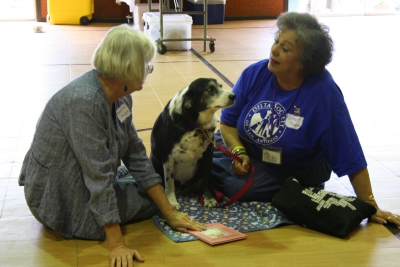
    I met her again a few years ago when she was honored by the Puccini Foundation. I handed her the photo of the two of us and it took her only a half-second to realize who I was…I have changed MUCH MORE than she has!  We keep in touch now; she lives in San Antonio and I was tickled to read recently that she keeps up her deep-sea fishing and is also active in a local Texas group which matches senior citizens with canine companions:

    gilda 5

    It’s been a long time since that day in Footlights soon after her NY debut that I pestered her with a million questions and she was unbelievably kind and patient. Once I wrote to her after she’d sung the title role in ANNA BOLENA in Dallas expressing my dismay that I couldn’t have been there; a few days later I was astounded to open the mailbox and find she had sent me a tape of the performance. That’s the generosity of spirit that Gilda always shows. So now, with love and gratitude, I’ve tried to put my admiration for her into words.

  • Wendy & Pauline

    (Imported from Oberon’s Grove, a 2007 story of one of my most memorable days as a blogger: a chance meeting with New York City Ballet’s Wendy Whelan and Pauline Golbin)

    wendy pauline c

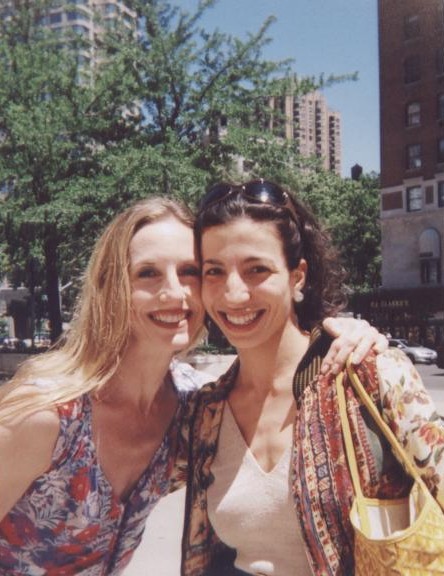
    This was my big opportunity as a blogger: having Wendy Whelan and Pauline Golbin and my camera all in the same place at the same time. To be honest, I almost always have my camera with me but I rarely work up the nerve to ask any of the dancers if I can take their picture. However, it was such a gorgeous day (6/23/07) and the girls were in such a great mood that I said ‘what the heck’ and asked them. I just love the results, if I do say so myself. And I will tell you that these two dancers have an awful lot to do with not only my devotion to NYC Ballet but the way I have come to watch the Company.

    After going to NYCB pretty often in the late 1970s, I sort of wavered; I was really into opera, and whenever I would come down to NYC from Hartford, opera was my main priority. It’s too bad because every time I did squeeze in a visit to the State Theatre I just loved it. I missed entire careers there, and dancers I really admired came & went without me being aware of it.

    In 1996 I was dating a Japanese guy named Toshi who lived on the East Side; he was a textile designer with an incredible eye. One night on a whim, I took him to NYC Ballet. Walking home across Central Park, I asked him if any of the dancers had made an impression. “Wendy Whelan. Can’t you see she is on a whole other level from the other dancers?” I had seen her dance a few times and always really liked her. So we started going pretty frequently and I realized he was right. There seemed to be something almost profound about everything she did – not profound in a weighty sense but in a way of making you feel and think about what she was doing as being more than just dancing.

    After I moved here in 1998 there was a season when most of the principal ballerinas were either sick, injured, or pregnant. Wendy, along with Yvonne Borree and Miranda Weese, was carrying the whole season and since there were lots of ballets that Yvonne & Miranda didn’t do, Wendy ended up dancing at literally every performance, and often two – and sometimes three – ballets a night. Far from getting tired of her or craving a different face and body, I became addicted. Wei and I went more and more frequently, just to see what she would do. We fell under her spell. Going so often simply became a habit, and when  the other ballerinas rejoined the ranks we found that Wendy had managed to get us hooked on the whole scene.

    It was Pauline Golbin who turned me into a corps-watcher. And again it was Toshi who noticed her. I must say that until 1996 I didn’t pay much attention to the corps. I knew they were there and that Mr B had given them plenty to do on any given night, but I couldn’t tell one bun-head from the next, and the boys I hardly ever even noticed. So after one piece, Toshi asked me: “Who is that girl with the black hair and the wonderful smile?” Hmmmm, well there’s about a dozen of ’em onstage; I couldn’t answer his question. We came out the side doors and this very girl dashed past us in a striking coat, scarf,  and hat.”That’s her! So chic!!” said Toshi. So next time we went we started looking for her; it became a ritual to find this girl onstage. Then, during an intermission, we scanned thru the season booklet and found her: Pauline Golbin.

    By watching for Pauline, I started  to notice how demanding the corps work was at NYCB, and that they weren’t just a mass of anonymous bodies but beautiful/handsome people who were doing amazing things. I began matching names to faces and hoping to see certain dancers get some of the featured roles. I began watching the corps much more intensely, and it really gave the performances a whole other dimension. There have been many nights when I have gone to a performance just because someone from the corps that I like had landed a solo.  Of course, I love to see them get promoted though I realize not everyone can be a soloist. Though many of them should be.

    wendy pauline 2 copy

    Pauline is famous for her hats, and I said something about it…and she reached into her bag and pulled one out. In the book ROUND ABOUT THE BALLET, Wendy was asked: “Is there anything people don’t know about you that you’d like them to know?” and she replied: “I’m a funny person! I think I come across as so serious in ballets. But I’m a pretty silly girl. I don’t know if people realize that.” So it didn’t surprise me when she started cutting up and trying to get under Pauline’s hat.

    As they strolled into the theatre, I really felt like I’d truly been in the right place at the right time.

  • I Lived With Madonna!

    kenny madonna

    (Another personal story from Oberon’s Grove: the story of Kenny and me.)

    My best friend Richard and I were living in a walk-up near Trinity College in Hartford in 1985, and we did our grocery shopping at Stop & Shop. Working there as a cashier was a very handsome and unusual-looking boy with red hair and Spanish eyes. Both Richard and I were quite taken with him but he was totally aloof: never made eye contact when he was ringing up our groceries, and if we asked him a question he would give a one-word, dismissive answer. However, that didn’t deter us from always choosing his check-out lane. Then one day he disappeared. I assumed he had found a better job.

    kenny 1

    I was right. He suddenly appeared in the cafeteria of the building where I worked. I managed to find out that he was working in a medical billing office which was renting space from my company. My one-sided infatuation suddenly took on a new aspect when – to my amazement – he began making eyes at me during lunch hour. My co-workers were instantly aware of what was going on, and they would always arrange for me to have a seat at the table with a clear prospect for flirting with the mystery boy. This went on for a couple of weeks; Franky, the Hispanic boy from the mail room who I was fooling around with, referred to the interloper as Peppermint Patty. Everyone seemed to be watching and waiting for something to happen.

    Then one afternoon Pam, the adorably mischievous little Black girl who did our filing, whispered in my ear: “You know that boy you like?  He’s upstairs at the soda machine!” I never moved faster in my life. I raced up the stairwell and found him coming down.  “Hi! I’m Philip.” “I’m Ken.” Then I shoved him up against the wall and started kissing him. He liked it. “How old are you?” “19,” he lied. I was thinking more like ‘barely legal’. Turns out he was 18.

    He came over that night and in between doing what boys like to do we found out about the complications that we would be dealing with in the weeks ahead: his girlfriend, my boyfriend, his mother. Extricating ourselves from these situations was a long and frequently agonizing process. Many nights we had no place to go and spent hours driving around in his car, Miss Malibu, listening to Madonna singing La Isla Bonita. Like all young people at that time, he adored Madonna. I got used to her, for his sake. We went to see DESPERATELY SEEKING SUSAN, blatantly making out in the darkened cinema.

    Sparing you the novel-length description of our travails, it’s enough to say we ended up finally freeing ourselves from our involvements with Carmen and Felix, and that his mom eventually came to accept me as a second son.

    kenny and me

    We set up house together in a very nice apartment in Downtown Hartford; for the first few weeks we holed up there, delighting in being alone together in our own place. The only thing I could cook was spaghetti with sauce from a jar. We ate that on so many nights and went out to our favorite haunt, Shenanigans, two or three times a week. Mostly we just talked and talked and talked. Kenny told me his story, which I found extremely moving. Abandoned in a hospital lobby in Columbia, South America as a baby (he has a white scar on his ankle where the I.V. was inserted that kept him alive) he was adopted via a Catholic orphan-placement organization by parents in Maine of Canadian descent. His adoptive father was a slacker, but Little Mama – as I came to call her – worked tirelessly at a manufacturing job to make a life for herself and her son. That he turned out so well is a credit to her energy and devotion.

    In my vanity, I loved introducing him to my friends; having a twenty-years-younger lover was a novelty for me and I was feeling rejuvenated. In truth though, neither one of us was ready for a committed, monogamous relationship. I still had a vast supply of wild oats to sow and he, newly exposed to the gay world, was a bit like a kid who had never been inside a particularly yummy candy store before. Knowing that young people need to be amused, I started taking him out to Backsteet. Hartford had a limited dance-club scene: Backstreet was pretty much it. There were flirtations, jealousies, three-ways. For a brief period we lived in a stormy menage a trois with a Portuguese boy. The one person who had the potential to be a major part of our life, Freddy, contacted viral pneumonia soon after we’d met him and died within three days.

    For all the turmoil in our socio-sexual lives, we stuck together. We basically liked each other and got on well despite the 20-year age difference.

    kenny 3

    We spent lots of time in Provincetown where the beaches, bars, jacuzzis and rooftop sundecks seethed with erotic possibilities all day and night. Following an afternoon on the dance floor at The Boatslip we would settle in for a long dinner at our favorite place, Gallerani’s. One of the many memorable evenings we spent in P’town was attending the local premiere of Madonna’s TRUTH OR DARE.

    We took in his cat, Boo, from his mom’s menagerie and moved to a lovely townhouse in the West End. Madonna’s poster was up, her music playing frequently. On one trip to P’town he played the DICK TRACY soundtrack about 1,000 times; I really didn’t mind. I’d gotten used to living with Madonna. 

    We sunbathed in the park, trekked to Jacob’s Pillow, adored Emmylou Harris, shopped at Macy’s in New Haven, and danced on weekends. He spent more and more time with his best friend Danny. I’d go down to New York City for opera and ballet knowing he was home getting into mischief. We sort of had an understanding…but, like most understandings, this one started to wear thin.

    When the owner of the townhouse wanted it back, we moved for the last time together to a nice but ordinary place. I nursed him thru a bout of illness, and we still sometimes referred to ourselves as lovers, but after six years of togetherness (with a couple breaks) we each had our own life and we were becoming something of a hindrance to each other. We couldn’t form relationships with other people when we were still tied to each other domestically. I had met and fallen in love with a Chinese callboy in NYC and was obsessed with all things Asian. Having enhanced his body at the gym, Kenny was quite the object of desire. Things had reached a turning point.

    After quarrels and edginess started to overwhelm the good times of our life together, we decided to live separately. He had expanded his social circle and after a while he moved to Philadelphia (leaving me bereft, though I never told him that) and eventually to Fort Lauderdale. I took a beautiful, huge old top-floor apartment in the West End, biding my time and knowing that by my 50th birthday I really needed to escape to Gotham. I did, and Kenny was among the guests at my 50th birthday lunch in the Village.

    kenny and me 2

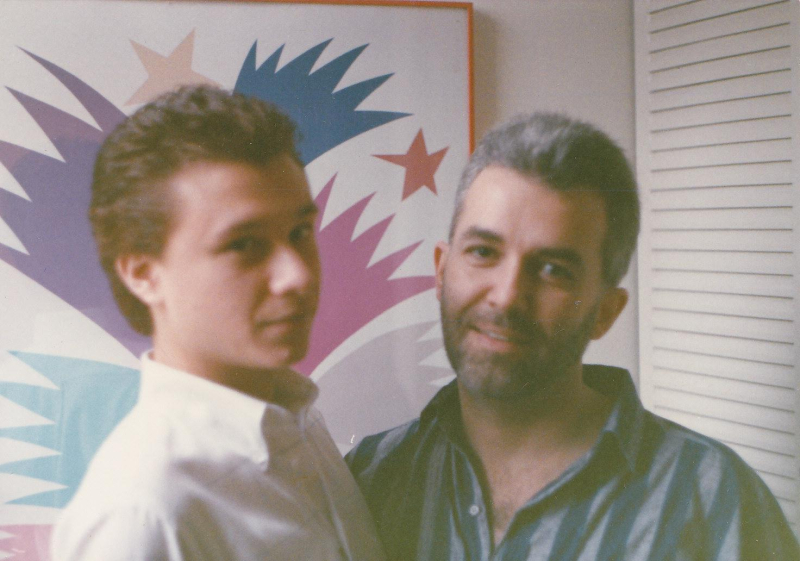
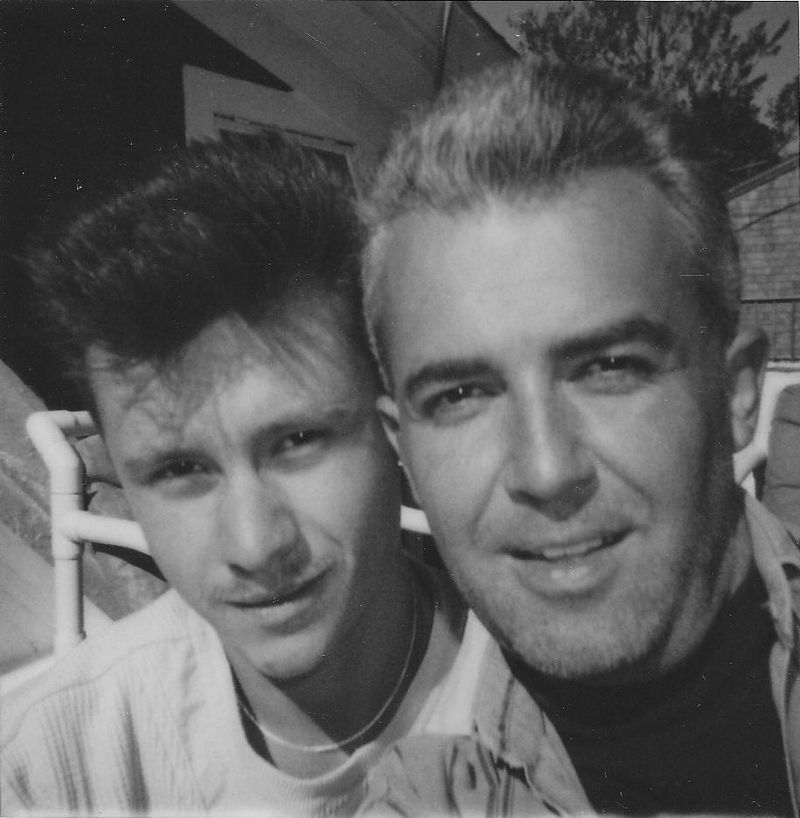
    One of my favorite pictures of Kenny & me, on the roofdeck of the Normandy House in P’town. I can imagine him saying: “Oh, my god…my hair!”  It was very stylish at the time, however.

    We have remained good friends and though we haven’t seen each other for years, we keep in touch and we understand one another in ways than only former lovers truly can. Whenever I hear Madonna’s voice, I remember our times together. In true romantic fashion, I have forgotten all the bad things between Kenny and me, and can best remember us driving around on those first unforgettable nights, when he would play ‘La Isla Bonita‘, singing along and changing the words: “…I fell in love with San Felipe…”

  • NYCB Flashback ~ Wendy Whelan’s Farewell

    (Bringing this 2014 article forward from the Grove to celebrate the one-and-only Wendy Whelan.)

    ww by matt murphy

    Above: Wendy Whelan, photographed by Matt Murphy

    Saturday October 18th, 2014 – No two ballerina farewells are ever alike. Darci Kistler’s farewell marked the end of an era, as she was considered “the last Balanchine ballerina”. At Heléne Alexopoulos’ gala we celebrated one of the greatest beauties ever to grace the stage. Yvonne Borree’s farewell was the most touching, Kyra Nichols’ the most moving. I missed the farewells of Jenifer Ringer and Janie Taylor, saying ‘goodbye’ to them in the days prior to their final bows, simply because I couldn’t imagine NYCB without them. Miranda Weese wasn’t given the full farewell treatment as she wasn’t retiring, just changing companies. I missed her even before she was gone, and I still miss her.

    Tonight, Wendy Whelan’s farewell summoned up an enormous range of emotions, just as her dancing has always done. The programme was well-chosen to underscore her association with four great choreographers, including a complete performance of one of her signature ballets, Balanchine’s LA SONNAMBULA, excerpts from works by Jerome Robbins, Alexei Ratmansky, and Christopher Wheeldon, plus a special pièce d’occasion: a new pas de trois devised for Wendy, Tyler Angle, and Craig Hall in a choreographic collaboration of Chris Wheeldon and Alexei Ratmansky.

    Daniel Capps was on the podium for the opening SONNAMBULA and the concluding Vivaldi/Richter setting for the premiere of BY 2 WITH & FROM; Andrews Sill led the Shostakovich score for CONCERTO DSCH. Throughout the evening, Company musicians were featured: pianist Cameron Grant playing the Chopin for GATHERING; Susan Walters at the keyboard for CONCERTO DSCH; violinist Arturo Delmoni with Cameron Grant for AFTER THE RAIN; and violinist Kurt Nikkanen for the Vivaldi/Richter. For each of them, Wendy had a very cordial greeting, and at the end of the evening she stepped to the edge of the stage and swept into a deep curtsey to thank the NYCB orchestra for their invaluable support throughout her career. That was a particularly lovely moment.

    The emotional temperature ran high all evening; in fact several people I talked to spoke of how they had experienced unusual mood swings from giddiness to despair throughout the day, anticipating Wendy’s dancing whilst regretting that it would be her last time on this stage. 

    Following LA SONNAMBULA‘s opening scene and divertissements, Wendy appeared to the first ovation of the night. She conveyed the mystery of the sleepwalker with her pin-pointe bourrées; in a trance, she managed to totally ignore Robert Fairchild’s endless attempts to intrude on her private world. Earlier in the work, Sara Mearns, Amar Ramasar, Likolani Brown, Megan Mann, Devin Alberda, David Prottas, Lauren King, Antonio Carmena, and Daniel Ulbricht were all vividly present, and they joined in the applause for Wendy during the bows.

    In the DANCES AT A GATHERING excerpt, Wendy joined Abi Stafford and Rebecca Krohn in dances of sisterly joy; Jared Angle, Adrian Danchig-Waring and Zachary Catazaro were the handsome cavaliers. In the passage where the girls are flung from one boy to the next, Zachary made an amazing catch of Wendy as she hurtled thru the air into his arms.

    It was that poignant piano theme in Shostakovich’s concerto #2 – played with great clarity by Susan Walters – that really put me over the edge. Wendy and Tyler Angle danced the adagio from CONCERTO DSCH luminously, with such expressive lyricism. A beautiful sextette of supporting dancers conveyed the quiet intensity of the little vignette Ratmansky has created for them here: Alina Dronova, Gretchen Smith, Lydia Wellington, Joshua Thew, Justin Peck, and our newly-promoted-to-soloist Russell Janzen. How thrilled they all must have been to share these moments with Wendy one last time.

    Wendy and Craig Hall then danced the pas de deux from Wheeldon’s AFTER THE RAIN, holding the audience in an enraptured state as the crystalline purity of the Arvo Pärt’s ‘Spiegel im Spiegel’ stole thru the silent hall in all its poignant grace. It seemed that time stood still here, allowing us to immerse ourselves in the spell-binding artistry of these immaculate dancers.

    In between the three above-listed shorter works, brief films were shown while Wendy changed costumes. In these films, the ballerina I have had the honor to know revealed so many facets of her personality. In one utterly Wendy moment, she played up the mock-jealousy of finding Craig Hall emerging from a rehearsal with ‘another woman’: Rebecca Krohn. That made me laugh out loud. 

    And all to soon, we had reached the end. The Ratmansky/Wheeldon collaboration provided an excellent setting for Wendy’s last dance on Mr. B’s stage. With her two princes – Tyler Angle and Craig Hall – she conveyed the supple strength, tenderness, gentle wit, and sheer overwhelming beauty that have made her one of the great dance icons of our time. The ballet ends with Wendy reaching for the stars.

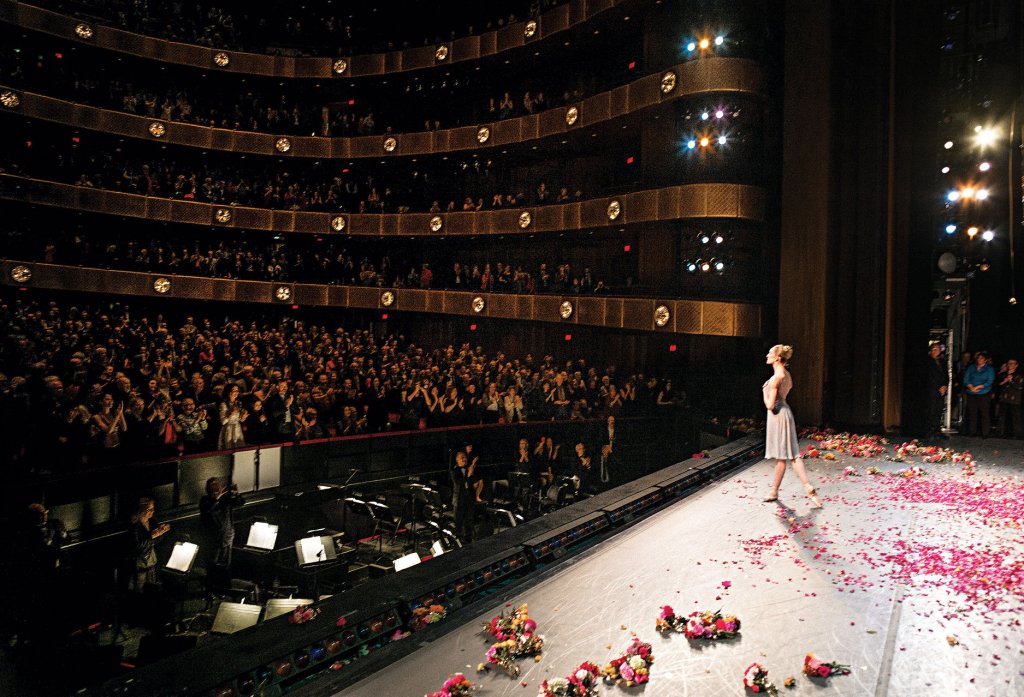
    At a farewell, the actual dancing often takes a back-seat to the event. The ballerina appears in selections from her cherished roles and as we savor her artistry one last time while secretly we are looking forward to the downpour of rose petals, the flinging of bouquets, the embraces of colleagues, the inevitable “last bow”, and the opportunity to express our admiration in unbridled clapping and shouting.

    ww farewell

    For Wendy, the huge ovation at the end signified not only our appreciation for all she has accomplished in her magical career to date, but also our plain unvarnished love for her as a human being.

    As the applause at long last echoed away, I started walking up Broadway, planning to attend the after-party. But then I just felt a need for solitude and reverie, so I jumped on the train at 72nd Street and came home. I was thinking yet again that it has been my great good fortune to have been in this City at the same time as Wendy Whelan.

    LA SONNAMBULA: Whelan, R. Fairchild, Mearns, Ramasar, Mann, Brown, Alberda, Prottas, King, Carmena, Ulbricht

    DANCES AT A GATHERING (Excerpt): A. Stafford, Whelan, Krohn, Danchig-Waring, Catazaro, J. Angle [Solo Piano: Grant]

    CONCERTO DSCH (Second Movement): Whelan, T. Angle [Solo Piano: Walters]

    AFTER THE RAIN Pas de Deux: Whelan, Hall [Solo Piano: Grant; Solo Violin: Delmoni]

    NEW WHEELDON/RATMANSKY (World Premiere): *Whelan, *T. Angle, *Hall [Solo Violin: Kurt Nikkanen]

    (It took me a long time to settle on a portrait of Wendy to headline this article. Matt Murphy took the picture at the top when Wendy guest-taught a class at Manhattan Movement and Arts Center a couple of years ago. To me, the photo is her…I love the wispy strands of hair at the nape of her neck, and her utterly unique beauty.)

    Bringing this story up to date, Wendy is currently the Associate Artistic Director of the New York City Ballet.

  • It’s All Because of Renata Tebaldi

    (One of my earliest long articles for Oberon’s Grove: the story of how my obsession with opera started.)

    tebaldi copy

    In a way, I could say that I am where I am today because of Renata Tebaldi. It’s simplistic, and of course there are a million things which influence our choices as time goes by. But it was Tebaldi who made me fall in love with opera; it was opera that brought me to New York City on my own for the first time in 1966;  it was in New York City that I – the proverbial small town boy – discovered that I was not the only male in the world attracted to other men; it was a fellow opera fan who introduced me to New York City Ballet; it was my devotion to opera and ballet that kept me coming to NYC from Connecticut for 22 years – and spending a fortune.  And finally it was the desire to have opera & NYCB at my fingertips that finally got me to move here in 1998. And once I did, I met Wei. So, I owe it all to Renata!

    It was on January 12, 1959 that I happened to watch the Bell Telephone Hour; Tebaldi sang excerpts from MADAMA BUTTERFLY. I know the exact date because the performance has been released on video. This was not my first exposure to operatic singing; my parents had some classical LPs in their collection and there were snippets of Flagstad and Lily Pons on these. But nothing that moved me or drew me in like watching Tebaldi’s Cio-Cio-San. That was the beginning.

    My parents bought me my first 2-LP set of opera arias; I found out about the Saturday afternoon Met broadcasts; I subscribed to OPERA NEWS; I wrote fan letters to singers I heard on the radio. I used my tiny earnings from my paper route and working in my father’s store to buy a few more LPs. I plastered a big bulletin board in my room with pictures of singers. My parents took me to my first opera at the Cincinnati Zoo. Then they took me to the Old Met.  But it was a lonely obsession; I had no one to share it with.

    In 1966 when the new Met opened, I was allowed (freshly out of high school) to make my first trip to NYC alone. I got a room at the Empire Hotel and timidly went across the street to Lincoln Center.

    tebaldi ticket line c

    There I found a group of people sitting outdoors along the North side of the Opera House. “Sign in and take a number,” said a girl who was minding the line. Somewhere I still have my tag; I think I was number 57. I sat down and soon people started talking to me; I suppose to the many gay men the sight of a novice seventeen-year-old must have been tantalizing even though I was pretty ordinary looking. But people were so nice: what operas did I want to see? What singers did I like? After 5 years of having no one to talk about opera to, I thought I was in heaven. I shyly mentioned liking Gabriella Tucci, who I had seen at the Old Met. So the Tucci fans gathered and we talked about her.

    I ended up not leaving the line for 3 days and 2 nights. The late summer air was comfortable; we slept (or stayed awake) on the pavement. We sang thru complete operas: we sang all of TOSCA and someone jumped into the (empty) fountain at the end. People gave me soda, a few of the girls brought home-made baked goods. Pizzas were ordered, and Chinese take-out. Someone smuggled out a recording of a rehearsal of FRAU OHNE SCHATTEN  – a work most of us were totally unfamiliar with. I was devastated hearing the voice of Rysanek in that music for the first time. Franco Corelli served coffee one night; Franco Zeffirelli came out and got in someone’s sleeping bag. News filtered out about the new productions that were being rehearsed. There was a flurry of excitement when Leonie Rysanek was spotted at the far end of the Plaza. The crowd, now hundreds strong, surged around her. In a panic, she gestured for security guards from the House to come to her aid. Once inside, she turned and waved to us.

    Finally the box office opened; I got my tickets: TURANDOT, TRAVIATA, GIOCONDA, ANTONY & CLEOPATRA, RIGOLETTO. I had made my first friends in NYC; I had addresses and phone numbers of people who would send me tapes and get more tickets for me.

    Grubby and ecstatic, I went back to the Empire. My pants were slipping down: I hadn’t been eating. I took the bus back to Syracuse, asleep. My parents picked me up and took me home. I fell asleep in the bathtub.

    Soon after, I was back in NYC for the performances I had bought. For some strange reason, I had also stopped by the New York State Theatre and bought a ticket for their Opening Night of Handel’s GIULIO CESARE. Beverly Sills was singing Cleopatra. I had heard her already when NYCO toured to Syracuse and she sang Rosalinda in FLEDERMAUS. The CESARE was of course Beverly’s “big bang”.

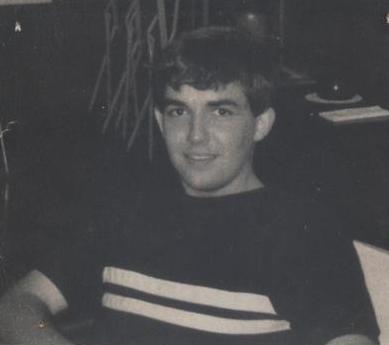
    This was what I looked like during that summer of 1966; I loved this t-shirt and wore it literally every day until it wore out. My sweet Jeanette says I was “embedded in it.”

    tebaldi me
  • My First – and Only – Public Appearance

    coppelia size

    (This article originally appeared on Oberon’s Grove in 2008. I’ve brought it forward to the Glade as it’s about an especially meaningful period of my life.)

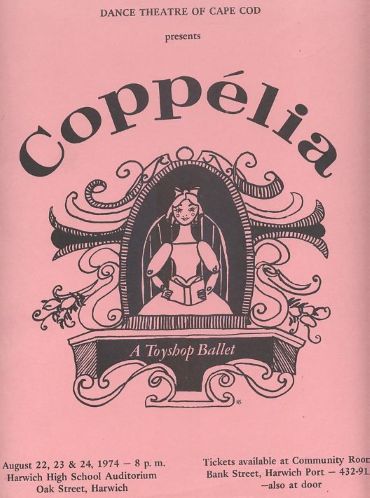
    When I was twenty-five I fell in love with a 17-year-old kid who spent his summers working for a small ballet company, Dance Theatre of Cape Cod. He invited me to spend a summer with him there; we would live in a room in a big house in Harwichport across the street from the studio.

    Within a week after we got there, he was totally immersed in the ballet. They were mounting COPPELIA at the end of the summer; he was dancing Franz and also was the business manager for the school. He and Helen, the woman who ran the program, were very close. I could see that I was going to be playing second fiddle to COPPELIA all summer.

    At this point in my life, I had never seen a ballet performance; just tidbits on TV. I was a big opera fan, but whenever there was a ballet in an opera performance I was bored to death.

    coppelia 2

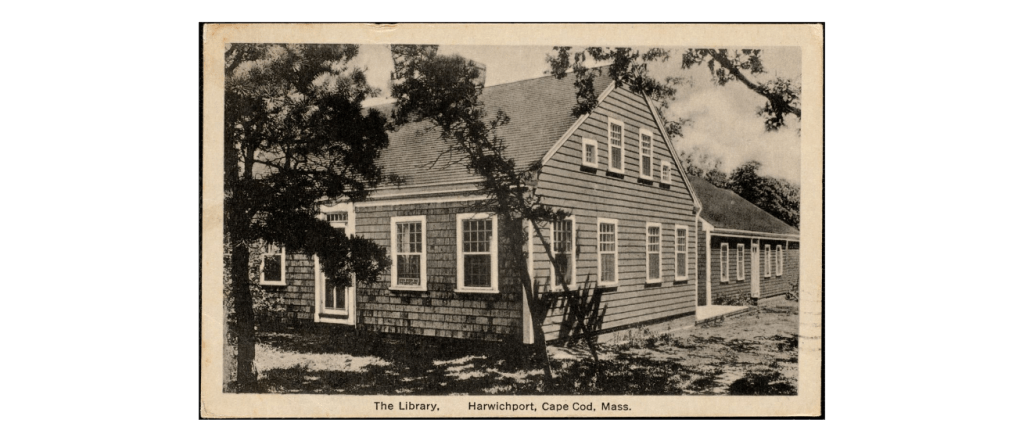
    The studio was located behind (and connected to) the Harwichport Town Library, directly across the street from the house where we were staying. So, the music of COPPELIA wafted over from the studio, and that drew me there. When I first walked into the studio I was much intrigued by the musty smell of old costumes that were hung out to air, and the girls (ages 8-16) were dazzled to have a man watching them. They became giggly and adorable.

    The teacher eyed me with the sort of interest that small-time ballet mistresses have eyed young men for decades: could she transform me into a “dancer”?  She had TJ to play Franz, she had a local actor to play Doctor Coppelius, and the boyfriend of one of the girls to play the Mayor. She wanted very much to have another male in her production, especially to pique the jealousy of the rival ballet school a few miles away.

    “I’m planning to stage a little folk dance in the third act,” she said to me. “Would you think about it? I’ll make it easy for you…” TJ was poking me in the ribs, “Say yes!” She played the piece for me: it would be myself and one of the girls; the music (which Balanchine uses for the Jesterettes) was bouncy and the piece was short.  Realizing that if I didn’t join in I would be seeing very little of TJ all summer, I said OK.

    Then came the clincher: I had to take class. This gave me pause, but only for a minute. I was slender then, and in reasonably good shape. We drove to a small dance supply shop in Hyannis where TJ helped me get a dance belt, tights and slippers.

    My first class was a riot. The beginners class, 8- and 9-year-olds, were thrilled to have a man in their class. They all wanted to stand next to me at the barre. When we began tendus, the teacher waltzed up to me and said: ” Point your foot!” to which I replied “Point my foot…at what?”

    The studio had a ghost, Ada, who we contacted nightly using a Ouija board. She was a nurse who told us she had cared for soldiers returning home after World War I. How she ended up in a dance studio was never revealed. (I have since found out that the building did indeed house recuperating soldiers upon their return from Europe!)

    I found that I had a natural affinity for ballet, not that I would have guessed. I began rehearsing my dance; my partner was a beautiful black-haired 14-year-old named Elaine. We got on perfectly. We played a betrothed couple who danced at Swanhilda’s wedding fete. Elaine was light and springy so the lifts were easy.In the dance, she did most of the work. Lots of stomping and romping. The piece ended with me on one knee; I reeled her in from some turns she was doing, she sat on my other knee and we smooched.

    coppelia 3

    Above: only known photo of me wearing tights…with my partner Elaine Aronson, a talented 14-year old.

    Costumes…I wore a blue satin vest, white tights and shirt, and blue suede boots. Elaine wore a white “peasant” dress with red character shoes and flowers in her hair. One of the mothers did my makeup. We had 3 performances, and our dance was a hit. One night one of Elaine’s friends tossed her a bouquet when we were bowing. Little kids asked us for our autographs.

    After that summer TJ and I moved to Hartford; eventually we split up. I continued taking class for about 3 years. Whenever I hear the music of COPPELIA I’m transported back to that sweltering studio and that care-free time.

    Beth Taylor had danced Swanhilda in our performances; the following winter she danced the Sugar Plum Fairy in another company’s NUTCRACKER. TJ and I drove down to the Cape in wintry weather to see her; aside from Beth several of the kids who had been in COPPELIA were dancing in the NUTCRACKER.

    coppelia 4c

    TJ took this picture of me & Beth after the show; it was the last time I ever saw her, or any of the other people I’d spent my memorable summer with.  

  • Singers: Jeannette Pilou

    (I have imported this story from Oberon’s Grove…it used to include lots of photos, but I just wanted to save what I’d written back in 2007. Here is a photo I took of her that she loved…she was so sweet as signed it for me.)

    pilou

    Around noon on October 7, 1967, I bought a big bunch of yellow chrysanthemums from a street vendor and rushed over to the stage door of the Metropolitan Opera House; the flowers were for one of my idols at the time, the Italian soprano Mirella Freni who was singing Juliette in Gounod’s ROMEO & JULIETTE that afternoon. I bounded up the steps to the Met’s stage door reception area and approached the desk. An indifferent woman was there, talking on the phone. When she finally hung up, she ignored me. “I want to leave these flowers for Miss Freni!” I said.  She looked up at me wearily and said, “Miss Freni is ill and is not singing this afternoon.”  Walking out, I held the door for a chorister who was coming in; “Want some flowers?” I said to her, handing her the mums. A few hours later I had fallen in love.

    Gay men fall in love with women all the time; of course, it isn’t ‘that kind’ of love. It’s usually an attraction to their beauty and their talent, tinged with a bit of regret that it couldn’t ever be the ‘other kind’ of love. That is exactly how I always felt about Jeannette Pilou. She made her Met debut that afternoon as Juliette and for the next few years she was a singer who intrigued me so often with the delicacy and charm of her singing, her unfailingly fresh dramatic interpretations of some of opera’s most beloved characters, and her modest sincerity and great kindness. The stages at Lincoln Center have been home to so many beauties, from Carol Neblett to Helene Alexopoulos, and Pilou was one of the most memorable of them all.

    Jeannette Pilou was born in Egypt and could trace her heritage to the Greeks, but for me she was always a French soprano. Her voice was lyrical with a metallic thread that gave it an easy projection. It was not in itself one of those beautiful instruments that immediately melt the listener; she never had a long breath line and her top register could get an edgy quality. Her appeal vocally was in the way she phrased and used a delicate pastel palette to make music you’d heard a hundred times seem new and alive. Aside from her incredible physical appeal, Pilou’s interpretations invariably brought those little gestures and expressions that you always remember. In the final act of TRAVIATA when the dying Violetta rises from her sickbed to be reunited with her beloved Alfredo, Pilou hastily looked at herself in the mirror before turning to present her ravaged face to her lover. I’ve never forgotten that moment of desperation which spoke so clearly of Violetta’s helpless regret over her fate.

    But I’ve gotten ahead of myself, because I must start with that debut Juliette which is where my love affair began. Pilou looked so fetching on her first entry at the Capulet ball, spiraling into her little introductory “Ecoutez, ecoutez!” with a voice that wafted clearly into the big house. Not long after, she won her first big applause at the Met singing Juliette’s waltz, “Je veux vivre” with easy scale-work, pointed diction and youthful vivacity; she even touched on the high-D in the cadenza which Freni had been omitting. Moments later Pilou encountered her handsome Romeo, Franco Corelli, and the chemistry was apparent from the start. Corelli was having quite a success as Romeo at the Met with his passionate vocalism, thrilling the house with a stunning diminuendo on the final B-flat of “Ah, leve-toi soleil!”. He was one of the few tenors at that time who looked good in tights, too. In their love duets, Corelli really seemed smitten with Jeannette and they sounded wonderful together. Corelli drew a thunderous ovation when he took a full-throttle top C upon Romeo’s banishment from Verona. The afternoon ended with a mammoth ovation; the curtain calls had been designed so that the title characters always bowed together and they came out several times until finally Jeannette made the beautiful gesture of withdrawing to let Franco have a solo call. The house exploded and Franco was so gracious when he brought Jeannette out again. In addition to the lovely impression her Juliette had made, Jeannette had endeared herself to the legion of Corelli fans in no uncertain terms. I met her after the performance and she was so lively and sweet, and even more beautiful up close than she had seemed to be onstage. Her speaking voice was so intimate and enchanting; I immediately added her to the list of singers whose performances would be a priority.

    Violetta in the Cecil Beaton production of TRAVIATA was my next Pilou role; she looked every bit as striking as Moffo in these costumes.  She was paired with the light-voiced tenor Luigi Alva  and they made a beautiful blend in the duets. Jeannette was so moving in the great Act II duet with Germont (Robert Merrill) where she struggled valiantly to maintain her composure as her fragile world crumbled around her. Phrase after phrase of wonderfully modulated vocalism wove a spell.  A few years later, Pilou stepped in to a broadcast of TRAVIATA replacing Montserrat Caballe; I was in the house enjoying Jeanette’s portrayal and her colleagues Carlo Bergonzi & Sherrill Milnes so much. A downward transposition in “Sempre libera” caused something of a scandal among the fans; I thought it was a rather minor transgression in view of what she was able to convey in the role.

    Micaela in CARMEN followed with Jeannette making a particularly lovely impression in the Act I duet with Nicolai Gedda. This was the infamous Jean-Louis Barrault production set inside the bullring. The cast, led by Grace Bumbry, almost managed to overcome the awkward staging; Jeannette’s big aria was lovingly phrased. Next came Zerlina in DON GIOVANNI in which she presented a very youthful, zesty portrayal of the peasant girl; singing opposite the Don of the young Puerto Rican heartthrob Justino Diaz, Jeannette reveled in the seductive expressiveness of “La ci darem la mano”.

    Jeannette & Franco Corelli created an atmosphere of extraordinary romance when they appeared together in BOHEME. This was one of Jeannette’s most moving portrayals,  using her mastery of parlando in the Act I narrative and spinning out some fragile piani in her ‘Addio senza rancor’. Franco was in prodigious voice, his singing so passionate and virile but also very tender; he was obviously smitten with his beautiful Mimi and changed the words in the love duet from “Dammi il braccio, mia piccina” to “Dammi il braccio, mia bambina.” In the moving trio where Rodolfo tells Marcello of Mimi’s hopeless ill-health, not knowing that Mimi is listening, Franco tore his heart out and the audience burst into a volley of bravos mid-act. Jeannette & Franco carried the romance of their characters into the curtain calls.

    At the dress rehearsal of NOZZE DI FIGARO in February 1972, Jeannette had one of her most attractive roles in Susanna. She gave a portrayal free of soubrette cuteness, utterly natural. Vocally she was in the captivating company of Cesare Siepi, the reigning Figaro of the day, the radiant Pilar Lorengar (Contessa) and the beloved and versatile Evelyn Lear (Cherubino). On the podium the great Karl Bohm served up perfect tempi and ideally supported his singers. The ensembles and gentle comic by-play were a joy. FIGARO soared. The photo shows Jeannette with one of New York’s best-known opera fans, Lois Kirschenbaum.

    It was amusing to walk Jeannette out from her dressing room after the rehearsal; when we came to the main reception area it was jammed with singers coming and going from coachings and I very much enjoyed observing the effect Jeannette had on all the men, including some very well-known tenors and baritones. If she was aware of the waves she was causing, it didn’t show; she greeted everyone with easy, modest charm and left them all panting in her wake.

    Later in the month, Jeannette took part in a memorable evening when FALSTAFF was revived. Sir Geraint Evans and Regina Resnik trod the boards with grand portrayals of Sir John and Dame Quickly. Renata Tebaldi was singing Alice Ford for the first time at the Met. The orchestra launched the scampering introduction to the second scene and when the curtain rose and the audience caught sight of the great Italian diva, the place erupted. The applause obliterated the music and when it died down the singers had lost their way; “Start over!” someone yelled and that is exactly what Christoph von Dohnanyi (debut) did. Jeannette was a cuddly Nannetta. In a magical moment she arrived at Herne’s Oak dressed as the Queen of the Fairies on a white Shetland pony. Her aria, “Sul fin d’un soffio” was spun out of moonlight. At the end of the romping ensemble which concludes the opera, Jeannette tackled a bright top-C. The curtain calls were so much fun and the audience truly reluctant to let the singers go. I had an aisle seat in the orchestra and sitting two rows ahead of me was Franco Corelli. I thought it was pretty nice of him to come out and support his long-time colleague Tebaldi. After the performance I spent a long time backstage with Jeannette who was in a particularly sociable mood. Everyone else had gone home, but she seemed in no hurry to leave. I said goodnight and came out to find Corelli pacing back-and-forth near the stage door with a limo waiting. Did they have a date? If so, she may have been standing him up.

    Jeannette and Nicolai Gedda were reunited in a wonderful performance of Gounod’s FAUST; the Met’s production was rather ugly (though later replaced by an even uglier one) but along with Cesare Siepi’s famed Mephistopheles, the singers carried the day.  The role really suited Jeannette to perfection: her clarity of enunciation of the French text added to the sweetness and dexterity of her singing made the long ‘Roi du Thule’ and Jewel Song sequence delightful. Later she and Gedda harmonized rapturously in the ‘Laissez-moi’ duet (the highlight of the score, in my opinion) and Jeannette sang the concluding lines of the Garden Scene (‘Il m’aime!’) with slowly mounting ecstasy. As the tides turned against Marguerite, Jeannette relied on the metallic thread in her voice to project over the orchestra in the Church Scene and in the ascending phrases of the final trio.

    It was a long time before I saw her onstage again; I spent some time in Houston and she was busy at other opera houses. In fact four years elapsed before I next saw her, again as Marguerite in FAUST, this time opposite the less-than-romantic looking but mellifluous Stuart Burrows in the title role. Jeannette’s interpretation had deepened although the production had deteriorated further with an especially awful ballet now being interpolated. She and Burrows rescued the evening.

    There was another very long hiatus before her next – and for me her most memorable – Met role as Melisande in Debussy’s masterpiece in 1983. The production was murky and grim (it has since been replaced by a far more atmospheric one) but musically it was so rewarding both in James Levine’s brooding traversal of the dense score and in the ideal interpretations of the three principal roles: Pilou as Melisande, Dale Duesing as Pelleas and the unforgettable Jose van Dam as Golaud.  As the gentle and mysterious Melisande, Jeannette ‘spoke’ her lines with a refined sense of lyricism and she was so moving in her simplicity and deeply feminine vulnerability. The overwhelming sadness of watching Melisande’s life fade away following the birth of her daughter left me feeling bereft.

    Two years later I saw Jeannette onstage for the last time, singing Nedda in PAGLIACCI. The tension in her upper register had taken its toll but she had some wonderful lyric passages, most notably in the duet with Silvio, and she mounted a fiery defense in the final moments before Nedda is brutally murdered.

    I had long since stopped visiting singers backstage but I did run into her in the Met lobby during her final season of Neddas and Micaelas and she was as lovely and gracious as ever. In the years since I first met Jeannette Pilou, the memories of her portrayals and of her easy kindness to a young and eager fan have stayed with me vividly.

    Here is Jeannette singing Juliette’s entrance and Waltz @ The Met.

  • Teatro Nuovo’s MACBETH @ City Center

    Teatro Nuovo 2025 Macbeth - Chorus of Scottish Exiles (Act Four)_Photo by Steven Pisano

    Above: the chorus of Scottish exiles; photo by Steven Pisano

    (Note: click on each image to enlarge)

    ~ Author: Ryan Vasquez

    Wednesday July 23rd, 2025 – This year, Teatro Nuovo staged both Verdi’s Macbeth (the 1874 edition) and Donizetti’s La Sonnambula. Verdi’s Macbeth is a relatively faithful adaptation of Shakespeare’s classic, but the opera could just as well have been titled Lady Macbeth, both because of the impressive music Verdi wrote for the character and because of Alexandra Loutsion’s commanding performance as the (almost) titular villain. The entire principal cast sang beautifully, but the night undoubtedly belonged to Loutsion.

    Teatro Nuovo is a summer festival where young singers and budding professionals spend the season working on two bel canto operas. Although Verdi is not typically categorized as a bel canto composer, his early works, Macbeth among them,clearly sit at the tail end of that stylistic era.

    The performance took place at New York City Center, just a block from Carnegie Hall. It was my first time attending a show at the venue, and it was fantastic, beautiful and acoustically quite pleasing. I was also glad to see a diverse audience that truly reflected the breadth of NYC’s population and age demographics.

    The full orchestra was positioned directly in front of the stage and served as a formidable counterpoint to the otherwise completely bare stage. I was surprised to find there were no set pieces at all, but I chose to be patient and see how things would unfold.

    Teatro Nuovo 2025 Macbeth_Jakob Lehmann conducting the Teatro Nuovo Orchestra_Photo by Steven Pisano

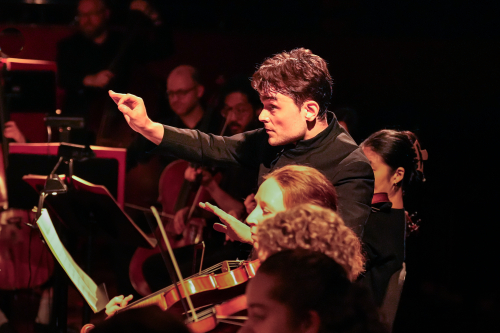
    Conductor Jakob Lehmann (photo above by Steven Pisano) walked out and began the overture. The orchestra displayed masterful control, delivering Verdi’s score with both power and delicacy. Their ability to handle the softer passages was especially noteworthy: opera orchestras aren’t always known for subtlety, but this one maintained finesse throughout the entire evening.

    I noticed the overture featured prominent use of brass, which I loved for its tone-painting quality. Brass instruments have long been associated with death, and Verdi’s thick brass textures effectively foreshadowed the bloodshed to come.

    Teatro Nuovo 2025 Macbeth_witchs chorus_Photo by Steven Pisano

    Above: the chorus of witches; photo by Steven Pisano

    The back wall of the stage lit up with a beautiful projection of Scotland, setting the scene for the witches’ chorus. Shakespeare’s version begins with three witches who famously chant, “Double, double, toil and trouble,” but this adaptation featured three groups of singing witches. All dressed in black, these choristers were young artists covering the main roles and performing comprimario parts.

    They sang well, and several performers fully embraced their witchy characters. However, a number of them seemed to lack fully developed characterizations. Overall, it was an effective, if slightly static, opening.

    Shortly after the choral number concluded, Macbeth, played by Ricardo José Rivera, and Banco, played by Cumhur Görgün, entered. Both were dressed in formal black attire, a costume choice shared by the rest of the male cast.

    They sang the duet “Due vaticini compiuti or sono” beautifully. I was particularly struck by Rivera’s smooth legato line. Görgün’s voice had a rich color, and I noted that the upper part of his range had more heft, making me wonder if he might actually be a bass-baritone. Regardless, the duet was a strong introduction to both characters and their voices.

    Teatro Nuovo 2025 Macbeth_Alexandra Loutsion as Lady Macbeth_Sleepwalking_2_Photo by Steven Pisano

    Above: Alexandra Loutsion as Lady Macbeth; photo by Steven Pisano

    After the stage cleared, a new projection depicted Macbeth’s castle. Lady Macbeth, portrayed by Ms. Loutsion, entered and delivered lines in wonderful Italian. I was surprised the passage wasn’t sung in recitative form, but soon she transitioned into the recitative section of her aria, “Nel dì della vittoria.

    Ms. Loutsion’s voice initially sounded like a mezzo’s, but given the heights her voice achieved, she was clearly a soprano. She commanded the stage and fully embodied the ambitious Lady Macbeth. The crowd adored her. Her coloratura rang with crystal-clear pitch, an impressive technical feat, and her intonation was impeccable. When she finished her aria, the audience erupted into applause. Well deserved cries of “Brava!” rang out. Loutsion stood in place until the cheers subsided, then exited the stage.

    Teatro Nuovo 2025 Macbeth_Ricardo José Rivera and Alexandra Loutsion as the Macbeths 3_Photo by Steven Pisano

    Above, the Macbeths: Mr. Rivera and Ms. Loutsion, photo by Steven Pisano

    Rivera’s characterization of Macbeth in the first scene leaned heavily into “anxious,” which worked initially but grew somewhat one-note. Fortunately, more nuance emerged during his duet with Lady Macbeth. The two had excellent chemistry, and Ms. Loutsion appeared more relaxed. If the shift in tone was an intentional choice to reflect Macbeth’s comfort in his wife’s presence, it was an effective one.

    They sang well, but I realized midway through their duet that I didn’t fully understand what had just happened to prompt the number. This moment highlighted the production’s biggest weakness: the acting and staging were secondary to the music.

    The motivation behind the duet was that Macbeth had just murdered the king and was now panicking over the bloodied dagger. However, the murder itself wasn’t shown. While the libretto indeed places the murder offstage, the production did little to make that event clear. The action often felt like an inconvenient hurdle rather than a driving force for the music.

    This lack of clarity recurred throughout the show. Events that should have been staged were either skipped entirely or summarized in supertitles. The most jarring example came at the end, when Macbeth and Macduff left the stage to fight. A supertitle then informed us that “Macbeth was fatally wounded.” After which the two returned. Macbeth proceeded to lie on the floor. And then die. 

    Returning to the earlier moment: after the Macbeth/Lady Macbeth duet, the chorus launched into a rousing Verdi finale. It had all the signature hallmarks of Verdi’s brilliance, even in this early work. I was particularly impressed by Martin Luther Clark, who sang the role of Macduff. Though Macduff doesn’t do much until the final act, Clark’s sterling tenor soared clearly above the orchestra.

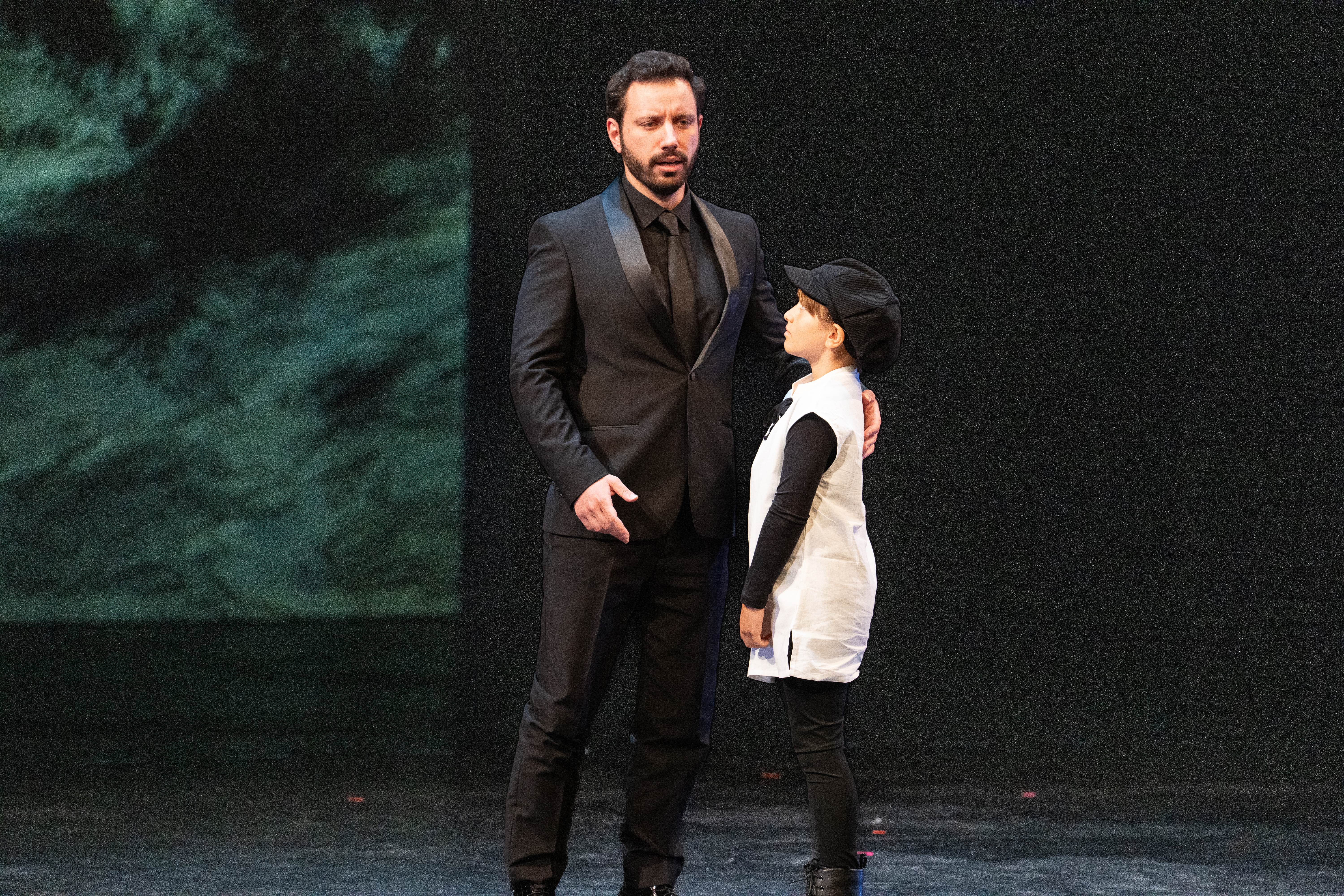
    Teatro Nuovo 2025 Macbeth_Cumhur Görgün as Banco  Olivia Trinchera Citterio as Fleanzio_Photo by Steven Pisano

    Above: Cumhur Görgün as Banquo and Olivia Trinchera Citterio as Fleance; photo by Steven Pisano

    In the next act, Banco and his child were outside the palace, unaware of the events unfolding within. Görgün sang Banco’s aria beautifully, again showing off his warm tone. Banco then exited the stage and was murdered (again offstage), and the scene shifted back to Macbeth’s castle.

    Teatro Nuovo 2025 Macbeth_Ricardo José Rivera as Macbeth_6_Photo by Steven Pisano

    Above: Ricardo José Rivera as Macbeth is haunted by Banquo’s ghost; photo by Steven Pisano

    Act II featured more beautiful singing, and Rivera seemed more animated and confident. During the finale, Banco’s ghost appears, visible only to Macbeth, but the staging failed to indicate he was a ghost. Since we never actually saw Banco die, the moment felt muddled. Simple makeup or lighting could have clarified things. Still, the ghost was soon forgotten as the act closed.

    Once again, the orchestra impressed. Their dynamic sensitivity, likely thanks to Lehmann’s direction, was a rare treat in opera.

    I thoroughly enjoyed the sprite scene in Act 3, where the female chorus returned as witches. The choral numbers throughout were well executed. The staging in this act was more dynamic, with some choreographed movement that added interest.

    Macbeth’s aria following the sprites was Rivera’s best of the night. His soft passages were beautifully rendered, showcasing his technique. He ended with a rousing cabaletta and held an extended final note that had the audience in raptures, particularly in the balcony, where the applause outlasted that of the orchestra level.

    The scene turned back to Macbeth’s castle. Although I had never seen this opera in person, I knew about the most famous scene that was Verdi’s take on Shakespeare’s famous lines for Lady Macbeth, “Out, damned spot! Out, I say!” Lady Macbeth’s attendants stood on stage giving the background details on why Lady Macbeth had seemed to have lost her mind. Once the preamble was finished, Ms.  Loutsion walked out as if in a trance and started to sing the famous aria Una macchia è qui tuttora.”  As the soprano mimed out washing her hands the audience was transfixed, for the entire scene, waiting with bated breath for the next moment to happen. And as Ms. Loutsion finished she walked off the stage with applause.

    Next came a scene featuring Macduff and Malcolm, the prince destined to take the throne Macbeth killed (offstage) to acquire. Romeo Lopez, who sang Malcolm, had a sweet voice but was overpowered by the orchestra. As a young artist, he has time to develop his voice, but for now, he struggled to be heard.

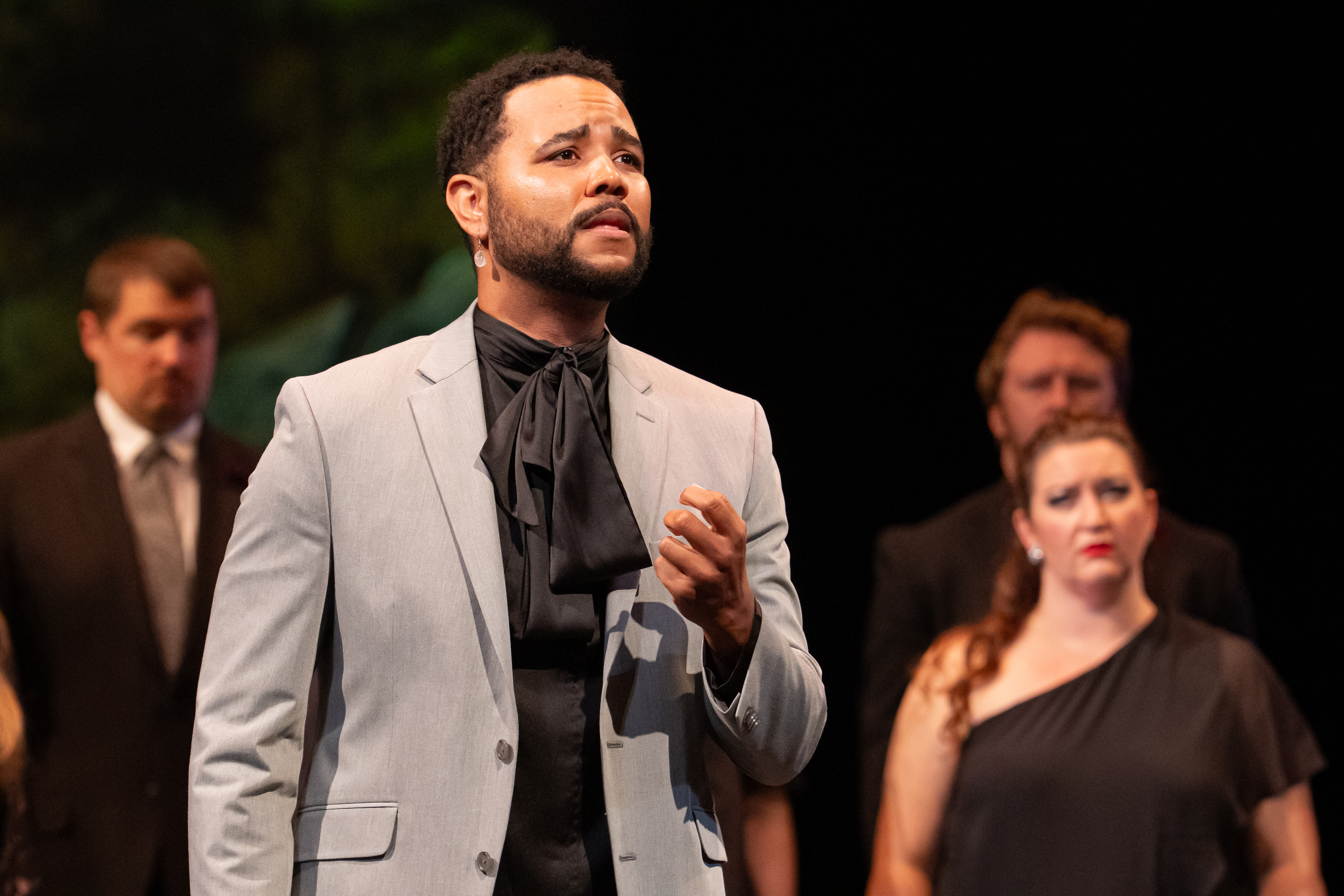
    Teatro Nuovo 2025 Macbeth_Martin Luther Clark as Macduff_2_Photo by Steven Pisano

    Above: Martin Luther Clark as Macduff; photo by Steven Pisano

    Clark’s rendition of Macduff’s aria “Ah, la paterna mano” was a standout moment. Macduff is one of those roles where you don’t have too much to do and learn, but you get a wonderful song that everyone remembers after the show. Clark performed it with tenderness and grief rather than anger, revealing the piece’s emotional depth. His pianissimi were particularly moving, making me appreciate the aria in a new light. The ovation was well earned.

    In the final scene, Macbeth and Macduff faced off. Macbeth, emboldened by the witches’ prophecy that no man born of woman could kill him, is shocked when Macduff reveals he was born via cesarean section. They leave the stage, Macbeth is mortally wounded, they walk back onstage, and the show ends.

    Musically, this Macbeth was executed beautifully. The orchestra was superb, and the singers brought Verdi’s music to life with skill and passion, thankfully, onstage.

    ~ Ryan Vasquez

    (Performance photos by Steven Pisano)

  • Shanghai Grand Theatre ~ LADY WHITE SNAKE

    White snake

    ~ Author: Oberon

    Saturday July 26th, 2025 – Wei was with me tonight for The Shanghai Grand Theatre’s production of LADY WHITE SNAKE, playing a brief run at Lincoln Center. The program note provides this outline of the story: “The legend of the White Snake is a classic Chinese folk tale about Bai Suzhen, a snake spirit who transforms into a beautiful woman in order to experience life and love as a human. She falls in love with and marries a mortal named Xu Xian, but their relationship is threatened by a Buddhist monk named Fahaj, who recognizes Bai Suzhen’s true identity. The story explores themes of love, sacrifice, and the conflict between the mortal and supernatural worlds.”

    There’s much more to the story than that, but I chose to focus more on the choreography and the music rather than on the narrative. The Shanghai company, under the direction of the marvelous Yuanyuan Tan, a longtime star of San Francisco Ballet who I once had the opportunity to meet, is full of beauteous dancers of both sexes. 

    I guess I was expecting a more mythic approach to the story; much of the time the look and feel were quite contemporary. Most of the visuals were stunning. The musical score, by Xu Zhou, which featured passing nods to Chinese folk music, was – in general – more redolent of Rachmaninoff and Borodin: grand, cinematic, and a bit glossy. The choreography, by Wang Peixian, is mainly rooted in classical ballet, with some acrobatic passages for the men woven in. Sets, lighting, and video designs were all strikingly impressive, especially the presence of an enormous bell hovering over the scene.  

    It’s been a while since I took notes in the House of Balanchine; I’d forgotten that it’s nearly as pitch-black as The Joyce. I soon found that I’d over-written existing comments with newer ones. 

    The storytelling was quite clear in Act I; Act II was less compelling, with some scenes feeling over-extended. The choreography lost some of its potency as the ballet progressed, though the level of dancing never faltered. The principals in the cast danced and acted to perfection: Liu Sirui as the White Snake and Wang Nianci as the Green Snake are beauties: my husband referred to them as sisters. Both women danced and acted with finesse and deep commitment. Sun Jiayong as Xu Xian, husband of the White Snake, was poetic, elegant of movement, and an attentive partner. As the rather sinister Psychologist, Fa Hai, Su Hailu gave a stunning performance, his acrobatic feats dazzling to behold. 

    Though losing some momentum after the interval, the production continued to be visually engrossing. The audience seemed thoroughly tuned in to the story-telling, though I began to think the tale of Lady White Snake might be more persuasively told as an opera rather than a ballet. A bit of research revealed that there is indeed an operatic setting of the story: Madame White Snake, composed by Zhou Long and premiered in Boston in 2010; two friends of mine – Ying Huang and Michael Maniaci – were in the cast. 

    The evening ended with a tumultuous ovation and a set of staged curtain calls that sustained the applause for several minutes. One delightful aspect of the performance for me was running into my long-time fellow NYC Ballet fan, Lynne Goldberg, and two of my beloved Graham divas: Xin Ying and Natasha Diamond-Walker.

    ~ Oberon