Category: Ballet

  • Cherylyn Lavagnino’s TALES OF HOPPER

    Hopper

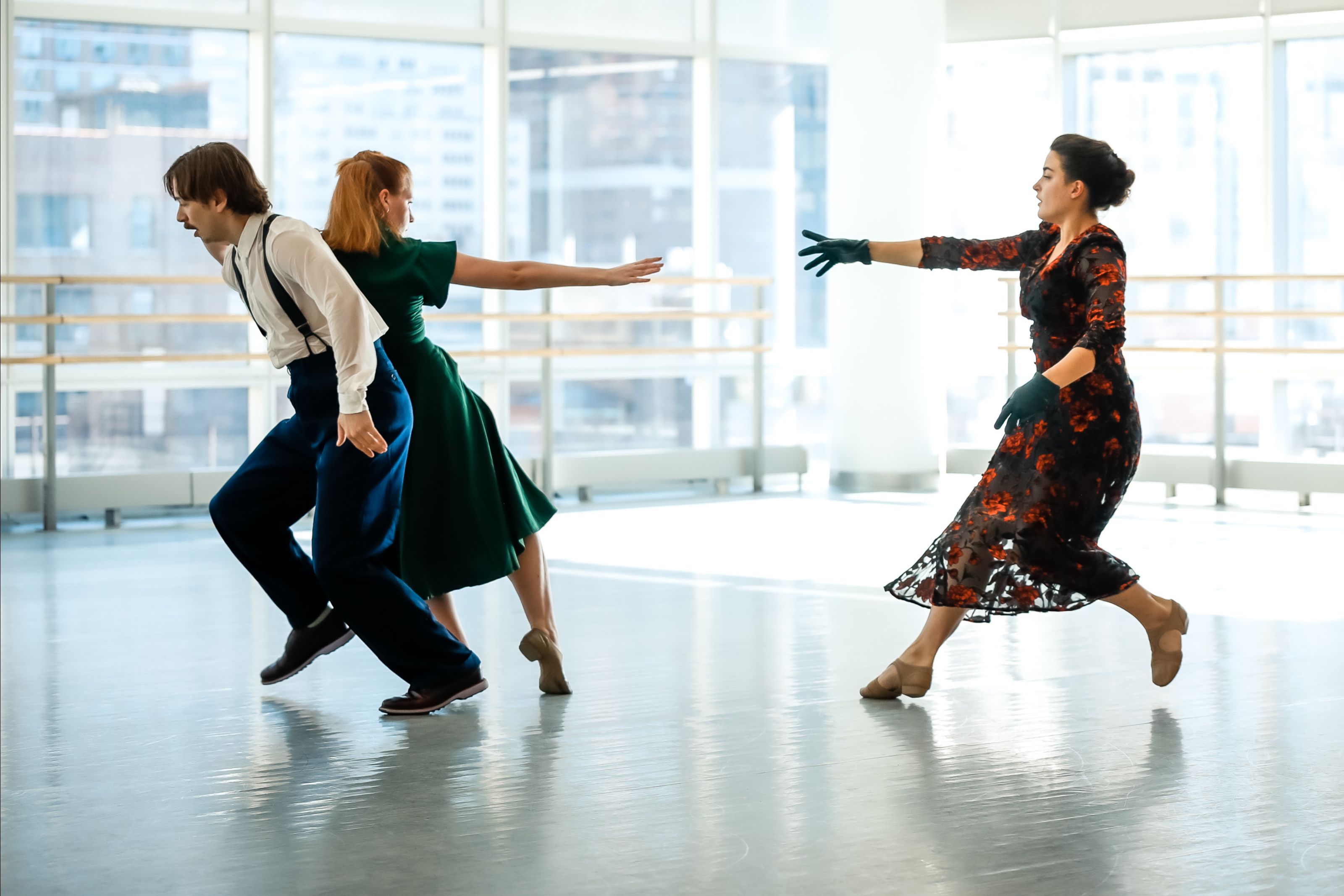
    Above: dancers Justin Faircloth, Corinne Hart, and Claire Westby in Cherylyn Lavagnino’s TALES OF HOPPER; photo by Charles Roussel

    ~ Author: Oberon

    {Note: this article has been updated with production photos by Charles Roussel}

    Tuesday February 25th, 2020 (dress rehearsal) – Today, choreographer Cherylyn Lavagnino kindly invited me to attend the dress rehearsal of her newest creation: TALES OF HOPPER. It’s a collaboration between Ms. Lavagnino and composer Martin Bresnick, inspired by the works of the American painter Edward Hopper. Two earlier works from Ms. Lavagnino’s treasure chest were also on the bill: Triptych and Veiled.  

    Hoping to get the clearest possible vision of the Hopper piece, I had asked the choreographer if I might attend the dress rehearsal rather than a performance so that my concentration would be unbroken. As a further enhancement, I had earlier watched a studio rehearsal of one of the ballet’s solos danced by Sharon Milanese; Ms. Milanese’s dancing that afternoon really moved me, and made me eager to see the entire piece. Although a dress rehearsal, the participating dancers and musicians were all at performance level.
    IVhBGl8g

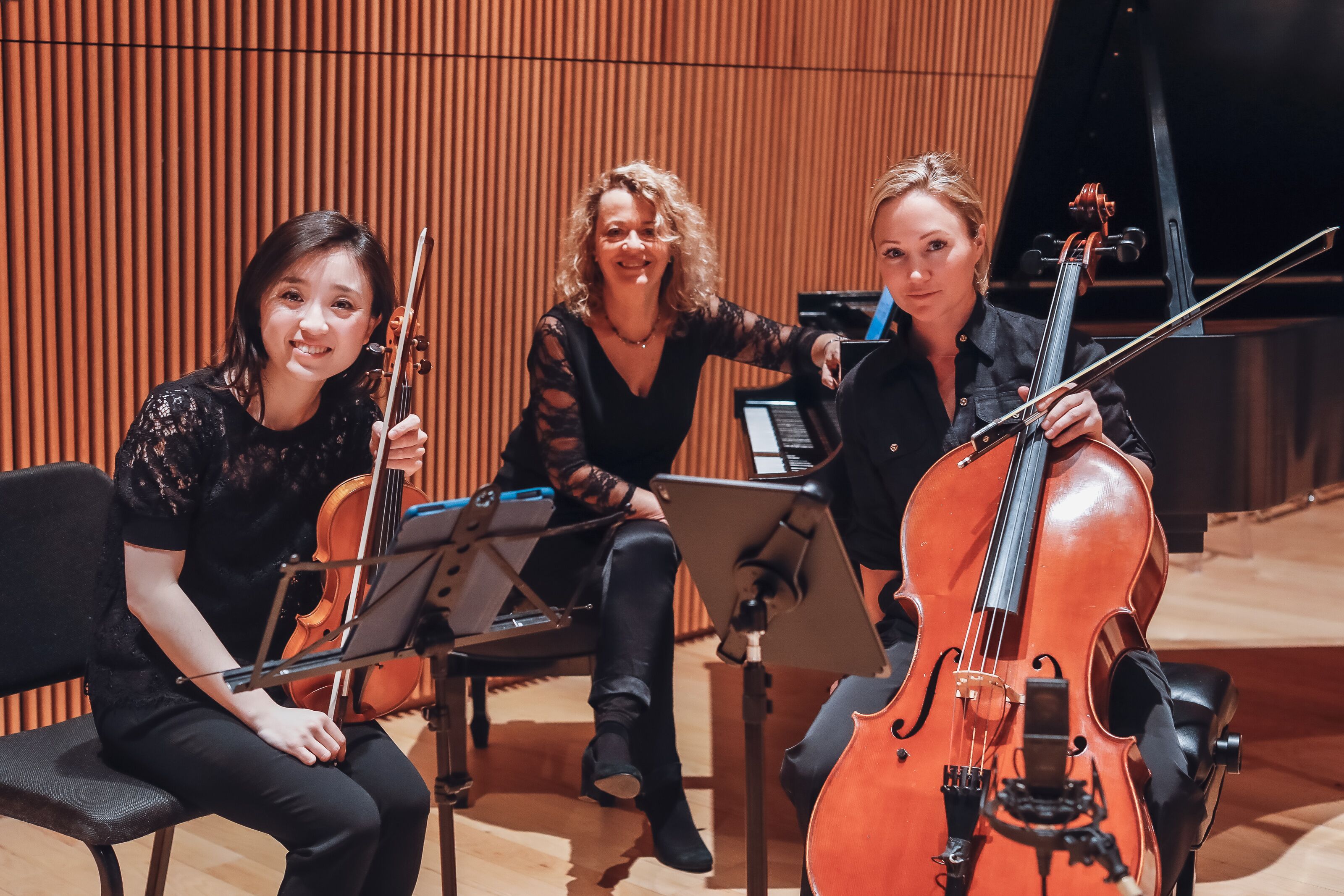
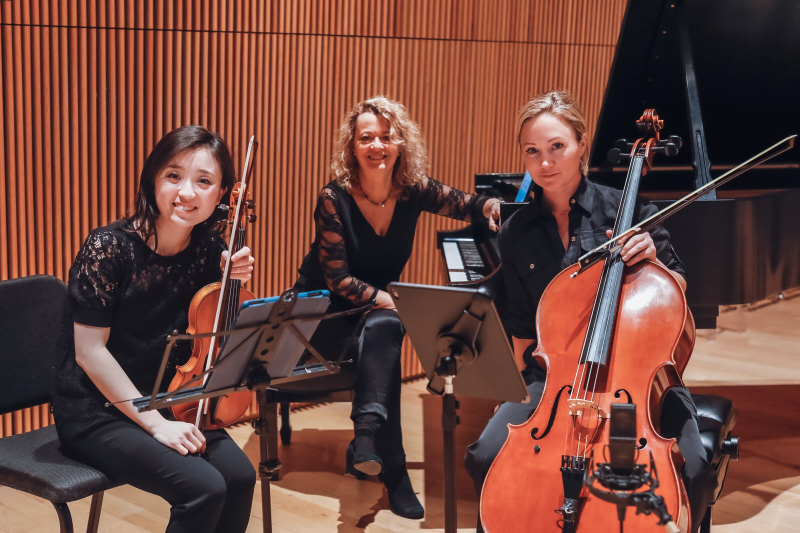
    This evening’s musicians: Elly Toyoda, Lisa Moore, and Ashley Bathgate; photo by Charles Roussel

    TALES OF HOPPER is a dance-theater work in which eight of Edward Hopper’s Americana masterpieces are brought to life. Mr. Bresnick’s original score is performed live – and excellently – by Lisa Moore (piano), Elly Toyoda (violin), and Ashley Bathgate (cello). Transparent set pieces, designed by Jesse Seegers, are re-configured to suggest the locale and mood of each of the Hopper paintings. The set changes are carried out by the dancers during blackouts between the vignettes. Frank DenDanto III created the lighting designs, and Christopher Metzger designed the ‘period’ costumes (the Hopper period, that is: the 30s thru the 60s); both gentlemen get top marks for their work, which were key elements in the evening’s success.

    A Prologue opens TALES OF HOPPER; violin and piano are heard in music with a nostalgic air; the cello soon joins in. All of the Company’s dancers take part, costumed as the ‘characters’ they will eventually play.

    TpDidpjg

    Sharon Milanese (above) appears as the woman in Hopper’s 1952 painting Morning Star. As the lights come up, the dancer is slowly awakening. The music is thoughtful, and Ms. Milanese – a compelling dancer with a strong theatrical sensibility – is perfect as this restless and vulnerable creature. The music becomes quite passionate; as the lights fades, the dancer is left to her thoughts.
    -AZX4CWQ

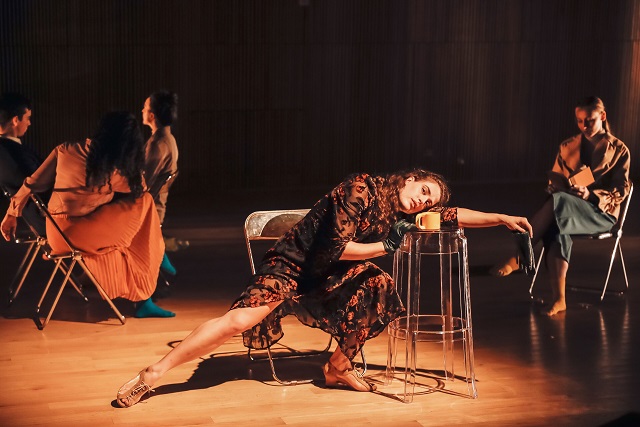
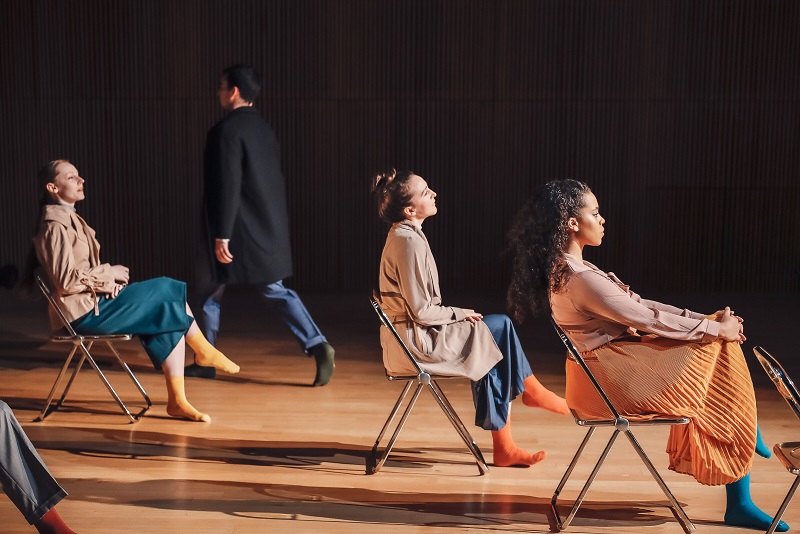
    Above: Emma Pajewski, Phil Strom, Gwendolyn Gussman, and Dervia Carey-Jones in People of the Sun

    Five dancers bring folding chairs to the stage for People of the Sun, Hopper’s 1960 painting showing a group of people enjoying the sunshine on a patio as they gaze out over an open field. The silence is broken by brief commentary from the violin, and by quiet laughter from Gwendolyn Gussman; she, Dervia Carey-Jones, Emma Pajewski, Malcolm Miles Young (reading a book), and Philip Strom constantly re-align their chairs so as to get the full benefit of the sunshine.
    XgjN_dIA

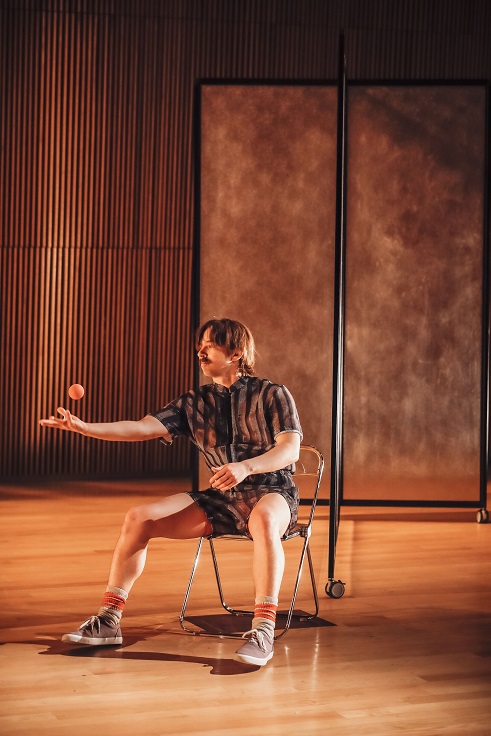
    Justin Faircloth (above) has a solo vignette in the 1940 painting Gas, wherein a young service station attendant fritters away his time between customers by bouncing a ball. The piano offers jagged chords, the cello rocks gently, the violin stammers. The attendant pumps gas, gives a car wash, tinkers with an under-body. Then he hits the floor for some pushups. 
    MaSbaASg

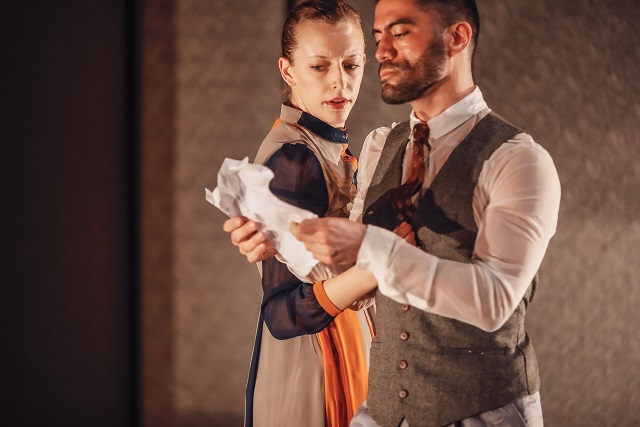
    Above: Lila Simmons and Oscar Rodriguez in The Office at Night

    A plucking cello interlude takes us to the Office at Night (1940) where a secretary (Lila Simmons) and her boss (Oscar Rodriguez) are carrying on an after-hours affair. A mysterious dropped document is a bone of contention between them; they are alternately amorous and antagonistic. They embrace, have a steamy duet, and find tenderness at the end.

    AHbsHTwg

    The magnetic Kristen Foote (above) is a cinema usherette in NY Movie (1940). Aside from some latecomers, the audience is already enjoying the film, and the usherette is biding her time by occasionally breaking into dance steps or miming lines from the movie.

    EM9SglDg

    Above: the duet from NY Movie, with Ms. Foote and Malcolm Miles Young

    Pensive music heralds the appearance of a handsome man (Malcolm Miles Young) who is perhaps real or perhaps a silver-screen illusion. They dance a romantic/passionate duet; a brooding atmosphere develops musically, and the usherette resumes her solitary post. This might have been my favorite “Hopper tale” tonight, but I think if I were to see the piece repeatedly, I would probably favor a different episode every time.

    PKO_I6AQ

    Above: Justin Faircloth and Claire Westby in Sunlight in a Cafeteria

    Sunlight in a Cafeteria (1958) commences with shimmering piano sounds. Justin Faircloth is nursing a cup of coffee when Claire Westby saunters past, intentionally dropping a glove. Justin is captivated. Then the openly provocative woman passes her admirer a note…and wanders off.
    6RgUooZQ

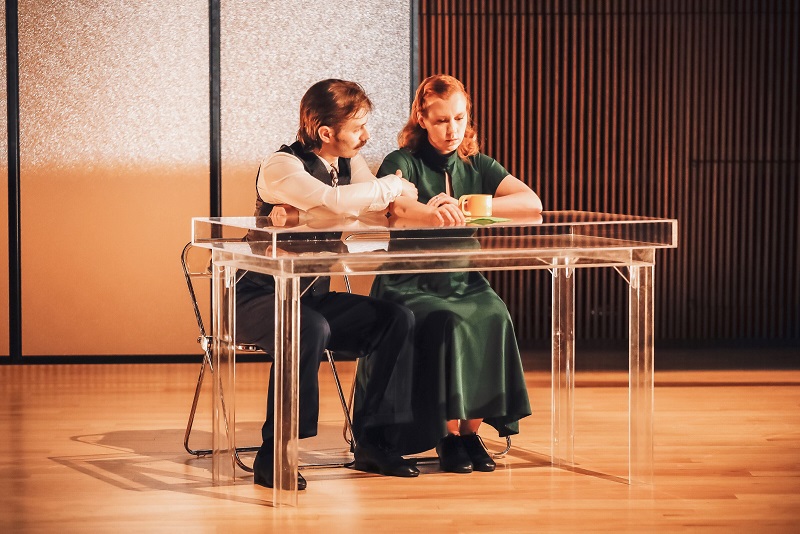
    Above: Justin Faircloth and Corinne Hart in Nighthawks

    With Nighthawks (1942), Ms. Lavagnino continues the ‘story’ of Sunlight. As Justin’s wife (or girlfriend), Corinne Hart (fetching in a deep green frock, which sets off her auburn hair) has found Claire’s note; the music (cello and piano) has a searching quality. Feeling betrayed, Ms. Hart confronts Mr. Faircloth: their romance breaks down. Claire Westby returns, and, after a tense trio, Justin chooses Claire over Corinne.

    HILHHPCw

    Above: Claire Westby in Automat

    Automat (1927) extends the story line of the two previous movements to its finish. Ms. Westby, disheveled and run down, is alone with a cup of coffee. What’s transpired in the interim, we don’t know. Claire’s gorgeous flower-flecked dress – now rumpled – reveals her legs as she rolls about on the floor in a sensual frenzy. She finally composes herself and again sits alone. The dancers now all return to the stage for a final tableau which unites the characters of all the eight tales of Hopper. 

    Following the interval, the stage has been cleared for Cherylyn’s ballets Triptych (excerpt – 2012) and the 2016 Veiled. Both works explore spirituality in different contexts, and they looked wonderful in this open and finely-lit space…and both were beautifully danced.

    4kD3TdoQ

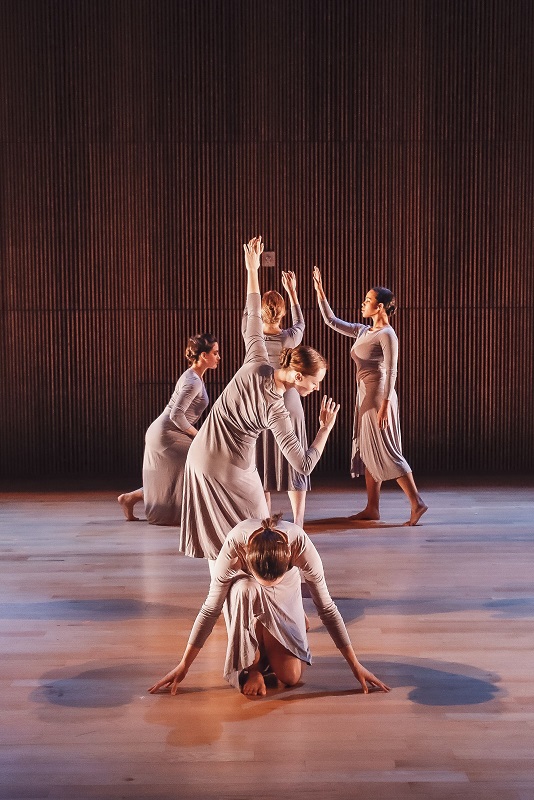
    Above: from Triptych

    Triptych is performed to the music of François Couperin: his Troisième Leçon à deux voix). With the men of the Company aligned upstage, Claire Westby performs a quiet solo with expressive port de bras; Claire prepares us for the entrance of the women – Dervia Carey-Jones, Gwendolyn Gussman, Emma Pajewski, and Lila Simmons – each a unique beauty and personality. The men – Mssrs. Faircloth, Strom, Young, and Rodriguez – come forward now, and Ms. Carey-Jones distinctively leads off a series of dances.

    A duet for Malcolm Miles Young and Gwendolyn Gussman has a rapturous quality, whilst Emma Pajewski and Justin Faircloth’s lyrical partnering is poignantly musical. A pas de quatre for Mlles. Carey-Jones, Gussman, Westby, and Pajewski follows: they are dancing in a state of grace. A pas de trois joins Lila Simmons, a dancer whose wide-ranging emotional palette always captures my attention, with Phil Strom and Justin Faircloth. Ms. Carey-Jones joins this trio, leading on to a finale for the full cast. Of Triptych tonight, I wrote in my notes: “…a slice of Heaven.” 

    1RjKq6Mw

    Above: from Veiled

    The notion of Heaven was sustained as the evening concluded with Veiled, a dance for female ensemble set to Martin Bresnick’s Josephine the Singer, performed by violinist Elly Toyoda. Danceworks that speak of sisterhood always end up fascinating me, and I found Veiled to be a particularly engrossing experience: one of those ballets I could watch over and over.

    The women are prostrated as Veiled ballet commences, with Ms. Todaya’s violin sounding in its highest range. As the piece unfolds, rituals of prayer, supplication, and consolation pass before our eyes; the atmosphere is paradoxically intense and calming. 

    I can’t find words to sufficiently praise the six women who danced Veiled tonight: Mlles. Carey-Jones, Gussman, Hart, Pajewski, Simmons, and Westby each had an inner glow that made them captivating to watch. Two duets passages – one for Claire Westby and Corinne Hart and another for Lila Simmons and Emma Pajewski – particularly moved me, but in fact everything about this ballet resonated richly.

    After a series of brief, fleeting solos, the women form a circle; then they dance in a stylized chain, holding hands. The violin shivers, a prelude to hesitant lyricism that finally reaches unearthly high notes. As the light fades, the women huddle; they seem wary, but also safe in the community of sisters.

    Vq8Ct2Yw

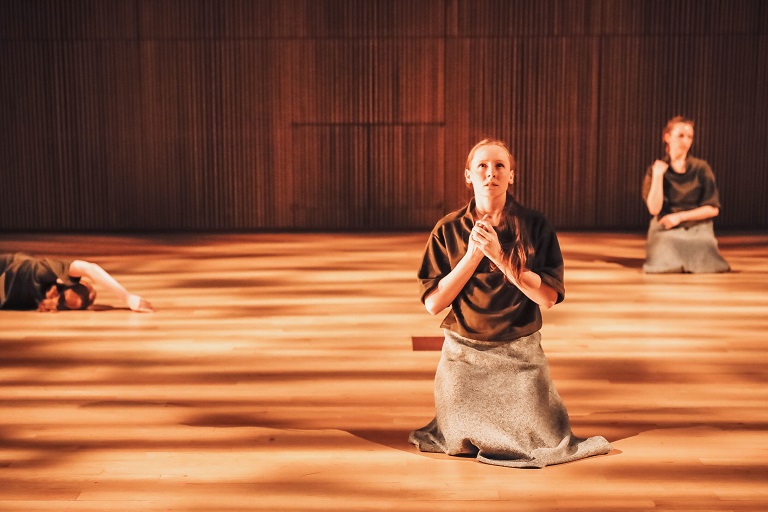
    Near the end of Veiled, Emma Pajewski (above), kneeling in prayer with an expression of hope on her lovely face, became an iconic image for me. In this Year of the Women, Ms. Lavagnino’s Veiled is truly something to behold.

    All photos in this article are by Charles Roussel. A gallery of additional production images from Mr. Roussel may be viewed here.

    ~ Oberon

  • Cherylyn Lavagnino’s TALES OF HOPPER

    Hopper

    Above: dancers Justin Faircloth, Corinne Hart, and Claire Westby in Cherylyn Lavagnino’s TALES OF HOPPER; photo by Charles Roussel

    ~ Author: Oberon

    {Note: this article has been updated with production photos by Charles Roussel}

    Tuesday February 25th, 2020 (dress rehearsal) – Today, choreographer Cherylyn Lavagnino kindly invited me to attend the dress rehearsal of her newest creation: TALES OF HOPPER. It’s a collaboration between Ms. Lavagnino and composer Martin Bresnick, inspired by the works of the American painter Edward Hopper. Two earlier works from Ms. Lavagnino’s treasure chest were also on the bill: Triptych and Veiled.  

    Hoping to get the clearest possible vision of the Hopper piece, I had asked the choreographer if I might attend the dress rehearsal rather than a performance so that my concentration would be unbroken. As a further enhancement, I had earlier watched a studio rehearsal of one of the ballet’s solos danced by Sharon Milanese; Ms. Milanese’s dancing that afternoon really moved me, and made me eager to see the entire piece. Although a dress rehearsal, the participating dancers and musicians were all at performance level.

    IVhBGl8g

    This evening’s musicians: Elly Toyoda, Lisa Moore, and Ashley Bathgate; photo by Charles Roussel

    TALES OF HOPPER is a dance-theater work in which eight of Edward Hopper’s Americana masterpieces are brought to life. Mr. Bresnick’s original score is performed live – and excellently – by Lisa Moore (piano), Elly Toyoda (violin), and Ashley Bathgate (cello). Transparent set pieces, designed by Jesse Seegers, are re-configured to suggest the locale and mood of each of the Hopper paintings. The set changes are carried out by the dancers during blackouts between the vignettes. Frank DenDanto III created the lighting designs, and Christopher Metzger designed the ‘period’ costumes (the Hopper period, that is: the 30s thru the 60s); both gentlemen get top marks for their work, which were key elements in the evening’s success.

    A Prologue opens TALES OF HOPPER; violin and piano are heard in music with a nostalgic air; the cello soon joins in. All of the Company’s dancers take part, costumed as the ‘characters’ they will eventually play.

    TpDidpjg

    Sharon Milanese (above) appears as the woman in Hopper’s 1952 painting Morning Star. As the lights come up, the dancer is slowly awakening. The music is thoughtful, and Ms. Milanese – a compelling dancer with a strong theatrical sensibility – is perfect as this restless and vulnerable creature. The music becomes quite passionate; as the lights fades, the dancer is left to her thoughts.

    -AZX4CWQ

    Above: Emma Pajewski, Phil Strom, Gwendolyn Gussman, and Dervia Carey-Jones in People of the Sun

    Five dancers bring folding chairs to the stage for People of the Sun, Hopper’s 1960 painting showing a group of people enjoying the sunshine on a patio as they gaze out over an open field. The silence is broken by brief commentary from the violin, and by quiet laughter from Gwendolyn Gussman; she, Dervia Carey-Jones, Emma Pajewski, Malcolm Miles Young (reading a book), and Philip Strom constantly re-align their chairs so as to get the full benefit of the sunshine.

    XgjN_dIA

    Justin Faircloth (above) has a solo vignette in the 1940 painting Gas, wherein a young service station attendant fritters away his time between customers by bouncing a ball. The piano offers jagged chords, the cello rocks gently, the violin stammers. The attendant pumps gas, gives a car wash, tinkers with an under-body. Then he hits the floor for some pushups. 

    MaSbaASg

    Above: Lila Simmons and Oscar Rodriguez in The Office at Night

    A plucking cello interlude takes us to the Office at Night (1940) where a secretary (Lila Simmons) and her boss (Oscar Rodriguez) are carrying on an after-hours affair. A mysterious dropped document is a bone of contention between them; they are alternately amorous and antagonistic. They embrace, have a steamy duet, and find tenderness at the end.

    AHbsHTwg

    The magnetic Kristen Foote (above) is a cinema usherette in NY Movie (1940). Aside from some latecomers, the audience is already enjoying the film, and the usherette is biding her time by occasionally breaking into dance steps or miming lines from the movie.

    EM9SglDg

    Above: the duet from NY Movie, with Ms. Foote and Malcolm Miles Young

    Pensive music heralds the appearance of a handsome man (Malcolm Miles Young) who is perhaps real or perhaps a silver-screen illusion. They dance a romantic/passionate duet; a brooding atmosphere develops musically, and the usherette resumes her solitary post. This might have been my favorite “Hopper tale” tonight, but I think if I were to see the piece repeatedly, I would probably favor a different episode every time.

    PKO_I6AQ

    Above: Justin Faircloth and Claire Westby in Sunlight in a Cafeteria

    Sunlight in a Cafeteria (1958) commences with shimmering piano sounds. Justin Faircloth is nursing a cup of coffee when Claire Westby saunters past, intentionally dropping a glove. Justin is captivated. Then the openly provocative woman passes her admirer a note…and wanders off.

    6RgUooZQ

    Above: Justin Faircloth and Corinne Hart in Nighthawks

    With Nighthawks (1942), Ms. Lavagnino continues the ‘story’ of Sunlight. As Justin’s wife (or girlfriend), Corinne Hart (fetching in a deep green frock, which sets off her auburn hair) has found Claire’s note; the music (cello and piano) has a searching quality. Feeling betrayed, Ms. Hart confronts Mr. Faircloth: their romance breaks down. Claire Westby returns, and, after a tense trio, Justin chooses Claire over Corinne.

    HILHHPCw

    Above: Claire Westby in Automat

    Automat (1927) extends the story line of the two previous movements to its finish. Ms. Westby, disheveled and run down, is alone with a cup of coffee. What’s transpired in the interim, we don’t know. Claire’s gorgeous flower-flecked dress – now rumpled – reveals her legs as she rolls about on the floor in a sensual frenzy. She finally composes herself and again sits alone. The dancers now all return to the stage for a final tableau which unites the characters of all the eight tales of Hopper. 

    Following the interval, the stage has been cleared for Cherylyn’s ballets Triptych (excerpt – 2012) and the 2016 Veiled. Both works explore spirituality in different contexts, and they looked wonderful in this open and finely-lit space…and both were beautifully danced.

    4kD3TdoQ

    Above: from Triptych

    Triptych is performed to the music of François Couperin: his Troisième Leçon à deux voix). With the men of the Company aligned upstage, Claire Westby performs a quiet solo with expressive port de bras; Claire prepares us for the entrance of the women – Dervia Carey-Jones, Gwendolyn Gussman, Emma Pajewski, and Lila Simmons – each a unique beauty and personality. The men – Mssrs. Faircloth, Strom, Young, and Rodriguez – come forward now, and Ms. Carey-Jones distinctively leads off a series of dances.

    A duet for Malcolm Miles Young and Gwendolyn Gussman has a rapturous quality, whilst Emma Pajewski and Justin Faircloth’s lyrical partnering is poignantly musical. A pas de quatre for Mlles. Carey-Jones, Gussman, Westby, and Pajewski follows: they are dancing in a state of grace. A pas de trois joins Lila Simmons, a dancer whose wide-ranging emotional palette always captures my attention, with Phil Strom and Justin Faircloth. Ms. Carey-Jones joins this trio, leading on to a finale for the full cast. Of Triptych tonight, I wrote in my notes: “…a slice of Heaven.” 

    1RjKq6Mw

    Above: from Veiled

    The notion of Heaven was sustained as the evening concluded with Veiled, a dance for female ensemble set to Martin Bresnick’s Josephine the Singer, performed by violinist Elly Toyoda. Danceworks that speak of sisterhood always end up fascinating me, and I found Veiled to be a particularly engrossing experience: one of those ballets I could watch over and over.

    The women are prostrated as Veiled ballet commences, with Ms. Todaya’s violin sounding in its highest range. As the piece unfolds, rituals of prayer, supplication, and consolation pass before our eyes; the atmosphere is paradoxically intense and calming. 

    I can’t find words to sufficiently praise the six women who danced Veiled tonight: Mlles. Carey-Jones, Gussman, Hart, Pajewski, Simmons, and Westby each had an inner glow that made them captivating to watch. Two duets passages – one for Claire Westby and Corinne Hart and another for Lila Simmons and Emma Pajewski – particularly moved me, but in fact everything about this ballet resonated richly.

    After a series of brief, fleeting solos, the women form a circle; then they dance in a stylized chain, holding hands. The violin shivers, a prelude to hesitant lyricism that finally reaches unearthly high notes. As the light fades, the women huddle; they seem wary, but also safe in the community of sisters.

    Vq8Ct2Yw

    Near the end of Veiled, Emma Pajewski (above), kneeling in prayer with an expression of hope on her lovely face, became an iconic image for me. In this Year of the Women, Ms. Lavagnino’s Veiled is truly something to behold.

    All photos in this article are by Charles Roussel. A gallery of additional production images from Mr. Roussel may be viewed here.

    ~ Oberon
  • Compagnie Hervé KOUBI @ The Joyce ~ 2020

    F751b7faaa4d48cf814701ab186c45bf

    Above: Compagnie Hervé KOUBI, photo by Frédérique Calloch

    ~ Author: Oberon

    Thursday February 20th, 2020 – Celebrating their 20th anniversary season, Compagnie Hervé KOUBI returned to The Joyce with Les nuits barbares ou les premiers matins du monde. I loved this Company when they appeared at The Joyce in 2018, and when I saw that they were returning to Gotham, I knew I’d want to be there.

    Performed by an all-male cast of dancers from the countries along the shores of the of the Mediterranean – from Algeria, Morocco, France, Burkina Faso, Italy, Israel, and Palestine – the work explores the human desire for belonging: an idea that harks back to ancient times, before the birth of nations.

    B66a9f62ccd24199abcd0119aec4dba6

    Above: photo by Frédéric de Faverney

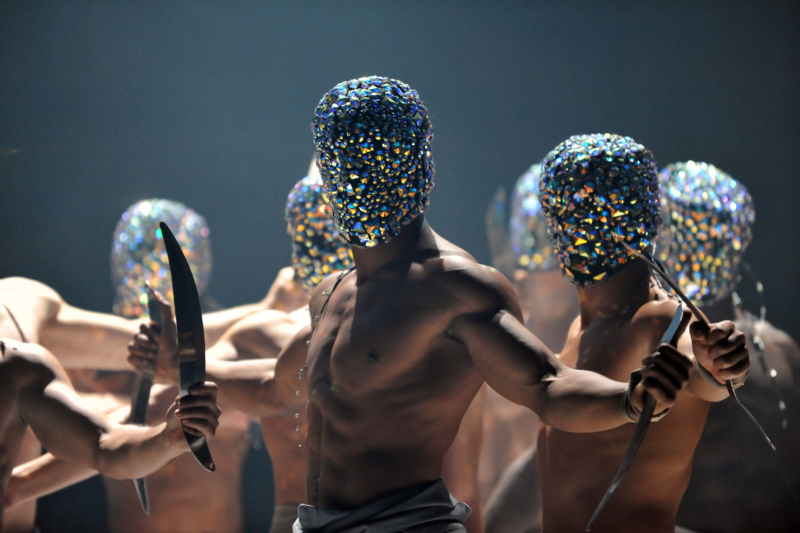
    The visually engrossing production features evocative lighting by Lionel Buzonie, and costumes by Guillaume Gabriel that include mask-like headgear adorned with Swarovski crystals which catch the light, adding to the mystique of the ballet’s darkish opening passages. The dancers appear first in long skirts, which are later shed in favor of fitted trousers. To say that these men are incredibly sexy is an understatement: they are also fearlessly committed to the work, and to the brotherhood.

    To sounds of primeval winds and waves, the dancers emerge from the shadows. They huddle together, earthbound, as the opening music of Wagner’s DAS RHEINGOLD speaks to us of beginnings. The community is restless, wary. They awaken in a brief passage of unison gestures.

    Knives are drawn, and an alarm sounds…but fades to mere tinkling sounds. There is a bathing ritual to the sounds of an antique flute, then the men take their places in a striking lineup across the rim of the stage, superbly lit.

    A tapping sound develops into vibrant drumming as the men compete in fantastic feats of tumbling, flipping, spinning on their hands or on their heads. The helmet-masks come off, the drumming gets wild. Then deep tones emerge from the sonic glow, alive with the exotic sound of finger cymbals.

    A respite, and then a whirring sound spins into a song – are the men actually singing? I was to far away to tell. Now the tribe begin tossing one another into the air; they soar with electifying bravura before being caught by their comrades. After circling in backbends, they cut loose to do more leaping and flipping: mind-boggling athleticism. The music turns metallic as the dancers again engage in uncanny break-dancing spins. Then they slowly disperse to music from the Mozart REQUIEM, only to return, engaging in ever more daring spinning and tossing.

    86734724_10218458400185321_4811273668363550720_n

    Suddenly one man is targeted and threatened with knives. Stripped of his skirt, and inverted, he performs a spectacular solo, spinning on his head as knife blades fan out from his whirling torso. The men – some on their knees like supplicants – return with metal poles; to the sound of distant voices, the poles become canes of props. Later they are tossed from man to man with amazing accuracy, and still later held aloft in cruciform.

    Now there evolves a big-beat, swirling tribal dance; the skirts have all been sheds. After more athletic feats and some spear-tossing, there is an intense run-about. To the sound of the deep chanting of Et lux perpetua, the men again line up along the edge of the stage: they seem to silently be bidding us farewell. Then they back into the shadows and begin to slowly exit – pairs or alone – heading into the unknown. As the last man vanishes from sight, one sensed the welling up of a great emotional force in the house. The audience, who have beheld this great human spectacle in awed silence, are ready to unleash a tremendous wave of applause.

    But…no: the men now return and, in a rather prolonged coda, continue to perform many of the same moves and feats we’ve already seen. As this coda brings nothing fresh to the piece, either choreographically or musically, it seemed expendable.

    At last, the packed house got their chance to hail Mssr. Koubi and his courageous dancers with waves of fervent applause and cheers.

    Efeeb7ea1079465dbd24d15aa611cea0

    Above: photo by Pierangela Flisi

    ~ Oberon

  • YCA: Nathan Lee @ The Morgan Library

    Lee_Nathan3CreditChrisLee

    Above: pianist Nathan Lee, photo by Chris Lee

    ~ Author: Oberon

    Wednesday February 19th 2020 matinee – Young Concert Artists continued their popular series of noontime concerts at The Morgan Library today as pianist Nathan Lee played works by Ludwig van Beethoven, Chris Rogerson, and Robert Schumann in succession with nary a break in between.

    The youthful pianist, clad all in black with subtly bejeweled shoes, opened his program with Beethoven’s Sonata No. 27 in E-minor, Op. 90 – a lovely gift to us for the composer’s 250th birthday celebration. Unlike most traditional sonatas, this one has only two movements; the composer’s tempo markings are in German rather than the usual Italian.

    The opening phrases are alternately robust and subtle, and as the music develops there is a continual shift between thoughtful and intense passages. Mr. Lee’s playing of swift downward scales was exhilarating, and he moved effortlessly from drama to delicacy as the piece evolved. The second movement offers a sweet flow of melody with contrasting moments of animation. Mr. Lee is as engaging to watch as to hear, his facial expressions reflecting the moods of the music, his eyes often closed.

    The music of Chris Rogerson, who was Young Concert Artists‘ composer-in-residence from 2010-2012, made a very positive impression on me when I first encountered his String Quartet #1 performed by the Omer Quartet at a YCA  concert at Merkin Hall in December of 2018. Ever on the lookout for music that might capture the imagination of one of my choreographer/friends, I sent this quartet on to Claudia Schreier. Long story short: Ms. Schreier is choreographing a ballet to Mr. Rogerson’s String Quartet #1 for Chamber Dance Project in Washington DC, which will premiere in June 2020.

    This afternoon, Mr. Lee played Chris Rogerson’s ‘Til it was dark; the work was Mr. Rogerson’s first YCA Commission in 2010. The composer’s program notes reveal the nostalgic background for ‘Til it was dark, and made me think of my own boyhood in the little town when we’d play tag and hide-and-seek outdoors as the sun set slowly on summer evenings.

    The work’s first movement, Break, seems to speak of the noisy euphoria we felt as kids when school let out. Mr. Lee was called on to bang emphatically on the keyboard or to reel off swirling festoons of notes. As the music turns dreamy, then mysterious, and finally pensive, Mr. Lee caught all these moods thru his canny use of piano/pianissimo gradations. Later, when virtuosity is called for, the pianist delivers in spades. 

    “Three more minutes!” was the warning call of Chris’s dad that it was almost time to come indoors. The music seems to depict the frantic desire to get as much fun out of the dwindling daylight as one could. By turns sprightly and loudly animated, things eventually calm before a final propulsive rush to a witty end.

    Important Things takes on a more serious tone; Mr. Lee’s playing becomes thoughtful, almost tender. In his program note, Mr. Rogerson writes of those “…quieter moments with friends, when you wanted to say something that was on your mind…but of course, you never did.” By turns expansive, wistful, and passionate, the music finally alternates short dreamy phrases with harsher ones. Dreaminess prevails, and quietude settles over us. In this very personal (yet also universal) reflection – which put me in mind of Samuel Barber’s evocative Knoxville: Summer of 1915 – Mr. Rogerson could not have asked for a finer interpretation that Mr. Lee’s.

    The young pianist then immediately commenced on Robert Schumann’s Carnaval for piano, Op. 9, written in 1834-1835. In these twenty-one miniatures, Schumann depicted himself (with Florestan and Eusebius representing his split personalty), his beloved Clara (Chiarina), his friends, and also characters from the commedia dell’arte. In 1915, Michel Fokine choreographed the music for his ballet of the same title, created for Diaghilev’s Ballets Russes. Amazingly, I’d never heard the entire Schumann score until today.

    Art_63_06_13

    Above: the legendary ballerina Tamara Karsavina as Columbine in Fokine’s ballet Carnaval

    Nathan Lee took us on a delightful journey with his brilliant playing, and thru his coloristic gifts introduced us to – among others – the lively Pierrot, the smug wit of Harlekin, the scampering Coquette, and the youthful gaiety of Chiarina. From the grand introduction, the music’s rhythmic subtleties and irresistible waltzes drew us onward thru this 30-minute panorama wherein the essential element – charm – was in abundance in Mr. Lee’s playing.

    The pianist returned for an encore: the Sarabande from Bach’s 4th Partita, subtly played.

    ~ Oberon

  • Lydia Johnson Dance ~ Studio Event

    DSCF2451

    Above: Stephen Hanna and Katie Martin-Lohiya

    On Sunday, January 26th, 2020, Lydia Johnson Dance presented excerpts from their repertoire – including a new work-in-progress set to music of Ludwig van Beethoven (celebrating the composer’s 250th birthday!) – at a studio showing held at the Alvin Ailey Dance Center. The afternoon offered a preview of the Company’s 2020 season, wherein Craig Hall and Stephen Hanna, both former members of New York City Ballet, will appear as guest artists.

    Due to a conflict, I was unable to attend the studio event, but Dmitry Beryozkin provides these images:

    DSCF2893

    Brynt Beitman and Kate Martin-Lohiya

    DSCF3113

    Brynt Beitman and Min Kim

    DSCF3672

    Laura DiOrio and Craig Hall; this is Craig’s second season guesting with Lydia Johnson Dance

    DSCF3353

    Stephen Hanna and Katie Martin-Lohiya; Stephen previously appeared as a guest with Lydia Johnson Dance in 2018

    DSCF3822

    Katie Martin-Lohiya, Craig Hall, Min Kim, and Catherine Gurr in a passage from the new Beethoven piece, which draws inspiration from the writings of Edith Wharton

    DSCF3835

    Brynt Beitman and Craig Hall, with Katie and Min

    DSCF3815

    DSCF3872

    The ensemble

    Lydia Johnson Dance‘s annual New York season will be at the Ailey Citigroup Theatre on June 17, 18, and 19, 2020.

    ~ Oberon

  • Amanda Selwyn Dance Theatre ~ Studio Event

    Thumbnail_20200115_AmandaSelwyn_AileyOpenRehearsal_ChristopherDuggan_107 copy

    Above: the dancers of Amanda Selwyn Dance Theatre, photo by Christopher Duggan

    Wednesday January 15th, 2020 – In preparation for their 20th season, Amanda Selwyn Dance Theatre tonight opened their studio doors to friends of the Company for a preview of Hindsight, which will have its premiere performances March 5th – 7th, 2020, at the Baruch Performing Arts Center.  Hindsight looks back fondly on two decades of Selwyn repertory, whilst also looking ahead – in new choreography – to the promise of the future.

    This evening’s open rehearsal took place at the Ailey Studios. As audience members settled in, we watched the dancers taking class. Amanda then welcomed us, and introduced her talented dancers in a series of excerpts from past productions which will be integrated into Hindsight as well as new passages created specially for the upcoming performances.

    The Selwyn dancers are exhilarating to watch, each one very much a part of the collective whilst also displaying distinctive personalities; they shine forth in these images from the evening’s presentation captured by the renowned dance photographer Christopher Duggan:

    Thumbnail_20200115_AmandaSelwyn_AileyOpenRehearsal_ChristopherDuggan_047 copy

    Manon Hallay

    Thumbnail_20200115_AmandaSelwyn_AileyOpenRehearsal_ChristopherDuggan_053 copy

    Minseon Kim, Sho Miya, Manon Hallay

    Thumbnail_20200115_AmandaSelwyn_AileyOpenRehearsal_ChristopherDuggan_065 copy

    Sho Miya

    Thumbnail_20200115_AmandaSelwyn_AileyOpenRehearsal_ChristopherDuggan_083 copy

    Ashley McQueen

    Thumbnail_20200115_AmandaSelwyn_AileyOpenRehearsal_ChristopherDuggan_075 copy

    Michael Bishop, Misaki Hayama

    Thumbnail_20200115_AmandaSelwyn_AileyOpenRehearsal_ChristopherDuggan_098 copy

    Nolan Elsbecker, Ashley McQueen, Sho Miya, Misaki Hayama

    The Company Dancers: Torrey McAnena (rehearsal director), Michael Bishop, Nolan Elsbecker, Alisa Gregory, Manon Hallay, Misaki Hayama, Isaac Kerr, Minseon Kim, Ashley McQueen, Sho Miya, Lauren Russo, and Evita Zacharioglou.
     
    ~ Oberon

  • Shanghai Ballet’s SWAN LAKE

    AatgRM6U

    ~ Author: Oberon

    Saturday January 18th, 2020 – Billed as the “Grand SWAN LAKE“, Shanghai Ballet’s production of the Tchaikovsky classic arrived at Lincoln Center for four performances, of which we saw he third. In this very traditional setting, the Derek Deane Petipa-based choreography offers no surprises, aside from the sheer number of swans to be seen: I guess that’s what makes it “grand”.

    The production is mostly pleasing visually, but the scene in the palace ballroom has a very ugly mish-mash of a set in which the vision of Odette seems like an afterthought, thus missing a key dramatic point. Garish costumes for the national dances added to the cheesy effect.

    NpBsJKht

    But the lakeside scenes were fine, and the 48 swans were wonderfully in-sync choreographically, making the stage seem full but not over-crowded. Mr. Deane deploys them skillfully as they form pleasing patterns and make smooth entrances and exits throughout the White Swan act. Zhu Haibo, a Rothbart with expansive wings dripping with seaweed, menaced Odette and her prince as Rothbarts have ever been wont to do.

    There’s no Jester in this production, nor does the prince have any friends to join him on his hunting expedition. There is a Tutor, who is thankfully not given much to do.

    DI8YdXbF

    At the heart of the matter, Qi Bingxue as Odette/Odile and Wu Husheng as Siegfried (above) danced expressively and with technical polish. Their love, doomed from the start, played out in the moving tenderness of their partnering, in their effortless brilliance in the feats of the Black Swan pas de deux, and in the jolt of betrayal. But the production ends rather weakly, as the lovers float over the stage on a large swan-boat while Rothbart lay dying. Once you’ve experienced the final moments of the Peter Martins SWAN LAKE, nothing else compares. 

    The New York City Ballet orchestra played the familiar score with some very nice solo parts shining thru, and Charles Barker conducted, keeping a firm rein on things whilst also admirably supporting the principal couple thru both the poignant and the showy passages.

    Late seating, and ushers wandering the aisles to admonish viewers about cellphones during the music, were serious distractions, as were the constant babbling of the two Russian women seated next to us, and of the two silly queens sitting behind us. But we stayed until the end, because Wei was enjoying it.

    Production photos by North American Photography Associates, courtesy of Michelle Tabnick PR

    ~ Oberon

  • Shanghai Ballet’s SWAN LAKE

    AatgRM6U

    ~ Author: Oberon

    Saturday January 18th, 2020 – Billed as the “Grand SWAN LAKE“, Shanghai Ballet’s production of the Tchaikovsky classic arrived at Lincoln Center for four performances, of which we saw he third. In this very traditional setting, the Derek Deane Petipa-based choreography offers no surprises, aside from the sheer number of swans to be seen: I guess that’s what makes it “grand”.

    The production is mostly pleasing visually, but the scene in the palace ballroom has a very ugly mish-mash of a set in which the vision of Odette seems like an afterthought, thus missing a key dramatic point. Garish costumes for the national dances added to the cheesy effect.

    NpBsJKht

    But the lakeside scenes were fine, and the 48 swans were wonderfully in-sync choreographically, making the stage seem full but not over-crowded. Mr. Deane deploys them skillfully as they form pleasing patterns and make smooth entrances and exits throughout the White Swan act. Zhu Haibo, a Rothbart with expansive wings dripping with seaweed, menaced Odette and her prince as Rothbarts have ever been wont to do.

    There’s no Jester in this production, nor does the prince have any friends to join him on his hunting expedition. There is a Tutor, who is thankfully not given much to do.

    DI8YdXbF

    At the heart of the matter, Qi Bingxue as Odette/Odile and Wu Husheng as Siegfried (above) danced expressively and with technical polish. Their love, doomed from the start, played out in the moving tenderness of their partnering, in their effortless brilliance in the feats of the Black Swan pas de deux, and in the jolt of betrayal. But the production ends rather weakly, as the lovers float over the stage on a large swan-boat while Rothbart lay dying. Once you’ve experienced the final moments of the Peter Martins SWAN LAKE, nothing else compares. 

    The New York City Ballet orchestra played the familiar score with some very nice solo parts shining thru, and Charles Barker conducted, keeping a firm rein on things whilst also admirably supporting the principal couple thru both the poignant and the showy passages.

    Late seating, and ushers wandering the aisles to admonish viewers about cellphones during the music, were serious distractions, as were the constant babbling of the two Russian women seated next to us, and of the two silly queens sitting behind us. But we stayed until the end, because Wei was enjoying it.

    Production photos by North American Photography Associates, courtesy of Michelle Tabnick PR

    ~ Oberon

  • Rehearsal: Cherylyn Lavagnino’s Monsters of Grace

    IMG_7835a

    Above: Dorrie Garland and Dervia Carey-Jones of Cherylyn Lavagnino Dance

    Monday November 26th, 2019 ~ In the early afternoon, I went down to the NYU/Tisch studios where Cherylyn Lavagnino was running a rehearsal of her latest creation, Monsters of Grace, set to the aria “In The Arc of Your Mallet” from the almost-forgotten Philip Glass opera Monsters of Grace.

    Here is the text of the aria, drawn from the writings of the Persian poet and scholar Rumi (1207-1273):

    “Don’t go anywhere without me.
    Let nothing happen in the sky apart from me,
    or on the ground, in this world or that world,
    without my being in its happening.
    Vision, see nothing I don’t see.
    Language, say nothing.
    The way the night knows itself with the moon,
    be that with me. Be the rose
    nearest to the thorn that I am.
    I want to feel myself in you when you taste food,
    in the arc of your mallet when you work,
    when you visit friends, when you go
    up on the roof by yourself at night.
    There’s nothing worse than to walk out along the street
    without you. I don’t know where I’m going.
    You’re the road, and the knower of roads,
    more than maps, more than love.”

    It seems very…contemporary, doesn’t it?

    And here are some photos from the rehearsal, courtesy of Cherylyn Lavagnino Dance:

    IMG_7826

    Dervia Carey-Jones, Dorrie Garland, Kaitlyn Yiu, and Lila Simmons

    IMG_7837

    Corinne Hart and Dervia Carey-Jones

    IMG_7853

    Kaitlyn Yiu and Dorrie Garland

    IMG_7854

    Kaitlyn and Dorrie

    Cherylyn’s choreography strikes me as ideally suited to the music; the ballet has the feeling of ritual…a feeling I love.

    My thanks to Cherylyn and her beautiful and generous dancers Dervia Carey-Jones, Dorrie Garland, Corinne Hart, Lila Simmons, and Kaitlyn Yiu for this engaging studio experience.

    ~ Oberon

  • Rehearsal: Cherylyn Lavagnino’s Monsters of Grace

    IMG_7835a

    Above: Dorrie Garland and Dervia Carey-Jones of Cherylyn Lavagnino Dance

    Monday November 26th, 2019 ~ In the early afternoon, I went down to the NYU/Tisch studios where Cherylyn Lavagnino was running a rehearsal of her latest creation, Monsters of Grace, set to the aria “In The Arc of Your Mallet” from the almost-forgotten Philip Glass opera Monsters of Grace.

    Here is the text of the aria, drawn from the writings of the Persian poet and scholar Rumi (1207-1273):

    “Don’t go anywhere without me.
    Let nothing happen in the sky apart from me,
    or on the ground, in this world or that world,
    without my being in its happening.
    Vision, see nothing I don’t see.
    Language, say nothing.
    The way the night knows itself with the moon,
    be that with me. Be the rose
    nearest to the thorn that I am.
    I want to feel myself in you when you taste food,
    in the arc of your mallet when you work,
    when you visit friends, when you go
    up on the roof by yourself at night.
    There’s nothing worse than to walk out along the street
    without you. I don’t know where I’m going.
    You’re the road, and the knower of roads,
    more than maps, more than love.”

    It seems very…contemporary, doesn’t it?

    And here are some photos from the rehearsal, courtesy of Cherylyn Lavagnino Dance:

    IMG_7826

    Dervia Carey-Jones, Dorrie Garland, Kaitlyn Yiu, and Lila Simmons

    IMG_7837

    Corinne Hart and Dervia Carey-Jones

    IMG_7853

    Kaitlyn Yiu and Dorrie Garland

    IMG_7854

    Kaitlyn and Dorrie

    Cherylyn’s choreography strikes me as ideally suited to the music; the ballet has the feeling of ritual…a feeling I love.

    My thanks to Cherylyn and her beautiful and generous dancers Dervia Carey-Jones, Dorrie Garland, Corinne Hart, Lila Simmons, and Kaitlyn Yiu for this engaging studio experience.

    ~ Oberon