Category: Ballet

  • Ballet Hispánico @ The Joyce ~ 2019

    Jared Bogart and Melissa Fernandez (c) Paula Lobo

    Above: Jared Bogart and Melissa Verdecia of Ballet Hispánico; photo by Paula Lobo

    ~ Author: Oberon

    Wednesday March 27th, 2019 – Ballet Hispánico’s season at The Joyce offered a very strong program: Annabelle Lopez Ochoa has re-set her brilliant masterpiece Sombrerísimo, originally danced by the Company’s men, for an all-female cast; and Asian influences came into the mix with world premieres by Edwaard Liang and Bennyroyce Royon, each of which was highly successful in its own way.

    I last saw perform Ballet Hispánico in 2016, and there have been major changes in their roster of dancers since then. Watching the Company tonight at The Joyce, I realized how bad my eyesight has become over time; it’s much more difficult for me now to single out individual dancers, and to put names to faces.

    Edwaard Liang, formerly a soloist at New York City Ballet and now the Artistic Director of BalletMet in Columbus, Ohio, has established himself among the front rank of international choreographers; his works have been danced by the Bolshoi Ballet, Houston Ballet, Joffrey Ballet, Kirov Ballet, New York City Ballet, Pacific Northwest Ballet, San Francisco Ballet, Shanghai Ballet, Singapore Dance Theatre and Washington Ballet. Tonight, Ballet Hispánico opened their program with Liang’s El Viaje (“The Voyage”).

    Set to the lushly lyrical Ralph Vaughan Williams score Variations on a Theme by Thomas Tallis, and gorgeously lit by Joshua Paul Weckesser, El Viaje resonates with themes of emigration and cultural re-location, particularly of Chinese peoples; it speaks to me personally as I married one such emigrant. 

    Liang

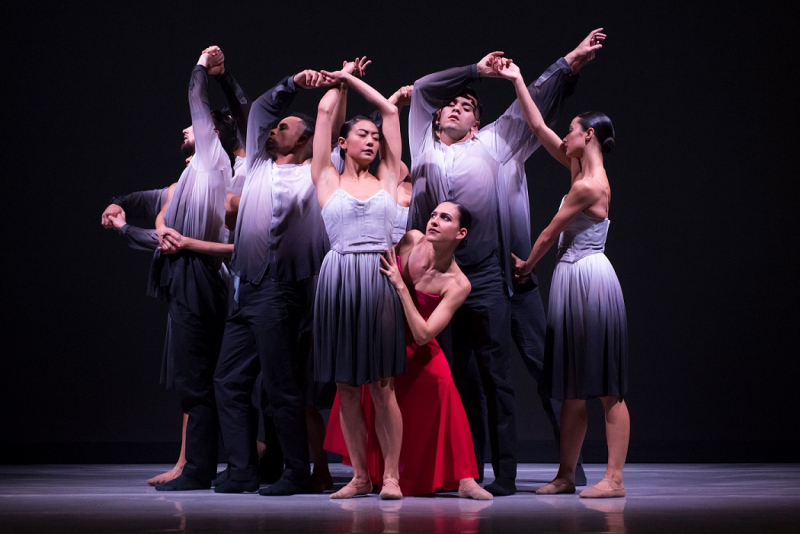
    Above: from El Viaje, photo by Paula Lobo

    Melissa Verdecia, striking in a red dress, is spotlit facing upstage as the curtain rises. Such rushes into a high lift as the ballet begins. The dance has a ritualistic feel, and a strong architectural framework. Partnering motifs, performed by the couples in unison, underscore the sense of community. Solo and duet opportunities abound, in which the Hispánico dancers revel in their power and beauty, buoyed by the marvelous music. At the end, the dancers stand together, facing the sunrise, uncertain but hopeful. 

    Dandara

    Above: Dandara Veiga in El Viaje, photo by Paula Lobo

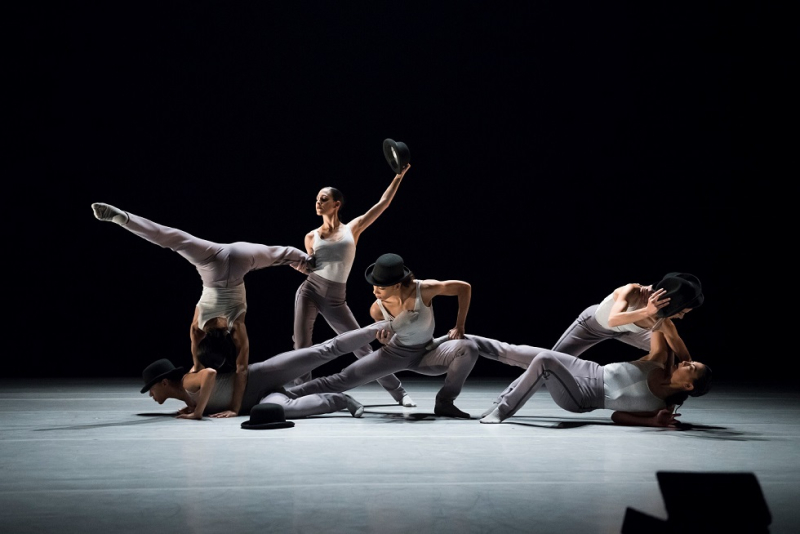
    Sombrerísimo was commissioned by New York’s City Center for Fall for Dance in 2013; I was present at the premiere, which was a huge hit with the audience. Choreographed for an all-male ensemble by Belgian-Colombian Annabelle Lopez Ochoa to a collage score by Banda Ionica, Macaco el Mono Loco, and Titi Robin, it of course now has a very different feel as danced by six women: Shelby Colona, Jenna Marie, Eila Valls, Gabrielle Sprauve, Dandara Veiga, and Melissa Verdecia. The movement ranges from swift and accented to cool and sexy, and there’s much by-play with the hats that inspired the ballet’s title. Joshua Preston’s lighting is atmospheric, and often produces a shadow-dancing effect. At the end, the girls toss their hats into the air while dozens of other hats fall from above.

    Sombrero

    Above: the Ballet Hispanico women in Sombrerísimo, photo by Paula Lobo

    Bennyroyce Royon’s Homebound/Alaala is a danced memory-book of his homeland in The Philippines. On the other side of the world, in Bato, Leyte, mi amor de loin keeps me in daily touch with that world – a unique on-line love affair that made Benny’s ballet especially meaningful to me.

    Chris B

    Above: Chris Bloom in Homebound/Alaala, photo by Paula Lobo

    Opening with a dazzling stars-scape, the stage is full of boxes which the dancers carry, push, construct, take down, open, and close throughout the ballet. Perhaps they are boxes full of memories: some are marked Fragile. To popular songs of the Tagalog, the people work, relax, joke, flirt, and dream. Unison dance passages emphasize the sense of community, which is so very strong in the Filipino culture.

    Central to Benny’s ballet is a gay ‘cruising’ duet, performed in silence. The two men warily circle one another, unsure of a response. In an overwhelmingly Catholic society, being gay in The Philippines faces barriers to acceptance; President Duterte tends to send mixed messages on the subject. My Brix thankfully has the support of his family, which many young people in the life there do not.

    But, back to Bennyroyce’s ballet: flip flops are lined up as the finale is reached. While I might have wished for more dancing in this piece, I loved the music, the spirit of commitment from the dancers, and feeling the connection to my Tico…a love from afar.

    ~ Oberon

  • Stravinsky’s FIREBIRD @ The NY Philharmonic

    Pintscher_matthias_1819

    Above: composer and conductor Matthias Pintscher

    ~ Author: Brad S. Ross

    Thursday February 21st, 2019 – It was an evening of exquisite sounds Thursday night at David Geffen Hall as the guest conductor Matthias Pintscher led the New York Philharmonic in music by two early 20th-century greats sandwiching one of his own, composed almost exactly a century years later.  Pintscher, a German-born composer and conductor now residing in New York City, has quickly built a reputation as one of the finest younger composer–conductors of recent memory to emerge on the world stage.  On this night, he brought with him a much-welcomed performance of his recent violin concerto, featuring the talents of the renowned French violinist Renaud Capuçon.

    The evening began with Maurice Ravel’s “Alborada del gracioso” (“Dawn Song of the Jester”) from his 1905 piano suite Miroirs, which he had transcribed for orchestra in 1918.  Ravel, a master of orchestration above all, peppered this score with myriad and most enjoyable colors, including numerous pizzicato phrases, muted brass, and varied percussive bursts.  Pintscher brought the best out of the Philharmonic, which performed here with precision and grace.  It made for a lively and dynamic opening piece.

    Violinist-Renaud-Capucon-

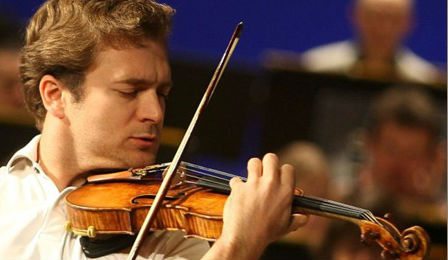
    Above: Renaud Capuçon

    Next up was Pintscher’s own mar’eh, a concerto for violin and orchestra composed in 2011 on a commission from the Lucerne Festival, Alte Opera Frankfurt, and the London Philharmonic Orchestra, which was here receiving its New York premiere.  Its title comes from a Hebrew word meaning “face sign” or, as the composer’s note indicates, “the aura of a face, a beautiful vision, something wonderful which suddenly appears before you.”  Why he chose to write it in lower case is as mystifying to me as any other inexplicably ungrammatical contemporary music title.

    The piece began quite eerily on a single suspended note played high on Capuçon’s violin, joined only by an ominous rumble in the percussion.  A languid melody soon entered, trading between Capuçon and various brass soloists, as dark colors began to emerge throughout the orchestra.  Following this menacingly silent introduction, a series of tantalizing full-ensemble swells seemed to indicate a change of direction for mar’eh before the work fell back into another series of quietly shifting timbres.  This carried on for some time until the same solitary high note and percussive rumble returned to bookend the concerto.

    Extended technique abounded throughout mar’eh and the players, including Capuçon, were at their absolute finest, but it was nevertheless hard to shake a sense of dissatisfaction when it was all over.  What the piece lacked was a sense of direction—momentum.  Its tempo always leaned toward the adagio, if that, and its dynamics, aside from the occasional fortissimo burst, rarely seemed to escape mezzopiano.  For a duration of roughly 23 minutes, this made for a hard-going listening experience.  The audience was politely receptive to it, however, even if their enthusiasm seemed more directed at its soloist than the composer.

    After intermission was the third and final piece of the night: Igor Stravinsky’s mighty Firebird.  Written in 1910, The Firebird marked the first of the composer’s many fruitful collaborations with the ballet impresario Sergei Diaghilev—a relationship that would also produce the likes of Petrushka and The Rite of Spring.  Premiering only eight days after his 28th birthday, it was also Stravinsky’s breakout piece and one that placed him on the world stage as one of the finest composers of his time and beyond.

    The audience knew it was in for a treat from the moment it began, as those memorable and ominous opening bars in the cello and bass harbingered the danger ahead.  The First Tableau was equal parts beautiful and menacing leading up to its volatile climax (the unforgettable “Infernal Dance of All Koschei’s Subjects”) and the haunting lullaby that follows.  The Second Tableau redeemed this carnage and misery with its exuberant and triumphant finale—one of the grandest in all classical music.

    The experience of hearing these magnificent bars played live by an orchestra as fine as the New York Philharmonic is one I wish every person on Earth could experience for himself.  The ethnomusicologist John Blacking once defined music as “humanly organized sounds…” if this be so, then these are no doubt some of the finest sonorities ever compiled by a single person.

    The crowd was quick to its feat upon conclusion with many shouts of “Bravo!”  This was easily one of the most animated displays of approval I’ve witnessed all season.  Pintscher and company received several curtain calls and every section of the ensemble was given a chance to take their bows.  The adulation was much-deserved for Pintscher and this stupendous orchestra, the gem of New York City.  Bravo, indeed.

    ~ Brad S. Ross

  • Great Performers: Russian National Orchestra

    Thumbnail_Screen Shot 2019-02-22 at 3.36.48 PM

    Above: conductor Kirill Karabits; photo by Konrad Kwik

    ~ Author: Ben Weaver

    Wednesday February 20th, 2019 – The Russian National Orchestra’s highly anticipated visit to Lincoln Center’s Great Performers series with an all-Rachmaninoff concert drew a big and appreciative crowd, filled with many Russian-speakers who were buzzing about Mikhail Pletnev’s performance. Mr. Pletnev, star pianist and new conductor, was the founding conductor of the orchestra in the early 1990s after the collapse of the Soviet Union found many Soviet orchestras starved for money. Pletnev, pulling in financial backing from the West, formed the RNO and hired many leading musicians from the now former USSR’s other orchestras, creating something of an all-Star ensemble. It remains to this day Russia’s only privately-backed orchestra. Maestro Pletnev has since stepped back from full-time conducting duties and on Wednesday, February 20th appeared as soloist in Rachmaninoff’s 2nd Piano Concerto. Kirill Karabits, who has gained much attention as chief conductor of Bournemouth Symphony Orchestra, was on the podium.

    Pletnev entered to a warm welcome from the audience, dressed all in black, looking very Russian dour. The playing was anything but, however. The brief solo introduction, a series of dramatic chords before the orchestra enters with its famous first theme, showcased Pletnev’s strong, muscled tone. The muscle, however, is not lacking in musicality and lyricism. The orchestra entered with a very slow Moderato. I wondered how the choice of tempo would be able to sustain the musical line without breaking.
     
    At first both Pletnev and Karabits (via RNO) managed fine. Pletnev’s beautiful control of the piano’s dynamics, the legato of the playing, never ceding control to the orchestra, but also never showcasing himself for the sake of showboating, he seemed to be playing a concerto with piano, not just for it. This beautiful integration of sound, the marriage between the instruments, was lovely to behold. But as the movement began to build to its climax and the drama began to build, the slow tempo caught up to the proceedings. Pletnev suddenly felt muzzled, needing to take extended breaks between chords that are usually played together so that the orchestra could catch up. Pletnev seemed to desperately want to move forward and felt restrained; it created an uncomfortable pull and push between orchestra and conductor as the movement ended. The concerto’s famous Adagio sostenuto was lovely – piano and orchestra finally breathing as one, and the thrilling final Allegro showcased Pletnev’s effortlessly perfect finger work. The audience exploded with satisfaction and Pletnev gave a fascinating performance of Scarlatti’s Sonata in D minor, K.9, making it sound like ringing bells.
     
    Thumbnail_mikhail-pletnevcalexey-molchanovsky

    A
    bove: pianist Mikhail Pletnev; photo by Alexey Molchanovsky
     
    All ears were now on Kirill Karabits for Rachmaninoff’s ever-fresh Symphonic Dances, Op. 45, his final composition and one he considered his best. Written in 1941 while Rachmaninoff lived on Long Island, NY, the piece was dedicated to The Philadelphia Orchestra and Eugene Ormandy (who gave the world premiere performance in 1941) and intended to be a ballet choreographed by Mikhail Fokine. Alas, Fokine died before the project could be brought to fruition. (It has been choreographed by several leading choreographers since, including Peter Martins for New York City Ballet.) 
     
    Maestro Karabits, handsome, trim and in a perfectly fitted suit, is a fun conductor to watch, his wide, dramatic and balletic gestures helping to propel the music. The opening dance, Non allegro, was very dramatic with its driving, sharp rhythms nicely articulated; the mournful saxophone solo – and the other wind instruments – shone in the mournful sections of the movement – before the dramatic, Stravinskian rhythms return – only to dissipate like Loge’s Fire Music from Wagner’s Die Walküre, the first time I’ve made the musical connection between those two sections. The boozy, mysterious waltz of the second movement (when the Symphonic Dances were still a ballet, this was called “Midnight”), a cousin to Ravel’s La valse, sashayed nicely with its weird combination of sexiness and creepiness. The dramatic final movement, with its extensive quotations of Rachmaninoff’s favorite leitmotif, the Dies irae, was a thrilling, thundering conclusion to a perfectly paced performance. This was perhaps the most exciting performance of the Symphonic Dances I’ve heard live, so kudos to the superb Russian National Orchestra and maestro Karabits.
     
    The audience shared my enthusiasm and received 3 encores: a ravishing Rachmaninoff Vocalise, The Russian Sailors’ Dance from Glière’s The Red Poppy, and Lysenko’s Overture to Taras Bul’ba.
     
    ~ Ben Weaver

  • Miro On A Monday

    Tom Schaefer photo

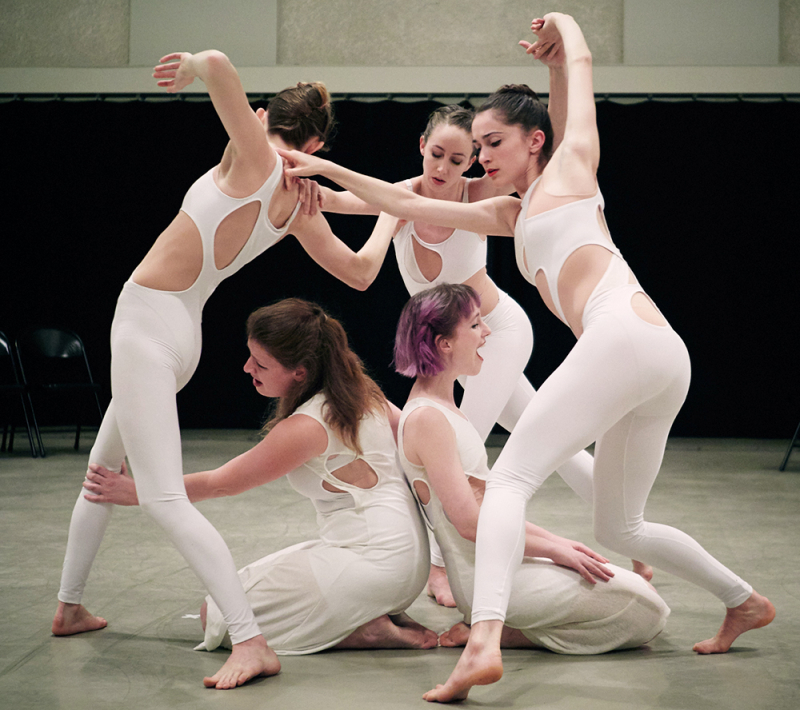
    Above: dancers from New Chamber Ballet and singers from Ekmeles in Miro Magloire’s SANCTUM; photo by Tom Schaefer

    Author: Oberon

    Monday February 18th, 2019 – Miro Magloire’s New Chamber Ballet normally give their performances on weekends, so I was surprised to be invited to see them on a Monday evening. Mondays are often quiet nights for me: neither the Philharmonic nor Chamber Music Society have Monday performances; nor – for that matter – does New York City Ballet. So it was nice to trek down to the City Center Studios on this clear, chilly evening to see Miro’s company, and to hear some incredible music, beautifully played…and sung. I must also say: the 7:30 PM start time was a big plus in my book.

    The program opened with MORNING SONG, a solo dancework to music by John Cage that Miro made on his uniquely marvelous dancer, Elizabeth Brown. Doori Na, a violinist who can master the trickiest score and make it mean something, played Cage’s ‘Cheap Imitation‘ (1st movement) to perfection whilst the dancer moved about the space with lyrical authority: a priestess evoking the dawn.

    With ecstatic gestures that recall the ground-breaking dances of Isadora Duncan, Elizabeth held the audience under a spell throughout the work’s duration. A very long pause, wherein she remains still, has a power if its own. Elizabeth’s slow circling of the space in calm, weighted/weightless stepping turns, was hypnotic. As dancer and violinist bowed to one another at the close of MORNING SONG, the return to reality was like awakening from a wonderful dream. All that is beautiful in music and dance seems to be distilled into this incredible work.

    After only the briefest pause, New Chamber Ballet’s bevy of ballerinas – Sarah Atkins, Kristy Butler, Amber Neff, Rachele Perla, and Madeleine Williams – joined three singers from the Ekmeles vocal ensemble – Charlotte Mundy, Mary Elizabeth Mackenzie, and Elisa Sutherland – and pianist Melody Fader and violinist Doori Na, for the premiere of Miro’s SANCTUM.  Vocal music by Kaja Saariaho (Changing Lights and From The Grammar Of Dreams) and Karin Rehnqvist (Davids Nimm) invites the singers to be part of the dance. Melody and Doori perform – luminously – Saariaho’s Nocturne, Calices, Prelude, Tocar, and Ballade, as well as Rehnqvist’s Dans.

    SANCTUM has been in-progress for some time, in various guises, and I have seen parts of it in rehearsal or in performance over the past several months. Tonight, with the dancers and singers in Sarah Thea’s bone-white costumes, Miro wove all the elements into a 70-minute ballet.

    SANCTUM opens with seated couples (dancers and singers) dreamily dependent on each other, rocking gently. The strikingly clear voice of Charlotte Mundy fills the space: this high, iridescent sound might be the voice we’ve been looking for for Berg’s Lulu. The dancing commences with a duet for two tall women: Kristy Butler and Madeleine Williams. Amber Neff and Rachele Perla, having donned toe shoes, join.

    The music is spectacularly beautiful – Saariaho (along with Penderecki) is for me the most fascinating of contemporary composers – and Melody and Doori play it thrillingly: being seated immediately next to these two musicians, every nuance and demi-tint of the scores become tantalizing.

    The dance continues to unfold, including Madeleine Williams in a solo that creates a stylistic link to the earlier-seen MORNING SONG. Amber Neff and Ms. Williams dance a duet in Miro’s trademark intense/entangled partnering mode; the music here features vertiginous piano scales which Ms. Fader played with intrinsic flair. Sarah Atkins, Rachele Perla, and Kristy Butler engage in a prancing trio, and Sarah also has a demanding, floor-oriented solo. The singers return, each pairing up with a dancer in a stop-and-start circular promenade. The ending of the ballet is not as powerful as one might hope: the women simply walk away, perhaps to carry on their antique rites in another part of the forest.

    Meanwhile, the two musicians have found a path into our subconscious with this other-worldly music. Over the course of the ballet, their playing has created a separate, almost alien, world. And at some point along the way, I realized that this particular work of Miro’s is not best-experienced in a fully-lit, in-the-round studio setting.

    As we observe the grace and power of the dancing, we must also face our mere-mortal counterparts seated across from us: fidgeting, reading their programs, even nodding off. The music continuously draws us away from the everyday to a mythic place of feminine mystique and magic; but the ordinariness of the studio setting keeps jarringly pulling us back to reality.

    I feel that, in a darkened theater with imaginative lighting, SANCTUM could be as compelling visually as it is musically.

    ~ Oberon

  • At Amanda Selwyn’s Rehearsal

    0D9A2416

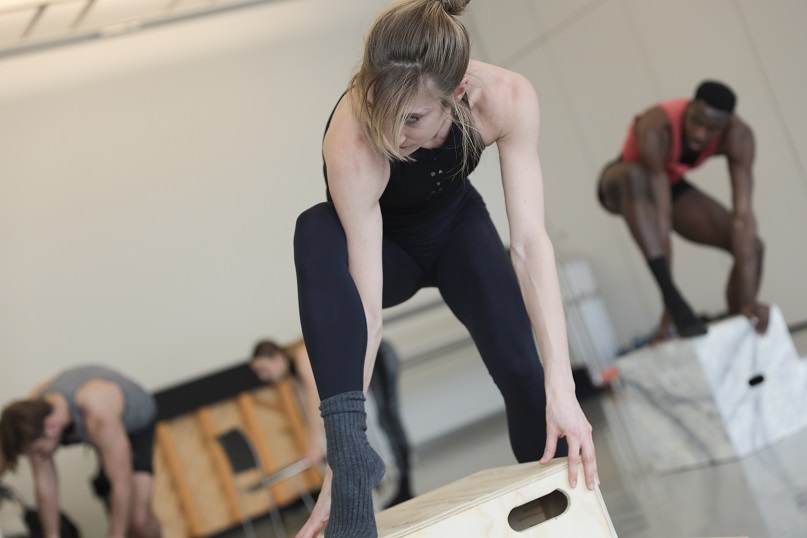
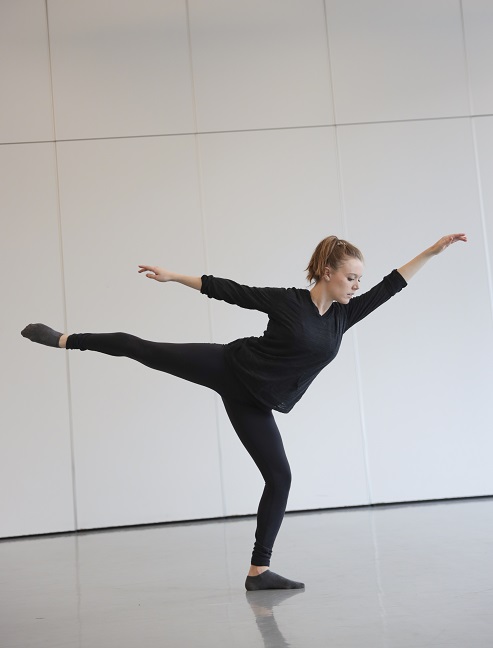
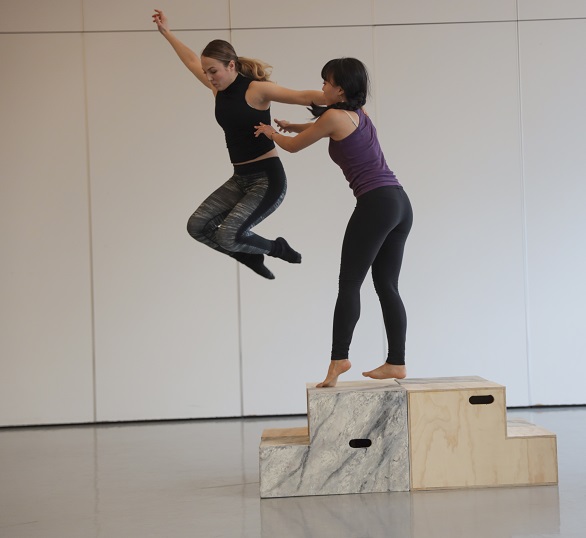
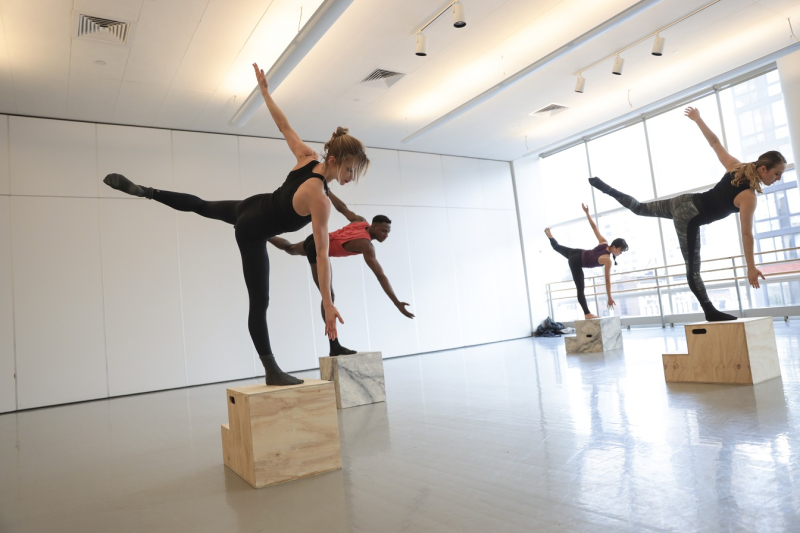
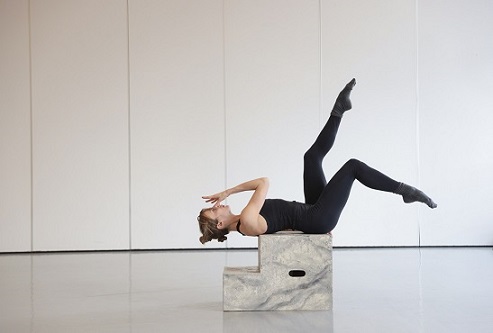
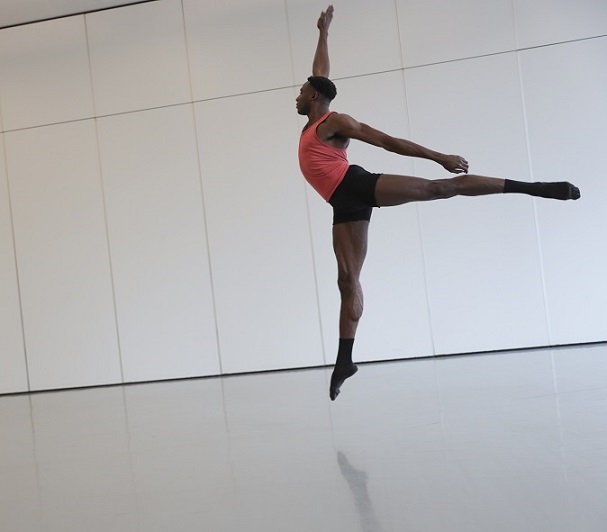
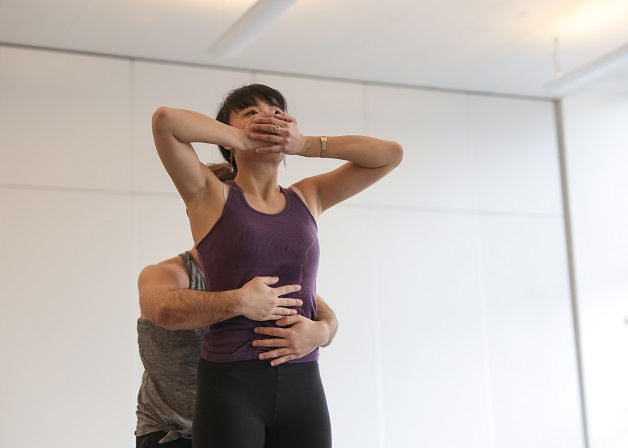
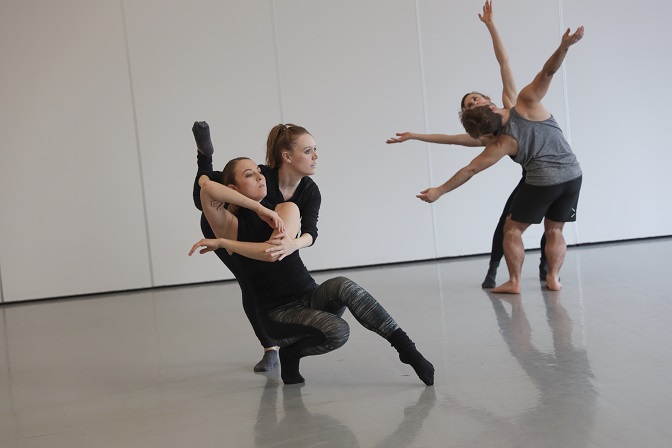
    Monday January 28th, 2019 – Photographer Travis Magee and I stopped in at the Ailey Studios today where Amanda Selwyn and her dancers were rehearsing their work-in-progress, CROSSROADS. Inspired by the art of Magritte and Escher, the premiere performances will be given June 20th thru 22nd, 2019, at New York Live Arts.

    In October, we had a first look at CROSSROADS when the Company held an open rehearsal. There, we watched the individual dancers creating movement phrases which are then taught to their colleagues, and later elaborated on or modified by the ensemble, to be finally woven into the overall fabric of the dancework. 

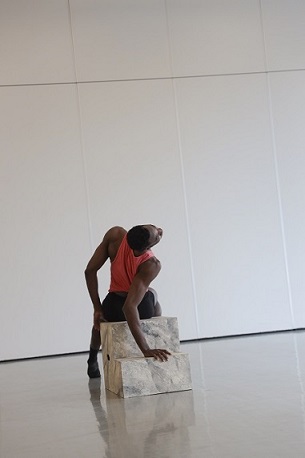
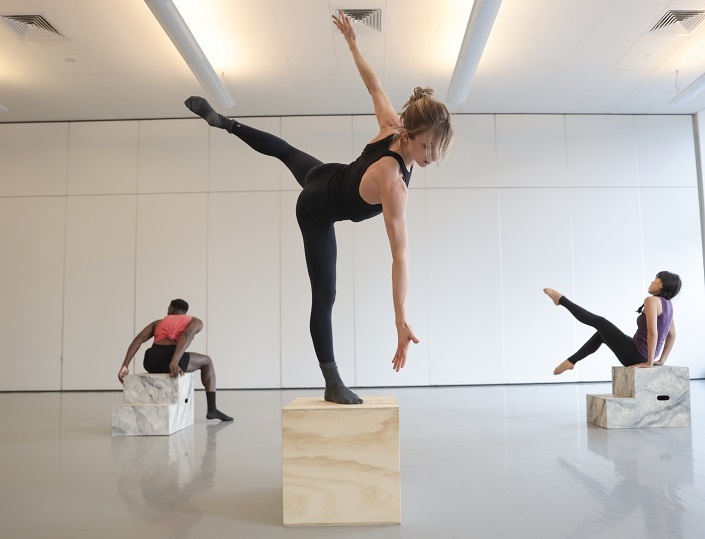
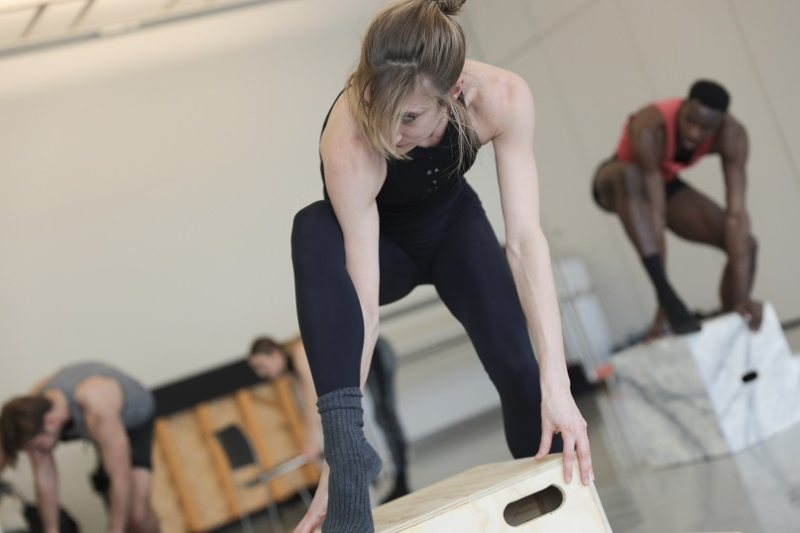
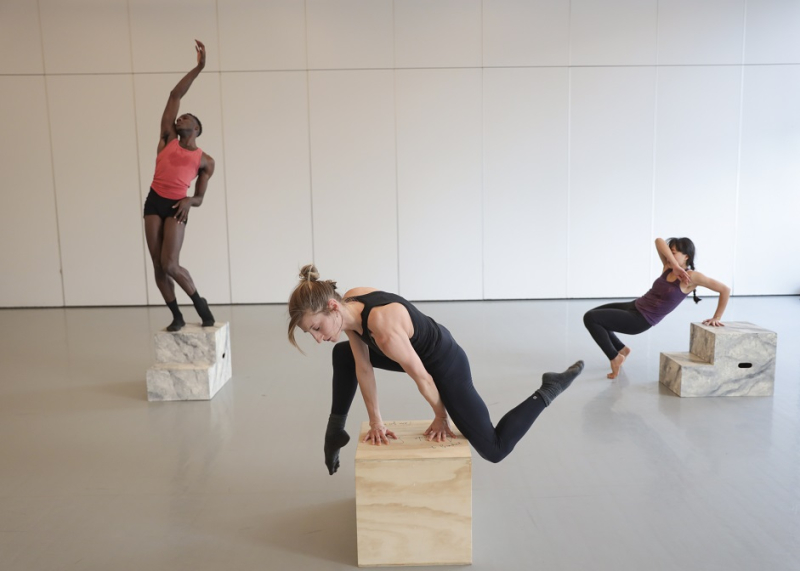
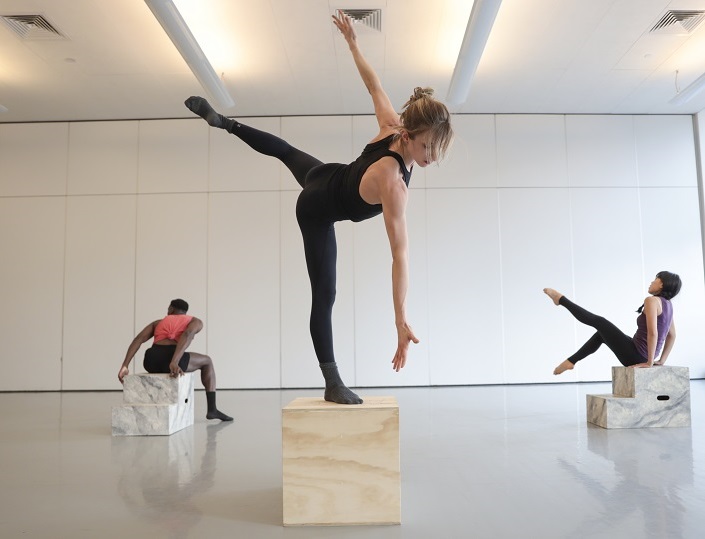
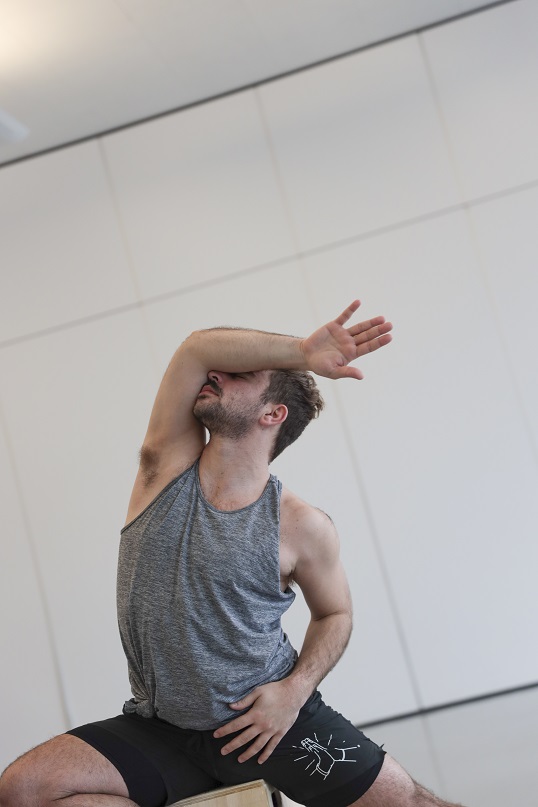
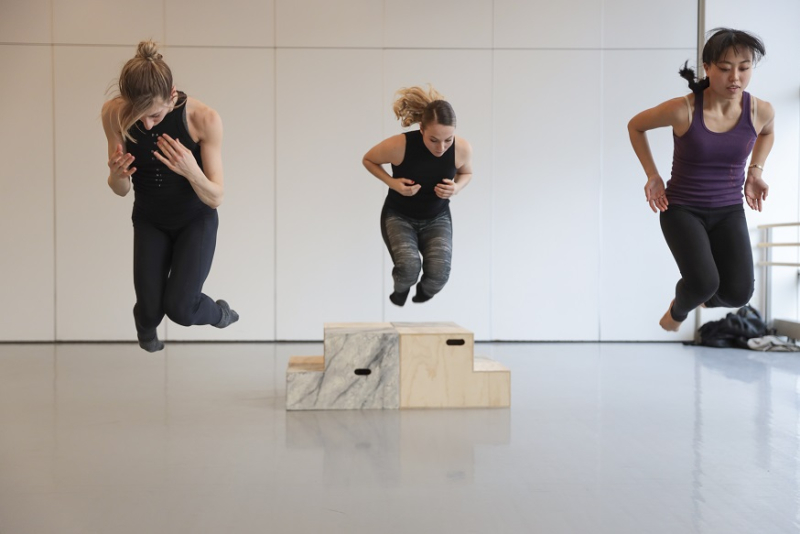
    This process continued today, and Amanda described to me the set pieces (doors, re-arrangeable boxes) that will become part of the staging. This afternoon, the stackable boxes were in play, with the dancers getting used to using them as seats, pedestals, and springboards for athletic feats. 

    The rehearsal atmosphere is relaxed, but with a strong focus on mastering the various movements that will become part of CROSSROADS.

    The dancers of Amanda Selwyn Dance Theatre are:

    0D9A2746

    Torrey McAnena…

    0D9A2476

    …Alex Cottone…

    0D9A2516

    …Sarah Starkweather…

    0D9A2477

    …Manon Hallay…

    0D9A2692

    …Fabricio Seraphin…

    0D9A2877

    …and Misaki Hayama. 

    And here are more of Travis Magee’s images from today’s rehearsal:

    0D9A2407

    0D9A2428

    Sarah Starkweather

    Fabricio

    Fabricio Seraphin

    0D9A2443

    Fabricio, Sarah, and Misaki

    0D9A2450

    Fabricio, Sarah, Misaki

    0D9A2537

    Fabricio

    0D9A2545

    Alex Cottone

    0D9A2658

    Alex and Misaki

    0D9A2709

    Alex and Misaki

    0D9A2736

    Torrey, with Alex and Sarah

    0D9A2751

    Torry McAnena

    0D9A2787

    Torrey, Manon, with Alex and Sarah

    0D9A2835

    Manon and Misaki

    0D9A2804

    Sarah, Manon, and Misaki

    All photos by Travis Magee

    ~ Oberon

  • At Amanda Selwyn’s Rehearsal

    0D9A2416

    Monday January 28th, 2019 – Photographer Travis Magee and I stopped in at the Ailey Studios today where Amanda Selwyn and her dancers were rehearsing their work-in-progress, CROSSROADS. Inspired by the art of Magritte and Escher, the premiere performances will be given June 20th thru 22nd, 2019, at New York Live Arts.

    In October, we had a first look at CROSSROADS when the Company held an open rehearsal. There, we watched the individual dancers creating movement phrases which are then taught to their colleagues, and later elaborated on or modified by the ensemble, to be finally woven into the overall fabric of the dancework. 

    This process continued today, and Amanda described to me the set pieces (doors, re-arrangeable boxes) that will become part of the staging. This afternoon, the stackable boxes were in play, with the dancers getting used to using them as seats, pedestals, and springboards for athletic feats. 

    The rehearsal atmosphere is relaxed, but with a strong focus on mastering the various movements that will become part of CROSSROADS.

    The dancers of Amanda Selwyn Dance Theatre are:

    0D9A2746

    Torrey McAnena…

    0D9A2476

    …Alex Cottone…

    0D9A2516

    …Sarah Starkweather…

    0D9A2477

    …Manon Hallay…

    0D9A2692

    …Fabricio Seraphin…

    0D9A2877

    …and Misaki Hayama. 

    And here are more of Travis Magee’s images from today’s rehearsal:

    0D9A2407

    0D9A2428

    Sarah Starkweather

    Fabricio

    Fabricio Seraphin

    0D9A2443

    Fabricio, Sarah, and Misaki

    0D9A2450

    Fabricio, Sarah, Misaki

    0D9A2537

    Fabricio

    0D9A2545

    Alex Cottone

    0D9A2658

    Alex and Misaki

    0D9A2709

    Alex and Misaki

    0D9A2736

    Torrey, with Alex and Sarah

    0D9A2751

    Torry McAnena

    0D9A2787

    Torrey, Manon, with Alex and Sarah

    0D9A2835

    Manon and Misaki

    0D9A2804

    Sarah, Manon, and Misaki

    All photos by Travis Magee

    ~ Oberon

  • The ASO: Sounds of the American Century

    DSC09652

    Above: Maestro Leon Botstein, in a Matt Dine portrait

    ~ Author: Brad S. Ross

    Friday, January 25th, 2019 – It was another fine program Friday night at Carnegie Hall’s Isaac Stern Auditorium as the music director Leon Botstein led The American Symphony Orchestra in an all-American program of under-performed greats aptly titled “Sounds of the American Century.”  And that it most certainly was.

    Mann

    The evening began with Fantasy for Orchestra, a tone poem by the late violinist and educator Robert Mann (above).  Mann, who died last year at the ripe old age of 97, was a long-time staple of the New York classical music scene, in front of and behind the scenes, and was first violinist of the Juilliard String Quartet for over fifty years.  In addition to performance and education, Mann also dabbled in composition to pleasantly effective results.  His Fantasy for Orchestra was originally commissioned by the New York Philharmonic and first performed by that ensemble under the direction of Dimitri Mitropoulos at Carnegie Hall itself in 1957.

    The piece opened on the violas sustaining a single note.  Other members of the orchestra soon joined and a collage of atonal sonorities began to emerge.  This menace continued to build until a percussive roll launched the work into more energized and frenzied territory.  Mann’s Fantasy played almost programmatically, as if scoring the unseeing drama of some unsettling film or ballet.  A haunting violin solo emerged, performed by the concertmaster Cyrus Beroukhim, as harp ostinati and melancholic low brass chords created an almost dream-like atmosphere.  After a near-silent decrescendo, the drama then built up to a sequence of full-orchestra blasts that rang the piece to a volatile conclusion.  This was a decidedly above-average mid-century tone poem, played with force by the American Symphony Orchestra, and one that should warrant more-frequent airings.

    Vivian-Fine

    Next, receiving its long-overdue New York premiere, was Concertante for Piano and Orchestra by Vivian Fine (above).  Fine, who was one of a handful pioneering female composers in the early 20th century, is perhaps best known for her many chamber works, including the atonally adventurous Capriccio for Oboe and String Trio.  The Concertante for Piano and Orchestra, composed in 1944, was the first of her orchestral repertoire.

    After Mann’s Fantasy for Orchestra, Fine’s Concertante was almost strikingly tonal, as if ripped from the pages of some lost Romantic-era score composed sixty years prior.  Comprising two movements, it opened on a stately and delicate Andante con moto and closed on a convivial and spirited Allegro risoluto.

    Charliealbright

    Pianist Charlie Albright (above) made solid sport of the piece’s numerous solo passages and improvised an impressively intricate and lively cadenza that charged the work to its end.  His admirable commitment to the piece brought much life to what otherwise struck me as a very dainty and anachronistic work, one I don’t expect to hear programmed again anytime soon.

    A minor ovation brought Albright back to the piano bench for an encore of a work that, as a friend of his apparently put it, “takes balls to perform.”  He then ripped into a breezy rendition of 1957’s “Great Balls of Fire” that cheekily concluded the first half of the concert.


    J Druckman

    After intermission came a performance of Prism, a three-movement orchestral set by written in 1980 the great and often unsung composer Jacob Druckman (above).  Inspired in part by Luciano Berio’s 1968 Sinfonia, Druckman crafted Prism by blending the musical styles of historic composers with his own decidedly modern voice.  Fittingly, each movement references the music of a Baroque or Classical-era composer for which it is titled.

    The first movement “After Marc-Antoine Charpentier” began on otherworldly textures consisting of percussion, woodwind clusters, pizzicato hits, and haunting tremolo in the strings.  Quotations of Charpentier soon emerged, complete with a synthesized harpsichord, but carrying with it the wild distortions and eerie timbres of the 20th century.  The second movement, “After Francesco Cavalli”, carried on in similar fashion, blending the sonorities of these disjointed eras.  A clarinet solo accompanied by atonal statements throughout the orchestra brought some much-appreciated color and allowed the piece to stand more fully on its own legs, rather than succumb to pastiche.  Violent punctuations opened the third movement, “After Luigi Cherubini,” which was occasionally discursive to a fault.  Nevertheless, this built to an impressively bombastic finale that rekindled any waning interest.

    Compositions that blend the styles of different musical eras like Prism or Berio’s Sinfonia (or Steven Stucky’s Dreamwaltzes or John C. Adams’s Absolute Jest, for that matter) tend to walk a fine line between tasteful reference and cheeky gimmickry.  While the merits of such genre-bending continue to be up for debate, I must confess enjoying Prism best when lived in its own era.

    P01l7krp

    The final piece of the evening was the Third Symphony by one of America’s greatest composers, William Schuman (above).  A contemporary of Robert Mann, Schuman was also a staple of New York’s classical music scene, albeit with a much wider influence.  Throughout the course of his life, he served as the president of the Juilliard School, president of Lincoln Center, and in 1943 became the first-ever recipient of the Pulitzer Prize for Music.  Among his impressive catalog of compositions are numerous ballets and concertante, two operas, dozens of chamber and orchestral works, and a whopping ten symphonies.  The Third Symphony, composed in 1941, is perhaps his most famous.

    Clocking in at about thirty minutes, the symphony is cast in two parts played with short pause—Part I comprising a Passacaglia and Fugue and Part II concluding on a Chorale and Toccata.  It begins on a slow and somber viola line that is gradually joined by the remainder of the strings and, finally, the rest of orchestra.  This tragic crescendo continues until a great fortissimo brass statement launches the work into new, dramatic frontiers.  Its form relaxed, but never rambling, the rest of the work is colored with mysterious string runs, noble brass statements, haunting solo passages, and occasionally violent musical statements.  Its final Toccata, opening on droning bass and military snare, eventually leads to vigorous string runs and bombastic low brass that slowly build it to a brilliant full-orchestral finale.

    Alternately lively and melancholic, stately and haunting, beautiful and ferocious, the symphony marks a high point of American orchestral writing.  It is one our nation’s finest symphonies and should be played as often as any of the best works of Aaron Copland or Leonard Bernstein.  Alas, it tends to languish, as do so many other great American orchestral works, on the dusty shelves of music libraries as the works of Beethoven, Brahms, and Mozart are performed ad infinitum.  It’s a scandal that American orchestras don’t find more time in their seasons to honor the music of their native soil, one that I’m happy to see Leon Botstein and company attempting to combat.

    While I wasn’t always thrilled with this interpretation of the piece, which occasionally leaned on the sluggish side, this still ultimately made for triumphant conclusion to a grand evening of American classical music at Carnegie Hall.  The mission of the American Symphony Orchestra, now in its 57th season, is one of the most admirable kind.  New Yorkers could do far worse than to hear this orchestra unearth great works of art from our nation’s past.

    ~ Brad S Ross

  • “Lydia Sokolova Triumph!”

    IMG

    “Lydia Sokolova Triumph – Famous Dancer’s Ovation at Covent Garden!”  Thus ran the headline in London’s Daily Express following a 1929 performance of LE SACRE DU PRINTEMPS by Diaghilev’s troupe at the venerable London opera house. The ballerina, having recently recovered from a horrendous illness, had taken a chance and re-created her role of the Chosen One in the Massine setting of the Stravinsky ballet. It was reported that her ovation equaled that of the great operatic soprano Rosa Ponselle, two months earlier in the same theatre.

    Born Hilda Munnings in suburban London in 1896, Lydia Sokolova was to become one of Diaghilev’s principal artists; it was the impresario’s idea to Russianize her name. She wrote a memoir, DANCING FOR DIAGHILEV which I recently very much enjoyed reading. In this 100th anniversary celebration year of Diaghilev’s first saison Russe (at Paris 1909) her stories left an especially touching impression.

    The book tells of her formative years as a dancer and of the many personalities who played a part in the Ballets Russes story, from Massine to Dolin, from Karsavina to Danilova. She gives details of the creation of several of the ballets in the Company repertoire and of her participation in their premieres.

    Sokolova’s life as a member of Diaghilev’s nomadic troupe was a rich one, crammed with incidents which she relates with modest charm. She was, for example, aboard the ship headed for South America where Romola de Pulszky and Vaslav Nijinsky shocked the entire Company (and the dance world at large) by falling in love. Their wedding in Buenos Aires, which Sokolova attended, caused a monumental rift between Nijinsky and Diaghilev and eventually contributed to Nijinsky’s decline into madness.

    Trapped with the Company in Lisbon during the war, Sokolova watched helplessly as her baby daughter’s health declined from lack of food and medicine to a point where she gave the child up for dead. Diaghilev, nearly penniless himself, came to her one night and gave her a few of his last coins to obtain a doctor’s treatment. Sokolova relates how on those long, hopeless days Diaghilev would sit in the park with her baby on his lap, allowing the girl to play with his monocle. The dancer had seen the human side of the great impresario and felt that their mutual despair had created a personal bond between them. After much trouble, the ballerina and the director escaped separately to London. Meeting again on the stage of the Coliseum, Sokolova was shocked to find Diaghilev back entirely in his cool, detached impresario mode. She realized that their brief closeness in dire circumstances was not to have any effect on their professional relationship.  

    Mw69606

    Lydia Sokolova and Leon Woizikovsky in LE TRAIN BLEU. The story of Lydia’s love life gave me special pleasure. Since in her photos she looks rather staid, I was delighted to read that she was a passionate woman; her affair with Woizikovsky began while both of them were married to others in the Company. There was a big scene when Leon’s wife found out the truth, and Lydia and Leon were forced to cool it. But things continued to smoulder and eventually their mutual passion won out. Freeing themselves from their spouses, they wed and – despite Leon’s penchant for gambling – their marriage was long-lasting.

    A terrible bout of illness and injury led Sokolova to curtail her activities in the late 1920s. For months she was unable to dance or even to be mobile at all. She tried everything – from freakish medical treatments to prayer – but nothing helped. Slowly, slowly she rejoined the world of the living and the story of her 1929 triumph in RITE OF SPRING in London was in a way a triumph of her will to dance again.

    Diaghilev_sergei

    Above: Serge de Diaghilev. Sokolova’s book ends abruptly with the death of Diaghilev; she and Leon were on a beach on the French coast when the newspaper was brought down to them bearing the tidings of the impresario’s death in Venice. Their lives were altered in that moment; Sokolova went on to teach and coach and even to perform on occasion: she danced for the very last time in London in 1962 and died in 1974.

    My favorite story from the book revolves around flowers. Sokolova, by then a well-established principal dancer, was incensed one day to find herself cast as one of the twelve maidens in FIREBIRD. She went to Diaghilev to protest; his reply was that it was an honor to dance in his corps de ballet. Sokolova stewed and fumed helplessly in the days leading up to the performance and even considered leaving the Company. Warming up backstage on the dreaded night, Sokolova stopped by the large table in the wings where bouquets to be handed the artists during the performance were laid out. She saw a magnificent spray with a card that said “Lydia Sokolova…after FIREBIRD” Since she had a lead role in one of the other ballets that night, she went to the stage manager and asked that she be given the flowers after that piece rather than FIREBIRD; she did not want to be singled out of a group of twelve with a floral offering. “Diaghilev’s order!” the stage manager told her. Her pleading fell on deaf ears.

    And so, during the FIREBIRD curtain calls, Lydia Sokolova was called forward from the corps to receive the enormous bouquet. Diaghilev knew how to make amends.

    {Reviving this article from 2009 as I am re-reading the book for the eighth or ninth time. It’s great!}

    ~ Oberon

  • “Lydia Sokolova Triumph!”

    IMG

    “Lydia Sokolova Triumph – Famous Dancer’s Ovation at Covent Garden!”  Thus ran the headline in London’s Daily Express following a 1929 performance of LE SACRE DU PRINTEMPS by Diaghilev’s troupe at the venerable London opera house. The ballerina, having recently recovered from a horrendous illness, had taken a chance and re-created her role of the Chosen One in the Massine setting of the Stravinsky ballet. It was reported that her ovation equaled that of the great operatic soprano Rosa Ponselle, two months earlier in the same theatre.

    Born Hilda Munnings in suburban London in 1896, Lydia Sokolova was to become one of Diaghilev’s principal artists; it was the impresario’s idea to Russianize her name. She wrote a memoir, DANCING FOR DIAGHILEV which I recently very much enjoyed reading. In this 100th anniversary celebration year of Diaghilev’s first saison Russe (at Paris 1909) her stories left an especially touching impression.

    The book tells of her formative years as a dancer and of the many personalities who played a part in the Ballets Russes story, from Massine to Dolin, from Karsavina to Danilova. She gives details of the creation of several of the ballets in the Company repertoire and of her participation in their premieres.

    Sokolova’s life as a member of Diaghilev’s nomadic troupe was a rich one, crammed with incidents which she relates with modest charm. She was, for example, aboard the ship headed for South America where Romola de Pulszky and Vaslav Nijinsky shocked the entire Company (and the dance world at large) by falling in love. Their wedding in Buenos Aires, which Sokolova attended, caused a monumental rift between Nijinsky and Diaghilev and eventually contributed to Nijinsky’s decline into madness.

    Trapped with the Company in Lisbon during the war, Sokolova watched helplessly as her baby daughter’s health declined from lack of food and medicine to a point where she gave the child up for dead. Diaghilev, nearly penniless himself, came to her one night and gave her a few of his last coins to obtain a doctor’s treatment. Sokolova relates how on those long, hopeless days Diaghilev would sit in the park with her baby on his lap, allowing the girl to play with his monocle. The dancer had seen the human side of the great impresario and felt that their mutual despair had created a personal bond between them. After much trouble, the ballerina and the director escaped separately to London. Meeting again on the stage of the Coliseum, Sokolova was shocked to find Diaghilev back entirely in his cool, detached impresario mode. She realized that their brief closeness in dire circumstances was not to have any effect on their professional relationship.  

    Mw69606

    Lydia Sokolova and Leon Woizikovsky in LE TRAIN BLEU. The story of Lydia’s love life gave me special pleasure. Since in her photos she looks rather staid, I was delighted to read that she was a passionate woman; her affair with Woizikovsky began while both of them were married to others in the Company. There was a big scene when Leon’s wife found out the truth, and Lydia and Leon were forced to cool it. But things continued to smoulder and eventually their mutual passion won out. Freeing themselves from their spouses, they wed and – despite Leon’s penchant for gambling – their marriage was long-lasting.

    A terrible bout of illness and injury led Sokolova to curtail her activities in the late 1920s. For months she was unable to dance or even to be mobile at all. She tried everything – from freakish medical treatments to prayer – but nothing helped. Slowly, slowly she rejoined the world of the living and the story of her 1929 triumph in RITE OF SPRING in London was in a way a triumph of her will to dance again.

    Diaghilev_sergei

    Above: Serge de Diaghilev. Sokolova’s book ends abruptly with the death of Diaghilev; she and Leon were on a beach on the French coast when the newspaper was brought down to them bearing the tidings of the impresario’s death in Venice. Their lives were altered in that moment; Sokolova went on to teach and coach and even to perform on occasion: she danced for the very last time in London in 1962 and died in 1974.

    My favorite story from the book revolves around flowers. Sokolova, by then a well-established principal dancer, was incensed one day to find herself cast as one of the twelve maidens in FIREBIRD. She went to Diaghilev to protest; his reply was that it was an honor to dance in his corps de ballet. Sokolova stewed and fumed helplessly in the days leading up to the performance and even considered leaving the Company. Warming up backstage on the dreaded night, Sokolova stopped by the large table in the wings where bouquets to be handed the artists during the performance were laid out. She saw a magnificent spray with a card that said “Lydia Sokolova…after FIREBIRD” Since she had a lead role in one of the other ballets that night, she went to the stage manager and asked that she be given the flowers after that piece rather than FIREBIRD; she did not want to be singled out of a group of twelve with a floral offering. “Diaghilev’s order!” the stage manager told her. Her pleading fell on deaf ears.

    And so, during the FIREBIRD curtain calls, Lydia Sokolova was called forward from the corps to receive the enormous bouquet. Diaghilev knew how to make amends.

    {Reviving this article from 2009 as I am re-reading the book for the eighth or ninth time. It’s great!}

    ~ Oberon

  • Fire in my mouth @ The New York Philharmonic

    NY Phil ~ Chris Lee

    ~ Author: Brad S. Ross

    Thursday January 24th, 2019 – Thursday evening at David Geffen Hall was one to behold as music director Jaap van Zweden led The New York Philharmonic in its most exhilarating performance of recent memory and more.  The night’s all-American program included the New York premiere of a late master, an American repertory standard, and one of the most hotly anticipated world premieres of the entire U.S. concert season.  One to behold, indeed.

    The evening began with Elegy, an instrumental interlude from the oratorio August 4, 1964 by the late American composer Steven Stucky.  Stucky, who died rather unexpectedly from brain cancer three years ago at the all-too-young age of 66, was one of America’s foremost contemporary composers, having written numerous concerti, one gorgeous symphony, an impressive opera, and two concerti for orchestra, the latter of which won him a long-overdue Pulitzer Prize for Music.  As the title suggests, August 4, 1964 details one fateful day during the presidency of Lyndon B. Johnson, including fallout from the Gulf of Tonkin incident and news of the discovered bodies of the murdered civil rights activists Andrew Goodman, Michael Schwerner, and James Chaney in Mississippi.  A Dallas Symphony Orchestra commission, the work was given its world premiere under the baton of van Zweden himself in September 2008.

    Maestro van Zweden wasted no time at the podium before setting things into motion.

    Elegy opened on a great crash—one that was sure to alert the senses of even the most droopy-eyed concert attendee.  The piece then descended into more somber territory as a quiet oboe, horns, and strings set its decidedly hymn-like tone.  The work possessed an almost filmic sense for drama, often building to thundering crashes followed by slow descents into haunting suspended dissonances.  Stucky aptly captured the turmoil of his subject matter, which seemed a prophetic meditation upon much of our current political turmoil.  Nevertheless, he ended the piece on a long-held major chord—one that seemed to offer a glimmer of hope in the face of uncertainty.  van Zweden milked this finale to tremendous dramatic effect, only lowering his baton after every note had its chance to reverberate throughout the hall several times over.

    Up next was Aaron Copland’s Concerto for Clarinet, Strings, and Harp.  Originally commissioned and performed by the great jazz clarinetist Benny Goodman, the concerto was one of handful of Copland works that incorporates elements of jazz in its composition.  It was written between 1947 and 1949, and went on to become one of the most-programmed clarinet concerti of the entire orchestral repertoire.  Performing tonight was Anthony McGill, the Philharmonic’s principal clarinetist.

    The piece began on a sorrowful elegy in the strings.  Copland’s voice here was its most stubbornly tonal—his broad rhythmic intervals and warm orchestration evoking the great open spaces of North America.  A lively and showy cadenza divided the work between its slow opening and an energetic climax, which Mr. McGill played with remarkable precision and zest.  The pace was then quickened as the orchestra performed a lovely call and answer in typical Copland fashion.  A final ascending glissando in the clarinet and upward rush in the strings brought the work to an animated close.  This exuberant finale brought some much appreciated levity to an otherwise solemn musical evening.

    If the program had ended here, it still would have easily been a great night at the Philharmonic.  What followed, however, transported the merely beautiful to the realm of the sublime.  This, of course, was the long-anticipated world premiere of Fire in my mouth by the celebrated American composer Julia Wolfe.

    Ms. Wolfe, who co-founded the contemporary classical music organization Bang on a Can in 1987 with the fellow composers David Lang and her husband Michael Gordon, has steadily earned a reputation as one of the world’s finest living composers.  Among her notable works are the concerto for string quartet My Beautiful Scream, the chamber/vocal work Steel Hammer, and her Pulitzer Prize for Music-winning oratorio Anthracite FieldsFire in my mouth, a gargantuan work for girls’ choir, women’s choir, and orchestra, marks her largest composition to date.

    A New York Philharmonic commission, the piece is based on the infamous Triangle Shirtwaist Factory fire that took the lives of 146 New York City garment workers, most of whom were young immigrant women, on March 25th, 1911.  The owners had locked the doors factory doors to prevent theft, leaving the workers trapped inside when the fire broke out.  They died of burns, smoke inhalation, or jumping to their deaths trying to escape the inferno.  The political fallout and public outcry for change that followed was as much an inspiration for Wolfe as the tragedy itself.  The work’s title, somewhat to my surprise, comes from a quote by the labor activist Clara Lemlich, who, reflecting on her years of activism, said, “Ah, then I had fire in my mouth.” The text of the piece was compiled from various interviews, speeches, and accounts of the event in addition to folk songs from the era.  Spanning roughly one hour, the piece is cast in four movements.

    50625251_10158453673037293_5445700866956853248_n

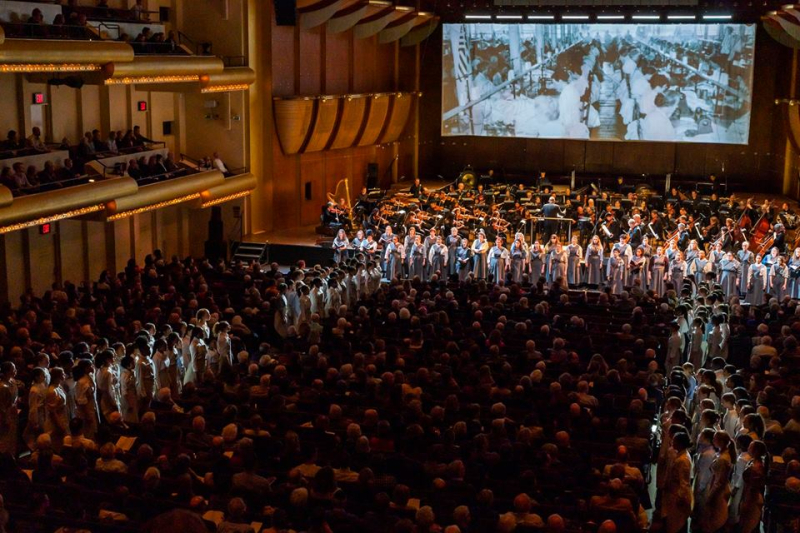
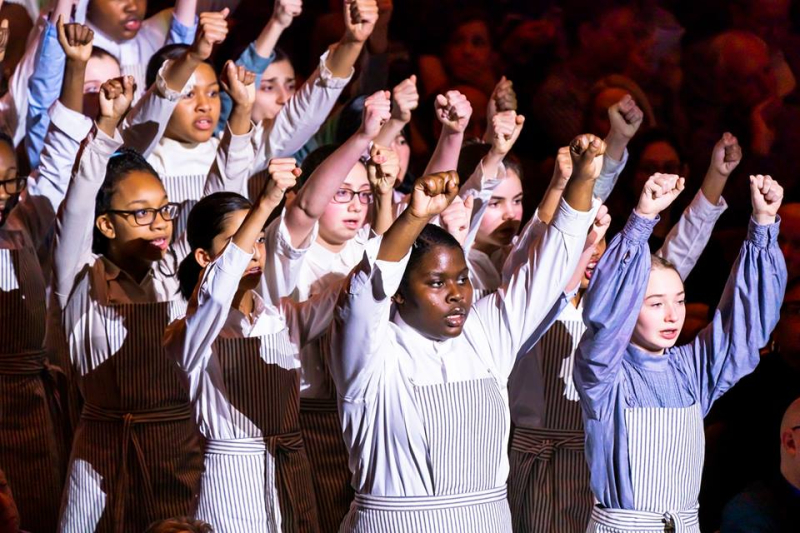
    The orchestra was joined in performance by the Philadelphia-based choral ensemble The Crossing (above) and The Young People’s Chorus of New York City (below). The photos are by Chris Lee.
    51068976_10158453669887293_5221514500502454272_n

    The text of the piece was compiled from various interviews, speeches, and accounts of the event in addition to folk songs from the era.  Spanning roughly one hour, the work is cast in four movements.

    The first movement “Immigration” began with chilling suspended high strings as the women’s chorus, decked in period regalia, began toning, “Without passports or anything we took a boat…”  Blueprints of passenger ships overlaid with footage of foaming ocean waves were projected behind the ensemble as brass swells harkened to the rolling seas of the Atlantic as these young women made their voyage to America.  Propulsive percussion and winds shifted under suspended vocal lines as familiar images of the Statue of Liberty and immigrants arriving to the United States were projected above.  This built to a great crash and silence fell throughout the hall as the first movement came to a close.

    The second movement “Factory” began to the sights and sounds of industry; images of machinery were cast on the screen above while the strings made eerie slaps that echoed the sounds of a sewing machine.  A growing menace emerged from the lower voices of the orchestra as the threat of disaster grew.  Splatting brass notes and unrelenting tremolo in the strings played on as the chorus mimed the actions of Sisyphean industrial labor.  Grainy images of factory workers punching their cards were projected overhead while dissonant vocals, driving bass, and unnerving glissandi rose to a violent and tragic crescendo—the effect was genuinely terrifying.  The chorus then used pairs of scissors to create a peculiar, yet distinct percussive beat as the work quietly transitioned into its third movement.

    The women’s choir then descended to the front of the stage for the start of the third movement “Protest,” singing, “I want to talk like an American, I want to look like an American.”  Rhythmic pulses in the strings played as newspaper headlines of protests and strikes were projected above.  Among the cacophony could be hear the whistles of policemen trying to contain the disorder.  The girls’ choir then emerged from the back of hall, marching and swaying in choreographed motion down the center aisle, as they sang in protest, “I want to say a few words.  I am a working girl.  One who is striking against intolerable conditions.”  The women’s chorus professed, “Ah—then I had fire in my mouth!” as the girls hauntingly repeated, “fire fire fire”—a harbinger of the tragedy to come.

    The girls’ choir joined the rest of the ensemble on stage as the final movement, “Fire”, began.  The string players created the haunting sound of breath by swinging their bows through the air.  Here Ms. Wolfe played up tragedy over terror as faded photographs of women interlaid with abstract images of smoke, fire, and rubble beamed overhead.  Fierce crashes, perhaps the loudest thing I’ve ever heard in David Geffen Hall, deafened the auditorium as musical hellfire consumed the ensemble (“I see them falling, see them falling…”).  A somber vocal line emerged, an indictment of social apathy, pronouncing, “I would be a traitor to those poor burned bodies if I were to speak of good fellowship.  I have tried you good people of the public and found you wanting.”  The chorus then sang the name of every soul who perished that day as Fire in my mouth quietly faded to silence; it was perhaps the greatest musical elegy since John C. Adams’s On the Transmigration of Souls.

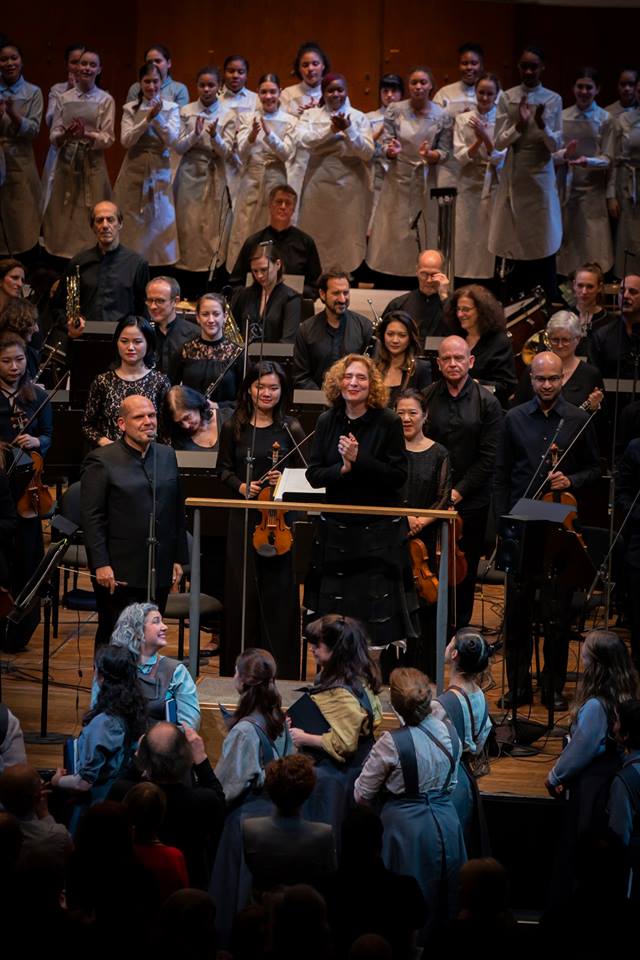
    The standing ovation that ensued lasted for several curtain calls as Ms. Wolfe, Maestro van Zweden, and company each had a chance to take their bows.  No one, save a few wheelchair-bound patrons, was still seated by the time the applause finally died out, something I’ve never seen at David Geffen Hall and don’t expect to see again for some time.  Indeed, it was the finest world premiere I’ve yet had the good fortune to attend.  I can only hope that many other metropoles may be graced with its performances in the near future.  Brava, maestro!
    50896920_10158453670227293_703449887135498240_n

    Above, the ovation: the conductor and composer onstage at the end of Fire in my Mouth. Photo by Chris Lee.

    ~ Brad S. Ross