Category: Ballet

  • Franck & Ravel @ The NY Philharmonic

    Thibaudet

    Above: pianist Jean-Yves Thibaudet

    Author: Oberon

    Saturday January 20th, 2018 matinee – This afternoon’s program at The New York Philharmonic might have been subtitled Music for Dancing: we heard a chamber score that’s been transformed into a ballet, and – after the interval – a succession of works inspired by dance forms: a sarabande, a set of waltzes, and finally a boléro that has become one of the most famous musical works ever created.

    From time to time, The Philharmonic programs a chamber work; this not only adds a new dimension to a given performance, but affords fans of the orchestra an opportunity to enjoy hearing some of the esteemed artists of The Philharmonic in a front-and-center setting.

    This afternoon, a sterling performance of César Franck’s Piano Quintet brought guest pianist Jean-Yves Thibaudet together with a quartet of extraordinary string players to play this gorgeous score – music used by choreographer Justin Peck for his lush and exquisite 2014 ballet Belles-Lettres at New York City Ballet.

    César Franck had fallen in love with one of his pupils, Augusta Holmès, who he met in 1875. The Piano Quintet was written under the influence of Franck’s romantic obsession, and thus was detested by Madame Franck to the end of her days. Composer Camille Saint-Saëns (no less) played the piano for the Quintet’s premiere performance, but he seems to have been offended by the music’s sensuality; Saint-Saëns rejected Franck’s proposal of dedicating the quintet to him.

    The players for the Franck quintet this afternoon were Sheryl Staples and Michelle Kim (violins), Cynthia Phelps (viola), and Eileen Moon-Myers (cello) with Mr. Thibaudet at the Steinway. The opening movement, Molto moderato quasi lento, commences with a violin theme played by Sheryl Staples; Ms. Staples throughout the Quintet played with ravishing lyricism. Mr. Thibaudet enters with a somewhat hesitant phrase, and then Ms. Moon-Myers’ dusky cello joins. The piano turns dreamy before a sudden eruption. Ms. Staples and Cynthia Phelps’ richly shaded viola savour every opportunity, and the Quintet has an especially nice role for the second violin which Ms. Kim set forth with lovely tone.

    The strings play in unison over a turbulent piano motif; a change to a more pensive mood finds piano and strings alternating. There’s a spacious, impassioned passage before the movement’s enigmatic end. 

    Late seating at this point was a serious distraction; the players waited patiently as latecomers stumbled to their seats. Ms. Staples was then thankfully able to re-establish the mood quickly with her silken playing of the soft, longing theme over hushed keyboard that opens the Lento con molto sentimento. A heart-wrenching descending motif for piano and cello announces a hauntingly beautiful passage with a poignant mix of voices. Then Mr. Thibaudet takes up another set of descending notes, like raindrops – or heartbeats. Ms. Staples plays with overwhelming beauty; the hesitancy of the piano recurs, and the cellist sustains a remarkable deep note. Mr. Thibaudet in the high register and Ms. Staples’s sweetest tones bring this romantic reverie to an end.

    The concluding Allegro non troppo ma con fuoco opens with Ms. Kim’s agitato figuration which Ms. Staples joins; the piano sounds almost ominous. Unison strings play over an active keyboard, evoking a sense of mystery and restlessness. A big, waltz-like buildup suddenly evaporates into an ethereal violin passage: Ms. Staples again at her finest. The music then grows unsettled in its rush to an abrupt finish.

    Warm enthusiasm greeted the quintet of players as they came out for a bow; I had hopes of an encore, but the stage was now to be re-set for the full orchestra.

    Jw

    Joshua Weilerstein (above) took the podium for the second half of this afternoon’s program, which opened with Ravel’s orchestration of Claude Debussy’s Sarabande et Danse. The sarabande originated in Central America as a dance for women, accompanied by castanets; it had an Arabian lilt. But the sarabande was regarded as too provocative, and was banned. Later the French took it on as a much more staid dance, at a slower tempo.

    Ravel’s setting of this piece, which Debussy wrote for solo piano, opens with a wind chorale; a full string section, with lovely basses, take over. Solo moments crop up – for clarinet (Anthony McGill), bassoon (Judith LeClair) and a trumpeter who I couldn’t see. The work ends with the sound of a gong which fades to nothingness. By contrast, the Danse was upbeat, showing Ravel’s orchestrational gifts to vivid effect. The harp and horn had their moments, and overall this coloristic, rhythmic little gem glowed.

    The Valses nobles et sentimentales is a suite of waltzes published in 1911 by Maurice Ravel as piano solos; an orchestral version was published in 1912. The title was chosen in homage to Franz Schubert, who had published a set of waltzes in 1823 entitled Valses nobles and Valses sentimentales. The Ravel orchestrated setting has a strong balletic association: Balanchine used them for his eerie La Valse, wherein a young girl is stalked by Death in a haunted ballroom.

    Mr. Weilerstein gave a vibrant interpretation, played fantastically by the huge orchestra. Mr. McGill (and a flautist I could not see from my location) made particularly fine impressions.

    Ravel’s Boléro was the closing work on the program, and it’s always great fun to hear it played live. Ravel composed this best-known of his works in 1928 for a ballet choreographed by Bronislava Nijinsky for Ida Rubinstein. Consisting only of repetitions of the same C-major theme over the same insistent rhythm, Boléro hypnotizes with its constant shifts in instrumentation as the music unfolds in one long, slow crescendo.

    The thrill of today’s performance for a devotee of the NY Phil such as myself was in hearing the various solo voices of the orchestra take up the tune: flute, clarinet, bassoon, saxophone (wow, this guy was really wailing!), and on and on in various combinations. And all the while, the relentlessly diligent strings pluck and the snare drums maintain the pace, starting softly and turning militant as the Boléro sways onward with mesmerizing inevitability.

    The crowd went absolutely wild as Boléro ended: everyone stood up and yelled.

    ~ Oberon

  • Franck & Ravel @ The NY Philharmonic

    Thibaudet

    Above: pianist Jean-Yves Thibaudet

    Author: Oberon

    Saturday January 20th, 2018 matinee – This afternoon’s program at The New York Philharmonic might have been subtitled Music for Dancing: we heard a chamber score that’s been transformed into a ballet, and – after the interval – a succession of works inspired by dance forms: a sarabande, a set of waltzes, and finally a boléro that has become one of the most famous musical works ever created.

    From time to time, The Philharmonic programs a chamber work; this not only adds a new dimension to a given performance, but affords fans of the orchestra an opportunity to enjoy hearing some of the esteemed artists of The Philharmonic in a front-and-center setting.

    This afternoon, a sterling performance of César Franck’s Piano Quintet brought guest pianist Jean-Yves Thibaudet together with a quartet of extraordinary string players to play this gorgeous score – music used by choreographer Justin Peck for his lush and exquisite 2014 ballet Belles-Lettres at New York City Ballet.

    César Franck had fallen in love with one of his pupils, Augusta Holmès, who he met in 1875. The Piano Quintet was written under the influence of Franck’s romantic obsession, and thus was detested by Madame Franck to the end of her days. Composer Camille Saint-Saëns (no less) played the piano for the Quintet’s premiere performance, but he seems to have been offended by the music’s sensuality; Saint-Saëns rejected Franck’s proposal of dedicating the quintet to him.

    The players for the Franck quintet this afternoon were Sheryl Staples and Michelle Kim (violins), Cynthia Phelps (viola), and Eileen Moon-Myers (cello) with Mr. Thibaudet at the Steinway. The opening movement, Molto moderato quasi lento, commences with a violin theme played by Sheryl Staples; Ms. Staples throughout the Quintet played with ravishing lyricism. Mr. Thibaudet enters with a somewhat hesitant phrase, and then Ms. Moon-Myers’ dusky cello joins. The piano turns dreamy before a sudden eruption. Ms. Staples and Cynthia Phelps’ richly shaded viola savour every opportunity, and the Quintet has an especially nice role for the second violin which Ms. Kim set forth with lovely tone.

    The strings play in unison over a turbulent piano motif; a change to a more pensive mood finds piano and strings alternating. There’s a spacious, impassioned passage before the movement’s enigmatic end. 

    Late seating at this point was a serious distraction; the players waited patiently as latecomers stumbled to their seats. Ms. Staples was then thankfully able to re-establish the mood quickly with her silken playing of the soft, longing theme over hushed keyboard that opens the Lento con molto sentimento. A heart-wrenching descending motif for piano and cello announces a hauntingly beautiful passage with a poignant mix of voices. Then Mr. Thibaudet takes up another set of descending notes, like raindrops – or heartbeats. Ms. Staples plays with overwhelming beauty; the hesitancy of the piano recurs, and the cellist sustains a remarkable deep note. Mr. Thibaudet in the high register and Ms. Staples’s sweetest tones bring this romantic reverie to an end.

    The concluding Allegro non troppo ma con fuoco opens with Ms. Kim’s agitato figuration which Ms. Staples joins; the piano sounds almost ominous. Unison strings play over an active keyboard, evoking a sense of mystery and restlessness. A big, waltz-like buildup suddenly evaporates into an ethereal violin passage: Ms. Staples again at her finest. The music then grows unsettled in its rush to an abrupt finish.

    Warm enthusiasm greeted the quintet of players as they came out for a bow; I had hopes of an encore, but the stage was now to be re-set for the full orchestra.

    Jw

    Joshua Weilerstein (above) took the podium for the second half of this afternoon’s program, which opened with Ravel’s orchestration of Claude Debussy’s Sarabande et Danse. The sarabande originated in Central America as a dance for women, accompanied by castanets; it had an Arabian lilt. But the sarabande was regarded as too provocative, and was banned. Later the French took it on as a much more staid dance, at a slower tempo.

    Ravel’s setting of this piece, which Debussy wrote for solo piano, opens with a wind chorale; a full string section, with lovely basses, take over. Solo moments crop up – for clarinet (Anthony McGill), bassoon (Judith LeClair) and a trumpeter who I couldn’t see. The work ends with the sound of a gong which fades to nothingness. By contrast, the Danse was upbeat, showing Ravel’s orchestrational gifts to vivid effect. The harp and horn had their moments, and overall this coloristic, rhythmic little gem glowed.

    The Valses nobles et sentimentales is a suite of waltzes published in 1911 by Maurice Ravel as piano solos; an orchestral version was published in 1912. The title was chosen in homage to Franz Schubert, who had published a set of waltzes in 1823 entitled Valses nobles and Valses sentimentales. The Ravel orchestrated setting has a strong balletic association: Balanchine used them for his eerie La Valse, wherein a young girl is stalked by Death in a haunted ballroom.

    Mr. Weilerstein gave a vibrant interpretation, played fantastically by the huge orchestra. Mr. McGill (and a flautist I could not see from my location) made particularly fine impressions.

    Ravel’s Boléro was the closing work on the program, and it’s always great fun to hear it played live. Ravel composed this best-known of his works in 1928 for a ballet choreographed by Bronislava Nijinsky for Ida Rubinstein. Consisting only of repetitions of the same C-major theme over the same insistent rhythm, Boléro hypnotizes with its constant shifts in instrumentation as the music unfolds in one long, slow crescendo.

    The thrill of today’s performance for a devotee of the NY Phil such as myself was in hearing the various solo voices of the orchestra take up the tune: flute, clarinet, bassoon, saxophone (wow, this guy was really wailing!), and on and on in various combinations. And all the while, the relentlessly diligent strings pluck and the snare drums maintain the pace, starting softly and turning militant as the Boléro sways onward with mesmerizing inevitability.

    The crowd went absolutely wild as Boléro ended: everyone stood up and yelled.

    ~ Oberon

  • Bronfman’s Bartok @ The NY Philharmonic

    Bronfman

    Above: pianist Yefim Bronfman

    ~ Author: Oberon

    Wednesday December 27th, 2017 – My friend Dmitry and I are fans of Yefim Bronfman, so this evening’s concert by The New York Philharmonic was a perfect classical-music finale for the year 2017.

    The evening opened with the overture to Smetana’s opera THE BARTERED BRIDE. I first heard this overture played live when James Levine chose it to open the Metropolitan Opera’s 100th anniversary gala in 1983. The gala (in two parts – matinee and evening) was telecast worldwide, but I was fortunate to have been in the House for the afternoon program. Let’s just say, they don’t make opera galas like that any more.

    It was great fun to hear the jolly, rambunctious Smetana overture again tonight under Bramwell Tovey’s baton; the Maestro set an exhilarating, ultra-fast pace for this music, and the Philharmonic artists took up his challenge: they played brilliantly and seemed truly to be having fun into the bargain. The music passes thru many modulations along the way, and solo moments sparkle forth – notably from Sherry Sylar’s oboe – as we are danced along in a lively manner. Really, an ideal concert-opener.

    Mr. Bronfman then appeared for the Bartok 2nd piano concerto. Following an ascending flourish from the Steinway, the first movement commences with rather wild brass fanfares. The piano sounds restless, set against winds; the turbulence builds only to subside, and Mr. Brofman’s playing turns subtle. Following another brass and piano build-up, there’s a full stop. Thereafter the music seems more melodious, though droll and ironic. The brass get quite noisy before the pianist silences them with a cadenza that flows up and down the keyboard. After a passage for flutes and piano, the soloist plays a double rising motif.

    Pensive strings introduce the the Adagio which develops into a marvelous duet for piano and timpani. Here Mr. Bronfman and timpanist Marcus Rhoten created an incredible atmosphere: moody and a bit ominous. Suddenly things perk up without warning and we are in a scherzo-like realm with an agitato feeling and with the pianist finding unusual delicacies. Mr. Bronfman then commences a remarkable pianissimo trill that goes on and on over misterioso strings.

    For the concerto’s finale, Bartók gets almost jazzy – in a slightly darkish way – and we hear from the trumpets; a feeling of a kind of war dance evolves. Another piano/percussion duet crops up – this time it’s Steinway vs bass drum – before the music turns unexpectedly dreamy. But the dream is short-lived as the trumpets re-awaken and the concerto ends brightly. Mr. Bronfman was well in his element throughout, his playing agile and multi-hued, with fine dynamic contrasts. The orchestra did their soloist proud.

    By way of perfect contrast to his grand-scale playing of the Bartók, Mr. Bronfman chose for an encore Chopin’s Étude in E Major, Op.10, No.3. The opening melody of this work, thought to have been Chopin’s favorite among the études, was later the source of a vocal song arranged by the soprano Félia Litvinne and recorded famously by Litvinne’s pupil, the tragic Germaine Lubin. This evening, Mr. Bronfman’s poetic rendering of the full étude cast a thoughtful spell over the hall. This magical experience, like so many others in recent years, was sadly spoilt in its most poignant passage by the ringing of a cellphone. Yet Mr. Bronfman continued, unperturbed, and left me a beautiful memory to cherish.
    94-ef6ab60c90ba3fb6a7911b7999dd5f4e

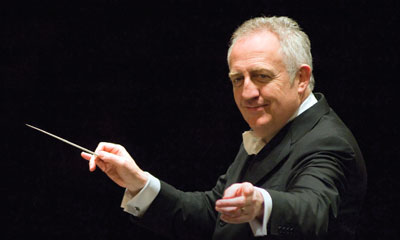
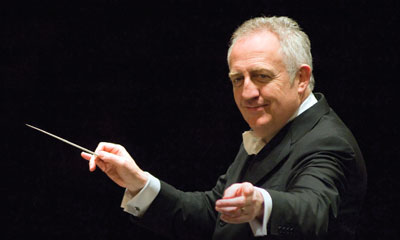
    Above: Bramwell Tovey

    Following the interval, an exciting performance of Mussorgsky’s Pictures at an Exposition (in the Ravel orchestration) again found the orchestra on peak form. Opening with a brass chorale Promenade, which recurs with variations during the first seven movements, the suite conjures up visions of the works of Viktor Hartmann. Upon Hartmann’s death in 1874 at the young age of 39, an exhibition of his work was mounted at St. Petersburg. Mussorgsky visited the exhibit and was inspired by what he saw to write a set of miniatures for piano. In 1922, Maurice Ravel orchestrated the pieces.

    A huge orchestra is in play, including five percussionists, two harps, and celesta. The ponderous Gnome, the child-like and playful Tuileries, the plodding Ox-Cart, the mini-scherzo of the Ballet of Unhatched Chicks, the bustling Marketplace at Limoges, the Roman Catacombs (deep brass), and the fanciful Hut of Baba-Yaga are all evoked in coloristic settings which the Philharmonic players delivered with evident affection.

    The movement which most impressed me was Il Vecchio Castello (The Old Castle) in which flutes, oboe, and bassoon were joined by the mellow, distinctive voice of the alto saxophone. This music was so evocative that I got lost in it. 

    The suite ends on a grand note with The Great Gate of Kiev. Sumptuously played, it brought a year full of music to an imperial finish.

    ~ Oberon
  • Bronfman’s Bartok @ The NY Philharmonic

    Bronfman

    Above: pianist Yefim Bronfman

    ~ Author: Oberon

    Wednesday December 27th, 2017 – My friend Dmitry and I are fans of Yefim Bronfman, so this evening’s concert by The New York Philharmonic was a perfect classical-music finale for the year 2017.

    The evening opened with the overture to Smetana’s opera THE BARTERED BRIDE. I first heard this overture played live when James Levine chose it to open the Metropolitan Opera’s 100th anniversary gala in 1983. The gala (in two parts – matinee and evening) was telecast worldwide, but I was fortunate to have been in the House for the afternoon program. Let’s just say, they don’t make opera galas like that any more.

    It was great fun to hear the jolly, rambunctious Smetana overture again tonight under Bramwell Tovey’s baton; the Maestro set an exhilarating, ultra-fast pace for this music, and the Philharmonic artists took up his challenge: they played brilliantly and seemed truly to be having fun into the bargain. The music passes thru many modulations along the way, and solo moments sparkle forth – notably from Sherry Sylar’s oboe – as we are danced along in a lively manner. Really, an ideal concert-opener.

    Mr. Bronfman then appeared for the Bartok 2nd piano concerto. Following an ascending flourish from the Steinway, the first movement commences with rather wild brass fanfares. The piano sounds restless, set against winds; the turbulence builds only to subside, and Mr. Brofman’s playing turns subtle. Following another brass and piano build-up, there’s a full stop. Thereafter the music seems more melodious, though droll and ironic. The brass get quite noisy before the pianist silences them with a cadenza that flows up and down the keyboard. After a passage for flutes and piano, the soloist plays a double rising motif.

    Pensive strings introduce the the Adagio which develops into a marvelous duet for piano and timpani. Here Mr. Bronfman and timpanist Marcus Rhoten created an incredible atmosphere: moody and a bit ominous. Suddenly things perk up without warning and we are in a scherzo-like realm with an agitato feeling and with the pianist finding unusual delicacies. Mr. Bronfman then commences a remarkable pianissimo trill that goes on and on over misterioso strings.

    For the concerto’s finale, Bartók gets almost jazzy – in a slightly darkish way – and we hear from the trumpets; a feeling of a kind of war dance evolves. Another piano/percussion duet crops up – this time it’s Steinway vs bass drum – before the music turns unexpectedly dreamy. But the dream is short-lived as the trumpets re-awaken and the concerto ends brightly. Mr. Bronfman was well in his element throughout, his playing agile and multi-hued, with fine dynamic contrasts. The orchestra did their soloist proud.

    By way of perfect contrast to his grand-scale playing of the Bartók, Mr. Bronfman chose for an encore Chopin’s Étude in E Major, Op.10, No.3. The opening melody of this work, thought to have been Chopin’s favorite among the études, was later the source of a vocal song arranged by the soprano Félia Litvinne and recorded famously by Litvinne’s pupil, the tragic Germaine Lubin. This evening, Mr. Bronfman’s poetic rendering of the full étude cast a thoughtful spell over the hall. This magical experience, like so many others in recent years, was sadly spoilt in its most poignant passage by the ringing of a cellphone. Yet Mr. Bronfman continued, unperturbed, and left me a beautiful memory to cherish.

    94-ef6ab60c90ba3fb6a7911b7999dd5f4e

    Above: Bramwell Tovey

    Following the interval, an exciting performance of Mussorgsky’s Pictures at an Exposition (in the Ravel orchestration) again found the orchestra on peak form. Opening with a brass chorale Promenade, which recurs with variations during the first seven movements, the suite conjures up visions of the works of Viktor Hartmann. Upon Hartmann’s death in 1874 at the young age of 39, an exhibition of his work was mounted at St. Petersburg. Mussorgsky visited the exhibit and was inspired by what he saw to write a set of miniatures for piano. In 1922, Maurice Ravel orchestrated the pieces.

    A huge orchestra is in play, including five percussionists, two harps, and celesta. The ponderous Gnome, the child-like and playful Tuileries, the plodding Ox-Cart, the mini-scherzo of the Ballet of Unhatched Chicks, the bustling Marketplace at Limoges, the Roman Catacombs (deep brass), and the fanciful Hut of Baba-Yaga are all evoked in coloristic settings which the Philharmonic players delivered with evident affection.

    The movement which most impressed me was Il Vecchio Castello (The Old Castle) in which flutes, oboe, and bassoon were joined by the mellow, distinctive voice of the alto saxophone. This music was so evocative that I got lost in it. 

    The suite ends on a grand note with The Great Gate of Kiev. Sumptuously played, it brought a year full of music to an imperial finish.

    ~ Oberon
  • Upcoming: Barnard/Columbia Dances @ NYLA

    23622175_1575201285874852_874849280968044420_n

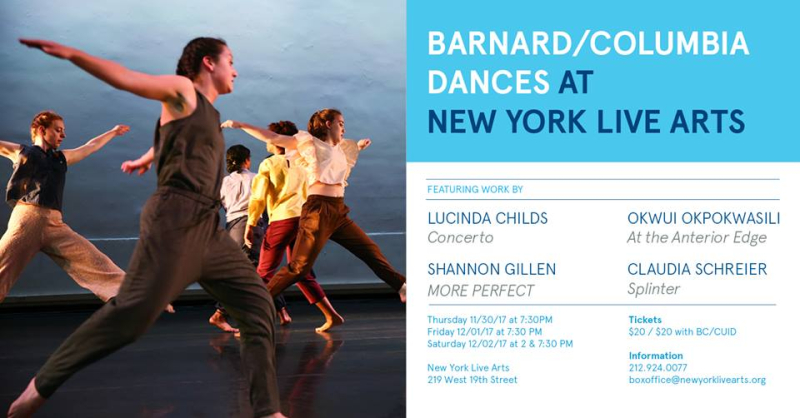
    The premiere of Claudia Schreier’s ballet SPLINTER is one of the works featured on a program at New York Live Arts by Barnard/Columbia Dances. The performance dates are November 30th, December 1st, and two shows on December 2nd. Tickets and more information here.

    Claudia’s SPLINTER gets its name from the Marc Mellits score from which she draws six of eight movements for her dancework. Each movement is named after a type of tree. It’s quite dynamic music, with passing moments of reverie. 

    L1900691

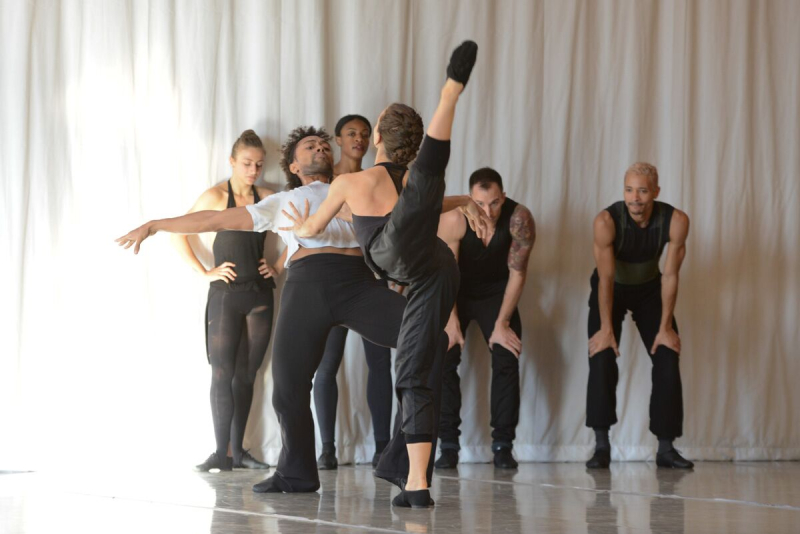
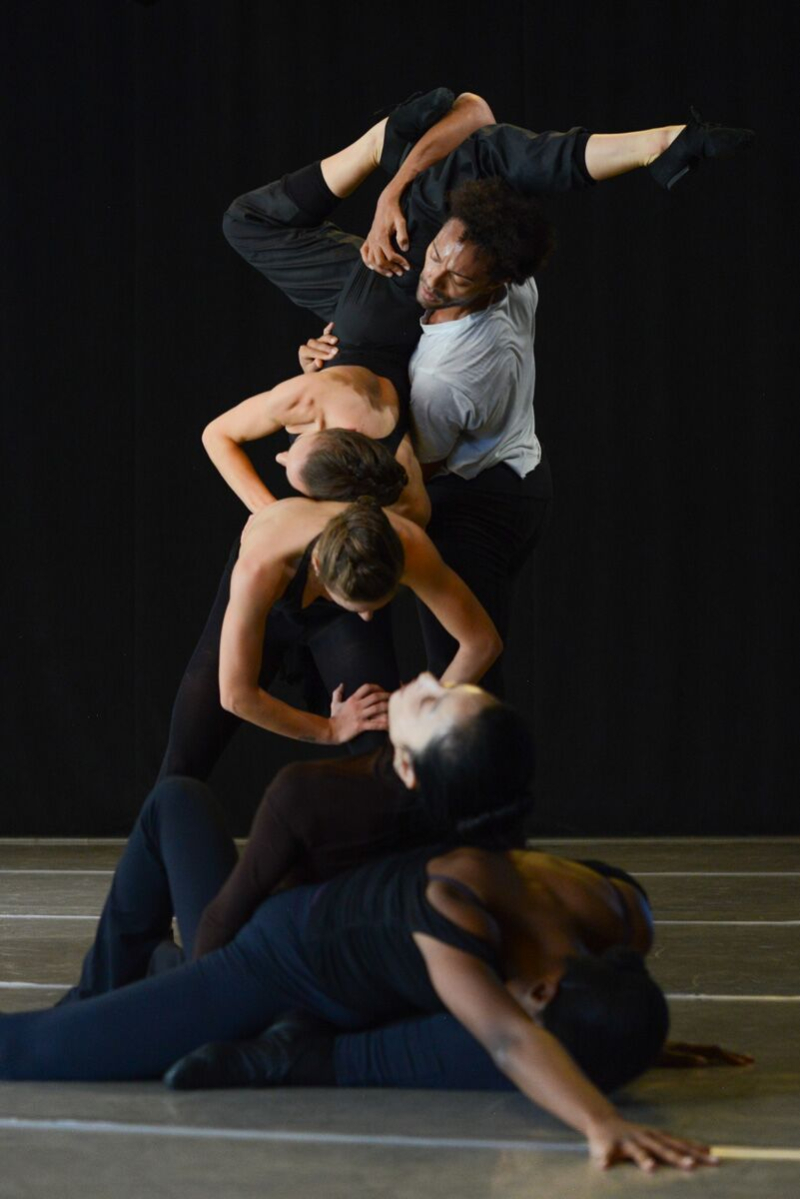
    Above: Claudia Schreier and dancers in rehearsal

  • Flute Affair @ Chamber Music Society

    11.19.17_Flute_Affair

    Above: flautists Ransom Wilson and Tara Helen O’Connor

    Author: Oberon

    Sunday November 19th, 2017 – In a well-conceived program of works composed in four different centuries, Chamber Music Society of Lincoln Center presented two of today’s foremost flautists – Tara Helen O’Connor and Ransom Wilson – joined by an ensemble of top-flight artists. The ink’s probably not totally dry yet on John Luther Adams’ newest score, a CMS co-commission having its New York premiere this evening.

    Music of Bach opened the concert: his Trio Sonata in G-major for two flutes and continuo was given an elegant performance by Ms. O’Connor and Mr. Wilson, with cellist Timothy Eddy and Juho Pohjonen at the harpsichord providing a gracious continuo. The sound of blending flutes has an enchantment that few other instruments playing in duo can evoke. The sonata’s Adagio e piano has an air of sweet melancholy, and in the propulsive rhythmic figures of the two Allegro sections, Mr. Eddy made music that went beyond keeping time.

    For Mozart’s C-major flute quartet, K 285b, Ms. O’Connor was joined by violinist Kristin Lee, violist Paul Neubauer, and cellist Timothy Eddy. In this two-movement work, the composer keeps the flute prominent but doesn’t neglect the other instruments. Rising from the gentle flow of the opening Allegro, Ms. O’Connor’s quicksilver fluting sends a melodic line over to Ms. Lee’s violin. The strings provide a rich yet cultivated blend. We then head into the second movement: a theme-and-variations setting. The theme feels like a courtly dance; in the first variation the flute sings over gently rocking strings. Ms. Lee shines in the second variation and Mr. Eddy in the third, where the Neubauer viola injects an insinuating little phrase that’s so delicious. The fourth variation takes a minor-key turn, with a sighing quality. Flute-song is the attractive essence of the fifth variation: Ms. O’Connor’s playing is soft and sweet. The sprightly closing variation is in spirit of the country dance known as the Ländler. It’s a short dance, but full of charm.

    John luther adams

    Above: composer John Luther Adams

    The new Adams was up next: ‘there is no one, not even the wind’ proved to be both intriguing and a bit problematic. The stage had been set for the work’s large ensemble, which includes our two flautists – Ms.O’Connor now playing alto flute – two percussionists (the excellent Ayano Kataoka and Ian David Rosenbaum, with a marimba for each…and a bass drum as well), piano (Mr. Pohjonen), violin (Ms. Lee), viola (Mr. Neubauer), cello (Mr. Eddy), and bass Anthony Manzo.

    The music begins delicately with the striking of individual bell tones. Ms. Lee’s violin enters on high; slowly, the other voices of the ensemble are mixed in: we seem to be floating thru space and time. Piercing flute notes from Mr. Wilson seem like signals from distant worlds; meanwhile Ms. O’Connor’s alto flute evokes ancient realms on Earth. Notes struck on the marimbas linger on the air, enveloping us in mystery.The bass drum sounds like distant thunder, with deep piano tones adding to an ominous feeling. The flutes resume; the music transcends reality as sound-clouds move across the horizon of the mind.

    The music is marvelously crafted and – needless to say – magically played. But there’s simply too much of it: even the most poetic dream can outlast itself. An annoying cougher infringed on the atmosphere, and a sense of restlessness began to intrude. Much as I loved the sounds I was hearing, I began to wonder if we had been adrift too long. And yet, I could definitely listen to this work again – preferably at home, where the imagination could be allowed full play.

    During the interval, there was considerable buzz about the Adams work: from what I could gather, people around us found it essentially fascinating but too extended.  

    Dutilleux young

    Above: composer Henri Dutilleux around the time he wrote his Sonatine

    Henri Dutilleux passed away in 2013 at the age of 97. His Sonatine for flute and piano was commissioned by the Paris Conservatory as a test piece for the graduating flautists of 1942; tonight, Ransom Wilson and Juho Pohjonen turned it into ten minutes of magic.

    The Sonatine begins mysteriously, the piano soon entwined with the flute. The music is very “French” with lingerings in the upper range and twisty rising scales. A bird-song cadenza shows off Mr. Wilson’s fluency of technique; this leads to a lyrical developmental section. There’s a full stop, and then rippling figurations from the piano draw us into music that’s light, bright, and subtly ironic. The piano writing turns grand before another cadenza – this one heading downhill – carries us on to a witty speed-up to the end. The audience gave the players – and the piece – a warm reception. I’m going to tell some of my choreographer-friends about it.

    We bounced back to the second decade of the 19th century for the evening’s final work: the Septet in D-minor by Johann Nepomuk Hummel. Dating from 1816, this septet sounds rather ahead of its time, thanks to the composer’s ideas about instrumentation, harmony, and modulation. It’s a piece that brings the listener a sense of elation in both its musical freshness and its inspired instrumentation: Hummel calls for a trio of strings and a trio of winds, and he sets them off brilliantly against writing for the piano that calls for great virtuosity and sensitivity.

    Juho pohjonen

    Within moments of the start of the Hummel, the audience could grasp the fact that the man at the Steinway, Juho Pohjonen (above), was playing with extraordinary dexterity, feeling, and commitment. He wasn’t just playing the notes, but investing them with colour and nuance – one could often sense a full dynamic range within a single passage; and how fine were Mr. Pohjonen’s taperings of the many scale phrases to keep us under his spell. When the septet ended, his colleagues urged the pianist to step forward where he was greeted by a barrage of bravos. Called back to the stage, the players sent Mr. Pohjonen out first, then they all held back so that he had a solo bow. It was one of my favorite moments from among the many evenings I’ve spent at Alice Tully Hall.

    The Hummel is simply bursting with great opportunities for each of the seven players to show what they can do. After a full-bodied start, hesitations creep in. Mr. Manzo’s bass makes the first of numerous incursions with rich, rhythmic sound. Mr. Neubauer’s viola pulses as the three wind players comment. Meanwhile, the piano writing is a joy to hear as Mr. Pohjonen veers from extroverted to delicate in the twinkling of an eye. He can be pensive at one moment and wryly light-hearted the next. Before the first movement ends, Mr. Eddy’s cello has its say.

    “It’s a piano thing!”, I wrote as the second movement commenced: it’s cleverly marked Menuetto o scherzo by the composer, and the bass gets us involved before the piano again draws our attention. Cello and viola meld with smooth sounds from Eric Reed’s horn; Mr. Reed repeatedly sustains notes which lead into melodic motifs.

    In the Andante cantabile, a melody gets passed about with variations. Mr. Pohjonen dazzles us yet again, later adopting a ‘toy piano’ sound for some fanciful coloratura. A slow-rising tutti sends the piano swirling; the bass lures us to a fun finish.

    The forward impetus of the concluding Vivace brings us to a conversation between the Neubauer viola and James Austin Smith’s congenial oboe; Mr. Eddy has a heartfelt cello passage with piano, and then Ms. O’Connor’s flute blends beautifully with the oboe and horn as Mr. Pohjonen’s playing is honed down to a thread. Cascades of notes from the keyboard underscore the final measures of this fantastic piece. 

    • Bach Trio Sonata in G-major for Two Flutes and Continuo, BWV 1039 (c. 1736-41)
    • Mozart Quartet in C-major for Flute, Violin, Viola, and Cello, K. 285b (1781)
    • J. L. Adams there is no one, not even the wind for Two Flutes, Two Percussionists, Piano, Violin, Viola, Cello, and Bass (New York Premiere, CMS Co-Commission) (2017)
    • Dutilleux Sonatine for Flute and Piano (1943)
    • Hummel Septet in D-minor for Flute, Oboe, Horn, Viola, Cello, Bass, and Piano, Op. 74 (c. 1816)

    ~ Oberon

  • Lubovitch’s LEGEND OF TEN @ Martha Graham

    SA3_9126_preview

    Above: Abdiel Cedric Jacobsen and Anne Souder of the Martha Graham Dance Company; photo by Nir Arieli

    ~ Author: Oberon

    Friday November 17th, 2017 – The renowned choreographer Lar Lubovitch will celebrate the 50th anniversary of his Company in the coming Spring when the Lar Lubovitch Dance Company will perform two programs at the Joyce Theater from April 17th through April 22nd, 2018. Joining in the celebration, the dancers of the Martha Graham Dance Company will perform the Lubovitch masterpiece LEGEND OF TEN, set to Johannes Brahms’s Piano Quintet in F minor; the Lubovitch Company premiered this work in 2010.

    This afternoon, photographer Nir Arieli and I stopped by at the Graham Studios at Westbeth to watch a rehearsal of LEGEND OF TEN. The Graham dancers are the crème de la crème of the dance world: in their combination of athleticism and artistry, they have few rivals. On top of that, they’re all really nice people. So any chance to be in their presence has a special meaning for me.

    I’ve seen LEGEND OF TEN three times in the past, danced by the Lubovitch Company. Yet today, I was struck afresh by its power and beauty. Taking wing on the Brahms score, LEGEND sends the dancers swirling thru dynamic movement that melds ballet motifs with elements of folk dance.

    In the course of today’s rehearsal, Mr. Lubovitch did quite a bit of dancing himself as he demonstrated for the Graham dancers. Assisting Mr. Lubovitch was Kate Skarpetowska – an estimable choreographer in her own right who has danced with the Lubovitch Company and is intimately familiar with his work.

    Here’s a gallery of Nir Arieli’s images from this afternoon:

    SA3_8351_preview

    From left: Ben Schultz, Anne O’Donnell, Kate Skarpetowska, So Young An, Leslie Andrea Williams, Lorenzo Pagano

    SA3_8409_preview

    Abdiel Cedric Jacobsen, Anne Souder, and Kate Skarpetowska

    SA3_8470_preview

    Watching a film of LEGEND with Mr. Lubovitch

    SA3_8477_preview

    SA3_8546_preview

    Lar Lubovitch coaching Abdiel and Anne Souder in a duet passage

    SA3_8568_preview

    Anne Souder and Anne O’Donnell

    SA3_8832_preview

    Leslie Andrea Williams

    SA3_8896_preview

    So Young An

    SA3_9155_preview

    Lorenzo Pagano

    SA3_8804_preview

    Ari Mayzick, Anne O’Donnell

    SA3_9348_preview

    Abdiel Cedric Jacobsen

    SA3_9481_preview

    Ecstatic moment

    SA3_8990_preview

    Abdiel with Anne Souder: pas de deux…continued below

    SA3_9101_preview

    SA3_9110_preview

    SA3_9111_preview

    SA3_9125_preview

    SA3_9139_preview

    SA3_9142_preview

    SA3_9144_preview

    Ensemble: Ari, Ben, Lorenzo, Laurel Dalley Smith, Leslie

    SA3_9180_preview

    Leslie Andrea Williams

    SA3_9337_preview

    Abdiel and Anne Souder

    SA3_9492_preview

    Leslie Andrea Williams

    SA3_9505_preview

    Many thanks to Denise Vale of the Graham Company for helping to arrange today’s studio visit, and also to Janet Eilber, publicist Janet Stapleton, to Mr. Lubovitch and Ms. Skarpetowska for letting us eavesdrop on their process, and – of course – to the phenomenal dancers. And although they weren’t dancing today, it was great to catch up briefly with Ying Xin and The Lloyds: Knight and Mayor.

    All photos by Nir Arieli.

    ~ Oberon
  • André Watts|ORPHEUS @ Carnegie Hall

    Watts11_high - david bazemore

    Above: pianist André Watts, photo by David Bazemore

    ~ Author: Oberon

    Thursday October 26th, 2016 – Pianist André Watts joined ORPHEUS this evening as the beloved chamber orchestra kicked off their 2017-2018 Carnegie Hall season with a New York premiere and classics by Mozart and Beethoven. We learned that 600 school-children were in attendance – up in the balcony – having been provided with tickets free of charge. A subtitle for the program might have been “Pianists Who Compose”, as Mozart, Beethoven, and Iyer each first won renown at the keyboard. 

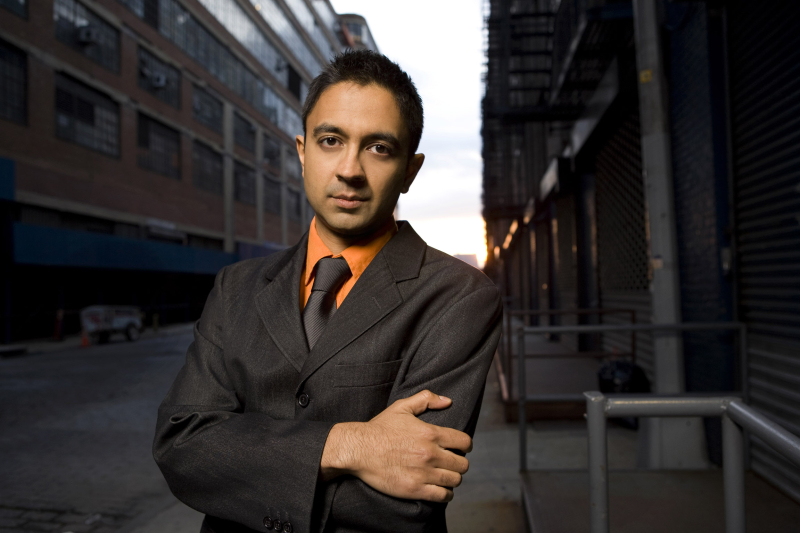
    Vijay-Iyer

    American composer Vijay Iyer (above) is a jazz pianist, bandleader, producer, electronic musician, and writer. Tonight ORPHEUS offered the New York premiere of Mr. Iyer’s Asunder, an eclectic and vastly pleasing work that suits the ORPHEUS players to perfection.

    In his program note, Mr. Iyer said that, on first receiving the ORPHEUS commission, he thought of writing a piece that would reflect the current deep divisions in our country and “…how it feels to be an American today: pulled apart, broken, anxious, untethered…” He thought of writing big, violent music but then he chose instead to write a piece that “…imagines unity anew…” Bravo! for taking such a stance, Mr. Iyer.

    Asunder is presented in four movements; it opens with pacing horns and an oddly noble feeling. Pulsing rhythms and a somewhat ominous timpani carry us thru to a passage for strident winds. Swirls of notes from both strings and winds allude to the movement’s title: Agitated. It ends with dour, deep sounds.

    Marked Patient and mysterious, the second movement begins with plucking and a jazzy piccolo solo over bass and cello. A Mid-Eastern flavour permeates; following a build-up to an almost militant passage, a Glassian repetitive motif takes over and we settle into a slow sway.

    Calm and precise, like clockwork begins with a gorgeous flute solo; bell tones and other percussive effects designate the effect of time. A repeated downward passage is repeated just a few too many times (my sole reservation about the work).

    Solo oboe over bass accompaniment opens the concluding Lush movement; then a rather drowsy clarinet takes over. The Mid-East is evoked again as the music assumes the feeling of a desert journey, then pulses up over deep bass notes. The glockenspiel sounds again, and after a plucked passage the finale turns cinematic.

    Percussionist Maya Gunji did a great job in the Iyer, as did several of her woodwind colleagues, though I couldn’t see them clearly enough to name names. And the strings sounded superb…all evening, in fact. Mr. Iyer was called to the stage and was enthusiastically applauded by audience and musicians alike.

    The Steinway was then rolled out, and André Watts appeared to a warm welcome from the Carnegie audience.

    André Watts came to public prominence at the age of 16 when Leonard Bernstein chose him as a soloist, making his New York Philharmonic debut on one of the orchestra’s Young People’s Concerts – a concert which was broadcast nationwide on CBS-TV. Two weeks later, Bernstein again called upon the young and charismatic Mr. Watts to substitute at the last minute for the ailing Glenn Gould in performances of Liszt’s E-flat Concerto with the New York Philharmonic. In 1976, André Watts’ recital for the Live From Lincoln Center series was the first full-length recital broadcast in the history of television.

    The Watts career has spanned over half a century, interrupted at times by health issues. Now 70 years old, he plays with the energy and distinction that have endeared him to audiences worldwide over the decades; he played, in fact, like a very jeune homme.

    Mozart’s Piano Concerto No. 9, composed in January 1777, picked up the appellation “Jeunehomme” “young man”) by mistake when Mozart’s mention (in a letter) of the name of the young pianist who inspired the work –  Victoire Jenamy (1749-1812) – somehow got scrambled from Jenamy to Jeunehomme. Victoire was the daughter of the famous 18th-century ballet master Noverre, and she was apparently in Salzburg during the winter of 1776-77 where she met Mozart. This was the first of the composer’s piano concertos to appear in print, published in Paris around 1780.

    My first impression of Mr. Watts as he began to play (I’d never heard him live before) was: “He makes the piano sing!” This concerto is very demanding, and – as the pianist remarks in his program note – shows such  maturity of writing from a 21-year-old that we could easily be convinced it comes from a later time in the Mozart’s career. It is, overall, music that brings genuine comfort and joy.

    In the opening Allegro, Mr. Watts displayed a light touch in a series of delicious trills, with much charming filigree; yet there was also warm power and rhythmic vitality to be enjoyed. An elaborate cadenza held the audience in silent thrall. The following Andantino begins in a somber mood, and the pianist’s sad song (again with some sweet trills) was expressively played. As a more hopeful feeling rises, the orchestra has a really lovely passage: the music has an unusual sense of containment, of assurance and grace. A downward-flowing cadenza, with yet more intriguing trills, showed Mr. Watts’ control and artistic depth.

    The finale, a Rondo, commences with virtuosic feats from the pianist. A fine flow develops, with cascades of piano notes. In the middle of the movement, Mozart injects a courtly Minuet interlude, introduced by the soloist who unfurls the melody gently over a pizzicato accompaniment. Another cadenza, now with a rising aspect, again gives us savourable trills.

    The audience abundantly hailed Mr. Watts and the ORPHEUS players: a full standing-ovation ensued. We hoped for an encore, but the pianist – perhaps wisely – left us to our Mozartean reveries.

    Following a longish intermission, the Beethoven 1st symphony provided a perfect finale to the evening. We’d just heard this work a couple of weeks ago, played by the Orchestra of St. Luke’s in this very hall. It’s such a cordial piece, and I’ve grown really fond of it. It was nice to hear it again so soon. 

    The Beethoven 1st is the symphony that seems to start mid-phrase. The ORPHEUS players gave a marvelous performance, with a breadth and richness of sound that filled the venerable space. Rhythmic acuity and some lovely solo bits from the winds players engaged us from first note to last, and made for an impressive end to a thoroughly satisfying evening of music-making.

    The Program:

    VIJAY IYER: Asunder (New York Premiere)

    MOZART: Piano Concerto No. 9, K. 271 “Jeunehomme

    BEETHOVEN: Symphony No. 1

    ~ Oberon

  • Tero Saarinen Company @ The Joyce

    TeroSaarinenCompany1

    Above: from Tero Saarinen’s Morphed; photo by Günther Gröger

    ~ Author: Oberon

    Friday October 20th, 2017 – Tero Saarinen Company, one of Europe’s premiere contemporary dance companies, presenting Morphed, an all-male work, at The Joyce.

    With a running time of just over one hour, Morphed is performed by seven dancers of varying ages and physiques on a truly fascinating set designed by Bessie-award winner Mikki Kunttu, who also supervised the excellent lighting. Finnish fashion designer Teemu Muurimäki’s black & white costumes ideally completed the visual setting. While the eye was constantly intrigued, the ear could revel in music drawn from three works by Finnish composer Esa-Pekka Salonen. Blending all these elements into a cohesive whole made for one of the most satisfying evenings of dance I’ve encountered in the past two decades.

    The sound of the French horn (my instrument!) commenced even as the lights went down immediately seizing the imagination, conjuring visions of both the dawn and of the hunt. This gorgeous music is Salonen’s Concert étude for solo horn (composed 2000). In a space surrounded on three sides by hanging ropes, the seven dancers – all in black hoods – simply walk and walk; sometimes their walking seems casual and free, at other times more regimented. The scene brightens and the dancers appear in silhouette.

    The hoods come off, and new music takes over – from Salonen’s Foreign Bodies (2001) – which has a kozmic energy.  The hanging ropes become part of the choreography as the men walk among them, gathering them, grasping them for support, sending them flying. Solo and duet passages unfold, observed (or ignored) by the men who are not dancing at the moment. One especially powerful pas de deux climaxes with one man dragging the other about by the shirt on his back.  

    Suddenly the music goes haywire and things get wild; the dancers rush about until calm is restored and the music becomes slow and other-worldly. Then, linking arms, the men begin to swirl like a turning wheel. The hanging ropes are activated, creating a mass effect of contrasted motions in the space: really impressive!

    Silence falls, and the agitato of Salonen’s violin concerto accompanies a lighting shift to blue. A solo is danced, which morphs into a trio. Bits of clothing start to come off. Then golden light settles in, and a stylized duet, with motifs reminiscent of Nijinsky’s Faune, is yet another compelling passage. The dancers, some of them now shirtless, continue to move, to strike poses, or to repose upon the floor as the curtain falls.

    I think the highest praise I can give to Saarinen’s Morphed is that, when it ended, I was ready to sit thru it again.

    ~ Oberon
  • Destinations: A Dancer’s Journey

    _MG_3049

    Above: Francesco Pireddu

    In 2011, the Sardinian dancer Francesco Pireddu appeared with Roberto Villanueva’s BalaSole Dance Company here in New York City. Francesco’s solo, Silence, was a highlight of the show. A few weeks ago, I heard from Francesco; together we arranged for him to write an article for my blog. And here it is:

    ~~~~~~~~~~~~~~~~~~~~~~~~~~~~~~~~~~~~~~~~~~~~~~~~~~~~~~~~~~~~~~~~~~~~~~~~~~~~~~~~~~~~~~~~~~~~

    Destinations: A Dancer’s Journey ~ Guest Author: Francesco Pireddu

    Hi. My name is Francesco Pireddu. And, like each one of us, I have a story.

    When I look at my childhood I see a small, very small village in the middle of the mountains, in the beautiful Italian island called Sardinia. My parents, myself, three brothers and one sister. A big Italian family surrounded by gorgeous nature, visited by particularly cold winters and delighted with bright and hot summers. There was not much to do, apart from going to school, doing the homework and help my mother out in the house. Discipline, simplicity and rigor were the key notes of my family’s life. I was profoundly drawn to everything that wasn’t there: dance, performance, self-expression in the deepest form. I needed to explore. And, as soon as I finished high school, I left.
    > First destination: Rome. I was excited, determined and scared. Dance and acting: that’s all I wanted to do, and I ran to register at the most prestigious acting school. I was told that, first things first, there was a “three-monologues-audition” to prepare. Three monologues? Did I have to perform three monologues in front of a bunch of people? No, thanks. I was too shy. Very self-conscious. The day after, I registered at one of the most famous dance schools and I felt so much better. Ballet, modern and improvisation classes: I was in my element. The movement was a beautiful journey. My body language was exposed and explored.

    > Second destination: Tuscany. Without a formal audition I was chosen to perform with Micha Van Hoecke, the renowned Belgian director. He was preparing RIGOLETTO, one of the greatest Italian operas by Giuseppe Verdi. Later, I joined Lindsay Kemp’s ensemble and toured the country with LE MASCHERE, a joyful and engaging operetta by Mascagni based on La Commedia dell’Arte. I was happy and proud of being part of such huge productions, and working with Lindsay Kemp, the great choreographer and director who worked closely with artists such as David Bowie and Kate Bush, is definitely one of the best experiences of my career.

    In Tuscany I also kept working on my craft and I intensely studied ballet with Marina Van Hoecke, a gifted and demanding teacher who trained Maurice Bejart’s male dancers for more than a decade. Her gentle and tough personality, her immense knowledge and captivating spirit defined profoundly my journey and improved my foundation.

    > Third destination: London. One day, Marina, out of the blue, said to me: “I don’t want you in my class anymore. Go somewhere else”. I was devastated. Speechless. I could not understand. I didn’t do anything wrong and I was a devoted student. Why was she pushing me away? It took me many years to understand that the people who really love you and believe in you are the ones who let you go or make you go. Since then, rejection hurts me minimally. I like to believe that that lesson was part of the training.

    In London I performed at the Royal Opera House, Covent Garden, in productions such as BORIS GODUNOV and LA FORZA DEL DESTINO, and I studied ballet with teachers such as Roland Price, Romayne Grigorova, Joan Hewson and Raymond Chai.

    > Fourth destination: New York. On my first day in the Big Apple I walked from 42nd street to 75th and Broadway and I ended up at Steps Dance Studio. I still remember the energy, the vibrancy that only a dance studio emanates. I was watching a ballet class and eating a massive walnut muffin. A tall and gentle lady was next to me. She was staring at me and started to ask me simple questions such as: what’s your name? Where are you from? Are you a dancer…..? And a conversation was born. She asked me to audition for her company and, a week later, I found myself in Hartford, Connecticut, rehearsing the Albano NUTRACKER. We performed in different cities and at Mohegan Sun arena.

    6a00d8341c4e3853ef015434168d1f970c-800wi

    I am still in New York City and so many beautiful things have happened: I performed at New York Live Arts with Balasole Dance Company (photo above, by Kokyat); at Dixon Place I co-created a solo with the director Albert Andrew Garcia for his new show “Tryptych”, and I was cast as a dancer and actor in the off-Broadway musical “The Raja’s Son and Princess Labam”. Last season I was in AIDA at the  Metropolitan Opera and I am currently in their production of TURANDOT. Along the way I was cast in numerous commercials such as: Chase Bank Holiday, JA Bank, Mountain Dew, Bud Light beer and Pima cotton sheets. I made my screen debut in the movie “Top Broker” and I just finished shooting the first season of the series “Play Love”.

    7566C6AF-85FA-4FB2-BD6C-99D1257F4CFB

    Above: Francesco performing in Table of Silence

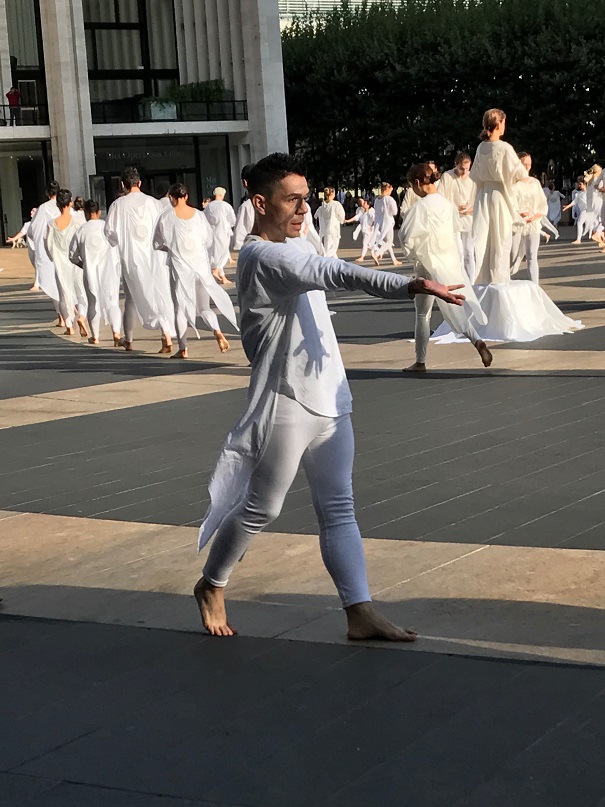
    Last September I joined the Buglisi Dance Company at the Lincoln Plaza in Table of Silence: with a beautiful and emotional dance tribute we remembered and honored the victims of 9/11 and the event was seen livestream all over the world. I was honored to be part of such a remarkable event.

    Oh, and in New York City I closed the circle: I trained full-time for two years at HB Studio, the prestigious acting school.

    IMG_5690

    I treasure my experiences. From a village of 600 people, zero money and infinite obstacles, my journey surprises me every day. Next destination: the next rejection(s)! Only then and there do miracles happen.”

    ~ Guest Author: Francesco Pireddu