Category: Ballet

  • Dances We Dance @ Graham Studio Theatre

    DWD_FS-20241121-DSC00027

    Above: dancer Kathleen Caragine in Water Study, photo by Steven Pisano

    ~ Author: Oberon

    Sunday November 24th, 2024 matinee – Francesca Todesco’s company Dances We Dance presenting ACQUA, a program of danceworks inspired by water. This evening’s afternoon’s was a performance that celebrated sisterhood and helped ease the after-effects of a painful recent election, in which women’s causes that seemed set to flourish under a Harris administration now seem destined for setbacks in the years ahead.
    DWD_FS-20241121-DSC00973

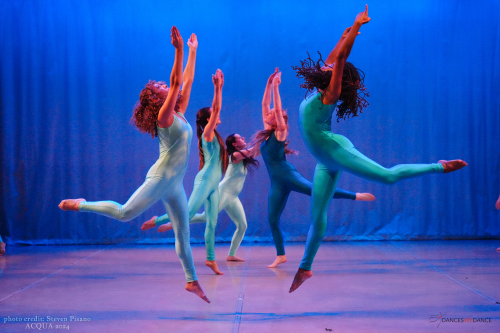
    Above: the ensemble in Water Study, photo by Steven Pisano

    The program presented a set of dances inspired by or alluding to themes relating to water, which – since the earliest beginnings of dance –  have evoked or reveled in this essential element. From the rain dances of the ancient tribes to Chris Wheeldon’s After The Rain… and Caterina Rago’s Alta Marea, water has been a constant source of inspiration in the dance community.

    As part of this exploration, the audience today experienced the re-staging of Doris Humphrey’s renowned 1928 choreography Water Study, performed by a cast of 11 dancers under the direction of master teacher Gail Corbin. This was preceded by a showing of Isadora Duncan’s 1905 piece Water Study, which has an improvisational feeling. As staged by Francesca Todesco, this opens to the sound of dripping water.

    As music of Schubert sounds, the lights slowly come up to reveal the dancers prone on the floor. Wearing blue/green costumes, they slowly rise and – as projections of the sea appear on screen – they come and go, executing fleeting steps and creating waves of movement suggesting the ebb and flow of the sea. A Schubert waltz sounds, and the dancers assume an ecstatic pose.

    DWD_FS-20241121-DSC01346

    Above: the dancers in Doris Humphrey’s Water Study; photo by Steven Pisano

    Silence falls as the Humphrey piece commences: the kneeling dancers awaken, the sound of their breathing hangs gently on the air. One by one they rise. Forming opposing lines, they race towards each other like tempest-tossed waves converging. They run en masse from corner to corner, as if crashing against sea walls. Standing, they sway from side to side to the sounds of their own breath. Then they fold into kneeling poses and the ballet ends as it began. Kudos to Ms. Corbin for bringing the fascinating work to currency. 

    DWD_FS-20241121-DSC01850

    Above: from Catherine Gallant’s Wave; the dancers are Colleen Edwards, Rosey Gentle, and Kathleen Caragine; photo by Steven Pisano

    The next three works were finely contrasted but they had one thing in common: each was so visually and musically enjoyable that they felt too short!     

    Wave, a 2001 work choreographed by Catherine Gallant, is an homage to Isadora with a contemporary touch. Three dancers – Kathleen Caragine, Colleen Edwards, and Rosy Gentle – are posed in a pool of light at the start. To the sounds of a Chopin mazurka, these beauties dance nobly and expressively in tunic-like costumes. They collapse and rise, evoking visions of Wagner’s Rhinemaidens, their faces are at once youthful and ancient: a sisterhood of goddesses. As the light fades, they return to their opening pose.

    Gallant

    Above: choreographer Catherine Gallant in an iconic photo

    I was ever so happy to see Catherine this evening; I felt reassured after speaking with her: now more than ever we must be there for one another. I told Catherine of the beautiful “Isadora” photo I have of her on my bookcase shelf (above); I can look up from my desk all thru the day and see her in that ecstatic pose.
    DWD_FS-20241121-DSC02476

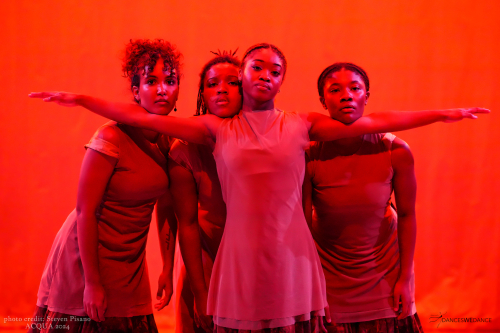
    Above: from Crosscurrents; the dancers are Jada Alfred, Marley Poku-Kankam, Autumn Rodrigue, and Alana Averett; photo by Steven Pisano

    Crosscurrents, choreographed by Hannah Howell, brought forth four lovely young ladies, each with a distinctive personality. To a wonderfully weird and quirky score by Angel Bat David, the dancers create movement patterns and dance in diagonal formations. The sound of the clarinet takes over – I love it! – and standing in a line up, each dancer has a brief solo. The music is incredibly evocative, it sings of solidarity. The stage becomes sun-drenched as the dancers fall and then resume their initial pose. 
    DWD_FS-20241121-DSC03010

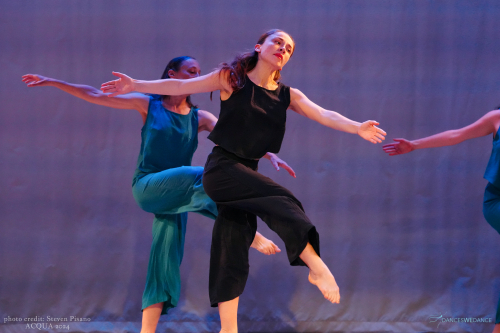
    Above: Lana Hankinson in Tidal Pool; photo by Steven Pisano

    Tidal Pool, set to deeply lyrical music by Yumira and choreographed by Rae Ballard, was danced by a quintet that featured Mlles. Caragine, Edwards, and Gentle joined by guest dancers Lana Hankinson and Lauren Naslund. The gentle flow of the dance created a sense of quiet serenity whilst the music evokes a luxuriant feeling of peace. Nearing the end, Ms. Naslund walks slowly forward center-stage while one by one the other dancer cross her path and depart, leaving her alone onstage with an expression of quiet wonderment. I’ve always been an admirer of Ms. Naslund, more so today than ever. Her calm beauty has the enviable gift of timeless grace. 

    DWD_FS-20241121-DSC03607

    Following the interval, Francesca Todesco’s brand new Cherchez La Femme (above photo by Steven Pisano) was danced by Mlles. Edwards, Gentle, and Caragine.These three women have developed into artists of high quality, thoroughly comfortable and assured onstage. Each has something personal to say, making their dancing really fascinating to watch.

    DWD_FS-20241121-DSC04519

    Colleen Edwards (above, photo by Steven Pisano), so impressive in the Gallant piece earlier in the program, was riveting here. As the Todesco trio commenced against a golden backdrop, the white-clad Ms. Edwards stood in the light, casting her shadow. She is joined by the other two, and shadow-play becomes a part of their movement.

    Ms. Edwards has the first solo: each character has a name, and she is Simonetta. To softly cascading piano motifs, her dancing is truly mesmerizing. She rushes about the space and finally withdraws as Ms. Gentle, clad in red as Camille, enters frantically, as if being pursued…she immediately collapses. A questing search and a plea reveal her desperation. Rising, she appears hesitant, as if seeking something…or someone. To music of Chopin, the search becomes a plea. Ms. Gentle’s dancing seemed to reveal her heart and soul to us.

    Now we meet Artemisia: fair of face, Ms. Caragine’s black hair sets off her expressive eyes; she moves beautifully, with a ballerina’s poise, as the steps and gestures flow on the music. The trio re-unite, Ms. Gentle now back in her white frock, as the dance moves to its finish.

    Here are more images from Cherchez la femme, photos by Steven Pisano:

    DWD_FS-20241121-DSC04747

    Rosy Gentle

    DWD_FS-20241121-DSC05113

    Kathleen Caragine

    DWD_FS-20241121-DSC03930

    Mlles. Edwards, Gentle, and Caragine in Cherchez La Femme 

    DWD_FS-20241121-DSC05679

    Above: Francesca Todesco in Memories; photo by Steven Pisano

    Ms. Todesco then took the stage alone to premiere a new solo choreographed by Rae Ballard to the always welcome music of Astor Piazzolla. Entitled Memories, this solo finds the dancer clad in severe black with black pumps; she seems like a widow, alone in her grief, recalling happier times The music has a lamenting feeling and becomes quite lush; a hint of a tango is woven in. Francesca’s innate musicality, with her expressive hands and face, creates a mood of longing. At times, she seemed to be dancing just for me.
    DWD_FS-20241121-DSC06615

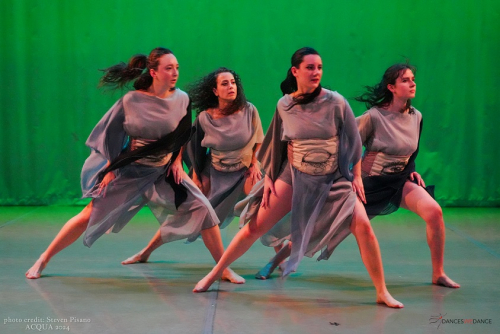
    Above, the sirens of Haunted Echoes: Colleen Edwards, Margherita Tisato, Kathleen Caragine, and Rosy Gentle; photo by Steven Pisano

    Closing the program was a newly commissioned work choreographed by the beloved former Paul Taylor star Annmaria Mazzini. This is Haunted Echoes, set to musical collage which propels a dance of the sirens – bewitching creatures all in sea-green. Drifting about the space, they pause to sing their alluring song. A big beat springs up and the dancing turns wild. And then the music becomes a bluesy lullaby, and the dancers drift off, a sisterhood lost at sea.

    On an evening that meant a lot to me, it was especially nice to greet the inimitable Jim May, who I’d only met once before, many, many moons ago at a Sokolow rehearsal. Tonight, it felt like a reunion of long-lost brothers.

    Performance photos by Steven Pisano.

    ~ Oberon
  • Voices from South Africa @ Weill Hall

    Siphokazi-Molteno jpg

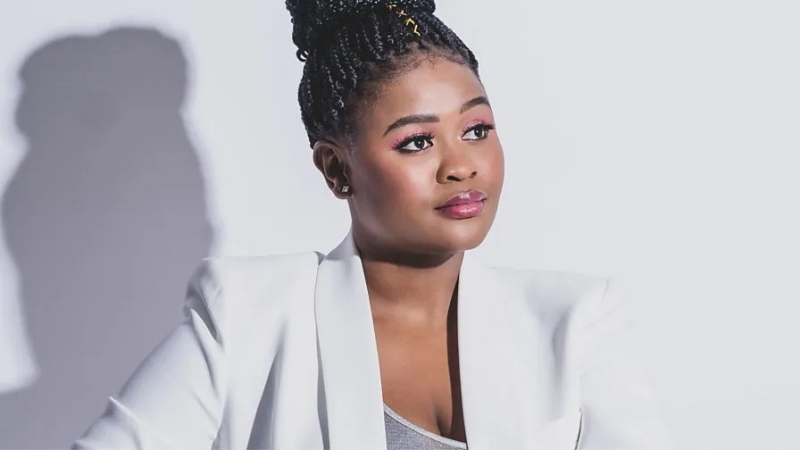
    Above: Siphokazi Molteno

    ~ Author: Oberon

    Monday October 28th, 2024 – The Met Orchestra Chamber Ensemble presenting a program of classic and contemporary works at Weill Hall. I was very keen to hear mezzo-soprano Siphokazi Molteno. who represented South Africa at the 2023 Cardiff Singer of The World competition, and who made her Metropolitan Opera debut in 2022 as Flora in LA TRAVIATA.

    Ms. Molteno opened the evening with the Brahms “Viola songs”, a pair of lullaby-like solos accompanied by viola (Shmuel D. Katz) and piano (Thomas Lausmann). The Molteno voice has a marvelous contralto richness as well as a lyrical warmth; to say she put me in mind of the great Florence Quivar is the highest compliment I can give. It’s a voice full of ‘humanity’ and a voice I will hope to hear again…and soon. Her colleagues from the MET Orchestra played sublimely, setting the evening gorgeously on its way.  

    There was then a longish pause while the stage was set for the next work, which involved five musicians: Seth Morris (flute), Tal First (viola), Hannah Cope (harp), Gregory Zuber (marimba), and Jeffrey Irving (percussion). Ndodana-breen

    Above: composer Bongani Ndodana-Breen

    The composer’s choice of instrumentation for his Rain Making really drew me in: if there’s a marimba to be heard, I want to hear it…and likewise the harp. Mr. Ndodana-Breen composed this piece in memory of Queen Modjadi, one in a line of Rain Queens of the Balobedu people in the Limpopo province of South Africa. A Rain Queen is believed to have the power to control the rain and the winds. This mythic association made the music even more intriguing for me.

    The players made a wonderful blend and the evocative sounds included a rhythmical flute, a plucked violin, and a bean bag played by the percussionist. The flute and violin trade melodic phrases, the violin shivers, the melismatic marimba enchants. Then, to a big, pounding beat propelled by the bass drum, the storm comes: the Rain Queen’s magic has succeeded. I loved this music, and watching the musicians as they entered into the spirit of the ritual; my only complaint was that the piece is too short.

    Maurice Ravel’s sultry Chansons madécasses found a most congenial interpreter in Ms. Molteno. I first heard these songs in 1975 when New York City Ballet premiered a Jerome Robbins ballet of the same title; the singer was Lorna Myers. Since then, I have frequently listened to the songs on Mira Zakai‘s marvelous recording. 

    The first of the three songs, Nahandove, has a beautifully sultry feeling: it tells of the seduction of a native woman. Jerry Grossman’s cello opens the piece, and Ms. Molteno’s voice is at its most sumptuous as she begins this tale of longing and ecstasy. Jazzy piano rhythms from Mr. Lausmann and the sound of the piping flute (played by Maron Khoury) develop a rocking feeling; the music turns pensive and then caressive. With the song’s final strophe, “Tu pars...” the tryst ends, though it seems the lovers will meet again at sunset.

    The second song, Aoua!, opens with the singer screeching a warning: do not trust the white men! The piano takes up a swaying rhythm as Ms. Molteno continues with singing of great intensity. This is violent, angry music, though eventually the cello and flute sound forlorn.

    By contrast, the final song – Il est doux – is a languid reflection on the joys of resting the shade of a tree on a late afternoon, while a lover whispers in your ear. The sensuous flute, the eerie cello on high echoing the buzzing insects with a trill, the voice and the cello entwining, solitary notes from the piano…so atmospheric.  Ms. Molteno’s singing was evocative and so pleasing to experience. The song ends with the swiftly spoken dismissal: “Go and prepare the evening meal…” 

    Mvd2022 jpg

    Following a longish interval, an ensemble of eight instrumentalists took the stage for music by Matthijs Van Dijk (above): we heard his extraordinarily powerful oratorio Moments in a Life. I had previously heard one of this Cape Town-based composer’s works [(rage) rage against the] played by the Signum Quartet in this very hall. 

    Thus, I expected a lot from the composer’s Moments in a Life, composed in 2016 for string quintet, clarinet, percussion, piano, overtone singer & narrator. Could lightning strike twice in the same place? The answer is a resounding YES!…Moments in a Life is one of the most powerful works I have ever experienced.

    The oratorio is based on the writings of Denis Goldberg, a native of Cape Town whose parents were politically active. In 1957, Denis joined the (banned) Communist Party and he was arrested and jailed in 1960 for supporting strikers. In the mid-1960s he was with other freedom fighters who were arrested for illegal acts and jailed. He remained a prisoner for 22 years, constantly being tortured and threatened with death.

    Gareth-lubbe

    At this evening’s performance, Gareth Lubbe (above) was the narrator. Mr. Lubbe is also an overtone singer; this is a technique in which the resonance in the mouth and throat are combined with tongue, lip, and jaw movements which create a perception of overtones as being individual notes. It’s a sound that is eerie…and fascinating.

    Moments in a Life, conducted by William Long, gives us so much to take in in its 40-minute duration. Trying to follow the narrative whilst also listening to the music was a bit of a challenge for me, a dedicated note-taker: I filled three pages with notes which barely scratched the surface of the work.

    “I was sure we would not die in prison,” marks the oratorio’s opening line. As the narration moves forward, the writer recalls his first teacher, who he fell in love with. He speaks of not seeing his wife and children for more than two decades while imprisoned. A fellow freedom fighter, Looksmart Ngudle, was tortured to death. Freedom costs.

    Nelson Mandela defends the accused patriots: “An ideal for which I am prepared to die”. Sentenced to life in jail, they are moved to a harsher prison affectionately known as “Beverly Hills”: three thousand prisoners singing hymns as individuals are led away to be hanged. Ironically, a gorgeous musical theme underscores this tragedy.

    Periodically thru the work, Mr. Lubbe’s overtone singing makes a striking impression: an indescribable mixture of humming and whistling.

    As to the music, the opening measures are pensively played by clarinetist Jessica Phillips: a slow, wide-ranging solo, soon joined by piano and strings. Cellist Mariko Wyrick underscores the story of the teacher, Ms. Cook. Andrew Gantzer’s double bass, so impressive throughout the piece, tells of Looksmart’s ordeal.

    Mr. Lubbe’s voice growls deeply; percussionist Jeffrey Irving plays a rollicking ‘cadenza’. Beauteous strings, the clarinet sings again; here are glowering chords and a lament played by violist Shmuel D Katz. Mr. Lubbe has an unaccompanied solo.

    Pianist Katelan Trần Terrell and Mr. Gantzer’s bass establish a beat; Mr. Katz strums his viola. A sudden militant outburst forebodes the assassination of activist Chris Hani; a poignant violin passage (Yurika Mok and Yang Xu) underscores the narrator’s reflections on Chris’s death.

    “A petty exercise of power that harms our people.”

    At last, in the forced-labor setting of The Quarry, where Nelson Mandela and his brother freedom fighters languished, a glorious theme of hope develops: “Let Freedom Reign”. Mr. Lubbe’s otherworldly overtones are heard over a long, sustained chord.

    The audience, who had witnessed the performance is a state of awed silence, now gave the performers a fervent round of applause.  

    Back home, I went to YouTube to see what I could find about this powerful work and immediately discovered this incredible document: Moments in a Life, recorded live in concert in the Endler Hall at the Stellenbosch International Chamber Music Festival on July 16th, 2016. This, I believe, was the work’s world premiere, with Denis Goldberg – then aged 83 – reading the texts (drawn from his autobiography) himself. The great freedom fighter passed away in 2020. 

    The work is so timely right now, when our democracy stands on a precipice. If we falter, our country – and indeed the world – will be forever changed.

    ~ Oberon
  • BalletX @ The Joyce ~ 2024

    20240925_BalletX-Heroes_ChristopherDuggan_853

    Above: Savannah Green in Takehiro Ueyama’s HEROES; photo by Christopher Duggan for BalletX

    ~  Author: Oberon

    Wednesday September 25th, 2024 – Philadelphia’s BalletX at The Joyce tonight, offering three New York premieres: Takehiro Ueyama’s HEROES, Jodie Gates’ BEAUTIFUL ONCE, and Loughlan Prior’s MACARONI. Over the years, this Company has commissioned nearly 130 world premieres.

    The three works presented tonight were well-contrasted, and I must immediately praise the Lighting Designer, Michael Korsch, whose work was nothing less than sensational; this gave a special glow to the evening. Of the beautiful and highly accomplished BalletX dancers, two were known to me: Savannah Green (who danced in the closing work) and Jerard Palazo, who danced in the ballets by Loughlan Prior and Takehiro Ueyama, and who generated considerable star-power.

    20240925_BalletX-BeautifulOnce_ChristopherDuggan_191

    Above: Minori Sakita and Ashley Simpson in Jodie Gates’s BEAUTIFUL ONCE; photo by Christopher Duggan for BalletX

    The evening opened with Jodie Gates’s BEAUTIFUL ONCE, set to a score by Ryan Lott performed by Son Lux and yMusic. The slurring music of the opening moments soon transforms into rhapsodic themes as the dancers meet on the gorgeously lit stage, embracing one another with genuine affection. The choreography – danced on pointe – is full of sweeping lifts and swirling movement, all gracefully executed. A series of duets, laced with fleeting solos and passages danced as trios and quartets, keeps the eye thoroughly engaged. 

    The music becomes dense and passionate, and a sense of belonging pervades the stage. When the dancers are not dancing, they remain on the sidelines, as if supporting their colleagues. A lovely quintet for the women seems to offer a perfect ending to the piece, but then the men take over and the dancing flows on. As the ballet nears its end, individual couples step forward and embrace – not passionately, but tenderly.

    The program note refers to BEAUTIFUL ONCE as “a response to the chaotic moments in life”, and reminds us of the blessèd assurance of friendship and community.

    20240925_BalletX-Macaroni_ChristopherDuggan_422

    Above: Jonathan Montepara and company in Loughlan Prior’s MACARONI; photo by Christopher Duggan for BalletX

    I hardly ever enjoy comic ballets (Jerome Robbins’ THE CONCERT being an exception) and I can’t say that I derived much pleasure from Loughlan Prior’s MACARONI, a spoof on gay manners from the powdered wig era. The music, by Claire Cowan, served the choreographer well, laced with sounds of the harpsichord to evoke the baroque.

    The cast of eight included three women en travesti, dancing on pointe. Everyone danced superbly whilst showing expert comic timing and entering fully into the campy atmosphere. But as the work progressed, I felt rather sad: yes, we have made so much progress over the years…and yes, we must be able to laugh at ourselves. But there is still rampant homophobia and plenty of anti-gay/anti-trans violence in this country. Just a week ago, I heard three Spanish boys talking about me on the subway, using their favorite slur: pato. Will it never end?

    20240925_BalletX-Heroes_ChristopherDuggan_529

    Above: Francesca Forcella and Jerard Palazo infrom Take Ueyema’s HEROES; photo by Christopher Duggan for BalletX

    After the interval, Takehiro Ueyama’s HEROES summoned up a world of poignant beauty and mystery – a world we can always access in our imaginations but which the choreographer here transforms into reality. In his program note, Take dedicates the ballet to citizens who played a crucial role in the recovery of Japan from the devastation of World War II.

    Here, Mr. Korsch’s lighting designs (in collaboration with Christopher Ham) were extraordinarily atmospheric, and Eugenia P. Stallings’ costume designs – red garments that seemed at once ancient and ultra-contemporary – evoked the priestly rites that bind the community together.

    The piece opens with a prologue: deep rumblings are heard, and the summoning sound of chimes. From the pit, Tokoshieni – composed by percussionist Kato Hideki and performed by him and violinist Ana Milosavljevic – transports us to an illusory place and time. A red-clad couple emerge from the shadows and perform a slow, stylized duet to the sound of mysterious whispers. An eerie, brooding feeling creeps in; the man performs a slow solo and and the woman responds in kind. They don red jackets and vanish into the darkness.

    The music of John Adams – The Chairman Dances – rises as the full stage becomes illuminated. A diagonal of white chairs stage right becomes a walkway as the dancers enter. They move the chairs about, establishing a place for the evolving ritual. The chairs are lined across the stage and there is a wonderful seated passage of arm and hand gestures. A unison dance and individual walkabouts are highlighted by brief solos. 

    The music turns spacious and the dance slows, only to rebound as the dancers march about. Another unison passage leads to everyone dropping to the floor…only to rise and race about in a circle. Now the jackets come off and are collected; the dancers sit in a semi-circle, with the corpse of a woman covered with a jacket.

    A new beat develops; there is an intense duet which evolves into a trio and then a wild female solo. The lighting continues to play a powerful part in the effect of the choreography. In a visual coup, there is a striking line-up across the space, and the dancers advance towards us. They then fall into single-file and proceed to cross the bridge of chairs, sure of their destiny.

    More of Christopher Duggan’s images from HEROES:

    20240925_BalletX-Heroes_ChristopherDuggan_616

    Above: dancers Skyler Lubin and Mathis Joubert

    20240925_BalletX-Heroes_ChristopherDuggan_917

    Above: dancer Itzkan Barbosa

    ~ Oberon

  • Pilobolus @ The Joyce ~ Summer 2024

    Image-asset

    ~ Author: Oberon

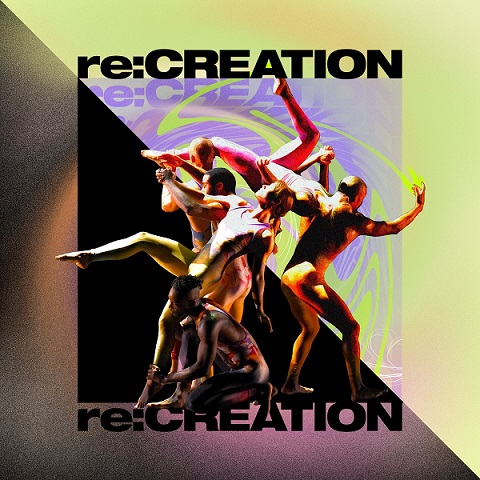
    Tuesday July 23rd, 2024 – It’s been a while since I last saw Pilobolus, and it was truly revelatory reconnecting with this unique, legendary dance company tonight at The Joyce. The season celebrates re:CREATION, a brilliant collection of works – old and new – from Pilobolus’s 50-year history which were offered on two specially-devised programs.

    Tonight’s program, entitled Dreams, featured five works; and while at times things seemed too same-y and certain passages went on too long, the cumulative force of the evening was incredibly powerful and meaningful on a personal level. Six dancers carried the entire evening, their awesome athleticism and boundless energy meshed with an innate sense of poetry and unstinting commitment to the work. 

    The program opened with Thresh|Hold, from Latinx choreographer and designer Javier De Frutos; several other names are listed in the program as collaborators. To shimmering music, the curtain rises on a closed door, which will become the epicenter of the piece. A rather haggard woman (the program tells us it’s either Marlon Feliz or Hannah Klinkman – not very helpful to someone attempting to write a review) opens the door and sits on the stoop; a male body is then thrown out onto the ground, and all hell breaks loose. The four men in the cast might be gestapo or just random trouble-makers. People chase each other about, torment the woman (or one another), whilst the door itself is the main character – spun about the stage, opened and closed at high speeds, allowing light to shine thru from varying angles. All this was handled with pinpoint timing by the dancers,

    As the piece unfolds, we hear a fractured recording of the Casta Diva from Bellini’s NORMA, merged with other noises, sometimes harsh or otherworldly. After the pitch of the aria sags and becomes incoherent, the melody resumes – now voiced by the inimitable Maria Callas, whose version has been used in numerous danceworks over the years…if you’ve never heard it, here it is.

    The dancework, nightmarish and somewhat incoherent, was engrossing to watch; the use of the door was truly clever and impressive. The woman (I believe it was Ms. Feliz) seems desperate to escape but is always thwarted, sometimes in mid-air. A men’s quartet near the end, with lifts, was oddly lyrical. The audience seemed captivated, and applauded heartily, but there were no bows.

    The New York City premiere of the duet Bloodlines followed; an epic love duet that packs a heart-rending wallop. Choreographed by the co-directors of Pilobolus, Renée Jaworski and Matt Kent, in collaboration with Ms. Feliz and Ms. Klinkman, who danced it together. The luminous ‘music-of-the-spheres’ score is attributed to five composers: Andre Heller, Michael Gordon, Elisapie Isaac, Eva Reiter, and Meredith Monk.

    Gorgeously lit by Diane Ferry Williams, Bloodlines was hypnotically danced as red rose petals fell from the sky. The two women, lovers, seem to retell the story of their love; they strike poses and move to jagged rhythms until a partnership is formed.

    To the sentimental sound of an old 78 recording for violin and piano, they become increasingly intimate, one dancer cradling the other. But something is amiss; thru age or illness, one of the women expires, leaving her beloved bereft. The two dancers brought so much beauty and poetry to this duet, making the end unbearably poignant.

    Still recovering from the emotional pull of Bloodlines, the deeply moving male quartet Gnomen sustained my intense involvement in what we were seeing and hearing. A tolling bell signals the opening of Gnomen, wherein we encounter a brotherhood of gnomes: ageless, deformed dwarves out of folklore who live in the earth.

    The four – Connor Chaparro, Quincy Ellis, Sean Langford, and Derion Loman – wear black briefs; they move hesitantly, seemingly in pain, with their bodies disfigured. They seem to be downtrodden victims of fate. Helping one another, their entwined figures struggle to walk. They appear to pray, and now the chime sounds louder: they move spastically, like contorted acrobats.

    The choreography is extremely athletic, strenuous, and demanding, and the dancers took it all in stride. Clockwork music and a dreamy harp are heard as the quartet attempt entwined tumbling. The sounds of the marimba transform to a melodious finish, with a sense of healing for the hapless creatures as the chimes sounds again. The seemingly healed gnomes kneel in prayer.

    After a longish intermission, Symbiosis – choreographed by Michael Tracy in collaboration with Renée Jaworski and Otis Cook – opens with thunder and lightning. To the music – a collage of pieces by Thomas Oboe Lee, George Crumb, Arvo Pärt, and Jack Body, played by the Kronos Quartet – dancers Marlon Fritz and Quincy Ellis, nearly nude, perform a sensuous duet. The elasticity and grace of their bodies develop an intimacy underscored by Mr. Pärt’s languid,  beguiling Spiegel im spiegel wherein the dancers tenderly see-saw in an embrace. The dancers’ athleticism takes on a poetic aspect as we surrender to the tender beauty of their entwined bodies. 

    Closing the program was Rushes, Pilobolus’s first collaboration with Israeli choreographers Inbal Pinto and Avshalom Pollak, and while it was overly-long and rather less engaging than the other works, there was an undercurrent which kept me focused.

    Circus music heralds the rise of the curtain, and we find five dancers – Mlles. Feliz and Klinkman and Mssrs. Chaparro, Ellis, and Langford – seated in wooden chairs in a circle of light. They seem to be waiting for something – a flight, perhaps? To the sound of rushing water, playful renderings of “Mary had a little lamb” and “Oh, they don’t wear pants on the sunny side of France” are fleetingly heard.

    Whimsical partnering, endless bouts of musical chairs, comic vignettes, and walkabouts come into play, but we don’t understand who these people are and what they are hanging about for. One character, played by Quincy Ellis, is an endearing elderly man with a suitcase full of dreams. In the end, the chairs are set in a row and the old man walks along them as the other dancers hastily move the seats so that his path remains endless. At the end. we again hear Arvo Pärt’s Spiegel im spiegelall of itwhich seemed to drag out the end of an otherwise engaging evening.

    ~ Oberon

  • Dorrance Dance @ The Joyce ~ SHIFT

    Dorrance_Dance

    Above: Michelle Dorrance

    ~ Author: Oberon

    Sunday July 21st, 2024 matinee – Michelle Dorrance’s SHIFT was another hit in the Joyce Theater’s mostly marvelous 2023-2024 season, which is now drawing to a close. The hour-long work was ideally lit by Kathy Kaufmann, with sound design by Christopher Marc, and casual costuming organized by Amy Page. Ms. Dorrance’s choreographic designs are a collaborative venture with her dancers, extending to improv.

    To say that the dancing was sensational and thoroughly captivating is an understatement; adding to the vibrancy of the show were segments when some of the dancers took up musical instruments and regaled us with their impressive playing…to say nothing of a couple top-notch vocalists.

    Before the house lights went down, the dancers appeared on the bare stage and began warming up – randomly at first, but then forming a circle and delivering individual tap motifs in turn as the others kept rhythm. This drew the audience deeply into the world of tap.

    Once the house lights are out, it’s a hopeless task to take notes at The Joyce. But I’ve done my best to salvage what I could from my over-written pages.

    The ‘formal’ program began with the first of six sections, entitled Dedicated To You, after the Sammy Cahn song, which was performed live by Ms. Dorrance (ukelele), Claudia Rahardjanoto (bass), with vocals by Ms. Rahardjanoto and Addi Loving, and danced by the Company’s male dancers – Sterling Harris, Luke Hickey, and Leonardo Sandoval – along with Elizabeth Burke and Ash Griffith is a smooth, swaying style. One of the singers soon joined the dancers whilst the other began whistling…such a fresh feeling, meshing music and dance in an imaginative union.

    There followed the little glass ii and the little glass ii remix, which sort of flowed together into one continuous number. An especially intriguing segment was a male solo in which the dancer was followed about by a wheeled spotlight; after a bit, the dancer and the light-man switched places. The music takes on a psychedelic aspect; the lighting turns blood-red. Phrases are passed about, from dancer to dancer. Michelle Dorrance has a solo, which the other dancers observed from chairs ranged around the space. Michelle resumes playing her ukelele, but the music turns into a deep rumbling. 

    I Don’t Want To Set The World On Fire, with Ms. Dorrance singing lead to her ukelele accompaniment, backed by Ms. Loving, Asha Grffith, and Elisabeth Burke; their harmonizing was terrific. The male dancers have a trio which morphs into an octet, danced in a pool of light. Competition and camaraderie vie, to rhythmic clapping.

    Elizabeth Burke seated herself at the grand piano for Moon, with Ms. Rahardjanoto on bass and Ms. Loving doubling piano/percussion. This followed by Ymir, to recorded music by Dawn of Midi. But I’d been forced to abandon note-taking in the dark, and so I just sat back and watched as the dancing continued – by turns subtle and sensational – from which I derived great pleasure. I began to feel a blessèd assurance in an uncertain world. 

    I’d expected a grand finale, a veritable tempest of tapping, but instead the performance  ended on a purely musical note, with a song that hit me like a tsunami: That’s The Way It Is, by Alex Kramer and Joan Whitney; it just happened to perfectly reflect the emotional state I’ve been in of late. I have to include some of the lyrics here, so that I’ll always know where to find them:

    “I tremble at your touch
    I know I shouldn’t
    But that’s the way it is
     
    I want you oh-so much
    I know I shouldn’t
    But that’s the way it is
     
    I can see so clearly
    That we are worlds apart
    But when you are near me
    I can’t see beyond my heart
     
    I worship at your shrine
    You said I shouldn’t
    But that’s the way it is
     
    I begged you to be mine
    I said I wouldn’t
    But that’s the way it is
     
    I love you forever
    Though it may never be
    But that’s the way it is
    With a guy like me”

    In the playbill, Ms. Dorrance offered the following note, in which she hit several nails on the head, reminding us of what’s at stake for our country in the weeks to come. I felt compelled to scan it and share it here:

    Dorrance jpg

    There were no curtain calls, and as the lights came up I realized what a sense of community had enveloped us during the show. I could easily have watched it again…immediately.

    ~ Oberon
  • Extreme Taylor @ The Joyce ~ 2024

    5_Runes_photo by Steven Pisano

    Above: Alex Clayton in Runes; photo by Steven Pisano

    ~ Author: Oberon

    Saturday July 29th, 2024 matinee – In the days leading up to this afternoon’s Paul Taylor Dance Company performance, I was trying to recall my first-ever experience of seeing the Company live. I knew it was at Jacob’s Pillow, but was it 40 years ago…or earlier?

    I went thru my archives (I save everything) and discovered that it was in the summer of 1983, though the exact date is not on the cast page. The program opened with Esplanade…is it any wonder I was hooked?  In fact, my old pal Richard and I loved the Company so much (and especially David Parsons and Christopher Gillis) that we went to the box office during intermission and got tickets for the following weekend.

    1st taylor-1 jpg

    But…zooming back via time-warp to today’s matinee, it opened with Taylor’s Post Meridian, dating from 1965, set to a score by Evelyn Lohoefer de Boeck. This was my first encounter with this ballet, and I loved everything about it.

    Post Meridian_photo by Steven Pisano

    Above: from Post Meridian, photo by Steven Pisano

    Somehow the Alex Katz costumes and Jennifer Tipton’s lighting created an impression of the dancers glowing from within. The music, described as “for magnetic tape”, is a delightful conglomeration of noises. The piece starts with thunder, or perhaps it’s the sound of a helicopter landing. Bizarre passages of spoken word, bang-on-a-can type percussive intrusions, a jazzy string bass rhythm, a trilling clarinet, music from a carnival funhouse: all this provides impetus to the dancers.

    In an opening segment of walk-ons and gestural moves, we first meet Eran Bugge, Lisa Borres, and Jada Pearman. The men join – Lee Duveneck and Kenny Corrigan – along with Jessica Ferretti. Kristen Draucker has a featured solo, beautifully danced. A striking segment of two parallel pas de trois is truly original, with Mssrs. Duveneck and Corrigan handling the partnering elements with aplomb. Ms. Bugge dances a solo, and as the music turns whimsical, she spins blithely about the space. Devon Louis is fantastic in a jazz-based solo..simply superb.

    Some images from Post Meridian:

    PTDC_Joyce_6.26.24_PostMeridian_Draucker_Thiele_002

    Kristin Draucker, photo by Ron Thiele

    PTDC_Joyce_6.26.24_PostMeridian_Louis_Thiele_004

    Devon Louis, photo by Ron Thiele

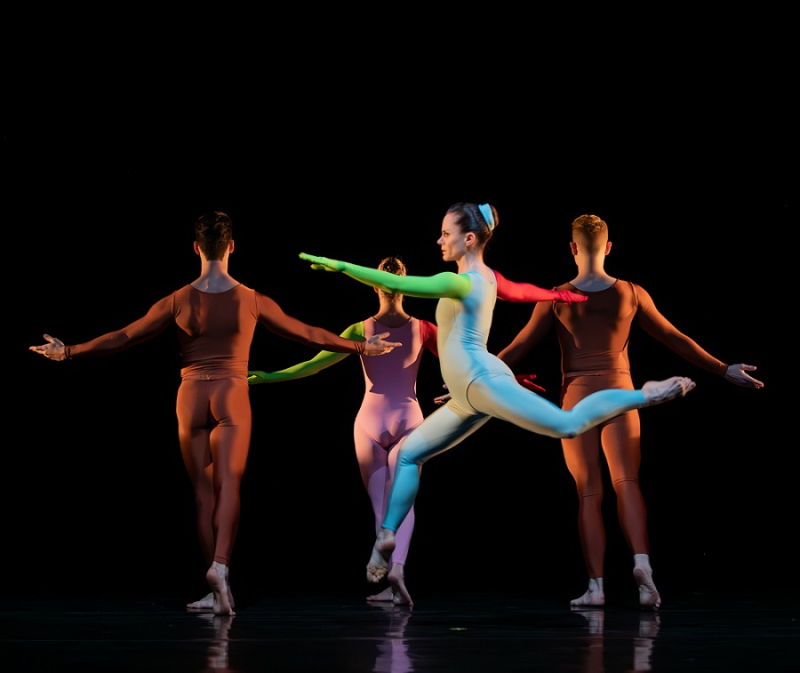
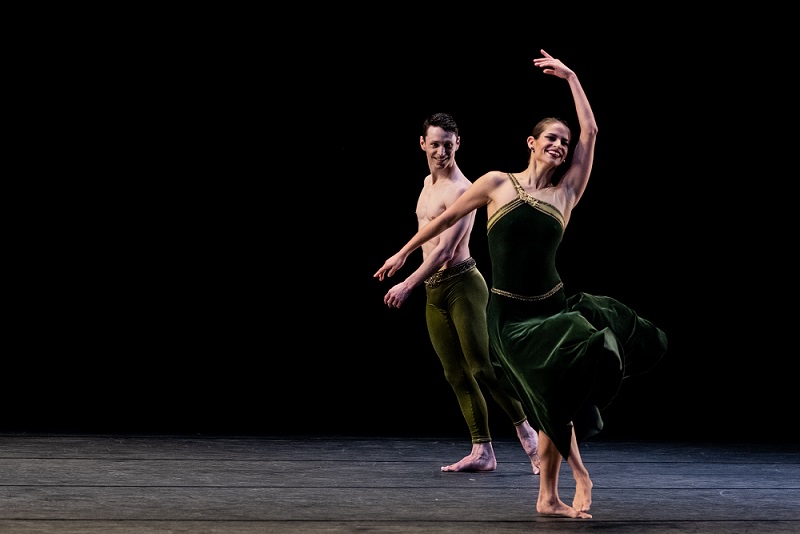
    Paul Taylor’s Brandenburgs (1988) is normally a closing piece, but this afternoon it fit neatly between the quirkiness of Post Meridian and the mythic bleakness of Runes. Brandenburgs is quintessential Taylor. It has a cast of nine, but somehow feels ‘larger’, whilst the iconic Bach score lends a sense of grandeur.

    3_Brandenburgs_Maria Ambrose  John Harnage_photo by Ron Thiele

    Above: Maria Ambrose and John Harnage in Brandenburgs; photo by Ron Thiele

    From its opening pose of the six men and three women, Brandenburgs is a nonstop dance feast: each of the women – Maria Ambrose, Eran Bugge, and Lisa Borres – has a flirtatious segment with the five men of the ensemble: Lee Duveneck, Alex Clayton, Shawn Lesniak, Austin Kelly, and Jake Vincent. The men are given demanding Taylor moves as they come and go throughout, crossing the stage in leaping combinations.

    1_Brandenburgs_John Harnage_photo by Whitney Browne

    The charismatic John Harnage (above, photo by Whitney Browne) holds the audience under a spell in the lyrical adagio, partnering Mlles. Bugge, Ambrose, and Borres in turn. In the succeeding faster movement, John admiringly observes solos by Maria, Eran, and Lisa, and then had a mesmerizing solo of his own. The animated finale brings us back to the ballet’s opening pose.

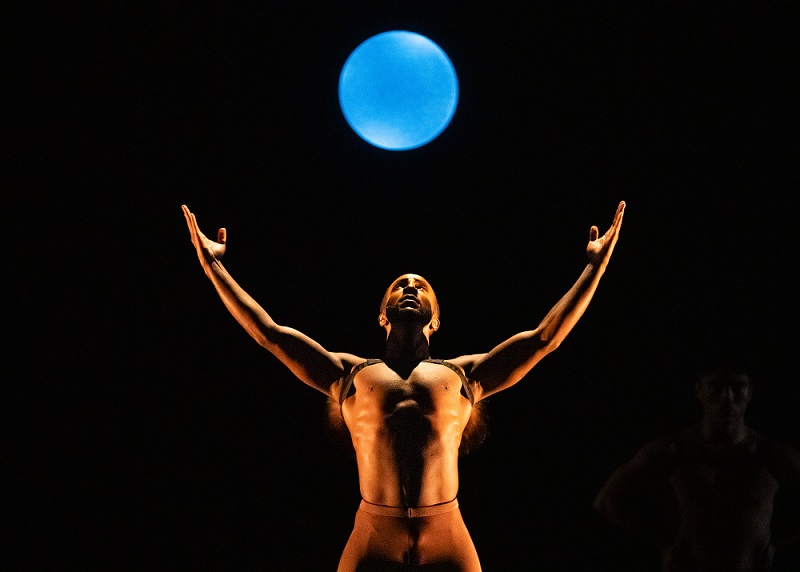
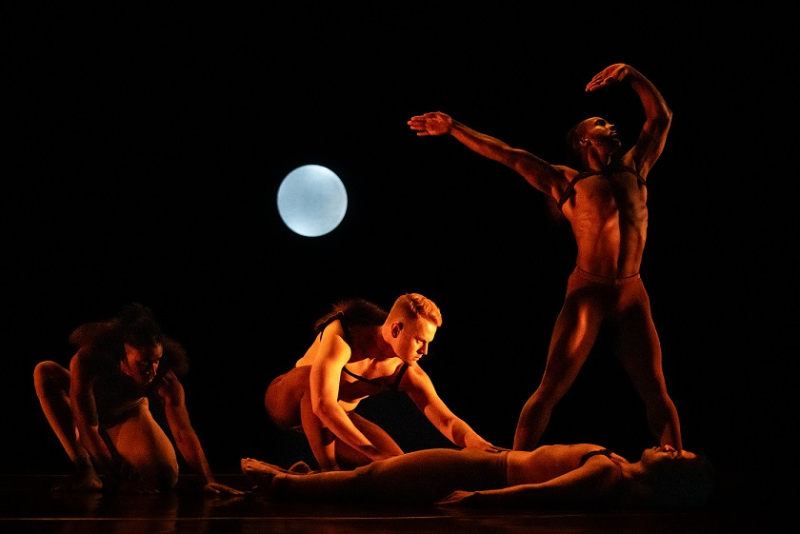
    Closing the program was Runes, choreographed by Paul Taylor in 1975 to piano music by Gerald Busby. The ballet opens with a blue moon in the sky and a corpse onstage. Jennifer Tipton’s perfect lighting creates a timeless feeling as an ancient tribe gather to perform their sacred rituals. Their stylized movement has an air of Martha Graham about it.

    2_Runes_photo by Steven Pisano

    Above: Patches of fur on the men’s costumes evoke images of the Druids…dancers Lee Duveneck and Alex Clayton; photo by Steven Pisano

    3_Runes_photo by Steven Pisano

    Eran Bugge (above, in a Steven Pisano photo) and Lee Duveneck have an intimate duet. They are joined by the captivating Ms. Draucker – as magnetic here as in Post Meridian; she and Devon Louis engage in a duet of their own, engrossing to watch.

    Christina Lynch Markham’s solo stood out as the centerpiece of the ballet; she is perhaps the high priestess of the community, dancing powerfully whilst exuding a spiritual glow. Alex Clayton’s magnetism dominated the stage in a solo danced before a semi-circle of seated women; both here and in the ensuing duet with the radiant Madelyn Ho, Mr. Clayton once again affirmed his esteemed place in the Company. Runes ends with the corpse again in its place as the mysterious rites come to a close.

    Lisa-Borres-770x433

    Above: Lisa Borres; portrait by Bill Wadman

    Throughout the afternoon, I kept my eye on Lisa Borres, a dancer I have known for some time thru her performances with Lydia Johnson Dance and Damage Dance. Lisa’s dancing and presence have always stood out, and it’s so wonderful to find her so thoroughly at home in the Taylor repertoire. 

    The afternoon marked the last time I will see Eran Bugge and Christina Lynch Markham dancing with the Taylor Company. Thru the years, they have each provided me with many wonderful memories, and their distinctive – and very different – personalities have always put a personal stamp on whatever role they are dancing. 

    Screenshot 2024-06-30 at 08-17-41 Steven Pisano Eran Bugge in Paul Taylor's Runes at the Joyce Theater his week. (Photo by Steven Pisano) @thejoycetheater @paultaylordance @eranbugge… Instagram

    Above: Eran Bugge in Runes, photo by Seven Pisano

    Christina_Lynch_Markham-1-936x1170

    Above: Christina Lynch Markham; portrait by Bill Wadman

    ~ Oberon

  • Flamenco Vivo Carlota Santana @ The Joyce ~ 2024

    Screenshot 2024-06-22 at 22-26-30 FANNY ARA (@fannyara) • Instagram photos and videos

    Above: dancer Fanny Ara

    ~ Author: Oberon

    Sunday June 23rd, 2024 – Flamenco Vivo Carlota Santana presenting the US premiere performances of  EQUILIBRIO (Clásica/Tradición) by Emilio Ochando. Featuring nine dancers and musicians, the work embraces flamenco tradition while creating a unique staging of dances set to an original score by guitarist Daniel Jurado and featuring multi-instrumentalist Gonzalo Grau.

    On the hottest day of the Summer (so far…and we are only on day 3) – with a high of 95 degrees – it was unfortunate that The Joyce’s air conditioning was malfunctioning. This made for a sweaty audience experience, and I can only imagine the effect on the dancers. But they persevered, looking as proud, noble, and sexy as ever; that’s an odd trio of adjectives, no?  But that describes them perfectly.

    Today’s program was rather different from last season’s Flamenco Vivo production; today was more of an ensemble affair. There were some impressive solos but none of the free-standing flamenco showpieces that feel like great operatic arias; instead, Mr. Ochando’s EQUILIBRIO had a more organic quality. Three fantastic musicians guaranteed an afternoon of fabulous music: Mr. Jurado is a guitarist de luxe, and Mr. Grau is extraordinary in his range, playing keyboard, drums, and cello in turn. (I bet if someone handed him a bassoon or trumpet, he could manage that as well). Vocalist Loreto De Diego displayed a multi-hued sound that ranged from slightly raspy parlando to clear, sensuous soft tones to full-fledged Broadway-style belting. Her singing was emotion-drenched and heartily applauded.

    Lighting designer Daisy Long kept things simple and effective. Large moveable rectangles of tube lighting changed hues to fit the mood of the music, and were easily shifted about the stage by the dancers, giving each of the scores thirteen movements a distinctive character. Carmelita Vestuario’s costuming had the women in red gowns with black underskirts and the men in fitted black trousers and red shirts (later, they donned black skirts for a while). Castanets, the iconic sound of flamenco, were often in use, delightfully played by the six dancers.

    Flamenco vivo 2024

    Above: the Company

    The afternoon opened with a keyboard solo from Mr. Grau. All six dancers appear with their castanets for a gorgeous opening, red skirts swirling. Mr. Jurado’s guitar comes in for the second movement, and Ms. De Diego’s voice begins to entrance us.

    Mr. Grau takes up the cello for a riveting fandango in which dancer Emilio Ochando, lying on his back, gives a virtuoso performance with the castanets. The clarity of his playing was amazing, especially when he honed the volume down to a mere whisper. Mr. Ochando then dons a vest embellished with silver bells for El Vito, with Ms. de Diego showing her vocal range whilst the three female dancers – Fanny Ara, Lorena Franco, and Laura Peralta – clap in varying rhythms.

    A somewhat competitive duet ensues, with Fernando Jimenez and Yoel Vargas doing some dynamic foot stamping; castanets continue to entice, and the four women observe the men’s ‘duel’, calling out to them, egging them on.

    The musicians take over for Zambra, a slow lament for cello, guitar, and voice. Then the music speeds up, and all six dancers take up spoons for a rhythmic ensemble piece…big, lush dancing here: the audience loved it.

    A classic Spanish fringed shawl is passed from dancer to dancer in Alegrias; Fanny Ara was especially captivating here, manipulating the shawl with flair. The six dancers, seated in a row of chairs, have a marvelous piece full of synchronized hand gestures and animated clapping. Again, the audience seemed to take special pleasure in this segment.

    I now realized that my note-taking was all jumbled and over-written; this usually happens at The Joyce where the house is in deep darkness during most performances. Further notes became impossible, but I must mention a passionate ‘aria’ sung by Ms. de Diego before the afternoon’s finale was reached.

    A large crowd gathered in the lower lobby after the performance where there was an impromptu Q and A, and where I got to greet the beautiful Ms. Ara: the dancer who first turned me on to flamenco. Bravissima Fanny!

    ~ Oberon

  • Raehann Bryce-Davis ~ La Luce Langue

    Raehann

    Raehann Bryce-Davis (above) sings Lady Macbeth’s “La Luce Langue” at a 2021 concert given at Antwerp. Alejo Pérez conducts the Opera Ballet Vlaanderen Orchestra. 

    Watch and listen here.

    In 2019, Ms. Bryce-Davies sang the mezzo-soprano part in the Verdi REQUIEM with Oratorio Society of New York at Carnegie Hall; she was truly impressive.

  • Sejong Soloists @ Zankel Hall

    240522 Sejong Here & Now Festival-5

    Above: Maestro Earl Lee, photo by Emilio Herce

    Author: Oberon

    Wednesday May 22nd, 2024 – Celebrating their 30th anniversary this evening at Zankel Hall, Sejong Soloists presented the US premiere of Unsuk Chin’s “Puzzles and Games” from Alice in Wonderland, and the world premiere of Texu Kim’s With/out book-ending a spectacular performance of Felix Mendelssohn’s Octet. It was one of most enjoyable concerts of the season, joining such Springtime delights as violinist Lun Li’s Young Concert Artists recital at the Morgan Library, the Orchestra of St. Luke’s splendid Brahms REQUIEM at Carnegie Hall, and Chamber Music Society of Lincoln Center’s thrilling program, Songs and Snow, on my list of musical events that have kept my spirits up in these chaotic times.

    240522 Sejong Here & Now Festival-13

    Making her Carnegie debut tonight, soprano Juliana Zara (above, photo by Emilio Herce) was the soloist in the Unsuk Chin work, a daunting 20-minutes of singing which at times carries the singer into the highest range of the soprano voice. Ms. Zara never seemed daunted by the vocal writing: in fact, she seemed to revel in it. Conductor Earl Lee and his musicians gave the singer perfect support, whilst also seeming to savor the composers’ quirky and colorful writing for the ensemble.

    One by one, oboe, clarinet, flute, and bassoon join in the introductory phrases to Alice – Acrostic before Ms. Zara’s clear, lyrical voice is heard. This brief song ends with deep chords. Pizzicati are passed about in the introduction to If I Never Reach the Gardens, with gentle (slightly eerie) passages for the strings (and did I hear a harmonica?) before the music turns woozy; the soprano speaks much of the poem. The third and fourth songs, on the Curiouser and Curiouser theme, seem to run together. The music stays groggy, the words largely spoken, until a crashing chord is struck. Dotty rhythms and semi-singing in Who In The World Am I? are underscored by by insectuous strings and burbling winds before the flute has a final say.

    The piano introduces The Tale-Tail of the Mouse, with melodramatic sprechstimme from the soprano. Spaced-out harmonies and scurrying flutes lead to the final words: “Condemned to Death”. I thought I detected a musette in the atmospheric lullaby Sleep Tight My Ugly Baby, though my ears may have deceived me. The music is filled with droopy sighs; a sense of quietude settles in, and night chimes are heard. In Cat’s Aria, Ms. Zara ventured impressively into the upper extremes of the soprano range, lingering there is a series of amazing (and intentionally annoying) meows-in-alt.

    Twinkle, Twinkle Little Star has a delightful delicacy about it; then the music turned livelier and a catchy xylophone ‘cadenza’ established a playful mood. The music fades away at the end. The final song is Speak Roughly To Your Little Boy, introduced by a drum roll. A pulsing beat accompanies this mean mother’s lecture, with tambourine and bassoon interjecting. Now the vocal line goes completely bonkers – Ms. Zara didn’t simply manage it, she triumphed over it – as cymbal crashes bring this dazzling, quirky piece to a close. The soprano basked in a shouting ovation from the crowd, so truly deserved; she graciously signaled her thanks to the musicians and the Maestro.

    240522 Sejong Here & Now Festival-31

    Above: Ms. Zara, Maestro Lee, and the ensemble; photo by Emilio Herce

    The first time I heard the Mendelssohn Octet played live was at the New York City Ballet, where, in 2004, Peter Martins created a lovely ballet to this score, written by the composer at the ripe young age of 16. It is a veritable treasure chest of melodic and rhythmic felicities, and tonight it elevated my mood – constantly dragged down of late by the darkness that is spreading throughout the world – to one of great joy. 

    240522 Sejong Here & Now Festival-57

    An octet of prestigious string players (above photo by Emilio Herce) was led this evening by the Metropolitan Opera’s concertmaster David Chan, and the NY Philharmonic’s concertmaster, Frank Huang. From the Sejong Soloists’ roster, violinists Daniel Cho and Andrew Wan, violists Brian Chen and Paul Laraia, and cellists Ole Akahoshi and Jesús Castro-Balbi joined to create an ensemble alive with multi-hued timbres which created a very cordial blend.

    The Mendelssohn Octet is a four movements, with the opening Allegro moderato con fuocoin my opinion, one of the greatest movements in all the string quartet repertoire – being the longest by far. It opens with joyous arpeggios and vibrant accompaniments. A more lyrical second theme has an elegant feel. The Andante brings restfulness, but with a rather intense middle section that offers contrast. Mendelssohn is the King of Scherzi, and here we are offered a feast of trills and an ethereal lightness of textures. The concluding Presto is both deliciously agitated and cunningly witty. There were times when the piece seemed almost like a concerto, thanks to David Chan’s virtuosity. 

    240522 Sejong Here & Now Festival-69

    Above, taking a bow after the Octet; photo by Emilio Herce

    240522 Sejong Here & Now Festival-82

    Above, the soloists for the Texu Kim premiere: David Chan, Daniel Cho, Andrew Won, and Franck Huang; photo by Emilio Herce

    Violins remained in the spotlight for the world premiere of Texu Kim‘s With/out, which was positively brilliant. This is a concerto for four violinists, with string orchestra and a single percussionist. Frank Huang now took the lead, with Mssrs. Chan, Cho, and Wen again creating a stellar quartet. 

    The opening movement, lonesome and fluorescent, starts with a hesitant pulse; the musicians interject melodic fragments and quirky sighs. There are touches of humor, and a fresh bass beat is taken up. A short downward motif is passed among the four soloists (it will recur in the final movement), and the music becomes briefly grand, with repetitive pulsings. Then there’s a whirlwind…until a whip cracks, restoring order. A brief da capo leads to an other-worldly conclusion.

    The second movement, subdued and imploding, is darker and a bit eerie. The four violins play in unison, and then a shivering misterioso mood sets in. The basses strike up, again the whip cracks, and the beating timpani feels like a slow, swaying dance. The sound-textures are varied, holding our keen interest; each soloist shines in turn. After briefly turning epic, there is a passage of harmonizing for the orchestra’s violins. A sustained trill from Frank Huang leads to a sudden stop.

    The final movement, festive!!, has an oddly familiar start: an homage to Stravinsky with a brief quote from his Violin Concerto. This gave my companion and I a jolt, as we are both Balanchine fans. The timpani plays a role, setting up a forward impetus. There is an intermezzo, with the descending motif from the first movement popping up again. The music becomes cinematic and, after a lull, rebounds to a finale.

    240522 Sejong Here & Now Festival-90

    Above: composer Texu Kim joins the musicians for a bow following his with/out, photo by Emilio Herce

    The hall erupted in a lively ovation which doubled in intensity when the charming, youthful-looking composer (he’s 34) hoisted himself onto the stage as cries of bravo! rang out. A perfect end to a perfect evening. 

    ~ Oberon

    Performance photos by Emilio Herce, courtesy of Beverly Greenfield/Kirshbaum Associates


  • String Resonance @ Chamber Music Society

    Bella 2

    Above: Bella Hristova

    ~ Author: Oberon

    Sunday April 21st, 2024 – A quintet of exceptional string players gathered this evening at Alice Tully Hall where Chamber Music Society of Lincoln Center was presenting works by Beethoven, Françaix, Bridge, and Mendelssohn.

    Beethoven’s Trio in E-flat major, Op 3, was superbly played by Bella Hristova (violin), Timothy Ridout (viola), and Sihao He (cello). In this early work, the composer gives us six movements instead of the usual four. Each movement seemed a bit drawn out, and – beautiful as the music is – various motifs recur until their originality wears thin.

    String

    Above: Bella Hristova, Sinhao He, and Timothy Ridout at the end of the Beethoven

    The opening Allegro con brio has a witty start; along the way, pauses will charmingly crop up. The violin part is quite florid, and Ms. Hristova played it vividly, The music veers from agitated to lyrical until – In a mood swing –  Mr. He’s cello suddenly digs in dramatically. The music fades, then rebounds with some lively bowing from all. After another lull, we move on to a brisk finale.

    The Andante has gentle start, with violin trills set over a graceful dance rhythm. Lovely subtleties emerge from the ideal blend of the three voices, and how lovely to observe the communication between the musicians. The movement ends with a brief plucked motif.

    The opening bars of the first Minuet have a hesitant quality; then a sense of irony develops. Sweet melodies entwine, laced with touches of humor. Mr. Ridout’s velvety viola opens the Adagio in a gently swaying mode. Mr. Hristova brings perfect clarity to a solo violin passage, then joins in the swaying feeling  as viola and cello take up the melodic line. The roles of melodist and accompanist shift graciously. A cadenza from Ms. Hristova is heard. Violin and viola echo one another, then the viola and cello commune. Near the end, a strange droning sound emerges.

    The second Minuet, marked Moderato, is light and lively at first, then the sound grow denser. A high, fanciful violin passage again shows off the Hristova magic. The Finale/Allegro begins with bright, virtuosic passages before sailing thru a variety of moods and rhythms. After some false endings, the final cadence is reached.

    String 2

    Above: Chad Hoopes, Sinhao He, and Matt Lipman playing the Françaix

    Nothing could have provided a more vibrant contrast to the Beethoven than Jean Françaix’s Trio for violin, viola, and cello, which was composed in 1933. Chad Hoopes (violin), Matthew Lipman (viola) and Mr. He (cello) took the stage for this delightful fifteen-minute piece which is alive with contrasts and gleaming tone colours. The opening Allegretto vivo is sprightly, with a jazzy feel; the Scherzo is a fast, waltzy dance.

    In the Andante, the individual timbres of the three players can be delightfully savored. Mr. Hoopes opens the movement with a sweet/sad violin theme; then Mr. He’s cello sets a slow rhythm before taking up the melody with his deep-violet sound. The theme then passes to Mr. Lipman’s distinctive viola. The zestful final Rondo is rapid and rhythmical, with the violin sailing to airy heights before the mood turns whimsical with the viola interjecting some cunning trills. Then, out of the blue, the music turns into a march. The three musicians seemed to be having so much fun with this refreshing piece.

    String 3

    Above: violists Timothy Ridout and Matthew Lipman after the Bridge

    Following the interval, I experienced Frank Bridge’s Lament for two violas for the first time. Composed in 1912, this eight-minute work is a real treasure for folks like me who love the viola sound. The two dapper young players, Timothy Ridout and Matthew Lipman, immediately drew us into the mood of the music. Mr. Lipman starts with a sorrowful theme, richly intoned. Mr. Ridout joins, playing poignantly in a higher range. In passages of close harmony, the music gets more passionate. A dialogue emerges: Matt in a lyrical mode as Tim plucks a rhythm: then they switch roles. In a passage of double-stops, we sense the aural illusion of a quartet. They two then play in unison, and Tim then sustains a long tone over Matt’s gentle plucking beat. The final chord fades. There was a big audience reaction to this rarely-heard work, and the players were enthusiastically applauded.

    Mendelssohn

    At last we come to Mendelssohn (above), who composed his Quintet #2, Op. 87, in 1845. The composer’s Piano Trio #1 is the piece that turned me on to chamber music…and his MIDSUMMER NIGHT’S DREAM is the perfect ballet score.

    In this evening’s Quintet performance, Mr. Hoopes was 1st violin, and Ms. Hristova 2nd, while Mr. Lipman was 1st viola and Mr. Ridout 2nd; anchoring the work with his opulent cello tones was Mr. He. The lively start of the Allegro vivace heralded a thrilling performance, the rich blend these players achieved had the effect of an orchestra playing. Tremolos spring up, adding to the vivacious atmosphere. A big theme sounds, Mr. Hoopes’ violin shines in high-lying passages…it’s all very grand. Suddenly things soften, only to surge up again to a glorious finish.

    The Andante scherzando has a sly start, later developing into a courtly waltz with cello pizzicati setting the pace. Minor-key harmonies emerge, and Mr. Ridout plays descending tremolos, opening an exchange of melodies between Mr. Lipman and Mr. Hoopes. The movement flows on to a wispy conclusion.

    A somber – almost tragic – atmosphere pervades the Adagio e lento, with achingly beautiful harmonies evolving over the tones of the cello rising step by step. A proud rhythm is taken up, almost like a noble Spanish dance, and the music grows more lyrical, with a reassuring violin solo. The doleful atmosphere returns, with Mr. Hoopes, and then Mr. Lipman, taking the melodic lead. Mr. Hoopes has a cadenza, and then shines in a high passage over shimmering tremolos. Passion rises to a sense of grandeur, with the violin soaring over all. The music calms to a wisftul end. 

    The final Allegro molto vivace is a bustling affair, with each player having a chance to shine. The violas, and then the violins, harmonize. After a lull, there is a final dash, further lifting the audience’s spirits and igniting a standing ovation wherein the players were recalled for a second bow while shouts of bravo! rang thru the hall.

    (Performance photos from the Chamber Music Society’s Facebook page)

    ~ Oberon