Category: Ballet

  • Graham @ City Center 2024 ~ RITE OF SPRING

    SCREEN~1

    Above:  Marzia Memoli and Lloyd Knight ~ THE RITE OF SPRING ~ photo by Hibbard Nash

    ~ Author: Oberon

    Friday April 19th, 2024 – Two of Martha Graham’s masterworks book-ended a repeat of Jamar Roberts’ newest work as the Martha Graham Dance Company continued their stint at City Center.

    The Aaron Copland score for APPALACHIAN SPRING was performed by the Mannes Orchestra under the baton of David Hayes. From my 5th row seat on house left, I had a great perspective of the Isamu Noguchi set, and a close-up view of the dancers’ expressive faces. The cast was perfection: the preacher’s followers were a delightful quartet of Graham girls: So Young An, Meagan King, Devin Loh, and Marzia Memoli; their worshipful interest in the pastor was charming.

    MGDC_Appalachian-Spring_MSherwood-74

    Above: Leslie Andrea Williams and Alessio Crognale-Roberts as the Pioneering Woman and The Preacher; photo by Melissa Sherwood

    As the object of his followers attentions, Alessio Corgnale-Roberts made a vivid impression, both in his dancing and his acting. The Preacher is framed as a good guy, but he has a dark side; in a solo danced while the young marrieds pray, Alessio showed a sinister undercurrent in the holy man’s personality. Brilliant!  And Leslie Andrea Williams as the Pioneering Woman was captivating in her quiet strength, her face reflecting the character’s innate nobility. Leslie is the epitome of personal magnetism; even when she is sitting stock still while others dance, you are drawn to her. 

    MGDC_Appalachian-Spring_MSherwood-15

    Above: Jacob Larsen and Anne Souder in APPALACHIAN SPRING; photo by Melissa Sherwood

    Over the years, I have seen many wonderful partnerships in the roles of the Husbandman and his Bride, back to those incredible Graham artists, Miki Orihara and Tadej Brdnik: my first Graham experience – many years ago – at Jacob’s Pillow. Each couple since then have seemed ideal in their own way, and this evening I felt an intrinsic perfection in Jacob Larsen and Anne Souder. Their sheer personal attractiveness would be enough to make them engrossing to watch, but they made so much of their roles, both in their dancing and their acting, that the time-honored ballet took on a new freshness.

    MGDC_Appalachian-Spring_MSherwood-10

    Jacob (above, in Melissa Sherwood’s photo) brings all the facets of his character to life: the energy of a young man, but also his far-searching gaze as he looks out over the land, and the pensive qualities of a new husband who now has a bride to care for and – undoubtedly – a family to raise in his future. Jacob’s athleticism was evidenced in the jumps and barrel turns that Graham weaves into the choreography. His partnering has lyricism and grace.
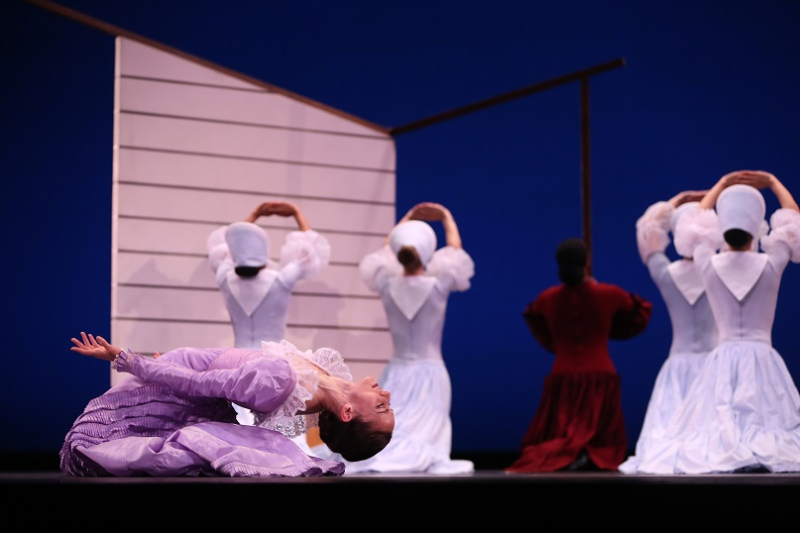
    MGDC_Appalachian-Spring_MSherwood-103

    Anne Souder as The Bride (above, in Melissa Sherwood’s photo) is a dancer who captures the nuance of every expression, step, and gesture; in doing so, she is never fussy or theatrical…rather, she dances from the heart. Her smile speaks of tenderness, and of hope for the future. There is a solo passage, though, when a shadow of worry passes over this young woman’s lovely face: can she do – and become – everything that is expected of her? Her husband’s embrace reassures her; the dark cloud vanishes.

    MGDC_Appalachian-Spring_MSherwood-91

    Ms. Souder’s technique has a silken, seamless quality; she has the extension of a prima ballerina as well as the combination of power and poetry that is the requisite of a great Graham dancer. I expected so much from her in this role, and was thrilled by her perfection.

    MGDC_Appalachian-Spring_MSherwood-96

    In the end, the newlyweds are left alone, and life begins.

    (APPALACHIAN SPRING photos by Melissa Sherwood)

    WE THE PEOPLE seemed even more powerful than on opening night, which is really saying something. The choreographer described the piece as “Part lament, part protest” which is manifested in the alternating passages of silent solos and vibrant, big-rhythm dance passages for the ensemble. 

    On opening night, I was far back from the stage and, in the prevailing darkness of the piece, I could not always tell who was dancing at any given moment. Tonight, sitting close, I could savour the individual energy and personality of each person onstage. Two of the company’s newer dancers – Devin Loh and Ane Arrieta – seemed super-charged by the music. The spotlit solos for Leslie Andrea Williams, Alessio Crognale-Roberts, and Lloyd Knight were riveting, and the duet for Meagan King and Jacob Larsen provides a contrasting touch of lightness and subtle humor. Laurel Dalley Smith, still on a RODEO high, was fantastic. There were times when it felt like someone (or maybe two) was missing, and that certain phrases had changed hands. A sextet for six women seemed like an octet on opening night, or am I hallucinating?  

    At any rate, WE THE PEOPLE should become a repertory staple of the Graham Company: it’s that good

    The evening closed with my favorite Graham work: RITE OF SPRING. The Mannes Orchestra were back in the pit, playing very impressively indeed under David Hayes’ vibrant command. The Stravinsky score, which – along with Nijinsky’s controversial choreography – caused a near riot at the ballet’s 1913 premiere, no longer seems radical, but instead is a powerful musical document of an unforgettable date in dance history. The wind players of the Mannes ensemble reveled in the score’s quirky demands. The setting where the ritual sacrifice takes place, conceived by the Company’s Artistic Director, Janet Eilber, is under an ominous sky; the feeling is both vast and curiously claustrophobic.

    The choreography is some of the most demanding imaginable, calling for extreme athleticism, intricate steps and gestural motifs, and pinpoint timing. The full Company participates in this grand-scale work, and so we get to know the apprentices – Zachary Jeppsen, Matthew Spangler, Justin Valentine, and Jai Perez – as well as the newest dancers (already making a mark for themselves) – Ane Arrieta, Meagan King, and Antonio Leone. 

    Alessio Crognale-Roberts and Jacob Larsen have a prominent place in the ritual; as the Shaman’s acolytes, they have a lot of work to do, and they do it handsomely, and with stoic resolve.

    It is The Shaman whose solo opens the piece with a ceremonial dance to sanctify the space for the dire ritual to come. The charismatic Lloyd Knight gave a magnificent portrayal as the man ordained by the gods to perform the sacrificial ritual; nothing will deter or distract him from his cold-hearted purpose. Lloyd’s command of the role’s uncanny partnering demands was something to behold. 

    In her debut performance as The Chosen One, Marzia Memoli gave a thrilling performance as she moved from being just another village girl to being the central figure in the gruesome ritual that will keep the community in the good graces of the gods for another year.

    Marzia has always been a truly vivid dancer, fearless and committed, and she now has a role that suits her to perfection. It is a role in which the dancer cannot simply portray the ill-fated character, but must become her. With a font of strength and energy that belies her slender frame, Marzia, with her mane of golden hair, gave a consummate performance, wherein the cross-currents of vulnerability and resolute courage ebb and flow as the girl’s fate closes in on her.

    The dancers were hit by a tidal wave of applause as they filled the stage for a bow. Lloyd Knight was hailed as the king of the Gotham dance world, and then Marzia took her solo bow to rapturous applause while Lloyd handed her a bouquet and they embraced. 

    I was sorry to hear that this memorable RITE had not been photographed for posterity, aside from the studio photo at the top of this article. But I have indelible images from the evening in my mind.

    ~ Oberon

  • Hubbard Street @ The Joyce

    Shota

    Above: Shota Myoshi of Hubbard Street Dance Chicago

    ~ Author: Oberon

    Wednesday March 20, 2024 – So great to see Hubbard Street Dance Chicago again! When I lived in Hartford, we’d go up to see them each Summer when they came to Jacob’s Pillow. Tonight at The Joyce, they offered a finely-devised program which was musically and stylistically varied, and superbly danced.

    Coltrane choate burnett foto michelle reid

    Above: dancers Jacqueline Burnett and Aaron Choate in Coltrane’s Favorite Things; photo by Michelle Reid

    Lar Lubovitch’s Coltrane’s Favorite Things was created in 2010 and was taken into the Hubbard Street rep in 2023. I confess that I’ve had a lifelong allergy to jazz, and while I admire John Coltrane’s inventive take on the Rogers and Hammerstein hit from The Sound of Music, I must admit that there were times when the music seemed endless. But: no worries! Mr. Lubovitch’s flowing, fleet-footed choreography filled the stage with movement, and the dancers seemed to be having a blast dancing it. 

    There may have been some cast changes from the listing in the Playbill, but one distinctive dancer stood out: Shota Myoshi (photo at the top) is a petite young man who dances large. His sheer joy at executing the technical feats of the choreography seemed to set the tone for his colleagues. Everyone danced their hearts out, winning a vociferous ovation at the end of the piece.

    On leaving the hall at the end of the show, I ran into the irrepressible JJ (aka Jonathan E Alsberry), an iconic Lubovitch dancer who is now Senior Rehearsal Director at Hubbard Street. And with him was the great man himself: Lar Lubovitch. So wonderful to see them again!

    Rena butler

    Hubbard Street’s giving the New York premiere performances of Rena Butler’s Aguas Que Van, Quieren Volver during this run; production photo above. It is a captivating work in every regard. And the first acclaim goes to lighting designer Julie E Ballard; her settings seemed to create a narrative of their own in the work, which details the shifting emotions of a ménage à trois. From some performance photos I found, it looks like this piece is sometimes danced (as tonight) by a man and two women, and other times by a woman and two men. 

    This evening, the dancers were Jacqueline Burnett, Simone Stevens, and Eliot Hammons. They were technically perfect, and emotionally powerful. Each has solos to dance – Ms. Burnett’s being particularly well-choreographed, and beautifully danced – and the partnering ranges from sexy to quirky. Ms. Stevens brought a nervous energy to her dancing, and a personal intensity, whilst the tall Mr. Hammons moved and partnered with a distinctive personal grace; he seemed to be holding the triangle together by sheer force of will and desire. The music, which often has a sexy sway, was sublime, especially the ‘title song’.

    At the end, order is restored – at least for the moment: beautiful final image of the threesome standing together. The work captivated me on a personal level, as I recalled the difficulties we faced in our own ménage à trois back in the early 1990s. Jealousy undid us.  

    Barton

    The program ended with a masterpiece: return to patience by Aszure Barton, sent to a score by Caroline Shaw that may have been inspired by Satie.  To me, this seemed to be a contemporary renewal of the tradition of ‘the white ballet’: everything is purely and wondrously white as the lights slowly come up on the entire company standing in place. Balanchine’s Serenade is cunningly given a graceful nod as the dancers in unison shift their feet into first position. Thereafter, thoughts of Swans, Wilis, Shades, and Sylphs constantiy dance thru the mind. Solos (again Ms. Burnett and Mr. Hammons stood out) are woven into passages for groups and fleeting partnering motifs. Mr. Myoshi was again entrancing.

    The group dances in sync, with lyrical arabesques and slow ‘leaning’ passages.The tempo speeds up, but only a bit, for another solo from Mr. Hammons, joined by a sextet. The movement becomes more animated, with a male quartet and a female solo observed by all in a semi-circle. There is a reverential bow, but that is not quite the end.

    Ms. Barton’s work held the audience under a spell, and then the dance seemed to recede as if we had experienced a dream that fades away. There was a moment of silence, before the audience responded with fervent applause.    

    ~ Oberon

  • Sankofa Danzafro @ The Joyce

    Dancers Liliana Hurtado  Yesid Quejada  Diego Leon de los Rios  Nicolas Mosquera  Wiliam Camilo Perlaza  Jhoan Andres Mosquera_Photo by Marcela Gómez (3)

    Photo by Marcela Gómez

    ~ Author: Oberon

    Wednesday February 28th, 2024 –  Still on a high from last night’s CARMINA BURANA at Carnegie Hall, I went down to The Joyce on a rainy evening to see the Colombia-based dance company Sankofa Danzafro performing Behind the South: Dances for Manuel, which took me even higher.

    The work references the Colombian writer Manuel Zapata Olivella, whose “Changó, el Gran Putas” – a mythological construction of South America’s African diaspora which spans more than five hundred years of history – took the author two decades to complete.

    The Company’s Artistic Director, Rafael Palacios’ work celebrates the traditional music and dances of the muntu (the African people) as a key element of the Afro-Colombian community. Sankofa means “to return to” or “to go back and fetch…”: a finding of one’s roots.

    I read all the background information regarding what I was about to see and hear, but it all vanished from my head when the house lights went down: for one hour I was simply mesmerized by music and movement.

    Seated in an upstage corner were the two drummers who cast a spell over the hall with their playing: Juan José Luna Coha and Gregg Anderson Hudson Mitchell. The rhythmic vitality of their drumming was a primal force – like the heartbeat of the universe – creating an irresistible and urgent need to dance. 

    In a brief prologue, individual dancers rush fearfully about the stage, dodging bullets and sometimes hurling stones at their oppressors. Then the first of the tales unfolds: Rebel Blood. A woman in a white gown stands trembling in a pool of light. The mood is somber, and mystical voices are heard. A red-clad quartet of dancers emerge; they dance in pairs. Now a heavily pregnant woman enters, tethered to her mate by a silken cord. The man begins to shake uncontrollably; a pale spirit appears and carries him away.

    Then comes the Song of Yemayá, a nurturing sea-goddess all in white who performs a flowing solo invoking protective energy. The red quartet return, and a vocal solo is heard, which evolves into a hypnotic rhythm. A procession now arrives, to the ringing of a bell: the pregnant woman and her mate return. The scene slowly fades. 

    A lone female, masked and ghostly, appears. Eerie vibraphone-like music is heard as spirits gather. Dancing with small, rapid steps, they move hypnotically about the stage in evolving patterns, almost like automatons. From the assembled community, fleeting solos stand out. The endless beat accelerates and things get wild before the initial woman is left alone.

    A freshly agitated rhythm leaps up, the dancing full of fast steps, and a sense of exuberance rises. There are swift comings and goings as the pace quickens, becoming a runabout, and a frantic man shakes violently. The dancing slows, and in the end the dancers strike poses in place as the light fades.

    The audience had clearly been enthralled throughout the piece; they now rose as one to scream heartily for the dancers. The two drummers came forward to a torrent of cheers. The stage was cleared, but insistent applause brought everyone back for another bow. Waves of love seemed to fill the hall, flowing to – and from – the stage.

    I don’t feel I’ve done justice to the evening and the emotions the piece evoked. I must say, it’s nearly impossible to take notes at The Joyce; in the darkness, you end up writing lines on top of lines, and when you get home it is all undecipherable. But what I was feeling during this hour can’t really be expressed in words…you had to be there.

    ~ Oberon
  • Joffrey Concert Group @ Ailey Citigroup

    Jcg jpg

    ~ Author: Oberon

    Saturday February 17th, 2024 matinee – The Joffrey Concert Group offering a program of four works by three choreographers at the Ailey Citigroup Theater. The dancers were all technically adept and physically attractive, and the performance was enhanced by excellent lighting. While each ballet was enjoyable to watch individually (and to listen to, at least until someone pumped up the volume), being performed one after the other made for an afternoon lacking in contrasts.

    Chicago-born Alvin Ailey American Dance Theater principal dancer Vernard J Gilmore has created “Dawn Of Love”, which opened the show. The work’s six movements do offer some variety of pacing and atmosphere, all basically coloured by the power and intensity of the music by Prince, distinctively played by the Vitamin String Quartet and mixed by long-time collaborator, DJ April Reign.

    Dawn Of Love” gets off to a big-beat start with Not Afraid” in which four couples wend thru various ballet partnering motifs. “Neverending” begins with the women, soon joined by the men – the music has a hoedown feeling. A steady beat pulses thru Specks of Hope“, danced by a trio of women, and then there is an ethereal solo, “I Will, I Am” danced poetically by Mari Murata, with her lovely pointe work. (I should note that, throughout the evening, some of the women were on pointe and others in soft slippers). A pointy duet for Annika Davis and Sydney Williams opens “Diamonds and Pearls“, danced to an insistent beat. The other women join, and finally the men. The ballet concludes with a duet for Breeanna Palmer and Faahkir Bestman entitled “Nothing…”; the stage is bathed in a red glow, and the music has an oddly Appalachian feel. Although this duet went on a bit too long, it was very finely danced. An extra bravo to lighting designer Michael Faba.

    There were no bows after the opening work, and after a brief pause Bradley Shelver’s “Random People With Beautiful Parts” commenced. The music draws on the Hilliard Ensemble’s recordings of J S Bach; the piece is in three sections, beginning with a solemn air of ritual. Traditional ballet combinations weave into the music, and a sense of light vs darkness develops. An interesting motif of skidding on pointe is introduced, reminding me of Mauro Bigonzetti’s gorgeous “Luce Nascosta” for NYC Ballet (2010). There’s a lot happening in this opening section; the eye is constantly drawn from dancer to dancer.

    Mr. Bestman joined Yumeno Takechi for the ballet’s central pas de deux, set to a pulsing beat. Then trilling percussion opens the dramatic finale, in which several individual dancers had a chance to shine, notably Charles Klepner. The dancing is showy and gets somewhat competitive as the music accelerates.

    The Relentless Nature of Dreaming” by choreographer Eryn Renee Young, is set to music by J.S. Bach and an original score by emerging composer Heather Cook. It’s been quite a long time since I last saw Ms. Young’s work: 2014, in fact, when I saw her excellent Bartok piece “Symphonie Miroir “. From the title of Ms. Young’s ballet on offer this evening, “The Relentless Nature of Dreaming“, I was envisioning an atmosphere of Shades or Wilis; but it’s actually the word “restless” in the title that most aptly applies.

    The large cast (seemingly everyone in the Company) were clad in red (the men) and hot pink (the women), making quite a breath-taking sight as the lights came up. The women are divided into two groups: some in soft slippers and other on pointe. Neat patterns and myriad steps are skillfully choreographed. An exceptional solo, danced by one of the soft-slipper girls, was a highlight of the opening movement, but I can’t tell you her name.

    The second section of Ms. Young’s ballet is danced to “Be My Water Tonight” by Heather Cook. For some reason, this was played at a very high volume; the dancing – at times quite animated – could have been really engaging, but the music was simply earsplitting. The song eventually turns watery, as if submerged (thus the word ‘water’ in the song’s title); there is so much going on for the dancers but it all gets lost in the musical overkill. The ballet ends with an elaborate final pose.

    Closing the program is “OOF”, choreographed by Mr. Shelver. Set to music by Machito, Sunny and the Sunliners, and Balkan Beat Box, it sustained the high-energy, rather relentless feeling of the program. There were passing moments when it seemed a mood-swing might happen – one such was a male solo which commenced in a pool of light – but the idea was not developed: it simply melded into an ensemble.


    The choreography is athletic and at times quirky, with something of a gypsy tinge to it. The final duet, set to “I Only Have Eyes For You“, was danced by Joliana Canaan and Faakhir Bestman, and was beautfully done.


    What was lacking in the evening was a feeling of emotional connections between the dancers; seldom was any tenderness expressed, though in fact the extroverted nature of the ballets rarely called for it.


    As to the music, there seems to be a tradition in this performing venue that music will be played in the theatre for a half-hour before curtain time, and during the interval. This means that the scores the choreographers have chosen to set become part of a larger sound scheme, diminishing their effect.


    ~ Oberon

  • Music from the Sole @ The Joyce

    Music from the Sole jpg

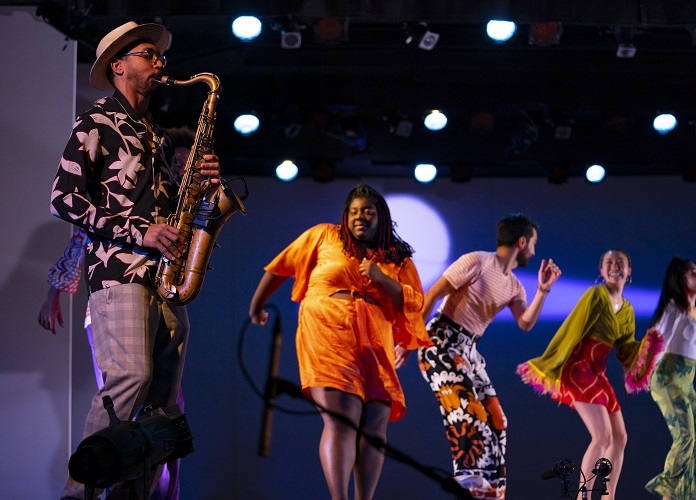
    Above: sax man José Carlos Cruzata Revé, and dancers Roxy King, Orlando Hernandez, Naomi Funaki, and Ana Tomioshi; photo by Titus Ogilvie Laing

    ~ Author: Oberon

    Tuesday January 30th, 2024 – I haven’t had this much fun in years…in decades, really! I Didn’t Come to Stay, an evening-length work from the New York City-based company Music From The Sole, opened at The Joyce on Tuesday night and it left me feeling higher than a kite. Everything about the evening was uplifting: such a joy to see…and to hear: for the musicians were beyond fabulous…and they can dance, too!

    The Brazilian tap dancer and choreographer Leonardo Sandoval had rocked me with the brilliant piece he devised for the Philip Glass études program earlier this season.

    Bassist/composer Gregory Richardson led the five-piece band featuring Jennifer Vincent (cello & bass…such resonant sounds!), José Carlos Cruzata Revé (delicious tones from his sax & flute), and stellar percussionists/keyboardists Noé Kains and Josh Davis, both of whom showed singing talent as well. The sounds and rhythms this ensemble produced were wondrously vivid and inspiring. And when they joined in the dancing, it gave the show one more thing to love.

    As we settled in, a projected ‘logo’ floated on the backdrop: a circle and a triangle; these changed colors throughout the evening. The lighting for the entire performance, by Kathy Kaufmann, was a major factor in the brilliance of the show: shadow effects, and a segment with the dancers in silhouette, were meshed with vibrant saturated hues illuminating the backpanel. The costumes, by Dede Ayite, seemed ideally matched to each dancer’s personality.  

    As the houselights dimmed, a commotion developed at the back of the hall: the dancers and musicians made a spectacular entrance, parading down the aisle and up onto the stage, singing and jamming. This created a feeling of rejoicing, which permeated the evening.

    02_TitusOgilvieLaing_MusicFromTheSole-GiseleSilva_LeonardoSandoval_LucasSantana_AnaTomioshi jpg

    Hypnotic, irresistible rhythms filled the space as the dancing progressed from full ensemble numbers (including the musicians) to solos and passages for smaller groups. Both abundant, full-out athletic energy and intriguing subtlety came naturally to these titans of tap. A particularly engaging quartet brought together Gisele Silva, Mr. Sandoval, Lucas Santana, and Ana Tomioshi (photo above by Titus Ogilivie Laing). Early in the evening, a solo by Orlando Hernandez displayed his appealingly casual grace and smoothness of style; then we didn’t see him again until the finale was imminent. Tall and super-cool, Gerson Lanza looked totally at home in every step and gesture; he also seemed to have a natural, effortless gift for acting. Along with Mlles. Silva and Tomioshi, the women all excelled technically: Naomi Funaki, a veritable speed-demon in some of the most demanding passages, and Roxy King, whose lively, suave dancing and sheer enjoyment in her art made her an audience favorite.

    The evening sped by; most of the crowd – myself included – were bouncing and swaying in our seats the whole time. There was a roaring standing ovation at the end as the company made their exit up the aisle, high-fiving people, smiling, singing, drumming, and blowing kisses to as, whilst tossing streamers into the air.

    What made the evening so special on a personal level was the fact that it made me feel young again. I was remembering how much I used to love going out dancing: in my late 30s, I had a much younger lover, and we would go out dancing most weekends, either in Hartford or P’town. Tonight, for the first time since then, I felt like dancing again.

    ~ Oberon

  • Compagnie Hervé KOUBI ~ Sol Invictus

    Abdelghani FERRADJI

    Above: dancer Abdelghani Ferradji; photo by Nathalie Sternalski

    ~ Author: Oberon
    Tuesday January 23rd, 2024 – Compagnie Hervé KOUBI returning to The Joyce with “Sol Invictus,” a dancework which brings elements of breakdance, martial arts, capoeira, and acrobatics together. Named after the all-powerful god of the sun, the theme of the piece is the ideal of love as the basis for peace. The original score is by Mikael Karlsson, interwoven with excerpts by Beethoven, Steve Reich, and Maxime Bodson.

    Hervé Koubi’s dancers are spectacular athletes who are also artists. The dancing all evening was jaw-droppingly sensational: for seventy-five minutes, the dancers flung themselves into the air, spun on their heads, executed daredevil flips and airborne somersaults, and tossed their fellow dancers heavenward with unflagging energy and commitment. The production was splendidly lit by Lionel Buzonie, and the staging was enhanced by a huge, billowing sheet of cloth-of-gold.

    Francesca BAZZUCCHI

    Above: dancer Francesca Mazzucchi; photo by Nathalie Sternalski

    While there was a narrative feeling, I could not discern a story line. In a program note, the choreographer said he wanted to make the stage “a playground of all possibilities” and that was indeed the best way for the large and wonderfully attentive audience to relate to the performance. It is impossible to describe the fantastical moves these dancers make: they have to be seen to be believed.

    At one point, the nurturing light of the sun goes out; the stage is plunged into smoky darkness, and the dancers appear as silhouettes, bereft of their source of energy.  Then, In the ballet’s most stunning moment, the light slowly returns, and emerging from under the golden shroud a beautiful new sun-king is born.

    The community rejoices in the renewed light, and the physical feats this inspires drew gasps from the audience. The dancers cheered each other on which shouts and whoops of joy as insane airborne combinations were daringly executed. 

    When the curtain fell, the audience released their pent-up excitement, hailing the dancers with a vociferous standing ovation. Once again, Hervé Koubi has brought life to Gotham.

    ~ Oberon
  • Dancing With Glass @ The Joyce

    MakiNamekawa_Photo by Steven Pisano

    Above: pianist Maki Namekawa, photo by Steven Pisano

    ~ Author: Oberon

    Tuesday November 28th, 2023 – The long-awaited opening of Dancing With Glass at The Joyce: a program wherein several of Philip Glass’s études were performed by pianist Maki Namekawa; five of the études had been choreographed by prominent artists in the danceworld: Lucinda Childs, Chanon Judson of Urban Bush Women, Justin Peck of the New York City Ballet, Brazilian tap artist Leonardo Sandoval, and Los Angeles-based choreographers Bobbi Jene Smith and Or Schraiber.
    A packed house, which included some luminaries of the NYC dance scene, seemed mesmerized both by the music and the dancing. Ms. Namekawa is a pianist with a special affinity for the works of contemporary composers; she played eleven of the études in the course of the evening, commencing with the spellbinding Etude #1. Her playing was remarkably clear, committed, and soul-filling.

    OrlandoHernandez_LeonardoSandoval_LucasSantana_AnaTomioshi_Photo by Steven Pisano

    The dancing commenced with a fabulous tap-dance setting of the 7th étude, choreographed by Leonardo Sandoval, who was tapping along with his mates Ana Tomioshi, Orlando Hernandez, and Lucas Santana (photo above by Steven Pisano). Noé Kains was onstage with the quartet, and he was dancing along when suddenly he stepped to the edge of the stage and eased his way down to the pit where he took over the keyboard and played the 7th étude to perfection. Meanwhile, his fellow tapsters – such gorgeous humans – continued to dance in sync, with brilliant solo moves etched into the choreography. An exhilarating start to the evening’s dancing.

    BobbiJeneSmith_Photo by Steven Pisano

    Above: Bobbi Jene Smith, photo by Steven Pisano

    Bobbi Jene Smith (co-choreographer of the memorable DEO for the Martha Graham Dance Company in 2019) and her husband Or Schraiber both choreographed and performed the familiar Etude #8. On a dusky, hazy stage, an anxious man and a moody woman take us thru various states of a romantic relationship. Each dressed all in black, with Ms. Smith’s luxuriant hair playing its own role, the dancers are hypnotic movers and shapers of phrase. Passion underscores everything: the wounded man is rejected, but – true to life – within seconds the couple are kissing again. Touches of humor are subtly woven in…and at the end, aggression turns to peace in the twinkling of an eye. The piece, marvelous in every way, made me think of so many evenings spent at home with my partner. 

    ChanonJudson_Photo by Steven Pisano

    Tall, lithe, and elegant in a sky-blue Josie Natori frock, Chanon Judson of Urban Bush Women (above, photo by Steven Pisano) took the stage for Etude #11. John Torres’ lighting – a major contribution to the evening’s pleasures – was especially perfect here. Ms. Judson danced with compelling authority and grace to the vividly dramatic music. Veering from madness to repose, this long-limbed goddess filled the space with her magnetic presence and riveting moves. Overcome by trembling, she is finally becalmed as the pulsating music fades to silence.

    Patricia Delgado_Photo by Steven Pisano

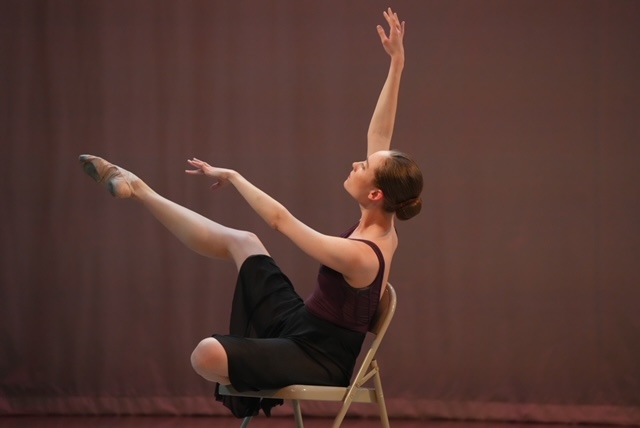
    Justin Peck’s setting of Etude #6 brought a stunning performance from Patricia Delgado (above, photo by Steven Pisano); I had only seen Ms. Delgado once previously, when she appeared in a 2009 gala here in New York featuring many alumni from the School of American Ballet. In her Glass solo tonight, she was fascinating to watch. Clad in a black trouser outfit, she is seated in a chair at curtain-rise. The music’s fast staccati underscore her restlessness. She at times ventures a few steps from her chair, but always returns to this safe haven. As the music turns grand, her mental instability becomes palpable. Ms. Delgado is both a gorgeous mover and a subtle actress. At the end, unable to cope, the woman seeks to hide herself from the world under her chair.

    CaitlinScranton_KyleGerry_Photo by Steven Pisano

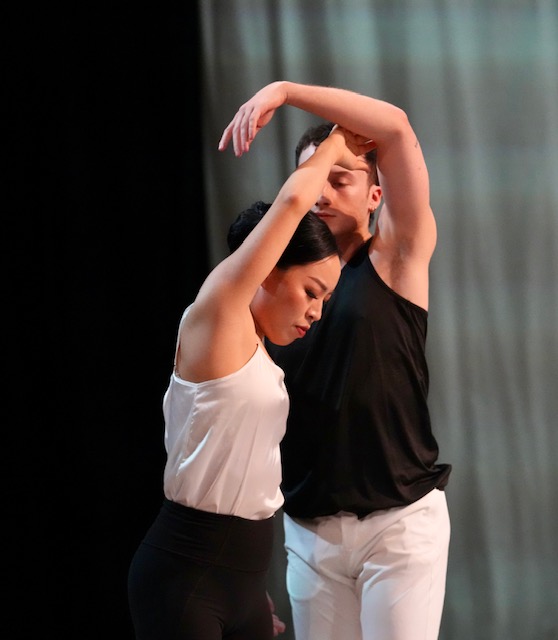
    Clad in white and looking like angels, dancers Caitlin Scranton and Kyle Gerry (above, photo by Steven Pisano) reveled in the flow of Lucinda Childs’ luminous choreography in Etude #18. Sometimes dancing side-by-side and at other times moving about the space with a sense of other-worldly beauty, the dancers perfectly embodied the lyricism of this particular Glass piece. 

    Bringing the evening full circle, Ms. Namekawa played the last of the études: #20. This rather long work gave us a chance to reflect on the evening, whilst savouring the pianist’s poised musicality. As the applause commenced, all of the dancers appeared onstage to receive the audience’s wholehearted accolades. Ms. Namekawa then drew Philip Glass from his seat to the side of the piano, while the standing crowd hailed him with a joyous ovation.

    All photos by Steven Pisano.

    ~ Oberon

  • Lydia Johnson Dance @ Westbeth 2023 ~ Gallery

    Thumbnail_Laura Michael Chapters Graham Steven P.

    Above: Michael Miles and Laura DiOrio in CHAPTERS; photo by Steven Pisano

    A gallery of performance photos by Steven Pisano from Lydia Johnson Dance‘s November 12th, 2023 matinee at Westbeth. Read about the afternoon here.

    The following photos are from FOR ELI, a ballet dedicated to the memory of a young pianist:

    Thumbnail_Catherine For Eli ( chair section) Steven Pisano

    Catherine Gurr

    Thumbnail_Mchael ( back) MaliQ holding hin For Eli Steven P.

    MaliQ Williams and Michael Miles

    Thumbnail_Michael held by MaliQ For Eli Graham Steven P.

    MaliQ and Michael

    Thumbnail_MaliQ w Michael Portrain diff angle For Eli Steven P.

    Michael and MaliQ

    Thumbnail_Emily Skkirt end of section 1 For Eli GRaham Steven P.

    Emily Sarkissian and MaliQ Williams

    The following images are from Lydia Johnson’s newest work, CHAPTERS, having its premiere performances:

    Thumbnail_Laura and Michael Graham Steven P.

    Laura DiOrio and Michael Miles

    Thumbnail_Min & Arieh Chapters Graham Steven P

    MinSeon Kim and Arieh Bates Vinueza 

    Thumbnail_Cara & MaliQ 2 Graham Steven P.

    Cara McManus and MaliQ Williams

    Thumbnail_Michael Chapters Graham Steven P

    Michael Miles and Arieh Bates-Vinueza

    Thumbnail_Cara & MaliQ Graham (Steven P.)

    Cara McManus and MaliQ Williams

    The program ended with a revival of Lydia’s NIGHT OF THE FLYING HORSES (premiered in 2013):

    Thumbnail_Min & Quinton FH Skirt Graham Steven P.

    MinSeon Kim and Quinton Guthier

    Thumbnail_Min and Cara FH arm gesture opening Graham Steven P

    MinSeon Kim and Cara McManus

    ~ All photos by Steven Pisano

  • TAKE Dance @ St. Mark’s Place

    TD 032

    Above: Corinna Lee Nicholson, Lynda Senisi, and Corinne McLoughlin in Jill Echo’s If You Find Yourself Missing; photo by Nir Arieli

    Author: Oberon

    Thursday October 26th, 2023 – TAKE Dance presenting the world premiere of Bamboo Dreams, the latest creation by the Company’s Artistic Director, Takehiro Ueyama. Also on the bill: the world premiere of If You Find Yourself Missing by TAKE Dance’s Associate Director, Jill Echo.

    TD 001

    If You Find Yourself Missing is not only choreographed by Ms. Echo, but she also designed the costumes, and wrote the text, which is spoken by Corinne McLoughlin (above). Comprising the musical setting are The Blue Hour by Federico Albanese and Dna by Akira Kosemura. 

    TD 025

    Corinna Lee Nicholson and Lynda Senisi (above) are the dancers, with Ms. McLoughlin joining the dance moves in addition to voicing the text.  This dancework raises the question: “Where is home?” The choreography is restless and poetic by turns, and beautifully articulated by the trio of women.

    More of Nir Arieli’s images from If You Find Yourself Missing:

    TD 030

    TD 040

    TD 047

    TD 057

    TD 136

    Corrine, Lynda, and Corinna take a bow after If You Find Yourself Missing

    Take’s latest, Bamboo Dreams, is danced to atmospheric music by Ryuchi Sakamoto, who passed away in March 2023. Take first heard Sakamoto’s music as a teen-aged baseball player in Japan, and now he honors the composer’s memory with this ballet.

    TD 167

    It commences with a vibrant, demanding solo for Kristen (Arnold) Bell (above), dancing with her customary authority and perfectly shaping the phrases.

    TD 150

    TD 186

    Kristen Bell in Bamboo Dreams; photos by Nir Arieli

    TD 204

    There follows a duet for Ms. Nicholson and Orion Duckstein (above). From 1999-2010. Mr. Duckstein was a member of the Paul Taylor Dance Company, where Take also danced for eight seasons.  Orion is a beautiful mover, actor, and super-partner, forming a compelling alliance with Ms. Nicholson, whose lithe beauty and fluent movement are intriguing at every moment.

    TD 203

    TD 205

    TD 209

    TD 212

    Photos by Nir Arieli

    Lynda Senisi and Kristen Bell now join the Nicholson/Duckstein duo. The ensuing quartet veers from huddling together to space-filling combinations. Each dancer is distinctive; you can focus on them as individuals, assured of their technical prowess and expressiveness.

    More of Nir Arieli’s images from the quartet:

    TD 272\

    TD 275

    TD 278

    TD 252

    Lynda Senisi (above) made a particularly vivid impression in this work…and all evening, actually.

    TD 299

    TD 330

    Photos by Nir Arieli

    TD 344

    A movement from last season’s duet, 10/18/22, now forms the finale of Bamboo Dreams. It opens with a solo for Kristen Bell (above, photo by Nir Arieli).

    Watching 10/18/22 for the first time last season, it immediately became one of my favorite dance duets, in part because it is danced so movingly by two of my favorite dancers: Kristen Bell and Corinna Lee Nicholson,  The ballet honored the memory of longtime TAKE Dance board president and friend, James Kraft, who passed away on that specific date; it is danced to solo violin music by J S Bach.

    TD 350

    TD 351

    TD 378

    TD 407

    TD 424

    The choreography veers from lyrical to athletic, from serene calm to moments when we might suspect the two women of being a bit deranged. Kristen and Corinna invested all their energy, strength, thoughtfulness, and commitment into this work, to striking effect. A ritualistic scattering of rose petals leaves a poignant impression:

    TD 359

    All photos by Nir Arieli.

    ~ Oberon

  • Coming Out ~ 50 Years Ago Today

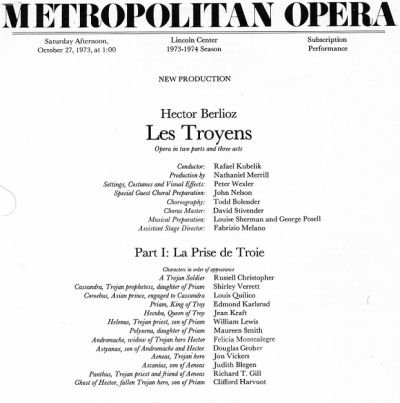
    Troyens jpg

    On October 27th, 1973, after spending a very long time in the closet, I had my first gay sexual experience. It was both thrilling and a bit frightening, but what I remember most was a great feeling of relief…and then wondering why it had taken me so long to do it.

    That day, I had spent the long afternoon with several of my opera-friends at The Met watching LES TROYENS  It was my first time seeing this monumental work, and it was unbearably exciting. Among the group was Z, the boy I had set my sights on since moving back home from Houston earlier in the year.

    Looking back, it all seemed pre-arranged, but at the time it felt spontaneous. After the Berlioz matinee, our friends all went their separate ways. But Z and I had 5th Ring tickets for an evening performance of FAUST at the New York City Opera. He sat in front of me in the single seats, whilst I was aching with desire; at this point, nothing had been said about spending the night together. 

    After Marguerite had succumbed to Faust’s poetic charms in the Garden Scene, we mutually decided it was time to leave. Z looked at his watch and announced that he’d missed the “last bus” home. Haltingly I said, “You can stay with me at the hotel.”

    We walked over to the Henry Hudson; nothing much was being said. We stayed up for a while, talking opera, and then it was time. He sat on the twin bed, undressing. “Should I sleep in the chair?” he asked. “I’ve slept in smaller beds with bigger people…” I replied. (This was a lie; I had only ever slept with my girlfriend, and always in big beds).

    So, keeping our briefs on, we got under the covers and turned out the lights. For what felt like an eternity, nothing happened. I began to think that maybe I had mis-read the situation and that we were simply going to sleep together. He had his back to me; the warmth and smell of his body were killing me. Suddenly, I put my arms around him, and several wonderful things happened. 

    After a while, we grew drowsy. “I’ve never done this before,” I said sleepily. “Me neither!” he replied. Keeping him in my arms, we drifted off.

    Waking to daylight, I got quickly out of bed and got dressed: I was meeting friends for breakfast. Z was groggy; he dressed slowly. I assumed he would head home, but – without saying anything – he tagged along to the diner.

    Our friends were obviously intrigued when we showed up together, but nothing was said. Only the quiet, bookish TJ looked at me knowingly. The conversation turned to the inevitable topic – opera – and my magical “morning after” became just another day.

    The aftermath: in the ensuing weeks, whenever I was in New York City, Z was friendly on the surface, but evasive on a personal level. He stood me up for a couple of lunch dates. I was naive enough to think that, because we had shared a sweet experience, we would become lovers. I became distraught.

    Unhappy to the core, I confided in TJ. He listened to my story patiently, then told me that Z already had a boyfriend and that he was unlikely to become the lover I was looking for. TJ and I spent more and more time together, and I became very comfortable with him as my confidante. Finally, I invited him to visit me in the little town. Our first night was awkward: I was such a novice, but he – who was four years younger than me – was already pretty experienced, starting with having been raped by his college roommate. 

    Over time, TJ and I developed a deep relationship; he invited me to spend the summer of 1974 with him on Cape Cod, working for a small-time ballet company. At summer’s end, I drove him to Sarah Lawrence where his senior year was about to begin.

    Our unspoken plan was to resume our lives – he at school and me back in the little town – and see each other whenever I came to the City. As we sat in the car saying goodbye, he suddenly started crying; it was then that I realized how strong our attachment was. Instead of leaving, I spent the night in the dorm with him. I left the next morning, but a few days later I received a letter from him, asking me to come and live with him in the dorm.

    This was the beginning of my life, really. When TJ had finished school, we moved to Hartford, where I spent the next 22 years. After a year, our domestic life faltered when I became smitten with someone else. TJ and I had a bad break-up, and he never spoke to me again. I embarked on a long and promiscuous journey, having a strange tendency to fall in love with everyone I slept with. 

    Meanwhile, my ultimate goal – to be living in New York City before my 50th birthday – loomed before me. At times, I thought it would never happen; but by a simple twist of fate, I moved to My City three months before the date I had set for myself.

    ~ Oberon