Category: Ballet

  • NYCB Tchaikovsky Festival 2013 #4

    Tchaikovsky 3

    Tuesday January 22, 2013 – Where better to be on January 22nd than in the house that Philip Johnson built for George Balanchine? Today we celebrate the great choreographer’s birthday and New York City Ballet saluted their founding father with a beautiful evening of Balanchine ballets set to the music of Tchaikovsky.

    Conductor Gerry Cornelius and the NYCB musicians mined all the melodic gold to be found in these three marvel-filled Tchaikovsky scores. Six principal ballerinas appeared (including our newest two) along with four of the Company’s most impressive and unique cavaliers; two handsome boys from the corps de ballet assumed major roles, and two girls who should be soloists led the ensemble passages in SWAN LAKE.

    No one who was there will ever forget the performance of Peter Martins’ SWAN LAKE in 2006 in which Sara Mearns – then a young unknown from the corps de balletstepped into the role of Odette/Odile and took her first leap to stardom. Tonight she re-created her Odette in the Balanchine setting and danced radiantly and with a quiet intensity that was enhanced by the nobly responsive presence of Jared Angle as her cavalier. Both the partnering and the poetry of this pairing made the familiar ballet seem fresh and ever-resonant. Megan LeCrone leading the Pas de Neuf has her own brand of magic – a truly intriguing dancer – while Lauren King, always a pleasure to watch, seemed particularly ravishing tonight as she embraced the full-bodied lyricism of the Valse Bluette. Scanning the ranks of the black-clad corps de ballet, faces and forms both familiar and new to me continually seized my imagination.

    Megan Fairchild’s plush technique finds a perfect expression in ALLEGRO BRILLANTE; she begins in a rather serious mode but as the ballet sweeps onward her smile illuminates the stage just as her silky-smooth pirouettes illuminate the music. Amar Ramasar’s space-filling dance, his deft partnering and sheer magnetism all add up to a top-notch performance in this ballet. The ensemble of King, Laracey, LeCrone, Gretchen Smith, Laurent, Peiffer, Tworzyanski and Andrew Scordato (stepping in unannounced) added nicely to this charming classic-style ballet all underscored by Elaine Chelton’s playing from the pit.

    Rebecca Krohn appeared in the haunted ballroom of TCHAIKOVSKY SUITE #3 to dance the Elegie, which has over the years become one of my great favorites among all of Balanchine’s works. Bare-footed and beauteous, Rebecca seemed so Farrellesque to me tonight. Zachary Catazaro, his pale and handsome face recalling the great matinee-idols of the silver screen era, made a wonderful impression as the lonely lover who momentarily finds his ideal. As Rebecca wafted her gorgeous gown and hair thru the music, Zachary was an ardent dream-cavalier; yet when the moment of their parting came his downcast expression of resignation was so moving: his fingers brushed the spot on his face where her hand had caressed him – did her perfume linger there? – and then he looked at his hands which had held his beloved and which were now empty. A frisson swept thru me at that moment.

    In the Valse Melanconique, Abi Stafford looked so angel-like and lovely with her hair down and clad in diaphanous white; as she swept about the ballroom amidst the bevy of beautiful corps ballerinas, Abi constantly kept us aware of the pulsing nuances of the waltz tempo. Justin Peck was excellent in the cavalier role here. And it’s always a real pleasure to see Faye Arthurs onstage.

    Beauty and brilliance combine in Ana Sophia Scheller’s superb dancing of the Scherzo; she brings a touch of prima ballerina elegance to everything she does and she puts her own gracious signature on every ballet in which she appears. Viva Ana!! Antonio Carmena’s vivid leaps and the handsome polish of his dancing matched up so well with the remarkable Scheller as they flew about the space in high style.

    Costume note: could we get rid of the blouse-like Pagliaccio tops for the men in this ballet’s first three movements?

    Ashley Bouder whipped up a delicious frosting for this evening’s Balanchine birthday cake with her brilliant dancing in Theme and Variations. In total contrast to her wonderfully lyrical performance of SERENADE‘s Russian Girl last week, here was Bouder in full ballerina tutu-and-tiara mode and dancing with regal aplomb. Andrew Veyette’s dynamic series of stupefying air turns won the crowd’s cheers, and his partnering was strong and sincere. The demi-solistes Mlles. Hankes, Sell, Muller and Pollack were finely shown-off by their handsome cavaliers: Devin Alberda (welcome back), Cameron Dieck, Daniel Applebaum and David Prottas. 

    In recent seasons they’ve taken away the lyre and re-branded the Company
    (like cattle?), changed the name on the theater’s facade, carved aisles
    in the seating where Balanchine/Johnson wanted none, arranged an
    alienating ticket-pricing scheme, scattered the faithful of the 4th Ring
    Society, put butt-ugly furniture on the wonderful wide-open space of
    the Promenade – where they have also (currently) piled up a useless
    tower of mediocre MoMA PS-1-type artwork – and all for what? But it
    doesn’t matter in the end because all that really matters is the dancers
    and the dance, the music and the movement. And in those essential
    elements, the Company stays strong.

    There was no Balanchine Birthday Vodka Toast this year but I’d rather be intoxicated by the dancers than by any beverage that might be served up. Happy Birthday Mr. B !!

    SWAN LAKE: Mearns, J. Angle, LeCrone, King, Dieck

    ALLEGRO BRILLANTE: M. Fairchild, Ramasar

    TCHAIKOVSKY SUITE NO. 3: ELEGIE: Krohn, Catazaro; WALTZ: A. Stafford, J. Peck; SCHERZO: Scheller, Carmena; THEME & VARIATIONS: Bouder, Veyette
  • Preview of Justin Peck’s New Ballet

    Pk-justin-peck-colour-bio2_620

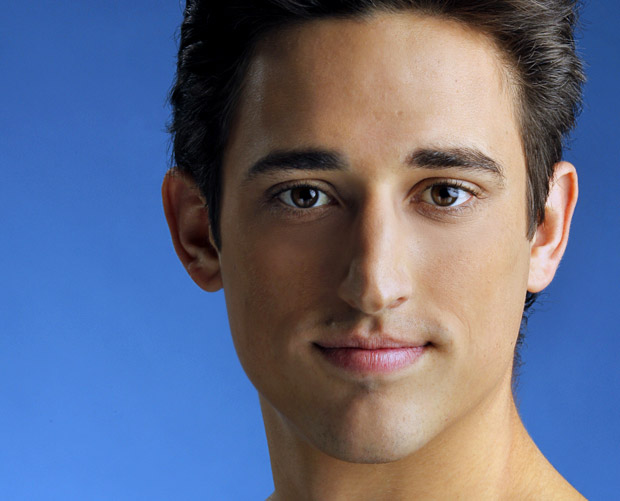
    Watch a brief video preview of Justin Peck’s new ballet for New York City Ballet here. Entitled PAZ DE LA JOLLA, the ballet is set to Bohuslav Martinu‘s Sinfonietta La Jolla and will premiere on January 31st, 2013 with additional performances February 2nd, 6th and 8th. Justin talks about the work and his choreographic career in a Time Out New York interview here.

    Photo of Justin by NYCB‘s Paul Kolnik.

  • Score Desk for LES TROYENS

    Cassandre

    Cassandra:

    “Malheureux roi! dans l’éternelle nuit,
    C’en est donc fait, tu vas descendre!
    Tu ne m’écoutes pas,
    tu ne veux rien comprendre,
    Malheureux peuple,
    à l’horreur qui me suit!”

    Saturday December 29, 2012 – The dilemma of whether or not to attend a performance of Berlioz’s LES TROYENS at the Met concerned me for a few days. This epic masterwork is one of the greatest operas ever written, unique in its structure (it is actually almost like two distinct operas; each could stand on its own), and it is a veritable goldmine of musical marvels. On a personal note, the opera plays a stellar role in my autobiography, since it was after a magnificent 1973 matinee performance of the Berlioz work that I had my long-awaited first homosexual experience. Normally it would be on my highest-priority list of operas to see in any Met season where it’s presented. But the combination of a production that has never really satisfied me visually, a conductor who has seldom – if ever – moved me, and the disastrous casting of two of the opera’s principal roles, I at first wrote it off completely.

    But then the thought that I might never again have an opportunity to hear LES TROYENS in-house decided me in favor of going; not needing to see the production, I bought a score desk and waited for the day with a mixture of excitement and dread. A few days before the performance, one of the singers whose participation was troubling me – Marcelo Giordani – was announced as ‘withdrawing’ from the remainder of the run after a reportedly awful night at the prima folllowed by vocal struggles in the ensuing performances. His announced replacement, Bryan Hymel, has been making a name for himself of late in some of opera’s most demanding roles.

    Elizabeth-bishop

    I arrived at the theatre to find another last-minute cast change: Elizabeth Bishop (above) was to sing Dido instead of Susan Graham. This was my second experience of hearing Ms. Bishop in a performance originally scheduled for Graham, and though I’d been looking forward to Graham’s Dido, Bishop was perfectly fine. So I settled in with my lovely old scores (one for each ”opera’), wishing for a different maestro and different Cassandra, but very much anticipating both the music and the singing of the other cast members. 

    The opera opened impressively with the lively chorus depicting the joy of the Trojan people who have discovered that the Greeks, who have besieged their city for a decade, have suddenly and inexplicably departed. Sadly, the afternoon then took a real slump as Deborah Voigt began Cassandra’s great opening monolog. Voigt’s voice has declined even further than from my last encounter with her in the theatre, and her singing of this iconic role was pallid; the voice is almost unrecognizable as the soprano who once thrilled me with her Ariadne and Elsa. Unsteady and small of scale, her singing seemed apologetic for the most part, with only very few notes that bore any relation to what she once sounded like. Her final high-B in the duet with Chorebus was desperate and unpleasant, and she simply lacked the expressive dramatic thrust for the great scene in which Cassandra tries to prevent the populace from bringing the giant horse within the city walls. And she was ineffectual in the opera’s great final scene. The role calls for forceful declamation and sweeping emotional conviction: a larger-than-life feel. That Voigt could not come within hailing distance of such great interpreters of the role as Shirley Verrett and Jessye Norman was indeed sad. Her shortcomings prevented the first half of the afternoon from making its usual vivid impression. 

    In 1994 Dwayne Croft replaced Thomas Hampson as Chorebus on a Saturday matinee broadcast of TROYENS; he sang superby that day and seemed in fine voice this afternoon until suddenly, near the end of the big duet with Cassandra, his voice seemed to go hoarse. Bryan Hymel made an impressive entry as Aeneas, his singing both beautiful and urgent. In the great scene where Aeneas is warned by the Ghost of Hector of Troy’s impending doom, Hymel and David Crawford were both excellent.

    In the haunting scene where the widowed Andromache brings her young son before the court, her injection of a stifled shriek was perhaps unnecessary in what is written as a silent role. But here Ms. Voigt as Cassandra did have one of her fine moments as she quietly intoned her warning to Andromache: “Save your tears, widow of Hector! Disasters yet to come will make you weep long and bitterly”.

    Though lacking a commanding Cassandra to lead them, the scene of the mass suicide of the Trojan women managed to make a very strong impression. Thus far, as the first part of TROYENS came to a close, Fabio Luisi’s conducting had been ‘factual’, each musical “i” dotted and “t” crossed (as per the score) but lacking in mystery and mythic grandeur. His pacing was on the quick side, which is fine.

    Moving to Carthage, Luisi and his players seemed to find a more congenial glow in the music. I must commend the conductor for making the ballet music (which could just as well have been cut) fully palatable; and from Iopas’ serenade thru the grand septet and on to the end of the sublime love duet, Luisi gave what was for me his finest music-making to date at the Met. 

    Elizabeth Bishop’s voice is not creamy and opulent but she’s a fine singer and not only did she save the day, she did so with distinction. Establishing herself in the opening public scene, it was in the more intimate settings that follow where Bishop made her finest mark: the ravishing duet with her sister Anna and then – impressing in both tonal allure and poetic nuances – from “Tout conspire a vaincre mes remords” straight thru to end end of the “Nuit d’ivresse”. In the anger of the fiery quayside duet, and in her later expressions of regret, and of futile fury, Bishop brought some touches of verismo passion which worked well for her. In the stately, resigned “Adieu fiere cite” she was at her most poignant, then rousing herself yet again vocally to bring the opera to a close with her visionary “Rome!…Rome!…immortelle!” As the afternoon progressed, Bishop dispelled the disappointment of not hearing Ms. Graham, and the audience greeted her affectionately at her curtain calls.

    Bryan-hymel-1340266185-article-0

    Above: Bryan Hymel. Mr. Hymel’s Aeneas was marvelous and his type of voice – a liquid and juicy ‘big-lyric’ with a blooming top – is very well-suited to the music. Wagnerian tenors like Jon Vickers, Gary Lakes and Ben Heppner have often been heard in this role (Vickers managed to make it very much his own), and Placido Domingo handled it impressively despite its being too high for him. But for me the best rendering of this arduous music in living memory has come from Nicolai Gedda on an abridged RAI concert recording. In vocal size and stylistic grace, Hymel comes close to the Gedda ideal. A trace of sharpness crept in here and there, but from his tender farewell to his son Ascagne right thru to his final “Italie!” as Aeneas’ ships cast off for to their destiny, Hymel sang beautifully and had the audience in the palm of his hand.

    He and Ms. Bishop found the magical blend that makes the love duet one of opera’s most memorable, and in his great scena “Inutile regrets” with its remorseful “Quand viendra l’istante” and the high-lying concluding ‘cabaletta’, Hymel was glorious. His singing was full-toned and expressive, encompassing some lovely piano effects, and so moving with his heartfelt “A toi mon ame!”; the audience reacted with excited cheers as the tenor swept to the sensational climax of this great scene, then drew our further admiration as he led his soldiers aboard ship to take leave of Carthage. 

    Cc54e53b-0776-4d1e-9433-8376d0be5f01

    There are two more tenor roles in LES TROYENS A CARTHAGE and both were ideally sung today. In Iopas’ wondrously evocative (and very exposed) “O blonde Ceres” Eric Cutler (above) gave the afternoon’s most fascinating vocalism, with lovely line and ravishingly heady piano effects, and a spine-tingling ascent to a gloriously lyrical high-C. Bravo!!! 

    PAUL_APPLEBY_93R3775-4WEB

    Above: Paul Appleby. In the homesick song of the young sailor Hylas, Mr. Appleby’s beautifully plaintive timbre and the haunting colours he wove into the words made this another high point of the day.

    Home

    Above: Karen Cargill. I had very much enjoyed Ms. Cargill’s Waltraute last season and was glad of a chance to hear her again as Anna. There’s a touch of Marilyn Horne in Cargill’s voice and she sang her two big duets (one with Dido, the second with Narbal) most appealingly.

    Kwangchul Youn’s voice is warm and sizeable; his tone seems to have taken on a steady beat now though he handled it quite well. His Narbal was pleasing, and he was also cast as Mercury, his voice bringing an ominous feel as he intones “Italie! Italie!” after the great love duet, reminding Aeneas of his duty and sealing Dido’s fate.

    Richard Benstein was a strong-toned and authoritative Panthus and I very much liked hearing old-stagers Julien Robbins (Priam) and James Courtney (2nd Soldier) again. Julie Boulianne was a fine Ascagne, Theodora Hanslowe was Hecuba, and Paul Corona shared the soldiers’ scene with Mr. Courtney.

    I so enjoyed experiencing this masterwork in-house again; it may not have been a perfect performance, but it certainly made for a very satisfying afternoon. So nice to see my friend Susan there, and – being n a good mood – I even chatted with some people around me: totally out of character. Very much looking forward to my next ‘score desk’ operas: DON CARLO and TRAVIATA (who needs to look at a clock and a sofa?), and then all the RING operas in the Spring. It’s the place to be!

    Metropolitan Opera House
    December 29, 2012 Matinee

    LES TROYENS
    Berlioz

    Part I: La prise de Troie

    Cassandra...............Deborah Voigt
    Coroebus................Dwayne Croft
    Aeneas..................Bryan Hymel
    Ascanius................Julie Boulianne
    Priam...................Julien Robbins
    Hecuba..................Theodora Hanslowe
    Helenus.................Eduardo Valdes
    Andromache..............Jacqueline Antaramian
    Astyanax................Connell C. Rapavy
    Panthus.................Richard Bernstein
    Hector's Ghost..........David Crawford

    Part II: Les Troyens à Carthage

    Dido....................Elizabeth Bishop
    Anna....................Karen Cargill
    Narbal..................Kwangchul Youn
    Iopas...................Eric Cutler
    Ascanius................Julie Boulianne
    Panthus.................Richard Bernstein
    Aeneas..................Bryan Hymel
    Mercury.................Kwangchul Youn
    Hylas...................Paul Appleby
    Trojan Soldier..........Paul Corona
    Trojan Soldier..........James Courtney
    Priam's Ghost...........Julien Robbins
    Coroebus's Ghost........Dwayne Croft
    Cassandra's Ghost.......Deborah Voigt
    Hector's Ghost..........David Crawford

    Laocoön.................Alex Springer
    Royal Hunt Couple.......Julia Burrer, Andrew Robinson
    Dido's Court Duet.......Christine McMillan, Eric Otto

    Conductor: Fabio Luisi

  • My Only 2012 NYCB NUTRACKER

    George-balanchines-the-nutcracker1

    Sunday December 23, 2012 matinee – Due to the rise in ticket prices at New York City Ballet, I’ve had to adopt strict budgeting rules: for the first time since moving to NYC, I found myself forced to skip NUTCRACKER season altogether. I’d been in the habit of going as many as eight times each year, seeing debuts and covering interesting casting combinations for my blog with genuine enthusiasm. I came to really love and admire the entire Balanchine NUTCRACKER experience, always finding fresh details in the thrice-familiar production.

    But this year, with prices really out of my reach and with the Tchaikovsky Festival looming ahead (I want to go every single night!), I was forced to forego NUTCRACKER; I’ve looked at the casting each week, wishing I could be there but simply unable to deal with the monetary situation.  Fortunately, my friend Monica very kindly offered me a ticket to today’s matinee.

    The cast this afternoon included some debuts, and there wasn’t a principal dancer to be seen onstage. But the soloist and corps de ballet did the Company proud, stepping into the leading roles with confidence and charm. Clothilde Otranto led a lively performance, and special kudos to concertmaster Kurt Nikkanen for his ravishing playing of the Interlude, replete with shimmeringly subtle trills in the highest register.

    LovetteLauren

    Lauren Lovette’s debut as the Sugar Plum Fairy was a major point of appeal in the casting today. This young ballerina has been doing excellent work in the corps, and she always makes a beautiful impression when she’s cast in a prominent role; her debut recently in Christopher Wheeldon’s POLYPHONIA was a real eye-opener, for she held the stage in mesmerizing fashion in her mysterious solo, danced to one of Ligeti’s most trance-like works. Her Sugar Plum today was lyrical and light in the opening solo, and showed the confident radiance of a seasoned star-ballerina in the pas de deux where her cavalier, the story-book-prince Chase Finlay, showed off his ballerina with  élan. Together they sailed smoothly thru the duet’s many difficulties: difficulties that have been known to undo the most seasoned dancers. Lauren and Chase drew the audience in with their youth and poise, winning a particularly warm reception.

    30240_1409846800214_5470712_n

    I met Mary Elizabeth Sell shortly after she joined the Company in 2006, and have kept an eye on her ever since. She and I share a birthday; I took the above picture of her one day a couple years ago when I ran into her on a rehearsal break. Always a dancer to draw the eye in any ballet because of her vivid presence and perfect smile (she was one of the few dancers to make an impact in the leaden OCEAN’S KINGDOM), her performances stand out in a way that have always made me think she could do well in major roles. This Winter the opportunity came her way – she had debuted yesterday as Dewdrop – and, just as I suspected she would, she seized the opportunity and gave a really exciting performance. Her Dewdrop was on the grand scale, able to make her own musical statement in the role by playing ever so subtly with the timing: holding an arabesque one moment, then swirling forward in a flurry of pirouettes. Her jeté was effortlessly brilliant, her extension regally unfurled, her attitude turns silky, her fouettés gracefully swift and sure. To all of this she added her dark eyes and gracious smile. Her performance had amplitude and (rare commodity:) glamour; in short, she put me in mind very much of one of my all-time-favorite Dewdrops, Colleen Neary. There’s no better compliment, in my book.

    Other notable newcomers were Cameron Dieck (handsomely squiring the marvelous Gwyneth Muller in Spanish), Claire Kretzschmar (leggy and cool as Arabian), and Joseph Gordon (bouncing high in Chinese). Sara Adams was pretty, precise and perfectly pleasing as Marzipan; Anthony Huxley – he of the fabulous feet – a stellar Candy Cane (I was hoping he’d jump thru his hoop on his exit in the finale, as he did when he first danced the role); Andrew Scordato an amusing Mother Ginger; Lauren King and Ashley Laracey led the Waltz of the Flowers with distinction…two of my favorite ballerinas.

    In Act I, Sean Suozzi replaced David Prottas as Drosselmeyer; the change was unannounced. Sean was superb, as we could expect from one of the Company’s most intriguing personalities; he even gave the grandmother a startlingly emphatic kiss. Amanda Hankes and Christian Tworzyanski were the appealing Stahlbaums, Kristen Segin and the very pretty Claire von Enck danced charmingly as Harlequin and Columbine, and Giovanni Villabos neatly executed the Soldier Doll’s solo.

    It’s kind of amazing that there are now dancers in the Company I cannot
    identify onstage; things seem to be changing more rapidly that ever in
    terms of the roster. During 2012 some of my favorite dancers left the
    Company unexpectedly; others are currently injured (an ongoing problem).
    The total complement of dancers stands at 85, the smallest number in my
    years of attending,; apprentices and (sometimes) senior SAB students
    seem to be filling the ranks in the big ensembles.

    SUGARPLUM: *Lovette; CAVALIER: Finlay; DEWDROP: Sell; HERR DROSSELMEIER: Suozzi; MARZIPAN: Adams; HOT CHOCOLATE: Muller, *Dieck; COFFEE: *Kretzschmar; TEA: *Gordon; CANDY CANE: Huxley; MOTHER GINGER: Scordato; FLOWERS: King, Laracey; DOLLS: Von Enck, Segin; SOLDIER: Villalobos, MOUSE KING: J. Peck; DR & FRAU STAHLBAUM: Hankes, Tworzyanski

    The house seemed nearly full, and so nice to run into some of the Company’s most ardent supporters during intermission.

    Thanks so much, Monica!

  • Steps Repertory Ensemble Rehearse Vignoulle

    L1050278

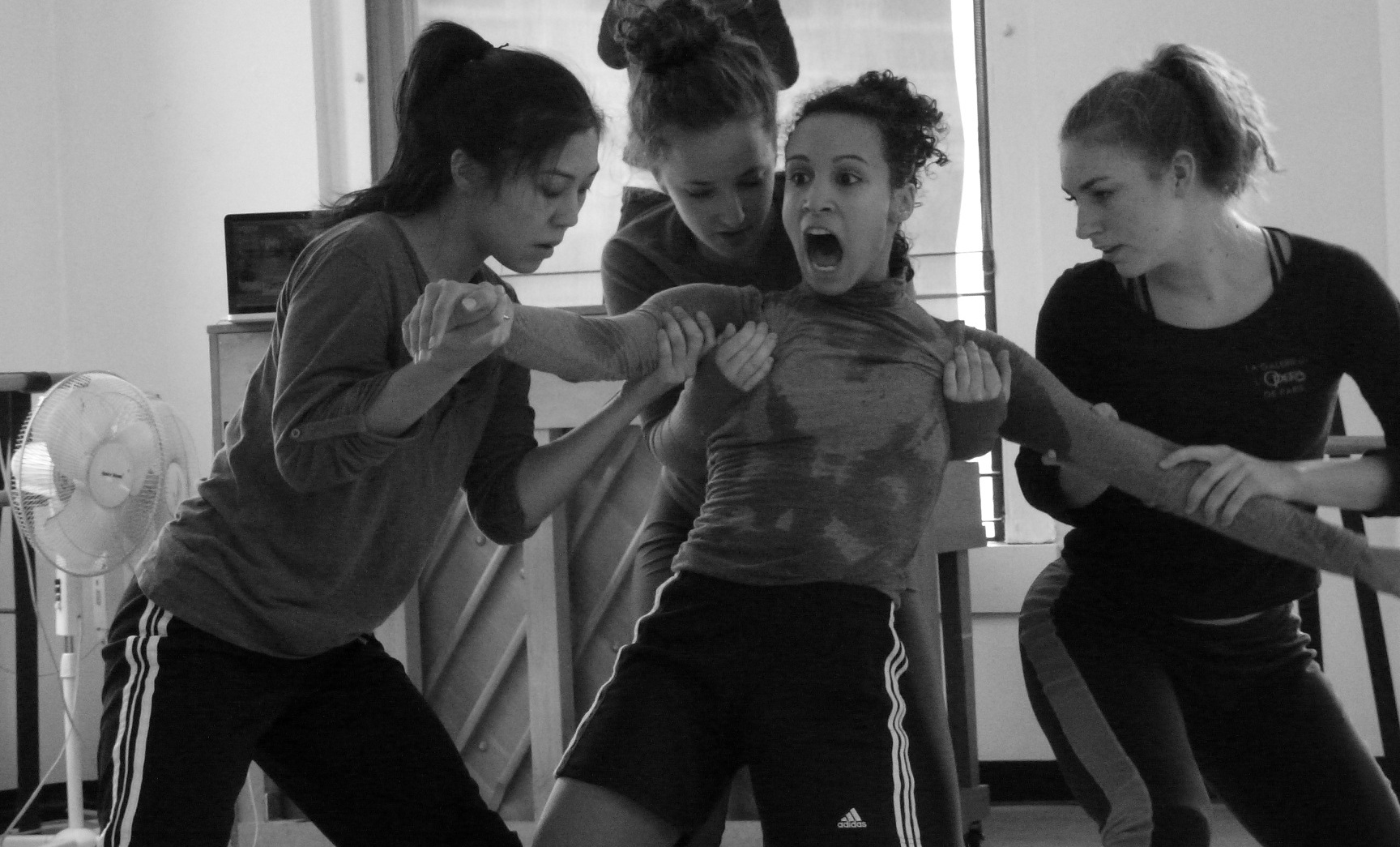
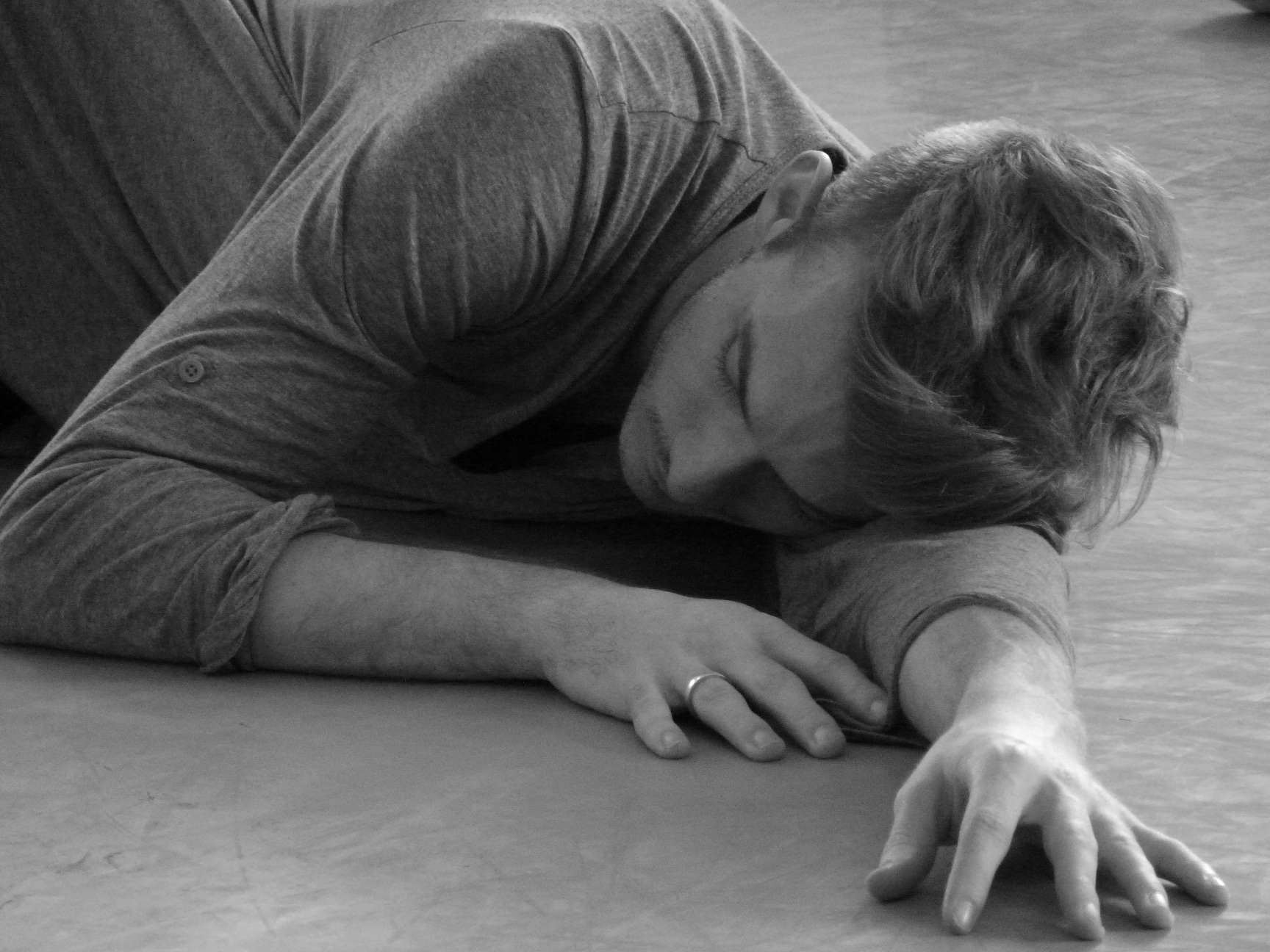
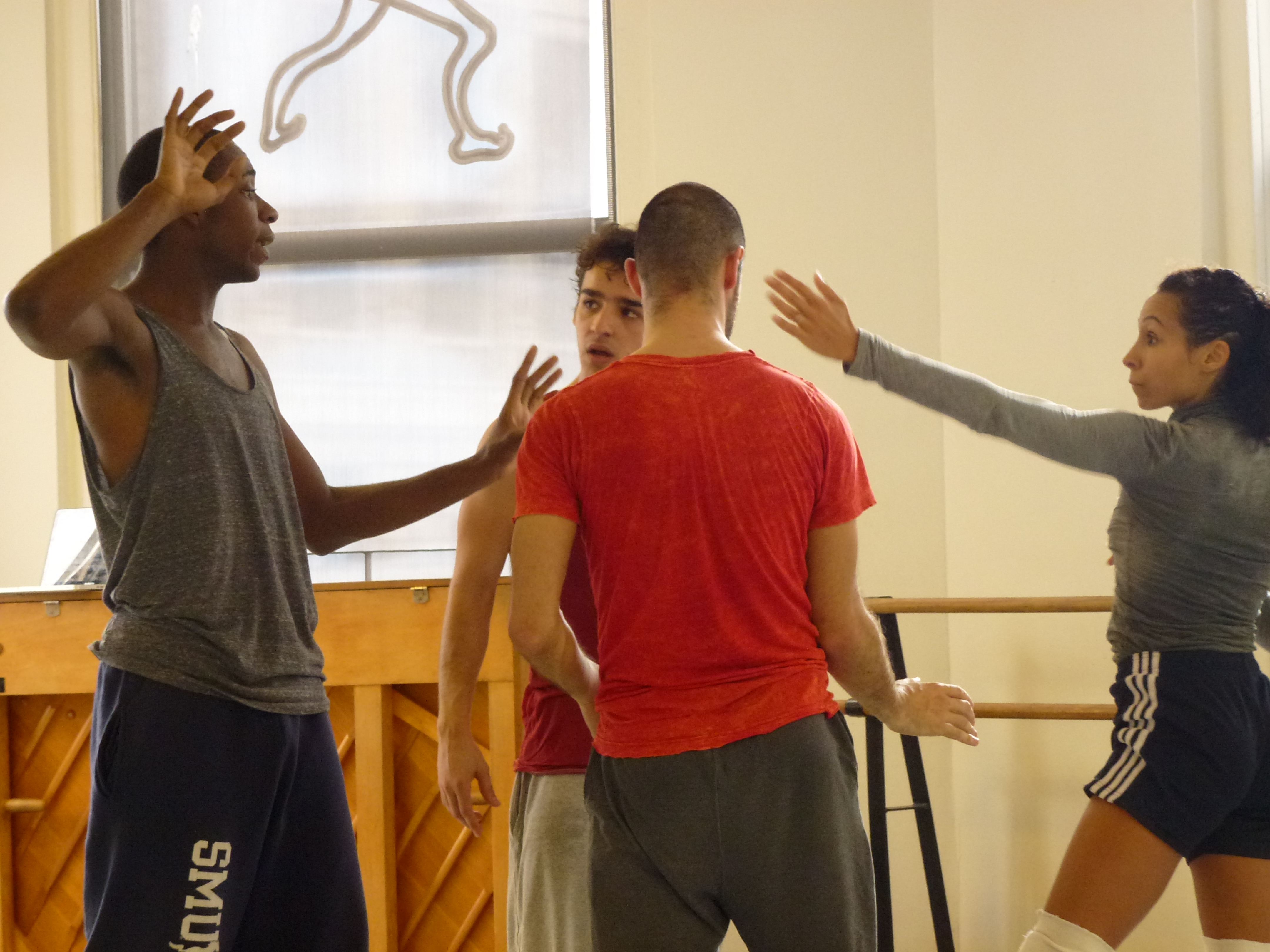
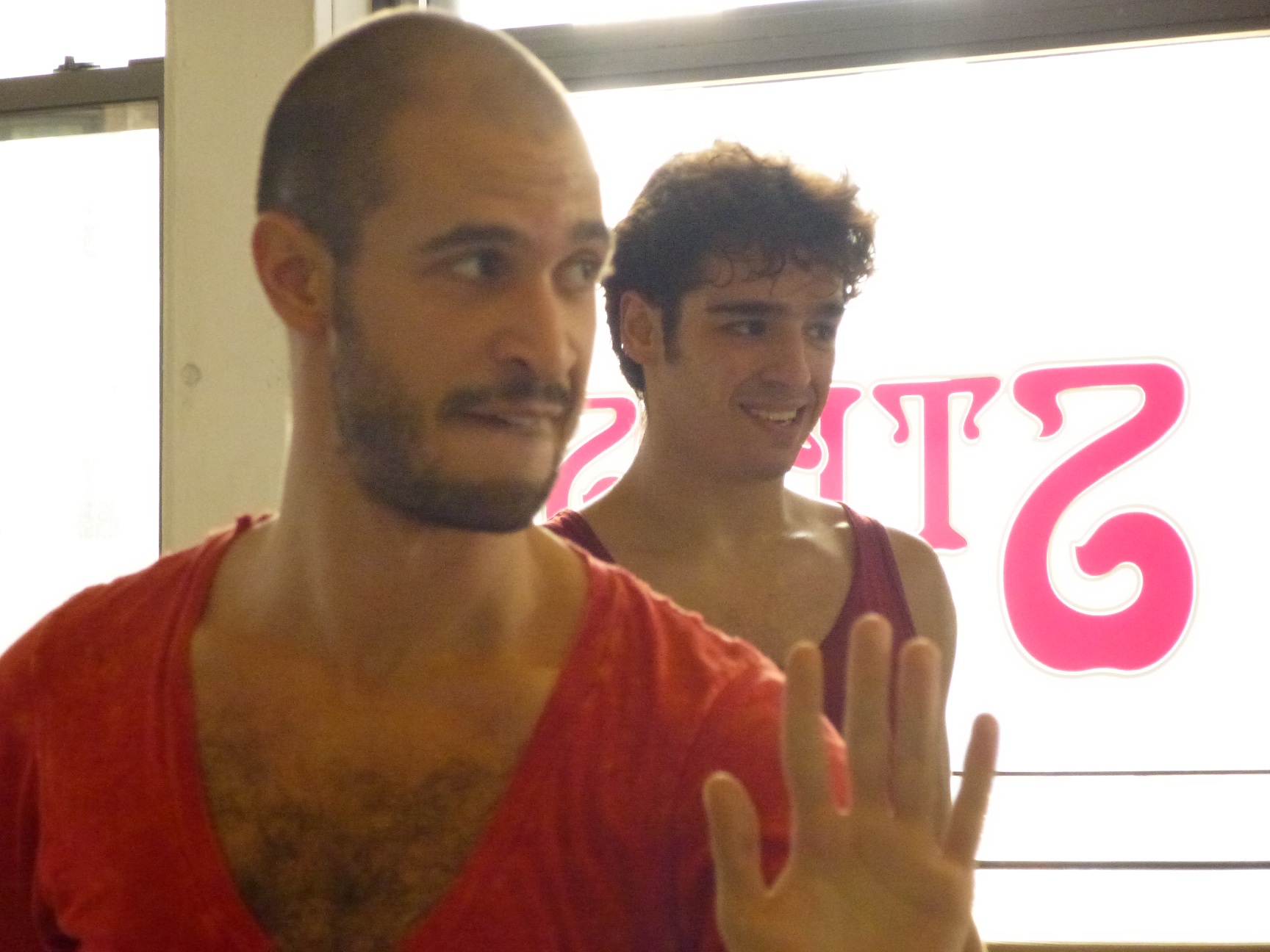
    Wednesday November 28, 2012 – I stopped by at Steps on Broadway today where the Steps Repertory Ensemble were rehearsing a new work by Manuel Vignoulle. I got to know Manuel as a dancer through his performances with Cedar Lake Contemporary Ballet. This was my first time meeting him, and his infectious energy and devilishly sexy accent made the studio hour fly by. It’s always fun when a choreographer leaps in to demonstate during rehearsals, and Manuel was continually showing the dancers what he wanted. His choreography is athletic and risky; a passage of repose contrasts to the edgy, restless atmosphere that the work has built up.

    Manuel’s piece for the Steps Repertory Ensemble is entitled “Le Moi Sauvage” and it will be part of the Company’s Celebrate Dance performances at Ailey Citigroup scheduled for April 19-21, 2013. Chances are it will be shown sooner than that in a studio setting.

    L1050403

    Britney Tokumoto, Lane Halperin, Marielis Garcia and Katherine Spradzs

    L1050383

    Victor Larue

    L1050308

    Discussing the mechanics of a lift

    L1050254

    David Scarantino, Gabriel Malo

    L1050256

    Landes Dixon

    L1050384

    Marielis Garcia

    L1050273

    Manuel Vignoulle

    Now that I’ve had my introduction to the Steps Repertory Ensemble (thanks to Mindy Upin), I’m hoping to cover more of their work in the coming months, leading up to their April performances.

  • Lauren Alpert for CBC

    C06

    Lauren Alpert created a new ballet for Columbia Ballet Collaborative‘s recent performances at MMAC. Above: dancer Gabriela Minden, photo by Jade Young.

    I was unable to attend the CBC performances this Autumn, but I did stop by at one of Lauren’s rehearsals of her new creation. Entitled signal:noise and set to a collage of contemporary music, this is probably one of the few danceworks ever to be inspired by working in a neuroscience lab. But it was there that Lauren developed the concept for her ballet.

    C04

    Lauren Alpert and dancer Rebecca Walden

    C02

    Audrey Crabtree-Hannigan and Rachel Silvern

    signal:noise is an ensemble work for seven women; although there are unison passages, much of the work is devoted to indivdual expression, some of it with an improvisational quality. I hope there’ll be a chance to see it again sometime.

    Photos: Jade Young.

  • Miro Magloire Goes Classical: New Chamber Ballet

    6a00d8341c4e3853ef017615b0efb6970c

    Above: Elizabeth Brown of New Chamber Ballet, photo by Kokyat. Click to enlarge.

    Saturday November 17, 2012 – Performances at New Chamber Ballet always feature live music, and quite often it is music that has been written in the 20th or even the 21st century. Tonight’s programme varied a bit from the New Chamber Ballet norm as three of the four works choreographed by the Company’s director Miro Magloire were set to works of Old Masters: Bach, Handel and Tchaikovsky.  In such company, the fourth work – by Karlheinz Stockhausen – gave the evening a nice tangy jolt.

    Super-familiar melodies from THE NUTCRACKER were transcribed for solo violin and played with alternating currents of delicacy and gusto by Clara Lyon. There were no candy canes or snowflakes to be seen, however: instead, three women (Elizabeth Brown, Nora Brown and Holly Curran) became obsessed with a gift-wrapped silvery pendant that changed hands several times in the course of the ballet. Technically demanding solos were spun thru the musical fabric, and elements of chase and deceit played out as each girl tried to claim the bauble for her own.

    Melody Fader attacked the hammering motif that opens Karlheinz Stockhausen’s Klavierstuck IX with flair; Elizabeth Brown and Holly Curran sit on either side of the pianist as Miro’s KLAVIERSTUCK commences: a ballet that became a memorial to the composer who passed away in 2007, shortly after having given Miro his blessing to choreograph the piece. The piano itself becomes the central element of the ballet, functioning as a barre and as an altar. Miro’s affectionate gesture to the composer he so admired has become New Chamber Ballet’s signature work.

    After a short break, Melody Fader switched modes and played a transcription of a Handel violin sonata (arranged by Miro) as the Company’s newest member Nora Brown gave lyric sweep to the pure classic vocabulary of the solo SPIEGELEIN. Wearing Candice Thompson’s fetching pale rose and white tunic, Nora’s graceful dancing had a lovely fresh quality.

    Its premiere having been delayed a couple of months, Miro’s new ballet THE OTHER WOMAN proved one of his finest works to date. Set to Bach’s B-minor sonata (played by Clara Lyon and Melody Fader) this ballet about duplicity and its resulting emotional impact on the personalities involved struck close to home. Elizabeth Brown and Holly Curran are the two women – and who could choose between them? – while Sarah Atkins en travesti gives a wonderful performance as the object of their affections. Sarah, in a black suit and bowler hat, danced her jaunty solo with  élan while the two girls vied for his attention in a situation where someone is bound to lose.

    New Chamber Ballet‘s audience continues to grow, with new faces among the crowd of familiar long-time supporters. In their mixture of classic, on-pointe dancing and live music in an intimate setting, Miro’s evenings hold a unique place in the Gotham dance scene. Their next performances are slated for February 15th and 16th, 2013.

  • Pivotal Works at Joyce SoHo

    Fanny ara

    Above: Fanny Ara

    Friday November 16, 2012 – The Vilcek Prize for Creative Promise this year honors foreign-born dance professionals working in the USA. The current winner is Michel Kouakou from the Ivory Coast; he will have his own evening at Joyce SoHo on November 17th, which unfortunately I cannot attend. Tonight the four “runners-up” presented their work at the Mercer Street venue.

    Any day that we fall in love is a good day; it doesn’t matter whether the object of our adoration is a boy from far away whose face we saw on a website or a dancer or singer who moves and touches us with their beauty and talent. My newest love is Fanny Ara, a gorgeous Flamenco artist who opened the evening with a pair of resplendant solos that literally made my heart race. Her first solo Romance was a slow and very personal contemporary ‘echo’ of the Flamenco style: I immediately fell under her spell – so alluring, so poised and self-confident, even in the dance’s most reflective nuances. Then a vivid pure Flamenco solo, Soler, in which the captivating expressive qualities of Fanny’s upper body, arms and hands – even her neck – mesmerized us while her footwork dazzled both the eye and the ear. Guitarist Jason MacGuire provided fabulously colorful playing in both works, joined in Soler by the vocalist Jose Cortes, whose slightly raspy quality had its own sexual edge. In the course of her 15-minute performance, Fanny Ara soared into the upper-most echelon of dance artists I have witnessed over the years.

    My friend Tom and I enthused over Fanny’s dancing while the stagehands took up the special flooring. Tom was just as thrilled by what we’d seen as I was.

    Two works by the Vietnamese-born choreographer Thang Dao followed: a large ensemble piece called S.O.S. is danced to a dynamic pop/rock song (Life Is A Pigsty by Morrissey) and a more refined, narrative work LENORE inspired by Edgar Allen Poe. In both pieces, Thang Dao showed fine craftsmanship and musicality. In S.O.S. there was a restless energy and much fast-paced partnering, with solo passages woven in. The dancers – and I am always happy to find dancers I know on any stage (Chris Bloom, Aaron Atkins and Virgina Horne were among Thang Dao’s ensemble) – kept the eye darting about the space, trying to take it all in. In the more aptly poetic LENORE, a mirage-like tracery of Bartok underpinned Basil Rathbone’s reading of The Raven, the poet in his white nightshirt is haunted by a trio of ravens and the endless intoning of ‘the word that was spoken’: Nevermore.

    DSC_0300

    From Scandanavia, the cool beauty of Pontus Lidberg (above, Nir Arieli photo) seemed the external masque of a man with a secret passion. From his WITHIN (Laybrinth Within) Pontus danced the opening solo which we’d just seen a few days ago when MORPHOSES premiered the dance/film masterpiece at the bigger Joyce. This visual poem evolves into a filmed passage of Pontus in a forest or standing on a lonely beach. The solo works well as a free-standing evocation of the longer work. And it’s a tremendous pleasure to watch Pontus Lidberg dance.

    Of the evening’s final work, a deadly dull and painfully protracted food fight, I’m not naming names. It simply reminded me of a conversation that Woody Allen has with his wife in the film CRIMES AND MISDEMEANORS. Urged to abandon his pathetic aspirations as a documentary film-maker, Woody reminds his wife: “Hey, I won Honorable Mention at that film competition last year!” to which she coolly replies: “Everyone who entered won Honorable Mention!”

  • Lar Lubovitch Dance Company @ Florence Gould Hall

    Saltimbanques-pierre-reverdy-L-1

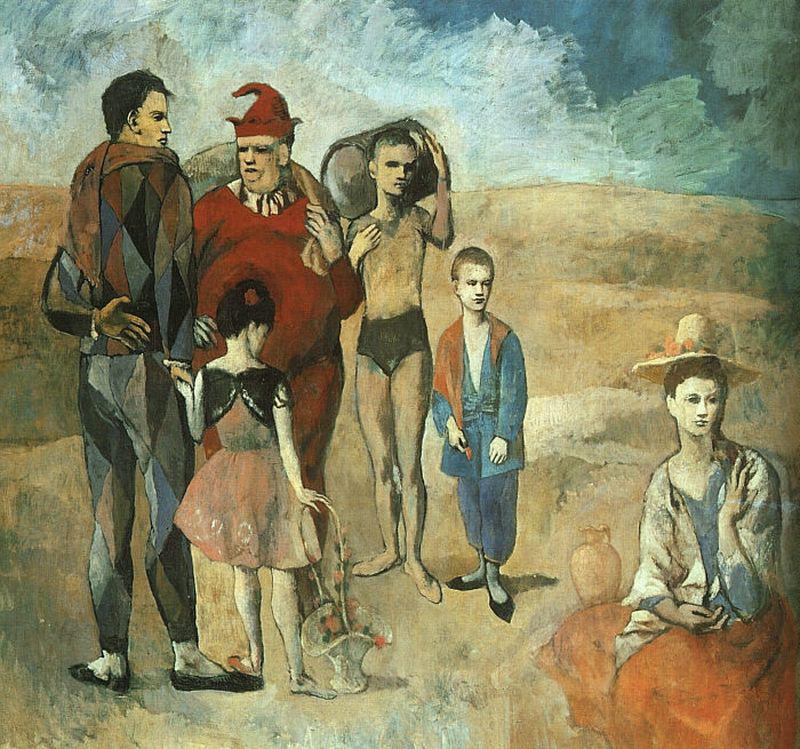
    Above: Les Saltimbanques, the painting by Picasso that inspred Lar Lubovitch’s newest creation, TRANSPARENT THINGS.

    Thursday November 15, 2012 – Three recent works by Lar Lubovitch comprised the programme tonight at Florence Gould Hall where Lar’s superb troupe of dancers held the stage to fine effect, abetted in the final work by excellent playing of the Debussy G-minor quartet by the Bryant Park Quartet.

    Opening with the ravishingly dark and lyrical LEGEND OF TEN, set to the Brahms F-minor quintet, the Lubovitch dancers showed from the first moment both their collective technical expertise and their individuality as poets of movement. In this dance of swirling and evocative patterns, the heartfelt music buoys the dancers throughout; from time to time a dancer will step forward and briefly pay reverence to the audience before melding back into the flow of the dance. The gorgeous and distinctive Lubovitch women – Nicole Corea, Laura Rutledge and Kate Skarpetowska – are partnered in ever-shifting match-ups by the beautiful men of the Company: Attila Joey Csiki, Reed Luplau, Brian McGinns, George Smallwood and Anthony Bocconi. A central pair – Elisa Clark and Clifton Brown – weave their ongoing pas de deux into the ensemble; tall and radiant, the couple bring an unusual sense of dignity to what might otherwise simply be a romantic duet. Clifton’s imperial wingspan and the hypnotic styling of his arms and hands are a blessing to behold, and Elisa matches him in expressive nuance. Compelling dance from all, and the work is surely one of Lar’s greatest masterpieces.

    377924_2509974742725_1469896582_n

    Darkness of a more jagged and comtemporary feel marks CRISIS VARIATIONS, in which a smaller ensemble of dancers – Nicole Corea, Laura Rutledge, Attila Joey Csiki, Reed Luplau and Anthony Bocconi – writhe and struggle against unseen demons whilst yet another of Lar’s imaginative duets – danced by the enigmatic Kate Skarpetowska and the dynamic Brian McGinnis – ebbs and flows among the struggling community. Kokyat’s image of Kate and Brian, above, captures one of the pas de deux’s most spine-tingling moments.

    What gives CRISIS VARIATIONS its unique flavour in the Yevgeniy Sharlat score; in this turbulent and entrancingly crafted music, individual instruments – harpsichord, saxophone, organ – lend a nightmarish gleam to the tapestry of movement. The ballet, though steeped in deep despair, is not without subtle hints of tongue-in-cheek self-pity.  

    The newest of Lar’s works, entitled TRANSPARENT THINGS, is a pure joy. Reid Bartelme’s costumes translate from the Picasso painting with remarkable faithfulness, and the dancers take to the mirthful and sometimes self-mocking characters of this vagabond troupe of entertainers with flair.

    Schreiber IMG_5214

    Attila Joey Csiki (above, Steven Schreiber photo) is perfect as the mercurial Harlequin, his solo dancing marked by the pure grace of his pliant style. Kate Skarpetowska and Laura Rutledge seem literally to have stepped out of the painting; Brian McGinnis is a tower of strength in his billowy red suit and Clifton Brown in simply marvelous to watch. Boysihly beautiful Reed Luplau brings a touch of innocence and a creamy, chiseled chest to his velvet-clad Blue Boy.

    Playing from memory, the musicans of the Bryant Park Quartet give a rendering of the Debussy score which ranges from sentimental to ebullient. Violinist Anna Elashvili seemed ready to spring from her chair and join the dance. At the close of the ballet’s third section, the dancers invade the musician’s space and are momentarily stilled; Attila lovingly rests his head against the cello. In this charming moment the marriage of music and dance are quietly celebrated. Brilliant!

  • Columbia Ballet Collaborative: Rehearsals

    L1030096

    Above: choreographer Lisa de Ribere works on a pas de deux to be danced by Rebecca Azenberg and John Poppe at the upcoming performances by Columbia Ballet Collaborative.

    Friday October 27th, 2012 – I stopped by at Barnard College where two of the five choreographers involved in the upcoming performances by the Columbia Ballet Collaborative were rehearsing. Lisa de Ribere is creating an ensemble work, while Emery LeCrone is reviving a solo piece originally made on Drew Jacoby, and now to be danced by Kaitlyn Gilliland.

    L1030068

    Lisa’s studio was my first stop; several dancers I know were there and she was sorting out a fast-paced section of her two-part ballet which uses music by John Pizzarelli (Traffic Jam) and Norman Dello Joio – an interesting pairing to be sure.

    L1030171

    At the start of the pas de deux (above) in which Rebecca and John slowly and warily investigate one another before moving on to a more intimate quality.

    L1030179

    Rebecca Azenberg & John Poppe

    Click on each image to enlarge.

    L1030233

    I then moved to the Streng Studio where choreographer Emery LeCrone (above) was working with one of Gotham’s most gorgeous dancers, Kaitlyn Gilliland, on a solo entitled ARIA.

    L1030605

    Kaitlyn Gilliland

    Set to music by the Balanescu Quartet, ARIA is a space-filling solo which suits Kaitlyn long limbs and her innate spiritual quality to perfection. Emery and Kaitlyn have an easy rapport and mutual appreciation, so the rehearsal was a particularly pleasant experience.

    L1030432

    Kaitlyn!

    The Columbia Ballet Collaborative‘s Autumn 2012 performances will take place at Manhattan Movement and Arts Center on November 16th and 17th. Details here. In addition to the works by Lisa and Emery, ballets by John Poppe, Nick Kepley and Daniel Mantei will be performed. I’m hoping to get to rehearsals of the three gentlemen’s creation in the next few days.