Category: Ballet

  • ONOKORO ~ creations/beginnings

    Miki 2

    Author: Oberon

    Sunday September 24th, 2023 – This evening at Westbeth, dancers Miki Orihara and Ghislaine van den Heuvel joined a fantastic ensemble of musicians in a program entitled ONOKORO – creations/beginnings. The production, Tokyo to New York, is under the artistic direction of Thomas Piercy; the performance took place at the Martha Graham Studios.

    Onokoro comes from the ancient Kojiki, Japan’s oldest mythology; it was the name of the first island formed by the gods Izanagi and Izanami when they were creating Japan. The evening’s program took us on a musical and spiritual journey from “Ryoanji” (the first sounds) to “Netori, Netori” (the emergence of organized sound and music), and onward thru to “Onokoro” (which combines the Eastern and Western styles of music and movement).

    The Graham space at Westbeth was the perfect setting for this production. As the house lights went out and silence fell over the space, the studio’s large windows created a feeling of l’heure bleue, that fleeting time when day yields to night. In the darkness, the musicians took their places to perform John Cage’s 1985 work “Ryoanji”. The only source of light in the room was the tablets from which the musicians read their scores. The piece opens with a kneeling percussionist, Marina Iwao, striking a bell; this summons is repeated insistently throughout the piece. Thomas Piercy plays the hichikiri, a small double-reed Japanese instrument which seems like a cross between flute and oboe. Mr. Piercy is joined by two other hichikiri players: Lish Lindsey and James Joseph Jordan. The sound of their instruments veers from sighs and whispers to squawking and whining. The audience seemed intrigued by the music.

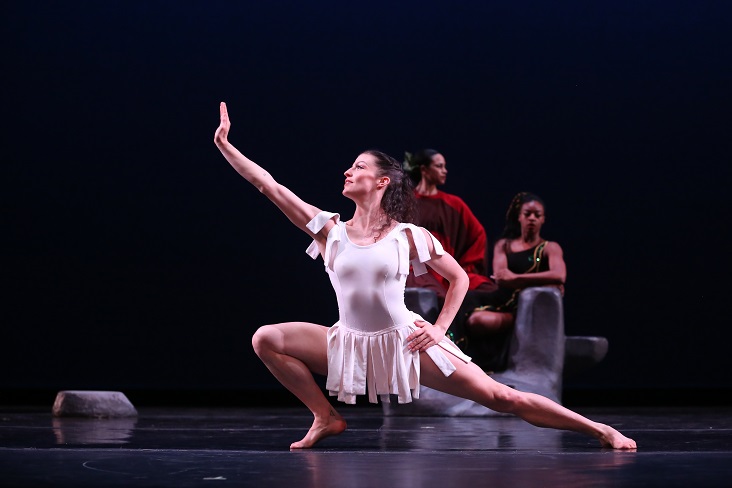
    Mr Piercy now took up his clarinet for Bin Li‘s clarinet concerto “Netori, Netori”. A seated Gagaku ensemble – Ms. Lindsey and Mr. Jordan joined by Harrison Hsu (sho) and Masayo Ishigure (koto) – create fascinating, otherworldly musical colours which are plucked or piped. As Mr. Piercy begin to play, dancer Maki Yamamae appears, dressed as a young warrior and carrying a ceremonial spear. The space is illuminated in golden light as the the slow ritual dance evolves in a series of poses. Mr. Piercy illuminates the music with soft trills and warblings, and the sound of escaping air; his dynamic control is uncanny. There are silent pauses in the music, and eventually the ensemble rejoins. Following the dancer’s exit, there is a quirky coda for the clarinet.

    Two works having their world premieres at these concerts came next. The first, Gilbert Galindo‘s “Primordial” for clarinet, cello, and piano, opened with a somber cello passage, introducing us to an extraordinary cellist: Daniel Hass. Mr. Piercy again took up his clarinet for this work, and Ms. Iwao was at the keyboard. Galindo’s pensive music is hauntingly beautiful, bringing us a magical mixing of timbres. Mr. Hass produced shivering tremolos while Ms. Iwao found poetic depths in the piano’s lower octaves, and Mr. Piercy’s lambent tone and dynamic variety made for an engrossing experience.

    After the briefest of pauses, the players proceeded to the second premiere, Miho Sasaki’s “黎明 – reimei – Dawn”. Here Mr. Piercy traded his clarinet for the ohichiriki. This music is intense, with threads of melody woven in amidst jarring harmonies. From this emerges high, delicate figurations from Ms. Iwao’s keyboard, while Mssrs. Piercy and Hass create a very distinctive tonal blend. The music, veering from disturbing to reassuring along the way, was very impressively served by these three musicians. And both the Galindo and the Sasaki works seemed to me ideal candidates for choreography.

    For the program’s concluding work, Masatora Goya‘s “Onokoro” Concerto for hichiriki and strings, Mr. Piercy was joined by a string ensemble: violinists Sabina Torosjan and Lara Lewison, violist Laura Thompson, bassist Pablo Aslan, with Mr. Hass’s cello  and Ms. Iwao at the piano.
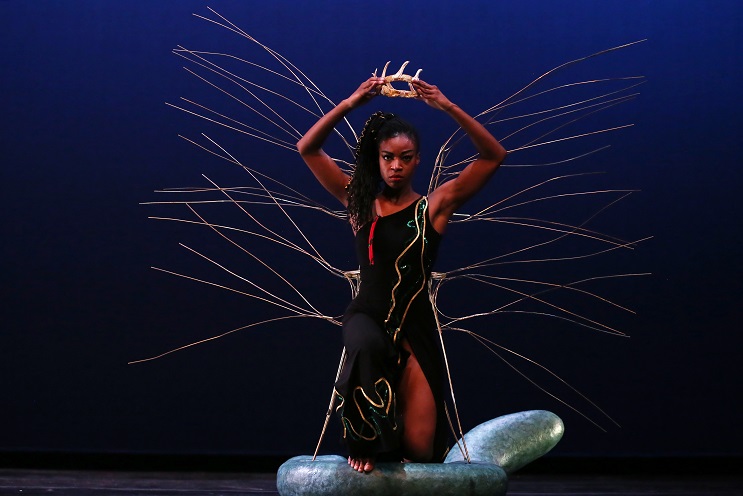
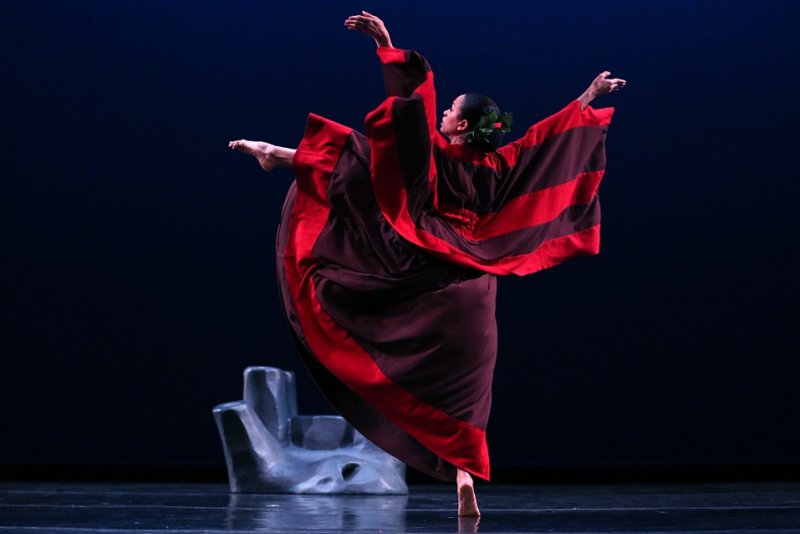
    Isolated notes from Mr. Aslan’s double bass set the mood as the space becomes fully lit. Mr. Piercy’s hichiriki seems to sigh before taking up a mournful (and vaguely jazzy!) passage. To quirky rhythms, the strings vibrate and the hichiriki wails. Mr. Hass’s cello introduces the dancers: Miki Orihara and Ghislaine van den Heuvel. Gorgeous string harmonies emerge as the dancers remain still. Playing over plucked string motifs, Mr. Piercy’s hichiriki urges the women forward; Miki Orihara is wearing a cape with an extraordinarily long train (costume design by Karen Young). For a fleeting moment, Mr. Piercy veers into a bluesy phase.
    Seated on the floor, the dancers commune with flowing port de bras. The train is briefly passed to Ms. van den Heuvel but then returned to Ms. Orihara. The music takes on a chorale-like feeling; the dancers rise, as if transfixed. Mr. Hass’s cello sounds gorgeously while the women kneel and arrange the cape between them, placing on it a beautiful mask, ‘Tuskiyom‘ (on loan from the Theatre of Yugen, in San Francisco). Their ritual complete, the dancers part and slowly back away. Mr. Piercy then embarks on a grand cadenza before the music fades with tremolo strings.
    The evening ended with warm applause from the audience, who had experienced the performance in a spellbound state, as if in church. While I wished on one hand that a large crowd could see this work, it was exactly the intimacy of the presentation that made it so meaningful.
    My thanks to Miki Orihara for alerting me to this engrossing production; it reminded me at times of Miki’s fascinating  2014 solo presentation, Resonance, which created the same kind of hallowed atmosphere. And how wonderful to see Ms. van den Heuvel again, after watching her magnetic dancing in a Graham 2 performance in 2022.
    To Mr. Piercy and everyone involved in ONOKORO, my deepest thanks for a truly inspired – and inspiring – evening.
    ~ Oberon

  • Sasha Cooke/Kirill Kuzmin ~ how do I find you

    Sashacooke

    Above: Sasha Cooke in a Stephanie Girard portrait

    Author: Oberon

    Thursday May 25th, 2023 – Mezzo-soprano Sasha Cooke presenting a program of songs she commissioned from some of the most distinctive composers of our time in a concert at Merkin Hall. This ambitious project was conceived by Ms. Cooke in 2020, at the height of the devastation of COVID-19, and many of the songs reflect a wide range of experiences tied to the pandemic, from the virus’s global effects to intimate, domestic stories of isolation and loneliness. Pianist Kirill Kuzmin was Sasha’s perfect musical partner for the evening. 

    In approaching the composers and lyricists for this project, Sasha had put no limits on subject matter. Of course, the pandemic was on everyone’s mind, but other important topics were brought forward: California wildfires, school shootings, current US politics, and the internment of Asian immigrants on Angel Island in the 19th and 20th centuries.

    The artists took the stage to a sustained round of applause. Sasha looked radiant in a shimmering gown, and within a few moments we were basking in the glow of her wide-ranging voice and her thoughtful way with words. 

    Caroline Shaw wrote both the music and the words for the evening’s title song, how do i find you. In this lyrical, melodious piece, everything that is dear to me about Sasha’s voice came into play: the warmth of her timbre, the cushioned, unforced low notes and rapturous highs, and the sheer seamlessness of it all. And she is sounding more gorgeous and expressive than ever.

    A five-note descending scale is a recurring motif in Ms. Shaw’s song, tailored so perfectly to the words. The music gets quite grand, and then briefly declamatory, before a final passage of sustained tones.  

    Listen (music by Kamala Sankaram, words by Mark Campbell) features some lovely writing for the piano, and explores a wide tonal range for the voice. There comes a great outpouring, and then a mix of pastel colors at the end. The poet’s words are simple yet infinitely moving: “Listen, as you would to the words of a dying friend…”

    Risk Not One (music by Matt Boehler, words by Todd Boss) Sasha jumps right in, and a rhythm develops; The words are urgent: “Go for broke!” Sasha’s voice is big and rich here, and Kirill at the piano has lots of lively notes to play. Glorious singing, with a big finish.

    Self-Portrait with Dishevelled Hair (music by Missy Mazzoli, words by Royce Vavrek) Inspired by Rembrant’s painting of the same name, and by the idea that a self-portrait captures a moment in time, the music veers from pensive to animated to moving. “I will paint you a self-portrait of me…so that you and I, separated by centuries, might lock into each other’s gaze.”

    Spider (music by John Glover, words by Kelley Rourke) was one of my favorite songs on the program, though – to be honest – all the songs were favorites. The piano begins to ripple as the spider builds her web, and the music is thoughtful. Sasha’s voicing of the words is so clear…and then she begins to hum, like a lullaby.

    MasksUsedToBeFun (music by Frances Pollock, words by Emily Roller) was the most political song of the evening. It’s a light-hearted take on serious matters. From a bright start, the words are sometimes sung and sometimes spoken. Full of irony – and finger snapping – the piece rushes along, eventually taking singer and pianist to the brink of madness. The final lines are a hymn to our beloved democracy, followed by a touching piano postlude.

    (During a Q & A after the performance, a woman in the audience asked why “we” (left wingers) don’t reach out to “them” (the right wingers). The answer is simple: “they” are inflexible, cannot be reasoned with, nor think of anything other than imposing their beliefs on everyone else, and getting their own way – by hook or by crook. That’s why “we” end up “talking to ourselves”, as the woman so blithely put it.)

    Everything Will Be Okay (music by Christopher Cerrone, words by John K. Samson) was another favorite of mine; it tells of the recovery of a lost ‘treasure’. The song grows from a low start via simple voice and piano lines to a more dramatic passage before finding a tranquil ending, as peace of mind is restored. 

    After the Fires (music by Lembit Beecher, words by Liza Balkan) is a poetic narrative recalling the California fires of 2020, wherein the writer tells of returning home after the devastation. “There’s a feeling of memories having been erased along with the place.” The music covers a wide dynamic range, and the role of the piano is key. The song becomes very reflective, and finishes with a sense of quiet resignation. I loved watching Sasha sing this piece.

    (A Bad Case of) Kids (music by Andrew Marshall, lyrics by Todd Boss) is a drunken song, and Sasha’s take on it made me think of Flicka von Stade’s hilarious PERICHOLE aria. A poor bloke is stuck at home with the kids all day, day after day.  He pleads: “Find me a bed on the topmost floor, far from the cries of the maternity ward!” Sasha and Kirill had a blast with this song, which is quite operatic at times. The music rolls along, like something out of a music hall revue: a vivid finale to the concert’s first half. 

    The Work of Angels (music by Huang Ruo, words by David Henry Hwang), which tells of Angel Island and the Chinese Exclusion Act of 1882, where Asian immigrants were held, some for months…or even years. Of course this made me think of my beloved Wei, and the ongoing threats to Asians in this country. The singing is intimate, contrasting with some grand passages for the piano. The sound of the words becomes hesitant, as if afraid to speak of the things that happened to these people. It was some of the most poignant music we heard tonight, and it ends with a wordless vocalise.

    Altitude (music by Timo Andres, words by Lola Ridge), an enigmatic and strangely captivating song, in which Sasha almost compulsively repeats words whilst Kirill plays dotty accents. Then Sasha concludes this unique song in a gorgeous high phrase. 

    Still Waiting (music by Joel Thompson, words by Gene Scheer) is the harrowing tale of a mother in this age of school shootings. Reassuring at first, humming to herself, the woman misses a text from her daughter telling of a shooter in the school, followed by a second text: “”I’m OK, We’re evacuating. I love you.” This brings a huge outpouring of voice. In the final unaccompanied passage, Sasha almost lost control. I imagine this song is very difficult for a mother to sing, but it needs to be heard.

    In the Q & A at the program’s end, Sasha spoke of her difficulty in deciding what should follow Still Waiting. She chose That Night (music by Hilary Purrington, words by Mark Campbell), a long and rambling paean to the vitality and chaos of New York City life. It was a lot of fun to watch Sasha toss off the words; despite all the extroversion, the song has a thoughtful finish.

    Inward Things is Nico Muhly’s setting of a text by the 17th century English poet and theologian, Thomas Traherne. Muhly fashioned the piece so compellingly, and Sasha brought opulent tone and an engaging dynamic palette to bear on this beauteous music. The song’s end was especially sublime.

    Dear Colleagues (music by Rene Orth, words by Colleen Murphy) details the abundant problems masses of people faced during the pandemic while trying to work from home where kids, pets, and daily domestic stuff keep interrupting. The song is a working mother’s melodrama, which Sasha sang and acted with flair, whilst Kirill relished the choice piano interjections. The song has a hilarious ending.

    The Hazelnut Tree (words and music by Gabriel Kahane) tells of emerging from the confines of the indoors, of newspapers and television screens, into the natural world where we can find the true beauty of life. Mr. Kahane gives the words a fine melodic flow, which Sasha voiced so persuasively.

    Where Once We Sang (music by Jimmy López Bellido, words by Mark Campbell) marked the end of the evening. From the title, we knew what it would be about: lost time, lost opportunity…the pandemic months depriving musicians, dancers, and performing artists of their reason for living. Some were taken from us, others gave up. And by the time it was deemed safe again, the lost days were irretrievable.

    From the song’s unaccompanied start, Sasha conveyed everything those of us for whom music is our lifeblood felt and feared throughout those dark days. The song grows in fervor, which is then becalmed, and a sense of hope and quiet rapture settles over us.

    What I will always remember about this evening is the great pleasure of having been in that space with that voice.

    ~ Oberon

  • Graham Classics + New Works ~ 2023

    Rigney

    Above: from Annie Rigney’s new work for the Martha Graham Dance Company, GET UP, MY DAUGHTER

    Sunday April 23rd, 2023 matinee – Two Graham masterpieces and two recently-premiered works new to the Graham Company repertoire held the stage at the Joyce Theater this afternoon.

    DARK MEADOW SUITE, one of Graham’s most beautiful works (with an equally beautiful Carlos Chávez score) opened the performance. At curtain-rise, the women are posed like icons, with Anne Souder slightly removed from the others. They begin stamping their feet. A plaintive violin theme is heard, joined by the cello. The women move with classic Graham steps and gestures; Ms. Souder is simply sublime.

    Lloyd dark meadow

    Now Lloyd Knight (above) appears, striking poses in a spellbinding opening solo which develops into a stage-filling dance. Ms. Souder joins him for a duet in which an electric current seems to pass between them; their intimate partnering is at once sensual and ritualistic.

    The kneeling men hold the women in a uniquely lovely leaning, questing pose, symbolic of seeking or longing; Ms. Souder and Mr. Knight continue to reign in duet and solo phrases: unbearably tender and heartfelt.

    Aside from the principal couple, the cast for MEADOW today featured Leslie Andrea Williams, Laurel Dalley Smith, Marzia Memoli, Devin Loh, Kate Reyes, Jacob Larsen, Richard Villaverde, and new-to-Graham James Anthony.

    MGDC2023_Steven-Pisano-44

    Above: Marzia Memoli and So Young An in Annie Rigney’s GET UP, MY DAUGHTER; photo by Steven Pisano

    Ms. Rigney’s debut piece for Graham opened earlier in the week. It is a harrowing work, set to a thrilling score by Marco Rosano which incorporates Bulgarian folk music with original themes by the composer, and with stunning lighting by Yi Chung-Chen. It tells a story similar to one that I heard long ago from my high-school girlfriend.

    A quartet of young women in satiny frocks – So Young An, Anne O’Donnell, Anne Souder, and Marzia Memoli – dance together to chanted harmonies. They seem wary, full of angst and longing.

    MGDC_Get-Up-My-Daughter_MSherwood_07

    Above, in a Melissa Sherwood photo: Richard Villaverde makes a disturbingly powerful impression as the man of the house, who singles out So Young An as his partner of the moment in a dramatic duet of control, resistance, and resignation. The music is solemn, with the haunting voice of the great counter-tenor Andreas Scholl bringing a timeless feel. 

    Ying Xin joins the sisterhood, who have apparently been drugged into near stupor; while heavenly harmonies are heard, they seem to plan an escape but lack the strength to attempt it. The organ joins the musical soundscape, lending a curiously religious air. Mr. Villaverde returns; the women tremble in fear. Drums thunder forth, and the piece ends suddenly.

    MGDC2023_Steven-Pisano-47

    Above: Ying Xin, Marzia Memoli, and So Young An in GET UP, MY DAUGHTER; photo by Steve Pisano

    Why this work affected me so deeply lies in recalling my girlfriend’s experience, of which I was unaware at the time. For three years, her father routinely raped her, her two older sisters, and her younger brother. I was aware of the extreme tension she endured living in a home with a drunken father, but I never knew about the sexual side of it until a few years later, after she had escaped and moved to Washington DC. I only knew how she clung to me in our tender, juvenile – but curiously “knowing” – love-making. Her father eventually blew his brains out.

    Cortege 1

    Above: from CORTEGE 2023, with Ruchard Villaverde kneeling; photo by Steve Pisano

    Equally thought-provoking this afternoon was the second darkly powerful new work, CORTEGE 2023, set to a score by Aidan Elias and choreographed by Baye & Asa. This piece spoke of the dangerous world in which we now live: scenes of violence, torture, and isolation alternate with depictions of mourning and consolation.

    Chimes sound at curtain-rise as a diagonal of dancers are seen covered by a shroud, which is slowly pulled away as the dancing starts. The lighting (again by Yi-Chung Chen) flashingly isolates various tableaux of people under duress: prisoners, the interrogated, the isolated, the bereaved.

    MGDC_Cortege-2023_MSherwood_7944

    Lloyd Knight’s solo (above photo by Melissa Sherwood), set to sinister music, is riveting. Rhythmic variety, and ritualistic acts, carry the piece eerily forward. Anne O’Donnell’s solo is so expressive, and James Anthony has an opportunity to shine.

    MGDC2023_Steven-Pisano-32

    Above: Lorenzo Pagano and the ensemble; photo by Steve Pisano

    Violence has become a fact of life, as indicated by a cataclysmic buildup of brass in the score. An animated quartet become a hypnotic sextet: the movement is non-stop. Deep chords invoke feelings of doom; and then, as silence falls, the vast shroud is used as a cover-up. 

    The afternoon ended with a spectacular performance of Martha Graham’s take on the Medea story: CAVE OF THE HEART. The Metropolitan Opera’s 2022-2023 season opened with the Met’s first-ever performance of Cherubini’s MEDEA starring the inimitable Sondra Radvanovsky, so the story is fresh in the memory.

    MGDC_Cave-of-the-Heart_LAW_MSherwood-24

    Leslie Andrea Williams (above, in a Melissa Sherwood photo) radiated her distinctive star-power in a performance that brought the character’s double personality – abandoned lover and conniving sorceress – vividly to life. When she is not doing, she is always thinking; Leslie’s expressive face, and her eyes – ever scanning the scene for what damage she can do – are as vital to her playing of the role as her dancing. 

    MGDC_Cave-of-the-Heart_LAW_MSherwood-16

    Laurel Dalley Smith (photo above by Melissa Sherwood) gave a dazzling performance as the naive bride, basking in Jason’s attentive courting, unaware of the doom that awaits her.

    MGDC_Cave-of-the-Heart_LAW_MSherwood-44

    Lorenzo Pagano as the proud Jason, looking to be King of Corinth whilst scorning the woman who made it all possible, pays the cost of his betrayal. His earlier show of pride, taunting Medea with his worshipful wooing of the young princess, plunges him headlong into disaster. (Photo above by Melissa Sherwood).

    MGDC_Cave-of-the-Heart_LAW_MSherwood-03

    Presiding overall, and striving in vain to prevent the ultimate catastrophe, the marvelous Natasha S. Diamond-Walker – a Graham goddess if ever there was one – conveyed both the dignity and the anxiety of the all-knowing Chorus in perfect measure. (Photo above by Melissa Sherwood). 

    It surprises me that Martha Graham did not bring the children of Medea and Jason into her telling of the story. The two young boys are a key element in the Cherubini opera, wherein Medea surpasses the cruelty of murdering Jason’s betrothed by knifing the youths. She flings their bloody corpses at Jason’s feet; aghast, he asks her: “What was their crime??” to which she calmly replies: “They were your children…”

    Following the performance, I went downstairs to greet and thank the dancers, and was thrilled to see again – after waaaay too long – two of my Graham idols, Blakeley McGuire and Carrie Ellmore-Tallitsch.

    ~ Oberon

  • Premieres @ Graham

    MGDC_Get-Up-My-Daughter_MSherwood_06

    Sunday April 23rd, 2023 – The Martha Graham Dance Company have presented two premieres during their current season at The Joyce. I saw them both on this afternoon’s program, and I found them to be engrossing (for different reasons), with fascinating musical scores, terrific lighting, and – needless to say – spectacular dancing.

    Some images have come my way, and I am posting one picture from each of the new works now, with my write-up to follow tomorrow. At the top, dancing Annie Rigney‘s GET UP, MY DAUGHTER, are Richard Villaverde and So Young An. The score, which sometimes draws on Bulgarian folk music, is by Marco Rosano.

    Below, from CORTEGE 2023, choreographed by Baye and Asa to a score by Aidan Elias, are dancers James Anthony, Anne Souder, and Richard Villaverde.

    MGDC_Cortege-2023_MSherwood_7899

    Both photos are by Melissa Sherwood, courtesy of the Martha Graham Dance Company.

  • Graham Gala @ The Joyce ~ 2023

    Ying xin melissa sherwood

    Above: Ying Xin of the Martha Graham Dance Company; photo by Melissa Sherwood

    Author: Oberon

    Thursday April 20th, 2023 – The Martha Graham Dance Company are at The Joyce for a couple of weeks, and tonight was their gala evening. The program offered Graham’s All-City Panorama and Embattled Garden book-ending three excerpts from Canticle for Innocent Comedians (choreographed by Sonya Tayeh with the individual sections by Jenn Freeman, Martha Graham, and Micaela Taylor).

    All-City Panorama is a re-take on Martha Graham’s 1935 work, Panorama, which premiered at a summer retreat in Bennington, Vermont. The original Panorama was 45 minutes long, set to a score by Norman Lloyd, and was performed by student dancers, It served as a rallying call to for social change. Panorama was lost until 1992, when an early film was discovered; from this, the dancework was reconstructed by Yuriko, who passed away in 2022 at the age of 102.

    Panorama rosalie banner

    Above: from All-City Panorama, photo by Rosalie Banner

    Tonight’s performance boasted a large ensemble of teen-aged dancers, all clad in red (Martha Graham had designed the original costumes). Heralded by drums, they take the stage with a youthful energy that is exhilarating. Forming and re-forming in various sub-groups, they move in compelling design patterns – from runabouts to noble processions – employing classic Graham steps and gestures.  

    A central quintet was impressively danced, and at one point, everyone musters into a moving, stage-filling circle: a celebration of community. Following a finale filled with traveling leaps, the stage is emptied. The dancers took their bows to a vociferous ovation from the packed hall.

    Janet Eilber then appeared onstage, hailing the young dancers as the future of Graham; later in the evening, the past was also honored as veteran dancers among the audience were cheered. Overall, the evening felt like a celebration of the proud continuum of the Martha Graham Dance Company, now in their 97th season. It all left me wondering if I will live to see the 100th season.

    I was not impressed with Canticle for Innocent Comedians when I first saw it a year ago at City Center; but last week, I had a chance to see a studio rehearsal which made me alter my opinion. The choreography is demanding and often quite beautiful. I enjoyed it much more with the dancers in practice clothes; the costumes, while visually striking, seemed to detract from rather than enhance the movement, and they sometimes affect the dancers’ line. Tonight, the music, by pianist Jason Moran, also seemed more captivating than I remembered.

    Performed this evening, a suite of excerpts from the work opened with the breath-takingly lyrical duet Moon, choreographed by Martha Graham herself – apparently the only portion of her 1952 the work to have survived more or less intact. Tonight, it was hypnotically danced by So Young An and Jacob Larsen with a gentle sensuality and a feeling of tenderness and trust. 

    Stars, choreographed by Michaela Taylor, was brilliantly danced by two of Company’s charismatic Italian stars, Marzia Memoli and Alessio Crognale. Their partnering is effortless, and their personalities meld persuasively to illuminate the dance.

    The beauteous Ying Xin then appeared for the solo Death/Rebirth, choreographed by Jenn Freeman. This solo is a profound depiction of loneliness, and Ying Xin’s suppleness of movement – and her expressive face – made for a captivating dance experience: paradoxically draining emotionally and uplifting spiritually. 

    Minutes later, Ying Xin was back onstage, portraying Eve in Graham’s iconic Embattled Garden

    At the same rehearsal where Innocent Comedians gave me a second look, Graham’s Embattled Garden had been danced, complete with sets and costumes. The work is always stunning to see, but up close it was simply thrilling. The cast of four must not only be dancers, but also acrobats, actors, and possessed of vibrant personalities.

    Tonight, in the theatrical setting, a slightly different cast made a most powerful impression. The Noguchi sets are masterpieces in their own right, and the Carlos Surinach score seemed fresh and vivid. Ying Xin’s Eve is the epitome of feminine grace, and her partner Lloyd Knight’s Adam is magnificent both as a presence and as a mover.

    Garden hibbard nash

    Above, trouble in paradise: Leslie Andrea Williams and Lorenzo Pagano in a Hibbard Nash image

    Observing Adam and Eve from his perch in a fanciful Noguchi tree is the Stranger, danced by Lorenzo Pagano; lounging in the shade, fanning herself, is Lilith, danced by Leslie Andrea Williams. These intruders in Eden are hellbent on destroying the happiness of the young couple…just because they can. Aside from the astonishing flair and virtuosity of their dancing, Leslie and Lorenzo communicate volumes with their facial expressions and especially with their ever-observant, knowing eyes. Brilliant!

    ~ Oberon

  • Jennifer Muller Has Passed Away

    Jennifer m by Matt Murphy
     
    It is very sad to read of the death of Jennifer Muller, a wonderfully musical and inventive choreographer. She was always very kind to me, opening her rehearsals to me and treating me almost like a member of her Company. I loved everyone who danced for her over the years that I knew her, and I grew very fond of her cozy rehearsal space. Above photo: Matt Murphy
     
    Some of my favorite memories of Jennifer’s work:
     
    Muller
     
    Above: from  MISERERE NOBIS
     
    Click each title to view:


  • 25 Years in Gotham

    Perry street

    Above: 118 Perry Street, my first NYC home; the building has been painted since we lived there

    March 28th, 2023 – Today marks the 25th anniversary of my move to New York City; after spending 22 years in Hartford, working at a thankless job with a bunch of wonderful people, I was ready to achieve my long-held goal of being a New Yorker before my 50th birthday.

    Me and wei-1

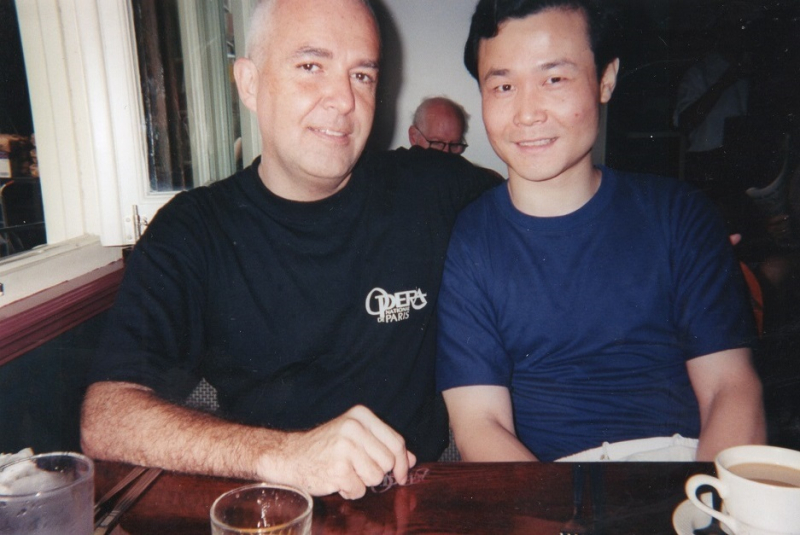
    Within two weeks of arriving in The City, I met Wei (above)…and I started a job in the opera room at Tower Records. My friends Paul and Tom had rented me their studio on Perry Street, and Wei and I were very cozy there for five years – a time period that included the 9/11 terrorist attack on the World Trade Center. I’ll never forget that morning, and rushing down to the street to see smoke pouring out of the Tower.

    15823701_10209672727348991_7172093874094922565_n

    My friend Richard (above) came down often during those years. and continued to do so until his untimely death in 2016.

    In 2003, Paul and Tom wanted their studio back, so Wei and I moved up to inwood. After a few weeks of feeling disoriented, I came to love it up here. Now, as the third act of my life/opera draws to a close, I keep wondering what the fourth act has in store for me. My friend Dmitry says, “The fourth act is the ballet!”

  • Renaud Capuçon/ORPHEUS @ Carnegie Hall

    _DSC8907

    Saturday February 21st, 2023 – Violinist Renaud Capuçon (above, performance photo by Chris Lee) joining the Orpheus Chamber Orchestra at Carnegie Hall for a program featuring works by Hanna Benn, Sergei Prokofiev, and Modest Mussorgsky.

    The East Coast premiere of Ms. Benn’s View (Un)titled, an Orpheus commission, opened the evening. The composer was inspired by artwork she had viewed at MoMA; she drew inspiration for the work’s structure from the beloved Mussorgsky piece which closed tonight’s program. Thus, View (Un)titled opens with a promenade: a walking motif set to a pacing rhythm from Orpheus’s rock-star bass player, Jordan Frazier.

    The musical exploration of the various artworks (eight of them) showed that Ms. Benn is a composer who values melody; her music has a fresh and vital feeling, and she has a gift for making a visit to a museum seem important. Which it is! 

    As the movements unfolded, my companion and i lost track of exactly where in the order of the things we were. So we simply enjoyed the work as a whole: its rhythmic variety, the rich strings, the distinctive sounds of the wind voices, and the cunning use of percussion. Cinematic one moment and intimate the next, this music continually delighted the ear…and the imagination.

    Hanna benn

    Above: composer Hanna Benn

    Ms. Benn was called to the stage for a bow after her work was played, and she was warmly greeted by the audience; returning to her seat, Ms. Benn received another around of applause, and she made a charming curtsey to the hall. During the interval, she slowly made her way up the aisle, pausing for autographs and selfie seekers. One tiny girl wanted to meet her, but was overcome by shyness (I know how she feels!); Ms. Benn knelt and spoke to her, putting the child at ease, and then they had a photo together: really such a sweet moment. 

    M. Capuçon then took the stage for a stunning performance of Prokofiev’s Sonata in F-Minor in an arrangement by Andrei Pushkarev.

    The opening Andante assai has a doleful feeling, from which the trilling of the violin emerges. Unison strings are heard in lamenting themes as M. Capuçon’s playing becomes increasingly passionate; the celli and bass play dirge-like passage. Now the enchanting sound of the marimba comes into play. The violinist executes slithering scales – and then a plucking passage – as the music fades away.

    In the Allegro brusco which follows, a military mood is established, the celli and bass trudging along, the drums issuing a stirring summons. M. Capuçon takes up a song, the accompaniment dance-like. The pace picks up, and reaches the sizzling point. The striking of the wood block draws our attention to the orchestra’s percussionist de luxe, Maya Gunji, who at one point plays the snare and bass drum simultaneously. The violin sings forth again, and this militant movement marches to its end. 

    Now comes the sonata’s luminous Andante. The delicious sounds of the marimba create a dreamy mood, and a lyrical melody from M. Capuçon becomes a duet with cello. The sound of the violin shimmering on high and meshing with the marimba evokes thoughts of the same composer’s Opus 19/The Dreamer.  Spine-tingling pianissimo arpeggios from the violinist bring the movement to an ethereal close.

    The concluding movement has a bustling start; the percussionist is kept endlessly busy, as is the violinist. But in a surprise move, the music gradually transforms to an andante, the violin turning lyrical, a fugue developing, the marimba sounding isolated notes.  A solo passage from the bass, and then the music slithers to silence.

    _DSC8797

    Above: M. Capuçon danced and swayed throughout his performance…very engaging; photo above by Chris Lee. The violinist won a fervent ovation, the Orpheus players joining in. He was re-called to the stage for two extra bows; the crowd was clearly hoping for an encore, though I am not sure what could have followed M. Capuçon’s dazzling playing of the Prokofiev.

    _DSC0128

    Modest Mussorgsky’s Pictures at an Exhibition was given in a fresh arrangement by Jannina Norpoth, and she gets major kudos for her luxuriant, imaginative vision of the music. Ms. Norpoth took a bow at the end, winning much-deserved shouts of approval from the hall…and spirited applause from the players, too. Chris Lee captured the moment in the above photo.

     A trumpet call heralds our entrance to the galleries where the pictures are on exhibition, and our tour is underway, interrupted periodically by a revisiting of the “promenade” theme. Applause between movements was distracting tonight, though understandable given the high level of the playing.

    Gnomes, a dolorous march, is by turns bustling, eerie, and clumsy…and superbly played. The Old Castle is an evocative, very slow dance for solo cello, joined later by violin and viola. The charming Tuileries tells of a dispute between children at play in the gardens. Bassoonist Gina Cuffari took a star turn with the droll and lumbering Cattle – music which gets big by the end. The whimsical, fluttery Ballet of the Chicks in Their Shells was charmingly set forth, and then we have Samuel Goldenberg und Schmuyle, which paints a picture of two Jewish citizens – one rich and one poor. The Market at Limoges is brisk and joyous, with a fast finish; in contrast come the long, organ-like chords of The Catacombs. Next, we feel shivers of mystery in Among the Dead. Following the big and boisterous Hut on the Fowl’s Legs (based on Baba-Yaga), we at last stand before The Great Gates of Kiev: a timely reminder of the world in which we now live.

    _DSC0175

    All of this was played sumptuously by the ladies and gentlemen of Orpheus, and the Carnegie acoustic suits them to a T: a wonderful night of music-making! At the end, the players and Ms. Norpoth formed a line-up stretching across the Carnegie Hall stage – Chris Lee’s photo above – enjoying the audience’s acclaim.

    ~ Oberon

  • Christmas Eve 2022 @ Carnegie Hall

    R rengel

    Above: violinist Rubén Rengel

    Saturday December 24th, 2022 – Spending Christmas Eve at Carnegie Hall with my longtime friend Rob Scott, we enjoyed the New York String Orchestra‘s annual holiday concert which brought us music by Elgar, Mozart, Bach, and Tchaikovsky. Jaime Laredo was on the podium, and the Venezuelan violinist Rubén Rengel was the soloist in a Bach violin concerto. The venerable Hall was packed to the rafters with music-lovers who ventured out on an extremely frigid, windy night to hear great music in the most perfect setting. 

    The New York String Orchestra is a young orchestra: as the players in this pre-professional ensemble took the Carnegie Hall stage, we were struck by their youthful energy and by their sense of dignity. Moments later, we were thrilled by the sheer richness and beauty of the sound they produced.

    Edward Elgar’s Introduction and Allegro, Op. 47, opened the concert. Composed in 1905 for performance in an all-Elgar concert by the newly-formed London Symphony Orchestra, the score calls for a string quartet and string orchestra. The NYSO’s concertmaster, Steven Song, led the quartet which further featured Minji Lee (Principal violinist), Raphael Masters (Principal violist), and Camden Michael Archambeau (Principal cellist).

    From note one of the Elgar, the players filled the Hall with music of abundant warmth, played with passion and poise. Among the quartet, violist Raphael Masters’ playing of a solo passage early on exemplified the high level of musicianship and tonal polish these young people have already achieved. The Elgar flowed on, with the agitated Allegro sections alternating with stretches of big lyricism that had the feeling of a classic film score. A fugue highlighted the sonic allure of each of the orchestra’s sections, and  – all evening, actually – the basses were extremely pleasing to hear.

    Mozart’s Divertimento in D-Major, K. 136, was luxuriantly played; the opening Allegro, with its familiar theme, was taken at a perfect tempo by Maestro Laredo. The Andante was noble and gracious, highlighted by silken sustained tones from Mr. Song’s violin. The steady pulse of the concluding Presto was finely sustained, whilst the music winks at us with sly touches of wit.

    Mr. Rengel now joined the orchestra for J. S. Bach’s Violin Concerto in A-Minor, BWV 1041. We had heard – and greatly enjoyed  – Mr. Rengel’s playing earlier this season with Ensemble Connect at Weill Hall. Tall and slender, the handsome Venezuelan caught the dancing spirit of the concerto’s lilting Allegro. In the Andante, his sweet tone and technical finesse produced enticing subtleties, his control of dynamics drawing us in to the music. The concluding Allegro assai again had a dance-like feeling, and Mr. Rengel’s fluency in rapid passages was a delight to the ear. The violinist, who had held the Hall in a palpable state of silence during this performance, was warmly cheered by the audience at the end, his colleagues onstage joining in the applause.

    Jaime laredo

    Above: Maestro Jaime Laredo

    Very high on my list of favorite musical works is Tchaikovsky’s Serenade for Strings. Like so many other people, I fell in love with this moving and melodious work through performances of Balanchine’s ballet Serenade at New York City Ballet. Tonight, hearing it in concert form, with the movements in their original order (Mr. B had placed the fourth movement before the third) was an immersive experience for me. The music was played with such heartfelt tenderness by these young people, the celli and basses constantly sending waves of poignant nostalgia thru me as memories – both sad and lovely – of past loves filled my mind.

    The love of music has, from a very early age, meant so much to me…most especially thru the dark years of my teens. Music is a constant lover: always there for me with its timeless, saving grace.  

    ~ Oberon

  • Fouad Boussouf’s NÄSS @ The Joyce

    Nass fff

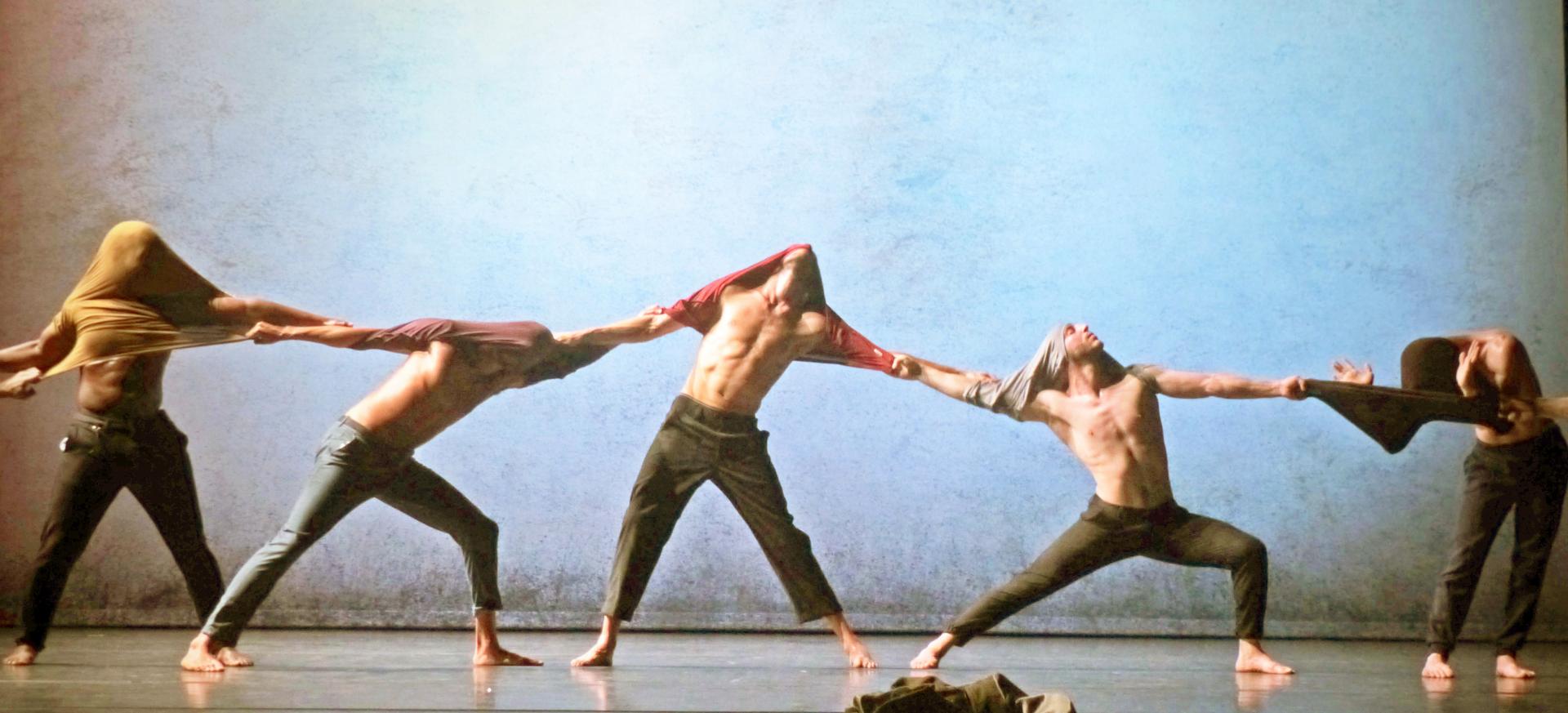
    Tuesday October 18th, 2022 – An exhilarating evening at The Joyce as choreographer Fouad Boussouf brought his handsome Company of dancers from his native Morocco to thrill us with Näss. The title is Arabic for “people”, and it’s a work where eclectic dance styles converge effortlessly, combining restless, relentless activity with a feeling of ancient masculine rituals. For an hour, the seven men danced to rhythmically wide-ranging music, with perfect timing and synchronization; though clearly carefully structured and well-rehearsed, Näss feels wonderfully and thoroughly spontaneous.

    The dancers in Näss are Sami Blond, Mathieu Bord, Maxime Cozic, Yanice Djae, Loïc Elice, Justin Gouin, and Maëlo Hernandez.

    Nass_Charlotte_Audureau4

    Above, photo by Charlotte Audureau

    The curtain rises on a totally darkened stage. Very slowly, the back panel is illuminated with the dancers ranged in a line-up, backs to the audience. Mingled with the sounds of street noise noise and garbled talking, angel voices are heard. Drumming strikes up and the men begin moving in place, stepping to the beat.

    Suddenly, they burst into movement, stomping and romping about the space. Unison moves, with gestures of supplication, are mingled with free-flowing solo passages and duets which vary in feeling from humorous to wildness. 

    Boussouf Nass_Charlotte_Audureau2

    Above photo by Charlotte Audureau

    The lighting takes on a golden hue; the men’s jackets are slowly shed and each is wearing a loose t-shirt of autumnal solour. Going into breakdance mode, they give us headstands and intricate floor motifs executed with panache. The t-shirts become part of the dance: they are pulled up to cover the men’s faces and expose their abs as the light fades a bit and a sense of calm is briefly felt. The dancers start talking.

    Then a quintet of men step-dancing in unison circle the stage in almost military precision whilst two others dance a pas de deux in their own world. The brotherhood then tramp about the space with heavy-footed accents. The lighting shifts, providing shadowplay.

    The dancers move upstage, clustered with backs to us; they become silhouettes as the music fades and the lighting is slowly extinguished until they vanish into the darkness from whence they came.   

    As silence fell there was a very brief lull before a house-wide standing ovation commenced. People screamed and shrieked as the dancers came out for their bows. Great atmosphere! Then the seven men began striking poses along the edge of the stage, and they commenced an impromptu encore, clapping their hands to set the pace. The audience picked up the rhythm, clapping and stomping. It was like being at a revival meeting where everyone has been saved. I felt high as a kite.

    Boussouf fouadcharlotteaudureau

    Photo: Charlotte Audureau

    ~ Oberon