Category: Dance

  • Lar Lubovitch ~ Three Dances

    NYCDP_LarLubovitch_0036

    Above: Lar Lubovitch, photo courtesy of NYC Dance Project

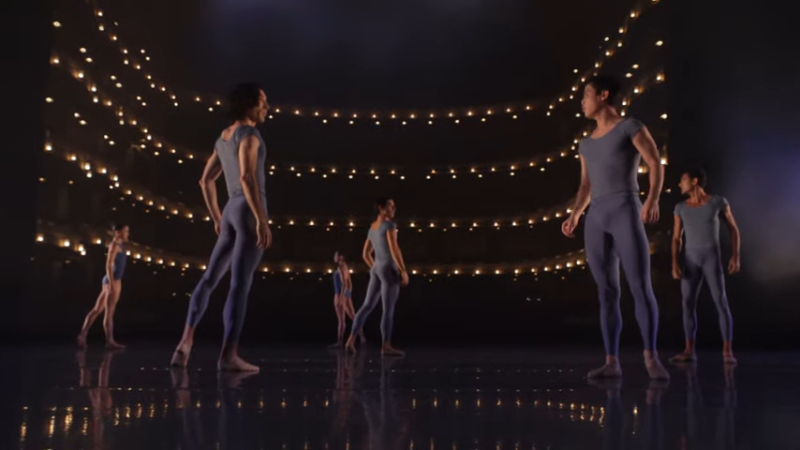
    Friday May 21st, 2021 – This evening I tuned in to watch a program of highlights from three works by the eminent choreographer Lar Lubovitch. The program featured excerpts from two familiar ballets by Lar, and part of his unique The Planets.

    Watching the film’s duet from Concerto Six TwentyTwo brought back memories of a beautiful afternoon photographer Nir Arieli and I spent watching a rehearsal of this piece in 2013.  Mr. Lubovitch was coaching dancers Attila Joey Csiki and Clifton Brown, and the atmosphere in the studio was palpable. 

    Concerto Six Twenty-Two #1 - photo by Jack Mitchell - Lafortune  Michalek jpg

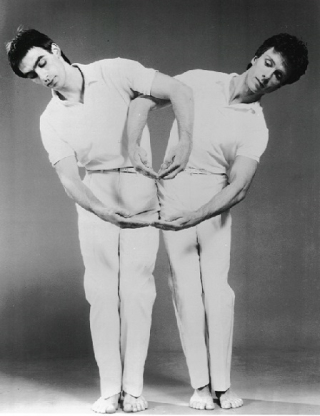
    Above: Sylvain LaFortune and Rick Michalek in Concerto Six TwentyTwo; photo by Jack Mitchell

    The duet is set to the adagio from Mozart’s Clarinet Concerto, a beloved work that reached a wide audience when it was used in the film Out of Africa. Sylvain LaFortune and Rick Michalek are the dancers in today’s program; clad all in white, they could be lovers, or brothers, or best of friends. The Lubovitch choreography is a poignant response to the music; the men are mutually supportive and tender without becoming cloying. There are solo passages, danced whilst the other man observes. It’s a study in masculine grace.

    Othello, which premiered in 1997, was a joint creation for the Lubovitch Company, American Ballet Theatre, and San Francisco Ballet. In 2018, as part of the celebration of the Lubovitch Company’s 50th anniversary, Fabrice Calmels and his colleagues from The Joffrey performed excerpts from Othello at The Joyce. 

    Screenshot_2021-05-21 Highlights from the Broadcast Premieres of Three Televised Works by Lar Lubovitch

    Above: Desmond Richardson and Yuan Yuan Tan in Othello

    This evening we saw the ballet’s third act from a filmed performance by San Francisco Ballet. The stellar cast featured Desmond Richardson as Othello, Yuan Yuan Tan as Desdemona, Parrish Maynard as Iago, Katita Waldo as Emilia, and a very young Gonzalo Garcia as Cassio.

    As Act III opens, Cassio is in chains, being interrogated by Othello with Iago a menacing observer. Despite his pleas of innocence, the young captain doesn’t stand a chance; he is taken away. Now Desdemona comes on the scene: Yuan Yuan Tan, achingly lovely, seeks to placate her jealous husband. Parrish Maynard as a scarily intense Iago watches the couple. The potent physicality of Desmond Richardson’s Othello holds sway over his blameless wife. Katita Waldo as Emilia joins for a pas de quatre set to dynamic music.

    Othello and Iago are left alone, and the latter summons up the green-eyed monster: jealousy. Here composer Elliot Goldenthal makes cunning use of the saxophone. Whilst Iago weaves his web of lies, Othello sees visions of Cassio courting his wife. Then Iago produces the handkerchief and Desdemona’s fate is sealed.

    The perfection of Desmond Richardson’s portrayal is now to be savoured in a solo of technical perfection and great dramatic intensity. He then confronts his wife, and, following an anguished  duet, he strangles her with the handkerchief. Now Emilia rushes in, and reveals Iago’s deception; she barely has time to state the truth before her husband murders her. Othello, overcome with remorse, stabs himself.

    The excellence of the cast made for a truly absorbing performance of this Lubovitch masterpiece.  

    Screenshot_2021-05-21 Highlights from the Broadcast Premieres of Three Televised Works by Lar Lubovitch(1)
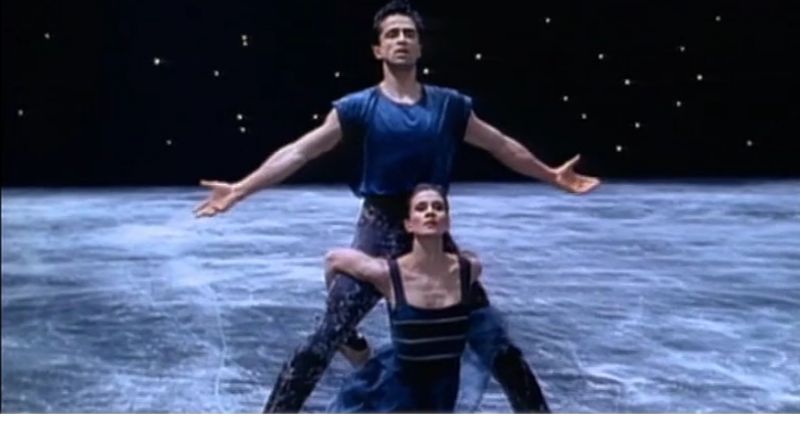
    Above: Isabelle and Paul Duchesnay in The Planets

    Completing the program, we had an excerpt from The Planets, in which figure skaters and ballet dancers joined together. The music is “Venus” from Holst’s The Planets, Mr. Lubovitch choreographed the skating, and Doug Varone the ‘court of Venus’. The goddess is portrayed by Sonia Rodriguez of the National Ballet of Canada, and the principal skating couple are Paul and Isabelle Duchesnay, 1992 Olympic Silver Medalists.

    Venus, after drinking from an enchanted pool, sees a vision of a company of lovers, come to pay her homage. These skaters fill the ice with swirling, flowing combinations. Now the principal couple – the brother-and-sister Duchesnays – execute a lush duet, sailing across the ice to the lyrical Holst music.

    Paul Duchesnay kneels before Ms. Rodriguez’s Venus; she is captivated by this mortal male and they begin a duet in which Ms. Rodriguez’s feet never touch the ice. The goddess then returns to her temple, but the encounter has left its mark on her. 

    Screenshot_2021-05-21 Highlights from the Broadcast Premieres of Three Televised Works by Lar Lubovitch(3)

    Above: Sonia Rodriguez in The Planets

    While watching the program, many memories of my experiences with Lar Lubovitch’s work – and of meeting him briefly in various settings – came flooding back. It’s thanks largely to my friendship with Attila Joey Csiki – an iconic Lubovitch dancer – that I discovered the world of Lubovitch. Here are some articles and images from my blog about these encounters:

    Meeting Attila in person for the first time in November 2010 when he was preparing a Lubovitch solo with pianist KathleenTagg.

    In 2011, with Attila teaching a Lubovitch class, is where the Lubovitch connection took hold. Three dancers in the class – Greg Lau, Sarah Pon, and Blake Hennessy-York – were embarking on their careers at the time.

    Attila arranged for Kokyat and me to watch a rehearsal of Lar’s Men’s Stories. This was the first time I met Mr. Lubovitch; he was quite formal, which I liked.

    2014 brought the fascinating Black Rose to The Joyce.

    In 2017, in preparation for the 50th anniversary of the Lubovitch Company, Lar set his Legend of Ten on the Martha Graham Dance Company. Photographer Nir Arieli and I had a fantastic time watching a rehearsal.

    And in 2018, the 50th anniversary was celebrated in high style at The Joyce.

    There’s so much more Lubovitch in my dance diary! And there’s no way I could finish this article without mentioning my two Lubovitch goddesses: Nicole Corea and Kate Skarpetowska.

    ~ Oberon

  • Nika Antuanette: HOLOGRAM

    Hologram_face_off_2020
     
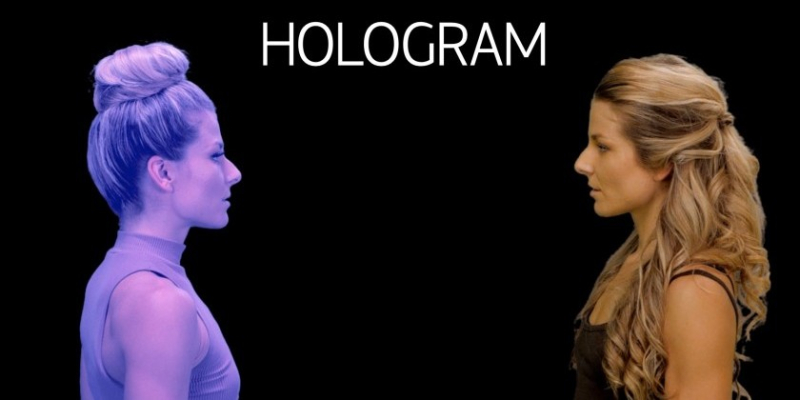
    “The world is round, the screen is flat…” is perhaps the most evocative line in Jeremy Cone’s soundtrack for dancer Nika Antuanette’s short film, HOLOGRAM. This collaboration between these two artists produces the most imaginative video to come my way during the pandemic: HOLOGRAM is both wonderfully entertaining and truly timely.
     
    The lavender holographic image of Nika Antuanette rises onto the blank, black screen; the actual Nika greets this image of herself with a wary smile, and the two Nikas find their common ground in dance. They pick up moves from one another, and dance in sync. Meanwhile, photos of places, people, and things – typical of the images that pervade the on-line world – flow across the screen at increasing speed.
     
    The dancer and her double continue to dance, becoming competitive. The real Nika begins to look frazzled; her energy flags while her virtual counter-part remains fresh and glowing; the real Nika, no longer able to keep up, falls out of the frame as her holographic incarnation continues to blissfully execute perfect pirouettes.
     
    The contrast between reality and the one-dimensional social media experiences in which so many of us spend our hours is thought-provoking, especially in these days of COVID isolation. But that is another topic altogether.
     
    For now, Nika Antuanette and Jeremy Cove’s HOLOGRAM is very much worth watching. Check it out in YouTube here.

  • Waltz of the Snowflakes

    Snapshot waltz

    Post:ballet presents a ‘Waltz of the Snowflakes‘ from Tchaikovsky’s THE NUTCRACKER for the time of the pandemic.

    Watch and listen here.

    This performance really gave me a lift during this unusual holiday season. I was especially happy to see Landes Dixon dancing; I met him a few years ago when he danced with Steps Repertory Company, and again when he danced with Michele Wiles/Ballet Next.

    Credits:

    Choreography by Robert Dekkers
    Cinematography/editing by Ben Tarquin
    Performed by Post:ballet dance artists Cora Cliburn, Landes Dixon, Emily Hansel, Caitlin Hicks, Jenna Marie
    With Berkeley Ballet Theater dance artists Mai Corkins, Cameron Heanue, Elizabeth Inami, Monique Jonath, Nina Owen, Frances Pine-Rinella
    Produced by Lance Hepler
    Costumes courtesy Berkeley Ballet Theater and Post:ballet
    Special thanks to Marge Funabiki
    Filmed in Alameda, CA following corresponding state and municipal COVID-19 Safety Guidelines for Media Production
    Presented by Post:ballet and Berkeley Ballet Theater

    Merry Christmas to all!

  • Claudia Schreier’s PLACES

    Snapshot places

    Miami City Ballet‘s Artistic Director Lourdes Lopez introduces Claudia Schreier’s PLACES, created at the time of the pandemic. The piece premiered digitally on November 19th, 2020.

    Watch and listen here.

    CHOREOGRAPHY Claudia Schreier
    MUSIC Jorge Mejia
    CINEMATOGRAPHY Alexander Iziliaev
    LIGHTING DESIGN John Hall and Alexander Iziliaev
    COSTUME DESIGN Eleanor Wolfe
    BALLET MASTER Joan Latham

    DANCERS Nathalia Arja, Emily Bromberg, Renan Cerdeiro, Satoki Habuchi, Kleber Rebello, Damian Zamorano

    MUSICIANS Jorge Mejia, Piano; Daniel Andai, Violin I; Sheena Gutierrez, Violin II; Modesto Marcano, Viola; Shea Kole, Cello; Antonio Escobedo, Double Bass

  • Miro Magloire’s NOCTURNE

    IMG_3202-sm

    Miro Magloire’s New Chamber Ballet have released NOCTURNE, a filmed ballet choreographed by Miro to the first and second movements of Johannes Brahms’ violin sonata No 1, opus 78. The dancers are Anabel Alpert, Megan Foley, Amber Neff, and Rachele Perla, and the score is performed by Doori Na (violin) and Sean Kennard (piano). Costumes are by Sarah Thea, assisted by Lauren Carmen. NOCTURNE was shot at Please Space, Brooklyn.

    The film was directed by Emily Kikta and shot by Peter Walker; Emily and Peter, members of New York City Ballet, have together formed KW Creative. As dancers, they have a unique gift for capturing dance on film. After watching the ballet, be sure to watch the interview with Emily and Peter further down the link:

    Watch NOCTURNE here.

    Anyone who has ever attended a New Chamber Ballet performance knows that Miro always takes you as close to dance as you can possibly get; but with NOCTURNE, KW Creative will make you feel like you are dancing yourself. The brilliant camera work brings you right into the action, much as the film ‘Backstage at the Kirov’ makes you feel like a fifth cygnet. And, as music and dance are equally essential to New Chamber Ballet‘s artistic credo, I can enthusiastically heap praise on the excellent rendering of the Brahms score by Doori Na and Sean Kennard.

    IMG_4358-sm

    The eerily atmospheric setting of Please Space after dark lends an air of mystery to NOCTURNE. The ballet evokes a feeling of urban Wilis carrying on with their nightly rituals. And, as with GISELLE, the coming dawn signals the end of their mystic rites. Amber Neff (above), who had opened NOCTURNE emerging hesitantly to dance in the sacred space, returns to her safe haven. The ballet has a timeless feeling; one could imagine these sylphs gathering to dance each night at moonrise for ages to come.

    Still photos by Miro.

  • Miro Magloire’s NOCTURNE

    IMG_3202-sm

    Miro Magloire’s New Chamber Ballet have released NOCTURNE, a filmed ballet choreographed by Miro to the first and second movements of Johannes Brahms’ violin sonata No 1, opus 78. The dancers are Anabel Alpert, Megan Foley, Amber Neff, and Rachele Perla, and the score is performed by Doori Na (violin) and Sean Kennard (piano). Costumes are by Sarah Thea, assisted by Lauren Carmen. NOCTURNE was shot at Please Space, Brooklyn.

    The film was directed by Emily Kikta and shot by Peter Walker; Emily and Peter, members of New York City Ballet, have together formed KW Creative. As dancers, they have a unique gift for capturing dance on film. After watching the ballet, be sure to watch the interview with Emily and Peter further down the link:

    Watch NOCTURNE here.

    Anyone who has ever attended a New Chamber Ballet performance knows that Miro always takes you as close to dance as you can possibly get; but with NOCTURNE, KW Creative will make you feel like you are dancing yourself. The brilliant camera work brings you right into the action, much as the film ‘Backstage at the Kirov’ makes you feel like a fifth cygnet. And, as music and dance are equally essential to New Chamber Ballet‘s artistic credo, I can enthusiastically heap praise on the excellent rendering of the Brahms score by Doori Na and Sean Kennard.

    IMG_4358-sm

    The eerily atmospheric setting of Please Space after dark lends an air of mystery to NOCTURNE. The ballet evokes a feeling of urban Wilis carrying on with their nightly rituals. And, as with GISELLE, the coming dawn signals the end of their mystic rites. Amber Neff (above), who had opened NOCTURNE emerging hesitantly to dance in the sacred space, returns to her safe haven. The ballet has a timeless feeling; one could imagine these sylphs gathering to dance each night at moonrise for ages to come.

    Still photos by Miro.

  • Backstage at the Kirov

    I’ve just been re-watching a favorite ballet video of mine…this article was originally published in 2008!

    51HPJ9WGC9L._SL500_AA280_

    Now that the ballet season at Lincoln Center has ended, we’ve been watching some videos from the Library of the Performing Arts. Unfortunately, I have found that many of the DVDs in their collection turn out to be badly scratched; it’s a shame that people who are sophisticated enough to want to to watch SLEEPING BEAUTY or GISELLE are not correspondingly considerate enough to take good care of the library’s property. I’ve actually been having better luck with VHS tapes, since they are not in plastic sleeves and thus you can check their condition before signing them out. The library has quite a substantial VHS dance collection.

    Mezen09Asylmuratova-jw The 1982 film BACKSTAGE AT THE KIROV starts out as a run-of-the-mill (though interesting) documentary but soon the story starts to revolve around two Odettes: the established prima ballerina Galina Mezentseva and the (then) rising young Altynai Asylmuratova. Performance footage is interspersed with specially recorded passages where the camera actually takes us into the midst of the Kirov’s corps. This produces an especially vivid effect in such moments as the Cygnets where we follow the four girls around the stage. Later, when Asylmuratova and her husband Konstantin Zaklinsky are performing a segment of the adagio, the camera magically circles around them, catching the attendant Swans in their long rows as a swirling backdrop.

    Wei and I both thought Mezentseva was an exceptional Odette. Against the sustained slowness of the tempo set for the adagio, Mezentseva’s dancing – her fluent upper body, long arms and elegant legs – has a timeless, suspended quality. Asylmuratova’s youthful candor – she says she’d rather have slept in than attend class – is slyly sweet; she is a beautiful girl and we can already see emerging the ballerina who was to be such an impressive Nikiya in the filmed version of the Royal Ballet’s 1991 BAYADERE.

    BACKSTAGE AT THE KIROV (now available on DVD) also shows some very young students in class, and the hard-working corps of Kirov swans, some of whom come in for sharp reprimands from the ballet masters. It’s an intriguing view of SWAN LAKE from the inside: I ended up watching it four times in a week.

  • The Beethoven Symphonies on Record

    Beethoven-

    My friend Ben Weaver has devoted a great deal of time over the years listening to the music of Ludwig van Beethoven. Here he writes about recordings of the nine symphonies that have particularly captured his interest:

    “With the 250th anniversary since Ludwig van Beethoven’s birth celebrations curtailed by a worldwide pandemic, what’s a Beethoven lover to do but try to make the best of semi-voluntary home imprisonment by turning to recordings of Beethoven. I have previously taken a stroll through recordings of Wagner’s Tristan und Isolde; why not go back to some of my favorite recordings of Beethoven’s Nine. THE Nine that started the count and turned the world of music on its head. (Mahler and Bruckner both feared the number 9 and that they would not be able to out-do Beethoven and compose a symphony beyond that number – and both turned out to be correct: Bruckner never finished his Ninth and Mahler only completed one movement of his Tenth.) I will only go through some of the finest sets of the complete Symphonies – this is not intended to be a study of every recorded cycle and I’m only looking at complete sets of the Symphonies. (I will honorably mention some stand-alone recordings at the end.)

    So where does one begin a traversal of Beethoven’s recorded Symphonies? Naturally, with Herbert von Karajan – the Dean of recorded sound who left behind 4 complete studio sets: one from the 1950s with the Philharmonia Orchestra of London on EMI and three with the Berlin Philharmonic, one for each subsequent decade. (There are also at least two complete sets recorded by Japanese radio during Karajan’s concert tours with the Berliners.) 

    Karajan’s Philharmonia set (in mono) is unjustly neglected: produced by Walter Legge it captures the great vintage Philharmonia (arguably a better orchestra in the 1950s than even the Berliners were) in all its warm virtuosic glory and the young(er) Karajan, still not the domineering force he would become later, in a more playful mood than he would be in his Berlin recordings. This is especially noticeable in the “non-heroic” symphonies: One and Two sizzle with excitement and Seven, which Wagner called “the apotheosis of dance,” zooms out of the speakers and around the room. Of course the fact that it’s in mono will deter many listeners. The current issue of the EMI (now Warner) set includes two versions of the Ninth Symphony, one in mono and one in Legge’s experimental stereo (Legge preferred mono); the stereo version has never been available before.

    Of Karajan’s three Berlin sets – recorded 1961-62, 1975-76, and finally 1982-84 – interpretively there was not a great change in Karajan’s approach over the years. Since the London days he would become a more “serious” musician, maybe wiser, with what one would call a Germanic (he was actually Austrian) sense of humor. And for all his stürm und drang, Beethoven was certainly a man of humor. Karajan’s firmer grasp of the music and structure grew, and he now had complete control over his Berlin Philharmonic, wrestled from Wilhelm Furtwängler’s cold, dead hands and remade in his own image. The teutonic sound of Karajan’s Berliners would become firmer over the years, its granite-like wall of sound could level buildings, its virtuosity would be second-to-none. (The roster of principals over the years has given birth to more star soloists than perhaps any other band, including the likes of flautist Sir James Galway who played for Karajan from 1969 to 1975 and clarinetist Sabine Meyer’s very unhappy stint as the Orchestra’s first female principal in 1982. The orchestra voted her out after her “trial period” over Karajan’s objections, angering the maestro who insisted the male-dominated orchestra objected to Meyer’s gender, not musicianship; the incident caused a serious rift in their relationship and saw Karajan perform with the Vienna Philharmonic more in his final years. Berlin’s star soloists today include flautist Emanuel Pahud, oboist Albrecht Meyer, and clarinetist/model Andreas Ottensamer. But I digress…)

    So what sets all that Karajan Beethoven apart from one another? The 1961-62 set is one of the most famous classical recordings ever made; it has never been out of the catalog and has been reissued a bazillion times. (There is a new 2020 remastering being issued on SACD in Japan only and it does sound spectacular.) But there is a separatist group of listeners, which includes myself, that consider the 1970s cycle to be superior. There’s something a little rough in the 1960s set; maybe it’s Karajan still fighting the ghost of Furtwängler, or the orchestra still resisting Karajan’s attempts to possess them, but for me the cycle doesn’t register as extraordinary and the Ninth is a disappointment: the over-large and poorly recorded choir is an aural mess and sounds like they were singing in an empty subway station. By the late 1970s recording techniques had been improved and Karajan’s takeover of the orchestra was complete: they were now an extension of himself, with no ensemble lapses, no hesitations. And the recorded sound is gorgeous: warm, from the softest to the loudest moments. Listen to the Storm of the Pastoral Symphony: it’s all encompassing in sound and terror, as if we are hearing God’s flood for Noah. But then the romantic sweep of the Shepherd’s Call is overwhelming too in its depth of feeling and beauty of sound.

    Claudio Abbado took the reins of the Berlin Philharmonic after Karajan’s death and though Abbado recorded the Symphonies with the Vienna Philharmonic in the 1980s, he took another stab with his new orchestra in the 1990s. The results were electrifying. Paring down Berliners’ big and saturated sound favored by Karajan and echoed by many others over the years, Abbado brought Beethoven down from Mount Olympus and gave the symphonies a fresh, more Classical sound, reducing the number of players and exploiting Berliners’ newfound energy without gratuitous rushing. Deutsche Grammophon released Abbado’s recordings in two different versions: first came a cycle recorded at the Philharmonie in 1999-2000 and then a cycle recorded in concert in Rome in 2001. (Except the Ninth, which exists only from its Philharmonie performance, but re-edited in 2001 from original recordings according to Abbado’s new wishes.) DG says the Rome cycle is intended to replace the earlier Berlin one. Many argue that the Rome performances are the real jewels: I don’t know if I personally hear a huge difference in Abbado’s take or the orchestra’s performances, but I’m glad to have both. (To add to the confusion, the Rome cycle was also issued on DVD, but with a different Berlin recording of the Ninth, this one with bass Eike Wilm Schulte replacing Quasthoff, who remains the bass on the audio-only recording.) 


    With Abbado’s many years of experience with these works and having had time to cleanse the orchestra of Karajan’s late-career excesses, everything sizzles. The Fifth reminds us why the first movement has had the world ta-ta-ta-taming for centuries and the rest reminds us why this is an extraordinary, world-changing work and is more than just 4 chords. The Eroica is exceptional in its nobility and the Fourth makes you wonder why it’s not as famous as the two Symphonies bracketing it. The Pastoral is a gorgeous, gentle giant and the Seventh an exuberant dance. A superb quartet of soloists in the Ninth (Mattila, Urmana, Moser and Quasthoff) dominate the grand finale.

    Perhaps no orchestra has recorded Beethoven’s symphonies more frequently than the Vienna Philharmonic over the years. Leonard Bernstein’s Vienna cycle from the late 1970s not only leaves his 1960s New York recordings in the dust, but it leaves almost everyone else in the dust too. The playing is stupendous and Bernstein finds threads and sounds that nobody else has unearthed. The is nothing gratuitous about the interpretations, no odd Bernsteinisms, nothing willful. Bernstein doesn’t pull the music in any perverse direction, like his New York Fifth’s preposterous tempos: and yet he and the orchestra create sounds and discover ideas that nobody has before or since. Inspired by Lenny’s fertile imagination the Viennese play like gods. From beginning to end it feels like you hearing these works for the first time. No matter what others have done with these works or will do, these lovingly shaped performances will always belong near the top of recommendations. 

    The late 1980s/early 1990s brought two exceptional sets: Nikolaus Harnoncourt’s and John Eliot Gardiner’s. Harnoncourt – with the Chamber Orchestra of Europe – brought his decades of period instruments experience to a modern instruments orchestra (except natural horns) and the results were electrifying, except a disappointing, shapeless Ninth. The rest of the cycle – a surprisingly big boned Eroica, cheerful Pastoral, delirious Seventh – can stand proudly along with the best. The blaring, natural horns, over smooth modern strings, is an inspired and attention-grabbing touch.

    John Eliot Gardiner’s cycle with the newly created Orchestre Révolutionnaire et Romantique (an expanded English Baroque Soloists, specifically created to perform music of the Romantics) was not the first period instruments cycle of the Symphonies. Roger Norrington and Christopher Hogwood, among others, preceded him. But nothing could have prepared the world for the barnstorming, hair-raising Gardiner set. For reasons unclear to me the earlier period instrument sets can often sound anemic and unsteady. For years people seem to have accepted that as the nature of period instruments. Sir John turned all that on its head: the Orchestre Révolutionnaire et Romantique comes at you like a category 5 hurricane. Suddenly the terror, confusion and wonder people felt at hearing Beethoven in his own time started to make sense. Yes the tempos are fast, but never feel rushed. Gardiner makes it all feel completely organic: from the opening chords of the First Symphony – no longer just a fluffy Mozart tribute, but a foreshadowing of something never heard before – all the way to the awe-inspiring choral conclusion of the Ninth, no one has done more to show the truly revolutionary Beethoven than John Eliot Gardiner. The Eroica is truly worthy of Napoleon and the Fifth is like a bat out of hell. The Pastoral transitions perfectly from sunshine to a storm of epic proportions, and Seven and Eight are dizzying. The Ninth is a crowning glory of the set: you can see how and why this work, above all else, changed the course of music. The extraordinary Monteverdi Choir levels all competition in its path and four exceptional soloists (Luba Orgonasova, Anne Sofie von Otter, Anthony Rolfe Johnson and Gilles Cachemaille) cover themselves in glory. This is essential listening.


    With the celebrations in full swing, everybody and their mother is issuing a new Beethoven Symphonies cycle. What is there left to say that hasn’t been said yet? Well, turns out a good conductor can still send a tingle up your leg.


    Among the highlights of the new cycles are Philippe Jordan’s exhilarating recordings with the Vienna Symphony Orchestra (an orchestra that lives in the shadow of the Vienna Philharmonic and unjustly so.) Jordan’s tight rhythms and mostly quick tempos – along with the orchestra’s virtuosity and beautiful sound – create numerous thrilling moments: the early symphonies are full of exuberance. With the Eroica Jordan manages to create something remarkable: a balance that melds the unmistakable early, Mozartian, youthful Beethoven with the forward-looking revolutionary. The Pastoral, a symphony that can be tedious in the wrong hands, is truly one of the most perfect performances of this work I’ve ever heard. There’s not a note or feeling out of place. These are carefully thought out and prepared performances, well recorded by Vienna Symphony’s home label.


    THE TOP CHOICES:


    Herbert von Karajan – Philharmonia Orchestra – EMI – Elisabeth Schwarzkopf, Marga Höffgen, Ernst Haefliger, Otto Edelmann


    Herbert von Karajan – Berlin Philharmonic – DG – Anna Tomowa-Sintow, Agnes Baltsa, Peter Schreier, José van Dam.


    Leonard Bernstein – Vienna Philharmonic – DG – Dame Gwyneth Jones, Hanna Schwarz, René Kollo, Kurt Moll.


    Claudio Abbado – Berlin Philharmonic – DG – Karita Mattila, Violeta Urmana, Thomas Moser, Thomas Quasthoff.


    Nikolaus Harnoncourt – Chamber Orchestra of Europe – Teldec – Charlotte Margiono, Birgit Remmert, Rudolf Schasching, Robert Holl.


    Sir John Eliot Gardiner – Orchestre Révolutionnaire et Romantique – Archiv – Luba Orgonasova, Anne Sofie von Otter, Anthony Rolfe Johnson, Gilles Cachemaille.


    Philippe Jordan – Vienna Symphony Orchestra – VS – Anja Kampe, Daniela Sindram, Burkhard Fritz, René Pape


    HONORABLE MENTIONS:


    André Cluytens’ 1959 Berlin Philharmonic cycle (in stereo for EMI) predates Karajan’s and has Furtwängler’s orchestra at his disposal. These are very noble readings from the old school. With Gré Brouwenstijn, Kerstin Meyer, Nicolai Gedda, Frederick Guthrie.


    Another terrific old-school set with a vintage Vienna Philharmonic can be heard under Hans Schmidt-Isserstedt on Decca in the late 1960s. And his quartet of soloists is an unbeatable all-star: Joan Sutherland, Marilyn Horne, James King, Martti Talvela.


    A glowing Staatskapelle Berlin can be heard under Daniel Barenboim from 1999 for Teldec. With Soile Isokoski, Rosemarie Lang, Robert Gambill, René Pape.


    A warm, ravishing Gewandhausorchester Leipzig plays for Herbert Blomstedt’s in a terrific set from Accentus Music. This recording shows off Blomstedt’s wonderful Beethoven to better effect than his Staatskapelle Dresden set from 40 years earlier. With Simona Šaturová, Mihoko Fujimura, Christian Elsner, Christian Gerhaher.


    Early music specialist Jan Willem de Vriend’s often surprising period instruments approach with modern instruments galvanizes the Netherlands Symphony Orchestra for Challenge Records. With Annemarie Kremer, Wilke te Brummelstroete, Geert Smits, Marcel Reijans.


    Paavo Järvi and the Deutsche Kammerphilharmonie Bremen set the music world buzzing with their fleet-footed, exciting cycle on RCA. With Christiane Oelze, Petra Lang, Klaus Florian Vogt, Matthias Goerne.


    Sir Simon Rattle’s exciting Berlin Philharmonic set – after he took over from Abbado, also having recorded a mediocre cycle in Vienna earlier – is great, old-school fun, released by Berlin’s own in-house label. With Annette Dasch, Eva Vogel, Christian Elsner, Dimitry Ivashchenko.


    Sir Bernard Haitink’s autumnal London Symphony Orchestra recordings from 2005-06 on the LSO Live label are old-fashioned, yet full of surprising touches and warmth. With Twyla Robinson, Karen Cargill, John Mac Master, Gerald Finley.


    Kent Nagano’s big, Romantic set with the Orchestre Symphonique de Montréal features beautiful, warm playing. With Erin Wall, Mihoko Fujimura, Simon O’Neill, Mikhail Petrenko. (Also includes excerpts from “Egmont” sung by Adrianne Pieczonka.)


    Period instrument specialist Jos van Immerseel presents a warm, sunny cycle with the Anima Eterna ensemble. With Anna-Kristiina Kaapola, Marianne Beate Kielland, Markus Schäfer, Thomas Bauer.


    George Szell’s vintage recordings on Sony with the Cleveland Orchestra are brilliant and brash. With Adele Addison, Jane Hobson, Richard Lewis, Donald Bell.


    Ádám Fischer’s recent strange, idiosyncratic set with the Danish Chamber Orchestra is full of surprises – some of which you may enjoy, some not so much – is worth exploring. With Sara Switlicki, male alto Morten Grove Frandsen, Ilker Arcayürek, Lars Møller.


    Japanese composer and conductor Joe Hisaishi’s new recording with a Japanese youth orchestra, Future Orchestra Classics, bring an exuberance only young people who have never played these works before can bring. A too-resonant acoustic takes getting used to, but the performances are fresh and engrossing. On the Exton label. With Yoko Yasui, Makiko Yamashita, Kei Fukui, Koji Yamashita.


    RECOMMENDED INDIVIDUAL SYMPHONIES:


    Ferenc Fricsay’s stereo recordings with the Berlin Philharmonic from the 1950s and 60’s is among the glories of the gramophone. Tight, thrilling, driven, insightful. A must own for any collector. Symphonies Nos. 3, 5, 7 and 9 (with Irmgard Seefried, Maureen Forrester, Ernst Haefliger, Dietrich Fischer-Dieskau) on DG.


    Carlos Kleiber’s legendary recordings of Symphonies Nos. 5 & 7 with the Vienna Philharmonic on DG are among the most beloved of all recordings. But also don’t miss his exhilarating live performances of Symphonies Nos. 4, 6 and 7 with the Bayerisches Staatsorchester on the Orfeo label.


    István Kertész died too young and left behind exciting recordings of Symphonies Nos. 2 and 4, plus some Overtures with the Bamberg Symphony Orchestra. (Plus a stunning Piano Concerto No. 3 with Conrad Hanson.)


    Sir John Eliot Gardiner, in addition to his complete cycle, more recently recorded Symphonies Nos. 2 & 8 (live at Cadogan Hall) and Nos. 5 & 7 (live at Carnegie Hall) with the Orchestre Révolutionnaire et Romantique and these are, if anything, even more exhilarating than his original recordings. On his own Soli Deo Gloria label.


    Kurt Masur’s NY Philharmonic recordings of Symphony No. 5 and the complete “Egmont” from the 1990s (with soprano Sylvia McNair and narrator Will Quadflieg) are first rate.


    Seiji Ozawa 1970 Symphony No. 5 (with Chicago Symphony Orchestra) and 1976 Symphony No. 3 (with San Francisco Symphony) are wonderfully old fashioned and exciting.


    Enfant terrible Teodor Currentzis – a modern agent of chaos – twists a lot of music into unrecognizable shapes. But sometimes the result are electrifying, even if they would send the composer spinning in his grave. Currentzis’ recent Symphony No. 5 for Sony with his Russian-based MusicAeterna orchestra is one of those performances. You may like it. Or you may want to throw your stereo out the window.


    Masaaki Suzuki, having completed his Bach Cantatas project, turns his gaze to Beethoven with an exciting Symphony No. 9 on period instruments. On Bis with Ann-Helen Moen, Marianne Beate Kielland, Allan Clayton, Neal Davies.


    Wilhelm Furtwängler recorded the Ninth Symphony a number of times. Famously in Bayreuth (twice) and in Lucerne just three months before his death in 1954 with the Philharmonia Orchestra (many consider this to be his best version.) But I don’t think anything quite comes close to the infamous March 1942 performance in Berlin recorded for German radio. (A few minutes of the finale were also filmed.) Consider the time and the place, consider who is in the audience and what is happening in the world. This performance – all fire, brimstone, rage bordering on hysteria and the most wrenching slow movement of this Symphony ever recorded – will put you through the wringer. Nobody will walk away unscathed. If you are not shell-shocked when it’s over, you are not human. With Tilla Briem, Elisabeth Höngen, Peter Anders, Rudolf Waltzke.


    ~ Ben Weaver

  • Krzysztof Penderecki Has Passed Away

    KP

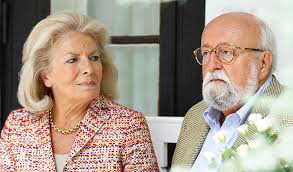
    It’s sad to read of the death of one of the greatest composers of our time: Krzysztof Penderecki. His music means a lot to me, most especially his 7th symphony which is subtitled The Seven Gates of Jerusalem. Read an article about this incredible work here. His Polish Requiem is another enduring favorite of mine, but then there is just one treasure after another to be found in the Penderecki catalog.

    Penderecki ~ O gloriosa virginum

    K & E

    There is an excellent documentary about the composer, wherein we meet his lovely wife Elżbieta Penderecka (née Solecka), whom he married in 1965. They lived in the Kraków suburb of Wola Justowska…

    Home

    …on a 70-acre estate where the composer had planted thousands of trees which he imported from around the world.

    Penderecki was the only contemporary composer who truly fascinated me – both thru his works and his personality – and the only one whose music I return to frequently. He lived a long life, and his music will continue to touch people’s souls. Now may he sleep in peace.

    ~ Oberon

  • Gregory Feldmann|Nathaniel LaNasa @ Weill Hall

    83265515_10157528132085353_8525152423453392896_o

    ~ Author: Oberon

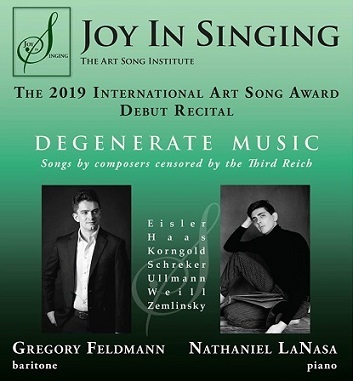
    Thursday February 27th, 2020 – Baritone Gregory Feldmann, recipient of the 2019 Joy in Singing Art Song Award, in recital at Weill Hall. Pianist Nathaniel LaNasa was the singer’s collaborator in a program of songs by composers whose music was suppressed under the Nazi regime.

    The program was particularly timely, living as we are during a period when our own government seems hellbent on destroying our democracy. It’s ironic that we fought Facism in the 1940s – and that in recent years we have sent our soldiers into harm’s way in faraway lands, purportedly to bring democracy and freedom to the oppressed – only to find our country is now under threat from within. With these thoughts in mind, tonight’s concert became much more than just another lieder recital.

    Mssrs. Feldmann and LaNasa, looking dapper in black bow-ties, took the stage to a hearty welcome from the packed house. The first half of their program was given over to songs by such well-remembered composers as Kurt Weill, Franz Schrecker, Alexander von Zemlinsky, and Erich Korngold.

    Kurt Weill’s cabaret-style “Berlin im Licht” opened the evening. Weill had been living in Paris – and then in New York – since 1933. But this song was composed for the Berlin Festival of September 1928 (ten years after Germany’s humiliation in World War I); that event marked a resurgence of German pride in its cultural endurance that would eventually fuel Hitler’s rise to power. Tonight, Mr. Feldmann and Mr. LaNasa gave the song a swinging, optimistic treatment.  

    Franz Schreker had died in 1934, but his music was still proscribed by the Third Reich. In three Schrecker songs, the musical attributes of this evening’s two artists came to the fore. In the Straussian style of Und wie mag die Liebe“, Mr. Feldmann’s handsome lyric baritone – and his persuasive way with words – assured us we were in for a great deal of very fine vocalism tonight. Of equal appeal was Mr.LaNasa’s playing, especially in the song’s postlude. 

    The partnership of the two musicians made for a luminous “Sommerfäden”, wherein the duo showed an affinity for Viennese-style melody. The shimmering piano introduction was enticingly played by Mr. LaNasa; this song has a rapturous mid-section, and then a big, operatic outpouring where Mr. Feldmann’s voice rang true.

    Stimmen des Tages” is darkish and unsettled at first; mood swings carry the two musicians thru to a passionate passage. Following a pause, the song resumes as if from the start. The gorgeous piano postlude was a treat in itself in Mr. LaNasa’s rendering.

    Four Alexander von Zemlinsky songs were most congenial to the Feldmann voice. The composer, who had moved to Vienna in 1933 and then on to New York City in 1938, was largely forgotten in Germany. His songs have long attracted great singers, and in the first three tonight – “Tod in Ähren“, “Nun schwillt der See so bang “, and “Entbietung” – singer and pianist were simply superb. “Tod in Ähren” stood out for me: following its big opening from the keyboard, it becomes a lament. Both musicians were so persuasive in this song’s gentle lyricism, and in the tenderness of farewell.

    The final Zemlinsky offering, “Afrikanischer Tanz” (African Dance), was a complete change of pace: aggressive and blood-stirring!  Mssrs. Fedmann and LaNasa caught the mood perfectly, and the song drew a whooping response from the crowd. 

    Erich Korngold, best-known of the evening’s composers (well, aside from Kurt Weill), was famous for his opera DIE TOTE STADT and for his film scores. He was already established in Hollywood by the time World War II broke out. Tonight we heard a set of four Korngold songs, of which the last – “Vesper” – was of particular appeal, with the piano’s repetitive notes evoking the evening chimes, and a vocal line that took the singer into his upper range. The song’s sustained ending was wonderfully evocative.   

    Following the interval, works by a trio of less fortunate composers: both Viktor Ullmann and Pavel Haas were sent to Theresienstadt, and then on to Auschwitz where they both perished in 1944, whilst Haans Eisler faced trials of a different sort.

    Ullman’s Liederbuch von Hafis consists of four songs, in which jazz influence can be felt. In the bouncy and ironic “Vorausbestimmung”, the music goes deep before one final bounce from the keyboard. In the following song,  “Betrunken” (Drunk), agitation finds a lull before proceeding on its droll trajectory.

    Mr. Fedmann’s lower range settled in nicely for “Unwiderstehliche Schönheit” (Irresistible Beauty), perhaps the most interesting of the Ullmann set: the piano takes up a trudging motif, a sort of tongue-in-cheek march. It is briefly interrupted by some bright, tinkling keyboard phrases before the pacing resumes. This leads immediately into the final song,”Lob des Weines” (In Praise of Wine), a salute to intoxication. Mssrs. Feldmann and LaNasa certainly had fun with this cycle. 

    Pavel Haas, who was Czech, drew on ancient Chinese texts for his Four Songs on Chinese Poetry; their sensual nature immediately won the label “degenerate”, and they offered so much fascination tonight as singer and pianist drew us along Haas’s musical pathway.

    The songs are full of longing – for home and for loved ones – which must have seemed all too poignant to Pavel Haas, who left his wife and child behind when he was deported. A recurring motif in the songs is a four-note musical ‘message’, referring to the Chorale to St. Wenceslaus: representing home and freedom, this small token would have been meaningful to other Czech prisoners at Terezín.

    In these four songs, Mssrs. Feldmann and LaNasa covered a wide spectrum of rhythmic, melodic, and poetic moods. Lines such as “My home is so far away…” and “My yearning keeps me awake…” seemed so poignant, and were so thoughtfully expressed tonight. But all is not gloomy, for the final song – “A Sleepless Night” – suddenly gives way to the sound of a magpie chattering at dawn, depicted by the pianist.

    A native of Leipzig, Haans Eisler spent the war years in Hollywood, where he was a successful composer of film score. His troubles came later, when he was investigated by the House Un-American Activities Committee; his own sister denounced him as a Communist. Eisler was deported in 1948.

    It was with Eisler’s “Friedenlied” (Peace Song) that the concert tonight ended. With a folkish feeling, this ballad sets forth a vision of hope. Despite a very annoying cellphone interruption, Mssrs. Feldmann and LaNasa carried on, with the pianist savouring a final postlude.

    A Zemlinsky encore was the performers’ response to a very enthusiastic ovation.

    These observations by the evening’s two artists are truly meaningful:

    “When we memorialize victims of atrocities such as World War II,” wrote Mr. LaNasa, “we must also remember the conditions that led to such horrors, and the voices of those who tried to tell the world what they feared was approaching.” And Mr. Feldmann said, “We want to commemorate the lives and work of these artists by giving our audience the opportunity to respond to their work. The oppressors of their day prevented society from hearing these words and scores, and it’s a privilege for us to thwart that mission with music that is so beautiful and potent.”

    The vociferous applause at the end of the concert indicated that the price these composers paid is not to be forgotten…and that they live on thru their music.

    ~ Oberon