Category: Dance

  • Karole Armitage’s You Took a Part of Me

    Armitage Gone! Dance_You Took a Part of Me (2019)_ Dancers_ Megumi Eda  Sierra French_Costume_ Peter Speliopoulos_ PhotoJulie Lemberger_2019-6891

    Above: Sierra French and Megumi Eda in Karole Armitage’s You Took a Part of Me; photo by Julie Lemberger

    ~ Author: Oberon

    Wednesday October 23, 2019 – Karole Armitage’s You Took a Part of Me, trailers and photos of which were apparently banned on Twitter, is playing this week at New York Live ArtsDrawing inspiration from Noh, the ancient ritualized Japanese form of dance-drama, You Took a Part of Me centers on the memory of an erotically charged love affair which has left a Woman (now a Ghost) in search of emotional resolution and a restoration of inner peace.

    On entering the theater, we see the stage set with an elevated platform outlined in fluorescent lights, with a small adjacent space with a low stool stage left; overhead, a square of tube light hovers. You Took a Part of Me is performed by three dancers: Megumi Eda (the Ghost), Sierra French (her Double), and Christian Laverde-Koenig (her Lover). A fourth dancer, Alonso Guzman, clad all in black with his face partly hidden, takes the traditional Noh role of the koken, a sort of valet. The lighting design by Clifton Taylor and the costuming by Peter Speliopoulos were key elements in the production’s success.

    Set to a poignantly spare, flute-centric score by Reiko Yamada, You Took a Part of Me unfolds in seven movements. Initially I felt that we might be watching a silent play, but the ballet is in fact filled with gorgeous, stylized dancing that flows like classical Japanese calligraphy. As the Woman’s memories darken, the dance becomes more angular and somewhat smudged.

    The Woman/Ghost is first seen seated on the low stool, the konen assisting her with her long hair. Her Double appears: identically clad in long white trousers, they seem like conjoined twins, with their hair entwined. They perform a mirror duet, in sync or in echo effect, with lyrical port de bras. During this, the Lover has taken a seat on the stool; an actor waiting for his entrance, he stares into the audience.

    03. Armitage Gone! Dance_You Took a Part of Me (2019)_ Dancers_ Megumi Eda  Cristian Laverde-Koenig_Costume_ Peter Speliopoulos_Photo Steven Pisano_20190611-DSC00346

    Above: Christian Laverde-Koenig and Megumi Eda; photo by Steven Pisano

    The Ghost and her Lover now dance a Memory Duet. To a spellbinding flute solo, they at first seem cordial and graceful, but then the seductiveness veers toward a more controlling stance on the Lover’s part. The konen enters and strips the two dancers down to thongs. The duet becomes intensely intimate, the flute so evocative of their passion. After their climax, silence falls. The Lover silently departs.

    As the Ghost dances a solo, Abandonment, the Lover – having put his shirt and trousers on – reappears and again sits on the stool. Ms. Eda, as the Ghost, collapses to the floor as her Double appears. Mr. Laverde-Koenig and Ms. French now engage in a pas de deux, Hijacked Mind, which replicates his earlier duet with Ms. Eda.

    Armitage Gone! Dance_You Took a Part of Me (2019)_ Dancers_ Megumi Eda  Sierra French  Cristian Laverde-Koenig_Costume_ Peter Speliopoulos_ Photo Julie Lemberger_2019-6671 copy

    In this intriguing scene (Julie Lemberger photo, above), as Ms. Eda dreams on the floor, the Double and the Lover seem to mimic his earlier duet with the Ghost. But here he often controls his partner without touching her. The konen again strips the couple; Ms. Eda rises and she and Ms. French have a competitive duet. As this progresses, Mr. Laverde-Koening reappears – now clad only in his thong – and again sits staring into space. Then a trio, Attachments, ends with the three wrapped in a seemingly naked knot on the floor.

    Now the Ghost/Woman is left alone, in white as at the start, the konen again ministering to her needs. She retains one of her long hairpins. As her memories replay in her mind, I found myself wondering if she intended to commit seppuku, inserting the pin into her neck, cutting the arteries with one stroke. This was the form of ritual suicide practiced by the widows of disgraced samurai.

    Armitage Gone! Dance_You Took a Part of Me (2019)_ Dancers_ Megumi Eda  Cristian Laverde-Koenig_Costume_ Peter Speliopoulos_ Photo Julieta Cervantes-252

    Above: Christian Laverde-Koenig and Megumi Eda; photo by Julieta Cervantes

    Between the excellence of the dancers, the power and poetry of the movement, and the sublime resonance of the music, You Took a Part of Me held the audience enraptured.

    Faye Arthurs, who I had a chance to catch up with after the performance, interviewed Karole Armitage for Fjord.

    ~ Oberon

  • Unsuk Chin’s Šu @ NY Philharmonic

    Dynamic-7d51bfe5-c754-58e3-8aab-5dbdf16210f5

    Above: Wu Wei, tonight’s soloist at The New York Philharmonic

    Author: Oberon

    Tuesday October 22nd, 2019 – Unsuk Chin’s Šu, for Sheng and Orchestra, performed by Wu Wei, was the centerpiece of this evening’s New York Philharmonic concert at David Geffen Gall. Susanna Mälkki was on the podium for a program that also featured music by Haydn and Strauss. It turned out to be a memorable evening, continuing a string of inspiring performances that I have enjoyed in these first weeks of the classical music season.

    Haydn’s Symphony No. 22, Philosopher, was the opening work. It’s a short – and very neat – symphony, which commences with an Adagio throughout which a steady, pacing pulse is maintained. The English horn is prominent, as are the horns (who excelled in the third movement). The concluding Presto had a lovely, bustling atmosphere. Ms. Mälkki’s finely-measured and elegant conducting drew excellent playing from the ensemble. 

    Wu Wei then took his place for Marie-Josée Kravis Prize-winner Unsuk Chin’s Šu. The composer stated that, for her, the sheng is associated with the “yearning for a distant sound…”  Šu – and Wu Wei’s playing of it – is truly engaging.

    56475_sheng_lg

    What is a sheng?  You may well ask (I certainly did). Above is an illustration, and here is an interesting article about this ancient Chinese reeded instrument. And what does the sheng sound like? Not similar to the oboe or bassoon – which was what I was expecting – but instead it reminds me very much of the musette, that enchanting little French bagpipe that was fashionable in French court circles in the 17th and 18th centuries.

    Šu begins with whispered, other-worldly sounds from the solo instrument. A vast array of percussion instruments will be heard as the work progresses – shimmering bells, eerie gongs, powerful drumbeats – whilst Mr. Wu’s sheng sighs and shivers. He produces echo effects, bending high notes to vary the pitch, and sometimes sounding like a squeezebox.

    The music seems to come to us from distant galaxies; images of frozen landscapes are evoked. The composer shows her mastery of texture and of rhythmic shifts. Violins stationed in the hall’s upper tier sing as if from from the heavens. Deep tuba rumblings give way to big, dense brass waves; the music becomes bouncy and then pounding.

    As calm sets in, Mr. Wu plays a sort of cadenza: fast, rhythmic, ascending, A forward impetus then takes over: the music sways, and the player sways with it, shifting his weight as he reels off amazing passages.

    The music subsides to a quiver; the orchestra produces a sustained, deep hum as the sheng is heard in ethereal whispers. Chimes sound, and this dreamworld fades into memory.

    Both the audience and musicians onstage enthusiastically applauded Wu Wei for his phenomenal performance. As a second wave of cheering swept thru the house, Mr. Wu returned for a brilliant (and sometimes witty) encore that called for incredible virtuosity; both his playing and his physicality – including some stomping dance steps and interjected shouts – captivated the crowd, and he basked in a rock-star ovation at the end.

    Malkki

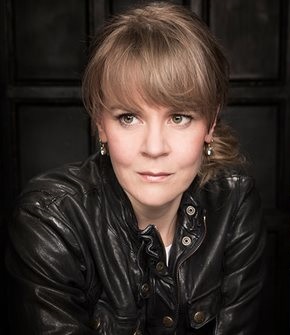
    Above: tonight’s conductor Susanna Mälkki

    Following the interval, Ms. Mälkki led a truly impressive performance of Richard Strauss’s Also Sprach Zarathustra. From its deep growl of a start rises the majestic, super-familiar theme that sets this blazing masterpiece on its way. The Philharmonic’s stellar bass section, joined by the organ, gave a rich depth to the music that sent chills thru me. Strauss has woven one appealing thread after another into this royal sonic tapestry; it’s a work in which there’s never a dull moment. Abounding in solo opportunities for individual instruments – clarinet, cello, trumpet, oboe, a trio of bassoons – the work further features a glorious tutti theme for celli and violins, and an enchanting Viennese waltz (led by the silken-tone of Sheryl Staples’ violin).

    Glimmers of ARIADNE AUF NAXOS, DER ROSENKAVALIER, and DIE FRAU OHNE SCHATTEN flitted thru the air as this epic performance by The Philharmonic sailed gorgeously forward. The only blot on the evening came when a grand orchestral cutoff was ruined by a child muttering and a cellphone going off, spoiling the dramatic effect of a sudden silence.

    ~ Oberon

  • Grimaud|Philadelphia Orchestra @ Carnegie Hall

    Default_4310-081

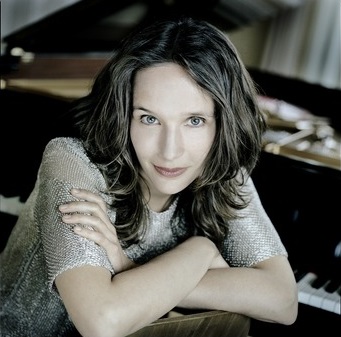
    Above: pianist Hélène Grimaud

    ~ Author: Ben Weaver

    Tuesday October 15th, 2019 – When The Philadelphia Orchestra premiered Valerie Coleman’s orchestral version of Umoja, Anthem for Unity last month, it was the first time the orchestra had played music by a living female African -American composer. Yes, there are still such firsts to be had in 2019. 

    Ms. Coleman’s work was originally written in 1997 for a female chorus, then arranged for a woodwind quintet (Coleman’s own acclaimed chamber ensemble, Imani Winds.) And now the full orchestral arrangement makes something clear: Ms. Coleman, born in Louisville, Kentucky, is a major voice in contemporary classical music and is a magnificent orchestrator.


    One thing I always note upon entering the concert hall where a contemporary piece is to be played is how big the percussion section is. Typically. it is large: everything and the kitchen sink. The problem, though, isn’t so much that there is more percussion than Mahler ever used, but that it is used as a crutch by so many contemporary composers; a crutch to transition from point A to point B to point C of the music. Unable to develop their material, too often composers rely on a few bangs and smashes from percussion to reset and change the subject. It’s lazy, it’s transparent and it’s bad music. And it is something Valerie Coleman notably does not do in her extraordinary orchestral version of Umoja, Anthem for Unity, a roughly 14 minute cinematic tone poem of shifting moods, sweeping melodies, surprising orchestral effects (the bowed vibraphone that opens the piece, for example) and undeniable joy.


    Thumbnail_6a00d8341c4e3853ef022ad378896b200c


    Ms. Coleman (above) explains in the Playbill that the work grew out of a simple, short melody. “Here the melody is sung sweetly in its simplest form and is reminiscent of Appalachian-style music. From there, the melody dances and weaves throughout the instrument families, interrupted by dissonant viewpoints led by the brass and percussion sections…” Someone described the work almost as a concerto grosso, where the music passes around, evolving and shifting from section to section. This gives many artists on stage to shine, notably the wind and the brass sections. Maestro Yannick Nézet-Séguin shaped the work expertly and the thunderous ovation that greeted Ms. Coleman on stage at the end, one hopes, sends a message to leaders of orchestras and opera houses. Tonight, the Metropolitan Opera’s  general manager Peter Gelb sat directly in front of me; did he realize that before us was an extraordinary composer, worthy of more commissions. Why not an opera, Mr. Gelb?


    Béla Bartók’s Piano Concerto No. 3 received a spectacular performance from Hélène Grimaud. The playful, spiky, percussive writing of the outer movements presented no challenges to Grimaud, her crystal clear playing etching each note as if out of marble. Yet the percussiveness was never mere banging on the keyboard either; Grimaud is too good of an artist for cheap tricks. But it is in the concerto’s slow movement, Adagio religioso, that Bartók’s soul and Grimaud’s musicality and artistry truly shone. Conductor and orchestra provided first rate support. 


    After intermission Richard Strauss’ last tone poem, Eine Alpensinfonie, received a thrilling, no holds-barred performance. Strauss began composing the work after years of putting it off after the death of Gustav Mahler in 1911. “Mahler’s death has affected me greatly,” Strauss wrote and set out to complete Eine Alpensinfonie, an unacknowledged tribute to Mahler. Certainly Mahler’s love of nature – which he attempted to capture in his music throughout his entire career – is here in spades as one travels through the Alps.


    Strauss divides the symphony into sections representing different parts of the region. Between the growling, dark Night that opens and closes the symphony, the wanderer observes a glorious Sunrise, a magnificent Waterfall, a treacherous Glacier, a horrifying Thunderstorm and chilling winds disappear with Sunset as Night returns. Strauss, of his many gifts, was an exceptional orchestrator. His command of large orchestral forces, of sound-painting has no betters. (Equals, maybe, but no betters.) The Philadelphians threw themselves into the music as if possessed, with Nézet-Séguin once again demonstrating that his grasp of the great Romantics is something of a specialty.


    ~ Ben Weaver


  • Dover Quartet|Emanuel Ax @ Zankel Hall

    Dover+Quartet+2+credit+Carlin+Ma

    Above: the Dover Quartet, photographed by Carlin Ma

    Author: Oberon

    Tuesday October 15th, 2019 – My first chance to hear the Dover Quartet live, in a finely-devised program at Zankel Hall that offered quartets by Britten and Brahms, plus the Schumann piano quintet with Emanuel Ax at the Steinway.

    Benjamin Britten’s String Quartet No. 1 in D-major was superbly rendered by the Dovers; their playing seemed to make an immediate and direct connection with the audience, who all evening were raptly attentive – and warmly appreciative.

    The opening passage of the Andante sostenuto finds the violins and viola blending in an ethereal, high-lying motif that evokes seabirds crying above a deserted beach. There is a feeling – not of loneliness, but of being alone – that is wonderfully evocative. The music then turns more vigorous, the players digging in over a steady rhythm. The mood shifts back to the otherworldly again, followed by a rich-textured paragraph with viola and cello playing in unison. A buildup of tension calms to a high pianissimo, and a coda resolves into a misty softness.

    In the Allegro con slancio, a soft pulsing underscores witty comments from each instrument; a sudden burst of joy in the music made me smile. A unison passage leads to a strutting dance; then, turning more subtle, the movement has a wry ending.

    A feeling of tranquility sets on with the Andante calmo, which is lulling and pensive. Octaves sound, violinist Joel Link takes up an achingly beautiful theme, and Camden Shaw’s cello sings poignantly. The music turns hymn-like. Violins and viola take phrases over an insistent cello plucking. The music ascends to the heights, and Milena Pajaro van de Stadt’s viola makes a lovely impression, and then Mr. Link’s violin rises to a sweet concluding high tone.

    In the last movement, Molto vivace, a witty theme is passed about, with plucking and strumming keeping things upbeat. The music’s driven and whimsical, with little shivers laced in. Banners of melody wave before us, and virtuosic bits lead on to a unison finish.

    The musicians did not leave the stage following the Britten; after acknowledging the audience’s appreciative applause – and having to rise a second time, thanks to prolonged applause – they commenced immediately on the Brahms quartet.

    Johannes Brahms’ Opus 67 – the String Quartet No. 3 in B-flat major – is one of those very pleasant works that does not always resonate for me. Tonight, from note one, the Dovers gave it a kind of freshness that made it seem new…like hearing it for the first time. And that’s saying a lot.

    The individual players shone in this music. The opening movement, Vivace, pairs the second violinist (Bryan Lee) with violist Milena Pajaro van de Stadt in a friendly doubles match against Joel Link (violino primo) and cellist Camdem Shaw. They trade duetting passages in a way that makes the term vivace ring true. Elsewhere, a recurring trilling motif from Mr. Link was a further enticement.

    In the Andante, Mr. Link makes  the gorgeous theme sound better than ever with his expressive playing. Here again, each voice makes its mark. The music ranges from pensive to urgent rising to a lovely “Amen” at the finish.

    The scherzo, here referred to (appropriately) as Agitato, opens with a surprisingly sad passage, but soon perks up.  Mr. Link revels in his dynamic range, and Ms. Pajaro van de Stadt’s viola is very prominent, her tone having an Autumnal glow but with a trace of grit tantalizingly thrown in here and there. She even has a sort of cadenza, the better for us to savour her playing. This movement ends on a sustained chord with a lovely feel of “settling”. 

    The Dover’s take on the opus 67’s theme-and-variations finale made me admire them all the more. Brahms weaves in themes heard earlier, and the music is sometimes quite meditative. Enthusiastic applause and cheers greeted the musicians as they took their bows.

    EA2215_LisaMarieMazzucco

    Following the interval, the inimitable Emanuel Ax (above, in a Lisa Marie Mazzuco photo) joined the Dover for Robert Schumann’s Piano Quintet in E-flat Major. This very familiar – and very marvelous – music seemed to flow like a limpid stream, the pianist setting the tone with his playing, which was both elegant and spirited.

    The Allegro brillante sets out dramatically, the cello and viola exchange plush-toned phrases. At the keyboard, Mr. Ax ‘s intrinsic gifts of timing and dynamic control are cause for delight. The listener could luxuriate in the Mozartean glow of the music, with passing wisps of dark cloud dispelled in a grand finish.

    The second movement, the dark clouds have lingered: it commences as a halting funeral march, and we feel the undertaker sneaking about. A sublime lyrical interlude follows, but then the lamenting march resumes. After being briefly invigorated, with the viola sounding forth and the piano in a rolling motif, the music resumes it funereal procession. Mr. Ax’s playing here is sublime.

    The Scherzo, its agile scales and lively arpeggios contrasting with a lyric interlude and a brief downcast passage, finally turns brilliant, with the feel of a gypsy dance. Sparkling playing from Mr. Ax here continued in the Allegro ma non troppo, which opens with an accented theme from the piano. Schumann juxtaposes dance-like gaiety with cunning lulls, and a fugue brings this entrancing work to a close.

    The audience responded to this stellar performance with a spontaneous standing ovation, laced with shouts of approval. The musicians were called out twice, and while we were all clearly in hopes of an encore, perhaps there’s nothing that could have followed that radiant Schumann.

    ~ Oberon

  • 20th Century Masterworks @ The NY Philharmonic

    _DSC9923

    Above: Katarina Karnéus in ERWARTUNG at The New York Philharmonic; photo by Chris Lee

    ~ Author: Oberon

    Thursday September 26th, 2019 – This long-awaited program by The New York Philharmonic paired Arnold Schoenberg’s monodrama ERWARTUNG with Béla Bartók’s expressionist opera BLUEBEARD’S CASTLE. The Philharmonic’s music director, Jaap van Zweden was on the podium, and a trio of esteemed singers took on the demanding vocal roles. The orchestra was simply splendid, from first note to last.

    In 1989, the Metropolitan Opera presented these two works on a double bill, conducted by James Levine. Jessye Norman sang both The Woman in the Schoenberg and Judith in the Bartók; Bluebeard was sung by Samuel Ramey. It was a magnificent evening musically, though the setting and direction for the Bartók left a lot to be desired. But the staging of the Schoenberg was unforgettable: just a grand piano, hundreds of white candles, and Ms. Norman. How I would love to see it again!

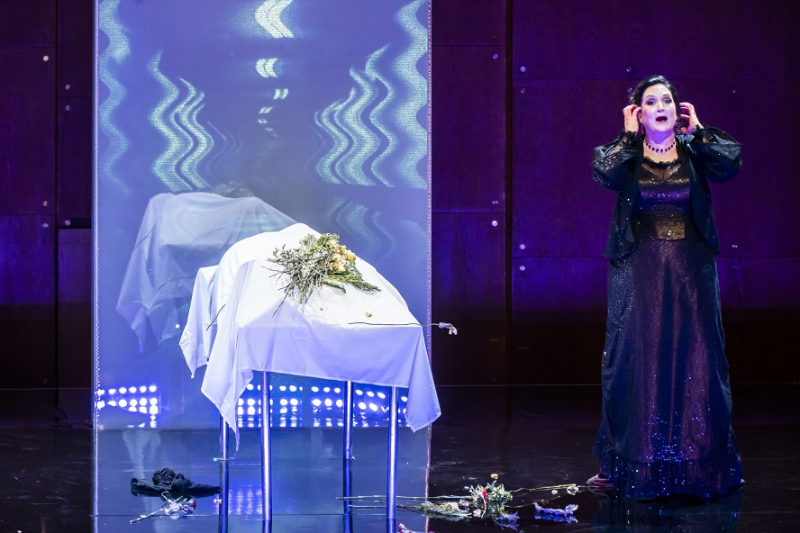
    The idea of presenting these two works in a semi-staged concert setting at Geffen Hall seemed intriguing on paper but was less successful in practice. The singers performed on a raised platform behind the musicians, who were seated in near darkness. The addition of silent actors – portraying medical staff and a crime-scene photographer in ERWARTUNG, and Bluebeard’s previous wives in the Bartók – neither added to nor distracted from the flow of the two works. From where we were sitting, we could not discern what was under the sheet of that autopsy table, which was revealed when they came to take The Woman away. One small screen sufficed for the projections, which were neither here nor there. The lighting effects, however, were well-integrated into the music, especially a blood-red drenching at one point.

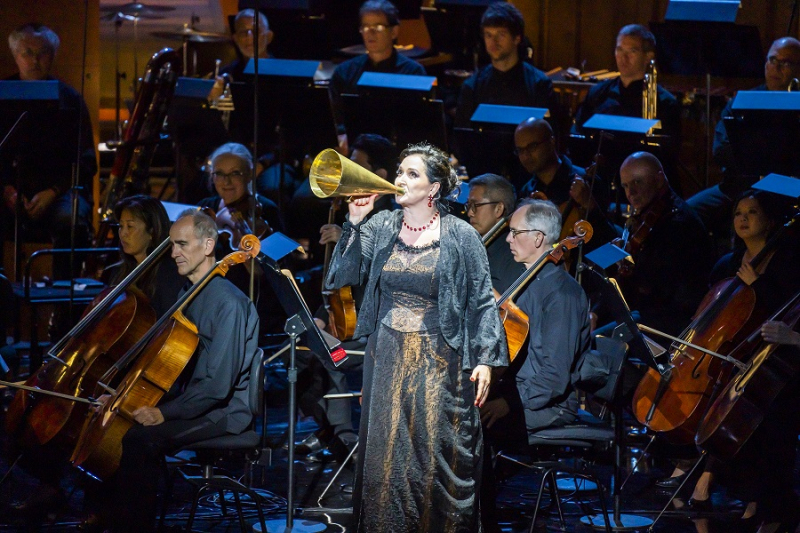
    The monodrama and the opera were linked theatrically by having Katarina Karnéus, who had just given a phenomenal performance in the Schoenberg, re-appear as the prologue to BLUEBEARD’S CASTLE. Here, Ms. Karnéus (using a megaphone) proved to be every bit as engaging as a speaker as she has been in her singing of The Woman. And while, in the end, the evening could have just as thrillingly been presented in straight-up concert form, that would have deprived us of Ms. Karnéus’s inspired acting of her role.

    The concert opened with a performance of the song Erwartung, from Schoenberg’s Vier Lieder, his opus #2, composed in 1899. This gorgeous piece of music, which I had never heard before, was originally written for voice and piano but was tonight performed in a setting for voice and harp. The Philharmonic’s harpist Nancy Allen played divinely, creating a poetic atmosphere. In a black gown shot with silver and holding a large bouquet, soprano Nina Stemme’s voice seemed beset by a wide tonal beat or fluctuation which rather undermined the strange beauty of the song. Ms. Stemme fared much better in BLUEBEARD, where she was fully warmed-up and with the voice profiting from the cushioning orchestra.

    Katarina Karnéus was the Cardiff Singer of the Year in 1995 and from there went on to a grand worldwide career. She came to The Met in 1999, debuting as Varvara in KATA KABANOVA and also appearing as Siebel, Olga in EUGEN ONEGIN, as Rossini’s Rosina, and as Cherubino. I had the pleasure of meeting her while I was working at Tower Records, and of attending a lovely recital she gave in 2001 with pianist Brian Zeger. She last sang at The Met in 2005; in the interim she has developed into a fascinating singing-actress.

    _DSC0141

    Above: Katarina Karnéus as The Woman in ERWARTUNG; photo by Chris Lee

    What a performance of ERWARTUNG Ms. Karnéus gave tonight! The voice encompasses an impressive vocal span, with a silvery sheen on the high notes and a dusky, dramatic throb in the lower range. Her wide-ranging singing is pointed and subtle in terms of word colourings, has a lovely vein of lyricism running thru it, and is possessed of striking power in the climactic moments. It’s an expressive, even bewitching, instrument. Beyond this, Ms. Karnéus is a compelling physical presence, and she captured the emotional state of The Woman with her vibrant and detailed physicality; at one point her entire body was overcome with trembling agitation. Mixed in with the madness were passages that were extraordinarily moving, as in the moment she tells her absent lover that he has “…not even the grace to let me die with you.”

    In recent years, only a handful of operatic performances have captivated me in the way Katarina Karnéus did tonight in ERWARTUNG. She is truly one of a kind.

    Here’s a sampling of the Karnéus voice:

    Katarina Karneus – Mahler ~ Ich bin der Welt abhanden gekommen

    _DSC0348

    Above: Katarina Karnéus in the spoken prologue to BLUEBEARD’S CASTLE at The New York Philharmonic; photo by Chris Lee

    After the interval, BLUEBEARD’S CASTLE commenced with a re-appearance of Ms. Karnéus in a speaking role; I must admit that I found myself wishing she was also singing Judith, for while there is no denying the power and commitment of Nina Stemme’s performance in that role, hers is a voice that has never reached me on a deeper level. That said, the soprano was in full-tilt form for the Bartók tonight and was much admired by the audience.

    In the role of Bluebeard himself, it gave me great pleasure to see onstage again the excellent baritone Johannes Martin Kränzle who, in 2014, was an ideal Beckmesser in his (to date) only Met appearances. We simply must have this man back at The Met, for he is a singing-actor (and an acting-singer) of the highest calibre. 

    _DSC0651

    Above: Johannes Martin Kränzle and Nina Stemme in BLUEBEARD’S CASTLE; photo by Chris Lee

    Ms. Stemme and Mr. Kränzle made the Bartók glow in all its dark radiance with their powerful vocalism and intense acting. They played beautifully off one another, seeming to feed off each others energy as well as off the astonishing sounds being produced by the artists of the Philharmonic.

    It was a performance to immerse oneself in totally, and by the time the harp and horns marvelously underscored Mr. Kränzle’s spectacular vocalism at the opening of the fourth door, I was thoroughly enthralled. Ms. Stemme’s blockbuster high-C at the opening of the fifth door was followed by simply mind-bogglingly impressivel singing from the baritone. Ever a compelling mover, Mr. Kränzle even executed a little dance, and then led his soprano is a waltz.

    Responding to Judith’s questions about the mysterious white lake, Mr. Kränzle was hauntingly moving as he replied: “…tears, Judith…tears!” And then – incredibly – he took his performance to an even higher level with his gorgeous singing of the passage where Bluebeard describes how he met his previous wives and what they mean to him: morning, noon, and evening have been personified for him by these women, and with Judith joining them, his world is complete. “Now it will be night forever!”

    _DSC1438

    Above: from BLUEBEARD’S CASTLE, photo by Chris Lee

    Throughout the evening, the playing of The New York Philharmonic was darkly dazzling, glorious, sublime. Maestro van Zweden reigned over the music with a sure sense of its enormous emotional range, from eerie piani to unfettered, magnificent fortes. The musicians played their hearts out, creating sonic textures that sent chills thru me time and again, and the numerous solo passages were given extraordinary clarity by these remarkable artists.  

    ~ Oberon

  • GrahamDeconstructed: Steps in the Street

    2019_MGDC_Steps in the Street_05

    Above: Anne Souder of the Martha Graham Dance Company in Graham’s Steps in the Street; photo by Elisabeth Atjay

    ~ Oberon

    Tuesday September 24th, 2019 – Kicking off their season of studio presentations, the Martha Graham Dance Company tonight gave us an up-close look at Steps in the Street, the second movement of Graham’s powerful and thrilling larger work, Chronicle. It was premiered in New York City on December 20th, 1936, and stands as the choreographer’s glorious response to the rise of Facism. As such, it resonates today when democracy is under threat from forces within our beloved country.

    It was in 2012, at an invitation-only studio rehearsal of Chronicle at Joyce SoHo, that I fell under the spell of Martha Graham. I was only slightly familiar with her work at that time, but on that afternoon, I fell in love with not only the choreography but with the dancers, both as a collective and as individuals. Over the ensuing years, the roster of artists has inevitably changed; but my feelings have not. The current Graham ensemble fascinates me every time I see them.

    Steps in the Street, which was considered a “lost” work for several years, was reconstructed in 1989 by Yuriko and Martha Graham, relying on a miraculously-discovered Julian Bryan film as a starting point.

    On this absolutely beautiful end-of-Summer evening, my choreographer-friend Claudia Schreier and I went down to the Graham homespace on the 11th floor of 55 Bethune Street for Steps in the Street. We were totally prepared to be blown away, and that’s exactly what happened.

    Brief excerpts from the old black-and-white film of Steps in the Street were being shown as we took our seats. Later, the Graham Company’s Artistic Director Janet Eilber used passages of this film as an introduction to the various movement motifs, which were then performed by the current ensemble of Graham women. Thus does this intriguing ballet grow from an opening passage of individual dancers walking backwards in silent, pensive poses slowly transform itself from a state of “Devastation – Homelessness – Exile” into a community of feminine determination.

    During the presentation, projections of drawings being spontaneously created by artist Sohyun Bae were shown; working with ambidextrous haste, the artist produced a series of pictures which did not attempt to literally depict the choreography, but rather to reflect the artist’s emotional response to the dancing and the music.

    A complete performance of Steps in the Street was then given. Leading the ensemble, Anne Souder, a lithe dancer of marvelous suppleness and intrinsic mystique, was spellbinding. Each of the ten women of the ‘corps de ballet‘ was able to display her unique gifts as an expressive artist whilst maintaining the stylized unity of the collective. The performance was simply fascinating to behold.  

    Alongside Ms. Souder, the participating dancers were So Young An, Alyssa Cybulski, Laurel Dalley Smith, Natasha M. Diamond-Walker, Charlotte Landreau, Marzia Memoli, Anne O’Donnell, Aoi Sato, Androniki Vasili, and Leslie Andrea Williams. They left me feeling both elated and hopeful.

    Photos by Elisabeth Atjay from this evening’s studio presentation of Steps in the Street:

    2019_MGDC_Steps in the Street_01

    Anne Souder; in the background, a projection of Sohyun Bae’s spontaneous drawing

    2019_MGDC_Steps in the Street_02

    Walking in silence: Anne Souder in the foreground

    2019_MGDC_Steps in the Street_03

    The ensemble, with Ms. Souder in the foreground

    2019_MGDC_Steps in the Street_04

    The final moments of Steps in the Street 

    ~ Oberon

  • Francesca Todesco ~ Isadora Duncan Classes

    20181011121518-f108-sokolowtodesco2018photobydanieldugan

    Francesca Todesco (above) is offering a series of classes focusing on the technique and repertory of Isadora Duncan, to be held on Fridays from 1:00-3:00 PM at 12 Saint Marks Place, on Manhattan’s Lower East Side. The classes will run from September 20th thru December 20th, 2019. Details below:

    70988457_2955578114469155_7951244578235875328_n

    Francesca’s dedication to the Duncan legacy – both as a dancer and teacher – makes her an invaluable spokeswoman in all matters Isadora. Francesca recently attended the Isadora Duncan International Symposium in London – an event held every other year in a different city – where an international gathering of performers, instructors, and writers meet to celebrate and honor the Mother of Modern Dance.

    Francesca Todesco epitomizes the enduring grace and power of the Duncan style, which has been handed down from generation to generation; she studied here in New York with Catherine Gallant and Loretta Thomas. Thru her classes, Francesca continues the tradition.

    Isadora Duncan is one of the most fascinating women of all time. I read her biography once a year, and have found that my interest in her took on a personal resonance when I realized that I am related on my mother’s side to one of Isadora’s pianists – and lovers: Walter Morse Rummel. Their story is but one of so many intriguing episodes in the life of this spellbinding woman.

    ~ Oberon

  • Table of Silence ~ 2019

    L2010773

    Wednesday September 11th, 2019 – Today marked the annual Lincoln Center performance of Jacqulyn Buglisi’s Table of Silence, a danced ritual commemorating the 9/11 terrorist attacks on New York City and Washington DC. This year, it took on an even deeper resonance as a plea for reason and compassion in our dark and dangerous world.

    As each day seems to bring ever more unsettling headlines, I am constantly put in mind of the words sung by the desperate wife and mother Magda Sorel in Gian-Carlo Menotti’s opera The Consul:

    “To this we’ve come:
    that men withhold the world from men.
    No ship nor shore for him who drowns at sea.
    No home nor grave for him who dies on land.
    To this we’ve come:
    that man be born a stranger upon God’s earth,
    that he be chosen without a chance for choice,
    that he be hunted without the hope of refuge.
    To this we’ve come. And you, you too, shall weep.”

    Table of Silence shines like a beacon of hope; each year, it seems more beautiful…and more meaningful. 

    ~ Oberon

    Note: some photos here.

  • Kuusisto/Sundquist ~ A Little Night Music

    Hp-little-night-music

    Above: the Stanley H. Kaplan Penthouse at Lincoln Center

    Author: Ben Weaver

    Saturday July 27th, 2019 – Finnish violinist Pekka Kuusisto and Swedish double-bassist Knut Erik Sundquist had a long evening at the Mostly Mozart Festival: first they performed a full concert of Bartok and Vivaldi with the Mostly Mozart Festival Orchestra, conducted by Andrew Manze, followed by a special appearance at the Stanley H. Kaplan Penthouse for a series called A Little Night Music, an intimate one-hour program of music and wine.

    Pekka Kuusisto is not your traditional classical violinist. Although classically trained and a winner (first place) of the Jean Sibelius Violin Competition (Kuusisto was the first Finn to win there, in 1995), he spends as much time performing non-classical music as classical. “Crossover” would not be the right word; he’s not necessarily playing arrangements from Cats. But his dedication to playing many different types of music and his improvisational skills place him in a somewhat different category from most other concert violinists. When he does venture into the strictly classical repertoire – as he did last year with a recording of J.S. Bach’s complete Sonatas and Partitas for Solo Violin – the results are unpredictable and often electrifying. 


    Kuusisto is a dynamic stage personality; encountering him in a small space like the Kaplan Penthouse is a singular experience. With the night-time NYC skyline shining behind the stage, Kuusisto and his frequent stage partner, the great double-bassist Knut Erik Sundquist, easily filled the hour with a wide range of music, hilarious banter (like a vaudeville act, the ease of their interactions can only be perfected over many years of friendship) and sound life advice (after a night of drinking, make sure you go home before you go to bed.)


    The duo broke up the musical selections into aptly titled Minuet Section, Sad Section, and Happy Section. The Minuets were courtesy of Bach and traditional Finnish folk dance, played and improvised seamlessly. The middle Sad Section was launched by a mysterious Austrian tune Kuusisto once heard on TV while watching a weather report at the Ischgl ski resort and transcribed for posterity. (Since Kuusisto has never been able to figure out the source of the tune, he simply calls it Memories from Ischgl.) Occasionally he hummed while playing this lovely, orphaned tune. And the final Happy Section of cheerful traditional melodies from Finland and Sweden, and – of all things – a Spanish tango from Poland that’s especially beloved in Finland. (Here I was reminded of a famous line from Edith Wharton’s The Age of Innocence about the opening night of the (Old) Met: “She sang, of course, ‘M’ama!‘ and not ‘he loves me,’ since an unalterable and unquestioned law of the musical world required that the German text of French operas sung by Swedish artists should be translated into Italian for the clearer understanding of English-speaking audiences.”)


    The beauty of all this music and the intimacy of the presentation made for a fascinating evening. Kuusisto’s command of his instrument, the ease of the playing, his ability to transform the sound from a “serious violin” to a “dancing fiddle” were extraordinary. The dreamy expression on his face when playing Bach and a Finnish folk tune reveal a deep love and appreciation for music, the source is secondary.


    Sometimes classical music lovers can get too hung up on purity. Truth is that music from any source can trigger the deepest feelings and memories: from Traditional to Bach to Cole Porter to Madonna. As the only truly universal language on Earth, music of all kind can bring out every imaginable emotion. This ability to communicate in different musical languages – and helping the audience embrace the differences – may be Kuusisto’s greatest gift to his audience.


    ~ Ben Weaver


    Note: Oberon has written about the July 26th performance of the Suusisto/Lundquist/Manze Four Seasons here.

  • Pekka Kuusisto @ Mostly Mozart

    Out_there_Kuusisto_Pekka_2018-19_03

    Above: Pekka Kuusisto, photographed by Kappo Kamu

    ~  Author: Oberon

    Friday July 26th, 2019 – An unusual and exciting program at Mostly Mozart this evening as violinist Pekka Kuusisto joined the Mostly Mozart Festival Orchestra under Andrew Manze’s baton. The program featured music of Bartók, plus Mr. Kuusisto’s setting of Vivaldi’s beloved Four Seasons into which folk music from Norway and Finland has been woven.

    Béla Bartók’s Romanian Folk Dances, arranged for string orchestra by Arthur Willner, opened the evening on an upbeat note. Mr. Kuusisto and his sidekick, bassist Knut Erik Sundquist, participated as members of the ensemble, further spicing up the already lively music. What a treat to hear these pieces played live! They have an irresistible impulse, to which the two guest soloists introduced embellishments that gave an additional flair.

    The six-dance suite commences with Jocul cu bâtă (“Stick Dance”), with an interesting ‘pulling’ rhythm. Then comes the jaunty Brâul (“Sash Dance”), followed by the Pe loc (“In One Spot”) into which Mr. Kuusisto injected a spaced-out, high violin passage. Buciumeana (“Dance from Bucsum”) was my favorite of the dances, being slowish and tinged with sadness. (Sample it is Emmanuel Pahud’s flute rendition here.)

    Then came the lively Poarga Românească (“Romanian Polka”) after which Mssrs. Kuusisto and Sundquist lit into a fast and funky duet which morphed into the Mărunțel (“Fast Dance”); here the violinist exceeded the speed limit with his amazing technical facility as well as fancy foot-work – as much fun to watch as to hear. Sweeping on with the orchestra to a grand finale, the players were awarded a vociferous ovation from the crowd for their exhilarating performance.

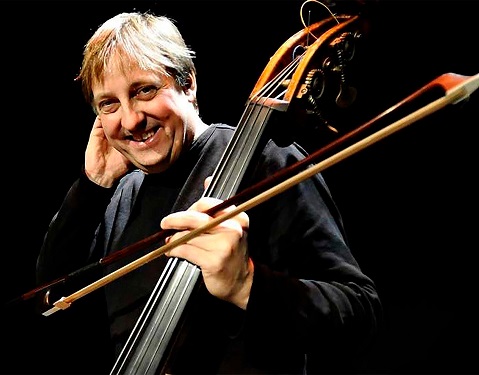
    Mwmzzhhrm93k6f281j4m

    If Mr. Kuusisto was in the limelight all evening, bassist Knut Erik Sundquist (above) made a vivid impression in his own right. I imagine that. had he not been constrained by holding onto his bass, he would have joined in the dancing. His facial expressions were priceless. 

    Without intermission, the performance continued with the ultra-familiar Vivaldi Four Seasons, rendered – as if by time-warp – as a fusion of Baroque and contemporary modes, into which Mssrs. Kuusisto and Sundquist interpolated traditional music from Finland and Norway. If you’re going to fiddle around (!) with the classics, this is the way to do it. 

    The great lilting start of “Spring” was flowing along congenially when suddenly sounds like a swarm of birds were heard. Later, the violas sounded seasick, and later still the drone of a bagpipe was evoked. In “Summer”, the strings melted and drooped, the violin and a cello engaged in an off-pitch dialog, and the music sizzled or soured before turning briskly exciting. A decrescendo brought whispers and falterings; and an en masse turn of the page was truly amusing. A storm breaks, the finale carries  on with more interruptions and some scraping motifs.

    “Summer” was perhaps the highlight of the Seasons, and a program note mentioned the fact that this concerto is “…built of exclusively unpleasant conditions, (connecting) it with the ongoing climate debate.”

    Kuusisto and Sundquist opened “Autumn” with a duet; the music sometimes took on an ‘outer space’ feeling. A snoring woman next to us rather spoilt the effect, but she woke up when Mr. Kuusisto started whistling. The tapping of bows on instruments and a ‘drunken’ passage kept us engaged. 

    Animated plucking – and a bit of humming from the orchestra members – were among the felicities of “Winter”; Mr. Kuusisto was by now in full “mad violinist” mode, his virtuosity simply mind-boggling. 

    An enormous standing ovation ensued, the audience clearly thrilled by what they had heard. Maestro Manze and the two soloists were called and re-called, to veritable tsunamis of applause. 

    Before the concert started, Maestro Manze spoke of what we were about to hear, and he asked that everyone in the audience “..stay to the end…”; I’ve never heard that kind of request at a concert. At any rate, a few people did head for the exits during The Four Seasons. But one woman, who was seated in the stage seats, attempted to leave and was sent back to her seat by an usher.

    ~ Oberon