Category: Dance

  • Arensky & Brahms @ Chamber Music Society

    Bella2

    Above: violinist Bella Hristova, photographed by Lisa-Marie Mazzucco

    Author: Oberon

    Tuesday March 28th, 2023 – Works by Anton Arensky and Johannes Brahms were on the bill at Chamber Music Society of Lincoln Center this evening as violinist Bella Hristova, cellist Dmitri Atapine, and pianists Wu Qian and Wu Han teamed up for some magical music-making.

    The concert commenced with Arensky’s Six Children’s Pieces for Piano, Four Hands, Op. 34, composed in 1894. These charming miniatures found our two pianists side by side at the Steinway, with Wu Han presiding over the upper octaves and Wu Qian the lower.

    To give the pieces their English titles, we start with Fairy Tale which begins in the minor key, has a folkish feeling, and then becomes quite dramatic. Wu Han plays a series of decorative trills as the music ranges from hesitant to animated. Then, Wu Qian plays the familiar two-note birdcall that signals the delightful Cuckoo bird is nearby. This is a sprightly little piece with a subtle finish. The mood changes for Tears, which has the feel of a lament, with a deep bass line supporting a hymn-like melody. The ending is very quiet.

    Rippling motifs underscore the lovely Waltz, which gets quite bouncy. A passing reverie turns expansive before fading away, as if the dance was continuing in another room. Cradle Song appropriately has a slow, rocking feeling; the melody is that of a gentle lullaby. The concluding Fugue on a Russian Theme is tuneful and jovial. The music turns grand, and the two pianists have a grand time playing it.
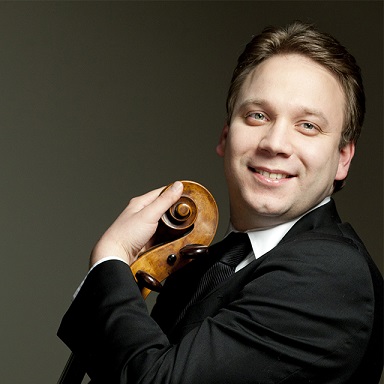
    Dmitri-atapine

    Listening to Bella Hristova and Dmitri Atapine (above), joined by Wu Qian, play the Arensky Trio No. 1 in D -minor for Piano, Violin, and Cello, Op. 32, makes one wonder why we don’t hear more of this composer’s gorgeous music. He wrote copiously for solo piano, and numerous chamber works as well. And why cannot we hear more of his large orchestral works – which include two symphonies – or his choral pieces?  He also wrote three operas, which must be wonderful to experience.

    At any rate, we must be thankful for any opportunity to hear the music of this pupil of Tchaikovsky, especially when it as a luminously played as this evening. The introductory theme of the opening Allegro moderato, first played by Ms. Hristova and then taken up by Mr. Atapine, is hauntingly beautiful. These virtuosos bring such richness of timbre to everything they play, and this trio – a veritable font of melody – affords them so many opportunities.

    It is restless, passionate music, interrupted by a Springlike interlude in which Wu Qian spins lovely swirling passages from the Steinway. Now a sense of drama takes hold; the opening theme recurs, played – if it’s possible to imagine – even more thrillingly. There is a coda full of lyrical grace before the movement ends quietly.

    The ensuing Scherzo opens with an odd, stuttering quality. There are crisp plucking and jaunty melodies to be savoured, whilst at the keyboard Wu Qian offers cascades of notes decorated with lively trills. Now a swaying feeling takes over, and the music gets grand. After a brief hesitation, the stuttering resumes and the Scherzo comes to its whimsical finish.

    The evocative Elegia is the heart of the trio: Mr. Atapine opens with a pensive theme, then the string voices entwine as Wi Qian introduces poetic phrases from the keyboard. The music seems to evoke the memory of a lost love as the gently rocking strings sound over the quiet rapture evoked by the pianist. Ms. Hristova in her high range, the pianist pulsing quietly, and Mr. Atapine plucking ever so gently give the music an ethereal quality. Ms. Hristova takes up an autumnal melody as Mr. Atapine’s deep resonance sounds and the music fades away on a sustained chord.

    A reverential silence filled the hall, and then the agitated drama of the final Allegro non troppo sprang up. Things cool off, melodic phrases are exchanged, but then restlessness builds and the music becomes impassioned. From a sudden silence, Wu Qian’s shimmering notes are heard as the strings sing softly. The music ascends, and becomes reflective with the poignant violin and the soulful cello sounding. Then, out of the blue, a bustling rush to the finish line springs up. 

    The music of Johannes Brahms took the limelight after the interval: our two pianists returned for selections from the composer’s Hungarian Dances for Piano, Four Hands; Wu Qian was now playing the upper range and Wu Han the lower. These delightful pieces were written between 1868 and 1880, and they are chock full of rhythmic and melodic variety, spiced with a dose of paprika. The two women seemed to be having a blast playing them, much to the audience’s delight.

    Bringing the evening to its close, Wu Han, Ms. Hristova, and Mr. Atapine illuminated the Brahms Trio in C-major Op. 87, with sumptuous playing.

    In the opening Allegro, a unison theme for violin and cello develops int something big ad thrilling. When cal finally settles in, a sense of yearning is felt. The textures created by the three players are rich indeed, each displaying alluring tone that meshes into a persuasive whole. Epic grandeur develops as we relish Wu Han’s superbly polished playing, which takes the movement to a royal finish.

    Unison strings again herald the Andante con moto: a theme with five variations. The music takes on a gypsy air, reflecting Brahms’ interest in Hungarian music, which began in his youth. Here the blend achieved by our three artists was nothing short of remarkable, continually drawing me in to the music, which reaches a touching, quiet ending.

    In the brisk Scherzo, I sensed a Mendelssohnian enchantment. Lush melodies sprang up, and there’s a songful outpouring before a feeling of Puck lurking about returned at the music’s sudden stop.

    From its opening agitato, the concluding Allegro giocoso brings an abundance of delicious melodic and rhythmical treats, and the Mendelssohn mood continued to be felt. The musicians were warmly cheered as they took their bows, and I simply must mention Ms. Hristova’s bejeweled shoes, which added an extra sparkle to an already brilliant evening.

    ~ Oberon

  • Ensemble Intercontemporain @ Zankel Hall

    Ec
     
    Above: the players of Ensemble Interconterporain
     
    Author: Shoshana W. Klein
     
    Saturday March 25th, 2023 – If you’re a contemporary music performer or aficionado, chances are you’ve come across the Ensemble Intercontemporain – they are one of the quintessential contemporary music ensembles and they have a ton of recordings and videos on YouTube. The ensemble was created by Pierre Boulez in 1976, and I’d say that makes it one of the oldest of its kind, but in a lot of ways it’s actually still one of the only of its kind. The members are full-time, and while they’re based in Paris, the group’s performances are mostly on tour all over. Despite groups like Alarm Will Sound, the Boston Modern Orchestra Project, and others, the US certainly doesn’t have an analogous ensemble – all those that come to mind are different instrumentation, different focus, and certainly not full-time for 31 members. Of course, that’s probably partially due to funding structure differences – Ensemble Intercontemporain is funded by the French government as well as by touring. The ensemble defines contemporary as 20th and 21st century pieces – though surely not all 20th century work, remembering that Rachmaninoff and Respighi were composing far into the 20th century that this group certainly wouldn’t consider in their wheelhouse. 
     
    The concert started with Arnold Schoenberg’s 5 Pieces arranged for this size ensemble. The short, extremely lyrical, and fully engaging movements were a good start to a concert in which the other two pieces were 45 minutes each. The ensemble works incredibly well together – I felt that particularly the woodwinds had a huge range of timbres and dynamics. 
     
    Next was Matthias Pintscher’s sonic eclipse, a kind of double concerto. The premise is very interesting, in which the first and second movements are each “celestial bodies” and the third is called “occultation” and describes the eclipse. The first movement has a trumpet soloist (Clément Saunier), the second a horn soloist (Jean-Christophe Vervoitte), and both in the third. While I’m not sure I heard the intended sonic eclipse, I was able to appreciate a lot of the sonic textures – the timbral flexibility of all of the players combined with the writing meant that I often could barely tell where a sound was coming from – they were able to match each others’ sounds so well. At one point the string tremolo was matching the trumpet soloist flutter tongue in a way that I would not have thought possible beforehand.
     
    Boulez
     
    Above: Pierre Boulez
     
    The last piece – Boulez’s Dérive 2 – had such a sustained energy throughout the 45 minutes that it made me think again about how many ensembles and how many players in the world can play this music, not to mention exceptionally. It’s not played live often, understandably.
     
    This program was very much the ensemble’s traditional repertoire – significant pieces by their founder, current music director (Pintscher, also conducting), and Schoenberg. There’s definitely something to be said about a contemporary ensemble that has such a canon of its own – is it a little bit of a contradiction? Or a difference in defining “contemporary”? It might be worth noting that while they have plenty of newer members – much of the ensemble seemed on the younger side – the group of around 20 people performing seemed to have three women, and of the full 31 members listed on the website, I saw five. 
     
    Despite the difficulty of the whole concert, the ensemble consistently seemed to be enjoying themselves, as did the audience – the almost full house called Pintscher back on stage something like 5 times with a long standing ovation.
     
    ~ Shoshana W. Klein

  • A New LOHENGRIN @ The Met

    Screenshot 2023-02-24 at 12-49-51 Videos

    Above: Piotr Beczala and Tamara Wilson in LOHENGRIN at The Met

    Author: Oberon

    Sunday February 26th, 2023 matinee – The premiere of a new production of Wagner’s LOHENGRIN at The Met; this marks the fourth production of this magnificent opera that I have experienced at The Met. My first encounter with the opera was in Wieland Wagner’s production in 1967 – a performance that featured the Met debut of the marvelous soprano Elisabeth Grümmer. In 1976, August Everding’s production – with designs by the great Ming Cho Lee – was first given; I saw it several times, with incredible singers like Rene Kollo, Placido Domingo, Pilar Lorengar, Mignon Dunn, Anna Tomowa-Sintow, Eva Marton, and Leonie Rysanek in the leading roles.

    In 1998, Ben Heppner and Deborah Voigt headlined the cast of Robert Wilson’s fascinating, stylized production; Karita Mattila and Rene Pape later sang Elsa and King Henry respectively in this production, and two very sharply contrasted but equally exciting tenors made their Met debuts in the title-role of the Wilson production: Johan Botha and Klaus Florian Vogt.

    This afternoon, director François Girard followed up his fascinating Met debut production of PARSIFAL with a LOHENGRIN that follows Parsifal’s son to the banks of the River Scheldt to protect the virtuous Elsa. With stunning sets by Tim Yip, this afternoon’s performance gathered together a strong cast whose hard work was sometimes nullified by Yannick Nézet-Séguin’s brassy conducting.

    In a large underground bunker in the ruins of a haunted castle near Antwerp, we find the people of Brabant huddled among the tree roots. Aside from the threat of the invading Hungarian forces, they are a community struggling with the disappearance of young Gottfried, whose sister Elsa is alleged to have killed the boy. In opposition to Elsa are Count Telramund and his sorceress-wife, Ortrud. The divided populace all wear black hooded cloaks which we soon find have colour-coded linings: green for the good guys, red for the baddies, and white for supporters of Elsa, who is either a murderess or a blameless virgin/victim. Throughout the opera, the populace open their capes to show where their loyalties lie; this unison ‘flashing’ gesture grew tiresome – even hilarious – over time.

    Joining the large Met chorus – who sang splendidly all afternoon – were a group of dance artists who performed in-sync stylized movements; among them, my beautiful friend Willy Laury brought his own personal magnetism to every gesture.

    LOHENGRIN is a big sing for the six principal artists; they need a very thoughtful and alert conductor at the helm to make the most of their magnificent music. But today, the singers were frequently jinxed by the blasts of sound coming up from the pit. In those climactic passages where the voices need cushioning support, the singers instead found themselves having to force their tone in order to stay afloat. This trend of ramping up the orchestral volume has been in frequent evidence this season where conductors like Armiliato, Rizzi, and Scapucci have sometimes seemed to have been on a joyride, using decibels to make the music more superficially “exciting”. In a Wagner opera, the balance between voices and orchestra is even more crucial; Nézet-Séguin should have learned this by now.

    Despite this imbalance, the orchestra played gorgeously, most especially in Elsa’s Procession to the Cathedral in Act II, where the featured wind soloists were especially lovely to hear. The prelude to Act III – where the orchestra has the music all to itself – was suitably grand; the director used this music for a solo pantomime for Christine Goerke’s vividly over-the-top (in a good way) Ortrud.

    Brian Mulligan’s noble, calming presence and expressive face, aligned to his warm and attractive voice, made the role of the Herald more prominent than is often the case. In this production, the character is not just an ‘announcer’ but also a confidante of the king. Mr. Mulligan was first-rate, despite having to cope with the onslaughts from the pit at times. 

    Günther Groissböck’s dignified King Henry was an excellent portrait of a leader who has come to this land with a purpose, only to find himself playing judge and jury in a local conflict. Mr. Groissböck is not a helden-basso, possessed, as he is, of a handsome lyrical timbre of ample power for this music…under normal circumstances. The brassy blasts arising from the pit did him no favors, but he held to his own, with much impressive vocalism.

    Yevgeny Nikitin as the sinister Telramund managed to out-shout the orchestra in a couple of spots, but it should not have been necessary; beyond that, he offered many creepily subtle passages. Sparks flew in his scene with Ortrud at the start of Act II, which was one of the highlights of the afternoon…in part because the orchestra playing here was thoroughly supportive. Later in the act, as the wedding procession began to move onward, Nikitin’s Telramund stepped out of the crowd and menaced Elsa to striking effect.

    Having seen several marvelous Elsas in my day – in addition to those named above, there were Sabine Hass and Arlene Saunders – this afternoon I was happy to add Tamara Wilson to the list. This soprano, whose Met debut as Aida in 2014 was superb, should be singing here far more frequently. She has a house-filling sound, grounded in lyricism, with an appealing vulnerable streak to her timbre, and high notes that can soar or float at will. Her ‘dream’ aria in Act I and her Song to the Breezes in Act II were vocal highlights of the afternoon, and in her Act II confrontation with Ortrud, Ms. Wilson and Christine Goerke made sparks fly. Ms. Goerke first backed her victim all the way across the stage, taunting the would-be bride menacingly. But Ms. Wilson summoned Elsa’s courage, and turned the tables: soon it was Goerke who was retreating as Wilson advanced. The agitated strings that provide the undercurrent for this encounter gave perfect support. Tamara Wilson went on to sing thrillingly in the bridal chamber scene, and she was given a spirited ovation at her bows. 

    Goerke ortrud

    You’ve got to love Christine Goerke’s Ortrud. Although in recent seasons her top register has become unreliable, the sheer force of her personality and the inherent power of her singing can work wonders. In the span of a few weeks, she has given us an incredibly touching Madame Lidoine in DIALOGUES DES CARMELITES and has now turned in an epic Ortrud, suitably grand-scale theatrically, and vocally firing on all cylinders, despite the random stray note.

    In this production, Ortrud appears during the prelude: a silent and imposing figure with red hair, clad all in blood-red and gold. The character has little to sing in Act I, but Goerke made Act II all about Ortrud. First comes the tremendous duet with Telramund, in which the Goerke voice simply dripped with evil intent and conniving insinuation; this is followed soon enough by her deceitful, servile plea to Elsa to grant her amnesty. Waiting for Elsa to descend from her balcony, Goerke launches Ortrud’s diabolical invocation to the pagan gods. Sung with blistering passion and commitment, Goerke made a meal out of it, sustaining the climatic passage with fierce intensity. In the ensuing duet, Ortrud eventually wins Elsa over, and they harmonize in an almost bel canto passage, leaving the orchestra to take up the gorgeous melody (my favorite part of the entire score) as they enter the castle. In the later confrontation between the two women before the wedding ceremony, mentioned above, Goerke showed off some chesty resonances.

    Ms. Goerke entered spiritedly into M. Girard’s somewhat hokey mime scene for Ortrud at the start of Act III: preening herself whilst casting spells to destroy the marriage of Elsa and Lohengrin, Goerke seemed larger than life.

    Enjoying a huge and well-deserved triumph, the Polish tenor Piotr Beczala was everything you want in a Lohengrin, and more. As if arriving out of a time warp, the character is clad in contemporary style: white shirt and black trousers. From note one, Mr. Beczala’s expressive singing seemed made for role of the mysterious visitor. Hauntingly lyrical, with refined piano turns of phrase woven in, he put me in mind of Nicolai Gedda’s only Wagnerian excursion. Every word and note seemed to mean something to the tenor, and his handsome presence made him as appealing to watch as to hear. Especially pleasing was his singing in the bridal chamber scene, blending timbres luminously with Ms. Wilson. Mr. Beczala then rose beautifully to the demands of the opera’s finale, where “In fernem land” and the poignant tenderness of “Mein lieber Schwan!” were so beautifully voiced. It was a thrill to hear (and to be part of) the massive wave of applause and cheers that greeted the tenor’s solo bow.

    As the ovation continued, there were boos for the production team; this was understandable – even inevitable – I suppose, yet overall it was an inoffensive and at times engaging take on the opera.

    Watch the final ovation and curtain calls here.

    ~ Oberon

  • Stutzmann/Weilerstein/NY Philharmonic

    Stutzmann

    Author: Ben Weaver

    Thursday February 23rd, 2023 – For many years,  Nathalie Stutzmann (photo above) has been a highly accomplished singer, with numerous operatic and lieder recordings under her belt, and many awards, too. In recent years she has begun to spend more time on the conductor’s podium. I am always skeptical of performers transitioning to conducting because these are all highly specialized crafts. There have, certainly, been many extremely successful switch-overs, but mostly coming from the instrumentalist sides (people like Vladimir Ashkenazy and Christoph Eschenbach come to mind). It’s rare for singers to make the jump, and while someone like Plácido Domingo has conducted many operas over decades, he has never become more than passable in the pit. Which brings me back to Nathalie Stutzmann, who made her New York Philharmonic debut with these concerts, conducting a varied program of Wagner, Prokofiev, and Dvořák. Based on what I heard, Maestro Stutzmann is a phenomenal musician and she would have been a far more interesting new Artistic Director for the Philharmonic than the flashy but vapid Gustavo Dudamel.

    The concert opened with a superb overture to Wagner’s Tannhäuser – an opera Stutzmann will conduct at the Bayreuth Festival this summer. The mournful strings that open the work were lovingly molded as the drama built, the Philharmonic’s wonderful string section matching Stutzmann’s passion at every step. The rock solid wall of horns, trombones, and tuba was heavenly. Appearance of Venus had a magical, light sound that – perhaps for the first time for me – sounded like a Mendelssohn fairy got lost in Wagnerland. The explosive, thrilling climax of the work brought down the house. I suspect Maestro Stutzmann’s Tannhäuser in Bayreuth will be very special indeed.

    Weilerstein jpg

    Above: Alisa Weilerstein

    One of my favorite musicians, cellist Alisa Weilerstein (in a glorious red pantsuit) played Prokofiev’s Sinfonia concertante, Op. 125. Composed for (and with the help of) a very young Mstislav Rostropovich, this is a supremely difficult piece, which posed no difficulties for Weilerstein. The playful opening – like a ticking clock – is echt Prokofiev, and the cello enters almost immediately. Weilerstein’s gorgeous, mellow, glowing tone is always a balm to the ear. Even the crazed, breathless opening of the second movement sounded like the most romantic love song. Weilerstein’s passion and commitment never wavered; even when not playing, she gently swayed to the music. Prokofiev’s kaleidoscopic music – sweepingly romantic one moment, mockingly blowzy the next – can be tricky to navigate, but Weilerstein and Stutzmann had a deep connection and made everything whole. Stutzmann’s history of singing for conductors no doubt make her deeply sensitive to her soloists. She was careful to let Weilerstein room to breathe and to never let the orchestra overpower the cello. I hope Weilerstein and Stutzmann enjoyed working together because they make wonderful, deeply sympathetic music together; may their partnership continue and grow.

    Antonin Dvořák’s Symphony No. 9 in E-minor, Op. 95 (subtitled hastily by the composer “From the New World” as he handed the score off to be copied for the world premiere performance by the NY Philharmonic in 1893) is easily one of the most standard works in the classical repertoire: a warhorse as popular as Beethoven’s  5th and Tchaikovsky’s Nutcracker. It’s easy to get jaded and cynical, and roll our eyes when another performance is on the program. These works can be played by any orchestra with their eyes closed, and the audience will dutifully applaud. But sometimes you hear a performance that makes you sit up and rethink your cynicism, and reevaluate why these works are warhorses in the first place. It’s not pure chance that some of these compositions have been played more than others, and will continue to be played.

    This evening’s performance of Dvořák’s 9th was such a performance: Maestro Stutzmann led a revelatory, fresh, thrilling interpretation of a work we’ve all heard countless times. She struck a perfect balance between embracing the familiarity of the melodies while not lingering on them for their own sake. Harking back to Mendelssohn’s fairies dropping in on Wagner’s Tannhäuser, many moments of Dvořák symphony sounded like his beloved Slavonic Dances of decades earlier, effortlessly swirling and swaying. The second movement was perhaps the most wonderful music making of the evening from all involved. It’s chamber music-like orchestration, with small sections of the orchestra handing off music to one another, was wondrously coordinated. I was reminded of that famous speech Salieri delivers in Peter Shaffer’s “Amadeus” about Mozart’s Serenade for Thirteen Wind Instruments: “A single note, hanging there, unwavering. Until a clarinet took it over, sweetened it into a phrase of such delight!” That’s what the entire Largo felt like tonight: every note being sweetened into phrases of delight. The opening notes of the final movement have never sounded more like the theme from “Jaws” (wouldn’t be even a little bit surprised if that’s where John Williams got the idea considering how many of his ideas were directly lifted from existing works). The swirling rhythms and melodies have seldom sounded this fresh and exhilarating.

    The ovation that greeted the performance was huge, people leaving the theater were buzzing about the debuting conductor. I hope we see and hear much more of Maestro Stutzmann at David Geffen Hall.

    ~ Ben Weaver

  • Accordion & Saxophone @ The Morgan Library

    Yca

    Above: Steven Banks and Hanzhi Wang

    Tuesday February 22nd 2023 – Young Concert Artists presenting a noontime concert at The Morgan Library featuring the unusual combination of accordion and saxophone. The players – Hanzhi Wang (accordion) and Steven Banks (saxophone) – have both previously appeared at The Morgan in solo recitals; they are brilliant, unique artists, and I was eager to hear them live again. But the afternoon did not turn out as planned.

    We settled into our seats, but after a few minutes we were shivering. We put our coats back on, but the damp chill was pervasive. Looking around, it seemed that everyone in the audience was bundled up, and I was recalling an evening many years ago when the young Frederica von Stade gave a recital in a frigid hall in Syracuse, NY, where the maintenance staff had inadvertently shut off the heat; luckily, someone located a small space heater which was set up onstage to keep the singer somewhat warm.

    This afternoon’s musicians took the stage, Mr. Banks towering over the petite Ms. Wang. They launched their program with an arrangement of Handel’s Recorder sonata in G-minor, HWV 360; it took a moment to adjust to the brighter sound of the saxophone in music we are accustomed to hearing played with the softer timbre of the recorder, but Mr. Banks immediately scaled back his dynamic palette, bringing delicious subtleties to the music. Meanwhile Ms. Wang, looking so lovely in her pleated white frock, transformed her accordion into a compact organ, playing with such cordial tone and bending the phrases with consummate skill. As he music veered from courtly to festive, the players were wonderfully in sync and so attentive to one another, making for a musical treat.

    Three miniatures by Krzysztof Penderecki – the great and sorely missed Polish master-composer – were so fascinating to hear. The first, Allegro, is weirdly spastic; it seems to reach its quirky end in a matter of seconds, with the players wryly relishing the innate humour of the piece. A dark and doleful Andante cantabile followed, the timbres of the two instruments blending to perfection. The concluding Allegro ma non troppo is a bouncy dance, polished off zestfully by Ms. Wang and Mr. Banks.

    Now Ms. Wang offered excerpts from Bach’s Goldberg Variations: the very familiar Aria, played with great depth of feeling, followed by four variations which called for all manner of fanciful fiorature, dispatched with effortless grace and polish by this remarkable virtuoso.

    Virtuosity continued in abundance as Ms. Wang gave us two works by Martin Lohse: Autumn Rain, with its dotty raindrops sparklingly defined, and the more somber Winter’s Tale, in which gentle snowflakes drift down on an overcast wintry afternoon. Ms. Wang’s incredible dexterity was simply mind-boggling to observe, her fingers flying nimbly over the keys as she spun out the music, much to our delight.

    But we were now chilled to the bone, and we silently agreed that we needed to leave and seek some warmth. We slipped up the stairs as the stage was being set for the next piece, and a few other audience members followed us out. I was sorry to miss Mr. Banks’s set, and the anticipated Astor Piazzolla finale.

    ~ Oberon

  • Accordion & Saxophone @ The Morgan Library

    Yca

    Above: Steven Banks and Hanzhi Wang

    Tuesday February 22nd 2023 – Young Concert Artists presenting a noontime concert at The Morgan Library featuring the unusual combination of accordion and saxophone. The players – Hanzhi Wang (accordion) and Steven Banks (saxophone) – have both previously appeared at The Morgan in solo recitals; they are brilliant, unique artists, and I was eager to hear them live again. But the afternoon did not turn out as planned.

    We settled into our seats, but after a few minutes we were shivering. We put our coats back on, but the damp chill was pervasive. Looking around, it seemed that everyone in the audience was bundled up, and I was recalling an evening many years ago when the young Frederica von Stade gave a recital in a frigid hall in Syracuse, NY, where the maintenance staff had inadvertently shut off the heat; luckily, someone located a small space heater which was set up onstage to keep the singer somewhat warm.

    This afternoon’s musicians took the stage, Mr. Banks towering over the petite Ms. Wang. They launched their program with an arrangement of Handel’s Recorder sonata in G-minor, HWV 360; it took a moment to adjust to the brighter sound of the saxophone in music we are accustomed to hearing played with the softer timbre of the recorder, but Mr. Banks immediately scaled back his dynamic palette, bringing delicious subtleties to the music. Meanwhile Ms. Wang, looking so lovely in her pleated white frock, transformed her accordion into a compact organ, playing with such cordial tone and bending the phrases with consummate skill. As he music veered from courtly to festive, the players were wonderfully in sync and so attentive to one another, making for a musical treat.

    Three miniatures by Krzysztof Penderecki – the great and sorely missed Polish master-composer – were so fascinating to hear. The first, Allegro, is weirdly spastic; it seems to reach its quirky end in a matter of seconds, with the players wryly relishing the innate humour of the piece. A dark and doleful Andante cantabile followed, the timbres of the two instruments blending to perfection. The concluding Allegro ma non troppo is a bouncy dance, polished off zestfully by Ms. Wang and Mr. Banks.

    Now Ms. Wang offered excerpts from Bach’s Goldberg Variations: the very familiar Aria, played with great depth of feeling, followed by four variations which called for all manner of fanciful fiorature, dispatched with effortless grace and polish by this remarkable virtuoso.

    Virtuosity continued in abundance as Ms. Wang gave us two works by Martin Lohse: Autumn Rain, with its dotty raindrops sparklingly defined, and the more somber Winter’s Tale, in which gentle snowflakes drift down on an overcast wintry afternoon. Ms. Wang’s incredible dexterity was simply mind-boggling to observe, her fingers flying nimbly over the keys as she spun out the music, much to our delight.

    But we were now chilled to the bone, and we silently agreed that we needed to leave and seek some warmth. We slipped up the stairs as the stage was being set for the next piece, and a few other audience members followed us out. I was sorry to miss Mr. Banks’s set, and the anticipated Astor Piazzolla finale.

    ~ Oberon

  • Ensemble Connect @ Weill Hall

    Connect = Photo-Credit-Fadi-Kheir jpg

    Above: the artists of Ensemble Connect; photo by Fadi Kheir

    Author: Oberon

    Tuesday February 21st 2023 – Ensemble Connect offering a wide-ranging program at Weill Hall this evening, opening with Jennifer Higdon’s Dark Wood, a work for bassoon and piano trio. Nik Hooks, the Ensemble’s excellent bassoonist, kicked off his busy evening here (he played in three of the four works); for the Higdon, he was joined by pianist Joanne Kang, cellist Laura Andrade, and guest violinist Stephanie Zyzak. The piece’s title refers to the lustrous, deep-dark polish of the bassoon. 

    Dark Wood opens with staccati for the bassoon and piano; the plucking violin and cello soon join. The music is jagged, buzzing with trills and big accents, full of nervous energy. A prolonged note for bassoon launches a sprightly, animated passage; then the piano begins to rumble, the bassoon and cello playing deep. Another long, dark bassoon tone leads to slithering strings and a pulsing piano motif.

    CH11325029

    Above: bassoonist Nik Hooks; performance photo by Fadi Kheir

    The violin and cello sigh, and things turn dreamy. Dotty violin notes sound over a wistful bassoon melody and then the cello offers a rich theme; this is all quite beautiful to hear. Things perk up, with the bassoon trilling and the strings sizzling, and then Ms. Kang at the keyboard takes over, with big playing, agitated and insistent. Heartfelt strings and a forlorn song for bassoon and piano follow; Ms. Kang offers plucked notes with a “prepared piano” sound, the others playing poignantly. Now the music rushes forward, somewhat chaotically, to a brisk finish.

    Ms. Kang and Mr. Hooks were soon back onstage for Mozart’s delightful Quintet for Piano and Winds in E-flat Major, K. 452, joined by three more of the Ensemble Connect’s brilliant wind players: Amir Farsi (flute), Jasmina Spiegelberg (clarinet), and Cort Roberts (horn).

    Mozart apparently thought highly of this piece, and he would doubtless have loved this evening’s performance of it. It opens rather hesitantly; Mr. Roberts plushy, golden tone immediately grabbed me,  frustrated high-school horn player that I am. The blend of wind voices was sonorous, and after the piano introduces a new and more animated theme, it is passed about from instrument to instrument.

    CH11325032

    Above: Cort Roberts (horn) and Jasmina Spiegeberg, clarinetist; performance photo by Fadi Kheir

    The Larghetto brings us a gracious, courtly melody, with Ms. Spiegelberg’s lambent tone and persuasive phrasing leading the way; flute, horn, and bassoon take up the line in succession. A bel canto atmosphere  develops, with the piano offering accentuations; Mr. Roberts’ horn cavatina is so stylish, with the others harmonizing expressively.

    The final Rondo/Allegretto rolls along, each player showing a vibrant sense of virtuosity: a sustained flute trill from Mr. Farsi was but one of many decorative delights.

    Wiancko

    Above: composer Michi Wiancko

    Michi Wiancko’s 7 Kinships, a Carnegie Hall commission, was having its New York premiere this evening. The composer charmingly introduced the work; she spoke of how 7ths and 9ths express a feeling of longing. I could not agree more.

    CH11325030

    Above: The evening’s wind players – Mssrs. Farsi, Hooks, and Roberts, and Ms. Spiegelberg – giving a sterling performance of the Wiancho; performance photo by Fadi Kheir

    In the work’s seven brief movements, Ms. Wiancho’s thoughtful craftsmanship gave the players ample opportunity to revel in their artistry. The music ranges from lyrical to animated, with moods veering from  whimsical to lamenting. The sounds of the instruments entwine to delight the ear, sometimes in strange harmonies, whilst rhythmically the composer displays touches of wit. The musicians seemed to genuinely enjoy playing this music.

    Before commencing the program’s final work, Robert Schumann’s Piano Quintet, violist Halam Kim read one of the composer’s letters to his beloved Clara; I admit this outpouring of love brought tears to my eyes. And then to recall that it was Clara who played the quintet’s demanding piano part at the work’s public premiere, making it all the more touching.

    CH11325026

    Above, playing the Schumann: Mr. Rengel, with Mlles. Zyzak, kang, Andrade, and Kim; photo by Fadi Kheir

    The Ensemble Connect’s marvelous violinist, Rubén Rengel, led the ensemble, with Ms. Kang honoring Clara Schumann with her delectable playing, and Mlles. Zyzak, Kim, and Andrade all sounding gorgeous.

    This beloved work is bursting with magical passages: the ‘dialogue’ for cello and viola in the opening movement, a theme to which Mozart frequently returns, is especially endearing, and in the dirge-like second movement, Mr. Rengel ‘s playing is exceptional. Mlles. Zyzak and Kim take ups this calmly funereal theme, and Ms. Abdrade’s sumptuous tone is ever at the heart of the matter.

    In the bustling Scherzo, Mr. Rengel is again in his element, and Ms. Kang has much to do, her rising scales setting the scene for a fast dance, her music-making on the grand scale. It is Ms. Kang who initiates the final Allegro ma non troppo with her scintillating playing. A hymn-like interlude arises, and then low rumblings from the piano develop into a slow sway; this then accelerates, dancing us on to the finish.

    All performance photos by Fadi Kheir, courtesy of Carnegie Hall.

    ~ Oberon

  • More Schubert @ Chamber Music Society

    Ben beilman

    Above: violinist Benjamin Beilman

    Sunday January 29th, 2023 – Continuing their Schubert-centric Winter Festival, Chamber Music Society of Lincoln Center today offered a full evening of the master’s works, performed by an elite sextet of artists.

    Schubert’s Adagio and Rondo concertante in F-major for Piano, Violin, Viola, and Cello, was composed in 1816. It is essentially a miniature piano concerto. At the Steinway, Gloria Chien was joined by Benjamin Beilman (violin), Paul Neubauer (viola), and David Requiro (cello).

    Extraordinary richness of tone as the players struck up the introductory phrases; Mr. Beilman then set forth with a dreamy melody. Ms. Chein’s crystal-clear technique offered a counter-song to the dense string harmonies as the music turned dramatic and then sprightly. Things get quite merry, with dancing rhythms propelled by vivid bowing. The music turns delicate before accelerating to a lively finish.

    For the composer’s Allegro in A -minor (“Lebensstürme”), dating from 1828, the pianists were Wu Han, taking the lower octaves, and Alessio Bax, taking the upper. From its dramatic start, the music has a restless quality. Passages of extroverted energy mingle with wonderfully subtle moments: huge crashing chords give way to a haunting misterioso passage, and sharp attacks are becalmed by a poignant, pensive theme. Suddenly, silence falls. And then the pianists play on to a swift finish. 

    Ben Beilman, looking very dapper in his velvet jacket, and pianist Gloria Chien then blew the roof off Alice Tully Hall with their sensational playing of the long and demanding Fantasy in C-major for Violin and Piano, composed in 1827. To Ms. Chein’s lovely, rippling piano modulations, Mr. Beilmen embarked on an achingly gorgeous violin theme, his playing so hushed and tender as he spun out magically pure sustained tones at super-pianissimo. The audience seemed to hold its collective breath, overcome by the sheer beauty of the playing.  

    Now a charming allegro springs up. The music – lilting, light, and dazzling – calls for festoons of fiorature from both players. After a dramatic outburst, with searing violin phrases, a piano cadenza restores peace. Then, in a moment of total silence, a cellphone sounded; I momentarily thought Mr. Beilman was going to stop playing, but instead he countered the intrusion with playing of ineffable sweetness.

    The music turns dancelike, with the violinist alternating edgy plucking with sweeping upward phrases. Virtuoso playing from both artists leads to an interlude, and to a gossamer violin cadenza. Then we return to the beginning: to the enchantment of the work’s first measures. Now commences an onward flight towards the finish, with Mr. Beilman’s incredible tremelos on succeeding notes taking on the air of a demented fiddler. As their astounding performance reached its end, the crowd’s pent up excitement burst forth in a tidal wave of applause and cheers; Ms. Chein and Mr. Beilman faced a full-house standing ovation as a great feeling of joy filled the hall.

    CMS_100721_Gloria_Chien

    Above: pianist Gloria Chien

    Following the interval, Wu Han strode onto the stage in her ruby-red shoes to tell us about some of the programs CMS will be offering in their 2023-2024; we picked up brochures in the lobby after the concert, and immediately marked off several dates to put on our calendars.

    The evening’s concluding work, also composed in 1827, was the Trio No.1 in B-flat major for Piano, Violin, and Cello. For this, Mr. Bax joined Mssrs. Beilman and Requiro.

    The trio’s movement, marked Allegro Moderato, begins in a celebratory mood. It’s lovely to welcome Mr. Requiro back to Alice Tully Hall: he is a cellist of noble tone, capable of great subtlety; here, he takes up a serene melody, to be joined soon after by Mr. Beilman. As the movement flows on, the two string players are heard in unison or with their timbres entwining. Mr. Bax’s playing is so fluent, and with a keen sense of timing.

    In the ensuing Andante un poco mosso, Mr. Bax leads off with a lullabye-like theme; the cello then commences a familiar melody, which is later passed on to the violin and piano. Mr Beilman’s flawless dynamic control is again something to relish, whilst the sound of Mr. Requiro’s cello tore at my heart. Counter-melodies and elegant tonal blends illuminate the music, which has a heavenly conclusion.

    The light and lively Scherzo Allegro draws on dance rhythms. It comes to a full stop, then rebounds, with fresh themes being passed from player to player. The concluding Rondo, with its sprightly start, is full of witty dotted motifs, arpeggios, and trills. The music dances on to a merry finish, leaving the players to savor the audience’s grateful applause and shouts of bravo!

    ~ Oberon

  • Yuja Wang ~ Rachmaninoff @ Carnegie Hall

    Yuja wang

    Above: pianist Yuja Wang

    Author: Ben Weaver

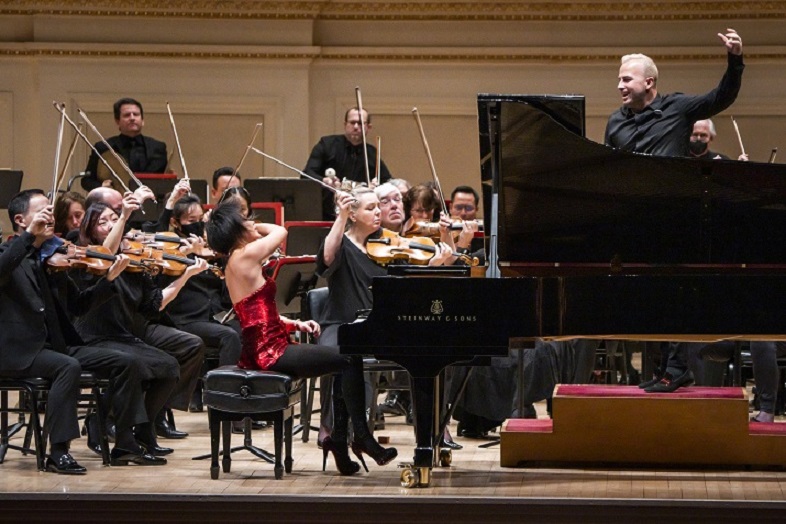
    Saturday January 28th, 2023 – Sergei Rachmaninoff’s four piano concertos are among the most challenging works in any pianist’s repertoire. Today, at Carnegie Hall, pianist Yuja Wang raised the bar for her colleagues by playing all four – plus Rhapsody on a Theme of Paganini – in one afternoon, accompanied by the Philadelphia Orchestra under the baton of Yannick Nézet-Séguin. These kinds of Olympic feats are rare; I’ve heard of the complete Beethoven Symphonies being conducted in a single day and Brahms’ two Piano Concertos in one concert, but I’m unaware of a single soloist taking on 5 concertos in one afternoon. Overall, the concert lasted nearly 5 hours, with two intermissions. Carnegie Hall was completely sold out, and, as a testimony to the artists and to the music, no one seems to have left early.

    One unscheduled extended pause was caused by a member of an audience collapsing and, apparently, dying just as the second movement of the 2nd Concerto ended. The man was revived in the hallway before the performance resumed. Maestro Nézet-Séguin informed us before performance of the 3rd Concerto that the gentleman was out of surgery and was expected to make a full recovery. That’s how long the concert lasted: a man died, was brought back to life, and was out of surgery at the 2/3 point of the afternoon!

    The marathon started with Rachmaninoff’s most enduring work and one of the most beloved works in the classical repertoire: the Piano Concerto No. 2 in C minor, Op. 18, composed in 1900-01 after an extended composers’ block Rachmaninoff suffered because of the disastrous premiere of his Symphony No. 1. After seeing a psychiatrist in France – which included hypnosis – Rachmaninoff composed this magnificent, melodic work which decades later would have pop-songs written to its tunes. (Eric Carmen’s “All By Myself” being perhaps the most successful chart-topper.) Ms. Wang’s strong, incisive solo introduction was a preview of the muscled playing that dominated the entire afternoon. She easily produced massive sounds from the Steinway, rising above Rachmaninoff’s dense orchestrations. Even on recordings, the piano sometimes gets lost in the famous melody at the beginning of Second Concerto’s Moderato movement. Not with Wang, who summoned torrents of sound that cut through the orchestra.

    Rachmaninoff was quite fond of the clarinet and wrote a number of magnificent music for it in his works, including in the Adagio sostenuto of this concerto. (The clarinet’s dark hues are also prominently featured in the contemporaneous Symphony No. 2). Clarinetist Ricardo Morales’ playing was invaluable here. I did feel the tempi in the first two movements were perhaps a bit too languorous; momentum seemed to be lost. But (after the performance resumed following the incident with the ill audience member), the closing Allegro scherzando was an exhilarating conclusion.

    Rachmaninoff’s Piano Concerto No. 1 in F-sharp minor, Op. 1 (composed 1890-91 and revised extensively in 1917) and Piano Concerto No. 4 in G minor, Op. 40 (composed in the US in 1924-26, and premiered by the composer with Leopold Stokowski and the Philadelphia Orchestra) are his least known concertos. Perhaps their melodies are not as hummable as the other works, but they are filled with melodies nonetheless, and wonderful writing for the piano. Ms. Wang met every obstacle with ease and bravura. Concerto No. 1, composed when Rachmaninoff was only 17, has all the trademarks that would define his style as he matured, including expansive, romantic melodies and dark orchestrations. And though Rachmaninoff always maintained that he was a romantic composer through-and-through (and was criticized for it by the modernists), his Concerto No. 4 sometimes echoes – intentionally or not – Ravel’s Piano Concerto and Gershwin’s Rhapsody in Blue (which Rachmaninoff heard at its 1924 world premiere performance.) So while he never became a modernist, Rachmaninoff was certainly influenced by the sounds of his contemporaries. I’ve heard Ms. Wang play a magnificent Ravel Piano Concerto live, and I was getting flashes of some of those moments as she played the Fourth here.

    The Rhapsody on a Theme of Paganini, Op. 43, composed in 1934 and premiered by the composer with Stokowski again conducting the Philadelphia Orchestra, is one of Rachmaninoff’s most brilliant works. Using the same Paganini Caprice that inspired numerous others to compose variations (Schumann, Brahms (two separate works), Liszt, Lutosławski, Schnittke), Rachmaninoff’s compact work never flags. It is a magnificent, tenacious bulldozer of invention. The original tune is shaped, reshaped, stretched in every imaginable way, and yet each variations is a beautiful thing of its own. The most famous of these, the immortal 18th Variation, is the original melody played upside down. The joy maestro Nézet-Séguin took in conducting of this section was clear: he seemed to be floating off the podium. Ms. Wang – needless to say conquered every technical challenge – but also the poetry, the beauty of her playing was unmatched.

    The concert ended with the Mount Everest of the concerto repertoire, the towering Piano Concerto No. 3 in D minor, Op. 30. Composed in 1909, while Rachmaninoff still lived in Russia, he intended it to be his calling card in the West, as he was embarking on his first American tour. And so the concerto was premiered in New York with the New York Symphony Orchestra, conducted by Walter Damrosch. (Six weeks later Raxhmaninoff played it again in New York, this time with the New York Philharmonic- the two orchestras later merged into one – under the baton of Gustav Mahler. There are stories that Mahler was not entirely happy with the collaboration.)

    I don’t know if this concerto actually drove David Helfgott to madness, but it is certainly enough to scare anyone into an asylum, and for Ms. Wang, playing it after roughly 4 hours of performing, was a brave decision. Fortunately for us her hands seem to be made of steel. This was not an example of someone crawling across the finish line: Ms. Wang crossed it at full speed. I noticed her hanging her hands down between playing, seemingly resting/stretching. But her playing did not show any sign of fatigue. Every note was crystal clear, and she – and Maestro Nézet-Séguin – did not shy away from the grandness and romanticism of Rachmaninoff’s music. And there is no better orchestra to play Rachmaninoff than his own favorite Philadelphians. They have this in their blood.

    One thing Yuja Wang is known for – outside of her extraordinary pianism – is outfits (she wore 5, one new ensemble for each work), but another is encores. She is very generous with encores: as long as the public wants more, she is happy to provide. I joked to a friend that really this concert was just a performance of the Second Concerto followed by encores of the rest of Rachmaninoff’s concertos. In the end – after such a grueling afternoon – she gave just one encore, an achingly beautiful “Dance of the Blessed Spirits” from Gluck’s Orfeo ed Euridice, transcribed by Giovanni Sgambati.

    There is so much to admire in Yuja Wang’s artistry. Some people seem to be distracted by her showmanship and outfits. I’m struck by her genuine love of performing live and love for her audience. It’s why she’s so happy to keep playing encores as long as her audience is on their feet. Another great pianist I recently saw live at Carnegie, after an extraordinary concert, offered an encore of just literally a few notes (something by Schoenberg.) Really, it was a joke, but it was also rude. Ms. Wang’s joy at being on stage is infectious. We’ve read about Liszt and Paganini’s shenanigans. Why can’t a contemporary artist do more than roll out, play, and leave? Brava, Ms. Wang, for treating this music as a living, breathing being and engaging with your audience with such generosity.

    ~ Ben Weaver

    Here’s a gallery of performance images by photographer Chris Lee documenting this unique evening:

    CH11298876

    CH11304127

    CH11304129

    CH11304132

    CH11304130

    CH11298873

    CH11298875

    Above: Maestro and soloist at the close of the evening; performance photos by Chris Lee, courtesy of Carnegie Hall

  • Oberlin Orchestra & Choral Ensembles/Carnegie Hall

    001-CHR-OC-Carnegie-012023

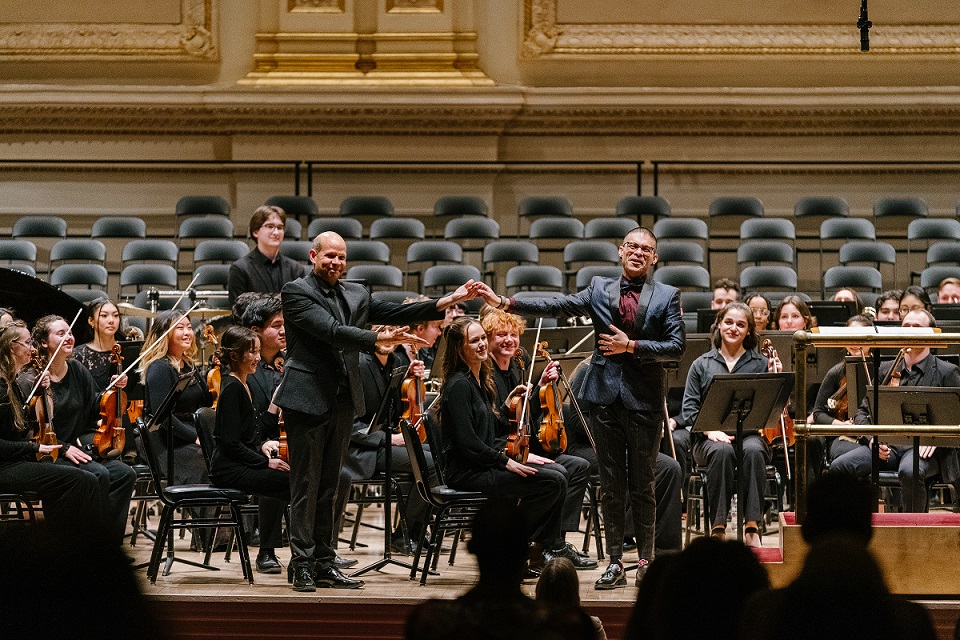
    Above: Maestro Raphael Jiménez with the Oberlin Orchestra at Carnegie Hall; photo by Fadi Kheir

    Author: Brad S Ross

    Friday January 20th, 2023 – On Friday evening, New York audiences were once again treated to a fine performance by the Oberlin Orchestra and Choral Ensembles as they returned to Carnegie Hall for the first time (publicly, anyway) since January 19, 2019. They were conducted by Oberlin Orchestras Director Raphael Jiménez, who led the performers in a unique program that included one repertory standard, one New York City premiere, and one buried gem.

    The evening began with long—very long—opening remarks by Oberlin College and Conservatory President Carmen Twillie Ambar and Oberlin Conservatory Dean William Quillen.

    Ambar’s remarks focused on two of the evening’s headlining pieces having been written by minority composers and therefore made all the requisite extollations about the need for representing historically marginalized groups. As important as this message is, it would be nice to hear the music of under-appreciated composers like Will Marion Cook, William Dawson, Florence Price, George Walker, etc., without this ever-obligatory preamble. My continued hope is that someday we will be able to let their music simply speak for itself.

    Quillen’s remarks, while less political, were a seemingly endless list of “thank you”s, not unlike an Oscar acceptance speech—only this time, there was no hope of the music playing him off. All the parents and staff in attendance no doubt appreciated the acknowledgements, but after a full quarter hour of talking I was getting pretty antsy for things to move along.

    Nevertheless, once the opening remarks concluded, the Oberlin musicians were finally able to grace the Isaac Stern Auditorium with their abilities—and what a pleasure they were to hear!

    First on the program was Johannes Brahms’s Tragic Overture, Op. 81, from 1880. There’s not much one can say about this work that hasn’t already been expressed over the last one hundred and forty years, so I won’t labor on it here. It’s a pleasant and undemanding symphonic poem, lasting about fourteen minutes and chock-full of the lyrical gestures typical of that Romantic master. Needless to say, the Oberlin musicians tackled the piece expertly, but it did leave me wanting to hear more of their technical skills.

    I was not left wanting for long, however, as the second work of the evening—the New York premiere of Iván Enrique Rodríguez’s A Metaphor for Power—immediately livened up the proceedings.

    Written in 2018, A Metaphor for Power is a single-movement essay for orchestra lasting about thirteen minutes. Rodríguez—a 32-year-old Puerto Rican native—composed the piece as a comment on the turbulence and inequalities of contemporary life in the United States, despite the promise of its founding (the title, indeed, comes from a quote by James Baldwin). His use of social commentary through music was much more subtle than that of other recent protest works, however (Anthony Davis’s quite overt You Have the Right to Remain Silent comes to mind), making for a composition that was both cleverly referential and electrifying to hear.

    The music opened with a bang before quickly diminuendoing into dream-like textures, complete with harp, mallets, and woodwind writing that sounded as though they had descended straight from Maurice Ravel’s Daphnis et Chloé. A contemplative middle section featured, among other memorable effects, distorted quotations from “America the Beautiful” and unsettling vocalizations from the orchestra as they recited overlapping lines from the Declaration of Independence. A great crescendo announced the beginning of the third, final section, which was marked by dramatic gestures that were almost filmic in execution. It all came to an energetic and wickedly engaging ending that lit up the room with excitement.

    002-CHR-OC-Carnegie-012023

    Above: Maestro Jiménez and composer Iván Enrique Rodríguez take a bow; photo by Fadi Kheir

    The composer practically leapt from his seat and ran to the stage to share an emotional embrace with Jiménez before they took their bows together. The moment was as touching as it was well-earned. The composer having been unknown to me until that evening, I must say that I look forward to hearing much more from him in the future.

    003-CHR-OC-Carnegie-012023

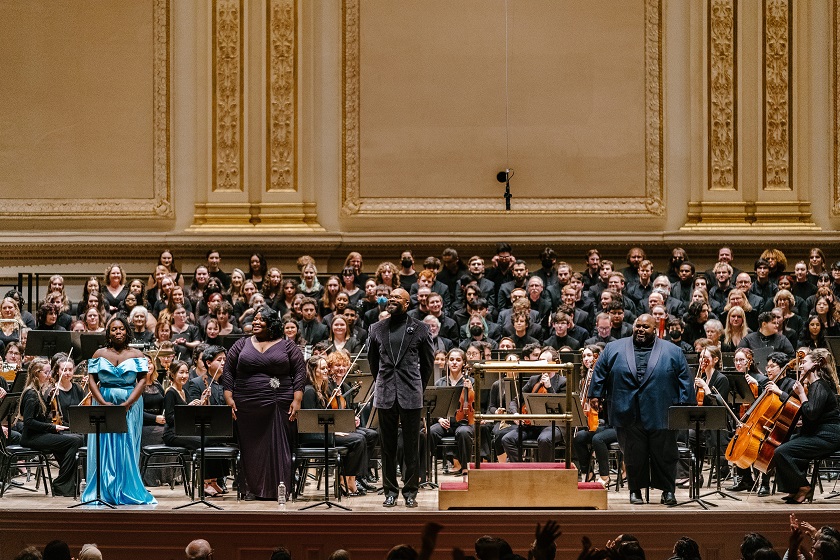
    Above: the vocal soloists for the Dett oratorio: Chabrelle Williams, Ronnita Miller, Limmie Pulliam, and Eric Greene; photo by Fadi Kheir

    The final and most substantial work of the evening was Robert Nathaniel Dett’s oratorio The Ordering of Moses. Dett, a Canadian-born American composer of the early 20th century, became the first black man to graduate with a double major from the Oberlin Conservatory in 1908. He initially wrote The Ordering of Moses as a thesis project while completing his Masters of Music from the Eastman School of Music in Rochester in 1932. Dett later revised and expanded the work, however, and it was premiered in its final form by the Cincinnati Symphony Orchestra under Eugene Goosens in 1937.

    Clocking just under an hour, the oratorio is divided into nine sections and is cast for orchestra, chorus, and four vocal soloists. Joining the Oberlin musicians for this performance were soprano Chabrelle Williams, mezzo-soprano Ronnita Miller, tenor Limmie Pulliam, and baritone Eric Greene.

    020-CHR-OC-Carnegie-012023

    Above: soloists Ronnita Miller and Eric Greene; photo by Fadi Kheir

    The first section opened on warm instrumentation that favored the lower voices of the orchestra. A lone cello voice emerged for an occasional solo before Greene’s sonorous tones took center stage as “The Word,” describing the bondage of the Israelites under the Pharaoh. He was joined briefly by Miller, who cried out for mercy as the voice of the Israelites. The music was rather languid here, until a great exclamation of “Mercy, Lord” announced an upbeat transition into the second section, “Go Down Moses.”

    010-CHR-OC-Carnegie-012023

    A recent last-minute Metropolitan Opera debutant, tenor Limmie Pulliam (above, in a Fadu Kheir photo) then entered as the voice of the reluctant Moses, who is given the famous command by God, “Go down Moses, way down in Egypt’s land; tell Pharaoh: ‘Let my people go!’” (this section featured a particularly cheeky musical joke where Moses sings “I am slow of tongue!” at the most sluggish pace imaginable). The drama then moved fairly seamlessly into the third section “Is it not I, Jehovah!” as God affirms his edicts to Moses.

    This was followed by a mostly uneventful instrumental interlude as the story was transported forward to Moses’s parting of the Red Sea (“And When Moses Smote the Water”). This exuberant, celebratory section was followed by two more instrumental interludes: “The March of the Israelites through the Red Sea” and “The Egyptians Pursue.” The former was an almost jaunty affair, complete with military snare and wordless chorus, while the latter featured brassy blasts and dramatic descending runs as the crashing waters swept away the pursuers.

    021-CHR-OC-Carnegie-012023

    Above: soprano Chabrelle Williams; photo by Fadi Kheir

    Ms. Williams’s soaring vocals finally entered the proceedings in the waltz-like “The Word,” as the Israelites jovially sang praises to Jehovah. All forces joined for the triumphant finale “Sing Ye to Jehovah,” as the oratorio built to a final satisfying tutti instrumental blast.

    Everyone performed splendidly throughout and the piece was met with one of the most enthusiastic standing ovations I’ve seen in a while, yet I couldn’t help feeling slightly underwhelmed by the music itself. Considering the scale of forces at work, the writing was not terribly economical. The instrumentation was often sparse and seldom were all of the elements brought together for fuller effect. The solo parts also heavily favored the male voices, leaving Williams and Miller very little to do for most of its duration.

    This isn’t to say it was bad—far from it—, but it did leave me wanting a little bit more. Had Dett not died of a heart attack at the relatively young age of 60 in 1943, one cannot help but wonder what other and more exciting large scale works he might have brought to the concert hall. Nevertheless, it was exciting as always to hear a buried musical gem such as this get dusted off and given new life. It was a grand conclusion to another memorable concert by the Oberlin Conservatory musicians, who will hopefully return again soon to grace New York City audiences with another memorable program.

    014-CHR-OC-Carnegie-012023

    All performance photos by Fadi Kheir.

    ~ Brad S Ross